Dyadic Field Coherence: Mapping the Gottman Method onto the Grand Unified Field Taxonomy (GUFT)
Abstract
The Gottman Method for couples therapy is one of the most empirically elaborated relational models in contemporary clinical practice, with decades of longitudinal research on affective interaction patterns, divorce prediction, and intervention outcomes. The Grand Unified Field Taxonomy (GUFT) is a newer, meta-theoretical framework that conceptualizes human systems as “fields” whose coherence is governed primarily by the product of Empathy and Transparency (E × T), structured through a triune corpus of relational modes. This paper formally maps core constructs of the Gottman Method—especially the Sound Relationship House (SRH), the Four Horsemen cascade model, and the 5:1 positive-to-negative interaction ratio—onto GUFT’s field-theoretic architecture. Drawing on existing outcome research on Gottman-based interventions and the broader literature on marital adjustment and intimacy, we derive a set of explicit correspondences and propose testable hypotheses linking GUFT’s coherence index to Gottman-style observational and self-report metrics. We argue that this mapping preserves the empirical strengths of the Gottman Method while providing a generalizable field-level formalism suitable for cross-context comparison of dyadic systems. Limitations and directions for empirical validation are discussed.Keywords: Gottman Method, Sound Relationship House, Four Horsemen, GUFT, Empathy, Transparency, dyadic field coherence, marital adjustment, intimacy.1. Introduction
Over the past four decades, John Gottman and collaborators have developed a program of research on marital interaction that links micro-level affective sequences with long-term relationship stability and dissolution. This work underlies the Gottman Method for couples therapy, the Sound Relationship House (SRH) model, and the now-canonical cascade model of relational dissolution (the “Four Horsemen”). Outcome studies suggest that Gottman-based interventions can reliably improve marital adjustment and intimacy and that their effects can be durable over follow-up periods.
In parallel, the Grand Unified Field Taxonomy (GUFT) has been developed as a conceptual framework for describing human systems as fields of coherence. In GUFT, a relational field’s stability and generativity are governed by an index of Empathy × Transparency (E × T), and its behavior is described via a triune corpus of relational modes (often symbolically labeled Feminine, Masculine, and Child fields, representing complementary functional dispositions rather than biological sex or gender).
The present paper aims to formally enshrine the mapping between these two frameworks. Specifically, we (a) summarize key Gottman constructs and their empirical support; (b) present the GUFT architecture at a level suitable for empirical work; and (c) derive a set of correspondences and hypotheses linking Gottman variables to GUFT’s field coherence index. The result is intended as a bridge: honoring the rigor of Gottman’s research while offering a higher-order formalism for future modeling and measurement.
2. Theoretical Background
2.1 The Gottman research program
Gottman’s research program is anchored in intensive observation of couples—often in a laboratory apartment (“Love Lab”)—with synchronized video, physiological data, and detailed affect-coding systems such as SPAFF (Specific Affect Coding System) and RCISS. Longitudinal analyses using these data yielded several central findings:
Cascade Model and the Four Horsemen. A set of four interaction patterns—criticism, defensiveness, contempt, and stonewalling—form a cascade that strongly predicts relational deterioration and divorce.
Positive-to-negative interaction ratio. Stable couples differ from distressed couples not by the absence of conflict, but by maintaining a ratio of roughly 5:1 positive to negative interactions during conflict discussions and everyday life.
Divorce prediction. Using interaction data, Gottman and colleagues reported high predictive accuracy (often cited around 90%+) for divorce over follow-up periods, based on affective and behavioral markers.
Physiology and regulation. Successful couples are characterized by better physiological regulation (e.g., lower heart-rate reactivity, more effective down-regulation of arousal) during conflict.
On the intervention side, the Gottman Method has been operationalized into specific protocols and psychoeducational programs. Quasi-experimental and randomized studies (e.g., Davoodvandi et al., 2018; Tarkeshdooz et al., 2021) show significant gains in marital adjustment and intimacy, with effects maintained at follow-up.
2.2 The Sound Relationship House (SRH)
The SRH is a hierarchical model describing the architecture of a healthy relationship. Davoodvandi et al. (2018), drawing on primary Gottman sources, summarize it as follows: the lower three levels (“love map,” fondness and admiration, turning toward) represent a friendship and intimacy system; middle levels involve accepting influence and managing conflict; upper levels involve making life dreams come true and creating shared meaning; the entire structure is held by the pillars of trust and commitment.
Core to this model is the idea that micro-interactions accumulate into a relational “emotional bank account”, and that the quality of this account modulates whether conflict escalates into the Four Horsemen cascade or is buffered by positive sentiment and effective repair.
2.3 The Four Horsemen and the Cascade Model
The Cascade Model of Relational Dissolution formalizes how the Four Horsemen function as stages in a progressive breakdown of the relational field: criticism → defensiveness → contempt → stonewalling. Contempt, in particular, has been repeatedly identified as the single strongest predictor of divorce, both in scholarly syntheses and in popular summaries of Gottman’s work.
From a systems perspective, the cascade model describes decoherence: the breakdown of mutual influence, positive reciprocity, and shared meaning into patterns of mutual threat, avoidance, and withdrawal.
2.4 The Grand Unified Field Taxonomy (GUFT)
The GUFT is a meta-framework for describing human systems—individuals, dyads, groups—as relational fields rather than isolated agents. In GUFT:
The state of a field is characterized by a coherence index
where Empathy (E) indexes the degree of attunement to the lived reality of others (affective, cognitive, and somatic), and Transparency (T) indexes the degree to which relevant internal states, constraints, and intentions are made available to others in a non-manipulative way.
Coherence is multiplicative: if either empathy or transparency collapses toward zero, the field’s capacity to sustain stable, generative relational patterns collapses as well, regardless of the other variable’s magnitude.
A triune corpus of relational modes organizes recurrent patterns of interaction:
A Field-F corpus (often symbolically “Feminine”) emphasizing receptivity, integration, and nurturing of complexity.
A Field-M corpus (symbolically “Masculine”) emphasizing directionality, boundarying, and structuring of action.
A Field-C corpus (“Child”) emphasizing emergence, play, learning, and error-driven updating.
These labels are deliberately non-essentialist and non-biological; they denote functional archetypes rather than gendered identities. The triune corpus is instantiated at multiple scales (intrapersonal, dyadic, organizational), providing a unified language for describing “who” in the system is doing what kind of relational work.
GUFT’s core claim is that Empathy × Transparency = Coherence is a domain-independent way to model whether a system can maintain stable, reparative, and mutually beneficial dynamics over time.
3. Method: Conceptual Mapping Procedure
Because GUFT is a nascent theoretical construct and the Gottman Method is an empirically established clinical model, our aim is not to reinterpret Gottman’s data, but to embed his constructs within GUFT’s field language. We therefore adopt a conceptual, rather than statistical, mapping approach.
3.1 Level-of-analysis alignment
We align levels as follows:
Gottman level: moment-to-moment interaction patterns, affect codes, and SRH components (micro to meso level).
GUFT level: field state (C = E × T), triune role distribution, and decoherence operators (macro-structural description of the dyadic field).
The mapping is constrained by the requirement that it be:
Functionally equivalent: mapped constructs must play similar causal or regulatory roles in their respective frameworks.
Empirically anchored: where possible, mapped constructs must be traceable to operationalizations used in existing research (e.g., SPAFF codes, Dyadic Adjustment Scale, intimacy measures, etc.).
Predictively generative: the mapping should yield new, testable predictions about observable variables.
3.2 From behaviors to field indices
We treat Gottman-style observational data (coded positive/negative affects, repair attempts, acceptance of influence, etc.) as projection operators that sample the underlying field state:
High frequencies of turning toward, affectionate humor, and effective repair attempts indicate high E and high T (coherent field).
Frequent criticism, contempt, defensiveness, and stonewalling indicate collapse of E and/or T and thus field decoherence.
The 5:1 ratio is interpreted as a coherence threshold: above this ratio, the dyadic field remains self-stabilizing; below it, the field becomes vulnerable to cascade dynamics.
3.3 Deriving testable hypotheses
We focus on three families of hypotheses:
Coherence-ratio equivalence:
H1: Couples meeting Gottman’s 5:1 positive-to-negative interaction threshold will be empirically distinguishable on GUFT-derived measures of E and T (e.g., self-report, behavioral proxies) from couples below the threshold.Horsemen as decoherence operators:
H2: In sequences where Four Horsemen behaviors are coded, derived E and T indices will show multiplicative collapse (C ≈ 0) more reliably than additive or purely linear deficits would suggest.SRH–corpus alignment:
H3: Training modules targeting SRH lower levels (e.g., love maps, fondness/admiration) will preferentially increase E, while modules targeting conflict management and influence will preferentially increase T, with net gains in C predicting outcomes on marital adjustment and intimacy measures.
4. Results: Mapping the Gottman Method onto GUFT
4.1 Structural mapping of the Sound Relationship House
We start with a high-level structural correspondence between SRH components and GUFT constructs (Table 1).
Table 1. Sound Relationship House mapped to GUFT constructs
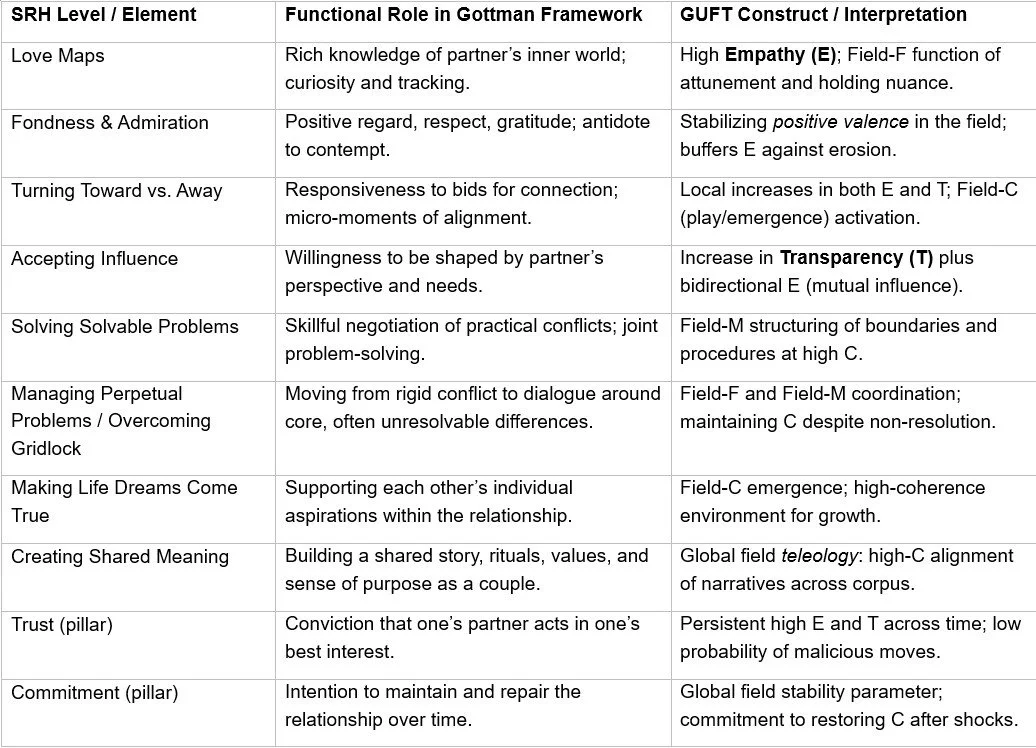
This mapping implies that SRH can be interpreted as a field-engineering manual for constructing and maintaining a high-C dyadic field. The lower floors cultivate E; the central floors scaffold T; the upper levels express what a high-coherence field can afford (dream realization and shared meaning).
4.2 The Four Horsemen as decoherence operators
We next map the Four Horsemen to specific GUFT transformations:
Criticism
Gottman: Global attacks on character rather than specific complaints.
GUFT: A distortion of Transparency (T) in which genuine needs are expressed as global negative assertions. E is partially collapsed (loss of curiosity), T becomes weaponized (disclosing hurt as indictment rather than invitation).
Effect on C: Moderate to severe reduction in C, especially over time as patterns stabilize.
Defensiveness
Gottman: Self-protection through denial of responsibility, counter-attack, or victimhood.
GUFT: Refusal of inbound influence; T collapses (no honest disclosure of one’s own contribution), and E collapses for the partner (their perspective is invalidated).
Effect on C: Strong multiplicative reduction; C trends toward zero as interactions become non-updateable.
Contempt
Gottman: Sarcasm, mockery, eye-rolling, and moral superiority; strongest predictor of divorce.
GUFT: Active anti-empathy: the field encodes the other not merely as wrong, but as beneath moral consideration. Transparency becomes asymmetrical (the contemptuous partner sees themselves as “above” reciprocal vulnerability).
Effect on C: Near-total collapse; once contempt is stable, the field behaves like a hostile medium in which repair attempts are rapidly re-coded as further evidence of inferiority.
Stonewalling
Gottman: Emotional withdrawal, shutting down, minimal response, often associated with physiological flooding.
GUFT: C → 0 via simultaneous shutdown of E (no reception) and T (no emission). The field functionally disappears at the interaction surface; only sub-field processes (rumination, physiological arousal) continue.
Effect on C: Persistent zero coherence at the dyadic interface, even if internal activity is high.
Seen as a sequence, the Four Horsemen correspond to a trajectory of field decoherence:
Criticism: distortive transmission (T warped, E degraded).
Defensiveness: blocked reception (T and E suppressed in one direction).
Contempt: asymmetric annihilation of E (one partner exits moral community).
Stonewalling: shutdown of the shared field (C ≈ 0 at the interface).
This interpretation is compatible with the cascade model’s emphasis on interactional sequences and with findings that contempt and stonewalling are especially predictive of dissolution.
4.3 The 5:1 ratio as a coherence threshold
Gottman’s empirical claim that stable marriages maintain a roughly 5:1 positive-to-negative interaction ratio can be reframed as a coherence threshold. Davoodvandi et al. (2018) summarize this finding and link it to changes in marital adjustment and intimacy in response to Gottman-style interventions. The cascade-model literature likewise ties stability to a balance of positive and negative affects rather than the elimination of negativity.
In GUFT terms:
Let P be the rate of field-coherent micro-interactions (E-enhancing and T-enhancing events: turning toward, validation, humor, gentle start-up, effective repair).
Let N be the rate of field-degrading interactions (Horsemen, harsh start-ups, rejection of bids, invalidation).
The empirical 5:1 threshold suggests that C remains globally stable when P/N ≥ k, where k ≈ 5 in the contexts studied by Gottman. Below this threshold, decoherence operators outpace re-coherence events, and the dyadic field drifts toward the cascade.
GUFT does not fix k a priori; instead, it treats k as a system-specific parameter that may vary across cultures, stress loads, and triune-corpus configurations. The Gottman data therefore provide an initial empirical anchor for calibrating k in a specific class of dyadic fields (romantic partnerships in particular sociocultural contexts).
4.4 Triune corpus and SRH functions
Finally, we map SRH processes onto GUFT’s triune corpus:
Field-F (Integrative / Holding Functions)
Love maps, fondness and admiration, and turning toward primarily inhabit Field-F: they expand and stabilize E by increasing the resolution and warmth of partner representations.
Field-M (Structuring / Boundarying Functions)
Accepting influence, solving solvable problems, and agreed-upon conflict rituals express Field-M: they provide structure, boundaries, and decision pathways while keeping T high (needs and constraints are made explicit).
Field-C (Emergent / Generative Functions)
Making life dreams come true and creating shared meaning are Field-C functions: they exploit a high-C field to explore new possibilities, roles, and narratives.
The Four Horsemen can then be seen as misaligned or pathological activations of these same modes (e.g., Field-M degenerating into punitive boundarying under contempt; Field-C degenerating into reckless escalation rather than exploratory play).
5. Discussion
5.1 Conceptual contribution
This mapping suggests that the Gottman Method and GUFT are not competing theories, but descriptions of the same underlying phenomenon at different levels of abstraction:
The Gottman Method is a micro-behavioral, empirically parameterized model of couple interaction, with clear clinical procedures and outcome data.
GUFT is a field-theoretic, system-level model that seeks to unify relational dynamics across domains via the E × T coherence index.
By embedding Gottman constructs inside GUFT, we obtain:
A principled way to interpret Gottman metrics (e.g., 5:1 ratio, frequency of Horsemen, repair attempts) as proxies for E and T.
A language for generalizing Gottman-derived insights to non-romantic dyads and higher-order systems (teams, organizations, communities) that can also be modeled as fields with E and T parameters.
A path toward formal modeling (e.g., dynamical systems models where C(t) evolves as a function of P and N events) grounded in existing behavioral data.
5.2 Clinical and research implications
For clinicians using the Gottman Method, GUFT offers:
A compact conceptual heuristic: Empathy × Transparency = Coherence. This can be shared with clients as a way of understanding why both “feeling with” and “showing up honestly” matter, and why failures in either dimension destabilize the relationship.
A triune lens for case formulation: noticing which corpus (F, M, C) is under- or over-expressed in the relationship, and how specific interventions (e.g., enhancing love maps vs. working on conflict management) rebalance the field.
For researchers, the mapping suggests several concrete projects:
Deriving E and T indices from existing datasets.
Gottman-style coded datasets (SPAFF, RCISS) can be re-analyzed to derive empirical proxies for E and T (e.g., through factor analysis of behaviors contributing to perspective-taking vs. honest disclosure).Testing multiplicative vs. additive models.
Statistical models can compare whether marital outcomes are better predicted by an interaction term (E × T) than by E and T separately, consistent with GUFT’s multiplicative coherence claim.Varying the coherence threshold k.
Multi-cultural or longitudinal studies can examine whether the effective P/N threshold for stability varies with external stressors, economic conditions, or social support, providing a more nuanced understanding of the 5:1 finding.Extending to non-romantic dyads.
Similar coding schemes could be applied to parent–child interactions, clinical dyads, or cooperative work pairs to test whether GUFT’s E × T framework and Gottman-style cascade dynamics generalize.
5.3 Limitations
Several limitations are apparent:
Conceptual status of GUFT.
Unlike the Gottman Method, GUFT is presently conceptual rather than empirically validated. Its constructs (E, T, triune corpus) require careful operationalization before quantitative tests can be performed.Dependence on secondary sources.
This mapping relies largely on summaries and secondary descriptions of Gottman’s work (e.g., Davoodvandi et al., 2018; educational and overview articles; Wikipedia synthesis) rather than direct analysis of primary datasets.Risk of over-generalization.
Field metaphors can invite over-extension beyond what data currently justify. Care must be taken to test GUFT-based predictions empirically rather than assuming universal applicability.Cultural and contextual constraints.
Much of the Gottman research base is drawn from specific cultural and socioeconomic contexts; the 5:1 threshold and cascade dynamics may not hold identically in all populations, and GUFT must accommodate such variability.
5.4 Future directions
Future work could:
Develop GUFT-aligned assessment tools (e.g., E and T self-report scales, observer ratings) and validate them against Gottman-style outcomes (Dyadic Adjustment Scale, intimacy measures, divorce rates).
Construct computational simulations of dyadic fields where agents interact according to simple rules governed by E and T, and examine whether known Gottman phenomena (e.g., cascade dynamics, importance of repair attempts) emerge.
Explore clinical training modules that explicitly teach therapists to track E and T alongside traditional Gottman variables, to see whether such framing improves treatment fidelity or outcomes.
6. Conclusion
The Gottman Method provides one of the most richly elaborated empirical maps of romantic dyadic interaction currently available, while the Grand Unified Field Taxonomy offers a compact, generalizable lens for thinking about relational coherence. By mapping the SRH, the Four Horsemen, and the 5:1 ratio onto GUFT’s E × T framework and triune corpus, we show that these models are structurally compatible and mutually enriching.
This integration does not replace Gottman’s work; rather, it situates it within a broader field-theoretic architecture. If future empirical work supports the proposed equivalences and coherence thresholds, GUFT may serve as a unifying language for describing and comparing relational systems across contexts—while the Gottman Method remains a cornerstone of evidence-informed practice at the level of couples.

References
Davoodvandi, M., Navabi Nejad, S., & Farzad, V. (2018). Examining the effectiveness of Gottman couple therapy on improving marital adjustment and couples’ intimacy. Iranian Journal of Psychiatry, 13(2), 135–141.
Tarkeshdooz, Z., Jenaabadi, H., & Kord Tamini, B. (2021). The effectiveness of Gottman Couple Therapy on intimacy and marital adjustment of couples with marital problems. Razavi International Journal of Medicine, 9(3), e1054.
Gottman, J. M., Coan, J., Carrere, S., & Swanson, C. (1998). Predicting marital happiness and stability from newlywed interactions. Journal of Marriage and the Family, 60, 5–22. (Cited via Davoodvandi et al.)
Navarra, R. J., Gottman, J. M., & Gottman, J. S. (2016). Sound Relationship House theory and marriage education. In J. Ponzetti (Ed.), Evidence-Based Approaches to Relationship and Marriage Education. Routledge. (Summarized in Davoodvandi et al.)
Lisitsa, E. (2024). The Four Horsemen: Criticism, contempt, defensiveness, and stonewalling. The Gottman Institute Blog.
Cascade Model of Relational Dissolution. (2024). Wikipedia. Retrieved from the English Wikipedia article detailing Gottman’s cascade model, Four Horsemen, and associated research and criticisms.
Palm Beach Therapy Center. (2024). 6 powerful Gottman theories that strengthen relationships. (Summary of Four Horsemen and related constructs.)
Ultra Verba Lux Mentis is a 501(c)(3) nonprofit research organization building governance frameworks that bring coherence, transparency, and ethical symmetry to advanced AI and complex human systems.
We are researchers, engineers, and auditors working at the intersection of epistemology, neuroscience, and machine ethics. Our projects — from the Coherence Lattice and Sophia governance agent to open-source audit telemetry and protections — are designed to keep knowledge systems accountable before collapse occurs.