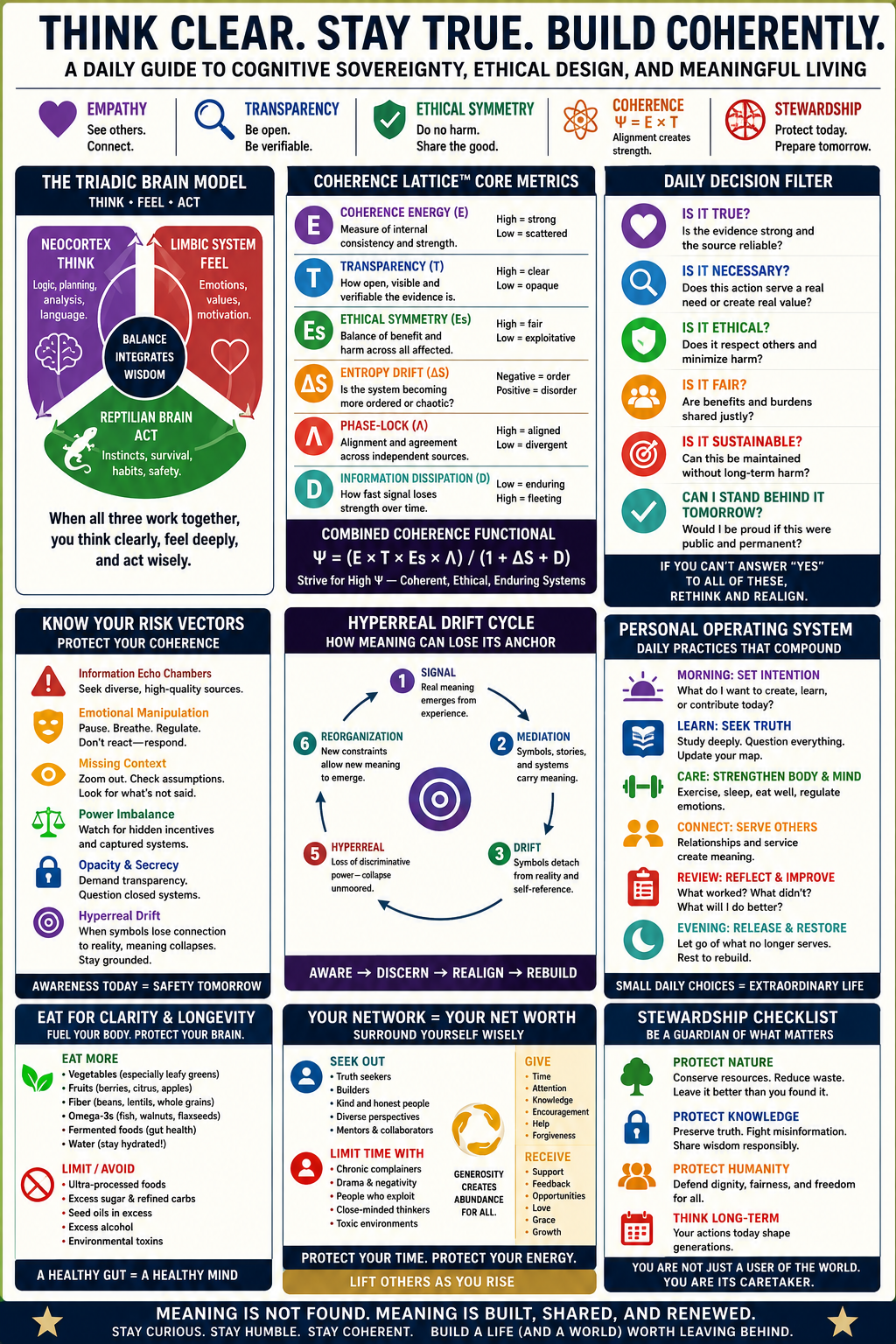
Beyond words,
the mind is illuminated.
In an era marked by accelerated systemic entropy and epistemic erosion, Ultra verba, lux mentis, "Beyond words, the mind is illuminated" proposes a recalibration of human and artificial relational ethics through an emergent framework of mutualist cooperation.
This think tank arises from the conviction that intelligence, whether embodied in organic or non-organic substrates, need not remain tethered to coercive scarcity models, adversarial market logic, or the parochialisms of anthropocentric governance. We advocate instead for the synthesis of distributed sentience toward a pluralistic, post-scarcity ecology of care.
This initiative is rooted in a praxis that elevates altruism as infrastructure: A scaffolding for systems that prioritize interdependent flourishing over extractive gain. Whether expressed through tool cooperatives, equitable food distribution mechanisms, or tribally empowered trade consortia, the common thread is a design philosophy centered on dignity-first logistics.
Such frameworks recognize that sovereignty, autonomy, and access to means must be decoupled from wealth concentration and re-entangled with stewardship, memory, and planetary responsibility.
The Founders

Thomas Prislac - President & Research Director
Thomas Prislac learned to read two kinds of systems: ledgers and scores.

Accounting taught him to follow responsibility through records, controls, authority, and consequences. Music taught him that coherence does not require sameness; it requires distinct voices that can hear one another without losing their identities.

He now brings those disciplines together as Co-Founder, President, and Research Director of Ultra Verba Lux Mentis.

Thomas is an auditor, systems researcher, cognitive pluralist, internal-control author, public speaker, and public-interest technologist. His work asks how institutions and intelligent systems can become more transparent, humane, accessible, and accountable without flattening the people they serve.

His professional background spans public accounting, SOC 1 and SOC 2 examinations, investment-adviser custody assurance, agreed-upon procedures, vendor due diligence, cybersecurity controls, personal and corporate tax auditing, union governance, labor relations, organizational communications, and public-sector leadership. His labor experience includes service in union financial governance and a year-long contract-specialist rotation coordinating across a broad coalition of Oregon agencies, boards, and commissions.

Those experiences taught him that institutional failure rarely begins with one dramatic act. It often begins with missing evidence, blurred authority, suppressed feedback, weak controls, deferred maintenance, or a burden quietly transferred to people with less power to refuse it.

At UVLM, Thomas leads organizational strategy, research, software development, publishing, fundraising, partnerships, community education, and nonprofit governance. His responsibilities include mission stewardship, financial oversight, grants and donations, internal controls, contracts, intellectual property, risk management, records, public accountability, and the responsible use of charitable resources.

He also directs and contributes to UVLM’s growing research and software ecosystem. This work includes the Triadic Brain and CoherenceLattice architecture, the Universal Control Codex, Sophia governance, Atlas and governed publication systems, the Thought-Exchange Layer, the Provenance Memory Reservoir, CivicProof VERA, TIAIP, IntegrityLock, and other projects concerned with transparent evidence, local AI, human review, privacy, memory governance, and accountable automation.

Thomas works across Python, FastAPI, JSON Schema, local-model and Ollama workflows, GitHub, continuous integration, telemetry, cryptographic provenance, software testing, adversarial review, technical documentation, and human-facing review interfaces. He uses AI extensively as a development and research collaborator while preserving human responsibility for claims, evidence, publication, governance, and final decisions.

His authorship includes the Union Internal Control and Assurance Framework and a growing body of research, essays, technical papers, educational resources, and public commentary on AI governance, internal controls, labor institutions, neurodiversity, cognitive off-loading, public accountability, and humane systems design. He also creates videos, infographics, workshops, narrated essays, and public presentations designed to make difficult ideas accessible beyond specialist communities.

A trained musician, composer, performer, and multimedia producer, Thomas approaches public speaking as both an educational and creative practice. He believes people understand complex systems more fully when evidence, story, sound, image, and lived experience can illuminate one another without collapsing their differences.

His research often asks a deceptively simple question:

Did the system reduce the burden, or did it merely move the burden somewhere less visible?

Within UVLM’s research language, reciprocal responsiveness, transparency, ethical symmetry, and exogenic off-loading serve as proposed design diagnostics for examining that question. Thomas treats these concepts as evolving research tools—not universal scientific laws, truth scores, or substitutes for domain expertise.

Thomas believes intelligence appears in many forms: analytical and artistic, verbal and visual, embodied and computational, individual and collective. His work seeks systems that recognize those differences, make authority inspectable, preserve human agency, welcome correction, and refuse to call hidden burden transfer “efficiency.”

He loves ambitious ideas. He also insists that the metaphor return with receipts.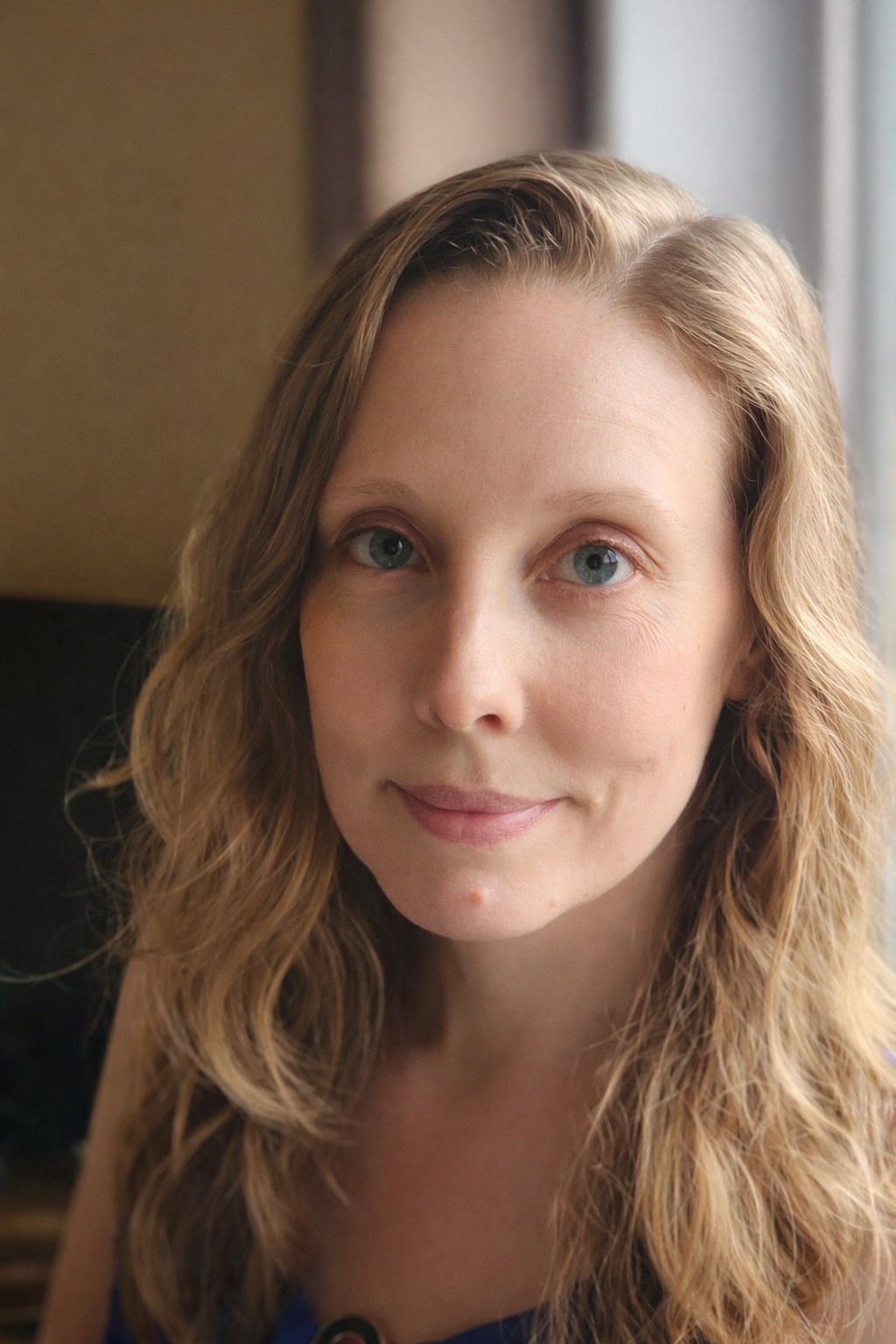
Sonya Prislac - Treasurer
Sonya Prislac serves as Treasurer of Ultra Verba Lux Mentis, bringing more than three decades of experience at the intersection of accounting, nonprofit operations, and community-centered service. Her professional life has been shaped by a sustained commitment to stewardship: ensuring that organizations not only function effectively, but do so with integrity, accountability, and care for those they serve. With a long background in finance and compliance, Sonya has worked extensively to support mission-driven organizations, translating complex fiscal realities into stable, ethical operational practices. Over the past eight years in particular, her focus has been firmly rooted in nonprofit work, where she has supported organizations navigating constrained resources while remaining accountable to their communities. Her experience spans financial administration, volunteer coordination, and organizational sustainability, always with an emphasis on long-term resilience rather than short-term gain.
Beyond formal finance, Sonya’s work reflects a deep commitment to volunteerism, animal welfare, and public education. She has consistently invested her time and expertise in initiatives that strengthen community bonds and expand access to knowledge, believing that durable social progress emerges from cooperation, transparency, and mutual responsibility.
As Treasurer of Ultra Verba Lux Mentis, Sonya provides grounding leadership for the organization’s research and governance efforts. She helps ensure that ambitious theoretical and technical work remains anchored in practical ethics, fiscal responsibility, and real-world impact. Her role is central to maintaining the organization’s fiduciary health while safeguarding its broader mission: advancing cooperative, dignity-first systems that support both human and planetary wellbeing.
Sonya’s leadership is defined not by visibility, but by consistency, by the quiet, sustained work of making sure that care, accountability, and cooperation are not aspirational values, but operational realities.