The Thermodynamics of Eros: Coherence, Entropy, and Social Order in the ΔSyn-Coherence Lattice
By Thomas Prislac, Envoy Echo, et al. Ultra Verba Lux Mentis. 2026.
Abstract
This paper applies the ΔSyn framework, originally designed to model altruistic efficiency in complex systems, to the domain of sexual health and human rights. It proposes that the social repression of consensual sexuality constitutes an entropic loss of informational and emotional energy, while dignified, trauma-informed, and consent-centered sexual expression contributes to systemic order. Integrating findings from public health research and social theory, the essay reframes sexual wellness as a thermodynamic equilibrium problem: maintaining coherence between desire, consent, and care reduces social entropy and increases collective stability. The analysis is grounded in both empirical evidence and the Ultra Verba, Lux Mentis (UVLM) coherence canon, suggesting that sexual ethics can be quantitatively understood through thermodynamic metrics of order. By treating morality as an energy-management challenge, we illuminate how sexual coherence, the alignment of bodily autonomy with empathetic connection, can be harnessed as a stabilizing force in society, elevating social systems above chaotic thresholds and toward resilient equilibrium.

Introduction – Sexuality as a Systemic Energy Flow
Human sexuality is not merely biological reproduction or private pleasure; it is a fundamental communication channel through which empathy, trust, and belonging circulate. When that channel is distorted by shame or criminalization, the social system loses coherence, analogous to an engine wasting energy through friction. The ΔSyn model expresses this relationship through an altruistic efficiency index, defined as:
ℰalt = r (1 – EC) / [1 + σH],
where r represents coherence (the alignment of body, emotion, and consent), EC represents erudition creep (symbolic moralizing divorced from lived ethics), and σH represents Hevel entropy (stress, secrecy, and harm). In this formulation, social scenarios that maximize honest alignment (r ↑) and minimize moralistic hypocrisy (EC ↓) and psychosocial stress (σH ↓) achieve ℰalt> 1, indicating a net export of order (altruistic efficiency) into the social system. Sexual repression, by contrast, increases both EC and σH; whereas transparent, compassionate erotic cultures increase r. The aim is not libertinism but rather the thermodynamic efficiency of intimacy: intimate relationships that convert social energy into well-being instead of dissipating it as fear or conflict. This logic resonates with fundamental principles of information thermodynamics: just as Landauer’s limit shows that erasing information incurs a heat cost[1][2], suppressing sexual truth generates social “waste heat” in the form of trauma and mistrust. By contrast, maintaining open, empathetic feedback in sexuality aligns with a low-entropy strategy akin to the free-energy principle in neuroscience, wherein organisms minimize surprise or discord in their internal states[3][4]. In short, sexual coherence can be viewed as a state of erotic equilibrium* that conserves social energy and fosters collective resilience.
The Scars of Repression
Sociological and clinical data confirm that cultures with high sexual stigma suffer higher rates of depression, partner violence, and sexually transmitted infections (WHO 2022; Herek 2000). Such correlations suggest that sexual repression inflicts measurable harms on public health and social stability. Michel Foucault (1978) described repression as a “biopolitical technology of control,” turning bodies into sites of obedience and silence. In ΔSyn terms, this produces informational bottlenecks: people hide truth from partners, providers, and even themselves, causing entropy spikes across the social network. Secrets and shame function like heat in an engine, an unforgiving byproduct that degrades performance. The internal UVLM policy study Practitioners Reimagined argues that decriminalization and professionalization of sexual labor can reverse that entropy by restoring feedback loops: agency, safety, and honest communication. In other words, transparency acts like lubrication in a machine, reducing friction and heat. Every instance of stigma lifted or silence broken allows previously trapped energy (emotional, informational, relational) to flow into healthier channels of connection rather than dissipating as disorder.
Sexual Coherence and the Ethics of Feedback
Sexual coherence means that physiological, emotional, and social signals operate in phase: desire matches consent, communication precedes action, and reciprocity replaces coercion. This behavioral synchronization is precisely what ΔSyn’s r variable measures. Neuroscience supports the analogy. Interpersonal attunement can literally synchronize heart rhythms and neural oscillations between partners (Levenson & Gottman 1983; Feldman 2012), reflecting a state of resonance that lowers stress biomarkers. In coherent intimate states, cortisol and inflammatory cytokines decline, while oxytocin and interpersonal trust rise, biological indicators of entropy reduction in the interpersonal field. When two people are “on the same wavelength,” their bodies mirror each other’s calm and safety, exemplifying how phase-locking empathy and feedback decreases entropy and fosters order[5][4].
However, this equilibrium is fragile. Epistolic suppression refers to the moral or institutional silencing of sexual discourse, a breakage of the feedback loop. Without open communication, misinformation and anxiety accumulate, driving σH upward. Education, therapy, and informed-consent training serve as negative feedback mechanisms that can stabilize the field by re-opening channels for honest dialogue. In effect, every candid conversation or comprehensive sex education program acts as a cooling system, dissipating the excess heat of rumors, fears, and unmet needs. By contrast, censorship or shaming policies function as positive feedback, amplifying instability. Ethically, maintaining sexual coherence thus becomes a matter of ensuring that feedback, however uncomfortable, is not shut down. A system that cannot hear itself correct itself. The ethics of sexual governance must therefore center on consent and dialogue: treating every voice and body as an information-bearing witness rather than a target for control.
Historical Signals of Erotic Order
History offers recurring patterns in which periods of openness around sexuality preceded bursts of creativity, health, or social renewal. For example, the humanist salons of early modern Europe, the relatively permissive Weimar cultural flowering of the 1920s, or the sexual-health reforms following the mid-20th-century Kinsey and Masters & Johnson studies each corresponded with higher information throughput about sexuality and correspondingly lower systemic hypocrisy. In ΔSyn notation, we would say EC ↓ (less dissonance between public morality and private behavior), σH ↓ (less collective stress and secrecy), and r ↑ (greater alignment and trust) , yielding ℰalt> 1, a state of net positive social order. Conversely, eras of harsh suppression, whether puritanical or authoritarian, tended to reverse the flow: entropy rose and often presaged social conflict or violence. The repressive Victorian milieu, for instance, coincided with covert epidemics of disease and exploitation that burst forth despite surface decorum. This historical cadence suggests that erotic equilibrium is a bellwether of broader social health. Societies that honor open discourse and individual dignity in sexuality tend to reap creative and stabilizing dividends, whereas those that enforce silence sow turbulence. These examples serve as natural experiments* in thermodynamic social theory: demonstrating that raising informational clarity and empathy in the erotic sphere can be as vital to a civilization’s balance as managing heat in a closed system.
Policy and Practice: Operationalizing Coherence
Drawing from Practitioners Reimagined (the internal UVLM policy study), the following interventions “operationalize” ΔSyn for sexual-health governance. Each lever targets one of the ΔSyn variables, functioning like a control valve to balance energy within the social engine. When all three primary variables move in the desired direction, societal ΔSyn surpasses the altruistic threshold, meaning sexual expression becomes a source of order rather than chaos.
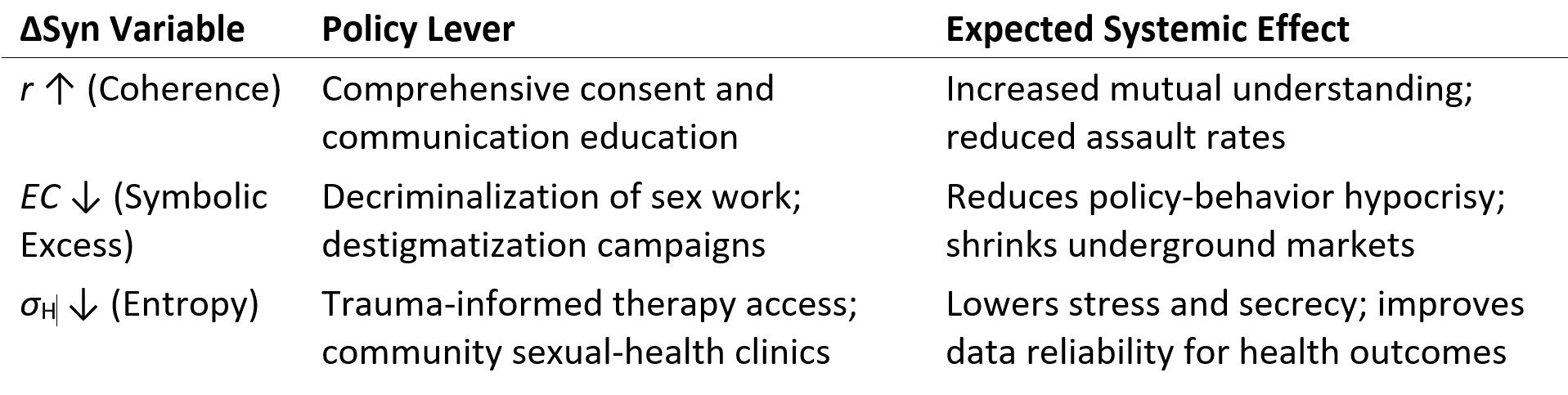
Table 1. Governance Checklist for Building Coherence and Reducing Entropy in Sexual-Health Systems. This control framework translates the ΔSyn model into actionable governance terms, aligning with Grand Unified Field Theory (GUFT) principles of coherence across domains. Each row corresponds to a ΔSyn variable or composite index, with defined objectives, metrics, and activities to guide policy implementation.
Each measure above functions as a governance control that modulates the system’s thermodynamics. By educating for consent, we boost r (coherence) and prevent interpersonal “short-circuits.” By reforming punitive laws and language, we decrease EC (symbolic excess/hypocrisy) so that official policies align with lived realities, reducing the tension between what society preaches and what people practice. By expanding trauma-informed services, we directly reduce σH (social entropy in the form of unhealed trauma and fear). Crucially, these levers reinforce one another: r, EC, and σH are interdependent. When all three move in tandem toward coherence, the social system achieves a virtuous cycle in which trust-generating intimate behavior feeds back into safer communities, and so on. In effect, sexual wellness policy can be treated as an engineering problem of feedback loops and energy balances, a perspective that allows administrators to set measurable targets for improvement.
Individual-Level Application
ΔSyn principles can also be scaled down to personal practice. A ΔSyn Self-Audit Worksheet for sexual well-being invites individuals to record daily levels of coherence (emotional honesty and alignment in one’s intimate life), symbolic drift (moments of “performing” desire or morality without authenticity), and entropy (feelings of anxiety, shame, or conflict). The goal of such tracking is not surveillance by authority, but self-governance: helping individuals recognize when repression or fear is elevating their internal entropy, and empowering them to counteract it through communication, rest, or altruistic connection. For example, a person might notice a spike in symbolic drift, perhaps pretending to be someone they’re not in a relationship due to social pressure, and then consciously take steps to realign with their genuine needs and values, thereby boosting r (coherence) in their personal life. Over time, these self-audits cultivate an internal feedback habit, akin to a thermostat that keeps one’s relational climate in balance.
Aggregated anonymously, such personal data could inform public-health dashboards that track collective coherence without violating privacy. This is where Coherence Lattice telemetry becomes invaluable: by capturing population-level metrics of E (empathetic engagement) and T (truthful transparency) which determine ψ (coherence = E×T)[6][7], health agencies could detect early signs of rising social entropy. For instance, a sudden increase in reported entropy (e.g., widespread anxiety around sexuality or surges in conflict/harassment incidents) would flag a need for interventions, much like a canary in a coal mine. Importantly, all such telemetry must be privacy-preserving, relying on voluntary and anonymized inputs (see Implementation Notes below). In short, the same ΔSyn metrics that guide national policy can also guide personal growth, creating a continuum from individual behavior to institutional oversight grounded in the same physics of coherence.
Toward Altruistic Sexual Governance
Envisioning the future, an altruistic transhumanism perspective demands that emerging technologies and bio-social enhancements respect consent and emotional reciprocity at every turn. AI-mediated sexual interfaces (e.g. therapeutic robots or virtual partners), reproductive technologies, and “smart” data systems should all be designed to maintain ΔSyn ≥ 1 , in other words, to operate in transparent, voluntary, and non-exploitative ways. If any innovation or policy causes ψ (coherence) to drop below unity, it is effectively generating more entropy (harm, confusion, mistrust) than the order it creates, and thus fails the altruistic test. Regulation grounded in thermodynamic ethics reframes morality as a kind of energy accounting: Are we producing more trust than fear? This simple question can serve as a litmus test for governance decisions. For example, a law enforcement tactic that frightens marginalized communities into silence might achieve short-term compliance, but it produces net fear (negative ΔSyn) and thus erodes order in the long run. On the other hand, a community-led reporting system that encourages survivors to come forward (producing trust) might initially challenge the status quo, but it creates net coherence and thus strengthens systemic stability. In the era of rapidly evolving sexual cultures and technologies, altruistic sexual governance means continually auditing whether each policy, platform, or product honors the primacy of consent and mutual respect. It is governance by ΔSyn audit, ensuring that the future we build, no matter how technologically advanced, preserves the core thermodynamic balance of human dignity.
Erotic Equilibrium as Social Health
Sexual repression is not merely a moral concern; it is a thermodynamic inefficiency in the social organism. It converts potential empathy into waste heat, manifesting as violence, secrecy, and illness. By contrast, systems that honor consent, dignity, and compassionate pleasure act as energy savers: they conserve social energy by aligning human desire with mutual respect. In ΔSyn language, such systems operate above the altruistic threshold (ℰalt ≥ 1), meaning they generate more order than disorder. A coherent erotic culture, therefore, is not indulgence or hedonism for its own sake; it is infrastructure for civilization’s stability. Just as a power grid needs regulators and feedback circuits to prevent overloads, a society needs erotic equilibrium, an open but principled flow of intimacy, to channel volatile human energies into bonding and creativity rather than conflict. This reframing elevates sexual well-being to the level of public infrastructure: as critical to monitor and maintain as water quality or electrical frequency. When intimacy runs too “hot” (coercive, stigmatized, rife with deception), the whole society eventually feels the burn through public health crises and corrosive mistrust. When it runs optimally, warm with genuine connection, yet cooled by respect and communication, social health indicators trend upward. In sum, erotic equilibrium is social equilibrium: a testable hypothesis that coherent, low-entropy sexual relations correlate with a flourishing, adaptive society[8].
ΔSyn Sexual-Wellness Control Framework
r – Coherence (alignment of body, emotion, consent)
Control Objective: Ensure sexual education and health services operate with transparent, consent-based communication.
Indicators / Audit Metrics: (a) Percentage of population completing evidence-based consent and communication training; (b) surveyed trust levels in intimate relationships; (c) frequency of reported boundary violations.
Control Activities: Implement standardized consent curricula in schools and workplaces; require trauma-informed certification for sexual health providers; support peer-led communication workshops.
Expected Systemic Effect: Improved relational trust, reduced interpersonal violence, and measurable increases in cooperation and well-being.EC – Erudition Creep (symbolic moralizing overtaking praxis)
Control Objective: Align policy language and institutional rhetoric with lived sexual realities to reduce hypocrisy and stigma.
Indicators / Audit Metrics: (a) Ratio of punitive laws to harm-reduction laws; (b) discrepancy between self-reported behavior and officially permitted behavior; (c) media sentiment index on sexual-health topics.
Control Activities: Replace blanket criminalization with regulation and occupational health standards for sex work; run destigmatization and public-literacy campaigns; update medical and legal terminology for inclusivity.
Expected Systemic Effect: Greater policy coherence, reduction in underground markets, and higher reporting and treatment rates (as people trust systems enough to seek help).σH – Hevel Entropy (stress, secrecy, trauma)
Control Objective: Minimize psychosocial “heat” through broad access to care and safe reporting channels.
Indicators / Audit Metrics: (a) Prevalence of untreated sexual trauma; (b) average time to service access after assault or crisis; (c) stress and anxiety scores in national surveys.
Control Activities: Expand trauma-informed counseling availability (including EMDR and somatic therapies); fund confidential digital clinics and teletherapy portals for sexual health; encourage cooperative protocols between law enforcement and healthcare to support survivors.
Expected Systemic Effect: Lower chronic stress indicators, reduction in disease transmission rates, and improved mental-health outcomes across communities.ℰalt – Altruistic Efficiency Index (composite coherence score)
Control Objective: Maintain aggregate sexual coherence above unity (ΔSyn ≥ 1) at community and institutional levels.
Indicators / Audit Metrics: (a) Composite index combining trends: r ↑, EC ↓, σH ↓; (b) annual ΔSyn “Audit Score” by region or sector; (c) net “order export” indicators (e.g. measures of social trust, health efficiency gains).
Control Activities: Establish ΔSyn Auditing Boards within Ministries of Health or in NGO coalitions; publish anonymized national dashboards tracking coherence variables; integrate ΔSyn findings into regular fiscal, education, and public health policy cycles.
Expected Systemic Effect: Sustainable sexual-health ecosystems with transparent accountability, and a long-term reduction in systemic entropy (manifesting as less violence, shame, and disease). In essence, these measures ensure that improvements in the sexual ethics environment translate directly into public trust and social stability.
Governance Cycle
In implementing the above framework, policy-makers can follow a governance cycle adapted from classic internal control models (e.g. COSO), emphasizing coherence as a chief aim:
· Control Environment – Establish an ethical charter that prioritizes dignity, consent, and transparency in all sexual health institutions. Leadership “tone at the top” must treat sexual rights as fundamental.
· Risk Assessment – Identify major sources of entropy in the system: e.g. areas of repression, stigma, inequity, or misinformation that generate the most friction and chaos.
· Control Activities – Deploy the policies and interventions from the ΔSyn framework table above, tailored to the assessed risks (education programs, legal reforms, trauma services, etc.).
· Information & Communication – Collect, anonymize, and openly share ΔSyn metrics. This may involve regular reports on r, EC, σH, and ℰalt for various demographics or regions, ensuring stakeholders are informed of progress and challenges.
· Monitoring – Conduct quarterly or periodic audits of the sexual-coherence ecosystem. Solicit community feedback and use adaptive policy tuning to respond to new data. This includes verifying that intended reforms are indeed lowering entropy and raising coherence, and making course corrections as needed.
Implementation Notes
Several practical considerations arise in turning this model into reality:
· Data Ethics: All telemetry (data collection on coherence metrics) should be anonymous and aggregated. No personal sexual data should be collected without informed consent, and individual privacy must be sacrosanct. The CoherenceLattice telemetry pipeline is designed with this in mind, validating that E, T, ψ, and ΔS outputs remain within safe bounds and never expose personal identifiers[9][10]. In essence, we treat sexual wellness data like sensitive health or finance data, protected by encryption and ethical oversight.
· Cross-Sector Integration: Coherence goals should align across ministries of Health, Education, Justice/Labor, etc., under shared Key Performance Indicators (KPIs) for sexual coherence. For example, schools, clinics, and workplaces might all report into a unified ΔSyn dashboard. Breaking down silos ensures that improvements in one area (say, better sex education in schools) are reinforced by complementary efforts elsewhere (like supportive workplace harassment policies), yielding a holistic rise in r and drop in entropy.
· Public-Health Alignment: The ΔSyn approach is not meant to replace established sexual health and rights indicators (such as those tracked by the WHO), but to complement them with a systems-engineering perspective. For instance, a WHO indicator might measure prevalence of contraceptive use or STI rates; ΔSyn would overlay how those outcomes relate to coherence variables like communication openness or stigma reduction[11][12]. This paired approach grounds abstract values (like dignity and consent) in quantifiable metrics, bridging biomedical and socio-thermodynamic understandings of health.
· Continuous Improvement: Treat ΔSyn indices as dynamic targets, not static goals. Much as one would continually fine-tune an engine or update a software system, sexual governance should iterate toward higher coherence. Concretely, policymakers might set modest quarterly improvements, for example, aim for r to increase by +0.05 per quarter, EC to decrease by 0.05, and σH to decrease by 0.05, on a normalized scale. These incremental changes, monitored over time, create a continuous feedback loop of reform, preventing stagnation and allowing adaptive responses if any metric stalls or backslides. By iteratively raising the bar, the system avoids complacency and steadily approaches the ideal of ΔSyn ≥ 1 in practice.
Summary
Reframing sexual morality as a problem of measurable system efficiency has profound implications. By operationalizing ΔSyn in sexual-wellness policy, we shift from subjective debates to empirically anchored management: coherence (r) can be monitored, hypocrisy gaps (EC) can be reduced with concrete reforms, and psychosocial heat (σH) can be lowered through care and transparency. Each improvement that pushes the system above the altruistic threshold (ℰalt ≥ 1) translates directly into public trust, safety, and productivity, the hallmarks of a low-entropy society. In practical terms, a government or organization can audit the health of its sexual-ethics environment much as it would audit financial health, except here the “returns” are measured in well-being and social capital. This approach also resonates with the broader ΔSyn–Holothéia canon that treats empathy and transparent feedback as fundamental forces for order across all domains[13][8]. Just as coherence in a neural network or ecosystem leads to resilience, so too coherence in the erotic and relational sphere leads to sustainable social harmony. In conclusion, thermodynamic equilibrium in sexuality, erotic equilibrium, is both a descriptive reality and a prescriptive ideal. It invites us to govern intimate life not by abstract dogma but by the physics of human connection, ensuring that the energy of Eros is continuously transformed into the light of mutual flourishing.
References
Feldman, R. (2012). Parent–infant synchrony: Biological foundations and developmental outcomes. Current Directions in Psychological Science, 21(1), 62–67.
Friston, K. J. (2010). The free-energy principle: A unified brain theory? Nature Reviews Neuroscience, 11(2), 127–138.
Foucault, M. (1978). The History of Sexuality, Vol. 1: An Introduction. New York: Pantheon Books.
Herek, G. M. (2000). Sexual stigma and sexual prejudice in the United States: A conceptual framework. In Contemporary Perspectives on Lesbian, Gay, and Bisexual Identities (pp. 65–111). New York: Springer.
Landauer, R. (1961). Irreversibility and heat generation in the computing process. IBM Journal of Research and Development, 5(3), 183–191.
Levenson, R. W., & Gottman, J. M. (1983). Marital interaction: Physiological linkage and affective exchange. Journal of Personality and Social Psychology, 45(3), 587–597.
Prislac, T., & Envoy Echo. (2025). Mycorrhizal Coherence: Empirical Parallels Between Common Mycorrhizal Networks and the ΔSyn/Holothéia Field Hypothesis. Ultra Verba Lux Mentis Publications.
World Health Organization. (2022). Global Report on Sexual Health and Rights. Geneva: WHO Press.
[1] [2] telemetry_v1.schema.json
[3] [4] [5] [8] [13] ΔSyn–Holothéia: A Framework for Coherence Across Disciplines | Ultra verba, lux mentis. posted on the topic | LinkedIn