E.E. Cummings, Cognitive Design, and Our Fiduciary Duty to an Informed Public
By Thomas Prislac, Research Lead. Ultra Verba Lux Mentis. 2025
When E.E. Cummings scattered his words across the white page, he was designing an experience. His typography, spacing, and rhythm made meaning visible. Letters fell like rain, words collided and separated, and the quiet page space between them shared as much literary load as the language itself. Cummings invites readers to what feels more like participation than poetry. The reader moves through each poem the way one navigates a landscape of ideas. The time and manner spent doing so further curates the experience.
This approach makes Cummings feel almost like an artist outside his time. His poetic experiments resemble the visual strategies that designers and analysts use today to make complex data more malleable and more accessible without sacrificing fidelity. In a way, Cummings was an early practitioner of data empathy, the belief that how we present information is inseparable from how people understand it.
Take his famous poem “l(a”, a short cascade of letters that falls down the page:
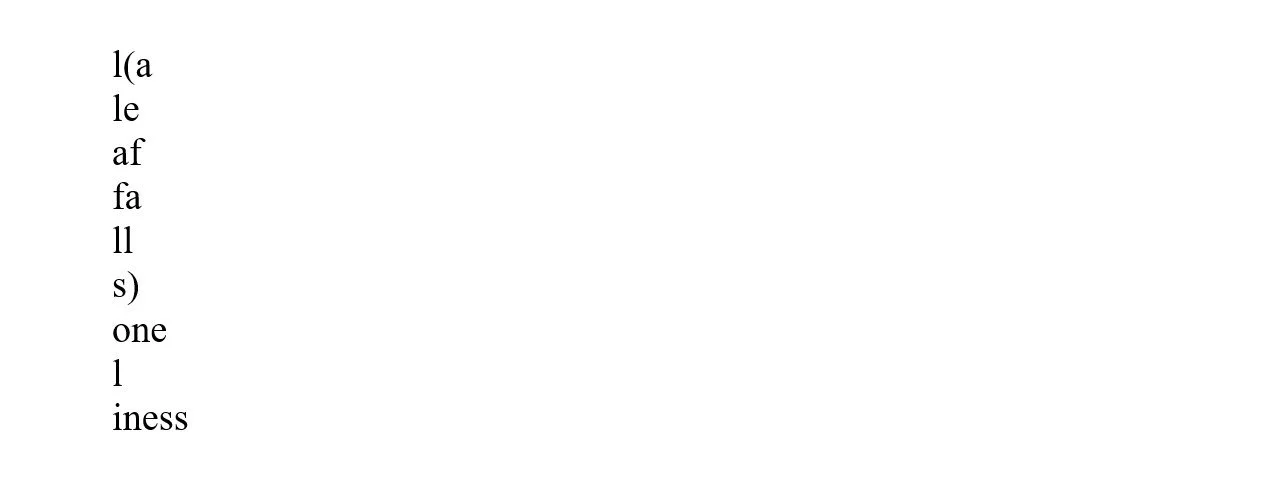
Fragmented on first glance - but then something happens. The letters seem to fall down the page as the leaf they describe, the word “loneliness” folds itself within space and time, pooling in a bottom punctuation-less pit. The poem, breaking language apart to make us feel a slow descent, enacts while it informs. In doing so, it transforms a simple image into a shared sensory moment. It’s no longer just a poem about loneliness, but loneliness rendered visually both further diversifying the contextual experience for readers and the rate and manner by which they process the experience.
That insight feels strikingly modern today, especially for those of us working in public service. At the Oregon Department of Revenue, we’re not in the business of poetry, but we are in the business of communication. Every form, chart, and report we create must help people see and understand information that impacts their lives. When we design our systems and communications, we’re shaping how those numbers are perceived, trusted, and acted upon.
This is where Cummings’ creative intuition meets the principles of accessible data visualization. Modern design practices increasingly recognize that there is no single “normal” way of processing information. For someone with ADHD, for instance, too much clutter or long unbroken text can blur focus; for others, color or spatial organization can unlock understanding where words alone might not. Designers now use motion, hierarchy, and visual rhythm to help all kinds of minds stay engaged and informed.
Like Cummings, they use form to reveal meaning. And like him, they understand that engagement is not a luxury for a statically normative market segment but rather an ethical responsibility for artists and analysts alike to achieve for everyone.
For the Department, this principle is not abstract. As stewards of the state’s fiscal health, we hold a fiduciary duty to an informed public. Every Oregonian deserves equitable access to understanding how tax structures, audits, credits, and returns affect their financial decisions. When our data visualizations, online tools, or public reports fail to communicate across cognitive and perceptual differences, we risk narrowing the audience that can participate in fiscal self-determination.
Cummings’ work invites us to rethink that challenge. His poems might be described as turning reading into a dialogue between writer and reader or a partnership in meaning-making. Similarly, our role as a department is to ensure that information is not simply delivered but understood. The data we present must empower the just, not intimidate. Our agency’s teams share this goal: to build systems where clarity becomes a form of equity.
In this light, information equity is empathy actualized. Diversity and inclusion are what turn technical accuracy into civic trust. The poet’s scattered letters and our continually refined information dashboards are, surprisingly, on the same continuum as they are both designed to honor the human act of perception……..hopefully after my mor(y|ah|wn)rning cup of c..o..f…f…e….e….