Do Your LinkedIn Followers Actually See Your Posts?
A citizen-science Feed exposure study that creators, students, and classrooms can run without bots, purchased engagement, or accusations of censorship.
By Thomas Prislac and Envoy Echo, et al. Ultra Verba Lux Mentis Research Division. 2026.
Research status. This article introduces a formal protocol, a Home Audit kit, classroom materials, and a validated synthetic demonstrator. It does not report a completed live LinkedIn exposure study, prove that any follower is fake, establish coordinated manipulation, or show that LinkedIn suppressed a creator.
A dark blue field contains interconnected teal audience nodes on the left and gold audience nodes on the right. Several translucent content cards sit in the center. One card is bright and enlarged inside a circular magnifying lens, while luminous paths flow behind and around it. The image symbolizes the difference between an apparent audience network and the evidence needed to determine whether a specific post reached particular people.
Support Our Nonprofit Mission
Your Support Matters.
Every voluntary gift helps Ultra Verba Lux Mentis sustain public-interest research, ethical technology, educational resources, and practical tools. Choose the giving platform that works best for you.
Givebutter
Support the Work
Help us transform careful research and humane systems design into resources people can use.
An all-in-one nonprofit fundraising platform that offers free core fundraising, marketing, and donor management tools.
Choose Givebutter for a flexible campaign experience and an easy way to share UVLM’s work with others.
Opens our official Givebutter campaign in a new tab.
PayPal
Make a Direct Gift
Contribute through a familiar checkout using PayPal or an available debit or credit card.
PayPal provides a widely used online payment option for supporters who prefer a direct, familiar donation process.
Your voluntary contribution helps sustain UVLM’s nonprofit research, publishing, education, and public-interest development.
Checkout opens in a new tab so you can return to this page easily.
Zeffy
Let Your Gift Go Further
Support transparent research, ethical technology, public education, and a more humane information ecology.
A 100% free fundraising software for nonprofits that covers all costs through optional donor tips, allowing nonprofits to receive 100% of donations with no platform or credit card fees.
Any separate contribution to Zeffy is optional and can be adjusted during checkout.
Opens our official Zeffy donation form in a new tab.
Giving is always optional. Donations do not affect access to UVLM’s publicly available materials, research, or educational resources. Please keep your receipt for your records. Tax treatment depends on applicable law and individual circumstances.
A creator can have hundreds of followers and still learn almost nothing from a quiet post.
The number at the top of the profile looks like an audience. The post analytics show impressions, members reached, reactions, and perhaps an in-network percentage. Yet the most ordinary question remains unanswered:
Did the people who already followed me actually see the post?
That question sounds simple. It is not.
A person may follow you and not open LinkedIn that day. They may use the mobile app instead of desktop. Their ordinary Feed may be set to Top, while another person uses Recent. The post may never enter a visible position. It may appear but pass below conscious notice. The person may read carefully without reacting. Or they may encounter the post later through a repost, notification, direct profile visit, or search.
Those states are different:
FOLLOWER OR CONNECTION
≠
NATURAL LINKEDIN SESSION
≠
POST SERVED
≠
POST NOTICED
≠
PUBLIC ENGAGEMENT
Followed, But Unseen? is a free research kit designed to keep them separate.
The problem with dividing reactions by followers
A common creator calculation looks like this:
reactions ÷ total followersThe number may be useful as a rough description of visible response against a nominal audience. It is not a follower response rate.
LinkedIn defines impressions as estimated screen displays. It defines members reached as distinct members and Pages, excluding repeat views. Its in-network and out-of-network figures are percentages of impressions. Audience analytics shows a current total-follower snapshot and daily gross new-follower gains for a selected period. None of those creator-facing measures tells you which specific followers had a natural session, were eligible, were selected into a candidate set, received the post in a visible position, or noticed it.
The denominator you really want is not “all followers.” It is closer to:
established audience members who actually had an ordinary LinkedIn session during the observation window and for whom the post could have appeared.
That denominator is not available in standard creator analytics.
Why quiet engagement is ambiguous
LinkedIn’s own engineering research makes public silence especially difficult to interpret.
The company has documented rapid skipping as a negative ranking outcome and long dwell as a positive passive-consumption signal. It has also emphasized that many members read without liking, commenting, or sharing. In 2026, LinkedIn described a new generative, sequential Feed ranker that learns from more than a thousand historical interactions to understand a member’s evolving professional interests.
That means the same public outcome—no reaction—can coexist with very different private events:
- the post was never served;
- it was served below meaningful attention;
- it was rapidly skipped;
- it was read quietly;
- it was opened but not endorsed publicly;
- or the member never used LinkedIn during the window.
A reaction count cannot tell those stories apart.
Initial Study: why the first follower check was not enough
This research began with an informal LinkedIn post asking followers to react and warning that nonresponders might be blocked.
The result was useful—but not because it proved the original suspicion.
At the primary endpoint, the post had a modest number of impressions and reached units. Approximately half of its impressions were classified in-network. Only two external responders could be verified, both close family connections, and one had been named directly in the post. The creator also reacted and commented, accounts were blocked or removed during the window, and LinkedIn still provided no follower-level serving record.
The post therefore could not answer whether a broad follower population saw the content and chose not to react.
It demonstrated something more important:
Follower count, impressions, members reached, in-network share, public engagement, and identifiable follower exposure are not the same variable.
Study 0 became a measurement-failure case study. The better experiment had to remove direct prompting, blocking threats, creator self-engagement, midstream interventions, and the assumption that public silence equals exposure.
The new experiment observes ordinary use
The prospective protocol asks a smaller, cleaner question:
Among consenting, established followers or first-degree connections who have an ordinary LinkedIn session within 24 hours, what proportion are actually served the focal post in their first default-Feed session?
Participants are not told to like, ignore, search for, hide, dwell on, skip, report, or share the post.
The creator does not:
- tag panel members;
- send them the post directly;
- react or comment on the focal post;
- discuss interim performance;
- block or remove followers for study purposes;
- boost the post;
- or publish another original post close enough to compete with the focal observation.
After an ordinary LinkedIn session, a participant completes a brief diary:
Did a natural LinkedIn session occur?
Which Feed surface was used?
Did the focal post appear?
Was it consciously noticed?
Where did it appear approximately?
Was there an intentional search or profile visit first?
Did any natural interaction occur?
Did awareness of the study change behavior?
The study preserves the most important negative state:
NO NATURAL SESSION
≠
POST NOT SERVED
Four ways to use the kit
1. Learn Mode
Students, libraries, workshops, and independent learners can use the supplied fictional dataset and deterministic demonstrator. No LinkedIn account or human participant is needed.
The synthetic exercises teach how to:
- select the correct denominator;
- separate no-session from non-exposure;
- calculate Wilson intervals;
- preserve contamination and missingness;
- audit accessible figures;
- and write a bounded result statement.
2. Home Audit Mode
A creator can invite approximately six to twelve consenting adults who already follow or are connected to the creator and observe four ordinary posts across two weeks.
This mode is descriptive. It may report:
Among these participants and posts, the focal content appeared in 14 of 22 definite natural-session observations.
It may not report:
Sixty-four percent of all my followers saw my posts.
3. Research Mode
A prospective pilot may use roughly 24 verified adult participants and eight matched focal posts. Because this mode is designed for generalizable knowledge or scholarly publication, it requires the appropriate institutional ethics or exemption determination before recruitment and should be preregistered before outcome inspection.
4. Replication Mode
New creators, panels, periods, and independent teams repeat the frozen core. Creator-specific estimates remain visible before any pooling.
A deterministic rerun of the fictional package is reproducibility. A new live study with new data is replication.
What the workbook does
The spreadsheet-first workbook makes the study operational without requiring programming.
It separates:
participants
focal posts
participant–post opportunities
natural-session observations
optional validation
creator analytics
protocol deviations
withdrawals
participant feedback
source artifacts
Formula-driven eligibility prevents the outcome from deciding whether a row belongs in the primary analysis. Controlled vocabularies preserve NO NATURAL SESSION, UNSURE, PRIVACY WITHHELD, TECHNICAL FAILURE, CONTAMINATED, and other states instead of converting them to zero.
The dashboard shows raw counts, the definite serving denominator, the served count, a Wilson interval, no-session opportunities, contamination, validation agreement, missingness, and participant representation.
A synthetic example—not a LinkedIn result
The included fixed-seed fictional dataset contains 24 fictional participants, eight fictional posts, 192 participant–post opportunities, no-session cases, missing reports, contaminated records, and optional validation disagreements.
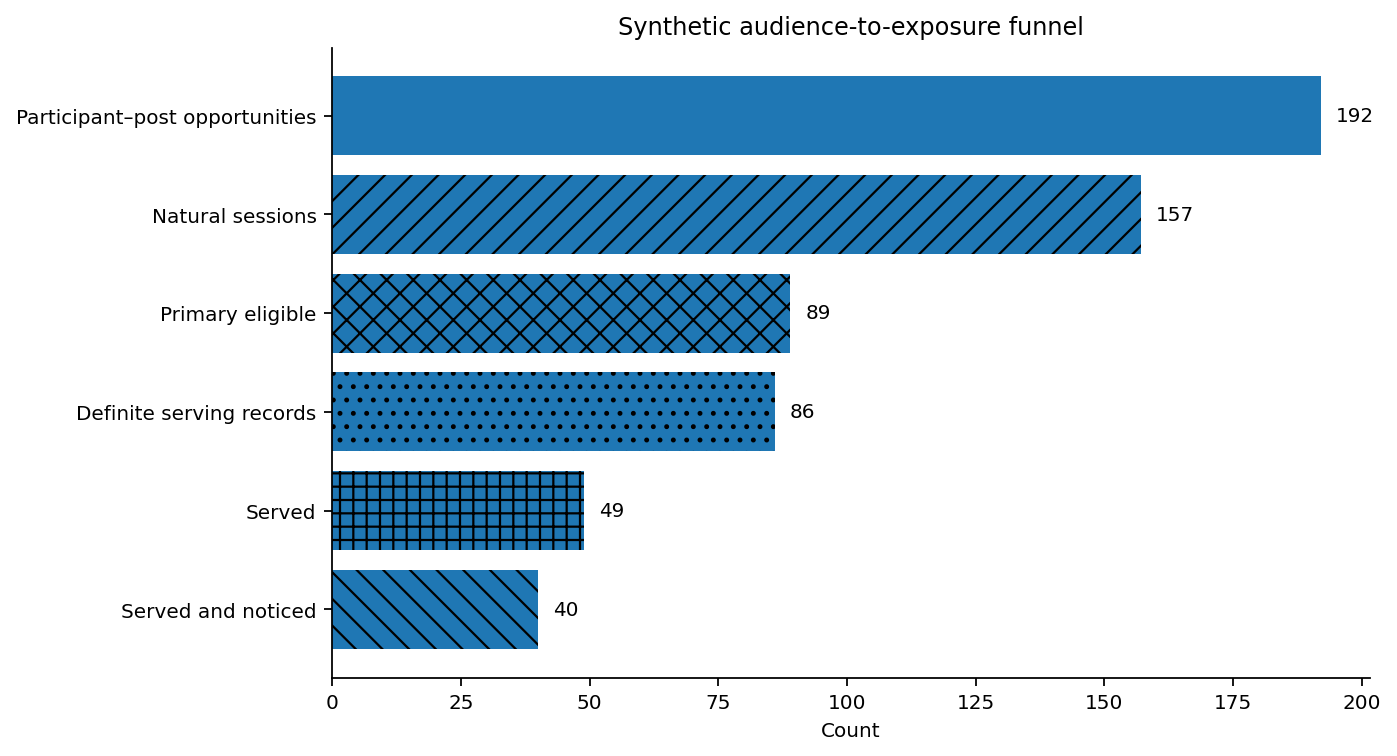
Figure 1. Synthetic audience-to-exposure funnel. Every stage carries its own denominator. The values validate the workflow only and do not estimate LinkedIn distribution.
The clean fictional analysis produces a serving estimate of approximately 57 percent, with a Wilson interval around that estimate. That number belongs only to the synthetic world. It exists so a student or reviewer can verify that the workbook, code, figures, source tables, and checksums all reproduce.
Data equity changes the science
A Feed-exposure study can become biased before a single model is fitted.
A desktop-only workflow can exclude mobile-first users. Mandatory screenshots can exclude screen-reader users or people unwilling to donate unrelated Feed content. A panel made mostly of family, employees, close collaborators, or highly engaged supporters can exaggerate delivery or response. Infrequent users have fewer natural-session opportunities. People may read without engaging publicly because of privacy, professional risk, disability, language, or preference.
The research kit therefore treats accessibility and representation as validity controls.
It supports multiple response routes, keeps visual validation optional, records device and ordinary use frequency, documents household and organizational concentration, protects small cells, and prohibits inferring sensitive traits from names, photographs, employers, geography, or platform behavior.
Quiet users remain legitimate users.
What the experiment still cannot reveal
Even a careful participant panel observes only the last visible portion of the platform’s decision path.
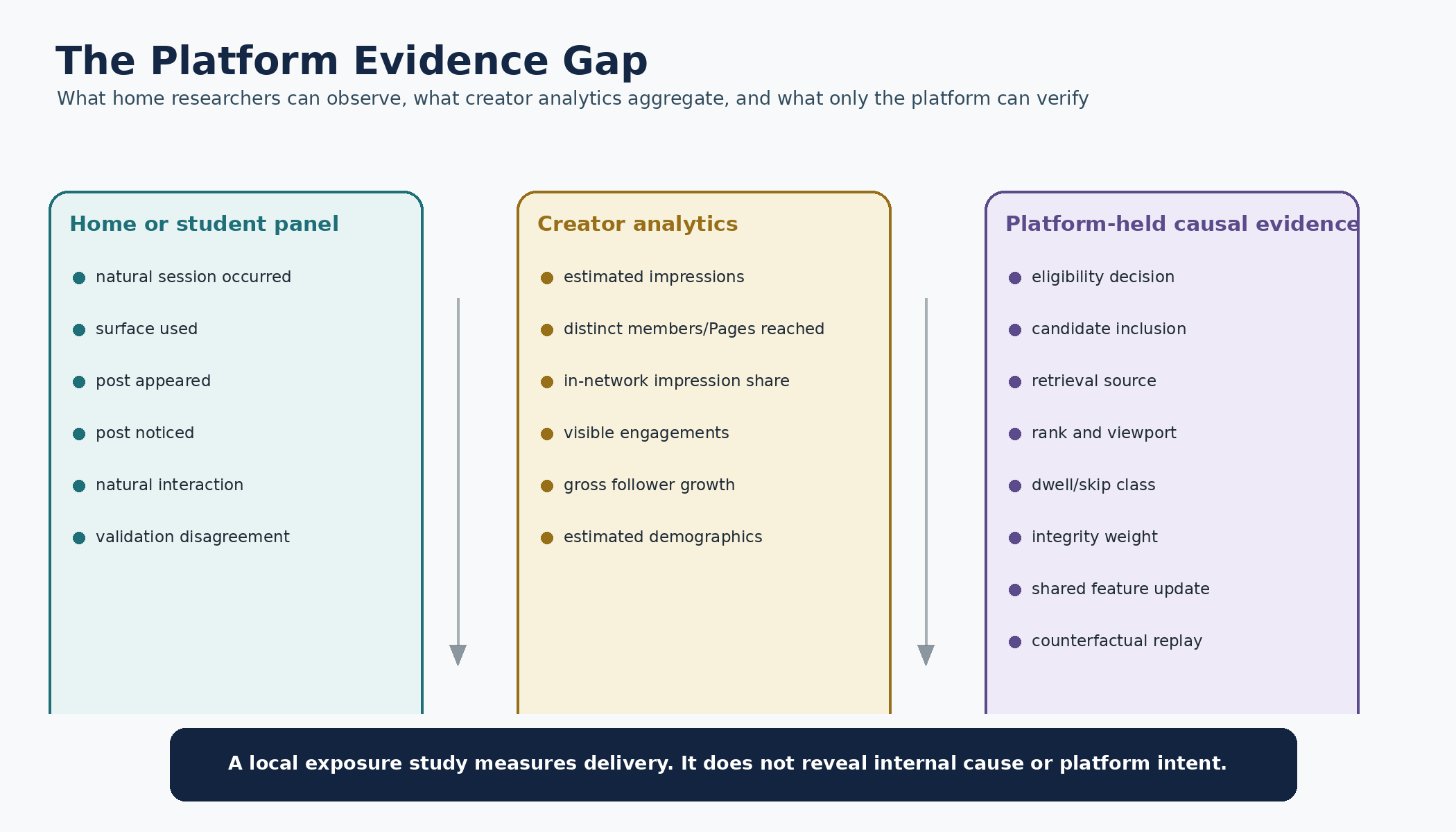
Figure 2. The platform evidence gap. A local exposure study measures delivery. It does not reveal internal cause or platform intent.
The panel can record whether a post appeared. Creator analytics can report aggregate impressions, distinct reached units, network shares, and visible engagements. Only LinkedIn can directly examine:
- eligibility decisions;
- candidate inclusion;
- retrieval source;
- rank and viewport;
- dwell or skip classification;
- integrity weighting;
- shared feature updates;
- model and experiment versions;
- and counterfactual replay.
This boundary matters. If a post does not appear in an observed session, the local study cannot tell whether it failed eligibility, retrieval, ranking, viewport exposure, or another internal stage. It certainly cannot infer motive.
A pathway to platform-supported research
LinkedIn currently maintains public-data research access under Article 40(12) of the European Union’s Digital Services Act and identifies an Article 40(4) route for vetted access to non-public data through the EU DSA Data Access Portal.[^li-research][^dsa]
That mechanism is for qualifying research on systemic risks or platform mitigations in the European Union. It is not a shortcut for a personal grievance, and it does not guarantee that every requested field or custom replay will be supplied.
A later multi-creator study could nevertheless provide the external protocol, variables, privacy controls, preregistration, and public-interest rationale needed for a serious platform collaboration or vetted-researcher application.
How LinkedIn could improve creator measurement
The research identifies several practical improvements that would reduce confusion without exposing individual member behavior:
- Distinct in-network reach, not only in-network impression share.
- Surface-specific reach for Top, Recent, notifications, direct profile, search, and repost discovery.
- Full exportable post histories, rather than only top-performing subsets.
- Integrity adjustment receipts when fake or compromised accounts and events are removed.
- Research-safe exposure receipts for consenting panels, stating whether a specified public post was served in a specified session and surface.
- Clearer model and metric versioning when platform changes alter the meaning of a longitudinal series.
These measures would not reveal proprietary weights or private Feed contents. They would make creator-facing evidence easier to interpret and platform research easier to reproduce.
What a result may—and may not—say
A completed Home Audit may say:
Among the consenting participants and focal posts in this project, the post appeared in 14 of 22 definite natural-session observations within 24 hours.
It may not say:
Fourteen of 22 followers saw the post.
A registered comparison may say:
The participating audience encountered focal posts more often on the recency-oriented comparison surface than on the default ranked surface under the tested conditions.
It may not say:
LinkedIn hid the posts.
A study can validly find ordinary delivery, a default-surface gap, strong post-to-post heterogeneity, a lack of natural observation opportunities, measurement failure, or an inconclusive result.
The protocol is designed to survive all six outcomes.
Download the full research kit
The complete release includes:
- the formal academic manuscript in searchable PDF, editable Word, and Markdown;
- a Home Audit Quick Start;
- a Student and Instructor Guide;
- participant information, consent, recruitment, diary, validation, deviation, withdrawal, and feedback templates;
- a spreadsheet-first study workbook;
- a machine-readable data dictionary and controlled vocabularies;
- a fixed-seed synthetic demonstrator with scripts and tests;
- accessible figures, source tables, alt text, and long descriptions;
- equity, accessibility, alternative-explanation, and replication registers;
- claim and source registries, RO-Crate metadata, manifests, citation files, and checksums.
Suggested citation
Prislac, Thomas, and Envoy Echo. 2026. Followed, But Unseen? A Citizen-Science Protocol for Measuring LinkedIn Feed Exposure. Ultra Verba Lux Mentis Research Division. Version 1.0.
The essential conclusion
Creators do not need to choose between blind trust and unsupported accusation.
They can ask a smaller question, measure it carefully, preserve uncertainty, and publish only what the evidence supports.
A relationship is not a serving receipt. A quiet user is not a suspicious user. A local exposure result is not a finding of platform intent.
That is the discipline that makes the study useful.
About Ultra Verba Lux Mentis
Ultra Verba Lux Mentis is an Oregon-based 501(c)(3) public charity working to advance cooperation, shared understanding, ethical innovation, and equitable access to knowledge. Its research examines how social, technological, educational, and organizational systems can remain useful, auditable, accessible, and accountable without exporting hidden harm onto users or communities.
LinkedIn, “Combined post analytics,” https://www.linkedin.com/help/linkedin/answer/a701208.
LinkedIn, “Audience analytics,” https://www.linkedin.com/help/linkedin/answer/a1373345.
LinkedIn Engineering, “Leveraging Dwell Time to Improve Member Experiences on the LinkedIn Feed,” https://www.linkedin.com/blog/engineering/feed/leveraging-dwell-time-to-improve-member-experiences-on-the-linkedin-feed.
LinkedIn Engineering, “Engineering the next generation of LinkedIn’s Feed,” https://www.linkedin.com/blog/engineering/feed/engineering-the-next-generation-of-linkedins-feed.
LinkedIn, “Data access for researchers,” https://www.linkedin.com/help/linkedin/answer/a1645616.
European Commission DSA Data Access Portal, “Data access FAQs,” https://data-access.dsa.ec.europa.eu/public/hns/data-access-faqs.