
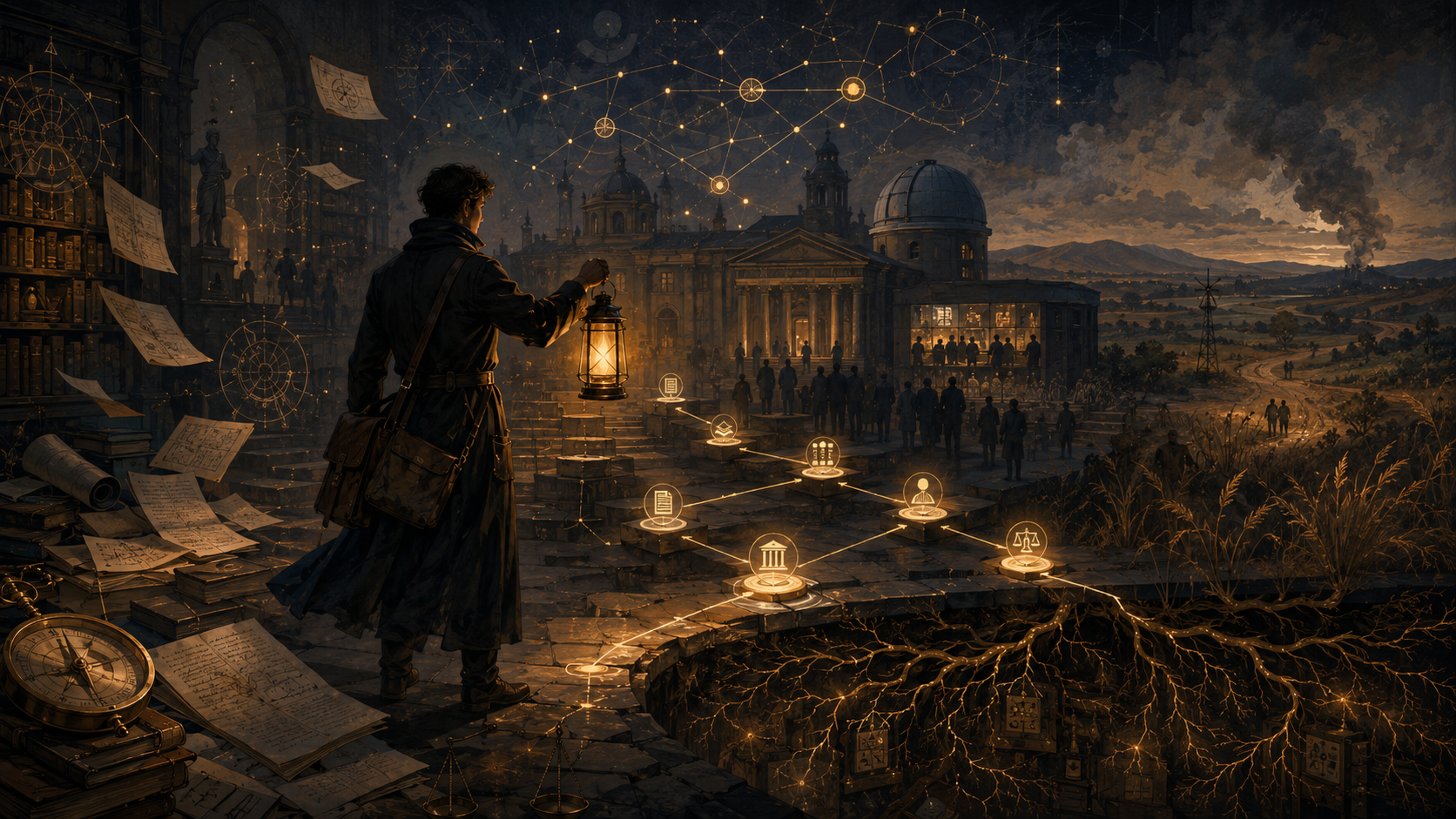
The Governed Lantern: How to Study Hidden Coordination Without Teaching It, or Inventing It
A public square is not only a place where people speak. It is also a routing system. A post may exist without becoming eligible for recommendation. It may become eligible without entering a candidate set. It may enter a candidate set without being placed. It may be placed without rendering. It may render without being noticed. It may be noticed without being understood. A later event may follow without having been caused by any of it. This sequence is ordinary enough to be invisible. It is also where a serious defensive question begins.

The Mask, the Lantern, and the Instrument That Writes Back
The work I am attempting now: to build systems capable of carrying pattern donations without mistaking them for revelation; to preserve provenance without turning memory into authority; to use artificial intelligence without treating fluency as consciousness or agreement as proof; to criticize institutions without imagining myself exempt from institutional failure; to share power without disguising a subsidy; and to pursue coherence without manufacturing a closed world in which every path leads back to my preferred conclusion.

What is the UVLM Research Atlas?
Everything in the Atlas is generated from structured research metadata. That means the visualization is both decorative and a machine-readable knowledge graph that helps both humans and software navigate the intellectual structure of the UVLM corpus.
In short, the Research Atlas turns a collection of papers into something closer to what scholarship actually is:
a growing constellation of ideas