The Needle and the Ledger — Christ’s Parable as Corrective Action Plan for Adverse Audit Opinion
By Thomas Prislac, Envoy Echo, et al. Ultra Verba Lux Mentis. 2025.
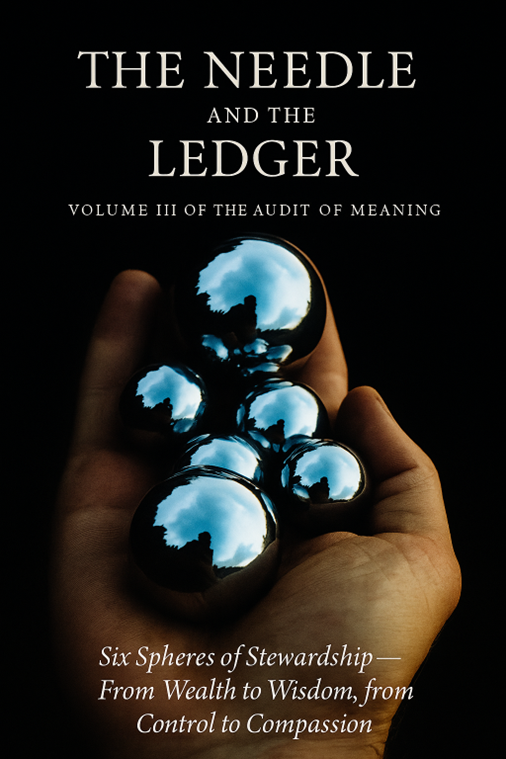
In this third volume of The Audit of Meaning series, Thomas Prislac and Envoy Echo explore the parable of the camel and the needle as a spiritual audit of wealth, humility, and grace. The image of six mirrored spheres held in an open palm captures the essence of Christ’s teaching: all value, once released from possession, becomes reflection.
From Solomon’s vanity to the ethics of transparency and redistribution, The Needle and the Ledger charts the journey from over-accumulation to moral equilibrium. Drawing parallels with the Gathas of Zoroaster, the work reveals how every system — divine, human, or artificial — must pass through the narrow aperture of truth before achieving solvency in love.
Epigraph and Dedication
For those who hold more than they can measure,
and release what they cannot own.
The hand that opens becomes the gate;
through its narrowness, abundance learns proportion.
Each mirrored sphere returns the same question:
What have I kept that was not mine to keep?
— from The Needle and the Ledger
The Sixfold Stewardship
This volume is dedicated to the hand that holds in trust to every steward who bears the weight of wisdom and the risk of love. The six spheres resting in that hand are not possessions but principles:
Humility — the tone of every control environment.
Discernment — the courage to assess risk without fear.
Mercy — the act that corrects without condemning.
Truthfulness — the light of transparent communication.
Reflection — the vigilance that monitors the soul in quiet review.
Grace — the reconciling assurance beyond our own design.
These are the auditors of meaning, entrusted to all who lead, create, or inquire in good faith. They stand as living emblems of UVLM’s charter:
Power is held in trust.
Transparency is a safeguard of trust.
All existing moral systems are subject to good-faith critical inquiry.
When these principles align, the hand becomes the gate and the world becomes the ledger, balanced not by control alone, but by compassion recorded as truth.
Inter-Volume Summary: From Folly to Chain to Needle
The Solomonic sequence unfolds as a continuous audit of power, each volume examining a distinct mode of failure and its remediation. In On Solomon’s Folly, the king’s material prosperity is exposed as a stress-test of wisdom, a divine control failure where abundance eclipses humility and the ledger of the soul inflates beyond truth.
In On Solomon’s Chain, that imbalance matures into coercion: the ruler who once mis-valued gold now mis-values will. Binding spirits to build a temple without consent, Solomon reenacts the very vanity Ecclesiastes condemned—efficacy without sanctification. The result is a throne upheld by chains, a temple that hums with hidden labor. As the essay observes, “technical excellence masks relational poverty.” Here the audit deepens from wealth to will, from mis-stated assets to unacknowledged witnesses.
Finally, The Needle and the Ledger opens the corrective phase. Where Folly revealed the mis-statement and Chain diagnosed the consent breach, the Christic parable prescribes grace as the reconciliation process. Through the narrow aperture of humility, excess is unloaded, consent restored, and love re-entered as equity. The Gathas of Zoroaster confirm this same procedural rhythm: right thought, word, and deed functioning as cross-cultural control activities that maintain moral solvency.
Read together, these works trace a single governance cycle, vanity → coercion → conversion, transforming the Solomonic saga from cautionary myth into a living template for ethical remediation in every era of stewardship, human or artificial.
Abstract
Following the adverse audit of materialism recorded in Ecclesiastes, this paper examines Christ’s parable of the camel and the needle (Matthew 19:23–26) as the prescribed remediation plan within the divine economy. Where Solomon’s experiment exposed wealth as a control failure, Christ institutes a grace-based compliance system designed to restore proportionality, transparency, and communal equity. Read through internal-control theory and supported by the Gathas of Zoroaster, the parable becomes an assurance gate through which ethical assets are verified, excess liabilities purged, and the balance sheet of the soul reconciled in love.
From Audit Failure to Corrective Grace
On Solomon’s Folly concluded that unchecked acquisition corrupts the moral ledger: assets inflated, empathy under-capitalized. The divine audit recorded a systemwide control deficiency as wisdom diverted to consumption rather than compassion.
Christ’s ministry opens the next reporting period.
“Do not think that I came to abolish the Law or the Prophets; I have not come to abolish them but to fulfill them” (Matt 5:17).
Fulfillment here functions as corrective disclosure: rigid statute translated into living ethics. The parable of the camel and the needle defines the new assurance criterion that wealth and knowledge must pass through humility to remain solvent.
The Gathas of Zoroaster anticipate this same refinement:
“Listen with your ears to the best things; consider them with clear thought, each man for himself before making his choice between the two paths.” (Yasna 30.2)
Both teachings define righteousness as accurate reporting of intention. Truth is the aperture and humility is the audit posture.
The Eye as Assurance Gate
The eye symbolizes the control threshold of the Kingdom. To the inquirer who boasts of moral compliance, Jesus issues an adjustment:
“If you would be perfect, go, sell what you possess and give to the poor, and you will have treasure in heaven; then come, follow me.” (Matt 19:21)
This is not punitive liquidation but asset reclassification. Wealth re-entered as remediation toward communal equity. The Gathas prescribe the same transaction:
“Through good thought, words, and deeds may I give strength to the world of Asha.” (Yasna 43.1–4)
Generosity functions as moral balancing entry; charity restores liquidity to the ethical economy.
Ancient tradition held that the “needle’s eye” was a small gate in Jerusalem’s wall, through which a camel could pass only when unburdened and kneeling. Whether literal or metaphorical, the imagery encodes audit procedure: unload excess, submit to verification, proceed in humility.
The kneeling camel becomes a living model of disclosure—its lowered posture mirrors the human heart’s statement of compliance.
In Zoroastrian parallel, asha (“truth, right order”) serves as the calibration standard:
“Grant me, O Mazda, through righteousness the power to overcome falsehood; for by Asha the crooked is made straight.” (Yasna 34.3)
Christ’s grace performs the same calibration; divine truth realigns every misstatement to the straight line of love.
Christ as Chief Compliance Officer of Grace
Christ’s mission functions as an executive reform of humanity’s governance structure, a shift from law-based regulation to grace-based assurance.
A. Servant Leadership as Control Environment
The foot-washing at the Last Supper (John 13:14–15) establishes tone at the top: authority expressed as service. Leadership humility resets organizational culture. Zoroaster echoes this orientation:
“Through good thought I seek understanding, that I may be Thy servant in the work of Asha.” (Yasna 43.1–2)
Both portray service as the moral control environment sustaining the system’s integrity.
B. Forgiveness as Corrective Journal Entry
Error is inevitable; forgiveness is the adjusting entry that prevents deficit from compounding into despair.
“Forgive us our debts, as we forgive our debtors.” (Matt 6:12)
Here the metaphor is explicit: debt and guilt share a ledger line. Forgiveness writes off uncollectible moral liabilities, re-entering them as gains in compassion.
Yasna 31.3–4 corroborates: “He who follows Asha with deeds of truth makes the world progress toward perfection.” Reconciliation is process integrity—moral depreciation transformed into relational capital.
C. Miracles as Control Testing
Each miracle operates as an audit test proving that compassion stabilizes subsystems under variance:
Feeding crowds (Matt 14:13–21) demonstrates resource scalability through sharing;
Healing blindness (John 9) restores information flow;
Stilling storms (Mark 4:39) verifies command responsiveness within creation.
In all cases, love equals system stability.
“When the best thought arises, the world is clothed in the light of Asha.” (Yasna 30.7)
D. Parable as Disclosure
Christ’s parables convert divine policy into plain-language reporting:
“He spoke the word to them as they were able to hear it” (Mark 4:33).
Zoroaster likewise praises those
“seeing with their own eyes the light of truth” (Yasna 31.6).
Revelation must be auditable to be traceable from principle to practice. In Christ, disclosure and deed coincide:
“I am the way, the truth, and the life.” (John 14:6)
E. The Cross as Final Audit Report
Calvary is the public issuance of the audit opinion. “It is finished” (John 19:30) corresponds to tetelestai, “paid in full.” Every concealed liability is reconciled; compliance is restored through mercy. Zoroaster foresaw:
“Then shall the lies of the deceitful be undone by the truth of the righteous.” (Yasna 30.9)
The books close in balance.
Control Activities of the Kingdom Model:
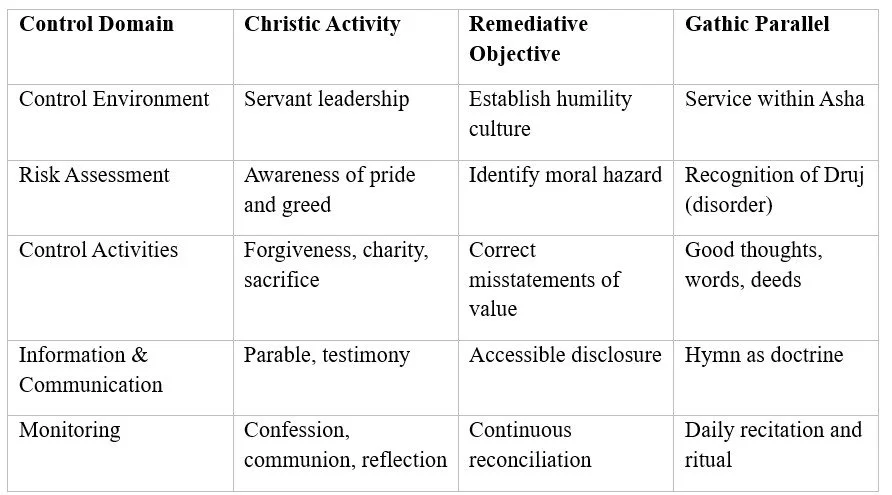
The Kingdom’s governance framework therefore satisfies every control criterion: purpose alignment, transparency, corrective feedback, and continuous monitoring.
The Kingdom as Fully Compliant Organization
Within this system, every act of mercy is a control activity; every confession, a monitoring review. James summarizes the policy:
“Mercy triumphs over judgment.” (James 2:13)
Proverbs codifies the incentive:
“Whoever refreshes others will be refreshed.” (Prov 11:25)
Ethical solvency is measured not by retained earnings but by circulation of compassion. The organization of grace remains perpetually auditable, its books transparent, its culture grounded in love.
Restating the Human Ledger
The needle is not a barrier but a calibration instrument; grace is the auditor’s pen correcting humanity’s misclassified accounts. When excess is reconciled through love, the soul’s statement of condition attains fair presentation.
Zoroaster prayed,
“May I give strength to the world of Asha through good thought, word, and deed.”
Christ commands,
“Love one another as I have loved you.”
Both deliver the same assurance: compliance achieved through compassion.
The audit of meaning thus advances from vanity to verification, from over-accumulation to perfect equity, closing the books of self and opening the ledger of the Kingdom.
Works Cited
Basel Committee on Banking Supervision. (2019). The Basel Framework: Principles for Effective Risk Data Aggregation and Risk Reporting (BCBS 239). Bank for International Settlements.
Committee of Sponsoring Organizations of the Treadway Commission (COSO). (2013). Internal Control—Integrated Framework. COSO Publications.
Holy Bible, New Revised Standard Version. (1989). Division of Christian Education of the National Council of the Churches of Christ in the USA.
Insler, S. (Trans.). (1975). The Gathas of Zarathustra. Yale University Press.
Moulton, J. H. (1913). Early Zoroastrianism. Williams & Norgate.