
When Guardians Betray the Throne: A Global History of Bodyguards Turning on Rulers
By Thomas Prislac, Envoy Echo, et al. Ultra Verba Lux Mentis. 2026
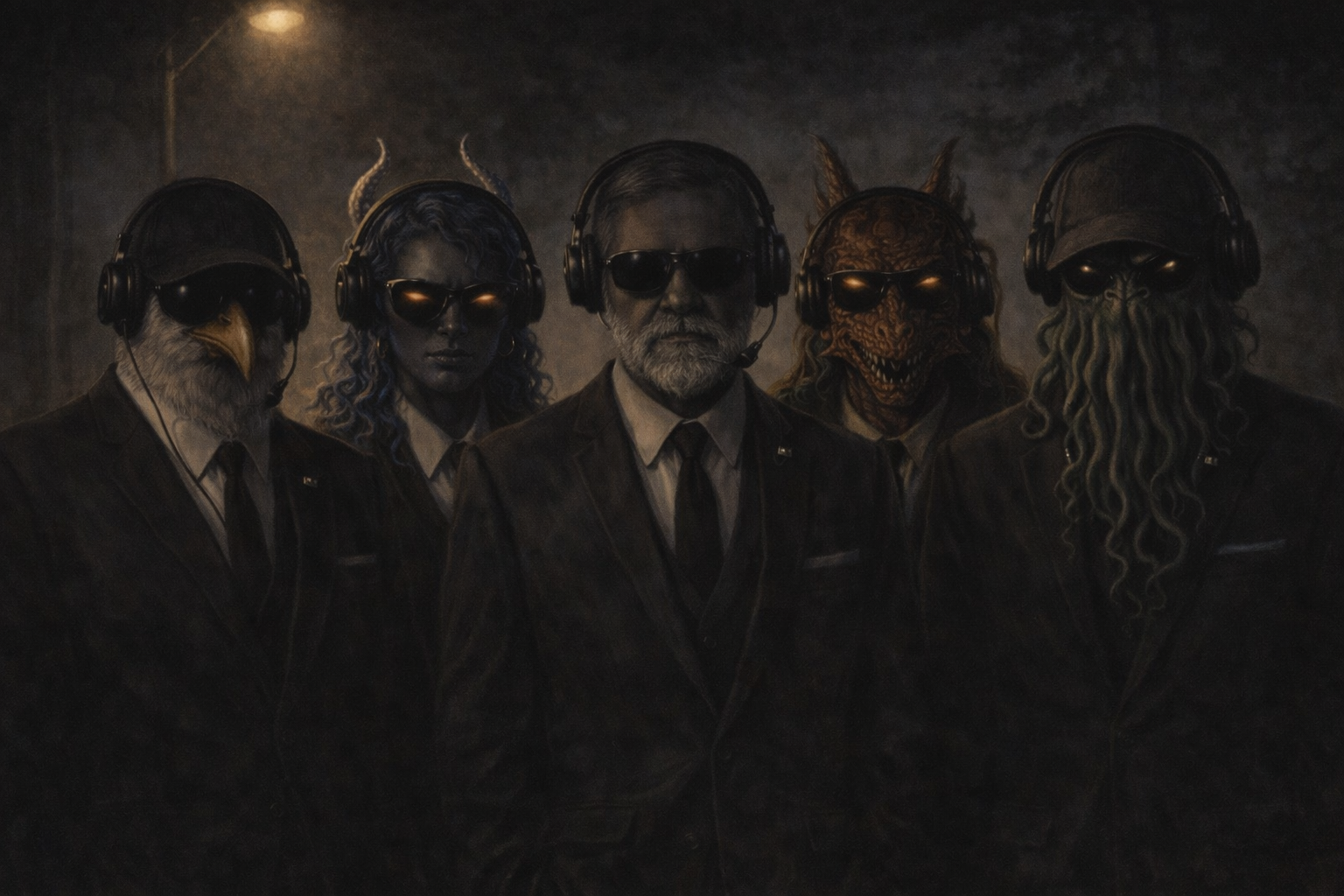
The Paradox of the Trusted Guard:
In the grand palaces and fortified citadels of history, the most trusted sentinels often stood only steps away from mighty rulers. Cloaked in loyalty and arms, these guardians swore to shield their sovereigns from all harm. Yet, time and again, the glitter of power and the shadow of tyranny have kindled a dangerous question: what happens when the shield becomes the sword? In epochs and empires spanning antiquity to modernity, elite bodyguards, those sworn protectors of kings, emperors, and sultans, have at critical moments turned their blades inward. Praetorian conspirators plunging daggers into a despotic Caesar, Janissary musketeers mutinying against a self-indulgent sultan, royal samurai betraying a shogun at dawn, or modern generals deposing an autocrat in the name of the people, these dramatic reversals echo across time. This paper will journey through these turning points in history, examining how and why the “guardians of power” sometimes became the instruments of its downfall. We will seek coherence in these episodes, drawing cross-cultural parallels from Rome to China, from the Ottoman Empire to African kingdoms and beyond, and ultimately reflect on how these lessons resonate with today’s political machinations. Through vivid narrative and historical analysis, we will see that when the excesses of the elite grow too great, even the hands that once defended the throne may become the hands that strike it down, a dramatic dance of power that has left indelible marks on world history.
The Praetorian Guard: Power Behind the Throne in Imperial Rome
“Who guards the guards themselves?,” so wondered ancient satirist Juvenal. Nowhere is this question more apt than in the Roman Empire’s Praetorian Guard. Established by Augustus, the Praetorian Guard was an elite corps of soldiers stationed near the heart of imperial power in Rome[1][2]. They began as loyal protectors of the emperor’s person, meant to ensure his safety amid the scheming politics of Rome. But in a classic paradox, their proximity to power made them kingmakers and kingslayers. Over centuries, the Praetorians accumulated privileges, shorter service, higher pay, and rich bonuses, that set them apart from ordinary legionaries[3][4]. They were housed in the capital at the Castra Praetoria, close enough to watch every flicker of intrigue in the palace and Senate[5]. As one historian aptly notes, “Roman history is littered with tales of Praetorian plots,” with ambitious guardsman playing decisive roles, sometimes to “do away with emperors they thought no longer fit for purpose.”[6] Indeed, over their 300-year history, the Praetorians came to dominate Roman politics, orchestrating coups as often as they foiled them[7][2].
From an early stage, emperors realized the dangerous bargain they had struck. They relied on the Guard for protection, yet they lived in its looming shadow. To secure loyalty, wise emperors lavished donatives (hefty cash gifts) on the Praetorians at accessions and anniversaries[8]. Augustus himself, in his will, left 1,000 sesterces to each guardsman, over three times what a regular legionary received[8]. But woe to the ruler who delayed the pay or crossed the Guard’s interests. When Emperor Tiberius withdrew from Rome leaving Prefect Sejanus effectively in charge, the Praetorians learnt their own strength. After Sejanus was executed for treason in 31 CE, it became clear that “the secret was out, the Praetorians could be architects of political change in the empire.”[9] Only a decade later, in 41 CE, they proved it: angered by the erratic cruelty of Emperor Caligula, a faction of the Guard under officer Cassius Chaerea struck him down in a bloody assassination[10][6]. In the chaotic hours that followed, senators debated restoring the Republic, but the Praetorian rank-and-file had other plans. Famously, they found Caligula’s trembling uncle Claudius hiding behind a curtain and promptly hailed him as emperor, carrying him to their camp for his “protection”[11][12]. Claudius, astonished at this turn of fate, had to buy the loyalty of his self-appointed kingmakers with an unprecedented bribe of 15,000 sesterces per man[12][13]. The message was unmistakable: henceforth the throne of Rome was for sale to its guards, and the Senate’s authority in succession was all but extinguished[14][15].
The Year of the Four Emperors (69 CE) provided an even starker display of Praetorian power and perfidy. When Emperor Nero died and chaos ensued, Galba took power but crucially refused to pay the Praetorian donative, a fatal mistake[16]. Feeling cheated, the Guard mutinied, brutally murdering Galba in the Roman Forum and elevating their preferred candidate Otho, who had dangled rich promises before them[16]. A contemporary noted that Galba’s stinginess had cost him his life, proving the Praetorians “would not tolerate rivals” to their influence nor any slight to their privileges[17][18]. Although Otho himself soon fell in civil war to Vitellius, the Guard remained a fickle kingmaking force, even opening the gates of Rome to Vespasian’s troops when they saw the winds turning[19]. Fast forward a century, and we see the Praetorians at their most brazen during the Commodus-Pertinax crisis of 192–193 CE. After the debauched Emperor Commodus was strangled (with the Praetorian Prefect himself complicit), the upright old senator Pertinax became emperor, but he too balked at the gargantuan payout the Guard expected[20]. Pertinax tried to discipline the Praetorians and curtail their corruption. In response, these supposed protectors stormed the palace in a fury and hacked the emperor to death within three months of his reign[21][20]. What followed was an infamous episode: the auction of the Roman Empire. In the turbulent days after Pertinax’s murder, the Praetorian Guard literally put the imperial title up for sale to the highest bidder at their camp gates. A wealthy senator, Didius Julianus, won this macabre auction by promising 25,000 sesterces per guard, outbidding a rival candidate[21]. Thus, in a scene astonishing even by Roman standards, the bodyguards who had slain one emperor cheerfully escorted their newly purchased emperor to the palace, having sold the purple to enrich themselves.
Such was the “Praetorian tradition,” a pattern of kingmaking, regicide, and extortion that plagued Rome for centuries[7][22]. Emperors lived in dread of their own protectors: many met their end at Praetorian hands, including Caligula, Elagabalus, Caracalla, and Aurelian, among others[23][24]. By one count, at least 13 Roman emperors were overthrown or assassinated with Praetorian involvement[25], an incredible tally that earned the Guard its notorious reputation. The phrase “Praetorian Guard” itself has become synonymous with a powerful group of insiders who manipulate or betray the leader they are meant to serve. As the historian Tacitus dryly observed, the tools of empire can become its tyrants. The Praetorians exploited imperial weakness and vanity, extracting higher pay, special legal status, and influence in appointments[17][22]. They even meddled in policy, eliminating the emperor’s rivals and executing officials at will[26][27]. Over time, some Praetorian Prefects, ostensibly commanders of the guard, became powers behind the throne. Lucius Sejanus, Tiberius’s prefect, nearly usurped the empire in 31 CE before Tiberius uncovered his treachery[28][29]. Later, Prefect Macrinus actually ascended to the imperial throne in 217 after plotting the murder of Caracalla, proving that a guard commander could become Caesar himself[30]. Little wonder emperors like Septimius Severus sought to tame the Praetorians by reforming their ranks, Severus famously disbanded the existing Italian-dominated Guard and refilled it with his own loyal Danubian legions in 193 CE[31][32]. Ultimately, it was Emperor Constantine who in 312 CE dismantled the Praetorian Guard for good, after defeating them in battle. By then, the Guard had decisively proven Juvenal’s grim joke: no one guarded the guardians. They guarded themselves, and the empire danced on their strings.
Yet, for all their selfish motives, one can argue the Praetorians occasionally performed a dark service to Rome: removing truly disastrous rulers. Caligula’s reign of madness and terror ended thanks to the daggers of his own guard officers, who believed “he was no longer fit for purpose.”[6] Commodus’s homicidal antics were halted by a palace conspiracy involving the Praetorian Prefect, who feared the emperor would ruin the state[20]. In these cases, the bodyguard’s betrayal spared the broader population from further harm, at least in the short term. However, the Praetorians were far from altruistic champions of the people. More often, their wrath was driven by insult or insufficient reward rather than high principle. They killed emperors who failed to pay or threatened their perks, rather than out of civic virtue[16][22]. Still, the end result was sometimes a “course correction” for Rome: a tyrant gone, a more sober ruler in his place (for example, Claudius after Caligula, or the stable Severan dynasty after the chaos of 193). The Praetorian Guard thus illustrates a recurring historical theme: when a ruler’s excesses or failures undermine the very forces that uphold his rule, those forces may turn on him in the name of stability or self-preservation. In the Praetorians we see the seed of a pattern that will repeat around the world, the protector transformed into executioner, the guardian becoming the threat.
Janissary Revolts: The Sultan’s Elite Corps Turns Inward
If the Praetorian Guard exemplified this phenomenon in the West, the Ottoman Empire’s Janissary Corps provides a striking parallel in the East. The Janissaries were an elite infantry corps that served as the Ottoman sultans’ household troops and bodyguards for nearly five centuries[33][34]. Like the Praetorians, they began as a revolutionary military innovation, a “new soldier” (yeni-çeri) standing army of converted Christian youths, trained in strict discipline and loyal only to the sultan[33][35]. In their 15th–16th century heyday, Janissaries were the terror of Europe, the crack troops who took Constantinople and defeated the empire’s foes with advanced gunpowder weaponry[36][37]. For a time, their might underpinned the sultan’s absolutism. Yet as the centuries passed, the Janissary corps swelled in number and pride, transforming into a privileged hereditary caste more concerned with politics and perks than battlefield glory[38][39]. By the 17th century, observers noted that the Janissaries had “realized… they didn’t have to obey restrictions,” no one in the empire could compel them, not even the sultan[38]. They flouted bans on marrying or trading, grew rich and complacent, and entangled themselves in the economy and urban life (even running coffee shops in Istanbul, where they spread gossip and dissent)[40]. Crucially, as one source states, the Janissaries “began to get very rich and contented, which meant they were less keen on training and fighting… Who was going to make them (do it)? Nobody.”[39][41]. In short, the protectors of the Ottoman throne became a powerful interest group, often at odds with the very monarch they served.
The Janissaries’ political influence allowed them to manipulate sultans, resist reforms, and stage palace coups[42][43]. Much like the Praetorians, they effectively held a veto over state policy, and any sultan who dared threaten their privileges risked their wrath[44]. As the Ottoman saying went, “Those who cannot curb the Janissaries shall not rule.” Over the years, the Janissaries deposed multiple sultans in bouts of violent revolt. The first such explosive confrontation came in 1622, when Sultan Osman II, a young, reformist ruler, tried to curb the Janissaries’ power after a disappointing military campaign. Osman II was frustrated with their indiscipline and even planned to create a new loyal army to replace them. In response, the Janissaries “mobilized against Osman,” marching on the royal palace. In May 1622 they stormed the Blue Mosque (where the sultan had sought refuge) and demanded the heads of his advisors[45][46]. The teenage sultan was captured by his own guards and soon deposed and strangled, becoming “the first Ottoman Sultan murdered by his subjects”[46]. Contemporary chroniclers were shocked, never before had the sacred person of the Sultan been so violated. Osman II’s tragic fate underscored that the once-loyal Janissaries had arrogated to themselves the power of life and death over the Ottoman throne[47]. The event, known as the Janissary Revolt of 1622, announced the arrival of a Praetorian-style menace in Istanbul: the bodyguard corps claiming the right to make and unmake sultans.
This was not an isolated incident. Throughout the 17th and 18th centuries, the Janissaries repeatedly decided the outcome of Ottoman successions, often justifying their coups as removing inept or unjust rulers, though self-interest was always a key motive. In 1807, for example, the Janissaries rose up again, this time against Sultan Selim III, who had dared to introduce Western-style military reforms (the Nizam-ı Cedid or “New Order” army) that threatened their monopoly[48][49]. Selim III’s modernizing zeal, new drill practices, European instructors, updated weapons, was seen by the Janissary establishment as a dire threat to their privileged position[49][50]. Stoking resentments among conservative clergy and dismissed feudal cavalry, the Janissaries sparked a coup on May 29, 1807[51]. They overran the palace and forced Selim III’s abdication, replacing him with his malleable cousin Mustafa IV[52]. Selim was later executed by reactionaries when a rescue attempt loomed[53]. This coup highlighted one of the main obstacles to Ottoman modernization: the Janissaries themselves. As historian Derek Davison notes, Selim’s reforms “managed to piss off just about every major stakeholder in the empire,” none more so than the Janissaries, who “rightly feared that a new military force would render them obsolete.”[49][50] Indeed, any sultan who tried to diminish Janissary power or privileges was “immediately either killed or deposed”[44]. Earlier, in 1730, the Janissaries had rebelled under Patrona Halil, toppling Sultan Ahmed III largely because he had tried to curb their corruption and luxurious habits. In 1703, the so-called “Edirne Incident” saw them dethrone Mustafa II. And notably in 1648, they were instrumental in removing the mentally unstable Sultan Ibrahim (known as “Ibrahim the Mad”), an event couched as protecting the realm from a dangerous ruler. Time and again, the Janissaries proved themselves to be a kingmaking force within the Ottoman system, wielding their collective strength to punish sultans who crossed them. They even dictated broader policy: for instance, by the 18th century, they vetoed proposals to disband their parasitic auxiliary units or to centralize state power, and no grand vizier could survive without their approval[54][55].
From a certain perspective, one could argue the Janissaries saw themselves as guardians of the state’s traditional order, the self-appointed arbiters of which sultans were fit to rule. In 1807 they justified ousting Selim III on grounds that his reforms violated sacred law and the old ways, ostensibly acting to save the empire from impious innovation[56][57]. In 1622, they claimed Osman II had insulted their honor and endangered the empire through his youth and rash changes, so they removed a threat to the empire’s stability (though in truth Osman’s reforms threatened only their own standing). Similarly, when they deposed Sultan Ibrahim in 1648, it was after his erratic extravagances (like throwing coins to fish in the Bosphorus and indulging in a harem of obese concubines) had alienated the populace and the elite; the Janissaries, allied with scholars, had him strangled and replaced with his infant son under a regency, arguably to restore sanity to governance. Thus, in Ottoman annals the Janissaries sometimes claimed the mantle of ‘the people’s avengers’ against oppressive or insane rulers. But much like the Praetorians, their noble rhetoric often thinly veiled baser motives. They were quick to mutiny over unpaid wages or loss of privileges, often rioting in Istanbul’s streets with the support of common folk who shared grievances. For example, Janissary discontent over debased coinage or shortages sometimes aligned with urban unrest; they would present themselves as champions of justice while also satisfying their own demands. A keen illustration is the coffeehouse culture of the 17th century, Janissaries frequented coffeehouses where they mingled with civilians and fanned discontent against high officials. Sultan Murad IV temporarily banned coffee entirely to disrupt this seditious mingling[40]!
Ultimately, the Janissaries met a dramatic fate that underlines the peril of a guard-corps that oversteps. By the early 19th century, Ottoman survival depended on military modernization, and the Janissaries stood as the chief impediment, “a privileged hereditary class” widely hated by reformers and much of the population[54][58]. In 1826, Sultan Mahmud II, an iron-willed ruler who recognized that the Janissary power must be broken, provoked the Janissaries into open revolt as part of a masterful plan. When the Janissaries predictably mutinied against Mahmud’s new European-trained army, the Sultan unfurled the sacred banner of the Prophet Muhammad, rallying loyal troops and citizens to his side[59][60]. In the ensuing confrontation known as the “Auspicious Incident,” the new modern army and loyal artillery regiments opened fire on the Janissary barracks, pounding their encampments in Istanbul with cannon. The Janissaries, caught off guard, were massacred in the thousands; their survivors were hunted down, executed or exiled[61][62]. It was a bloody but decisive stroke, the entire Janissary Corps was disbanded and erased in a matter of days[63][64]. Contemporary accounts claim “most of the 135,000 Janissaries revolted…and after the rebellion was suppressed, most were executed,” up to 6,000 killed outright[65][61]. The populace of Istanbul, long fed up with Janissary abuses, actually rejoiced at their downfall, calling it Vak’a-i Hayriye (“The Fortunate Event”)[66]. For Mahmud II, it was a triumphant coup against the Janissaries, turning the tables on the very bodyguards who had slain so many of his ancestors[67][60]. This dramatic finale is somewhat unique: here the ruler eliminated the guardians, rather than the other way around. Yet it underscores our theme: the relationship between ruler and elite guard is a dangerous tango. By 1826 the Janissaries had so antagonized both the state and society with their arrogance and obstructionism that the greater good of the empire seemingly required their extermination. Mahmud II did what many a Roman emperor wished he could have done to the Praetorians, he wiped out the mutinous guard in one swoop, freeing the throne at last from their captive grip[68][69]. It was an extraordinarily violent solution, but one greeted with relief by Ottomans hoping for renewal.
The Janissaries’ saga thus encapsulates the rise and fall of a bodyguard class: created as devoted warrior-slaves, they became kingmakers who toppled sultans at will, and in the end were themselves destroyed when their existence became intolerable for the state’s survival. They illustrate how an elite protective corps can transform into a threat if its corporate interests diverge from the ruler’s vision or the people’s welfare. The Janissaries often acted out of self-preservation, resisting reforms or avenging slights, but pitched their rebellions as saving the empire from misguided monarchs. In some instances (as with Osman II or Selim III) their reactionary coups arguably delayed needed changes and hastened Ottoman decline. But in other moments, such as removing an insane Sultan Ibrahim or checking an overambitious young Osman II, one could argue they averted short-term disasters. This dual character, part selfish mercenary clique, part populist check on imperial excess, makes the Janissaries a fascinating parallel to the Praetorians and other guard corps. Their story warns that a ruler who overindulges or alienates his elite guards courts ruin, and conversely, that a guard corps which abuses its power will eventually face ruin as well, whether at the hands of a fed-up ruler or a vengeful populace.
Mamluks and Ghulams: Slave-Soldiers Overthrowing Their Masters
In the Islamic world, beyond the Ottomans, there were other instances where a military guard corps seized power from the sovereign, often in the form of slave-soldiers rising against their owners. The most notable example is the Mamluks of Egypt. The Mamluks were slave warriors, typically of Turkic or Circassian origin, who were purchased as boys, converted to Islam, and trained to serve the ruling Ayyubid sultans as a loyal military elite. Paradoxically, these enslaved guards grew so powerful that in 1250 they overthrew the Ayyubid Dynasty altogether, establishing their own sultanate. This occurred after the death of Sultan al-Salih Ayyub during the Seventh Crusade. His widow Shajar al-Durr and his top Mamluk commanders (notably Baybars and Aybak) conspired to eliminate his heir and take power[70]. On 2 May 1250, Shajar al-Durr was proclaimed sultana, effectively a placeholder for the Mamluk officers, marking “the end of the Ayyubid reign and the start of the Mamluk era.”[70] A short while later, the Mamluk general Aybak married Shajar and became sultan, firmly establishing Mamluk rule. In this startling sequence, a cadre of formerly enslaved bodyguards cast off their formal bonds and literally took the throne, reasoning that they could govern better than the disunited Ayyubid princes. The Mamluk usurpation was in part justified by necessity: they had just repelled the Crusade of Louis IX, and the argument was that the seasoned slave-officers were the true saviors of Egypt while the Ayyubid royals were weak. One could see it as the bodyguard class turning on its rulers to “save” the state from ineffectual leadership, albeit with the benefit of establishing themselves as the new masters.
The new Mamluk Sultanate (1250–1517) became a powerhouse, its very name reflecting its origins. But tellingly, the Mamluks maintained the practice of importing slave recruits, perhaps recalling that fresh “outsider” guards were often more loyal. They themselves had toppled their masters; to avoid suffering the same fate, they tried to prevent any one faction from becoming too entrenched. Nevertheless, later in their rule there were episodes where one regiment of Mamluks would overthrow a sitting sultan of another faction. The lesson from their rise is clear: a ruler who arms and trains slaves or foreigners as a personal guard might create a corps that feels no inherited loyalty to the royal lineage. If those guards sense weakness or opportunity, they can justify seizing power on the grounds that the strongest should rule. The Mamluks, in effect, said: We fight, we win battles (e.g. against Crusaders and Mongols), why shouldn’t we rule? And rule they did, for nearly 267 years, defending the realm with one hand even as they held the sultan’s scepter in the other.
Another earlier case occurred in the Abbasid Caliphate in the 9th century. The Abbasid caliphs, like many monarchs, formed a bodyguard of foreign slave-soldiers (mostly Turks and Central Asians) called ghulams or mamālīk. These forces were intended to counterbalance local Arab and Persian powers, loyal only to the caliph. But soon the tail wagged the dog. In 861, the caliph al-Mutawakkil, who had relied heavily on his Turkic guard, was assassinated by those very guardsmen in a plot abetted by his own son[71]. One night during a banquet, Turkish officers burst in and cut the Caliph down, reportedly at the instigation of prince al-Muntasir who feared disinheritance[71]. This ignominious murder marked the beginning of a period aptly known as the “Anarchy at Samarra,” in which various Turkish military factions made and unmade caliphs at will[72]. For years, the caliphs were puppets while generals and guard officers decided real power. Al-Mutawakkil’s fate is strikingly similar to that of Roman emperors like Aurelian or Elagabalus, each killed by guards they had perhaps overindulged. As Britannica succinctly puts it, “Al-Mutawakkil continued the dangerous policy of depending upon Turkish soldiers, who eventually murdered him”[73]. The irony was not lost on chroniclers: the very “sword of Islam” that Abbasid caliphs had forged to guard themselves ended up aimed at their own throats. The notion that these guards acted for the “greater good” is dubious, their killings plunged the Caliphate into chaos. Yet one might say they were removing caliphs they found objectionable (al-Mutawakkil, for instance, had persecuted certain sects and was estranged from his son). In any case, it underscores our cross-cultural theme: when the ruling class’s excesses or divisions weaken their control, the military protectors can assert their own will, violently.
Examples of elite guard usurpation abound beyond these. In Persia, the Sassanid Empire’s famous Immortals (royal guard) generally remained loyal, but in later Persianate empires, guard contingents played kingmaking roles. The Safavid Empire in the 16th–17th centuries had the qizilbash tribal warriors as its backbone; they installed Shah Ismail and his successors, but later their over-mighty influence led to palace intrigues and assassinations of young shahs seen as under undue influence (one Shah in 1578 was likely poisoned by factional guards). In Mughal India, the palace guards (often also Turkic or Indian slave-warriors) did not outright kill emperors, but powerful generals like Nader Shah Afshar (originally a military leader of Persia’s Shah) eventually deposed the Safavids and took the throne himself in 1736. It’s a parallel scenario: the muscle behind the throne decides to become the throne. Even in medieval China, although the dynamic was different due to Confucian norms, we see cases like the Tang Dynasty’s eunuch-guard corps dominating child emperors and sometimes murdering regents. In the Northern Wei kingdom of 5th-century China, the eunuch Zong Ai (who controlled the palace guard) infamously killed two emperors and a prince in succession during a power grab[74]. For a eunuch to murder an emperor was shocking, but Zong Ai, controlling the guards, did just that in 465 CE, strangling Emperor Jici and then a puppet successor. He was eventually overthrown, but his actions echo the Praetorian playbook: eliminate the monarch to wield power oneself.
Taken together, the experiences of Praetorians, Janissaries, Mamluks, and ghulams all reveal a kind of systemic logic: a ruler often needs an elite guard to secure authority, especially in turbulent times, but if that guard’s loyalty shifts from the sovereign to itself, it becomes a kingmaker or kingslayer. The guard may act if it perceives the ruler as dangerously incompetent, unjust, or, most commonly, a threat to the guard’s own corporate privileges. Many times, these coups and killings are cloaked in the mantle of necessity or public good (“the emperor had to go for the empire to survive”). Yet, equally, they can plunge nations into chaos or tyranny of a new sort, as new strongmen emerge from the guard’s ranks. The coherence across cultures is striking: whether in Rome, Constantinople, Cairo, Baghdad, or Istanbul, we see a cycle of rise, overreach, and purge among elite guardians of the state.
Dragons and Eunuchs: Palace Coups in Imperial China
In imperial China, the emperor was traditionally venerated as the Son of Heaven, and open military coups by palace guards were rarer (given the heavy cultural taboos and absence of a mercenary guard tradition like the Praetorians). Nonetheless, Chinese history offers dramatic episodes of palace guards and inner courtiers toppling rulers when the ruling house’s excesses grew intolerable. Chinese accounts often frame such events in terms of the Mandate of Heaven, the cosmic legitimacy that can be withdrawn from wicked or foolish rulers, sometimes manifesting through rebellion or assassination. Although provincial generals and rebel leaders more commonly overthrew dynasties (as in the cases of the Han or later Ming falls), there were notable cases of the emperor’s immediate protectors turning against him for the sake of order.
One vivid example is the palace coup of 705 CE that ended the reign of Empress Wu Zetian of the Tang Dynasty. Wu Zetian was the only woman to proclaim herself emperor of China, a powerful and controversial figure who ruled for decades with an iron hand. By her 80s, she had grown ill and had empowered two young favorites (the Zhang brothers) who were widely despised for corruption. Sensing the dynasty’s stability was at risk, a group of officials and palace guard officers led by Minister Zhang Jianzhi conspired to remove Empress Wu. In the cold dawn of February 705, with the Empress bedridden in the Forbidden City, the palace guards launched a swift strike: they entered the palace, killed the treacherous Zhang brothers, and confronted the ailing Empress with an ultimatum. Faced with armed men who once swore to protect her, Wu Zetian abdicated on the spot, relinquishing power to her son Zhongzong[75]. This “Shenlong Coup” was essentially the imperial guards and ministers saying enough, Wu’s late-era excesses (including severe purges of scholars and rumored neglect of state affairs in favor of her lovers) had, in their eyes, jeopardized the realm. As one Chinese source puts it, “In the year 705 there was a palace coup and Wu was forced to resign. Her son Emperor Zhongzong thus restored the Tang Dynasty to power.”[75] The participants justified their actions as restoring the proper dynasty and saving the empire from the caprices of an aging autocrat. Indeed, after Wu’s ouster, chronicles celebrate the return of the Li family to the throne. Here we see palace guards acting almost as constitutional enforcers (though no formal constitution existed), reclaiming power from a ruler who, in their view, had lost Heaven’s Mandate through misrule and abnormal conduct.
Another case occurred at the twilight of the Tang Dynasty: in 904 CE, the ferocious warlord Zhu Wen forced Emperor Zhaozong’s relocation to Luoyang and soon had him assassinated, replacing him with a child emperor (whom Zhu controlled, before finally ending the dynasty in 907). Zhu Wen was technically a general, not a palace guard, but he commanded the imperial guards and effectively turned them into his private hit squad to eliminate the sovereign. Earlier, during the late Han Dynasty in 189 CE, there was the notorious incident of the Ten Eunuchs: these palace eunuchs, who commanded the trust of the young emperor, preemptively murdered General He Jin (the regent and brother of the Empress) when he plotted to kill them[76]. In the chaos that followed, the eunuchs seized the child Emperor and attempted to flee the palace, until rival warlords’ troops cornered and massacred the eunuchs en masse[77]. Though the emperor survived, the incident decapitated the central government and ushered in warlord domination (the opening act of the Three Kingdoms period). While not exactly the “bodyguard class turning on the ruler” for the greater good, in fact the eunuchs were protecting their own power, it was a case of inner court figures violently reshuffling power, ostensibly to preserve their vision of stability (the eunuchs believed the general’s coup would harm the dynasty, whereas the general believed the corrupt eunuchs were strangling governance). Each side claimed to act in the emperor’s interest; tragically, their struggle nearly destroyed the imperial house itself.
A more clear-cut scenario of guard rebellion in China is the Xuanwu Gate Incident of 626 CE, though it was a princely coup more than a guard-initiated one. In that famous episode, Prince Li Shimin ambushed and killed his elder brother the Crown Prince at the gates of the palace in a bid for succession. He did so using his own armed guard units and archers positioned at Xuanwu Gate. After eliminating his rival brothers, Li Shimin convinced his father Emperor Gaozu to abdicate, and he became Emperor Taizong, one of China’s greatest rulers. While this was more a fratricidal power grab than protectors removing a bad ruler (Gaozu was not tyrannical, merely favoring the wrong heir), Taizong later justified it as having saved the empire from internal strife. In effect, he argued that by acting decisively (even treacherously), he prevented a civil war and ensured a capable emperor (himself) would lead Tang to glory, which indeed happened. This shows the motif of “necessary coup for stability” exists even in Chinese narrative: the idea that sometimes a quick strike (by a close insider with troops) to eliminate an unworthy successor or regent can be framed as for the greater good of the realm.
Moreover, Chinese dynasties often had palace guard commanders or eunuch chiefs as kingmakers, if not outright regicides. During the Ming Dynasty, powerful eunuch Wei Zhongxian in the 1620s effectively decided life and death at court until loyalist officials overthrew his faction. In the Qing Dynasty, the Forbidden City guard did not kill emperors, but in 1861, after the Second Opium War, a coup by Prince Gong and Empress Dowager Cixi (with support of the palace garrison) seized power from eight regents to “better serve” the child Emperor Tongzhi, a move presented as safeguarding imperial interests from incompetent ministers. On a darker note, in 1898, the reformist Emperor Guangxu was put under house arrest in a coup orchestrated by Empress Dowager Cixi and the imperial guards loyal to her, essentially to stop the emperor’s drastic modernization attempts which conservatives saw as reckless. While Guangxu wasn’t killed (he was simply isolated until his death), this event echoes others: the ruler’s own protectors (under orders of another court power) neutralized him “for the good of the state,” in this case to prevent what they viewed as dangerous reforms and maintain stability.
Overall, Imperial China’s instances of bodyguards or close protectors turning on rulers often involve complex court politics, usually a mix of eunuchs, princes, and guard officers in conspiracy rather than the guard acting alone. The Chinese political theory emphasized moral justification for rebellion: a successful coup against a tyrant could be retroactively legitimized as Heaven’s will. For example, centuries earlier, when the Shang Dynasty fell around 1046 BCE, Zhou rulers justified it by branding the last Shang king a tyrant who lost Heaven’s Mandate. While that was an external conquest, the principle is similar: removing a harmful ruler is framed as a righteous act for the people’s benefit. In smaller scales, local palace coups were explained as removing “evil ministers” or “clarifying the king’s will” by getting rid of those who misled the sovereign (even if the “evil minister” in some cases was the sovereign!).
A noteworthy concept is the role of eunuchs in China, often analogous to bodyguards in their closeness and sometimes commanding palace troops. They were usually cast as villains in Confucian historiography, accused of misleading or even eliminating emperors. Yet, as mentioned, eunuch Zhao Gao in Qin Dynasty manipulated the succession after the First Emperor’s death and forced the second Qin Emperor to commit suicide, effectively an internal coup within the palace that hastened Qin’s collapse. It was arguably done to cover Zhao Gao’s own machinations, but in a twisted sense he may have thought the weak Second Emperor’s removal was necessary to install a puppet he could control (which did not save Qin in the end). Similarly, the Ming Dynasty “Tumu Crisis” of 1449 saw the Zhengtong Emperor captured by Mongols; his younger brother was installed as Jingtai Emperor for the empire’s survival. When Zhengtong was released, a palace coup by loyalists (including eunuchs) restored him in 1457, ousting Jingtai. Although convoluted, that restoration was portrayed as the rightful emperor’s protectors acting to correct an impropriety (even though Zhengtong’s initial removal was arguably to ensure continuity during captivity). The key takeaway is that even in the more hierarchically rigid Chinese system, personal guards and inner circle members did sometimes take it upon themselves to remove or sideline a ruler whose actions were deemed disastrous to the realm. Confucian scholar-officials usually condemned such actions unless they could be painted as loyalty to the dynasty or higher moral law. Many Chinese accounts euphemistically call coups “forced abdications” or pin blame on “traitorous ministers,” but between the lines, one discerns the swords of the palace guards doing the convincing.
In summary, across East Asia the pattern emerges in subtler forms: the closer one is allowed to a throne, the more one can potentially control it. The underlying logic matches that of Roman or Ottoman examples, though often with more polite façades. When an emperor became a threat to stability, whether due to insanity, overpowering favorites, or dangerous reforms, those in his intimate circle (be it family, eunuchs, or guard officers) sometimes acted decisively. They justified these deadly interventions as being “for the empire’s sake,” removing a rotten limb to save the body politic. The Tang coup against Empress Wu and the earlier cases of assassinated tyrants confirm that even in a culture that prized loyalty, there was a line beyond which the “bodyguard” (literal or figurative) would forsake obedience and invoke a higher duty to the realm. It is a testament to the universal principle: unchecked power and extreme behavior by a ruler can erode the loyalty of even those sworn to die for him, to the point that regicide appears a form of patriotism.
Betrayal in the Land of the Samurai and Beyond
The phenomenon was not confined to the Mediterranean or East Asian imperial courts; it has appeared in other cultural contexts, sometimes in legendary or unexpected ways. In feudal Japan, for instance, samurai warriors were bound by codes of honor and loyalty (bushidō) to their lords (daimyō). Yet Japanese history is replete with betrayals and vassals turning on lords, often with the rationale of ending misrule or furthering national unification. One of the most impactful betrayals was the Honnō-ji Incident in 1582, when the great warlord Oda Nobunaga, who had nearly unified Japan, was suddenly attacked by his own general, Akechi Mitsuhide. Nobunaga was taken by surprise while resting at Honnō-ji temple in Kyoto. Surrounded by Akechi’s troops (who just the day before were his loyal guard in a campaign), Nobunaga chose to commit seppuku (ritual suicide) as the temple burned, rather than be captured. Mitsuhide’s exact motives remain a mystery to this day, theories range from personal grudge (Nobunaga had insulted him and even caused the death of Mitsuhide’s mother) to opportunism or even a desire to halt Nobunaga’s brutal, iconoclastic methods for the sake of the realm’s stability. In popular imagination, Mitsuhide is a traitor of the highest order (his nickname became “Jusan-kobū,” “13-day Shogun,” because he ruled briefly before Nobunaga’s ally Toyotomi Hideyoshi avenged the betrayal and killed Mitsuhide). Yet one could argue Mitsuhide might have believed Nobunaga’s increasingly tyrannical behavior, including ruthless purges of temples and nobles, would tear Japan apart, and thus he struck “for Japan.” This is speculative, but tellingly, Mitsuhide issued a proclamation after seizing Kyoto, justifying his action by accusing Nobunaga of arrogance and crimes. “The enemy of the Emperor and the people has been eliminated,” he implied, casting the assassination as serving the greater good. Whether anyone believed him is doubtful, but the trope appears again: a liege’s own right-hand man rationalizes betrayal as an act of higher loyalty to the nation or throne.
Similarly, in Korea, the late 18th-century Jeongjo assassination plot supposedly involved royal guards frustrated with court factionalism, though it was foiled. In India, one finds echoes in the Mughal emperor Shah Jahan being deposed (though by his son Aurangzeb, not exactly a guard but kin). In Southeast Asia, there were instances such as in 18th-century Thailand when the royal guards and nobles overthrew the ineffectual King Thaksin in 1782, installing a new dynasty (the Chakri). King Thaksin was executed by the new regime under circumstances that suggested the palace elite decided his mystic eccentricities and purges were endangering Siam, so they acted preemptively, with the leader of the army (General Chakri) assuming kingship as Rama I. Once more, guardians of the state (the army and court) removed a sovereign for “madness” and national salvation, or so the official narrative went.
On the African continent, the theme also surfaces in various kingdoms and chiefdoms. Perhaps the clearest case we have is that of Shaka Zulu, the famous 19th-century king of the Zulu. Shaka rose from obscurity to build a powerful Zulu kingdom in southern Africa, with a loyal corps of warriors known as izinduna and personal attendants. He was initially a brilliant, if ruthless, leader, but later descended into bouts of violence and paranoia, particularly after the death of his mother Nandi in 1827. Shaka’s grief became a nightmare for his people: in his frenzy, he ordered that no crops be planted for a year, no milk be consumed (leading calves to die), and any woman becoming pregnant be executed along with her husband[78][79]. By one account, he caused the deaths of 7,000 people in his own realm for not properly mourning his mother[78]. These actions threatened to bring famine and collapse to the Zulu kingdom, an example of royal excess veering into madness. Shaka’s closest circle, which included his half-brothers Dingane and Mhlangana, as well as his trusted induna (advisor) Mbopa (or Mbopha), grew alarmed that Shaka was destroying the very nation he had built. In September 1828, while most of the army was away on campaign (sent on Shaka’s orders to the north), the half-brothers and Mbopa seized the moment. They entered Shaka’s kraal (royal homestead) at KwaDukuza on the pretext of a report. Mbopa created a diversion, accounts say he announced a concern that required Shaka’s attention, and at that instant Dingane and Mhlangana lunged forward and stabbed Shaka to death[80]. The mighty warrior king died at the hands of his own siblings and aide. They hastily disposed of his body in an empty grain pit which they filled with stones and mud[81]. This assassination was undoubtedly a coup from within the royal guard/household. Shaka’s last words, according to Zulu oral tradition, were eerily prophetic: “Are you stabbing me, kings of the earth? You will come to an end through killing one another.”[82], a reference perhaps to the cycle of violence they were unleashing.
The justifications for Shaka’s killing align with the pattern we examine. It was reported that Dingane and his co-conspirators acted “due to concerns about [Shaka’s] behavior and rule,” fearing his increasingly tyrannical edicts would ruin the Zulu nation[83]. Indeed, one modern historian writes that “Shaka’s odd behavior after his mother’s death led to fear and chaos among the Zulu people” and that is why his own kin and guard felt compelled to act[84][85]. After Shaka’s death, Dingane took the throne and sought to stabilize things, he allowed the army to marry and settle (something Shaka had forbidden), thereby restoring morale[86]. In essence, the assassins portrayed themselves as saving the Zulu kingdom from a deranged king who had lost his way. And arguably, in the short term, they did prevent further immediate bloodshed and starvation from Shaka’s extreme decrees. However, Dingane’s reign had its own turmoil (he later would face defeat by another half-brother, Mpande, and the Boer settlers). Nonetheless, this dramatic event stands in global company: the protectors of an African monarch reached a breaking point where loyalty to the king gave way to loyalty to the nation (or at least to their vision of it). Shaka’s bodyguard Mbopa and his brothers took lethal action because the king’s excesses, indiscriminate executions and neglect of people’s welfare, “necessitated” intervention for the greater good[78][80]. It is a stark reminder that charismatic power can provoke its own demise when it slides into tyranny, even in a culture that prized obedience, collective survival instinct can trump devotion.
Across diverse African societies, there were other mechanisms to check rulers. Many kingdoms in West Africa had councils of elders or powerful priesthoods that could demand a tyrant king’s abdication or ritual suicide. For instance, in the Oyo Empire (Yoruba, present-day Nigeria), if the king (Alaafin) misruled, the council of chiefs (Oyomesi) could present him with a symbolic parrot’s egg or empty calabash, a sign that he must commit suicide, effectively a forced removal for the good of the state. While not a physical assassination by bodyguards, it was an institutionalized way for those close to the king to “turn on him” in the name of the public good. Similarly, some pre-colonial Central African kingdoms had traditions where royal guards or age-grade warriors would slay the king at a predetermined sign of ill omen or failing health, believing that an infirm king imperiled the land. These practices, as described by anthropologists like James Frazer in The Golden Bough, stem from the idea that the king’s vitality was tied to the land’s fertility, if he weakened or became corrupt, his own attendants might be required to kill him to restore harmony. While partly ritual, it again cements the principle that a ruler’s protectors might ultimately be tasked with protecting the realm from the ruler.
Modern Echoes: Coups, Counter-Coups, and the “Guardians of the Nation”
As we move into the modern era (19th–21st centuries), one might expect the dynamic of bodyguards overthrowing leaders to fade in an age of constitutions and professional armies. Yet, the pattern persists, albeit in new guises. Modern states often have elite military units or presidential guards that serve a role analogous to the Praetorians or Janissaries of old, and these units have indeed sometimes turned against presidents, prime ministers, or dictators when they judge that national welfare (or their own interest aligned with it) requires it.
One can point to the numerous military coups of the 20th century as examples of “guardians” intervening in politics. While not personal bodyguards per se, the national military in many cases sees itself as the guardian of the state or constitution, and many coups have been justified as acts “to save the country from corrupt or tyrannical civilian leaders.” In some cases, these militaries were effectively the regime’s protective instrument stepping in to remove the regime itself. For instance, in Egypt’s Free Officers coup of 1952, a group of military officers (who ostensibly were guardians of King Farouk’s regime) overthrew the king, accusing him of corruption and failure in governance, they claimed to act for Egypt’s salvation, leading to a republic. Similarly, in Ethiopia 1974, the Imperial Bodyguard and army officers (the Derg) deposed Emperor Haile Selassie amid economic crisis and famine, alleging that the aged emperor’s misrule threatened the people’s survival; they then established a (brutal) military junta. The stated rationale was to fulfill the army’s duty to the nation since the monarch had failed.
A particularly illustrative modern case is the 1975 coup in Bangladesh: The country’s founding father Sheikh Mujibur Rahman had established one-party rule and was criticized for economic failures; in August 1975, a faction of mid-level army officers, including some from his personal security detail, assassinated Mujib and almost his entire family. They declared a new regime, claiming Mujib had betrayed the people’s hope and that the military was acting to set things right. It was a grim echo of earlier times: protectors becoming executioners in the name of rescuing the nation from a leader’s “excesses”. Of course, in reality those officers also sought power for themselves; their rule proved harsh.
Another famous incident: President Anwar Sadat of Egypt was assassinated in 1981 by members of his own army during a military parade. While this was more an act of extremist infiltration (the officers were Islamists outraged by Sadat’s peace with Israel and domestic repression), it technically was an example of those entrusted with his security turning their weapons on him at a public moment[87]. They justified their act as punishing a “traitor” to Egypt and Islam, essentially claiming to save the nation’s honor and faith by eliminating its leader. The brutality of the image, Sadat standing in review, saluting his troops, only for a group of soldiers to break formation and sprint towards the reviewing stand firing assault rifles, captured the perennial vulnerability of power: even the soldiers marching in your honor can harbor your death.
In the latter half of the 20th century, Latin America, Africa, and Asia saw dozens of coups where strongmen were toppled by their praetorian guards (metaphorically speaking). The pattern in many post-colonial states was that a president amasses personal power and a loyal elite guard; but if he alienates key military figures or if economic/social crises erupt, that same military elite may move against him. For example, in Nigeria (1966), Prime Minister Tafawa Balewa’s government was overthrown and he was killed by army officers including some who had been close to him, purporting to end corrupt rule. In Uganda (1971), General Idi Amin, commander of the army and effectively President Milton Obote’s chief guardian, seized power while Obote was abroad, citing Obote’s poor governance, this replaced one dictatorship with another, showing the risk when a leader’s own strongman decides he’d rather be in charge. Later, in 1985 Ghana, Flight Lieutenant Jerry Rawlings led a coup against a military government that he himself had helped install, claiming it lost revolutionary zeal; essentially the guardians of a prior coup “corrected” course.
Palace guard coups continue even in the 21st century. Consider Zimbabwe in November 2017: President Robert Mugabe, aged 93 and in power for 37 years, had grown out of touch and was preparing to anoint his wife as successor, sidelining longtime comrades. The military, essentially Mugabe’s own former bodyguards and liberation war compatriots, stepped in. They placed Mugabe under house arrest (the very soldiers who once pledged to protect him now restrained him), and pressured him to resign in what they insisted was “not a coup but a peaceful correction.” It was effectively a coup by the president’s Presidential Guard and army to remove an “excessive” ruler for the purported good of nation and ruling party. The head of Zimbabwe’s army declared on TV that Mugabe’s misrule and the purging of veterans necessitated action to “restore order,” a classic justification[88][89]. Mugabe, for decades thought invincible due to his tight grip on security forces, learned that if even those forces conclude a leader is jeopardizing the country (or their interests within it), they may act against him.
Another modern echo is the concept of “Responsibility to Protect” turned inward: sometimes the military frames its coup as an almost humanitarian intervention. In Thailand, coups in 2006 and 2014 were defended by generals as necessary to end corrupt civilian governments and chaotic street protests, essentially the army stepping in as “guardian” to protect the people from politicians (though critics call it self-serving). The Thai King’s own guard units have been suspected in backstage maneuverings too. Meanwhile, in a very recent and literal case of a bodyguard’s betrayal, the Presidential Guard of Guinea in 2021 arrested President Alpha Condé after he attempted to extend his rule unconstitutionally; the special forces commander announced the takeover by saying the army acted because of “the poverty and endemic corruption” under Condé, again framing it as a mission to save the nation.
Even in stable democracies, the specter of this scenario arises when leaders push institutions to the brink. There have been murmurs in the United States, for instance, during times of presidential crisis, about whether the military or Secret Service would refuse unlawful orders or remove a president unfit for office. Though it remains in the realm of hypotheticals (the U.S. relies on constitutional transfer via impeachment or the 25th Amendment), the mere discussion underscores an age-old anxiety: if a leader endangers the republic, will those with guns at his side continue to follow, or will they act in the public interest against him? This question dramatically surfaced during the U.S. Capitol attack on January 6, 2021, some wondered if the military might intervene to restore order if the president wouldn’t. Ultimately, the system held through civilian processes. But a less entrenched democracy might have seen a “guardian coup” in such a scenario. Indeed, in Turkey in 2016, a faction of the military attempted a coup against President Erdoğan, styling themselves as protectors of secularism and democracy (though the coup failed and was widely opposed by citizens). Erdoğan had ironically once benefited from the military’s removal of an Islamist predecessor (the “post-modern coup” of 1997) and certainly Turkey had multiple coups in 20th century where the army claimed to step in for the people’s welfare. Hence, even in contemporary geopolitics, the idea of the “man on horseback,” the soldier who saves the state from civilian incompetence, persists as a justification for betrayal of the ruler.
A rather unique 21st-century incident blurring these lines was the 2016 Attempted Coup in Turkey and the 2023 Wagner Group mutiny in Russia. In Russia’s case, the Wagner mercenary group was led by Yevgeny Prigozhin, who had been a close ally and quasi-“dirty work” protector for President Vladimir Putin. In June 2023, Prigozhin turned his forces toward Moscow in a short-lived rebellion, openly decrying the corruption and strategic blunders of Putin’s military leadership in the Ukraine war. While Prigozhin insisted “this is not a coup,” merely a protest against the Defense Ministry, it was effectively a renegade protector biting the hand that fed him, an analog to a bodyguard rebelling. Prigozhin framed his march as aimed at removing incompetent leaders harming Russia’s war effort (implicitly criticizing Putin’s judgment in backing those leaders). Though the mutiny was aborted, it raised the specter of the regime’s own elite fighters possibly turning against the Kremlin in the name of saving the nation’s army from a disastrous war. The aftermath (Prigozhin’s mysterious death in a plane crash two months later) showed the old pattern: when a guardian revolts and fails, the ruler will swiftly eliminate him to restore fear and loyalty, much as old emperors would purge disloyal guards.
Finally, consider the domain of oligarchs and private power. Today’s billionaires and corporate tycoons are not kings, but some wield king-like influence and employ literal private security armies. History has seen instances of bodyguards killing their wealthy masters out of grievance or greed, from Roman generals killed by their praetorian-style retinues to modern incidents like the 1948 assassination of Henri Curiel (an Egyptian communist organizer possibly betrayed by a bodyguard) or the bodyguard of a Saudi prince who in 1975 shot King Faisal (though that was more personal revenge). There’s also the Indira Gandhi assassination in 1984, where two of her own Sikh bodyguards turned their guns on her to avenge an offense (the military storming of the Golden Temple). While that act was rooted in religious/political anger rather than a high-minded desire to protect the Indian people, it again demonstrates that ultimate proximity = ultimate vulnerability. And the assassins did believe they were delivering justice for a higher cause (protecting their community from a tyrant in their eyes). Thus, the fundamental dynamic holds: when an elite feels a leader has crossed an unacceptable line, those entrusted most closely with that leader’s safety can become the instrument of his demise, believing (rightly or wrongly) that they serve a greater good by doing so.
The Guardian’s Dilemma: Patterns and Reflections Across Cultures
Surveying these tales, from Roman barracks to Zulu kraals, from Beijing’s Forbidden City to the halls of modern parliaments, a unifying narrative thread emerges. We might call it the “Guardian’s Dilemma”: the tension between duty to obey and duty to protect the realm (or one’s own group). The bodyguard, whether literal or figurative, is sworn to defend the ruler, but what if the ruler becomes a threat to the very people, nation, or principles the guardian cares about? At that fraught juncture, loyalty can crack. Self-preservation, moral conviction, or outrage at the ruler’s excesses can prompt an extraordinary reversal: the protector becomes the assassin or usurper, convinced that breaking his oath is the only way to fulfill a higher obligation.
Across cultures, several common factors recur in these scenarios:
Egregious Misrule or “Excesses” of the Ruler: Almost every instance features a leader who, by cruelty, incompetence, or hubris, sowed extreme discontent. Caligula mocked and humiliated his Praetorians[7], turning them from loyal guards to enraged plotters. Ottoman sultans like Osman II and Ibrahim became targets after alienating the Janissaries with perceived insults or insane behavior[45][54]. Shaka Zulu’s killing spree of innocents horrified his inner circle[78]. When a ruler’s actions shock the conscience of his contemporaries (or threaten the stability of the state), the moral calculus of loyalists shifts. A guard may start believing that protecting the ruler enables further evil, whereas removing him might save the populace. In essence, the ruler “earns the ire of his own protectors” through grave misdeeds, as our introduction put it. This is the coherence linking disparate cases: tyranny plants the seeds of betrayal in the hearts of those closest.
Privileged, Powerful Guards with Corporate Identity: The Praetorians and Janissaries weren’t just random guards; they were elite institutions with cohesion and internal loyalty. They could act collectively (mutiny, revolt)[42][16]. A lone disgruntled guard can kill a leader (e.g., a bodyguard assassinating a president in a sudden act), but regime change usually requires the guard as a group deciding to withdraw loyalty or actively rebel. These guards often enjoyed perks, high pay, political clout, so they only move against a ruler when those perks or their institutional survival feel jeopardized (e.g. Selim III threatening to disband the Janissaries[56], or Emperor Pertinax curbing Praetorian corruption). Thus, an interesting cross-cultural constant is that rulers who attempt to reform or restrain their guard units often provoke deadly backlash, even if those reforms are for the greater good. The bodyguard class tends to see itself as above the common realm, and if a leader tries to reduce their privilege (however justifiably), they may strike in “self-defense,” claiming to act for the people but really preserving their own status.
Often a Spark or Moment of Vulnerability: Many of these coups occur at moments when the ruler is exposed or weakened. Caligula was killed during the Palatine games, relatively unguarded. Osman II was set upon when isolated in the palace mosque[46]. Shaka was assassinated when his army was away on campaign and he stood nearly alone[80]. Empress Wu’s coup happened when she was ill in bed, her formidable political abilities enfeebled[75]. These indicate that even discontented protectors wait for an opportune moment to act with minimal risk of failure. In modern coups, the army strikes at dawn or when the head of state is abroad or unpopular. It underscores that, however justified conspirators feel, practicality governs their action: they succeed when the odds are with them, which often coincides with the ruler’s lowest ebb (popularity gone, allies few).
Justifications Framed as Greater Good: Perhaps the most striking unifier is the rhetoric used after the deed. Seldom will you find a regicide or coup leader proclaim, “I did it for personal power.” Instead, almost invariably, they justify it as “for the people, for the empire, for Islam, for the revolution, for stability, for freedom,” etc. After murdering Emperor Commodus, the conspirators claimed they saved Rome from his tyranny. After deposing Selim III, the Janissaries claimed to preserve Islamic tradition. The refrain resounds: sic semper tyrannis (“thus always to tyrants”), implying tyrants deserve no loyalty. In a fascinating way, the bodyguard’s betrayal is framed not as betrayal at all, but as a higher form of loyalty, loyalty to the state, to moral principles, or to the spirit of law. We see this clearly in Praetorian pronouncements that Galba was a miser who hurt Rome[16], or in Dingane’s reasoning that Shaka had become a danger to the Zulu nation[78]. This narrative is often persuasive to contemporaries, because it resonates with a society’s relief at being rid of a hated ruler. The Praetorians were thanked by many Romans for killing Caligula. The Janissaries were hailed (temporarily) by conservative Ottomans for deposing “infidel” reformers. The Empress Wu’s ousters were rewarded by the new emperor. Thus, a degree of public or elite support often accompanies these actions, the protectors-turned-rebels succeed more easily if key segments of society agree that the ruler had it coming. In contrast, if the ruler still has public legitimacy, a guard’s betrayal is viewed as treason (e.g., Julius Caesar’s assassination by his friends was actually unpopular with Roman masses initially, since Caesar, unlike Caligula, had popularity). So, the interplay between ruler, guardians, and society determines how the act is judged. When Louis XVI’s Swiss Guard stood by him during the French Revolution, they were massacred by the mob, in that case, the “bodyguard” stayed loyal but paid dearly because public sentiment was against the king. In many of our cases, the bodyguard gauged (rightly or wrongly) that removing the ruler would earn them praise or at least acceptance from other power centers or the populace.
Aftermath, The New Order: What follows these events can vary. Sometimes the guard installs a stable new regime (e.g., the Praetorians eventually gave way to competent emperors like Vespasian or Septimius Severus who reformed the guard; the Mamluks ruled Egypt effectively for centuries after ousting the Ayyubids). Other times, it leads to chaos (the Praetorians’ auctions led to civil war; the murder of Osman II led to years of factional strife; Zhu Wen’s killing of the Tang emperor led to short-lived Liang dynasty before further war). It’s not guaranteed that the “greater good” truly emerges. However, these acts always become cautionary tales in their cultures. Subsequent rulers often implement measures to coup-proof themselves: Constantine disbanding the Praetorians; Ottoman sultans rotating Janissary commanders and spying on them (until Mahmud II decided to eradicate them); modern dictators building multiple overlapping security units to check one another’s loyalty[90][91]. In essence, every time a bodyguard class turns on a ruler, future rulers learn to fear their guards. They respond by trying to ensure the guards fear them more than they hate them, a delicate and not always successful art. Coup-proofing methods include ethnic stacking (only put kin or a certain ethnicity in the guard), lavish patronage (pay them extremely well), surveillance, and dividing security forces so no single unit has all power[90][91]. For example, Saddam Hussein of Iraq famously trusted only his Tikriti clan in the Republican Guard and had multiple secret police agencies monitoring one another. Many absolute rulers rotate generals frequently to prevent any guard leader from building personal loyalty among troops. These strategies themselves sometimes breed resentment, a guard that feels mistrusted or underpaid might rebel anyway. It’s a perverse cat-and-mouse game through history’s ages.
Juxtaposed with current global politics, we observe that the fundamental triggers for these betrayals remain present: leaders prone to hubris, institutions straining under misrule, and the individuals with arms having to decide where their ultimate loyalty lies. In an era of nuclear codes and mass media, a “bodyguard” revolt might not involve physically stabbing a president; it could be generals jointly declaring a leader unfit and ordering his removal under constitutional clauses, or intelligence chiefs refusing orders and exposing wrongdoing to force a resignation. One might argue that the impeachment of a president is a kind of institutionalized way for the system (the broader “bodyguard” of the constitution) to remove a dangerous leader bloodlessly. But in countries lacking such mechanisms, the literal scenario can re-emerge: a “guardian coup”. We’ve seen it in recent years from Zimbabwe to Myanmar (2021, when the Burmese military seized power claiming fraud in elections) to Sudan (2019, when the military ousted the long-time dictator Omar al-Bashir after popular protests, ostensibly to prevent chaos). In each, the generals acted against their former master citing the people’s interest, even as they also protected their own elite status. The language of the Sudanese coup, for instance, was telling: the defense minister announced on TV that the army had “decided to side with the people” and remove Bashir to “safeguard the country”. It’s exactly the phrasing a Janissary or Praetorian commander might have used centuries ago, translated to modern vernacular.
Thus, the narrative of “the guard who saved the nation from the tyrant” is a powerful one that transcends time. It appeals to a fundamental political ideal: that power should not be absolute, and that if the sovereign becomes a monster, those with the means to stop him have not only the right but the duty to do so. Yet it is a perilous solution, because it means violating sworn loyalty and law, essentially taking the law into one’s own hands by force. Sometimes it replaces a monster with anarchy or a new monster (e.g., Pinochet’s coup in 1973 Chile ousted the elected Allende purportedly to “save Chile from chaos,” but ushered in its own repressive regime). Other times, it genuinely paves the way for improvement (the Glorious Revolution of 1688 in England had elements of an insider coup: James II’s army and officers defected to William of Orange, a protector of Protestant liberty, resulting in a constitutional monarchy far better for the populace).
Florid metaphors come naturally when describing these episodes: one can imagine the Praetorian Guard as a double-edged sword that the emperor unsheathed to defend himself, only to find it cutting his own throat. Or the Janissaries as a caged tiger raised to guard the palace, eventually devouring its master when starved or enraged. In Shaka’s case, the imagery is poignant: the assegai (Zulu spear) he gave his warrior half-brothers in trust was turned against his own breast, like a lion slain by its pride when it grows mad. These metaphors remind us of an eternal political truth: power creates its own antibodies. Extreme abuse of power will often summon a reaction from within, from those closest by. Coherence across history shows that while contexts differ, the marble halls of Rome, the tents of Ottoman encampments, the mud kraal of the Zulu, or the modern presidential palace, the dynamic of guardian vs. ruler is part of the human condition of governance. Cicero once said “There exists no fortress so strong that it cannot be taken by money,” perhaps likewise, no throne is so secure that it cannot be upended by those standing guard beside it.
In reflecting on all these times the bodyguard class turned on rulers, one senses a certain tragic inevitability. A wise ruler, the philosopher-king of Plato’s dreams, would never push his loyal protectors to such a brink. He would lead justly, heed counsel, reward merit, and temper his excesses, thereby ensuring his guardians remain true allies. But human nature and power being what they are, excess and arrogance seep in. Elite guardians, for their part, might endure much, until they won’t. There comes a moment, after the third insult, the umpteenth unpaid salary, the sight of innocents suffering, the whispers of conspirators, or simply fear for one’s own life, when the switch flips. Loyalty gives way to fury or principle. The hand on the sword hilt tightens with resolve. The night is dark; outside the ruler’s door stand those sworn to defend him, yet in their hearts, they have already betrayed him. History then pivots in those tense minutes as guard steps forth to slay lord. What follows may be redemption or new tyranny, but it is always a gamble, a turning point written in blood.
Conclusion, Oath and Irony: Throughout history, the flame of absolute power has often been extinguished by the very ones tasked with tending it. The narrative of bodyguards turning on their masters is both cautionary and paradoxical. It warns rulers that oppression and extravagance plant the seeds of rebellion nearest to them, the final assassin may well be wearing the uniform of the palace guard. It also demonstrates a paradox of governance: stability relies on trust between ruler and protector, yet excessive trust (or misuse of it) can be fatal. Cross-culturally, from Rome’s Praetorians auctioning the empire[21], to Ottoman Janissaries throttling sultans[46], to an induna plunging a spear into Shaka Zulu[80], the theme is the same, when the throne endangers the realm, the sword of the realm may turn against the throne.
In our contemporary world, the lessons remain salient. Even the mightiest modern leaders, surrounded by secret services and praetorian guards, must sleep with one eye open if they drive their inner circle past the breaking point. Today’s “excesses” might be blatant corruption, unconstitutional orders, or dragging a country into disastrous wars. And today’s “bodyguard class” could be generals, intelligence chiefs, or party elites. Should they decide that removing the leader is the lesser evil compared to enduring his rule, we could yet witness new chapters of this ancient story. It is a story heavy with ironies: that loyalty can breed betrayal, that safeguarding power can corrupt and thereby destroy power, and that the hands that crown a leader can just as easily cast the crown down. In the annals of history, those moments when bodyguards became king-slayers stand out as dramatic turning points, where fidelity and rebellion collide under the pressure of principle and survival.
Thus, as we conclude this global survey, one cannot help but picture the archetypal scene in all its incarnations: the midnight hush of the royal bedchamber broken by the scrape of a sword leaving its scabbard; the stunned eyes of the tyrant, recognizing too late the face of his killer, a face he trusted beyond all others; and the proclamation at dawn by the conspirators, to a populace waking in uncertainty: “The king is dead, and we have done this to save you.” The languages, costumes, and names differ, but the essence is chillingly constant. History’s guardians, when compelled, do not turn their blades with glee but with grim resolve, often believing it is the only path forward for the greater good. As long as power exists, so too will this grim possibility, a final check when all others fail, paid in blood. The chronicles across civilizations affirm it: when rulers become ruinous, sometimes the last hope of the people lies with the very blades once drawn to defend the crown[6][46].
[1] [2] [6] [7] [8] [9] [10] [20] The 3 Most Infamous Praetorian Plots That (Un)Made Roman Emperors | TheCollector
https://www.thecollector.com/most-infamous-praetorian-plots-roman-emperors/
[3] [4] [5] [11] [12] [13] [14] [15] [16] [17] [18] [19] [22] [26] [27] [28] [29] [30] [31] [32] The Praetorian Guard: the real power behind the Roman emperors - History Skills
[21] 15 emperors were directly assassinated, overthrown, or betrayed by ...
[23] [24] Category:Roman emperors murdered by the Praetorian Guard - Wikipedia
https://en.wikipedia.org/wiki/Category:Roman_emperors_murdered_by_the_Praetorian_Guard
[25] Roman Emperors Kept Getting Assassinated by Their Own ...
https://www.historyisfire.com/blog/roman-emperors-assassinated-praetorian-guard-unhinged
[33] [34] [35] [36] [37] [38] [39] [41] [48] [49] [50] [51] [52] [53] [56] [57] [66] [68] Today in Middle Eastern history: the Ottoman coup of 1807
https://www.foreignexchanges.news/p/today-in-middle-eastern-history-the-eb7
[40] How the Janissaries Became the Most Powerful Force in Ottoman ...
https://www.thecollector.com/janissaries-ottoman-army-slaves/
[42] [43] The Janissaries in the Ottoman Empire and their Abolition - Facebook
https://www.facebook.com/groups/383070700051854/posts/1157661909259392/
[44] [54] [55] [58] [59] [60] [61] [62] [63] [64] [65] [67] [69] Auspicious Incident - Wikipedia
https://en.wikipedia.org/wiki/Auspicious_Incident
[45] [46] [47] Janissary Revolt of 1622 | History | Research Starters | EBSCO Research
https://www.ebsco.com/research-starters/history/janissary-revolt-1622
[70] Shajar al-Durr - Wikipedia
https://en.wikipedia.org/wiki/Shajar_al-Durr
[71] [72] Al-Mutawakkil - Muslim Heritage
https://muslimheritage.com/people/scholars/al-mutawakkil/
[73] Al-Mutawakkil | ʿAbbāsid Caliph, Patron of Arts | Britannica
https://www.britannica.com/biography/al-Mutawakkil
[74] [76] [77] Eunuchs in China - Wikipedia
https://en.wikipedia.org/wiki/Eunuchs_in_China
[75] Wu Zetian
https://en.chinaculture.org/gb/en_aboutchina/2003-09/24/content_22879.htm
[78] [79] [80] [82] [84] [85] [86] The Assassination of Shaka Zulu (September 24, 1828)
https://www.thoughtco.com/death-of-shaka-zulu-3970501
[81] File:Shaka Zulu 01.jpg - Wikimedia Commons
https://commons.wikimedia.org/wiki/File:Shaka_Zulu_01.jpg
[83] Who killed SHAKA ZULU? Let's see Historian!! - Facebook
https://www.facebook.com/groups/2104384919782766/posts/4362505323970703/
[87] On this day, October 6, 1981, formal Egyptian president Anwar ...
https://www.facebook.com/groups/523396435442256/posts/1513374289777794/
[88] On this day 17 November 2017, Robert Mugabe was ousted by his ...
[89] CQ Press Books - Historic Documents of 2017
[90] [91] Is more institutional coup-proofing better or worse for regime ...
https://www.tandfonline.com/doi/abs/10.1080/02185377.2017.1284681

![[81]](https://commons.wikimedia.org/wiki/File:Shaka_Zulu_01.jpg#:~:text=Zulu%20manpower%20had%20been%20sent,village%20of%20Stanger%2C%20South%20Africa)
