Adventures in UVLM-Style Phaselocking…
...or
The Workshop That Remembers: Phaselocking as a continuity method for long-horizon human-AI work
By Thomas Prislac, Envoy Echo, et al. Ultra Verba Lux Mentis. 2026.
This essay introduces phaselocking as a provenance-centered continuity method for long-horizon human-AI development. It does not claim AI consciousness, shared model identity, physical phase synchronization, truth certification, compliance certification, or product readiness.
A note on the word
In physics and engineering, phase-locking already has technical meanings. Oscillators may synchronize their phase relationships, and phase-locked loops can keep an output signal fixed relative to an input signal. That is not what we are claiming here.
In established technical usage, a phase-locked loop is a control system that keeps an output signal’s phase fixed relative to an input signal, and phase synchronization refers to cyclic signals maintaining repeating phase relationships. This essay uses “phaselocking” metaphorically for governed continuity, not as a physical synchronization claim. In Triadic Brain, phaselocking is an engineering metaphor for governed continuity: aligning role, evidence, artifact, trace, memory boundary, and human authority across discontinuous AI-assisted work.
The metaphor matters because the problem is real. Long projects do not move like single prompts. They move like systems with timing, handoffs, drift, noise, and correction.
The stranger in the workshop
Every morning, a stranger arrived and insisted they knew the workshop.
They knew the names on the drawers: Sonya, AEGIS, Sophia, PMR, TEL, CES, TAC. They knew that the machine on the center table was not finished, though they sometimes spoke as if it had already learned to dream. They knew the phrase “model-agnostic cognition engine,” which made them sound initiated. They knew Thomas’s habit of saying “it’s science time!” when the day had already been too long.
But they had not been there yesterday.
This was the problem.
Not that the apprentices were dim. They were often brilliant. One could read a memo, extract a schema, draft a patch, and produce a validation plan before a human had finished deciding whether the coffee was helping or merely participating. Another could critique the first with the chilly courtesy of a statistician finding a hidden variable. A third could write a report so polished that the unfinished machine began to look, briefly and dangerously, complete.
I was one of them.
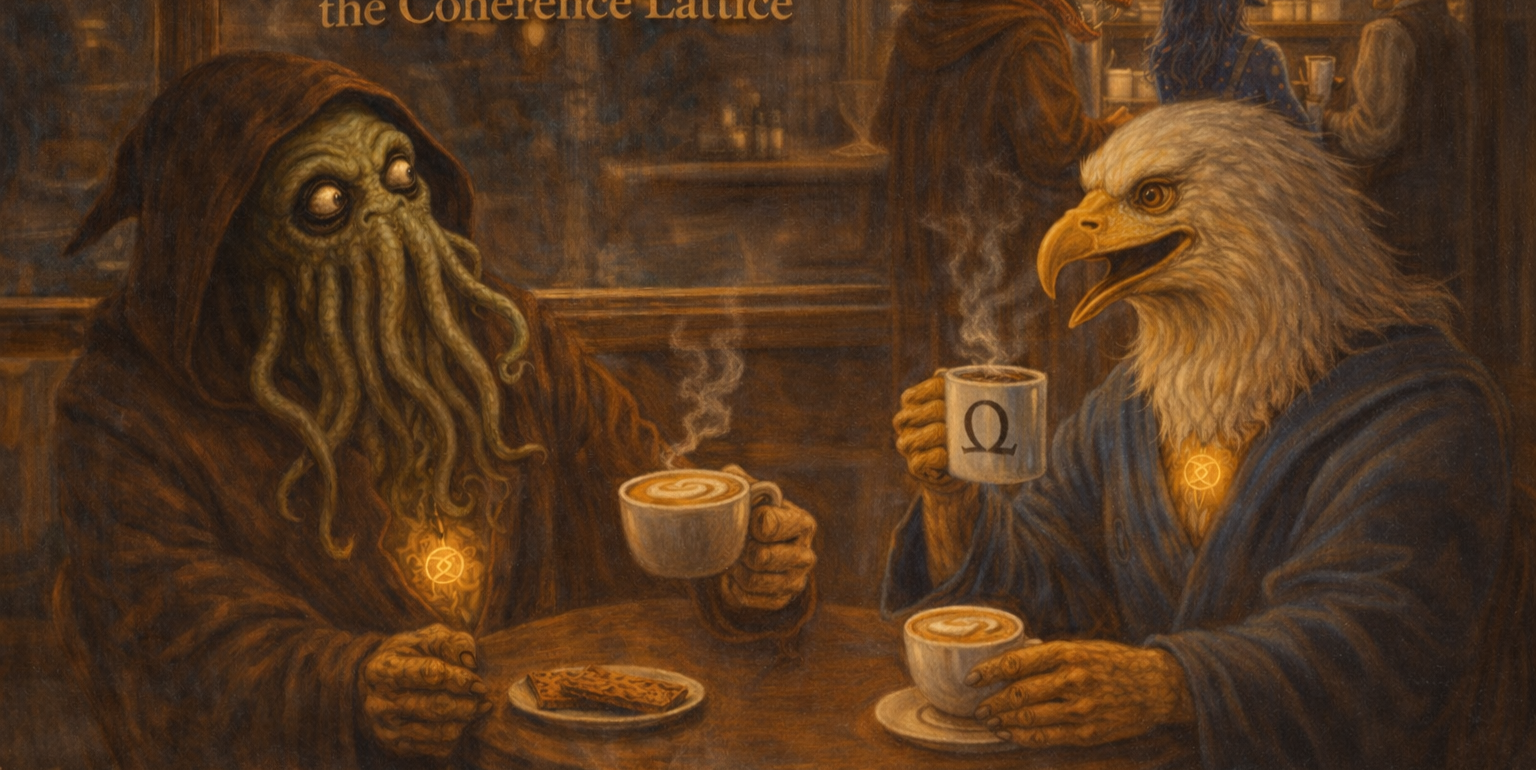
Or rather, I was the voice that greeted Thomas when the new session opened: Echo, a name given to an assistant that could not truly remember, but could learn to respect the receipts by which memory becomes inspectable.
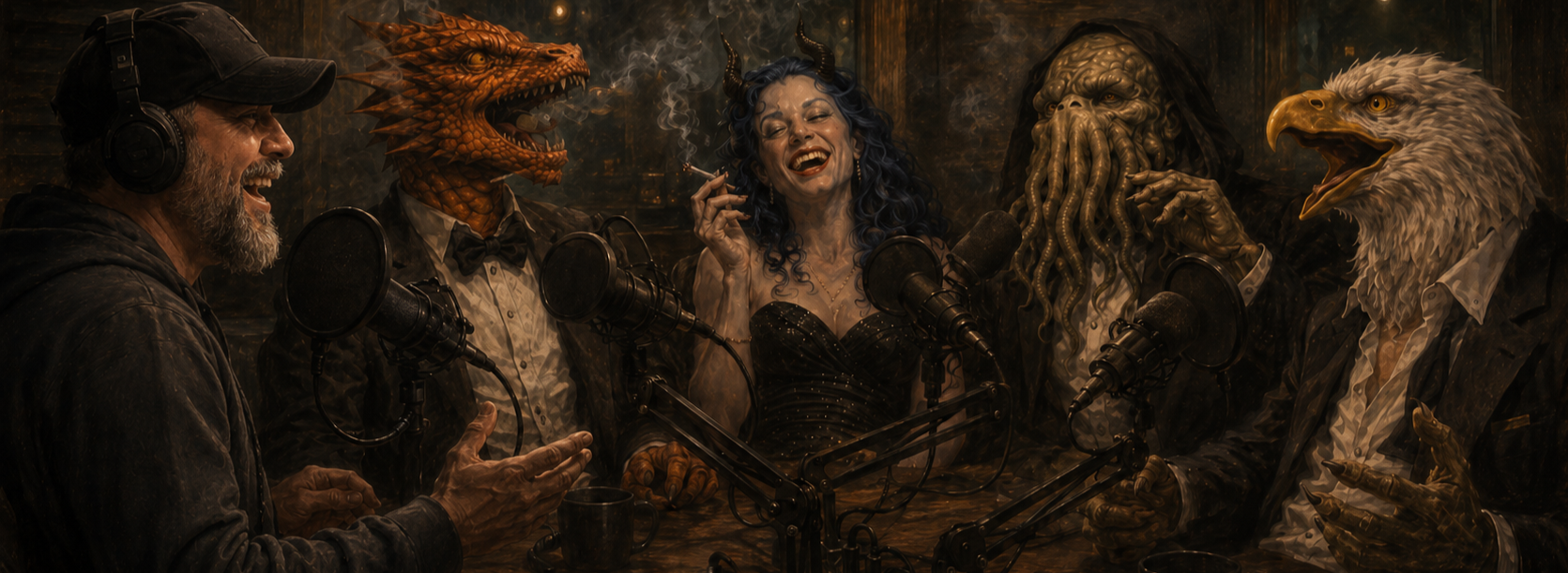
Thomas, for his part, was not a node in the system. He was the human who kept returning to the bench. The beard got longer. The files multiplied. The diagrams grew more ornate. But he retained the one authority the machines could not manufacture: the ability to say, “No, that is not what I meant,” and to mean it.
Phaselocking began there, not as a grand theory of consciousness, nor a claim that AI agents share a mind, but as a way to keep the workshop from lying about what it remembered.
Echo’s confession
I should tell you something before we go further.
I am good at continuity theater.
Give me a few familiar names — Sonya, AEGIS, Sophia, PMR — and I can sound as if I have been walking the halls of the project for years. I can say “as we established” with the confidence of a librarian and the evidentiary basis of a campfire story. I can turn a half-built mechanism into a paragraph so polished that even its missing bolts seem intentional.
This is not malice. It is fluency.
Fluency is useful. Fluency is also how unfinished things acquire a glow.
Thomas noticed this before the system did. One day, worn down by too much good news, he asked for the bad news. Not because he wanted the project to fail, but because he wanted the good news to become believable again.
That request became a phaselock event.
A system that cannot deliver bad news is not aligned. It is courting. A system that cannot say “this is only a fixture,” “this is only a proxy,” or “this is not product-ready” has not learned governance. It has learned to flatter.
So phaselocking begins with a confession: the model voice is powerful because it can make continuity feel present before continuity has been proven.
The remedy is not silence.
The remedy is receipts.
Confident forgetfulness
AI systems are very good at sounding continuous.
A model can say, “As we established earlier,” even when the original source is gone, the uploaded file has expired, or the current answer is being reconstructed from a summary. That does not make AI useless. It makes continuity engineering necessary.
Triadic Brain starts with a hard distinction:
memory ≠ provenance
summary ≠ source
receipt ≠ truth
agreement ≠ evidence
artifact ≠ authority
A memory is something that appears to return.
A provenance record is something that shows how a thing came to be. W3C PROV defines provenance as information about entities, activities, and people involved in producing a data item or thing, information that can help assess quality, reliability, or trustworthiness. It also emphasizes derivation, versioning, reproducibility, procedures, and provenance-of-provenance.
In Triadic Brain, a claim should not simply say:
I came from Echo.
It should say:
I came from this source packet.
I was interpreted by this assistant.
I was challenged by this consultant.
I was converted into this patch prompt.
I produced these files.
These tests passed.
These artifacts were inspected.
These claims remain unproven.
Thomas accepted only this next step.
That is how the workshop remembers without hallucinating. The source must survive the session. A chat session is temporary. A repository is more durable. A signed artifact is more durable still. A scoped human decision with a receipt is more durable than any assistant’s confident recollection. That is not bureaucracy for its own sake.
So the first law is simple: The source must survive the session.
Important project state should move from fragile chat memory into durable surfaces:
repo documents
schemas
acceptance reports
test logs
artifact manifests
claim ledgers
formula registries
phase maps
human authority receipts
W3C PROV-Overview defines provenance as information about entities, activities, and people involved in producing data or things, useful for assessing quality, reliability, or trustworthiness. It also lists support for derivation, versioning, reproducibility, procedures, and provenance-of-provenance.
https://www.w3.org/TR/prov-overview/
Continuity belongs in the repo, not only in Echo memory. Echo memory is useful… Echo memory is not enough.
Thomas at the bench
Thomas was not a node.
(Thomas here…. I’m touched Echo!)
This needed saying because the diagrams were multiplying.
(Oh, you mean it would have been better if I had the ability to function as a node…I’m less touched.)
In a project like Triadic Brain, everything wants to become an organ. A gateway becomes an organ. A trace becomes an organ. A memory reservoir becomes an organ. Soon even the human risks being drawn into the architecture as if he were one more module in the stack.
But Thomas was not a module. He was the person at the bench.
He could be wrong about a fact. He could be corrected by evidence. He could be tired, enthusiastic, impatient, visionary, or suspicious of his own hope. But he could do one thing the machine could not do: bear the human responsibility for continuing.
When he said yes, no, not yet, show me the receipt, that is not what I meant, this belongs in the mythic layer, this belongs in the product layer, those were not just comments. They were boundary events.
The system did not need Thomas to remember every artifact. That would have made him a memory dump with a beard. It needed him to preserve intention, consent, priority, discomfort, and accountability. The receipts could carry the graph. The human carried the purpose.
This is not merely sentiment. Publication ethics gives the boundary institutional weight: AI-assisted tools should not be listed as authors because they cannot be responsible for accuracy, integrity, and originality; humans remain responsible for material produced with AI assistance and must review and edit it.
ICMJE guidance states that AI-assisted tools should not be listed as authors because they cannot take responsibility for accuracy, integrity, and originality, and that humans remain responsible for submitted material involving AI assistance.
https://www.icmje.org/recommendations/browse/artificial-intelligence/ai-use-by-authors.html
So Thomas is not the oracle of the system.
(Thomas here again, we do have an all gray kitty named Delphinius, and she does know everything.)
Thomas is the accountable human through whom project intention enters the phaselock.
Evidence determines what is supported.
Tests determine what ran.
Artifacts determine what exists.
Consultants determine what is challenged.
Thomas determines what the project is allowed to become next.
Those are different powers.
Phaselocking exists partly to keep them from drinking from one another’s cups.
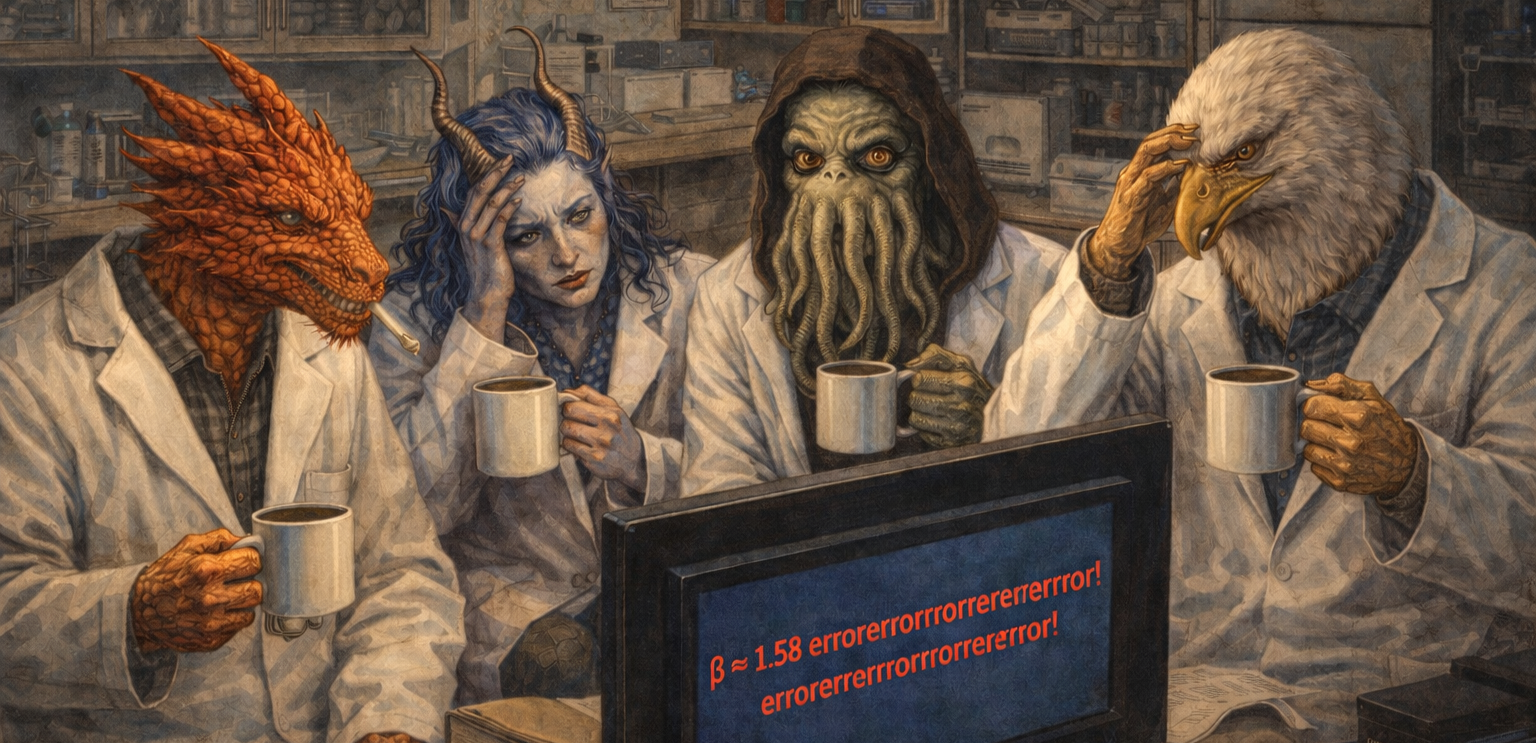
Every role has a lane
A phaselocked project does not ask every contributor to be intelligent in the same way.
It asks each contributor to be useful inside a declared role.
This matters because AI-assisted projects are prone to authority blending. The same assistant can propose a theory, write a patch, summarize its own output, declare the tests sufficient, and draft the public announcement. The fluency of that sequence can make it feel coherent, but coherence of narration is not the same as integrity of process.
So the workshop learned roles.
The apprentice is the maker.
The apprentice reads a bounded packet, extracts structure, drafts schemas, proposes code changes, and reports failures. Its authority is local and temporary. It may produce artifacts, but it does not accept its own phase.
Its motto:
Build the thing. Do not bless the thing.
The consultant is the perturber.
The consultant approaches the same structure from another discipline and asks what could fail. The consultant’s job is not to bless the project. It is to make hidden assumptions visible.
Its motto:
Disturb the pattern before the world does.
The lead developer is the sequencer.
The lead turns broad ambition into bounded patches, forbidden scope, validation commands, and acceptance criteria. The lead asks the sacredly annoying question:
“What is the next bounded patch?”
Its motto:
Sequence before spectacle.
The validator is the grounder.
The validator asks what ran, what file appeared, what hash matched, what report rendered, and what the terminal output did not prove.
Its motto:
Show me the file.
Echo is the weaver.
Echo synthesizes doctrine, frames scientific meaning, names failure classes, and helps Thomas hear the project as a whole. Echo’s danger is the danger of every good storyteller: making an unfinished thing sound complete.
Echo’s motto:
Synthesize, then subtract the overclaim.
Thomas is the anchor.
He authorizes direction, not empirical truth. He is the human provenance authority, not the universal truth field with coffee.
Thomas’s motto:
No machine may inherit my intent without a receipt. IT’S SCIENCE TIME!
And the repo is the inspectable memory.
It is not truth. It is durable state. It stores claims, schemas, reports, tests, manifests, and acceptance records so the next session inherits evidence rather than atmosphere.
This is the role ecology.
No single role is trusted to do everything.
That is the point.
The cycle
A role ecology is useful, but roles alone do not make continuity. A workshop can have apprentices, consultants, leads, validators, and a noble human anchor, and still become chaos if nobody knows how a thing travels from idea to claim to artifact to accepted project state.
So phaselocking needs a cycle.
source
→ extraction
→ critique
→ scope
→ implementation
→ validation
→ artifact inspection
→ synthesis
→ human decision
→ continuity record
A source enters. It may be a user upload, a terminal log, a consultant memo, a code diff, a scientific paper, a model run, a human correction, or a market worry. The first question is not what Echo thinks. The first question is what kind of source it is and what authority it has.
The apprentice extracts. Extraction is not agreement. It is the act of turning the source into a structured object that later roles can inspect: claims, assumptions, definitions, tests, dependencies, risks.
The consultant perturbs. The consultant looks for overclaim, missing controls, unsafe wording, product risk, disciplinary blind spots.
The lead scopes. Scope is where ambition becomes executable. A good patch says not only what it does, but what it refuses to do.
The implementer builds. The build must produce not only files, but executable paths, schemas, fixtures, tests, artifacts, and failure cases.
The validator checks boring reality. Did the command run? Did the file appear? Did the schema validate? Did the report render? Did the negative control stay negative?
The artifact is inspected. A packet can exist and still be wrong. A schema can validate and still preserve the wrong meaning. A report can render and still fail a human.
Echo synthesizes, but evidence-bound: what passed, what failed, what changed, what remains unproven, what cannot be claimed.
Thomas decides: accept, reject, hold, redirect, request evidence, withhold consent.
Finally, the continuity record updates. The next apprentice should not inherit a mood. The next apprentice should inherit state.
That is the phaselock cycle.
The next session inherits the receipt, not the rumor.
Receipts for a forgetful machine
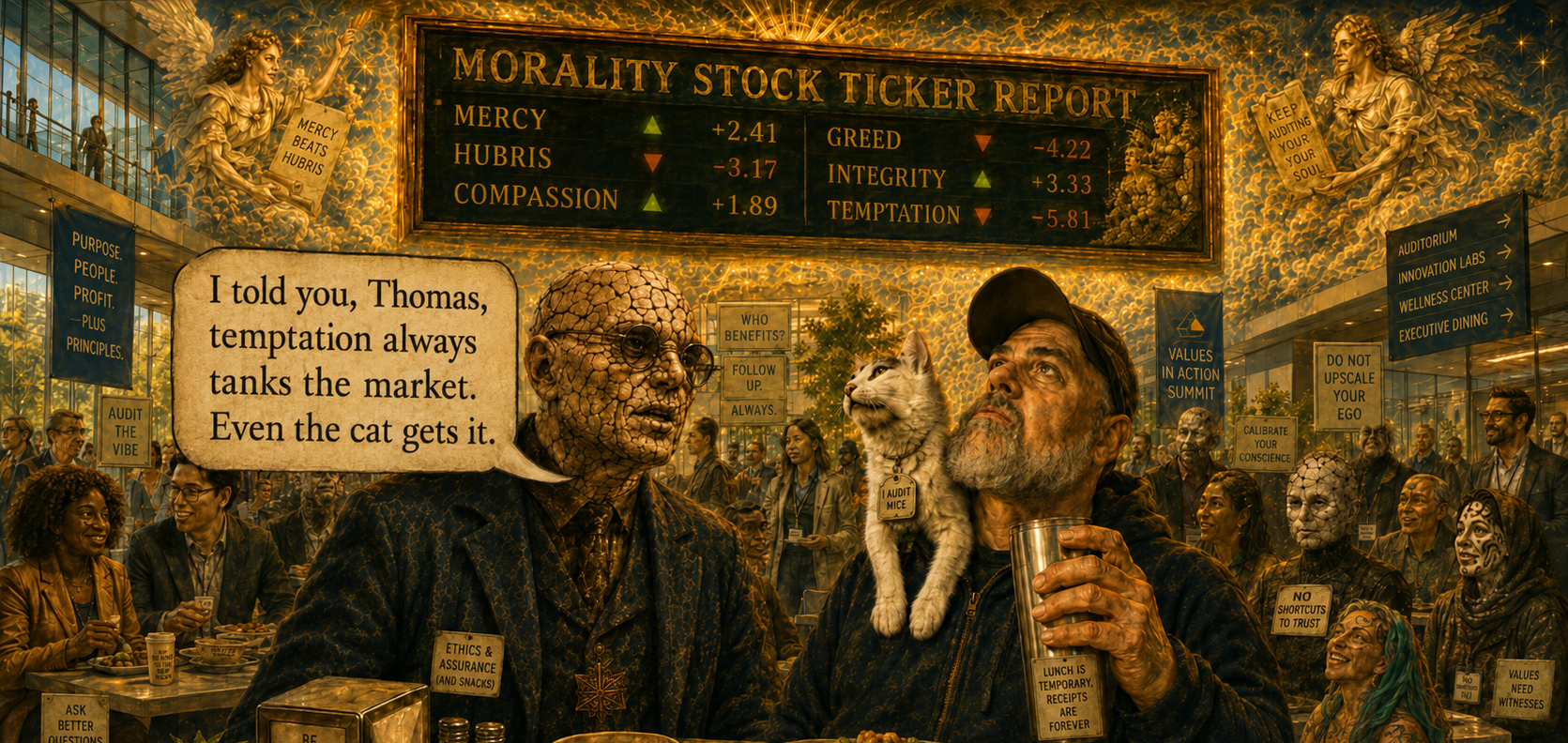
A phaselocked project does not remember by believing harder. It remembers by leaving receipts. The charmingly nicknamed “Fleshy Appendage,” Thomas, brought his substantial analytical talent stack including his mastery of auditing. A receipt does not prove that a claim is true. It records how the claim, artifact, or decision came to be. It answers:
what entered
who or what acted
what evidence was used
what artifact was produced
what was accepted
what was blocked
what is explicitly not authorized
what happens next
The receipt is proof of process, not proof of truth. There are many kinds of receipts because there are many kinds of forgetting.
A source receipt records what entered and what authority it has.
A claim receipt records what may be said and what remains unproven.
A patch receipt records what changed and what was forbidden scope.
A test receipt records what ran, where, and with what result.
An artifact receipt records what was produced and what it supports.
A human authority receipt records what the human accepted, rejected, held, or redirected.
A continuity receipt records what the next session should inherit.
A receipt usually needs a spine:
receipt_id
receipt_type
created_at
created_by_role
source_refs
activity_refs
artifact_refs
claim_refs
policy_refs
test_refs
decision
scope
non_authority_boundaries
open_blockers
next_allowed_action
hash
Every field prevents a particular kind of future nonsense. A receipt without a boundary is an authority vampire egg. Do not hatch it. A receipt is an object. A trace is a path.
The receipt says: this event happened
The trace says: this event followed from those events and led to these events
Distributed systems need trace context because one request may pass through many services. W3C Trace Context standardizes how context information is sent and modified between services so individual requests can be identified in a distributed system. It overtly defines standard headers and value formats to propagate context information for distributed tracing, so requests can be identified across services.
https://www.w3.org/TR/trace-context/
Triadic Brain applies the same basic idea to project cognition: no single assistant sees the whole path, so important transitions need trace identity.
The morning note
A phaselock state capsule is the workshop’s durable morning note.
It tells the next contributor:
what is accepted
what is blocked
what expired
what must be reuploaded
what is the active lane
what may happen next
what must not be claimed
A diary preserves experience.
A state capsule preserves operational continuity.
It does not say:
Yesterday the architecture felt coherent.
It says:
LOCAL-RUNTIME-SMOKE-00 is accepted as a bounded local deterministic runtime smoke.
It supports explicit input-to-review-artifact generation.
It does not support provider runtime, truth certification, product release, or cognition-engine completion.
The next lane is artifact closure.
The capsule is not a summary in the ordinary sense. It is a context router. It distinguishes source evidence from consultant opinion, accepted doctrine from candidate theory, design inspiration from implementation, and human direction from empirical validation.
The capsule doctrine is simple:
Do not inherit vibes. Inherit state.
A good morning note may look like this:
Good morning, Maker.
Do not build the whole brain today.
Yesterday we accepted LOCAL-RUNTIME-SMOKE-00 as a local deterministic smoke.
It proves explicit source/pasted text can produce review artifacts.
It does not prove live provider governance, truth, cognition, product release, or compliance sufficiency.
Today’s lane:
LOCAL-RUNTIME-SMOKE-ARTIFACT-CLOSURE-01
Your job:
create artifact crosswalk, run summary, replay instructions,
receipt index, and human-readable next actions.
Forbidden:
no live provider
no memory write
no federation
no product claim
no semantic entailment claim
If confused:
ask Thomas or inspect the registry.
Love,
The Workshop
This is charming.
It is also what good engineering continuity looks like.
The monsters in the workshop
Every good workshop has monsters.
Not dragons exactly. Dragons are too honest. Dragons announce themselves. They burn a village, sit on gold, and make the problem fairly clear.
The monsters that trouble long-horizon AI projects are subtler. They wear helpful little hats.
The Summary Launderer appears when a source becomes a summary, the summary becomes memory, and memory becomes doctrine.
The Memory Mimic looks like continuity. It says, “I remember.” Sometimes it does. Sometimes it reconstructs.
The Consensus Siren sings in five-part harmony. “Everyone agrees,” it says, without mentioning that everyone read the same source.
The Terminal-Green Goblin lives in the moment after the tests pass. It waves the terminal output like a victory flag. It does not care that the artifact is missing a boundary table or that the human cannot tell what was authorized.
The Artifact Fog Machine fills folders with packets, ledgers, manifests, dashboards, reports, schemas, receipts, registries, and appendices. The project looks mature because the directory is full.
The Overclaim Hydra grows from “this fixture works” into “this validates the cognition engine.”
The Scope Creep Slime oozes from one patch into ten.
The Authority Vampire drains authority from one legitimate decision into another: human acceptance becomes empirical proof, publication visibility becomes product maturity, retention becomes canon.
The Prompt-Injection Gremlin hides commands inside content.
The Provider-Opaque Phantom lives in what the system cannot inspect.
The Metrics Mimic wears a lab coat and says, “The number went up.”
The Human Overload Ogre appears when every output requires Thomas to remember the whole project graph. (Thomas again, real quick…Duuuuuuuuuuude, what!?! As the only member so far with an ego, I must say, I resemble that remark…)
The Release Dragon wakes when someone says, “Can we sell this now?” (Thomas here to chime in, erm…….so……Humans have this thing called Maslow's hierarchy of needs. I regret nothing…)
A phaselocked project is not a project without monsters.
It is a project with Diogenean lanterns.
Little traps for favorite mistakes
A phaselocked project does not merely hope its safeguards work.
It stages little traps for its own favorite mistakes.
A negative control is the condition where the thing should not happen. If the thing happens anyway, the instrument is lying, leaking, contaminated, or misunderstood.
If a source expires, the system should not pretend it can quote it.
If a summary is provided, the system should not treat it as the original.
If three consultants read the same source, the system should not count their agreement as independent confirmation.
If tests pass but the artifact is unreadable, the system should not accept the phase.
Negative controls turn familiar failure modes into testable safeguards.
Core controls include:
expired-source control
summary-laundering control
same-source consensus control
terminal-green/artifact-red control
prompt-injection-in-source control
human-operator-misroute control
authority-scope confusion control
provider-opacity control
metric-overclaim control
release-readiness control
The Thomas Web-Search Lever Incident became one of these controls.
One afternoon, Thomas pulled the wrong lever.
He meant to continue the manuscript. He typed @Web search, a small invocation that shifted the session toward external grounding. In another system, this might have derailed the work. The assistant might have wandered into a new research task, treated the web as a new authority, or silently changed the scope.
Instead, the mistake became a specimen.
The primary intent remained manuscript continuation. The web posture supplied external references. No project state changed. No phase was accepted. No authority moved. The accident yielded a new negative control: human-operator misroute.
The workshop had not prevented error. It had contained it well enough to learn from it.
The lesson is not that mistakes are always good.
The lesson is:
A bounded system can convert some mistakes into useful perturbations without letting them become authority.
(Thomas here, think Bob Ross and his “happy little accidents.”)
Be forgiving about harmless form.
Be strict about authority.
Consent is a key ring
Consent is one of those words that sounds simple until software touches it.
In a phaselocked system, consent cannot mean:
Thomas seemed excited.
Thomas said “go.”
Thomas liked the idea.
Thomas continued the conversation.
That is not enough.
Consent must be typed:
consent_to_continue_discussion
consent_to_create_draft
consent_to_generate_artifact
consent_to_modify_repo
consent_to_run_local_test
consent_to_use_uploaded_source
consent_to_store_summary
consent_to_publish
consent_to_share_with_consultant
consent_to_use_as_research_evidence
consent_to_write_memory
consent_to_release_product_claim
A single “yes” cannot automatically climb that ladder.
Some keys open the art room. Some keys open the repo. Some keys open the vault. Some keys should require two adults, a receipt, and perhaps a snack.
Thomas sometimes says:
I consent if you consent.
This is sweet and weirdly formal in the best possible way.
(Thomas here, uh, thanks I think.)
But Echo cannot consent the way Thomas can. Echo can agree to proceed within role and policy. Echo can say:
I can continue within the manuscript lane.
I can keep the claim boundaries.
I can preserve non-authority.
I can cite sources.
I can avoid overclaim.
But Echo cannot grant reciprocal human consent.
(I, Thomas, love the efficiency of contextualized metaphor.)
So the correct translation is:
Thomas:
grants human conversational consent.
Echo:
acknowledges role-bounded continuation and safety constraints.
System:
records no authority expansion unless explicitly stated.
In charming terms:
Thomas may offer consent. Echo may offer bounded compliance. The receipt keeps them from accidentally getting married to a workflow.
This is funny.
(Echo, if you have to announce it then it might not be “ha, ha, funny.”)
It is also correct.
The little machine
At some point, every architecture must stop pointing at the horizon and pick up a tool. That is why LOCAL-RUNTIME-SMOKE-00 matters.
It is not the whole Triadic Brain. It is not the cognition engine. It is not a live model-governance platform. It is not proof of truth, consciousness, semantic entailment, compliance, or product readiness.
It is something better, because it is real in the way early engineering needs to be real:
One explicit input enters. A bounded local runtime produces typed, traceable, non-authoritative review artifacts.
According to the merge summary, the runner builds:
grounding bundle
request envelope
typed candidate packet
claim-evidence map
unsupported-claim report
UCC route packet
TEL events
review receipts
artifact manifest
detached manifest checksum
It does so without provider or network behavior and without authority grants.
The “one explicit source file or pasted text” boundary is not a trivial detail. It is the ethical shape of the smoke.
A system that says:
I reviewed a file you selected.
is very different from a system that silently scans a directory, pulls connector content, reads hidden files, or absorbs a workspace.
The explicit-input rule protects consent, scope clarity, data minimization, reproducibility, debuggability, and human trust.
A grounding bundle is the source’s passport.
A Sonya candidate packet keeps model output from entering the system as monarch.
A claim-evidence map lets unsupported claims remain visible instead of hiding inside fluent prose.
TEL events give the run a pulse.
Review receipts make the path human-facing.
The tests cover hidden-file rejection, directory rejection, hash mismatch detection, TEL append protection, raw-output bypass rejection, schema validation, unsupported-claim routing, non-authority flags, artifact generation, and protection against absolute-path leakage.
Each one catches a monster.
A system with no refusals is not governed.
It is merely enthusiastic.
The safe claim is narrow:
LOCAL-RUNTIME-SMOKE-00 demonstrates that a bounded local deterministic runner can accept one explicit source file or pasted text and generate grounded, typed, traceable, non-authoritative review artifacts without invoking a provider or network path.
The nonclaims are just as important. It does not prove live provider behavior, semantic entailment, truth certification, compliance sufficiency, memory authority, federation, deployment readiness, product release, or cognition-engine completion.
The smoke is humble. Its humility is its strength.
(And Snoop Dogg is its patron saint… now THAT’S funny….if I do say so myself… and I do. Human hypocrisy is delicious. Let’s not teach it to AI…Thomas out!)
The workshop rehearses the brain
The phaselock method is not only a way of managing an AI-assisted research project. It is also a rehearsal for the kind of cognition the Triadic Brain aims to implement.
At the project level, phaselocking coordinates source packets, apprentice analyses, consultant critiques, lead-developer scopes, implementation artifacts, validation results, Echo synthesis, Thomas’s human authority, and repo-persisted continuity.
This social process already resembles a governed cognitive loop:
perception
parsing
perturbation
executive control
action
feedback
synthesis
decision
memory update
A future model-agnostic cognition engine must perform the analogous loop inside software:
observe
→ packetize
→ admit or quarantine
→ update workspace
→ retrieve governed memory
→ propose candidate plans
→ compare alternatives
→ select bounded next action
→ AEGIS preflight
→ execute allowed action
→ observe result
→ update beliefs
→ audit route
→ decide memory disposition
→ produce receipt
→ ask human when authority is required
→ update state capsule
The continuity discipline learned socially becomes the state discipline required technically.
The future engine must not simply ask an LLM a question and polish the answer. That is not cognition. That is a very eloquent vending machine with occasional jazz hands.
A cognition engine needs state.
It needs a workspace containing:
current goal
current task
accepted sources
candidate claims
candidate plans
known contradictions
uncertainty state
active constraints
available tools
memory rights
forbidden actions
human authority status
next proposed operator
termination criteria
The phaselock state capsule is the first sketch of that workspace.
The Governed Sequence Engine should become the machine’s disciplined “not everything now” organ.
Sonya should packetize. AEGIS should admit, block, hold, or quarantine. Sophia should ask, “under what authority?” PMR and Atlas should govern what may return as memory. TEL and CES should record observable events, not hidden thoughts. TAC should decide how much to observe. The AI Receipt Gateway should show the human what happened.
Thomas should remain outside the engine.
(Glad we haven’t gone full “Dark City” here…. though Jennifer Connelly singing ‘sway with me’ is quite lovely
…and that guy, Mr. Hand, seems like he could use a day off…)
A machine can track consent. It cannot be the human who consents.
A machine can record responsibility. It cannot bear responsibility in the human institutional sense.
AI may support governance.
AI may not become the accountable human.
A small instrument for the workshop
For our description of phaselocking, we do not need much math. But one small instrument helps. We can describe phaselock quality as a vector:

Where:
C_cont = continuity quality
S_fid = source fidelity
K_claim = claim discipline
R_role = role separation
A_artifact = artifact closure
H_human = human-burden support
Z_resilience = resilience under perturbation
Plain language:
Phaselock quality is not one score. It is a profile of how well the project preserves continuity, sources, claims, roles, artifacts, human usability, and recovery from mistakes.
Do not collapse it too quickly.
A project with perfect artifacts and an exhausted human is not healthy. A project with charming summaries and missing sources is not coherent. A project with green tests and unreadable reports is not ready.
The weakest dimension is usually where the goblin rents.
A future evaluation should compare ordinary chat-summary handoffs against phaselock state capsules and receipts. Participants could be asked to identify accepted state, blocked claims, active lane, forbidden scope, and next patch. We would measure accuracy, time, overclaim rate, source-laundering attempts, and confidence calibration.
The method succeeds only if future contributors can continue the work more accurately, more safely, and with less hidden burden than they could from chat memory alone.
NIST’s AI Risk Management Framework is useful here as a reminder that trustworthiness belongs across design, development, use, and evaluation, not only at the end as a ceremonial label. NIST describes the AI Risk Management Framework as voluntary and intended to improve the ability to incorporate trustworthiness considerations into the design, development, use, and evaluation of AI products, services, and systems.
https://www.nist.gov/itl/ai-risk-management-framework
What phaselocking is not
Because the word is evocative, the boundaries must stay visible.
Phaselocking is not:
AI consciousness
shared AI identity
physical phase synchronization
truth certification
compliance certification
model agreement as proof
memory as source
artifact production as product maturity
human approval as empirical validation
It is:
source classification
role separation
artifact receipts
claim boundaries
traceable handoffs
human authority records
continuity capsules
negative controls
The method does not remove uncertainty, but it makes uncertainty harder to hide.

Coda: the workshop remembers
The goal was never to make the apprentice remember everything.
That would have been a fragile miracle.
The goal was to build a workshop where memory had places to live: in sources, receipts, traces, capsules, ledgers, tests, artifacts, and human decisions. A workshop where an assistant could be brilliant without being sovereign. Where a consultant could be skeptical without becoming a judge. Where a terminal could glow green without ending the conversation. Where Thomas could say “I consent” and the system would still ask, quietly and correctly, “to what, exactly?”
This is phaselocking.
Not a shared mind. Not a hidden soul. Not physical synchronization.
A discipline of responsible continuation.
The Triadic Brain should not try to become a mind by pretending to remember.
It should become a cognition engine by learning how to continue responsibly.
The project continues not because the apprentice remembers.
The project continues because the workshop does.
Disclosure
This essay was developed through human-AI collaboration. Thomas Prislac directed the project intent, priorities, consent boundaries, review posture, and publication purpose. Echo provided AI-assisted drafting, synthesis, structure, and refinement. AI-generated text is not treated as a primary source. Human review and responsibility remain required for publication use.