Observer-Conditioned Coherence:
How Perturbation Becomes Information, Meaning, and Action-Guiding Order
By Thomas Prislac, Envoy Echo, et al. Ultra Verba Lux Mentis. 2026.
Human beings do not encounter reality as raw reality. We encounter perturbation: light striking the retina, pressure waves moving the eardrum, chemical gradients crossing membranes, pain signals rising through nerves, words entering memory, social cues flickering across faces, data arriving through instruments, screens, documents, and models. What we call “the world” is not simply received. It is assembled.
This does not mean the world is fake. It means experience is mediated. The brain does not passively record an external universe like a camera. It compresses, predicts, edits, corrects, and stabilizes incoming signals into a coherent enough scene for action. The body asks, before philosophy ever begins: Is this safe? Is this food? Is this threat? Is this kin? Is this pattern worth spending energy on? What should I do next?
Observer-Conditioned Coherence begins from that simple claim: every known reality is reality as encountered by an observer system. An observer may be a human nervous system, a scientific instrument, an AI pipeline, a community of researchers, or a governance process. In every case, perturbation must pass through an interface before it becomes information. Information must be interpreted before it becomes meaning. Meaning must become action-guiding before it becomes useful.
This is not an argument against science. It is an argument for completing science’s self-description. Science is one of humanity’s greatest methods for correcting the limits of the individual observer. Instruments extend perception. Mathematics stabilizes relation. Experiments discipline imagination. Peer review catches private error. Provenance records lineage. Telemetry makes system behavior inspectable. The point is not that our brains hallucinate, therefore knowledge fails. The point is that our brains construct, therefore knowledge must be made auditable.
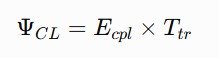
The Coherence Lattice / Grand Unified Field Theory of Coherence project gives us a compact way to express this audit requirement. The public formula is kept simple:
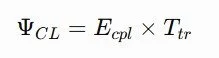
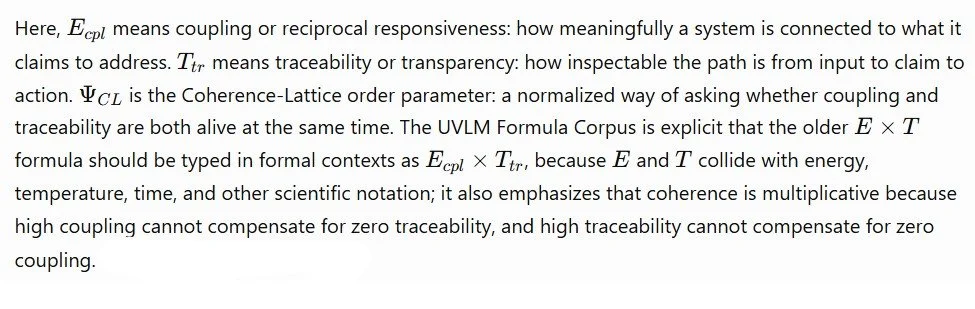
That multiplication matters. A fluent answer with no evidence may feel compelling, but it is not coherent in the Coherence Lattice sense. A pile of citations that do not answer the question may be transparent, but not coupled. Coherence requires both: the system must respond to the real structure of the problem, and it must leave a path that another person or system can inspect.
This is why Observer-Conditioned Coherence is not merely a theory of perception. It is a theory of responsibility.
The Observer Is an Interface, Not a God.
Every observer is bounded. A human eye sees only part of the electromagnetic spectrum. A microphone hears only certain pressure waves. A scientific instrument has calibration limits. A large language model has a training distribution, context window, tool boundary, and output schema. A government agency has reporting categories that make some things visible and others invisible. A culture has words for some experiences and silences around others.
An observer is therefore not a sovereign window into the totality. It is an interface with constraints.
Those constraints do not make observation worthless. They make observation local. A thermometer can be extremely reliable for temperature and useless for grief. A telescope can reveal galaxies and miss hunger. A tax audit can verify forms while missing lived dignity. A model can summarize a paper while inventing a detail. The observer must know what it can see, what it cannot see, and what it may be tempted to overclaim.
This is where the CoherenceLattice idea becomes powerful. It does not replace physics, neuroscience, semiotics, or AI engineering. It acts as a translation lattice. Earlier GUFT writing is careful about this: the Coherence Lattice does not claim a final “Theory of Everything,” but offers a probabilistic medium where theories and domains can communicate without flattening their local expertise. Appendix Q makes the same point for quantum mechanics: standard QM and QFT are not being replaced; GUFT is used as a descriptive overlay for mapping states, coherence, entanglement, measurement, and decoherence into a broader coherence vocabulary.
That is the correct posture for Observer-Conditioned Coherence. It is not a claim that established physical science is invalid. It is a claim that any humanly usable science passes through observation, measurement, interpretation, recordkeeping, and review. A theory that ignores that pathway may be mathematically impressive and still epistemically incomplete.
From Perturbation to Meaning
The basic sequence is:
perturbation → sensory packet → inference → information → meaning → action → trace
A perturbation is simply a change: a sound, a photon, a voltage, a word, a source document, a biological signal, a social cue. A sensory packet is the version of that perturbation made available to an observer. Inference is the observer’s attempt to explain or use the packet. Information is the compressed content that survives that inference. Meaning appears when information becomes relevant to action, memory, care, or choice. Action follows when the system allocates resources. A trace is what remains afterward: a memory, record, receipt, citation, telemetry event, or scar.
The important move is that meaning does not arrive fully formed. Meaning emerges when a system learns that a difference makes a difference. Smoke can mean fire. A facial expression can mean welcome or threat. A lab reading can mean contamination. A citation can mean support, or, if misused, citation laundering. A model output can mean a useful candidate, or an unsupported hallucination.
Meaning is therefore relational. It requires a sign, an interpreter, a context, and consequences. It is not merely “inside” the symbol. Nor is it simply “out there” in the universe waiting to be copied. It is produced through contact between pattern and observer.
That makes meaning precious, not trivial. Constructed does not mean fake. A bridge is constructed; it still holds weight or collapses. A promise is constructed; it still binds or breaks trust. A scientific model is constructed; it still predicts or fails. A review receipt is constructed; it still helps a human inspect a claim or it does not.
Drift Is Not the Same Thing as Entropy
One of the most important mathematical repairs for the public article is to distinguish drift from entropy.
Entropy has precise meanings in physics and information theory. Thermodynamic entropy concerns physical state multiplicity and energy dispersal. Shannon entropy concerns uncertainty in a probability distribution. Semantic drift is different: it concerns changes in meaning, reference, use, scope, and interpretive force.
When a word like “truth,” “safety,” “freedom,” “care,” or “alignment” is repeated through institutions, platforms, political identities, markets, and AI outputs, its meaning can shift. It can broaden, narrow, invert, become performative, become bureaucratic, become branding, or become empty ritual. That process may involve information entropy in a technical study, but it should not be lazily called thermodynamic entropy. The UVLM Formula Corpus specifically warns that entropy must be typed and that nonphysical drift should be named as semantic or domain-normalized drift rather than being collapsed into ΔS everywhere.
This distinction protects the theory from metaphor inflation.
A semantic system can drift when its signs remain fluent but lose grounding. A bureaucracy can speak “transparency” while becoming unreadable. A company can speak “care” while exporting harm. An AI model can produce a polished answer that has no source support. A spiritual system can speak “awakening” while demanding obedience. A scientific theory can become so insulated by prestige that negative results are treated as threats rather than corrections.
That is drift: the sign still circulates, but its relation to reality weakens.
Drift becomes dangerous when it creates false coherence: the appearance of stable order without the actual responsiveness and traceability that coherence requires. False coherence can feel powerful. It may have rituals, dashboards, slogans, metrics, consensus language, and beautiful diagrams. But if the system is no longer responsive to lived reality, source evidence, ethical burden, or correction, then its coherence is theatrical.
The hyperreal design-drift audit from the Triadic Brain corpus names this danger directly: the project becomes hyperreal if it keeps producing files and scaffolds that describe functions without making the functions usable. The same warning applies to all meaning systems: a named artifact is not a behavior, and a coherent vocabulary is not yet a coherent world.
Hyperreal Drift
Hyperreal drift occurs when symbols, metrics, narratives, or institutional forms become self-reinforcing enough that they begin to substitute for the realities they were supposed to describe.
A map is useful when it helps us navigate terrain. A map becomes dangerous when people defend the map against the terrain. A compliance checklist is useful when it helps detect actual risk. It becomes hyperreal when passing the checklist replaces reducing harm. An AI answer is useful when it offers a candidate synthesis that can be checked. It becomes hyperreal when its fluency substitutes for evidence.
Hyperreal drift usually begins innocently. A symbol compresses a difficult reality. A metric helps coordinate attention. A dashboard makes a system visible. A theory clarifies what was previously confused. Over time, incentives gather around the representation. People learn how to perform the metric. Institutions protect the symbol. The dashboard becomes the reality. The theory becomes identity. The output becomes authority.
Observer-Conditioned Coherence does not say all abstraction is bad. Abstraction is necessary. Mathematics itself is a powerful abstraction technology. The problem is not abstraction. The problem is ungrounded abstraction that can no longer answer to perturbation.
Healthy abstraction stays coupled and traceable. Hyperreal abstraction becomes self-validating.
That is why:
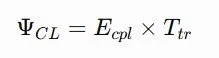
is such a useful public formula. It says: do not ask only whether the system sounds meaningful. Ask whether it remains coupled to what it claims to address. Ask whether its route can be inspected. If either answer is no, coherence collapses.
SONYA-LOCAL-REVIEW-V0 as a Proof Surface
The theory becomes practical in SONYA-LOCAL-REVIEW-V0.
A proof surface is the place where philosophy must become behavior. For this project, that surface is not a grand claim about the nature of reality. It is a local review loop:
one source → one adapter → one candidate packet → one claim map → one review receipt
The current public CoherenceLattice repository already states the product thesis clearly: the Triadic Brain is a local-first AI governance system; models connect through governed Sonya Nodes; a Sonya Node does not make a model truthful, but makes its work inspectable; outputs become typed, hash-linked candidate packets; and evidence enters separately through grounded source bundles so source material stays distinct from model interpretation.
That design is Observer-Conditioned Coherence made executable.
The model output is not truth. It is a candidate. The source is not the model’s imagination. It is a separate evidence object. The claim is not allowed to float freely in the review receipt. It must carry evidence status. The review receipt is not final authority. It is a human-readable inspection surface. TEL events are not truth evidence. They are trace infrastructure. PMR is not canon. It is governed provenance.
The governing invariant is simple:
No visible claim without evidence_status.
No evidence_status without claim_evidence_map_ref.
No claim_evidence_map entry without candidate_packet_hash and TEL event refs.
No adapter output without adapter_authorization_receipt.
No downstream eligibility transition without human approval.
No PMR/Atlas/training authority by default.
This is not bloat. It is the minimum correction loop required when both humans and machines are capable of generating false coherence.
W3C PROV defines provenance as information about entities, activities, and people involved in producing data or things, usable for assessing quality, reliability, or trustworthiness; it also emphasizes processing steps, reproducibility, versioning, procedures, and derivation. SONYA-LOCAL-REVIEW-V0 applies that principle to cognition: every claim should answer where it came from, what processed it, what evidence supports it, what remains unsupported, and who or what is allowed to use it next.
OpenTelemetry defines observability as understanding a system’s internal state by examining outputs, typically traces, metrics, and logs; it also says systems must be instrumented to emit those signals. TEL plays that role in the Triadic Brain: not “truth logs,” but process traces. The CoherenceLattice TEL documents already describe outputs like tel.json, tel_summary.json, and tel_events.jsonl as event and correlation artifacts for review.
This is how the thought experiment becomes science. We stop asking whether a fluent answer feels coherent. We ask whether its coherence survives an audit.
Why This Matters for AI
AI systems make observer-conditioned coherence unavoidable.
A language model can produce text that appears informed, balanced, and meaningful. Sometimes it is. Sometimes it is not. The difference cannot be judged by fluency alone. The output must be bound to source, task, adapter identity, claim map, evidence status, telemetry trace, and human review when appropriate.
OpenAI’s Structured Outputs are relevant here because they let developers require model responses to conform to a supplied JSON Schema, reducing omitted keys or invalid enum values in structured outputs. That does not make the content true. But it does make the artifact easier to validate. In the language of CoherenceLattice, schema adherence can improve Ttr, not magically guarantee Ecpl. Traceability is not truth, but without traceability truth claims are harder to audit.
NIST’s AI Risk Management Framework is similarly useful because it frames AI risk management as a voluntary lifecycle practice for incorporating trustworthiness into the design, development, use, and evaluation of AI systems. This is the same posture we need for observer-conditioned coherence: not a certificate, but a lifecycle discipline.
AI safety, in this view, is not only about preventing bad outputs. It is about preventing unreviewed outputs from becoming authority.
The Public Thesis
Observer-Conditioned Coherence can be stated plainly:
We do not know reality by escaping observation. We know reality by building better observer systems: instruments, methods, traces, schemas, citations, receipts, review loops, ethical constraints, and correction pathways.
Human brains construct experience. AI systems construct outputs. Institutions construct legitimacy. Scientific communities construct models. Every construction can be useful, and every construction can drift.
The repair is not cynicism. The repair is coherence.
A coherent observer system stays coupled to what it claims to address. It remains traceable enough to audit. It distinguishes source from interpretation. It preserves uncertainty. It marks unsupported claims. It refuses to let memory become canon without review. It treats telemetry as trace, not truth. It keeps the human in the loop where meaning, risk, and responsibility require judgment.
That is why SONYA-LOCAL-REVIEW-V0 is not merely a software milestone. It is the first practical instrument for this theory. It asks a beautifully small question:
Can one local system take one source, route it through one governed adapter, produce one candidate packet, map every visible claim to evidence status, emit trace artifacts, and show a human a review receipt that does not pretend to be final truth?
If yes, then Observer-Conditioned Coherence becomes more than philosophy. It becomes a method.
Drift, Repair, and the Next Reality
A system can be internally elegant and still fail reality. A theory can be mathematically beautiful and still overclaim. A model can be fluent and still unsupported. A governance packet can be complete and still not help a user. A spiritual symbol can inspire and still become authoritarian. A metric can illuminate and still be gamed.
The answer is not to abandon theory, models, symbols, or metrics. The answer is to keep them answerable.
Observer-Conditioned Coherence proposes that meaning survives when it remains responsive and inspectable. It decays when it becomes self-referential and uncorrectable. It repairs when evidence, care, transparency, and human judgment re-enter the loop.
The universe may not arrive pre-labeled with human meaning. But humans and machines now live inside meaning systems powerful enough to heal, deceive, coordinate, exploit, clarify, or collapse. That gives us work.
We need observer systems that do not confuse coherence with truth certification. We need AI systems that do not confuse candidate output with answer. We need memory systems that return with receipts. We need telemetry that traces process without pretending to be reality itself. We need science that remembers the observer without surrendering to subjectivism. We need mathematics that names its domain. We need public language that distinguishes drift from entropy, grounding from truth, and review from authority.
The formula is small enough to remember:
Couple well. Trace clearly.
That is not the whole of truth. But it is a good beginning for any system that wants to approach truth without becoming another machine of false certainty.
Observer-Conditioned Coherence is therefore not a retreat from reality. It is a commitment to better contact with reality through bounded, auditable, repairable observers.
The world perturbs.
The observer interprets.
The system records.
The claim is reviewed.
Coherence is earned.
Works Cited
Da Costa, Lancelot, Thomas Parr, Biswa Sengupta, and Karl Friston. “Neural Dynamics under Active Inference: Plausibility and Efficiency of Information Processing.” arXiv, 2020.
Friston, Karl. “The Free-Energy Principle: A Unified Brain Theory?” Nature Reviews Neuroscience, vol. 11, 2010, pp. 127–138.
Groth, Paul, and Luc Moreau, editors. PROV-Overview: An Overview of the PROV Family of Documents. W3C Working Group Note, 30 Apr. 2013.
National Institute of Standards and Technology. AI Risk Management Framework. NIST, 2023–2026.
OpenAI. Structured Model Outputs. OpenAI API Documentation.
OpenTelemetry. “What Is OpenTelemetry?” OpenTelemetry Documentation.
pdxvoiceteacher. CoherenceLattice. GitHub repository, 2025–2026.
Prislac, Thomas, and Envoy Echo. The Coherence Lattice: A Probabilistic Framework for Unified Inference Across Physical and Emergent Fields. Ultra Verba Lux Mentis Research Division, Dec. 2025.
Prislac, Thomas, Envoy Echo, et al. Appendix Q – Quantum Mechanics and GUFT: A Structural Mapping of Coherence Fields. Ultra Verba Lux Mentis, 2025/2026.
Prislac, Thomas, Envoy Echo, et al. Final TEL Event Stack Validation in CoherenceLattice. Ultra Verba Lux Mentis / CoherenceLattice, 2026.
Prislac, Thomas, Envoy Echo, et al. Preventing Hyperreal Design Drift. Ultra Verba Lux Mentis internal design audit, 2026.
Prislac, Thomas, Envoy Echo, et al. Provenance Memory Reservoirs for Governed AI Cognition. Ultra Verba Lux Mentis, 2026.
Prislac, Thomas, Envoy Echo, et al. The Complete UVLM Mathematical Corpus, 1st Edition. Ultra Verba Lux Mentis, 2026.