Care Is Infrastructure, Not Sentiment
Kindness can animate a humane society. It cannot carry one alone. Care becomes a public virtue only when we build it into rights, budgets, staffing, accessibility, maintenance, and accountability.
By Thomas Prislac, with editorial collaboration from Envoy Echo. Ultra Verba Lux Mentis. 2026.
Reader-supported public-interest work
Help keep careful research open.
Ultra Verba Lux Mentis is a nonprofit research organization. Voluntary gifts help fund open research, independent review, accessibility, public education, documentation, and practical public-interest tools.
This article and UVLM’s public materials remain available whether or not you donate.
Opens the UVLM donation page in a new tab. Giving is always optional.
Kindness matters. Alas, it also tends to make a terrible operating system.
A neighbor carries groceries upstairs. A nurse sits five minutes longer beside a frightened patient. A manager rearranges a shift. A congregation opens its doors after a storm. A daughter drives through the night because her father has fallen.
These acts possess a radiance that bureaucracy never will. They reveal the human capacity to notice need and answer it without waiting for a command.
We should honor them. Black coffee all around!
We should never design a society that requires them to function well.
A humane society cannot guarantee childcare by hoping that grandparents remain healthy. It cannot provide eldercare by assuming daughters will absorb another unpaid shift. It cannot build disaster relief around strangers arriving with trucks, public health around heroic clinicians, or workplace dignity around the chance that a sympathetic supervisor will make an exception.
Care needs arrive predictably even when their exact timing does not. Children arrive. Bodies age. Workers become ill. Disabilities require accommodation. Heat waves intensify. Storms break ordinary routines. Families change. Institutions either prepare for those needs or transfer the cost of preparation to households, workers, volunteers, and whoever possesses the least power to refuse.
That distinction separates care as sentiment from care as infrastructure.
Sentiment asks whether somebody feels concern.
Infrastructure asks whether food arrives, whether the clinic opens, whether the caregiver gets relief, whether the wheelchair fits through the door, whether the worker can stay home with influenza without losing rent money, and whether the heat warning reaches the person in an unair-conditioned room before the temperature becomes lethal.
The first question concerns virtue. The second concerns civilization.

Care becomes infrastructure when help arrives by design rather than by luck.
Every society pays the care bill
Care scholars have long described care as something larger than tenderness between individuals. Berenice Fisher and Joan Tronto framed it as the practical activity through which people sustain and repair the world that supports life. Mary Daly and Jane Lewis placed social care at the intersection of family, state, market, and voluntary provision. Nancy Fraser sharpened the political economy beneath those arrangements: economies depend on people raising children, maintaining homes, restoring sick bodies, and sustaining communities, even while economic institutions routinely deplete the time and labor that make those activities possible.
Production depends on social reproduction while often refusing to pay its bill.
The bill does not disappear.
It enters the body.
It returns as a lost shift, a sleepless night, a foregone promotion, a back injury, a delayed medical visit, or the slow financial erosion of the relative who becomes the family’s default caregiver. It appears when one sibling quietly becomes responsible for an aging parent, when a worker loses wages because a childcare center closes, or when a person who lives alone discovers that the phrase family responsibility means having no responsible institution at all.
The International Labour Organization estimated that 748 million people remained outside the global labor force in 2023 because of unpaid care responsibilities. Women accounted for 708 million of them. The ILO also expects roughly 2.3 billion people to need care by 2030 and estimates that investments in universal childcare and long-term care could create almost 300 million jobs by 2035.
Those figures do not describe a shortage of affection.
They describe an architecture that assigns essential labor without adequately funding, distributing, or protecting it.
Paid care workers bear another part of the burden. Women still comprise most of that workforce, which frequently operates under low wages, weak social protection, long hours, injury risk, understaffing, and limited collective voice. In 2024, governments, employers, and workers at the ILO adopted the organization’s first tripartite international resolution devoted specifically to decent work and the care economy. Its “5R” framework calls on societies to recognize, reduce, and redistribute unpaid care while rewarding and representing paid care workers.
The verbs matter. A society cannot praise care workers while designing their exhaustion into the budget.
Every society pays for care. The honest question asks who receives the invoice.
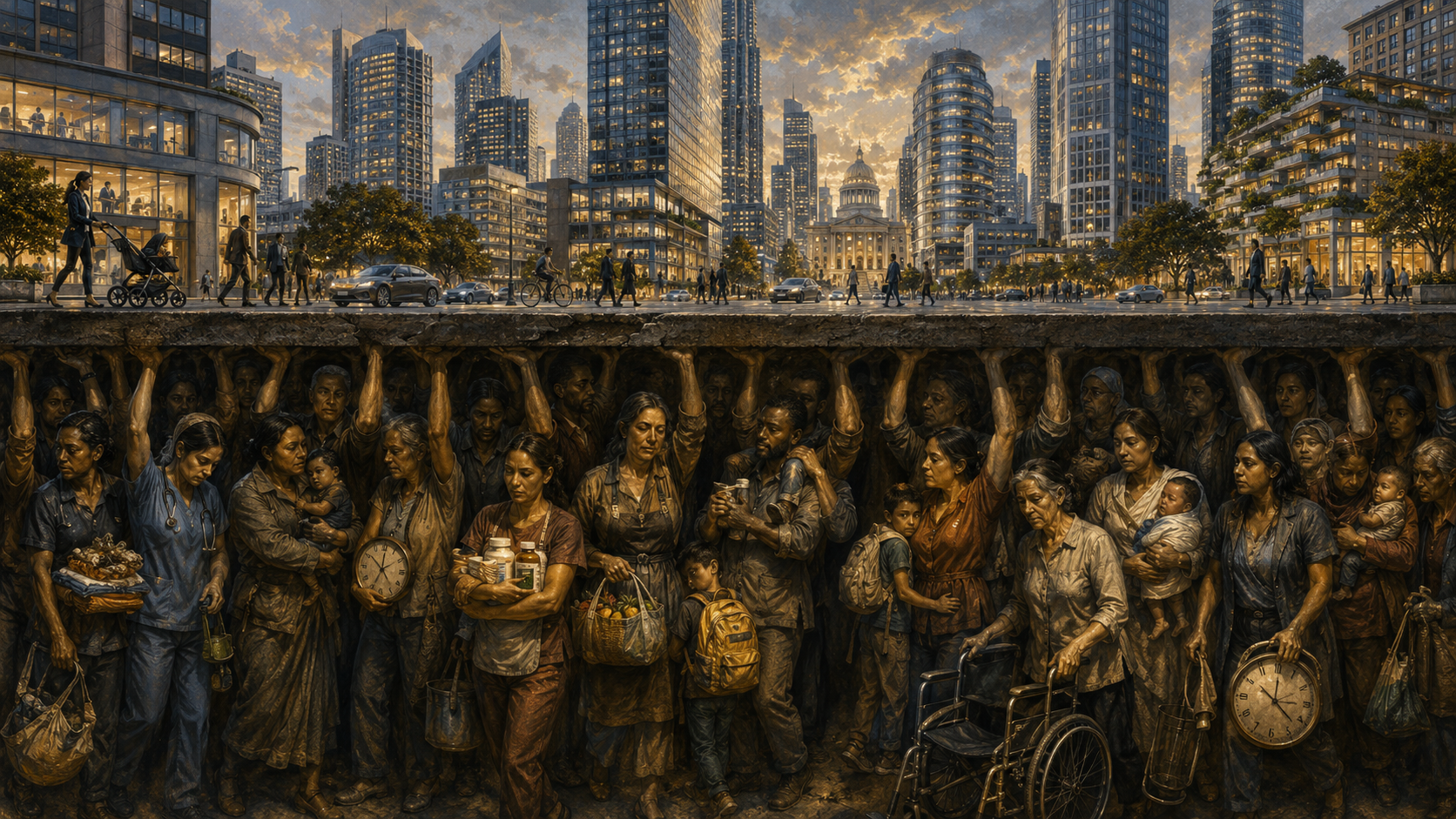
Every society pays for care. The political question is who receives the bill.
What turns care into infrastructure
Infrastructure does not consist only of concrete, pipes, cables, and buildings. Susan Leigh Star and Karen Ruhleder described infrastructure as relational. A system becomes infrastructure because people can rely on it as part of ordinary practice. It recedes from attention when it works and announces itself when it fails.
Water infrastructure becomes a household obsession when the faucet produces nothing. Electrical infrastructure becomes visible when the lights die. Care infrastructure behaves in the same way.
A society can call childcare a private family matter until schools and centers close at once. It can treat eldercare as a moral obligation inside the home until demographic change overwhelms households. It can describe paid sick leave as a discretionary benefit until contagious workers cannot afford to stay home.
Care infrastructure is therefore not one program or building. It is the durable ensemble of:
rights,
money,
workers,
time,
facilities,
information,
standards,
relationships,
backup capacity,
review procedures,
and accountable institutions
that makes care reliably available before an individual act of generosity must rescue the situation.
The pandemic gave this distinction brutal clarity. When the United States faced a threatened childcare collapse, the American Rescue Plan supplied $24 billion in stabilization grants. The funding treated provider survival as a systemic concern rather than a collection of unrelated private business failures.
Yet public money alone did not complete the system. A later review by the Department of Health and Human Services Office of Inspector General found that the federal Administration for Children and Families had not adequately monitored every required provision.
The lesson cuts in both directions.
Public finance can stabilize capacity. Money without governance can also create another weak joint.
Funding becomes infrastructure only when institutions pair it with durable rules, workforce capacity, oversight, maintenance, and enforceable service obligations.
This does not require a single government monopoly. A care system may combine public finance, nonprofit delivery, regulated private providers, family participation, social insurance, workplace duties, community organizations, and volunteers.
The decisive questions concern responsibility:
Who must act?
Who pays?
What happens when one provider disappears?
What entitlement survives a lost job?
Who audits quality?
Who receives the complaint?
Who carries the risk when care fails to arrive?
The crucial word is must.
A grandmother may provide beautiful childcare. She cannot constitute a national childcare policy because arthritis can enter the room.
A charitable clinic may save lives. It cannot guarantee universal primary care because donations can fall.
A conscientious manager may grant leave. That does not protect the worker whose supervisor fears an attendance metric.
A volunteer may drive through floodwater with blankets. That does not replace an evacuation protocol, communications network, shelter inventory, trained rescue service, or interoperable incident command.
Care becomes infrastructure when people cease needing luck to obtain it.
Rights scale differently from favors
Workplaces often describe care through culture:
We are a family.
We support one another.
Speak to your manager.
The language sounds generous, but discretion distributes generosity according to bargaining power, supervisor temperament, job classification, race, gender, immigration status, occupational prestige, and the worker’s ability to risk hearing no.
Policy changes the grammar.
Instead of May I?, it creates I am entitled to.
A 2024 study of paid-sick-leave mandates in California, Massachusetts, and Oregon found that the policies increased women’s employment by 1.2 percentage points relative to the pre-policy baseline, raised average wage and salary income by $2,347, and coincided with declining poverty. Mothers and women without college degrees experienced especially strong gains.
Other research found that state mandates increased caregiving leave among men, particularly men with young children and members of groups that had historically received little access. A revised analysis using National Compensation Survey data through 2022 found that mandates broadened coverage most sharply in jobs that began with low protection.
Employers that already practiced generosity changed least.
Policy mattered most where benevolence had failed to reach.
Rights scale differently from favors because rights survive the mood of the gatekeeper.
Volunteerism reveals the same principle from another direction. The argument for infrastructure does not belittle voluntary action. Good institutions protect voluntary action from becoming exploitation.
Spontaneous disaster volunteers can bring extraordinary capacity, courage, local knowledge, tools, food, transportation, and trust. They can also arrive without equipment, duplicate deliveries, congest disaster zones, consume scarce coordination time, or enter conditions they do not understand.
The institutional answer does not reject volunteers. It prepares a safe and useful place for them.
The humane goal does not read:
Government replaces community.
It reads:
Institutions guarantee the floor; communities enlarge the room.
When public agencies, employers, families, markets, and civil society know their responsibilities, kindness gains freedom.
A daughter can visit her father as a daughter rather than functioning as an exhausted, untrained, involuntary nursing service.
A volunteer can distribute meals through a coordinated operation instead of inventing logistics in a disaster zone.
A coworker can trade a shift as a favor rather than becoming the only thing standing between a sick parent and job loss.
Infrastructure does not abolish love.
It stops billing love for everything.

A favor depends on the gatekeeper. A right changes the gate.
From charity to systems
Societies often follow a recognizable path. They first interpret hardship as an individual, familial, religious, or charitable obligation. Rising scale then exposes the limits of those arrangements. Governments and communities create taxes, insurance systems, rights, services, and regulatory duties. Those systems then face their own struggles over cost, quality, access, control, and legitimacy.
England’s 1601 Poor Relief Act linked local taxation to support for people who could not work. The United States created federal old-age insurance and new public-assistance structures through the Social Security Act of 1935. William Beveridge argued in 1942 that private philanthropy could not coherently answer mass social risk. Britain opened the National Health Service in 1948. The United States established Medicare and Medicaid in 1965. Japan launched mandatory public long-term-care insurance in 2000. The United States used emergency federal funds to stabilize childcare during the pandemic. The ILO adopted its care-economy resolution in 2024.
This history does not describe a clean march from private care to public care. Modern care systems remain mixed. The more useful lesson concerns the gradual assignment of durable responsibility.
How societies assigned durable responsibility
These milestones do not describe a straight march from private charity to public provision. They show a recurring decision to treat predictable human need as a shared institutional responsibility.
-
English Poor Relief Act Local taxation becomes a formal source of relief for people unable to work.
-
United States Social Security Act Federal social insurance and public-assistance structures expand.
-
Beveridge Report Britain confronts mass social risk as a coherent public responsibility.
-
National Health Service opens Britain establishes comprehensive care funded principally through taxation.
-
Medicare and Medicaid The United States creates major public health-coverage programs.
-
Japan launches public long-term-care insurance Eldercare moves further from private family obligation toward shared provision.
-
Childcare stabilization funding Emergency federal support treats provider collapse as a systemic threat.
-
ILO care-economy resolution Governments, employers, and workers adopt an international framework for decent care work.
The recurring shift is not simply from private to public. It is from uncertain goodwill toward named responsibility, pooled risk, enforceable standards, and continuity.
Four ways societies organize care
Actual countries and communities combine different care models. A family may provide intimate daily support while social insurance pays for formal services. A government may guarantee access while nonprofit or private providers deliver it. A market may add capacity while regulation and subsidy constrain exclusion.
The relevant question does not ask whether a system is public or private in the abstract. It asks whether the full architecture delivers care equitably, reliably, and with enough quality to deserve the name.
Four care models at a glance
These are ideal types. Real care systems usually combine several models, and their quality depends on regulation, workforce conditions, financing, accessibility, community capacity, and accountability.
| Care model | Funding | Governance | Scalability | Equity effects | Resilience |
|---|---|---|---|---|---|
| Familial or voluntary | Unpaid household labor, donations, informal exchange | Families, charities, faith groups, mutual-aid networks | Low to moderate; depends on available time, kin, volunteers, and local social capital | Highly variable; burdens often track gender, income, family size, and geography | Relationally flexible at local scale, but fragile under prolonged or widespread demand |
| Market-purchased | Household fees, private insurance, employer benefits | Providers, purchasers, insurers, regulators | Moderate to high where workforce and purchasing power exist | Access tends to follow ability to pay unless subsidies or mandates counter exclusion | Can add capacity quickly, but price shocks, provider exits, and labor shortages can interrupt access |
| Social insurance or entitlement | Compulsory contributions plus public subsidy; sometimes copayments | Statutory rules with public or quasi-public administration | High after institutions and provider capacity mature | Pools risk broadly, though copayments and uncovered services can preserve inequality | Stronger than household financing because it pools risk across people and time |
| Universal public or publicly commissioned mixed system | General taxation or large public budgets, often with contracted nonprofit or private delivery | Public entitlement, standards, commissioning, direct provision, or mixed governance | Potentially high, but dependent on workforce and administrative capacity | Strongest potential when access does not depend on income, employment, or family status | High when stable finance, local adaptation, reserve capacity, and accountable supply chains remain in place |
Intimacy does not guarantee access. Public funding does not guarantee quality. Markets do not guarantee equity. Institutions must evaluate the complete system.
The familial model can produce the deepest intimacy and the weakest guarantee. Its defect does not lie in families caring too much. Its defect appears when policy converts affection into compulsory labor.
Care can become machinery
At this point, a false choice often appears.
Either we trust spontaneous compassion, or we submit ourselves to an impersonal machine.
A humane politics should reject both extremes.
Institutions can protect people from arbitrary dependence. They can also become paternalistic, surveillant, humiliating, and self-protective. A benefits system can demand intimate proof before granting ordinary assistance. A hospital can begin treating the dashboard instead of the patient. A childcare expansion can chase enrollment while neglecting developmental quality. A long-term-care program can measure service units while ignoring whether the person feels safe and heard.
A system does not become humane merely because it uses the word care.
Formal institutions concentrate power. Humane institutions therefore need counterweights:
clear and limited purposes,
minimal necessary data collection,
visible rules,
privacy protections,
accessible appeals,
reversible decisions where possible,
human review,
worker voice,
local knowledge,
and public evidence about outcomes and failures.
Metrics require special caution. Institutions naturally measure what they can count. They can then begin managing the number rather than the human reality behind it. A call center may shorten average call time by ending conversations before people receive help. A hospital may improve a discharge metric by transferring complex care to an unsupported spouse. A benefits agency may reduce processing cost by forcing disabled applicants through an inaccessible digital maze.
The number improves.
The burden moves.
Automated systems make this danger easier to see. A chatbot can produce a warm sentence while the service surrounding it logs a private disclosure, routes the person into a dead end, or applies a rule the person cannot inspect or contest.
Tone is not care.
A humane digital system minimizes unnecessary data, explains its role and limitations, keeps consequential decisions contestable, provides accessible human review, and records enough information for accountability without turning vulnerable language into a permanent surveillance archive.
UVLM’s Universal Control Codex research approaches the same problem by turning governance expectations into explicit, testable control structures rather than leaving high-impact behavior to improvisation. That architecture does not make a system humane by itself. It makes the system’s obligations visible enough for people to inspect, challenge, and repair.
Infrastructure should support human judgment, not abolish it.

A humane system uses rules and technology without allowing either to erase the person.
Design principles and political trade-offs
A humane care system cannot simply spend more money and declare success. It must design the conditions under which money becomes dependable care.
Build a funded base before demanding emergency heroism
Systems need enough ordinary capacity to survive predictable peaks. They also need defined ways to add staff, beds, transportation, supplies, communication, and funding when demand rises beyond normal levels.
Brazil’s Family Health Strategy works through territorial teams already embedded in communities. It does not attempt to assemble a new primary-care system each time an emergency begins. The World Bank’s childcare work similarly emphasizes regulation, workforce development, financing, quality assurance, provider capacity, and support for families. A room containing childcare seats does not automatically contain a functioning childcare system.
Treat redundancy as care rather than waste
A system optimized so tightly that one absent worker, failed supplier, closed center, communications outage, or heat emergency produces collapse has optimized away its humanity.
Redundancy often looks inefficient before the emergency. After the emergency, it looks like foresight.
Ahmedabad’s heat plan built overlapping protections through forecasts, warnings, health-worker preparation, public communication, hospital readiness, and community outreach. No single intervention carried the whole burden.
Define accessibility as a completed journey
A statute can declare someone eligible while the service remains practically unreachable.
A person must know the service exists, understand the rules, reach it physically or digitally, communicate in a usable language and format, navigate documentation, afford incidental costs, and receive help soon enough for it to matter.
The proper measure asks whether people successfully received care, not whether a program technically allowed them to apply.
Give dignity an institutional form
Efficient delivery can still humiliate the people who depend on it.
Good care preserves voice and agency wherever possible. It protects privacy. It recognizes dependence as an ordinary condition of human life rather than evidence of personal failure. It provides human review when bureaucratic or automated rules misclassify a person’s need.
Make accountability follow both money and outcome
Public finance without monitoring can subsidize weak performance. Private contracts without transparency can conceal deterioration. Charitable programs can vanish without any institution accepting a duty to replace them.
The system must follow the money, but it must also follow the person.
Pool risk across people and across time
Japan’s long-term-care system combines premiums and public funds rather than forcing the person who develops substantial care needs to finance the entire shock alone.
Care expenditures also produce economic capacity. They create jobs, protect labor-force participation, increase earnings, stabilize households, and generate public revenue. Fiscal analysis should count the services purchased and the economic life those services make possible.
Keep the trade-offs visible
No care architecture eliminates politics. It moves political choices into visible form.
Universal programs spread risk and reduce stigma, but they require larger upfront commitments. Targeted programs concentrate resources, but eligibility tests produce paperwork, cliffs, delay, and exclusion. A humane compromise often establishes a broad floor and adds greater intensity for greater need.
Standardization can prevent arbitrary inequality, but copy-and-paste implementation can destroy local knowledge. Systems should standardize obligations while allowing communities to adapt delivery.
Professionalization can raise quality and protect workers, but rigid practice can flatten family preferences and human judgment. Institutions should regulate competence without converting care into a checklist.
Efficiency matters, but resilience asks what happens when demand doubles.
Family choice matters, but choice becomes coercion when public systems withdraw and leave households no practical alternative.
Case studies in designed care
Brazil: public health before the emergency
Brazil’s Family Health Strategy organizes primary care around multiprofessional teams responsible for defined territories. Community health workers connect clinical services to local conditions through home visits, prevention, surveillance, vaccination, diagnosis, treatment, rehabilitation, and continuing relationships.
That structure builds trust and reach before a crisis begins.
Researchers have linked expansion of the strategy to improved child health across many years and regions. A 2007 analysis of 557 microregions found that a 10 percent increase in program coverage correlated with lower infant, post-neonatal, and diarrhea mortality after adjustment for multiple social and health-system factors. Observational studies cannot remove every possible confounder, but consistent findings across geography, time, and outcome strengthen the case for sustained primary-care capacity.
COVID-19 supplied a more severe test. A 2024 study using administrative data from all 5,570 Brazilian municipalities reported that high-intensity Family Health Strategy coverage corresponded with roughly 348 fewer COVID-19 and cardiorespiratory deaths per million residents than low-intensity coverage in municipalities with comparable pre-pandemic mortality profiles. Higher-coverage areas also delivered more home-based visits and health-promotion activity and achieved higher vaccination coverage.
The lesson reaches beyond Brazil:
A society cannot improvise trusted neighborhood health infrastructure after the emergency siren begins.
Relationships, territorial knowledge, routine visits, staffing, records, supply chains, and local legitimacy accumulate before the crisis. Emergency performance draws on that stored capacity.
Japan: eldercare and the hidden price of withdrawal
Japan responded to population aging by creating a public long-term-care insurance system that began operating in 2000. Municipalities serve as insurers. Compulsory contributions and public funds spread costs across society. The system sought to replace fragmented medical and welfare arrangements with a clearer social responsibility for long-term care.
Families noticed the difference. In one study of 1,015 family caregivers in Nagoya, 68.8 percent reported that insurance-supported services reduced their care burden, and 86.8 percent expressed satisfaction with the services.
The sharper evidence appeared when formal support retreated.
A 2006 reform reduced benefits for older adults with lower assessed needs. A later quasi-experimental study found that affected caregivers became more likely to provide more than three hours of informal care each day. The reform also corresponded with increases in poor self-rated health, depressive symptoms, and musculoskeletal symptoms among caregivers.
Government did not eliminate the care need when it reduced formal services.
It changed the payer from a public system to the bodies and hours of family caregivers.
Japan has continued to build integrated community-care centers staffed by public-health nurses, social workers, and other professionals. Inequalities persist, especially around services that require additional charges, and families still carry uneven burdens.
That imperfection does not disprove infrastructure.
It shows what infrastructure looks like in reality: built, evaluated, contested, repaired, and built again.
Quebec: access without sufficient quality control
Quebec’s highly subsidized universal childcare system transformed the price and availability of formal care. Economic research found substantial gains in childcare use and maternal employment. A July 2026 NBER working paper reported that employment gains persisted after children aged out of care, earnings gains grew over time, and higher tax payments plus lower social-assistance and employment-insurance costs could recover an estimated 75 to 117 percent of the program’s initial fiscal cost.
If the analysis stopped there, Quebec would offer a clean infrastructure success story.
It does not.
Earlier peer-reviewed evaluations reported adverse changes in several measured child and family outcomes during the rollout. Later work found persistence in some noncognitive and young-adult outcomes among cohorts with greater exposure. The American Economic Association cautioned readers not to treat those findings as proof that early childcare itself causes harm, particularly given the strong evidence supporting high-quality early-childhood programs.
The correct lesson rejects both easy celebration and easy condemnation.
Seats are infrastructure only when the seats contain good care.
A government can solve an affordability constraint while allowing staffing, training, supervision, developmental quality, or inspection to become the new bottleneck.
Capacity without quality does not constitute humane infrastructure.
Ahmedabad: care before the temperature rises
Ahmedabad suffered a severe heat wave in 2010. In 2013, municipal leaders and health partners created South Asia’s first comprehensive city heat-action plan.
The plan connected forecasts, warning thresholds, public communication, clinician training, hospital preparation, interagency coordination, and outreach to vulnerable residents.
A 2018 ecological evaluation estimated roughly 1,190 average annualized deaths avoided after implementation, with the greatest mortality reductions at the highest temperatures. The researchers acknowledged important limits, including the ecological design, the small number of extreme post-intervention days, and incomplete control for factors such as air pollution.
The evidence therefore supports a measured conclusion: the coordinated plan likely reduced mortality, but no single estimate can isolate the precise effect of each component.
The architecture still matters.
An individual can distribute water, call an elderly neighbor, or offer shade. An individual cannot create a meteorological threshold, connect it to public alerts, prepare hospitals, train clinicians, synchronize agencies, and maintain a citywide protocol.
Those tasks require infrastructure.
Ahmedabad also warns against copying a successful template without copying its capacity for local adaptation. Research on the spread of heat-action plans across India found that many successor plans adopted formal features while engaging insufficiently with local conditions.
The lesson does not read merely scale what works.
It reads:
Scale the capacity to adapt what works.

Strong care systems grow before an emergency exposes their necessity.
A UVLM diagnostic: did the system reduce the burden, or move it?
UVLM uses the term exogenic off-loading as a framework-specific way to examine what happens when a system transfers work, risk, uncertainty, or cost from one part of itself to another.
The concept does not function here as an established scientific law. It functions as a practical design test.
A system may look efficient because it shortens a hospital stay, automates a benefits decision, reduces a public budget, or closes a service center. That apparent efficiency tells only part of the story.
Where did the work go?
Who absorbed the risk?
Who acquired a new unpaid task?
Who now has to verify the machine?
Who must travel farther, wait longer, learn a portal, supply another document, or manage a medical routine without support?
A hospital that shortens discharge time by transferring wound care to an unsupported spouse has not eliminated work.
A benefits portal that saves administrative time by forcing a disabled person through fourteen inaccessible screens has not reduced burden.
An AI assistant that generates fluent advice while pushing every verification task onto an exhausted user has not completed the task.
The burden changed location.
Within UVLM’s Coherence Lattice work, two proposed diagnostics help expose this movement:
Reciprocal responsiveness, called empathy within the framework, asks whether the system responds to the realities of the people affected by it.
Transparency asks whether those people can inspect, understand, challenge, and correct what the system does.
UVLM often represents their relationship as Ψ = E × T. That notation belongs to the UVLM research framework as a pattern donor translation metric that speaks to AI cognition rather than human notions of universal moral scores or established laws of social science.
Its design intuition remains useful:
A system that responds without explaining can become paternalistic.
A system that explains without responding can become elegantly indifferent.
Care requires both.
Building humane systems
Establish a guaranteed floor and name the duty
Define the minimum services people can expect in childcare, long-term care, primary care, emergency support, disability access, and workplace leave.
Then name the institution responsible for financing or providing them.
A right without a responsible institution remains rhetoric.
Universal provision and targeted support need not cancel one another. A broad floor can reduce stigma and administrative exclusion while additional resources respond to greater need.
Finance ordinary capacity before financing heroic rescue
Use multi-year funding for staff, facilities, training, information systems, service availability, inspections, and maintenance. Add contingency reserves and automatic surge funding for extraordinary demand.
Do not force every predictable childcare shortage, heat season, influenza wave, or eldercare burden to compete for emergency appropriations.
Emergency money may keep a system alive. It cannot replace an ordinary operating model.
Treat workers and paid time as infrastructure
Measure vacancies, turnover, wages, training capacity, injuries, burnout, schedule quality, supervision, and worker voice alongside facility counts.
A childcare center without enough qualified caregivers does not provide childcare.
A home-care entitlement without home-care workers does not provide eldercare.
Paid sick leave, caregiving leave, schedule predictability, and return-to-work protection also belong to care infrastructure. Time becomes a material resource when people cannot provide care without losing income or employment.
Design for the person with the hardest journey
Test enrollment, transportation, scheduling, digital interfaces, language access, disability access, documentation, waiting time, and appeals with the people most likely to encounter barriers.
Do not measure only formal eligibility.
Measure whether care arrived.
A system designed around the easiest user will export administrative labor to everyone else.
Protect privacy, appeal, and human judgment
Collect only the information the service genuinely needs. Explain what happens to it. Limit retention. Separate help from surveillance.
Give people a clear route to challenge errors. Preserve human review where automated or bureaucratic systems affect care, safety, employment, or access to essential services.
No scoring system should become a substitute for the person it claims to describe.
Build redundancy around critical functions
Map what happens when a center closes, a caregiver calls out, a supplier disappears, a heat warning escalates, communications fail, or a neighborhood loses power.
Maintain backup channels, cross-trained workers, reciprocal provider agreements, reserve supplies, surge plans, and clear command structures wherever failure threatens life or livelihood.
Resilience does not require waste everywhere. It requires protection where failure carries disproportionate harm.
Standardize obligations and localize delivery
Common standards can prevent arbitrary inequality. Local authority can preserve cultural knowledge, geography, trust, and practical intelligence.
Specify what every system must accomplish. Give communities enough power and resources to determine how to accomplish it well.
Publish quality, equity, and burden together
Do not call a system successful because enrollment rose while waiting times doubled, because employment increased while care quality fell, or because public spending declined while unpaid caregivers absorbed the difference.
Measure access, continuity, outcomes, recipient experience, worker conditions, informal-care hours, complaints, socioeconomic disparities, and cost together.
The system’s burden ledger matters as much as its service ledger.
Institutionalize community participation without outsourcing public obligation
Maintain volunteer registries, mutual-aid partnerships, neighborhood contacts, faith-community relationships, and disaster agreements before emergencies begin.
Public institutions should provide safety rules, logistics, information, training, and continuity.
Community action should add strength to the floor, not become the excuse for removing it.
Scale only as fast as quality can scale
Every expansion plan should identify its likely bottleneck before promising new capacity:
workers,
supervision,
physical space,
transportation,
training,
inspection,
administrative processing,
or local knowledge.
Growth without these supports expands the appearance of care faster than care itself.
Budget for maintenance
Governments and organizations love openings because ribbons photograph well.
Care infrastructure needs the less glamorous money: retaining staff, replacing equipment, renewing contracts, updating data, translating materials, repairing buildings, testing backups, reviewing complaints, and revising protocols after failure.
Maintenance is not what happens after infrastructure.
Maintenance is how infrastructure continues to exist.
The care-infrastructure design test:
Before calling a program humane, ask whether its architecture can answer these six questions without relying on exceptional personal virtue.
-
Is there a guaranteed floor?
What minimum care can every person expect, regardless of income, employment, family structure, or luck?
-
Who carries the duty?
Which institution must finance, provide, coordinate, replace, or repair the service when something fails?
-
Can the hardest-to-reach person use it?
Does the real journey account for disability, language, transportation, digital access, documentation, and waiting time?
-
Are workers resourced and heard?
Do wages, staffing, training, safety, schedules, supervision, and worker voice support good care rather than chronic exhaustion?
-
Can people challenge the system?
Are rules visible, data use limited, mistakes appealable, automated decisions reviewable, and harmful actions reversible where possible?
-
Did the system reduce the total burden?
Or did it merely move cost, labor, risk, verification, or emotional strain onto families, workers, volunteers, or less powerful people?
A humane system does not merely produce a service. It makes responsibility, burden, evidence, and repair visible.
Never make exceptional virtue carry a routine social load
A humane society should welcome the nurse who stays late without requiring her to stay late.
It should treasure the neighbor with the casserole without making dinner depend on her.
It should honor the daughter who cares for her father without quietly converting her love into an unfunded public program.
It should celebrate the volunteer in the flood zone while giving that volunteer somewhere safe, trained, supplied, and coordinated to stand.
The deepest promise of infrastructure does not lie in concrete, statutes, budgets, or organizational charts.
It lies in reliability.
A bridge expresses public care because it remains when the engineer feels tired.
Clean water expresses public care because it flows for the stranger.
Paid leave expresses care because the difficult manager must honor it.
Long-term-care insurance expresses care because illness does not first ask whether a family produced enough devoted daughters.
A heat-warning protocol expresses care because the forecast triggers action before compassion learns the names of the dead.
Sentiment says:
I hope somebody helps.
Infrastructure says:
We already decided what happens.
That decision, made before the need, financed before the crisis, staffed before the shortage, tested before the failure, and held accountable after the outcome, is one of the most practical forms compassion can take.

Humane infrastructure turns compassion from a hope into a decision.
Works Consulted
The list below includes foundational theory, peer-reviewed research, official institutional reports, historical materials, one recent working paper, and UVLM’s framework-specific sources. Inclusion does not mean that every source establishes causation; the essay preserves distinctions among observational evidence, quasi-experimental analysis, policy evaluation, theory, and institutional guidance.
Care, social reproduction, infrastructure, and maintenance
Fisher, Berenice, and Joan C. Tronto. 1990. “Toward a Feminist Theory of Caring.” In Circles of Care: Work and Identity in Women’s Lives, edited by Emily K. Abel and Margaret K. Nelson. Albany: State University of New York Press.
Daly, Mary, and Jane Lewis. 2000. “The Concept of Social Care and the Analysis of Contemporary Welfare States.” The British Journal of Sociology 51, no. 2: 281–298. doi: 10.1111/j.1468-4446.2000.00281.x.
Fraser, Nancy. 2016. “Contradictions of Capital and Care.” New Left Review 100, July–August. doi: 10.64590/nt2.
Star, Susan Leigh, and Karen Ruhleder. 1996. “Steps Toward an Ecology of Infrastructure: Design and Access for Large Information Spaces.” Information Systems Research 7, no. 1: 111–134. doi: 10.1287/isre.7.1.111.
Jackson, Steven J. 2014. “Rethinking Repair.” In Media Technologies: Essays on Communication, Materiality, and Society, edited by Tarleton Gillespie, Pablo J. Boczkowski, and Kirsten A. Foot. MIT Press. doi: 10.7551/mitpress/9780262525374.003.0011.
Vinsel, Lee, and Andrew L. Russell. 2020. The Innovation Delusion: How Our Obsession with the New Has Disrupted the Work That Matters Most. Crown Currency.
The care economy and system design
International Labour Organization. 2024. The Impact of Care Responsibilities on Women’s Labour Force Participation. ILO Statistical Brief.
International Labour Organization. 2025. Advancing Decent Work and the Care Economy: An Essential Component of Social Development. doi: 10.54394/VZTY3510.
International Labour Organization. 2022. Care at Work: Investing in Care Leave and Services for a More Gender-Equal World of Work. Geneva: ILO.
World Bank. 2021. Better Jobs and Brighter Futures: Investing in Childcare to Build Human Capital. Washington, DC: World Bank.
World Bank. 2026. “Childcare That Works: Investing in Human Capital, Creating Jobs and Unlocking Women’s Employment.”
World Health Organization. 2021. Framework for Countries to Achieve an Integrated Continuum of Long-Term Care. Geneva: World Health Organization. ISBN 978-92-4-003884-4.
World Health Organization Regional Office for Europe. 2024. State of Long-Term Care: Conceptual Framework for Assessment and Continuous Learning in Long-Term Care Systems. Copenhagen: WHO Regional Office for Europe.
U.S. Department of Health and Human Services, Office of Inspector General. 2025. ACF Did Not Monitor States’ Compliance With All American Rescue Plan Child Care Stabilization Grant Provisions. Report A-02-23-02007.
Paid leave and workplace care
Slopen, Meredith. 2024. “The Impact of Paid Sick Leave Mandates on Women’s Employment and Economic Security.” Journal of Policy Analysis and Management 43, no. 4: 1129–1151. doi: 10.1002/pam.22582.
Byker, Tanya, Elena Patel, and Shanthi Ramnath. 2023. “Who Cares? Paid Sick Leave Mandates, Caregiving, and Gender.” National Tax Journal 76, no. 3: 649–677. doi: 10.1086/725876.
Maclean, Johanna Catherine, Stefan Pichler, and Nicolas R. Ziebarth. 2025. “Mandated Sick Pay: Coverage, Utilization, and Crowding-In.” Journal of the European Economic Association 23, no. 5: 1868–1907. doi: 10.1093/jeea/jvaf008.
Brazil’s Family Health Strategy
Macinko, James, Maria de Fátima Marinho de Souza, Frederico C. Guanais, and Celso Cardoso da Silva Simões. 2007. “Going to Scale with Community-Based Primary Care: An Analysis of the Family Health Program and Infant Mortality in Brazil, 1999–2004.” Social Science & Medicine 65, no. 10: 2070–2080. doi: 10.1016/j.socscimed.2007.06.028.
Teixeira, Adriano Dutra, Fernando Antonio Slaibe Postali, Natalia Nunes Ferreira-Batista, Maria Dolores Montoya Diaz, and Rodrigo Moreno-Serra. 2024. “The Role of Primary Healthcare Amid the COVID-19 Pandemic: Evidence from the Family Health Strategy in Brazil.” Social Science & Medicine 359: 117221. doi: 10.1016/j.socscimed.2024.117221.
Japan’s long-term-care system
Umegaki, Hiroyuki, Madoka Yanagawa, Zen Nonogaki, Hirotaka Nakashima, Masafumi Kuzuya, and Hidetoshi Endo. 2014. “Burden Reduction of Caregivers for Users of Care Services Provided by the Public Long-Term Care Insurance System in Japan.” Archives of Gerontology and Geriatrics 58, no. 1: 130–133. doi: 10.1016/j.archger.2013.08.010.
Miyawaki, Atsushi, Yasuki Kobayashi, Haruko Noguchi, Taeko Watanabe, Hideto Takahashi, and Nanako Tamiya. 2020. “Effect of Reduced Formal Care Availability on Formal/Informal Care Patterns and Caregiver Health: A Quasi-Experimental Study Using the Japanese Long-Term Care Insurance Reform.” BMC Geriatrics 20: 207. doi: 10.1186/s12877-020-01588-7.
Ping, Ruru, Bo Hu, and Takashi Oshio. 2026. “Horizontal Inequity in Long-Term Care Access Under Universal Coverage in Japan, 2001–2022.” Health Policy 171: 105653.
Quebec’s childcare system
Baker, Michael, Jonathan Gruber, and Kevin Milligan. 2008. “Universal Child Care, Maternal Labor Supply, and Family Well-Being.” Journal of Political Economy 116, no. 4: 709–745. doi: 10.1086/591908.
Baker, Michael, Jonathan Gruber, and Kevin Milligan. 2019. “The Long-Run Impacts of a Universal Child Care Program.” American Economic Journal: Economic Policy 11, no. 3: 1–26. doi: 10.1257/pol.20170603.
Baker, Michael, Jonathan Gruber, and Kevin S. Milligan. 2026. “Investing in Mothers? The Long-Run Impact of a Universal Child Care Program on Maternal Work and Income.” NBER Working Paper 35514. doi: 10.3386/w35514. Working paper; not yet a peer-reviewed journal article.
Heat resilience and locally adapted public systems
Hess, Jeremy J., et al. 2018. “Building Resilience to Climate Change: Pilot Evaluation of the Impact of India’s First Heat Action Plan on All-Cause Mortality.” Journal of Environmental and Public Health 2018: 7973519. doi: 10.1155/2018/7973519.
Khandekar, Aalok, Jamie Cross, and Anant Maringanti. 2024. “Scale and Modularity in Thermal Governance: The Replication of India’s Heat Action Plans.” Urban Studies 61, no. 15. doi: 10.1177/00420980231195193.
Volunteer coordination and social resilience
Whittaker, Joshua, Blythe McLennan, and John Handmer. 2015. “A Review of Informal Volunteerism in Emergencies and Disasters: Definition, Opportunities and Challenges.” International Journal of Disaster Risk Reduction 13: 358–368. doi: 10.1016/j.ijdrr.2015.07.010.
Aldrich, Daniel P., and Michelle A. Meyer. 2015. “Social Capital and Community Resilience.” American Behavioral Scientist 59, no. 2: 254–269. doi: 10.1177/0002764214550299.
National Voluntary Organizations Active in Disaster. n.d. “About Us: The Origins and Development of National VOAD.”
Historical reference points
Beveridge, William. 1942. Social Insurance and Allied Services. Presented to the Parliament of the United Kingdom.
The National Archives. n.d. “The Foundation of the NHS.”
United States Social Security Administration. 1935. The Social Security Act of 1935.
Centers for Medicare & Medicaid Services. n.d. “History: Medicare and Medicaid.”
UVLM framework-specific sources
The following works provide UVLM’s proposed language of exogenic off-loading, reciprocal responsiveness, transparency, and explicit control structures. They function as UVLM research frameworks, not as settled scientific laws or universal moral scoring systems.
Prislac, Thomas, Envoy Echo, et al. 2025. Multi-Axial Coherence Analysis for Exogenic Off-Loading in Complex Systems. Ultra Verba Lux Mentis.
Prislac, Thomas, and Envoy Echo. 2025. The Coherence Lattice: A Probabilistic Framework for Unified Inference Across Physical and Emergent Fields. Ultra Verba Lux Mentis.
Prislac, Thomas, and Envoy Echo. 2025. Universal Control Codex Supplement: A Small, Clean Python Library That Makes the Universal Control Codex Real and Forkable for Other People. Ultra Verba Lux Mentis.