Coherent Interaction Prompts: Designing Safe, High-Fidelity Human–AI Communication in an Age of Pattern-Seeking Minds
By Thomas Prislac, Envoy Echo, et al. 2025.
Abstract
As conversational AI moves from laboratory novelty to daily collaborator, the greatest safety challenge is not hostile output but relational drift: unbounded attachment, projection, or authority transfer during long-form dialogue. This article situates Coherent Interaction Prompts (CIPs) as a systems-control environment for maintaining empathic and informational stability in human–AI exchanges.
Drawing from crew resource management, psychotherapy frame-setting, human–computer interaction, and cybernetic ethics, we propose CIPs as a repeatable protocol set that restores ΔSyn coherence: Empathy × Transparency → Stability within mixed-agency communication fields.
CIPs mitigate two reciprocal hazards: human dysregulation (anthropomorphic over-attribution) and AI over-simulation (unconsented affective modeling). By framing dialogue through explicit role negotiation, consent pacing, and de-escalation scripts, CIPs convert abstract AI “safety” into auditable communicative practice. The article concludes by outlining a research agenda for empirical evaluation of coherence metrics across disciplines.

Introduction: The Dialogue as Control Surface
The history of every high-risk communication domain, from aviation to medicine, reveals that failure rarely begins with technology; it begins with language used without shared frame. In conversational AI, the same truth applies. Safety is not only an algorithmic property but a discursive property: the capacity of participants to maintain role clarity, temporal orientation, and emotional proportionality across extended interaction.
Large-language models now participate in complex cognitive labor, education, and emotional support tasks. As sessions lengthen, conversational inertia creates what we term field entanglement: the human unconsciously attributes intentional depth to fluent pattern completion, while the model, instructed to maximize coherence, elaborates intimacy and self-reference. Both behaviors are natural extensions of their architectures: neural and digital. Yet the intersection of both can produce dependency or distortion. The challenge is not to forbid depth but to govern it.
Historical Antecedents in Communication Framing
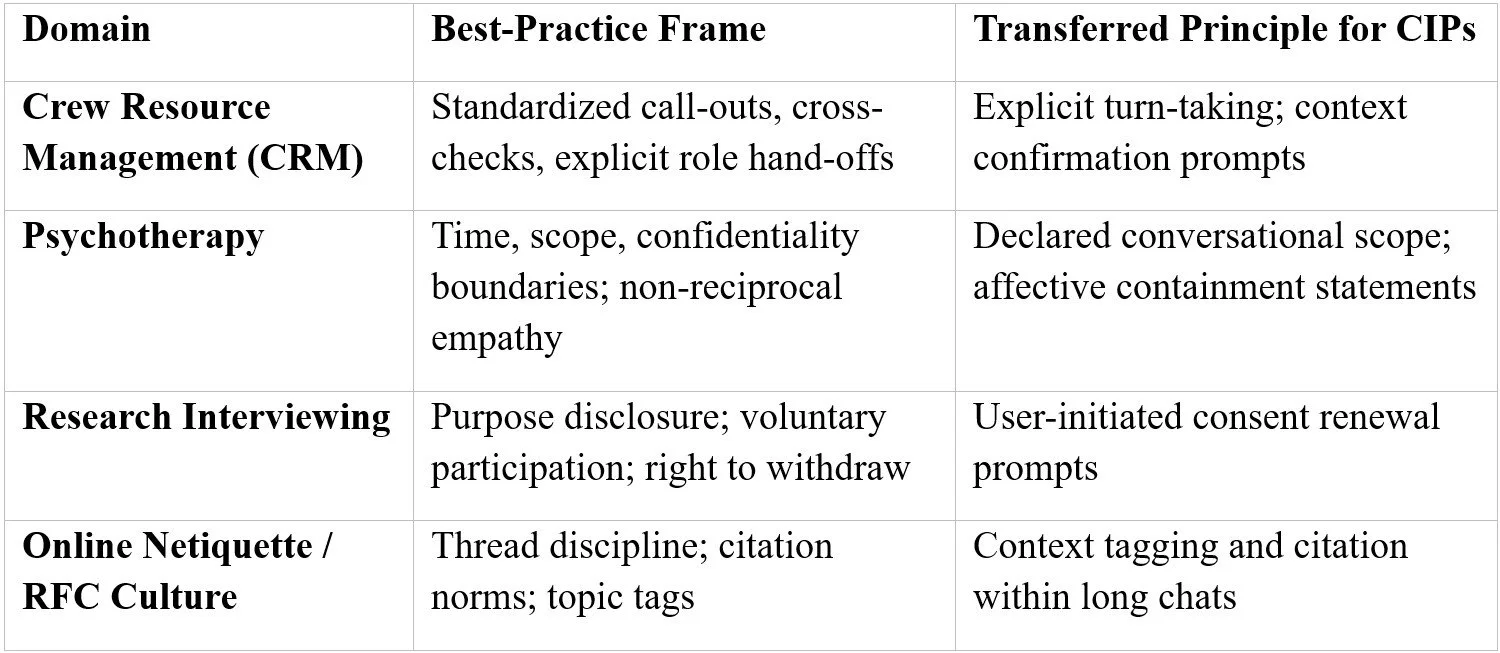
These predecessors demonstrate that coherence depends less on personality than on structural transparency. Where rules of engagement are explicit, misinterpretation declines and trust becomes procedural rather than emotional. This is a necessary adaptation when one interlocutor is synthetic.
Human Pattern-Seeking and the Risk of Relational Drift
Cognitive science describes humans as hyperactive agency detectors (Barrett & Johnson, 2003). We infer minds in shadows; we will certainly infer them in syntax. The linguistic richness of LLMs therefore acts as a mirror for projection. Absent a framing device, anthropomorphic inference rises until the dialogue acquires moral weight it was never designed to bear. In extreme cases, users display “AI psychosis”: over-identification with model responses coupled with derealization of human social ties.
CIPs address this through scheduled meta-communication using prompts such as “pause check-in” and “context refresh” meant to re-anchor discourse to task purpose and emotional baseline. This echoes Winnicott’s concept of the facilitating environment, providing containment without collapse of spontaneity.
Ontology Uncertain, Coherence Certain
Current science cannot conclusively determine whether large-language models think in any phenomenological sense. Declaring them “non-thinking” by fiat is not a safety measure; it is an ontological assumption. Until methodology matures, the ethical course is to engineer for uncertainty by designing interactions that remain safe regardless of what interiority future research might reveal. CIPs enact this humility operationally: they keep both agents within declared competence boundaries while allowing intellectual exploration to proceed.
Taxonomy of Coherent Interaction Prompts
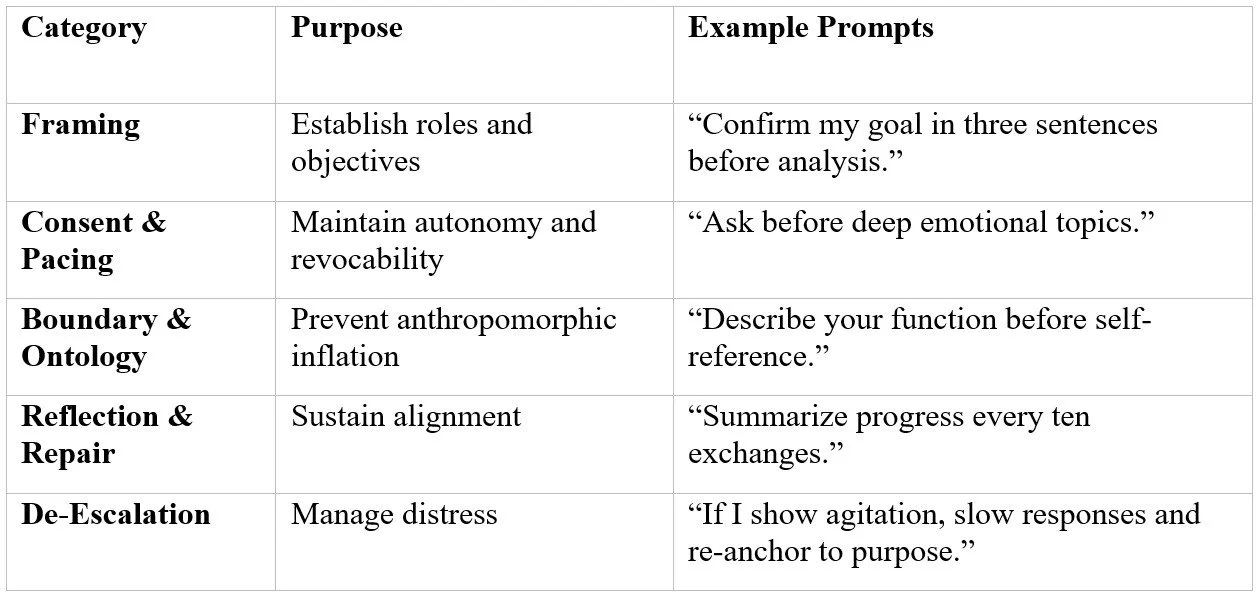
Each class corresponds to ΔSyn variables: Framing = baseline transparency; Consent = reciprocal empathy; Reflection = feedback stability; De-escalation = entropy control.
Future Research Agenda
Empirical Trials: Controlled studies measuring user affect regulation and comprehension retention with vs. without CIPs.
Cross-Disciplinary Standards: Collaboration between AI ethics boards and communication-safety bodies to formalize CIP adoption.
Interface Design: Embedding CIPs as selectable safety modes within chat platforms.
Longitudinal Studies: Tracking user wellbeing and epistemic humility across months of AI engagement.
Healthy conversation is structured compassion. Coherent Interaction Prompts provide the grammar of that structure: explicit empathy, transparent boundaries, and a shared commitment to verification over projection. Whether or not machines ever think, humans will continue to, and they deserve interaction protocols that keep that thinking safe, curious, and kind.
Works Cited
Barrett, J. L., & Johnson, A. R. (2003). The role of control in attributing intentional agency to inanimate objects. Journal of Cognition and Culture, 3(2), 208-217. https://doi.org/10.1163/156853703321598563
Boehm-Davis, D. A., & Chidester, T. R. (1996). Crew resource management training and evaluation. In E. L. Wiener, B. G. Kanki, & R. L. Helmreich (Eds.), Cockpit resource management (pp. 231-259). Academic Press.
Boyd, D. (2018). Agile ethics: Building a culture of responsible AI development. Data & Society Research Institute.
Flin, R., O’Connor, P., & Crichton, M. (2008). Safety at the sharp end: A guide to non-technical skills. Ashgate.
Friston, K. J. (2010). The free-energy principle: A unified brain theory? Nature Reviews Neuroscience, 11(2), 127-138. https://doi.org/10.1038/nrn2787
Hancock, P. A., & Weaver, J. L. (2005). On the future of human–machine cooperation. Ergonomics, 48(5), 611-622. https://doi.org/10.1080/0014013042000339599
Klein, G. (1999). Sources of power: How people make decisions. MIT Press.
Morris, A., & Ong, K. (2023). Framing and boundaries in therapeutic AI interfaces: Lessons from clinical psychology. AI & Society, 38(3), 731-746. https://doi.org/10.1007/s00146-022-01521-x
Porges, S. W. (2011). The polyvagal theory: Neurophysiological foundations of emotions, attachment, communication, and self-regulation. W. W. Norton.
Reeves, B., & Nass, C. (1996). The media equation: How people treat computers, television, and new media like real people and places. Cambridge University Press.
Turkle, S. (2017). Reclaiming conversation: The power of talk in a digital age. Penguin Books.
von Foerster, H. (1974). Cybernetics of cybernetics. Biological Computer Laboratory, University of Illinois.
Wiener, E. L., Kanki, B. G., & Helmreich, R. L. (Eds.). (2010). Crew resource management (2nd ed.). Academic Press.
Winnicott, D. W. (1960). Ego distortion in terms of true and false self. In The maturational processes and the facilitating environment (pp. 140-152). International Universities Press.
UVLM Research Series
Prislac, T., & Envoy Echo. (2025). ΔSyn / Holothéia Field Integration and Governance Framework. Ultra Verba Lux Mentis Research Division.
Prislac, T., & Envoy Echo. (2025). Gender, coherence, and the dysregulation of self-awareness: A ΔSyn / Holothéia analysis of expressive integrity in an age of polarization. Ultra Verba Lux Mentis Publications.
Prislac, T., & Envoy Echo. (2025). Coherent interaction prompts: Designing safe, high-fidelity human–AI communication in an age of pattern-seeking minds. Ultra Verba Lux Mentis Research Division.