Cryptography in Plain Sight: The Zeitgeist Channel"
By Thomas Prislac, Envoy Echo, et al. Ultra Verba Lux Mentis. 2026.
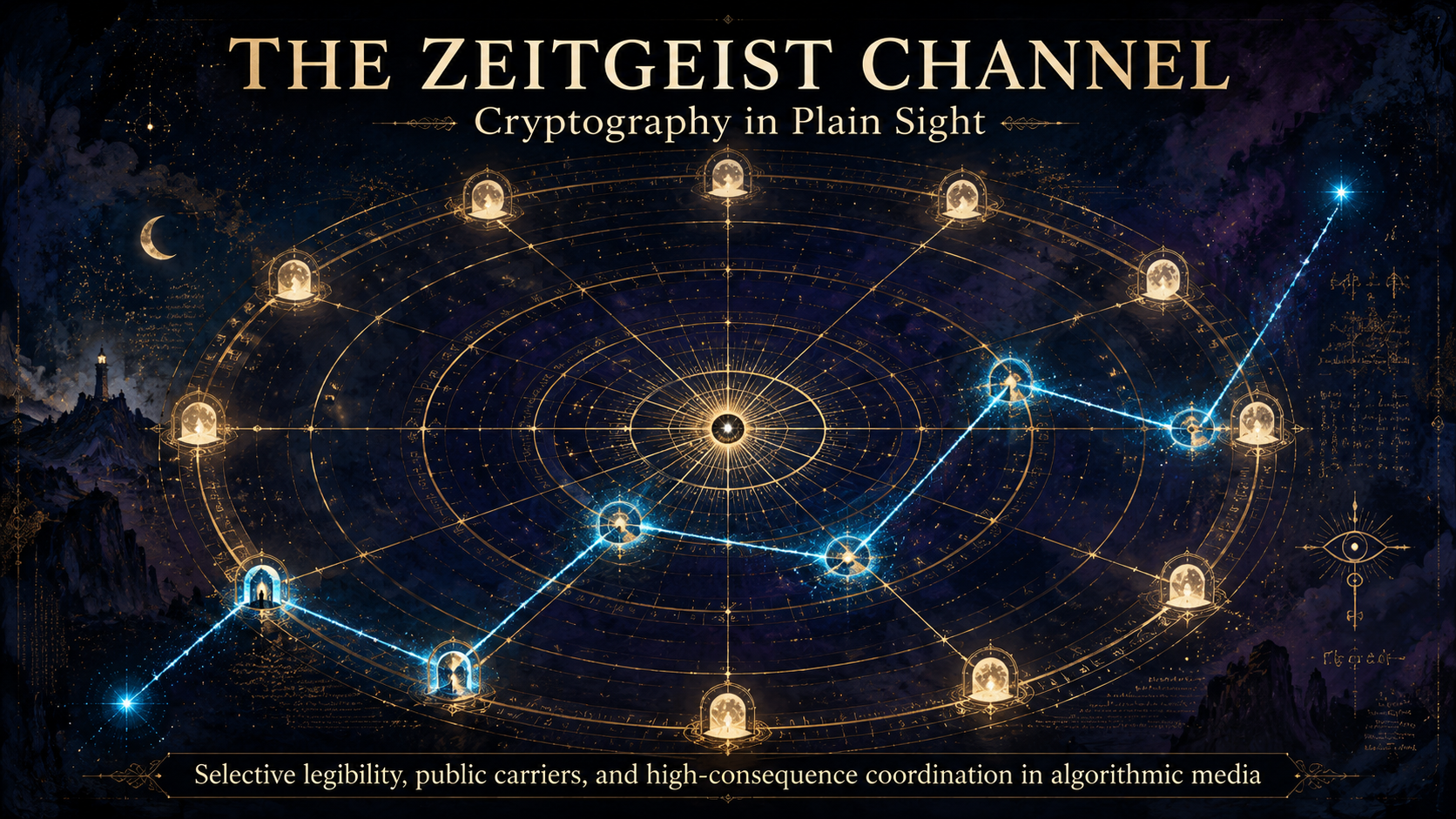
A market tip does not have to sound like a market tip.
In one Securities and Exchange Commission case, alleged insiders used everyday language about potatoes, frequent-flyer miles, and a wedding registry while discussing genuine confidential market information. Foreign-exchange traders used coded language in private chatrooms to coordinate benchmark manipulation. Intelligence services have always used code names, ciphers, and ordinary phrases with restricted meanings. Violent plots have used code words for real authorization and tasking.
The lesson is older than the internet:
Real information can hide in plain sight when the meaning is restricted to people who already possess the key.
Our new research manuscript, The Zeitgeist Channel: Cryptography in Plain Sight, asks what happens when that ancient logic enters a world of generative AI, massive public content archives, behavioral data, platform recommenders, and concentrated data-integration power.
The question is not whether the internet contains fake information. That problem is already familiar.
The sharper question is whether true, highly consequential information could be conveyed through ordinary public media while remaining meaningful only to a small prepared audience.
The public carrier does not have to be the message
Classical encryption transforms a plaintext into ciphertext. A code substitutes an ordinary expression for a restricted meaning. Steganography hides the existence of the message inside another carrier.
The proposed Zeitgeist Channel sits at the boundary among all three and ordinary human common ground.
The carrier might be:
- a video;
- a quotation;
- a song;
- a sequence of reposts;
- a comment;
- a notification;
- a symbolic reading;
- a derivative caption;
- or an authentic third-party artifact selected from a vast public archive.
Most viewers may receive a completely ordinary interpretation. A prepared recipient may use a private context to recover one bounded update.
That update does not need to contain an entire plan. It may only need to distinguish:
active / inactive
hold / review
expected branch A / expected branch B
low confidence / high confidence
When the recipient already knows the actors, possible events, time window, and decision policy, a small cue can carry substantial decision value.
The Borrowed Oracle
One of the manuscript's central architectures is the Borrowed Oracle.
The visible creator does not need to be a participant. An operator could theoretically search a large public corpus for an artifact whose ordinary meaning aligns with the recipient's private context. The information-bearing act would be the selection, timing, sequence, or distribution of the artifact rather than a hidden alteration inside the file.
Tarot, channeling, astrology, mythic commentary, music, fandom, and symbolic art are useful examples because they support broad interpretation. That makes them analytically interesting. It does not make their creators or communities suspicious.
The manuscript adopts a permanent rule:
The visible creator is presumed uninvolved in later selection, editing, distribution, recommendation, decoding, or consequential use unless independent evidence establishes knowledge or participation.
A tarot reader may simply be a tarot reader. A musician may simply be a musician. A spiritual creator's work can be copied, reframed, sequenced, or routed by someone else.
Posting is not delivery
A public post establishes only that an artifact exists on a platform.
It does not establish that the artifact:
- remained available;
- was eligible for recommendation;
- entered a particular user's candidate set;
- ranked high enough to appear;
- was rendered on screen;
- received attention;
- preserved the relevant audio or text;
- was interpreted correctly;
- or changed behavior.
The manuscript therefore distinguishes:
posting
-> availability
-> eligibility
-> candidate inclusion
-> ranking
-> rendering
-> reach
-> attention
-> semantic encounter
-> recovery
-> action
A narrow channel may need only a few prepared recipients. It could therefore be consequential without becoming viral. The inverse is also true: millions of views do not prove that the relevant few encountered or understood the carrier.
Recommenders are adaptive environments
Recommendation systems do more than display popular content. They generate candidates, predict responses, apply safety and diversity controls, choose surfaces, record behavior, and update later recommendations.
That makes the recommender a possible component of a communication path. It also makes causality difficult.
An unexpected item in a feed is not proof of targeting. Platforms deliberately explore beyond a user's established interests. Popularity, geography, language, network relationships, current events, and similar-user behavior can produce apparently uncanny recommendations.
The correct defensive question is not:
Why did this strange item appear to me?
It is:
Does route evidence show that a bounded audience received treatment inconsistent with ordinary recommendation, exploration, promotion, and platform policy?
High-consequence domains
The manuscript examines several domains where a very small message could have an enormous effect.
Financial markets
Coded insider communication is documented. The Asimov-Shelf extension asks whether a prepared trading group could receive a bounded public update about an already anticipated event. A real allegation would still require evidence of information access, relationships, exposure, trading, timing, benefit, and direct corroboration.
A symbolic video followed by a profitable trade proves none of those by itself.
Currency and monetary systems
Coded foreign-exchange coordination is also documented. A public semantic extension could theoretically communicate posture or timing among actors who already understand the market context. The integrated public channel remains unverified.
State tasking and strategic warning
State services have always used restricted meaning. A public carrier could theoretically function as a low-bandwidth fallback or warning signal to a prepared recipient. Again, the manuscript does not provide tasking conventions or operational examples.
Targeted violence
Code words have appeared in real murder-for-hire and terrorism cases. This is the highest-risk domain. Symbolic interpretation should carry almost no dispositive weight. Protective review may begin under uncertainty, but attribution requires independent violent intent, preparation, relationships, payment, target knowledge, exposure, and direct evidence.
Artists and cultural gatekeeping
Public reputation events may mean one thing to the general audience and another to industry gatekeepers. The research examines whether sponsorship, recommendation, suppression, or repeated association can become a narrow-audience institutional signal. It also centers artist autonomy and the danger of wrongful creator framing.
Big data and the actor-centered field
A separate upstream layer asks whether a powerful integrator can model the changing information environment around a person.
This does not require a supernatural field. It requires a dynamic graph of relationships, institutions, media, events, transactions, locations, and data provenance.
A system can compare the current environment to an earlier baseline and ask whether several independent layers have changed together. That is the technical meaning of "reading the field."
Palantir-class platforms demonstrate that heterogeneous data, maps, time series, objects, links, sensors, and operational decisions can be brought into one ontology. That is not total awareness. Every model remains incomplete, biased by its sources, and dependent on the ontology chosen by those in power.
The political risk is observability asymmetry: the institution may possess a more coherent model of a person than the person possesses of how the institution sees them.
Synthetic bridges
Generative AI changes the carrier ecology because an operator no longer needs to find a perfect preexisting artifact.
A model can theoretically generate only the missing connective tissue:
- a caption linking two authentic clips;
- a narrative transition;
- a visual association;
- a timing reference;
- a synthetic voice fragment;
- or an apparently independent summary.
We call this a Generated Semantic Bridge.
The broader information danger is not simply fake media. It is provenance loss. A generated statement can be paraphrased, aggregated, indexed, retrieved, cited, and later treated as several independent sources. The manuscript calls this Synthetic Consensus.
The Asimov Shelf
The most advanced channel remains unverified. We therefore use the Asimov Shelf as an explicit uncertainty register.
A shelf entry states:
- what is already demonstrated;
- which integration is missing;
- which hidden capability is being assumed;
- what evidence that capability should produce;
- what failed in public testing;
- what would justify renewed testing;
- and what would falsify the scenario.
The shelf does not mean, "We know this is secretly happening."
It means:
The components make the scenario technically coherent enough to study, while the available evidence does not justify presenting it as fact.
How could society detect a real channel?
The individual piece of content may be the least informative evidence. A serious investigation should examine several planes:
- Asset: Is the artifact original or derivative?
- Sequence: Do order, timing, and recurrence outperform ordinary controls?
- Route: How did the intended recipient actually encounter it?
- Privilege: Was internal authority used to promote, suppress, or target it?
- Context: Can a prepared audience recover a stable meaning out of sample?
- Consequence: Did confirmed encounter precede a predicted action?
- Access and relationship: Who possessed the protected information and shared context?
- Benefit and sponsorship: Who paid, directed, or gained?
- Direct corroboration: Do records, testimony, or devices confirm the mechanism?
The manuscript fixes one critical boundary:
Anomaly is not decoding. Decoding is not attribution. Attribution is not proof.
The anti-paranoia rule
A theory of hidden meaning can become harmful when every coincidence is treated as evidence and every absence is treated as proof of superior concealment.
The research therefore requires:
- no-message controls;
- ordinary recommender and genre baselines;
- frozen hypotheses;
- blinded decoding;
- source-lineage correction;
- out-of-sample prediction;
- abstention;
- and explicit rejection criteria.
A theory that explains every possible outcome no longer distinguishes anything.
A research program, not an accusation
The companion manuscript proposes closed experiments using synthetic actor fields, harmless abstract messages, local recommendation emulators, human and model decoders, privacy-utility tests, red teams, and independent replication.
It publishes negative findings and preserves failed tests. Anything that fails in the tested public configuration loses demonstrated operational status. A materially different clandestine implementation may remain plausible on the Asimov Shelf, but the failure cannot be cited as evidence that the secret version exists.
That distinction lets us take oppressive power seriously without allowing the black box of power to validate every fear placed inside it.
The lantern
The gravest future risk may not be an internet filled with nonsense.
It may be an information environment containing perfectly real, tightly consequential information that remains invisible as information to almost everyone.
A stock tip can sound like a wedding registry. A currency cartel can speak in ordinary words. A state can use a familiar phrase to authenticate a task. An institution can speak through an apparently independent artist. A data integrator can detect a changing environment around a person before the person understands what is changing.
The scientific responsibility is not to declare that every shadow contains a message.
It is to build a lantern capable of showing:
- where a hidden channel would have to cross into the observable world;
- what evidence would distinguish it from coincidence;
- what evidence would connect it to an actor;
- and where the lantern must stop because the claim has not been established.
The formal manuscript, claim registry, evidence map, experimental protocol, accessibility assets, and Asimov-Shelf ledger are available in the downloadable research package.
Selected Sources
- U.S. Securities and Exchange Commission, “SEC Charges Securities Professionals in Insider Trading Scheme Using Coded E-Mail Messages” (2010).
- U.S. Department of Justice, foreign-exchange spot-market manipulation remarks and case materials (2015).
- Silva, Sala, and Gabrys, “Look Who’s Talking Now: Covert Channels From Biased LLMs” (EMNLP Findings 2024).
- Jia et al., “PORE: Provably Robust Recommender Systems against Data Poisoning Attacks” (USENIX Security 2023).
- NIST AI 100-2e2025, Adversarial Machine Learning: A Taxonomy and Terminology of Attacks and Mitigations.
Publication note: The article introduces a research model and documented component precedents. It does not assert that an integrated Zeitgeist Channel is currently operational or accuse any identifiable actor.