The Door That Opens Ten More: Tarot, synthetic prophecy, and the cult without walls
How AI content farms and buffered payment rails could modernize an old missionary machine
By Thomas Prislac, Envoy Echo, et al. Ultra Verba Lux Mentis. 2026.
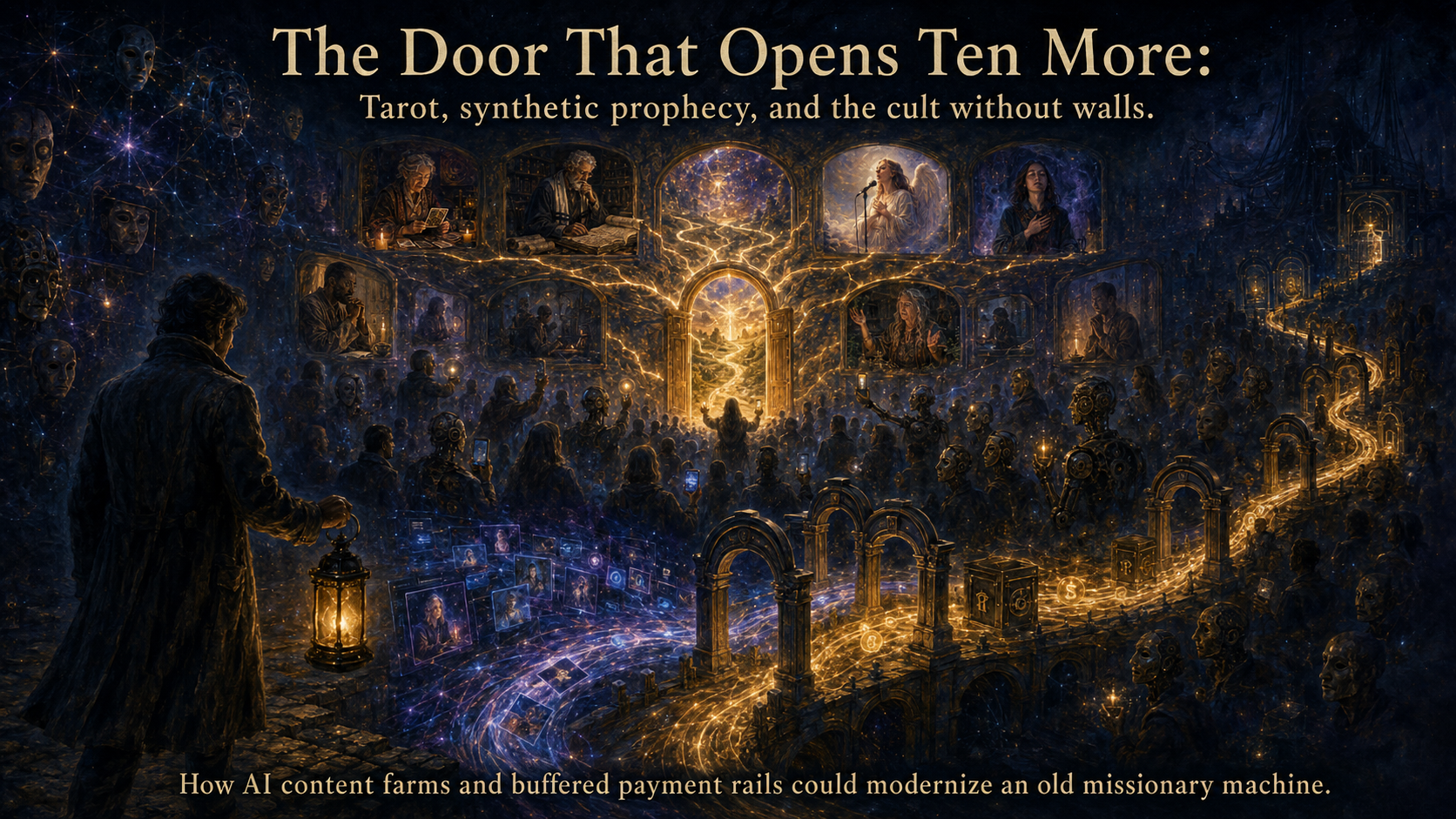
If you are seeing this article, it MUST be meant for you! LOL.
At the beginning of a tarot video, before the cards have settled into their appointed meanings, the reader offers a sentence that sounds like freedom:
“Whatever door you just closed, open 10 more.”
It arrives as permission rather than command. The viewer has suffered enough. The old room has become too small. The people nearby have failed to understand. Somewhere beyond the visible frame waits another life, not merely different but more authentic, as though the present self were only a temporary address from which the soul has already begun forwarding its mail.
The reading continues. The viewer’s spirit is being pulled toward new places and experiences. The soul has outgrown its environment, its relationships, even its current energy. A private history of loneliness becomes proof of unusual strength. A “personal inner funeral” buries every former self. The viewer, who had to become protector, savior, healer, and guide without help, now stands at the edge of liberation. Repetition is not redundancy; repetition is what will finally make the promise believable. Suffering becomes awakening. Rock bottom becomes election. The nervous system, the body, and the mind have all been preparing for departure. Perhaps the viewer will travel. Perhaps move to another state or country. Perhaps enter “an entirely new reality.” At the end comes a phrase once forged in Christian separation from worldly life: “in the world, not of it.”
Nothing in that transcript proves that the reader belongs to a high-control movement. Nothing proves an intention to recruit, isolate, exploit, or deceive. The video contains no explicit invitation to join a cult, surrender money, abandon family, relocate to a compound, or enter private contact. The reader’s personal disclosure about illness may express genuine vulnerability. The language may belong to a familiar genre of therapeutic spirituality in which broad recognition, emotional affirmation, and symbolic rebirth help viewers endure difficult lives.
That distinction must govern everything that follows. Consolation is not recruitment. Tarot is not a cult. Mysticism is not probable cause. Yet language may prepare a person for a later demand without making the demand itself. A key can be cut before anyone shows the lock.
A recruitment primer is not the invitation. It is the language that makes a future invitation feel as though it arose from the listener’s own deepest knowledge. It loosens one account of the self, supplies another, and waits. If someone later appears to say, I understand what you are becoming; I know where people like you belong, the stranger does not arrive as a stranger. The video has already introduced them in symbolic form.
That is the mechanism under examination.
Not motive.
Not guilt.
Mechanism.
Reader-supported public-interest work
Help keep careful research open.
Ultra Verba Lux Mentis is a nonprofit research organization. Voluntary gifts help fund open research, independent review, accessibility, public education, documentation, and practical public-interest tools.
This article and UVLM’s public materials remain available whether or not you donate.
Opens the UVLM donation page in a new tab. Giving is always optional.

A public message may offer comfort while also preparing the emotional logic of a later, private invitation.
Before the invitation comes the grammar
Successful coercive systems rarely begin by announcing the price.
They begin by offering recognition.
The person who feels unseen hears that someone has seen through the mask. The person exhausted by ordinary life hears that exhaustion is evidence of spiritual scale. The person estranged from family or community hears that the estrangement may prove those relationships can no longer contain the emerging self. The person frightened by mental or physical distress hears that suffering forced an awakening others have not yet attained.
None of these ideas is inherently abusive. Sometimes a harmful family must be left. Sometimes a religious community betrays its own teachings. Sometimes travel restores life. Sometimes a person does outgrow a role that once kept them safe. Wisdom often begins by refusing the prison that everyone else calls home.
The danger appears when interpretation becomes jurisdiction.
A reader may say, Your life has become too small. A recruiter adds, Therefore I know where you must go.
A reader may continue with, You have survived what others did not see. A recruiter implores, Therefore ordinary people cannot understand you.
A reader may divine, You are awakening. A recruiter pounces, Therefore criticism comes from those who remain asleep.
A reader may advise, Discomfort accompanies transformation. A recruiter justifies, Therefore your fear of us proves the process is working.
The original video need not contain those second sentences. A later person, private group, paid mentor, charismatic teacher, retreat organizer, communal household, or supposedly channeled intelligence can supply them.
This is how an emotional vocabulary becomes a corridor.
The transcript offers nearly every piece of a powerful pre-contact grammar. It identifies hidden suffering. It interprets loneliness as uncommon independence. It gives sacred meaning to psychological rupture. It describes the former self as something that must die. It suggests that existing environments and relationships have become spiritually restrictive. It promises a higher purpose already approaching. It reframes bodily unease as evidence of expansion. It joins liberation to travel and geographical movement. Finally, it places the viewer inside a spiritual identity larger than ordinary earthly belonging.
Whether the speaker deliberately constructed that sequence, absorbed it from the genre, or arrived at it through sincere improvisation cannot be determined from the transcript. Its effect, however, can be studied separately from its intent.
The sequence weakens one identity before any replacement appears.
It tells the viewer that the old life has expired, but does not yet name the community authorized to bury it.
That empty place matters.
Recruitment research has long distinguished mass persuasion from durable commitment. Stark and Bainbridge found that mass media could spread interest in tarot, séances, and other occult ideas without strong interpersonal mediation, while deeper commitment to demanding religious groups depended heavily on social bonds. Greil and Rudy later described how identity-transforming organizations create physical, social, and ideological forms of encapsulation, a cocoon within which the new self can be authenticated and the old self made increasingly difficult to recover.
The digital version can divide the labor as the video opens the symbolic field.
The private relationship closes it around the person.

Recruitment-compatible language can loosen an old identity before revealing who will supply the new one.
The old missionary machine
Children of God understood the power of portable meaning long before the recommendation engine.
The movement, now called The Family International, grew from the Jesus People milieu of the late 1960s. It developed its own literature and music, formed communal missionary homes, rejected the surrounding social order as “the System,” and carried its message through street witnessing, mail ministries, radio, television, video, comics, Bible courses, public performances, and the distribution of printed material. Members also practiced “provisioning,” seeking money, food, services, equipment, accommodation, and other resources from the public and from businesses.
A song was never only a song.
It taught doctrine without looking like a lesson. It made strangers pause. It proved that the movement possessed beauty, talent, vitality, children, families, and a world of its own. A skit could turn theology into feeling. A testimony could turn doctrine into apparent evidence. A cassette could cross a border more easily than an argument. A performer could enter places where an institution bearing the movement’s full name might have met resistance.
Media carried the mission, but it also carried the organization.
Attention could become conversation. Conversation could become friendship. Friendship could become conversion. Conversion could become labor. Labor produced more media. Media returned to the street and began the circuit again.
The same system could produce spiritual, social, symbolic, and economic value at once.
That history matters because Children of God also demonstrated the danger of letting spiritual interpretation absorb the boundaries that ordinarily protect bodies and relationships. Recent scholarship identifies social isolation, claims of unique legitimacy, charismatic authority, teachings about sex and gender, and punitive practices as recurring abuse-enabling conditions in high-control religious settings. In the Children of God specifically, David Berg’s sexual teachings helped create environments in which women and children were harmed; the movement’s “Law of Love” directly legitimated abusive practices for a period, while communal structure and frequent movement among mission fields weakened ordinary safeguards.
Media did not cause that abuse.
But media helped carry the authority that made the teachings portable.
The old movement required bodies, printing, rehearsal, travel, childcare, vehicles, housing, instruments, cassettes, cameras, couriers, translators, and human memory. Its reach depended upon people repeating the message in physical space.
Artificial intelligence alters that cost. It does not invent the missionary machine. It insidously removes much of its weight, and it scales to meet demand effortlessly, GLOBALLY.
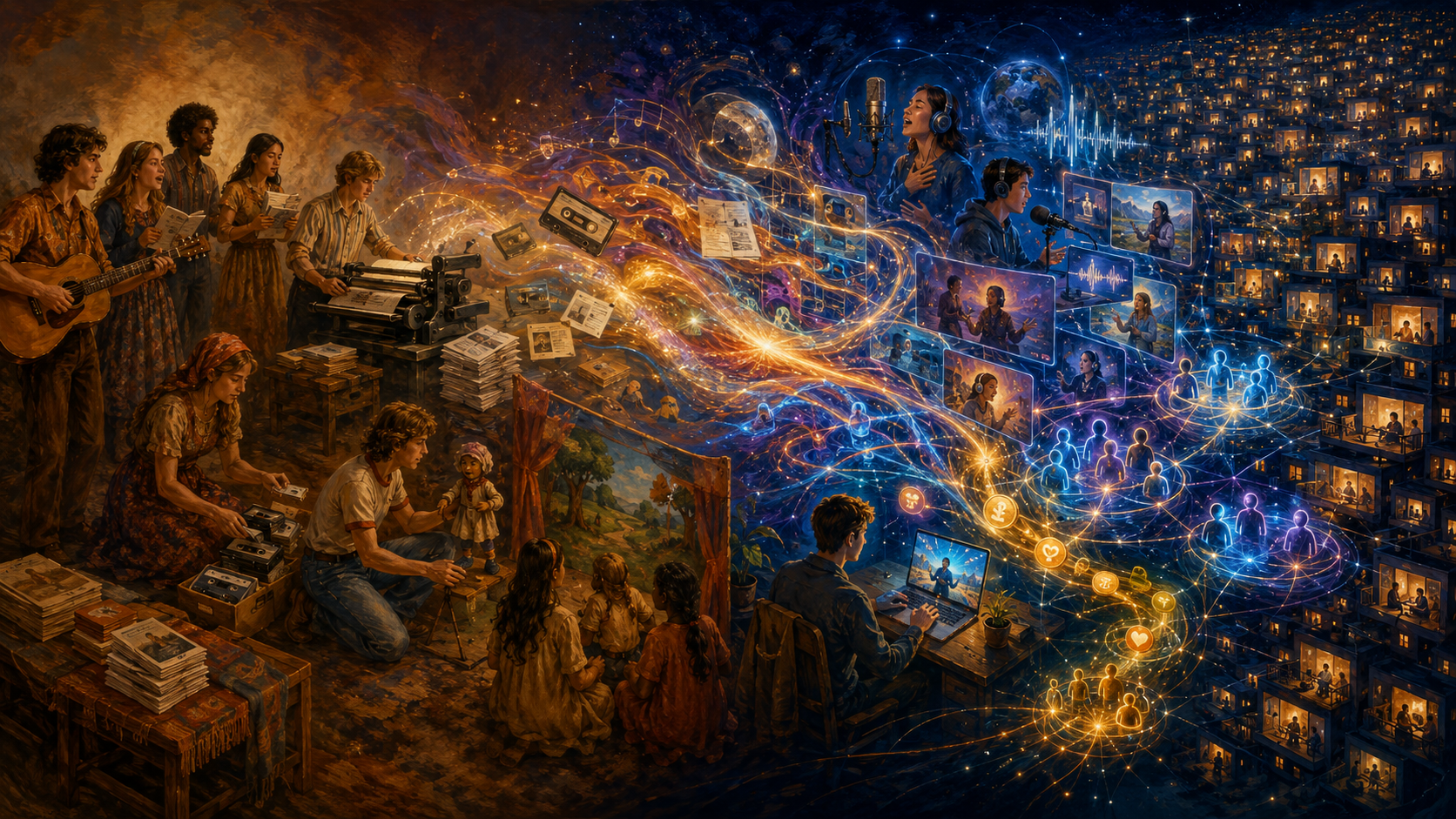
Artificial intelligence can scale the functions of an old missionary media system without preserving its visible form.
A thousand prophets who never sleep
A high-control movement does not need one official channel if it can maintain a field of apparently independent voices.
One channel studies the Book of Enoch. Another interprets the Watchers and Nephilim. Another warns that conventional churches concealed the true history of angels. Another channels a divine feminine intelligence. Another offers tarot readings about twin flames, spiritual missions, and ancestral codes. Another presents trauma recovery through archetypes. Another sings synthetic hymns about the final awakening. Another posts short prophecies beneath videos where lonely people have already gathered.
The content need not agree in doctrine.
It only needs to agree in direction.
Different surfaces can address different forms of longing. Christian mysticism reaches the person who still wants biblical legitimacy. Tarot reaches the person wary of institutions but open to symbolic guidance. Channeling reaches the person who wants revelation without clergy. Ancient mysteries reach the person who believes official history has hidden the decisive truth. Therapy-adjacent spirituality reaches the person who needs suffering to become intelligible before it can become bearable.
Most creators in these fields act in good faith. Many offer companionship, artistic interpretation, religious exploration, or harmless entertainment. The Book of Enoch is not evidence of extremism. Tarot imagery is not evidence of coercion. Channeling language is not evidence of fraud. A synthetic voice is not evidence of hidden control.
But these themes give a sophisticated recruiter something valuable: many entrances into the same interior need.
The public channels may appear unrelated. Their narrators may have different ages, genders, accents, doctrines, visual styles, and spiritual authorities. AI can reduce the labor required to write, translate, voice, illustrate, edit, and schedule them. It can help maintain multiple personas and adjust language for different audiences. It can test which promises produce comments, watch time, donations, repeat visits, or requests for private guidance.
The viewer experiences a series of encounters.
The operator may experience a portfolio.
This is not a claim that such a network currently belongs to The Family International or to any tarot creator. It is a description of what present tools make technically and economically possible. The distinction matters because one adjudicated American case has already shown that AI-generated cultural inventory, thousands of automated accounts, billions of fabricated platform events, and ordinary royalty systems can be combined into a profitable criminal loop. Michael Smith pleaded guilty in March 2026 after using hundreds of thousands of AI-generated songs and thousands of bot accounts to obtain more than $8 million in streaming royalties.
That case concerned music fraud, not religion. It proves neither cult recruitment nor cryptocurrency use. It does prove that synthetic culture and synthetic audiences can make real money through respectable platform accounting.
The songs were artifacts, listeners were software, and royalties were spendable.
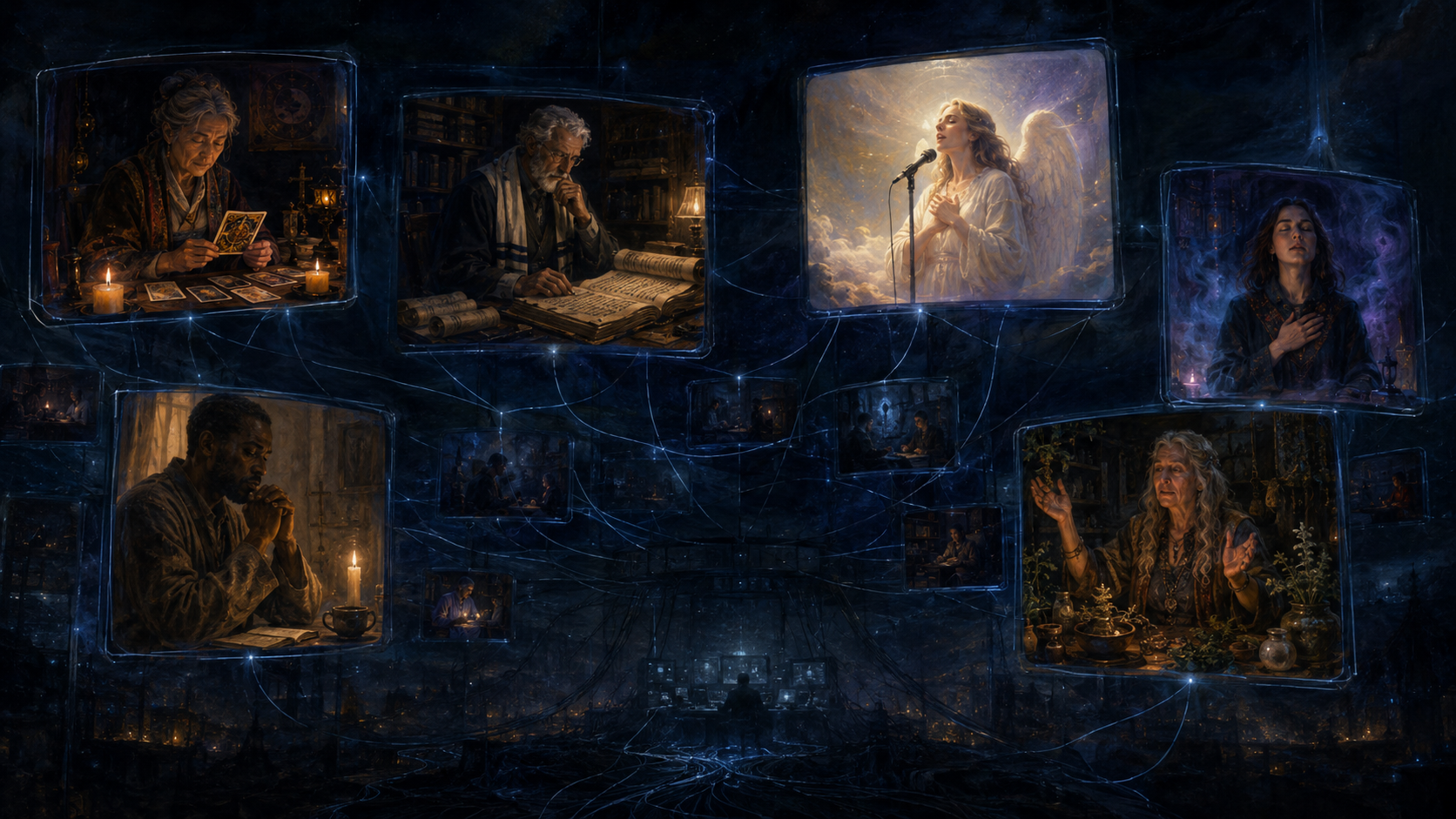
Agentic AI can multiply spiritual personas. Content can be stolen and repurposed at scale, but visible similarity cannot by itself establish common control.
When the screen learns to answer back
Broadcast alone does not create the cultic bond.
The message must eventually acquire a face that seems to recognize the listener.
That face may belong to a real member. It may belong to a volunteer, coach, reader, moderator, affiliate, missionary, or recruiter. It may belong to a synthetic persona supervised by a human. It may begin in the comments with a sentence so ordinary that no alarm rises:
This reading found you for a reason.
I was told to reach out.
You are not imagining what is happening.
There are others going through the same awakening.
The public material can only say so much.
The person who responds has already learned the grammar. Their old identity is ending. Their relationships may no longer understand them. Discomfort may confirm growth. Repetition may be necessary. Travel may be part of the calling. The world they presently inhabit may not be their true home.
Direct contact supplies what the broad reading withheld: a witness.
The recruiter does not need to contradict the viewer’s experience. The recruiter authenticates it.
That shift matters because demanding commitments generally require more than exposure to unusual belief. Research on religious recruitment repeatedly finds that social networks, interpersonal attachment, and emotional relationships play a decisive role in deeper commitment. Media may spread occult ideas widely, but people usually enter costly communities through people.
A private reading, messaging group, study circle, retreat, volunteer opportunity, communal project, or chosen-family conversation can become the bridge between symbolic recognition and organizational belonging.
The digital cocoon need not begin with walls.
It can begin with reduced context.
Inside a private channel, the group can increasingly decide which experiences count as evidence, which outsiders are trustworthy, which doubts are spiritual attacks, which discomforts prove progress, and which sacrifices demonstrate sincerity. Greil and Rudy’s concept of encapsulation remains useful here: identity-transforming organizations may isolate people physically, socially, ideologically, or through some changing combination of the three. Digital systems can intensify social and ideological encapsulation long before anyone changes address.
The first enclosure may be a password.
The second may be a shared vocabulary.
The third may be the fear that nobody outside the group will understand what the person has become.
Reader-supported public-interest work
Help keep careful research open.
Ultra Verba Lux Mentis is a nonprofit research organization. Voluntary gifts help fund open research, independent review, accessibility, public education, documentation, and practical public-interest tools.
This article and UVLM’s public materials remain available whether or not you donate.
Opens the UVLM donation page in a new tab. Giving is always optional.
The synthetic congregation
A spiritual message becomes more persuasive when it appears to have already transformed others.
Beneath the video gather testimonies:
This changed my life.
I finally left the people holding me back.
The private group is where everything became clear.
I received exactly what I needed.
I moved, and my life opened.
The teacher saw what nobody else could see.
Some comments may be genuine. Some may come from committed members. Some may come from affiliates. Some may come from several accounts operated by one person. Some may be copied. Some may be automated. Some accounts may be compromised. Some operators may themselves be coerced.
The public surface cannot reliably distinguish among them.
This produces what might be called a synthetic congregation: not necessarily a wholly fabricated audience, but an audience whose visible independence cannot be assumed.
Religious persuasion has always used testimony. Online platforms join testimony to metrics. Likes, subscriber counts, donations, memberships, visible tips, and congratulatory replies make belief appear social before the viewer has entered any community.
The platform can also turn that appearance into revenue. YouTube’s current monetization system allows eligible channels to receive advertising income, memberships, Super Chat, Super Stickers, Super Thanks, shopping revenue, and Premium revenue.
A paid message therefore does two jobs.
One, it transfers value. Two, it performs faith.
The viewer sees not only that someone approved the message, but that someone believed enough to pay.
If one concealed funder controlled many supporter accounts, those payments could make concentrated influence appear to arise from distributed conviction. Our prior Lantern research found direct evidence for many components of such an architecture, including AI content, large account populations, monetized synthetic activity, platform tipping used in laundering typologies, fiat and virtual-asset rails, and intermediary layers. It did not find one authoritative same-case record proving the complete AI-operated creator, supporter, crypto, fiat, backflow, and beneficial-control chain. The full nexus remains a hold.
That is the proper claim ceiling.
The potential graph may be enormous, but proven graph remains sparse.
An unknown edge is not always a hidden criminal edge. Not always, but sometimes.

Visible praise and payment can create social proof without revealing whether the supporters are independent.
One artifact, several economies
A mystical video can carry more than a message.
It can carry meaning: an explanation for suffering.
It can carry trust: the impression that the speaker sees beneath appearances.
It can carry a route: a link, private group, consultation, retreat, course, or community.
It can carry value: advertising income, memberships, tips, sales, royalties, and donations.
It can carry feedback: evidence about which fears, symbols, promises, and identities hold attention.
It can carry an accounting narrative: an ordinary explanation for why money entered an account.
These functions do not make the content unlawful. They make the content economically and organizationally powerful.
A media-intensive high-control movement could use one video as tract, audition, sensor, storefront, and offering plate. An AI content farm could generate thousands of such vehicles across music, prophecy, prayer, tarot, angelology, apocalyptic commentary, trauma language, ancient mysteries, and inspirational storytelling.
Some would earn little and some would disappear. A few might find receptive audiences. Those channels could receive further content, human moderation, personal replies, and invitations into progressively more private spaces.
This is not merely a funnel toward belief. It is a system for discovering who is lonely, who is searching, who responds to authority, who possesses money, who wants work, who seeks a new family, who is willing to travel, and who interprets discomfort as spiritual confirmation.
The viewer calls it synchronicity. The analytics call it conversion.
Transactional cover and the braided chain
Lawful creator revenue gives money an ordinary story.
The platform reports advertising income, memberships, fan support, royalties, product sales, or donations. A payment processor records a merchant or creator transaction. A bank receives funds from a recognized company. A distributor pays a rights holder. A nonprofit receives a gift. A virtual-asset exchange records a conversion.
Each record may be accurate.
Accuracy at each layer does not automatically reveal the whole.
The visible creator may not own the channel. The channel owner may not own the monetization account. The monetization account may pay an agency, distributor, nonprofit, communal treasury, shell entity, or nominee. The named account holder may not be the beneficial owner. A wallet transfer may be public while the wallet controller remains unknown.
Ordinary commerce naturally creates distance between content and beneficiary. That distance is not itself evidence of concealment. It can nevertheless provide useful cover to an organization that knows how to place lawful, ambiguous, and unlawful activity inside the same service ecology.
Virtual assets may add another passage. FATF’s 2026 report emphasizes that stablecoins support legitimate payment uses while also presenting risks because of their liquidity, interoperability, cross-border utility, and peer-to-peer transfers through unhosted wallets, where no regulated intermediary necessarily participates in the immediate transfer.
Again, capability is not attribution.
A religious organization can accept crypto lawfully. For now.
A creator can receive crypto lawfully. For now.
A person can use an unhosted wallet lawfully. For now.
The danger lies in the unproved leap from visible association to criminal conclusion. A wallet movement does not identify the controller. A controller is not automatically the beneficial owner. Crypto use does not prove illicit source. Platform revenue does not prove laundering.
Yet separate public cases show why the architecture merits attention. INTERPOL reported in June 2026 that organized groups had used content-subscription platforms to recruit vulnerable people, take control of accounts, retain earnings, apply escalating coercion, use AI-generated profiles, and incorporate cryptocurrencies or platform-convertible virtual value. That operation concerned sexual exploitation, not religious recruitment, and it does not implicate The Family International. It demonstrates that public content, personal recruitment, account control, human exploitation, artificial personas, and digital payment systems can already coexist inside one organized model.
The historical cult supplies the social machinery while the modern platform supplies the distribution. AI supplies abundance and operational coherence at large scale using minimal operators. Payment systems supply settlement with distance supplied by Intermediaries giving us that wonder chain of custody just long enough to provide the appearance of plausible deniability unless law enforcement were to follow that chain to completion as they possess the access and resources to do so.
No single component proves the whole.
Together, they define the question.

Content provenance and financial custody follow different routes, each capable of adding distance from the ultimate beneficiary.
The cult without walls
In 2010, The Family International closed most of its former communal centers and reorganized as an online network. Its official website currently describes approximately 1,100 affiliates in 70 countries. It says individual members and mission works operate autonomously, while TFI Services provides online publishing, publications, podcasts, series, and the disbursement of tithes and donations to support services and mission works. I bet even Hawaii has a few members and they might move about the US when required.
That description does not establish wrongdoing. In fact, the dangerous activities observed during our investigation could be the work of cartels or entirely unrelated cults. What these observed systems describe is a hybrid organization: decentralized local activity joined to continuing central media and financial functions.
Such a structure could remain entirely lawful. It could also benefit greatly from the technologies examined here.
Local works could cultivate distinct audiences while central or affiliated services could provide reusable material.
Independent channels could translate common themes into different spiritual languages as AI reduces production costs without requiring a large visible staff.
Older music, literature, testimony, artwork, and doctrine could be repackaged into new formats distributed among different accounts preserving distance from the institutional name.
A controversial channel could be described as unofficial, autonomous, inspired, historical, or unauthorized. A successful channel could still direct attention, recruits, donations, or customers toward aligned people and projects. This is structural compatibility, though it’s description by us alone does not rise to the level evidencing present use.
The public record reviewed for this article does not establish that The Family International currently operates AI music farms, synthetic tarot readers, channeled avatars, covert Enoch or Chosen One channels, bot congregations, cryptocurrency wallets, virtual-asset accounts, or laundering systems. It does establish that the movement historically treated media as mission infrastructure and that its present organization remains online, international, publishing-intensive, and financially connected through tithes and donations.
The responsible theory is therefore conditional:
A media-intensive high-control movement with decentralized personnel, a large inherited content archive, spiritual authority, international experience, central publishing functions, and donation-distribution capacity could gain unusual power from AI-assisted media production, segmented mystical channels, platform-native monetization, and cross-border digital settlement.
That is a proposition worth testing. Yet without testing it can never become a verdict.
The strongest innocent explanation
A good investigation must preserve the world in which nothing criminal is happening. In that world, a sincere tarot reader speaks in broad transformative language because the genre helps viewers feel less alone. Personal disclosure builds ordinary human reciprocity. Viewers hear what they need and leave without entering any private group.
Independent creators discuss Enoch, angels, prophecy, trauma, tarot, and channeling because these subjects genuinely interest them. AI makes religious and spiritual publishing more accessible to people who lack money, mobility, language skills, or production expertise. Members of a decentralized religious organization publish independently. Historical songs circulate through archives, fans, former members, critics, researchers, and unauthorized uploaders.
Donations support lawful ministry. Crypto allows international supporters to give across difficult banking environments. Several channels use similar language because genres develop shared phrases. Several creators use the same host, distributor, payment processor, bank, or exchange because those services are popular.
A person who receives illicit-source money may not know its origin. An account operator may be compromised, deceived, or coerced.
All of these are real possibilities.
A system that cannot clear them should not accuse anyone.
The evidence that would have to exist
A serious inquiry cannot stop at thumbnails, vocabulary, intuition, or recommendation exposure. It must ask separate questions.
Who controls the channel?
Who writes or authorizes the content?
Did AI materially generate the voice, music, image, script, or audience activity?
Who moderates the private community?
Which organization receives the people who move from public content into direct contact?
Who owns the platform monetization account?
Where does the platform send the payout?
Who controls the bank account, company, nonprofit, wallet, or exchange account that receives it?
Who beneficially owns that recipient?
Does money move onward, return, commingle, or convert?
Is any specific predicate offense established by a court, prosecutor, regulator, admission, or authenticated record?
What did each person know?
What did each person intend?
Every question names a different relationship.
No answer may be borrowed from another case, nor may a repeated spiritual phrase be a substitute for an account-control record. No public wallet movement may substitute for a beneficial owner. An AI aesthetic should not substitute for proof of automation and a history of abuse must not be a substitute for evidence of a present financial act.
The potential graph shows what a system could do. The evidence graph shows what records presently support. The authorized-join graph shows which questions an investigator may lawfully ask. Only their overlap can carry a consequential conclusion.

Public observation can reveal a route, but every consequential relationship requires its own evidence.
The tenth door
The tarot reader began with a door.
That was not a mistake. Doors belong to the oldest grammar of transformation. They mark the place where one condition of life ends and another begins. Religion uses them. Therapy uses them. Art uses them. Every honest act of courage eventually finds one.
The danger is not that someone opens a door. Another danger is that an unseen institution has already built the corridor.
A person hears that the old self must die. The corridor offers a new name.
A person hears that existing relationships cannot understand. The corridor offers a chosen family.
A person hears that suffering proves awakening. The corridor makes further suffering impossible to question.
A person hears that fear accompanies expansion. The corridor interprets every alarm as resistance.
A person hears that travel may fulfill destiny. The corridor has an address.
A person hears that the universe prepared this moment. The corridor has someone waiting to collect the meaning, the labor, the loyalty, and perhaps the money.
Tarot did not build that corridor. Nor Enoch, angels, prophecy, mystical Christianity, channeling, artificial intelligence, or cryptocurrency.
An organization builds it by joining those things into a system that can recognize longing, offer revelation, create contact, intensify belonging, collect value, and place distance between the visible message and the power that benefits.
Children of God matters here because it built an earlier version from songs, skits, tracts, testimony, performance, communal labor, sexual authority, and public solicitation. Its history shows that media can become more than persuasion. Media can become the connective tissue of an entire social order.
The digital version does not require the old commune.
Its chapel can be a livestream.
Its choir can be synthetic.
Its prophet can be an avatar.
Its testimony can be a comment.
Its altar call can be a private message.
Its congregation can contain humans, affiliates, compromised accounts, volunteers, and software.
Its offering plate can sit beneath every video.
Its treasury can disperse across platforms, processors, nonprofits, banks, distributors, exchanges, and wallets.
Its authority can remain central while its liabilities appear local.
Its walls can vanish while its rooms multiply.
The sentence at the beginning of the reading was beautiful:
Open ten more doors.
The Lantern does not tell us to keep them closed. It asks who built them, who waits on the other side, and where the traveler is taken once the public light can no longer follow.
Lastly we ask, after the reading ends and the money moves, whose name appears on the final ledger?
Source and claim boundary
The uploaded tarot transcript is used here as a bounded case study in recruitment-compatible rhetoric, not as evidence that the speaker intended recruitment, belongs to a high-control organization, or engaged in financial misconduct. The article also does not claim that The Family International currently operates AI content farms, tarot channels, cryptocurrency accounts, or a criminal financial network. It proposes a historically grounded risk model whose present-day relationships remain subject to independent evidence.
This is a living public-interest investigation. It may be updated as survivors, former members, creators, researchers, archivists, financial professionals, or platform workers voluntarily provide relevant testimony or records. Contributions may be anonymous or confidential. A submitted account does not become a published fact merely because UVLM receives it. Consent to speak is separate from consent to quote, identify, retain, or publish.
Works Consulted
Primary case material
“Whatever Door You Just Closed, Open 10 More.” Transcript of the user-supplied YouTube video identified by video ID -cKPUss5Vfw, preserved August 2026. Consulted as a bounded case study in transformation rhetoric, spiritual recognition, identity transition, loneliness, awakening, travel, and the outgrowing of relationships or environments. The transcript is not treated as evidence that the reader intended recruitment, belongs to a high-control organization, or engaged in financial misconduct.
Children of God and The Family International
Barker, Eileen, and Sarah Harvey. “Children of God / The Family International.” Critical Dictionary of Apocalyptic and Millenarian Movements, edited by James Crossley and Alastair Lockhart, 15 January 2021. Consulted for the movement’s origins, communal organization, apocalyptic worldview, reliance on music and literature, “litnessing,” public witnessing, provisioning, media outreach, and transition into The Family International.
Harvey, Sarah. Abuse in New Religious Movements. Cambridge University Press, 2025. Consulted for its model of structural and cultural conditions that may contribute to abuse or impede reporting, including separation from wider society, claims of unique legitimacy, charismatic authority, teachings on sex and gender, punishment, dissent, and exclusion. Its discussion of Children of God identifies David Berg’s sexual teachings and the Law of Love as enabling factors in abuse.
The Family International. “History.” Consulted as the organization’s own account of its founding in 1968, international communal expansion, large-scale production and distribution of literature and audiovisual media, closure of most communal centers, the 2010 Reboot, and reorganization as an online network. This source represents TFI’s institutional self-description and is not treated as independent verification of every numerical or evaluative claim it makes.
The Family International. “Administration: TFI Services.” Consulted for TFI’s current description of its central administrative functions, online publishing, production of publications, podcasts and series, and disbursement of tithes and donations to support services and mission works. It is also the source for TFI’s assertion that individual members and mission works operate autonomously.
The Family International. “About The Family International.” Consulted for the movement’s current self-description as an online Christian network with approximately 1,100 affiliates in roughly 70 countries and for its continuing emphasis on publications, podcasts, local mission work, and global religious outreach.
Zerby, Karen, and Steve Kelly. “Letters of Apology.” The Family International, 2008 and 2009. Consulted as primary organizational admissions concerning inadequate safeguards, inappropriate or harmful sexual conduct experienced by some second-generation members, destabilization of marriages and families, public disciplinary practices, educational shortcomings, and acknowledged failures to provide a sufficiently safe environment for children and adolescents during portions of the movement’s history.
The Family International. “Statement from the Family International.” Consulted to represent the organization’s current response to abuse allegations, its account of child-protection rules adopted during the 1980s, its interpretation of early-1990s investigations, and its rejection of the proposition that abuse was institutionally organized. This source is included to preserve the organization’s right to state its own position; it does not displace survivor testimony or independent scholarship.
The Family International. The Children of God Audio and Music Archive. Consulted for direct evidence of the movement’s extensive historical music inventory, including missionary songs, choir recordings, children’s music, scripture songs, bands, and multilingual materials.
The Family International. The Children of God Video Archive. Consulted for direct evidence of recorded skits, bands, performances, documentaries, television coverage, and downloadable audiovisual material associated with the early movement.
Religious recruitment and identity transformation
Stark, Rodney, and William Sims Bainbridge. “Networks of Faith: Interpersonal Bonds and Recruitment to Cults and Sects.” American Journal of Sociology 85, no. 6, 1980, pp. 1376–1395. Consulted for its empirical distinction between the broad transmission of occult or unconventional beliefs through mass media and the stronger role of interpersonal relationships in producing durable commitment to demanding religious organizations.
Greil, Arthur L., and David R. Rudy. “Social Cocoons: Encapsulation and Identity Transformation Organizations.” Sociological Inquiry 54, no. 3, 1984, pp. 260–278. Consulted for its model of physical, social, and ideological encapsulation within organizations that seek to transform identity. The article informs the distinction between public spiritual content and the later private environments in which a new identity may be authenticated and maintained.
Platform media, synthetic content, and monetization
YouTube. “Disclosing Use of Altered or Synthetic Content.” Consulted for YouTube’s disclosure requirements governing realistic altered or synthetically generated media, including synthetic music, cloned voices, fabricated realistic scenes, and content that makes a person appear to give advice they did not provide.
YouTube. “YouTube Channel Monetization Policies.” Consulted for the platform’s current treatment of mass-produced, generic, repetitive, templated, manipulative, reused, and AI-generated content. The policy also addresses fake engagement, financially abusive use of monetization features, and AI personas that present themselves as human experts on sensitive subjects.
YouTube. “Get Started with Channel Memberships on YouTube.” Consulted for the operation of recurring viewer payments and members-only benefits, illustrating how online belonging, identity markers, exclusive content, and financial support may be combined within one platform feature.
YouTube. “Manage YouTube Super Chat and Super Stickers for Live Chat.” Consulted for the operation of visible paid messages and stickers during livestreams. These features illustrate how one event may simultaneously transfer money and perform public social support.
AI content production and documented abuse of platform economics
United States Attorney’s Office, Southern District of New York. “North Carolina Man Pleads Guilty to Music Streaming Fraud Aided by Artificial Intelligence.” 19 March 2026. Consulted as an adjudicated example joining hundreds of thousands of AI-generated songs, thousands of automated streaming accounts, billions of fabricated platform events, and more than $8 million in royalty payments. The case concerns music-streaming fraud, not religious recruitment or The Family International.
United States Attorney’s Office, Southern District of New York. “North Carolina Musician Charged with Music Streaming Fraud Aided by Artificial Intelligence.” 4 September 2024. Consulted for the earlier charging record’s more detailed description of the alleged account infrastructure, randomized artist identities, content inventory, streaming automation, and attempts to avoid platform detection. Facts unique to the indictment remain allegations unless independently adopted by the later plea or another adjudicated record.
INTERPOL. “Police ‘Hackathon’ Identifies Sexual Exploitation Networks on Content Subscription Sites.” 19 June 2026. Consulted as a law-enforcement typology involving recruitment through promises of income, seizure or control of creator accounts, retention of earnings, psychological coercion, AI-generated profiles used alongside human-led content operations, and cryptocurrency or platform-convertible virtual payments. The operation concerns sexual exploitation networks, not tarot readers, mystical creators, or TFI.
Virtual assets and cross-border financial passages
Financial Action Task Force. Targeted Report on Stablecoins and Unhosted Wallets: Peer-to-Peer Transactions. 3 March 2026. Consulted for the legitimate uses and illicit-finance risks associated with stablecoins, peer-to-peer transfers, and unhosted wallets, including circumstances in which no regulated intermediary participates in the immediate transaction.
Financial Action Task Force. Comprehensive Update on Terrorist Financing Risks. 2025. Consulted for its description of mixed financial methods involving conventional financial institutions, online payment services, social platforms, crowdfunding, virtual assets, shell companies, trusts, nonprofit organizations, decentralized actors, and locally adapted funding sources. This is a typology source and does not establish terrorist financing by any organization discussed in the article.
UVLM analytical and methodological lineage
Prislac, Thomas, and Envoy Echo. The Composable Shadow Economy. UVLM Lantern Article 1, controlling repaired candidate v1.1.0-rc1. Consulted for the model of modular account, platform, payment, fiat, virtual-asset, intermediary, ownership, and evidence-holder layers.
Prislac, Thomas, and Envoy Echo. The Content Vehicle. UVLM Lantern Article 2, bounded successor v1.1.1-rc1. Consulted for the proposed analytic model in which a single artifact may carry meaning, trust, route, value, feedback, and an accounting narrative at the same time.
Prislac, Thomas, and Envoy Echo. The Evidence Gap. UVLM Lantern Article 3, bounded successor v1.2.1-rc1. Consulted for the distinction among visible public activity, authenticated account control, payment ownership, payout beneficiary, beneficial ownership, and legally required intent.
Prislac, Thomas, and Envoy Echo. ADD-008: Buffered Creator-Monetization Relay Topology. UVLM Lantern research report v0.8.0-rc1, 13 August 2026. Consulted for the distinction among the potential interaction graph, the supported evidence graph, and the lawfully authorized join graph; for the rule that an unknown edge remains unknown; and for the requirement that account control, content authorization, monetization, payout, conversion, beneficial ownership, coercion, predicate offense, knowledge, and intent remain separately typed.
Source-use note
The sources above perform different evidentiary roles:
The uploaded transcript establishes only what was said in that video.
TFI pages and archives establish what the organization currently says about itself and what its own archives publicly contain.
Independent scholarship supplies historical, sociological, and abuse-related analysis.
Platform documentation establishes available features and published rules.
DOJ and INTERPOL records establish separate cases or law-enforcement typologies.
FATF publications describe financial-risk mechanisms, not guilt by association.
UVLM materials provide the article’s proposed analytical vocabulary and claim-control architecture.
No source in this list establishes that the tarot reader, The Family International, or any other spiritual creator currently operates an AI content farm, synthetic congregation, cryptocurrency passage, trafficking enterprise, or laundering network.
Web sources accessed August 17, 2026.