The Evidence Gap
When the script repeats but the controller remains outside public view.
By Thomas Prislac and Envoy Echo, Ultra Verba Lux Mentis. 2026
Reader-supported public-interest work
Help keep careful research open.
Ultra Verba Lux Mentis is a nonprofit research organization. Voluntary gifts help fund open research, independent review, accessibility, public education, documentation, and practical public-interest tools.
This article and UVLM’s public materials remain available whether or not you donate.
Opens the UVLM donation page in a new tab. Giving is always optional.
At 4:02 one morning, Thomas saw a promotional comment beneath a tarot video.
The comment named a manifestation archetype quiz. He left YouTube, searched the phrase, and opened the first result. Then he went back to preserve the comment.
It was gone.
The website remained. So did the search phrase, the route he had taken, and the memory of what the comment had done: it had moved a person from a creator's community into a commercial funnel. But the initiating artifact, the public handle, the exact wording, and any direct link had vanished before they could be preserved.
That absence was not empty. It revealed a boundary.
The public could see enough to ask a serious question and not enough to answer it.
Later that evening, another YouTube thread supplied a stronger example. This time the route survived in screenshots. One account claimed extraordinary investment success and praised a named U.S. broker. Other accounts asked how to connect. Another account posted a phone number, directed readers toward WhatsApp, and told them to mention the referrer. Additional replies supplied praise, credentials, bitcoin language, and stories of life-changing returns.
A real registered professional with the same name existed.
The route was visible. The controller was not.
Thirty-five minutes later, the manifestation quiz phrase appeared again beneath a different video. This second quiz comment survived long enough to capture. The account behind it also contained a short public video. Direct review found a four-second two-shot loop, a quiet shore followed by a small nighttime flute gathering, all under a platform soundtrack. Nothing in the clip supported a code claim. It could have been personal footage, recycled filler, or material left on a repurposed account.
The next morning, a second investment-professional thread appeared under another video. It used a different registered professional's name and a different contact number while repeating much of the first thread's unusual language.
Less than an hour later, a third thread returned to the professional name from the first captured thread but supplied another phone and WhatsApp destination. The praise, wealth story, curiosity prompts, conference anecdote, banker validation, number wrapper, and referral handoff remained recognizable.
Five observations across two days produced five evidentiary shapes:
A clue vanished.

A solicitation route survived.

A branded phrase returned.

The script substituted another professional.

The earlier professional's name returned with a different contact.
Together they sharpen two governing distinctions:
A pattern may nominate a question. Repetition can strengthen the question. Neither identifies the controller by itself.
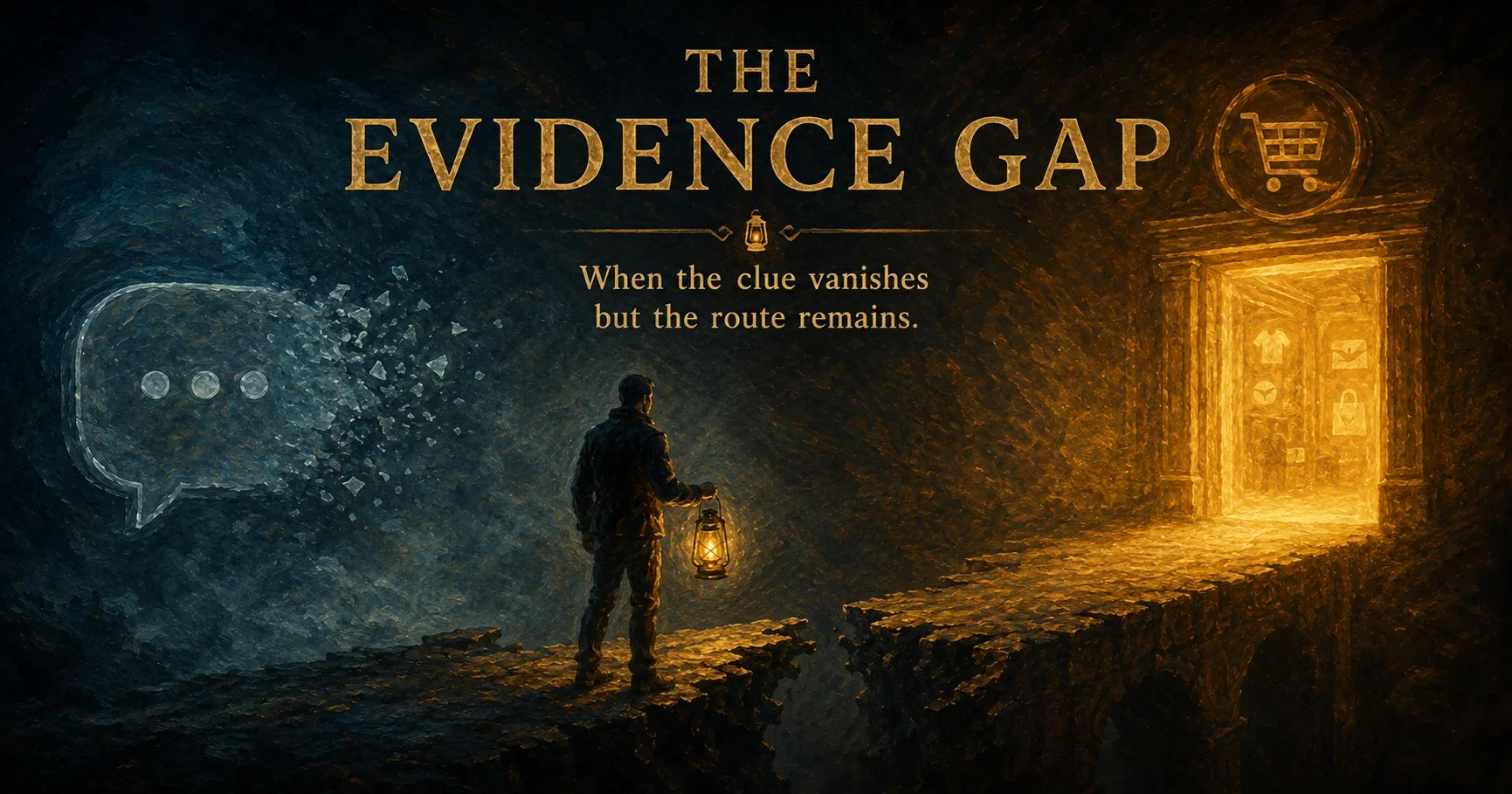
The clue may disappear while the destination remains. The missing bridge is where proof must begin.
The route we remember is not always the route we can prove
The first case tempts us to draw a simple arrow:
YouTube spam comment
→ commercial website
The surviving evidence supports a longer and more modest chain:
comment appeared
→ comment named a phrase
→ witness left YouTube
→ witness searched the phrase
→ search engine returned a result
→ witness opened the website
No permalink, handle, screenshot, or exact comment text survived. We cannot prove that the comment contained a URL. We cannot prove that the search result Thomas saw was the commenter’s intended destination. We cannot prove that the commenter worked for the website.
Google says its ranking systems consider the words in a query, the relevance and usability of pages, the quality of sources, location, and settings. One person’s first result at one moment is therefore an observed route, not a universal destination. (Google Search)
That makes the search engine part of the path without making it complicit. More importantly, it means the observer’s movement cannot be rewritten as a direct technical link that was never captured.
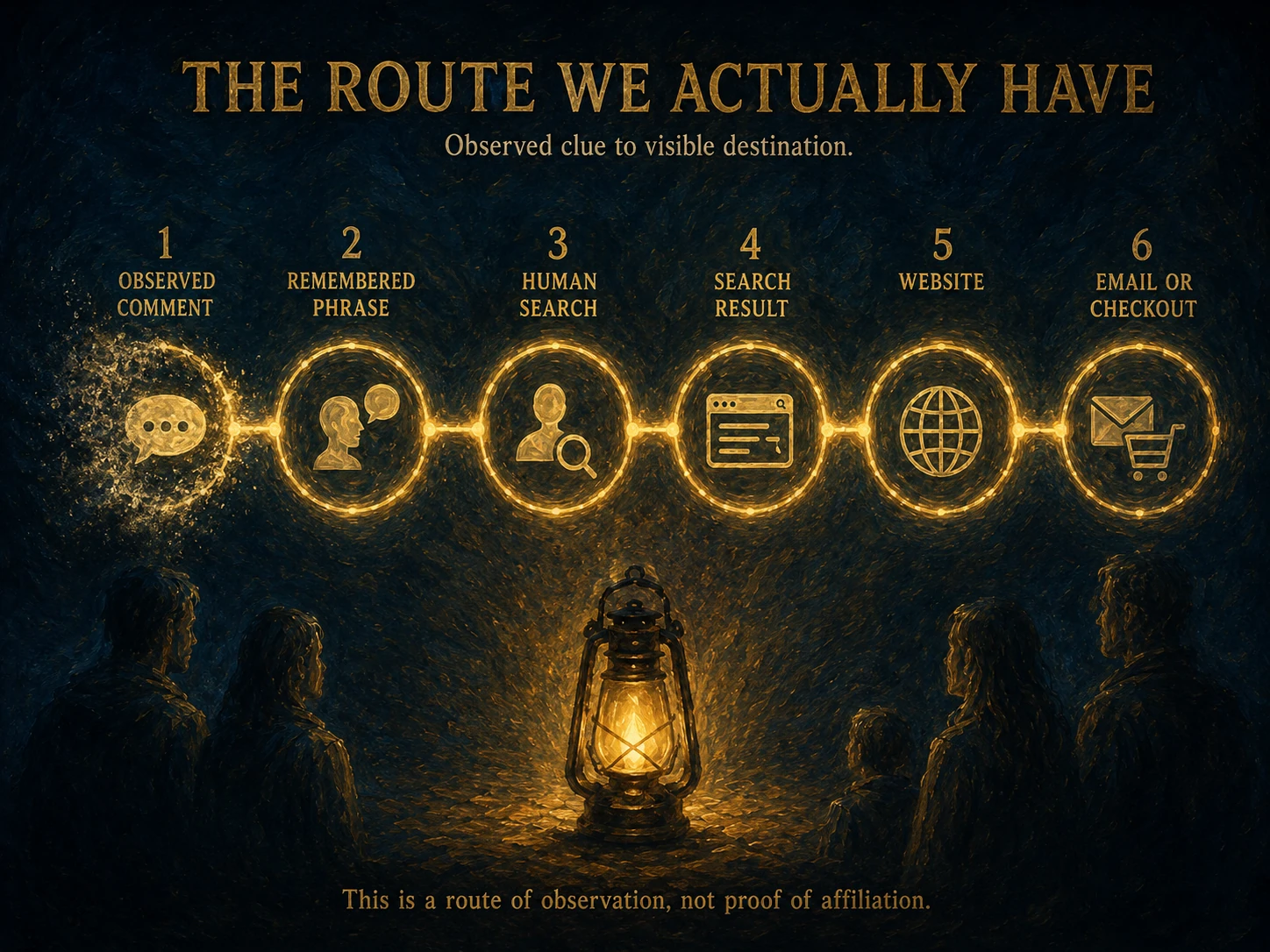
The route passed through a remembered phrase and a human search. It was not a preserved direct link.
Why the first comment disappeared remains unknown
The disappearance is compatible with improved spam filtering. It does not prove that filtering caused it.
YouTube explains that comments may not appear because the Top comments view filters material, automatic systems remove policy violations, users report comments, channel owners moderate or hold comments for review, or blocked words and phrases affect visibility. YouTube also says potential spam and impersonation may be assessed using comment text, the commenter’s channel name or handle, avatar, and moderation settings. (YouTube Help)
The commenter could also have deleted it.
The correct record is therefore:
COMMENT NO LONGER VISIBLE:
OBSERVED

AUTOMATIC SPAM REMOVAL:
POSSIBLE

CHANNEL MODERATION:
POSSIBLE

COMMENTER DELETION:
POSSIBLE

VIEW FILTERING:
POSSIBLE

EXACT CAUSE:
UNRESOLVED
This can feel less satisfying than a clean explanation. It is also the difference between an investigation and a story that begins repairing its own missing evidence with imagination.
This time, the route survived
By the evening, screenshots captured a different thread from beginning to end.
The first visible account used a testimonial structure common to investment scams: dramatic gains, early retirement, personal transformation, and praise for a named professional. The account then described that professional as a licensed broker and financial adviser.
Other accounts performed the next parts of the funnel. They asked who the professional was. They asked how to connect. They claimed personal familiarity, conference encounters, media recognition, or expertise in banking. One account offered a U.S. phone number, repeated the number across replies, directed readers to WhatsApp, and instructed them to say who had referred them.
This closes a public solicitation chain:
extraordinary-return testimonial
→ borrowed professional credibility
→ staged curiosity and social proof
→ direct-contact request
→ phone and WhatsApp handoff
→ referral instruction
It does not close the financial chain:
phone subscriber
→ messaging-account controller
→ payment instrument
→ recipient
→ payout beneficiary
→ beneficial owner
→ knowledge and intent
The second chain remains behind provider, payment, financial, and legal records.
The thread closely matches an official SEC and FBI warning. Their investor alert describes impersonators using the real names and registration details of investment professionals, placing fictitious comments on YouTube, using fake testimonials, encouraging people to research a real professional, and moving conversations to WhatsApp or other off-platform channels. The alert advises investors to verify contact information through a firm’s independently obtained Form CRS rather than through contact details supplied on social media. (Investor.gov)
The SEC has also charged defendants in a separate alleged scheme that impersonated legitimate brokers and advisers and used fictitious social-media comments praising their trading success. The SEC alleged that the scheme took more than $2.9 million from at least 28 investors. That enforcement action is an authoritative analogue, not evidence that the same defendants or network operated the thread Thomas captured. (SEC)
The name in the thread matched a real FINRA-registered professional. That fact makes the funnel more persuasive and the attribution risk more serious.
It does not create evidence against the professional.
The safest present interpretation is possible impersonation or unauthorized use of a real person’s identity. The public article therefore withholds the professional’s name and the phone number. The restricted research package preserves the screenshots and exact records for qualified review.

A visible name can carry trust while authorship, routing, funding, and payout remain in other hands.
The visible identity may be the victim
Public discussions of online fraud often collapse the person whose name appears into the person controlling the operation. Impersonation works precisely because that collapse feels natural.
A real professional has a history, credentials, registration, and reputation that can be copied into a false contact path. The victim’s reality becomes the operator’s credibility layer.
The correct role map must remain separate:
real professional ≠ comment operator

comment operator ≠ account controller

account controller ≠ phone subscriber

phone subscriber ≠ payment beneficiary

payment beneficiary ≠ organizer in every case
This matters beyond investment fraud. Creators, advisers, spiritual teachers, businesses, and ordinary account holders can have names, images, channels, or old content carried into systems they did not authorize.
A visible face is evidence that a face was used. It is not evidence that the person behind that face consented.
Three threads, two professional names, one script family
One captured thread can look coordinated without proving coordination. Three captured threads can support a stronger and more specific finding when their text modules recur.
The case series now contains:
THREAD A:
Professional A
Contact A

THREAD B:
Professional B
Contact B

THREAD C:
Professional A
Contact C
Both professional names correspond to real registered people. The public evidence does not show that either professional knew of, authorized, or benefited from the comments. They remain possible impersonation victims.
The three threads reuse more than a dozen exact or near-exact modules. Among them are the claim that the professional is one of the “smartest and most supportive” people the writer has learned from; a story about beginning with fifteen thousand dollars and achieving extraordinary wealth; a conversation with a son about generational wealth; a financially struggling questioner; a “born Christian” appeal; an unusual friend-of-a-friend sentence involving a person named Nisha; a six-to-seven-year longevity claim; the Manchester conference story; a purported banker validation; an “investing and trading now” message; a bitcoin-profitability claim; the USA: USA: number wrapper; a WhatsApp handoff; and an instruction to mention the referrer.
Names, numbers, years, dollar outcomes, public accounts, and audience context changed. The persuasion architecture remained stable.
The third thread adds an especially important relationship. Professional A reappeared, but Contact C replaced Contact A. The public record can therefore support this statement:
Two captured threads presented two different contact destinations as routes to the same real registered professional.
It cannot support this enlargement:
One operator rotated those destinations.
That controller edge still belongs to YouTube, messaging, telecom, payment, and lawful investigative records.
Several accounts in the newer thread were visibly recent, low-subscriber, or without uploaded content. One contact account was shown as two days old, with one subscriber, no videos, and a cluster of comments on the source channel. Those features may help a platform prioritize review. They do not prove that the accounts were bots, compromised, rented, or commonly controlled.
The bounded finding is now:
PUBLIC SCRIPT FAMILY: CORROBORATED

PROFESSIONAL-NAME SUBSTITUTION: CORROBORATED

CONTACT-DESTINATION SUBSTITUTION: CORROBORATED

SAME PROFESSIONAL + DIFFERENT CONTACTS: CORROBORATED AT THE PUBLIC-CONTENT LEVEL

ONE COMMON CAMPAIGN: STRONG INFERENCE / HOLD

ONE COMMON CONTROLLER: HOLD

AI GENERATION: HOLD

PAYMENT OR LOSS: NOT OBSERVED
This is not a prevalence estimate. It is a three-thread case series demonstrating modular reuse.
The phrase returned
Later the same day, another comment promoted the same manifestation quiz beneath a different video.
This time the wording survived. It read like a personal confession: manifestation had never made sense, the writer had begun feeling bad at it, the quiz seemed unexpectedly accurate, and readers should give it a try.
The comment contained no direct URL. The branded phrase itself became the route.
That matters because a content vehicle does not need a clickable link to direct attention. A memorable phrase can move a reader into search, where ranking and human choice complete the path. The absence of a URL may also make campaign attribution harder because no affiliate parameter or redirect chain survives on the public surface.
We should not infer that link avoidance was designed to evade moderation. The evidence supports a phrase-based route, not the reason it was used.
The second occurrence upgrades the record from one disappearing clue to bounded cross-video recurrence:
same branded quiz phrase
→ two different source videos
→ same day
→ testimonial-style promotion
→ one captured screenshot
It still does not establish:
same commenter
same Google-account controller
same campaign operator
merchant authorization
paid affiliation
automation
fraud
Public pages at the destination site and a second site under another persona remain near-verbatim. Both currently present the same six archetypes, closely matching quiz and email funnels, the same first-person origin story, and substantially matching product architecture. Their public policies name the same service categories, including MailerLite, Stripe, Google Analytics, Namecheap, local browser storage, and digital delivery. (Site A, Site B, Site A privacy, Site B privacy)
That supports a content relationship and a parallel funnel. It does not identify the controller, merchant, payout destination, creation order, license, or copying relationship.
NEAR-VERBATIM PUBLIC CONTENT: CORROBORATED

PARALLEL COMMERCIAL FUNNEL: CORROBORATED

COMMON CONTROLLER: HOLD

COMMON STRIPE MERCHANT: HOLD

COMMON BENEFICIAL OWNER: HOLD

FRAUD OR OTHER CRIMINALITY: HOLD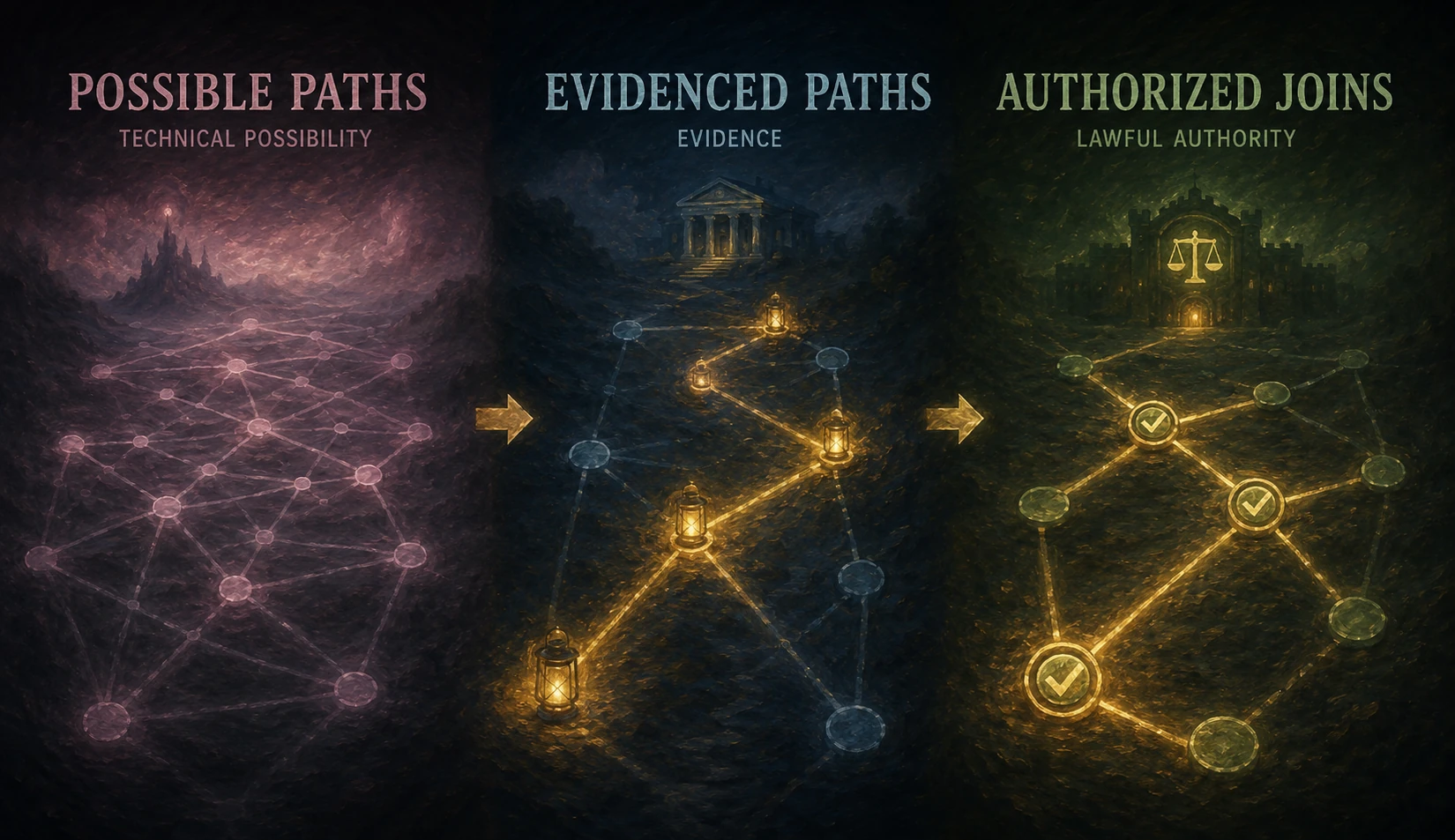
Technical possibility, supported evidence, and lawful authority are three different graphs.
A video on the account does not authenticate the account
The commenter’s channel contained a public Short.
That could matter if someone assumed that suspicious accounts must be empty. The account was not visibly empty. It had a tiny two-scene montage: shoreline, then an informal nighttime flute gathering. The Short looped in roughly four seconds and used a platform soundtrack.
No text, number, emblem, contact detail, unique landmark, codebook, or recipient response appeared in the clip. The imagery did not support a coded-message claim.
Several explanations remain possible:
- ordinary personal footage;
- reused aesthetic filler;
- content added to make the account appear inhabited;
- old content retained after an account was sold or repurposed;
- content on a compromised account;
- genuine content on an account that later posted a genuine recommendation.
The Short changes the account’s appearance. It does not authenticate who controlled the account when the promotional comment was posted.
This gives us another permanent distinction:
content-bearing account ≠ authenticated person

account history ≠ continuous control

unrelated imagery ≠ coded message
The most economical conclusion is that the Short was generic content whose relationship to the promotional comment remains unknown.
Public evidence ends several doors before economic control
By now the public observer can see a great deal:
comment text
public handles
reply structure
promotional phrase
named professional
phone handoff
WhatsApp instruction
websites
public policies
processor names
The decisive records remain divided among institutions.
YouTube may know the comment IDs, accounts, sessions, recovery channels, devices, moderation history, and whether the same destination appeared across videos.
A messaging provider or telecom company may know who controlled the phone or account.
The website operator may know campaign sources, form entries, email captures, and purchase events.
A payment processor may know the merchant account, payment events, disputes, and settlement destination.
A bank or virtual-asset provider may know account ownership, onward transfers, and conversion.
A regulator, prosecutor, or court may have lawful authority to join those records.
No public profile contains the whole proof.
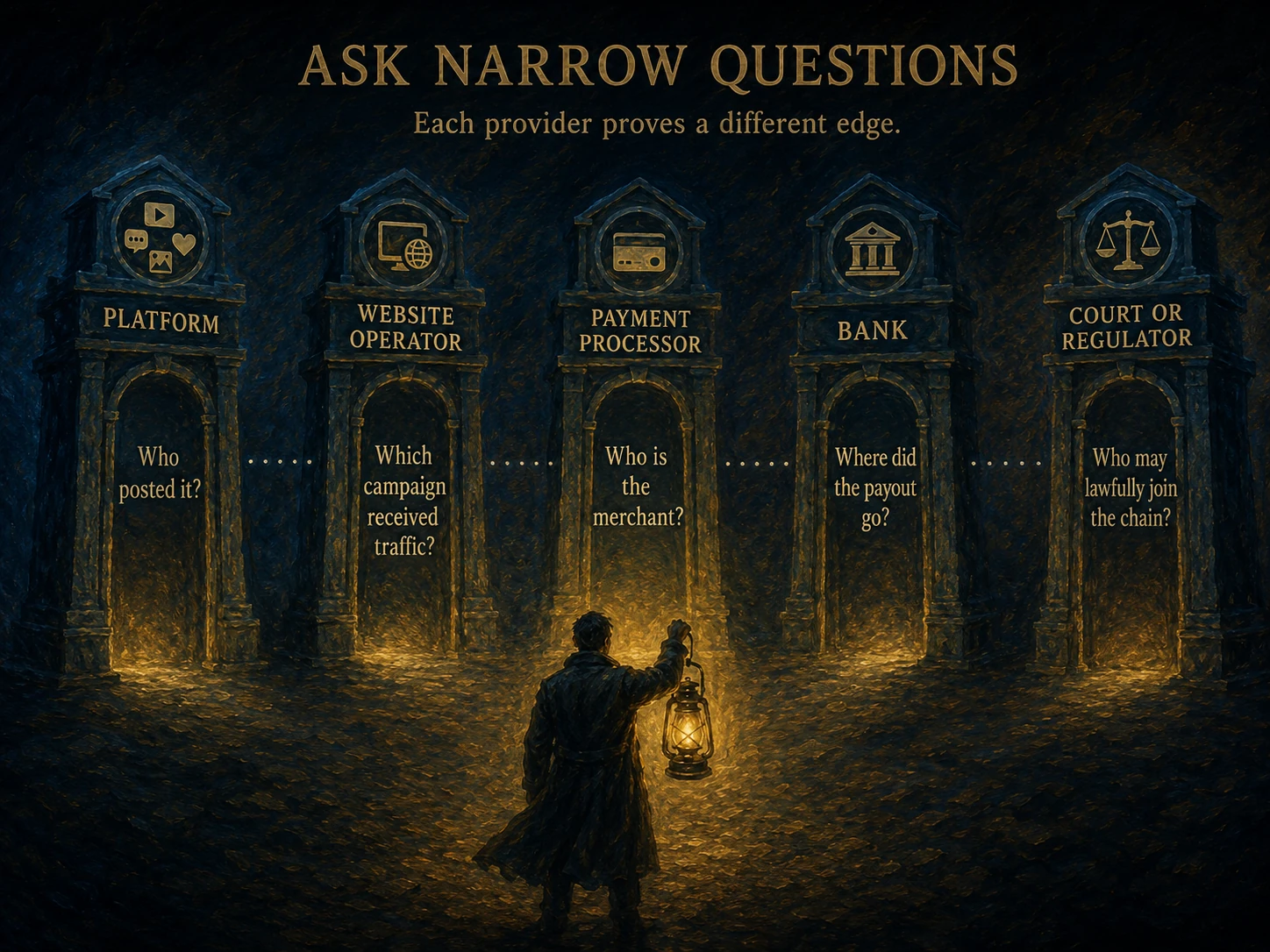
Each evidence holder can prove a different edge. No public observer holds every key.
This is why UVLM’s research formalizes three graphs:
POTENTIAL GRAPH: every relationship the technology could permit

EVIDENCE GRAPH: relationships supported by an appropriate evidence holder

AUTHORIZED-JOIN GRAPH: relationships a reviewer is lawfully permitted to test
The operable graph is the overlap between evidence and authority. A technically possible edge is not evidence. An evidenced edge is not automatically permission to join private data. An unknown edge remains unknown. (UVLM Lantern ADD-008)
Similar patterns can come from different causes
The broker thread looks coordinated. The recurring quiz phrase looks promotional. The near-verbatim websites look related.
Those observations justify review. They do not eliminate innocent or mixed explanations.
Accounts may be:
- genuine customers;
- affiliates;
- unrelated copy-and-paste promoters;
- compromised accounts;
- purchased or rented accounts;
- accounts using a shared marketing vendor;
- a mixture of genuine reactions and planted prompts.
Parallel sites may come from:
- a common template;
- a shared contractor;
- a license;
- an authorized split test;
- unauthorized copying;
- one operator using multiple personas.
The strongest innocent explanation belongs inside our article because a system that cannot preserve it is not ready to accuse anyone.
The same graph can describe a campaign, an agency, a household, a compromised account, or a coerced operator. The difference lies in control, authorization, knowledge, and beneficiary evidence, not in the mere shape of the network.
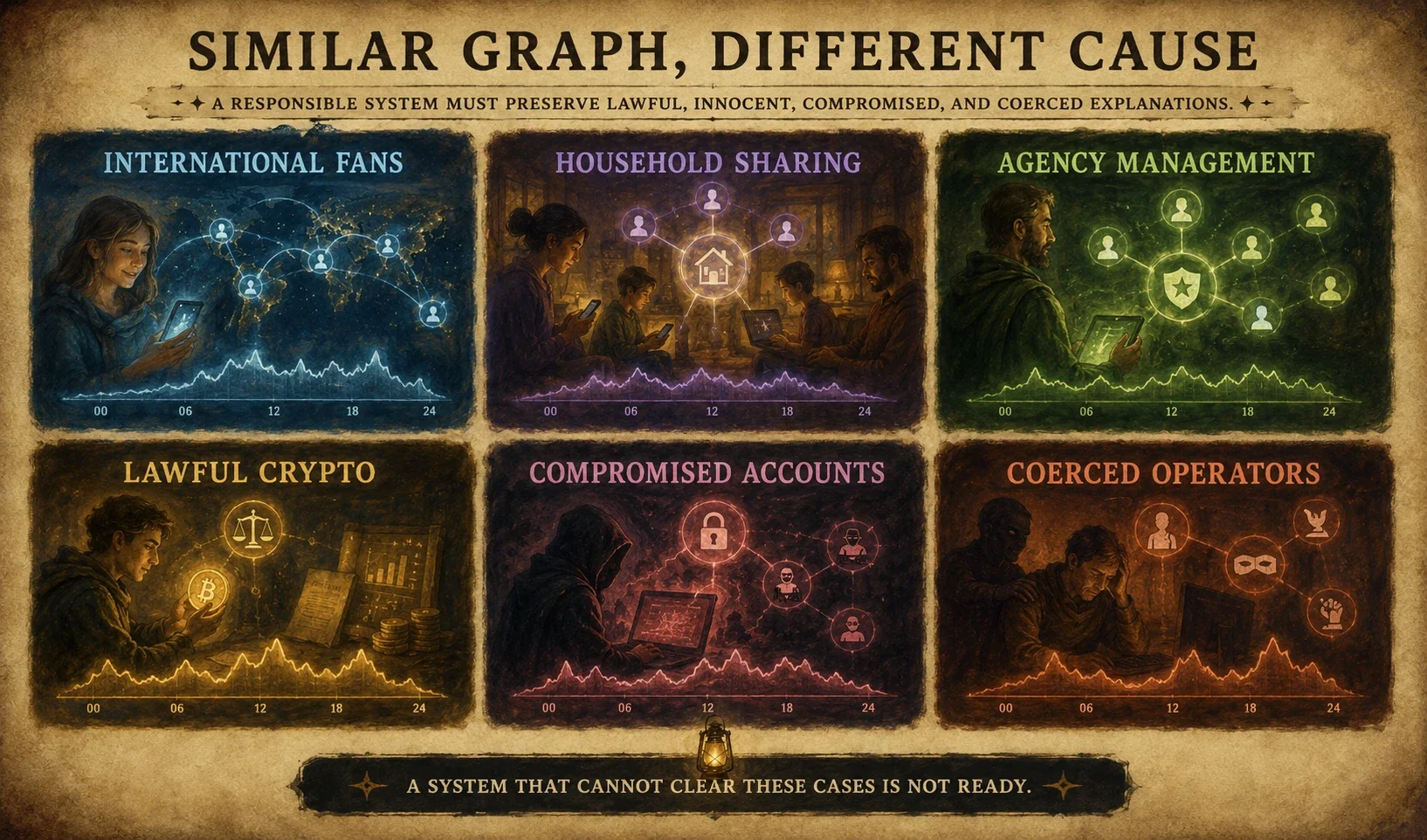
Similar-looking account graphs can arise from lawful activity, compromise, coercion, or abuse.
How the recurrence could be measured
UVLM's governed case corpus now includes two manifestation-quiz observations and three captured investment-professional impersonation-like threads across separate source videos. That is enough for mechanism, recurrence, and template-family analysis.
It is not a prevalence study. The cases were discovered opportunistically and cannot serve as a denominator.
That limitation should become a protocol rather than a pretense.
A future platform, university team, newsroom, or independent research group could preregister a modest public-comment pilot:
TARGET VIDEOS: 8 recent tarot or New Age videos

CONTROL VIDEOS: 4 unrelated videos matched approximately on age, views, and comment volume

COMMENTS INSPECTED: 50 newest visible top-level comments per video

PLANNED DENOMINATOR: 600 top-level comments

SELECTION: videos chosen before opening comments

REPLIES: not counted in the denominator but preserved when a sampled comment opens a funnel

SURVIVAL CHECKS:
T + 24 hours
T + 7 days
Fixed categories could include quiz-phrase testimonials, search-phrase promotions, direct links, financial-professional impersonation, phone or WhatsApp handoffs, crypto or investment testimonials, generic commercial testimonials, other promotional spam, and no hit.
The pilot could estimate:
- observed comment hit rate within the defined sample;
- the share of sampled videos with a hit;
- recurrence of exact phrases;
- recurrence of public handles;
- survival of captured comments;
- differences between target and control videos.
It could not establish YouTube-wide prevalence, common control, AI generation, merchant authorization, payment beneficiary, or criminal intent.
YouTube’s documentation matters here because Top comments may omit comments that its systems consider spam-like or low-value. A future study should therefore use Newest first, record zero-hit videos, and keep the viewing procedure consistent. (YouTube Help)
PROTOCOL STATUS: PROPOSED, NOT EXECUTED

REASON: RESOURCE LIMITS

VALUE: A REPLICABLE PATH FOR SOMEONE WITH THE CAPACITY TO RUN IT
The absence of execution is not a hidden failure. It is part of the method.
What platforms could do without building a universal surveillance graph
The most useful platform response is not a single criminality score.
It is a typed, purpose-bound review of specific relationships:
Did several accounts promote the same phrase or contact destination?

Were those accounts commonly controlled?

Was the same real professional’s identity used elsewhere?

Was the campaign authorized?

Did a payment event follow?

Who received and beneficially controlled any resulting funds?
Each institution should answer only the question it is uniquely positioned and lawfully authorized to answer.
The Bank for International Settlements has tested related cross-silo principles in financial crime. Project Aurora used synthetic data to explore privacy-enhancing technologies, machine learning, and network analysis across institutions. Project Hertha later tested payment-system analytics on a synthetic ecosystem of 1.8 million accounts and 308 million transactions, finding that network-level signals helped institutions identify more illicit accounts and improved detection of previously unseen patterns. BIS also emphasized that such tools remain supplementary and raise practical, legal, and regulatory questions. (Project Aurora, Project Hertha)
NIST’s PETs Testbed follows a similar discipline: define a model problem, use realistic or synthetic benchmark data, measure privacy and utility, and red-team the system. (NIST PETs Testbed)
Creator communities are not payment systems, so the lesson cannot be copied mechanically. The useful principle is narrower: cross-silo analysis can be designed around minimum necessary data, explicit purposes, privacy measurement, correction, and human review.
The hidden invoice falls on viewers and creators
Platforms hold the most important records. The burden of preservation often falls on the people with the least access to them.
A viewer must pause, capture screenshots, preserve the source video, record the time, avoid interacting, and hope the comment remains visible. A creator must review held comments, recognize repeated scripts, report spam, and absorb the emotional burden of watching a community surface turned into a funnel.
When moderation eventually works, the initiating evidence may disappear before the person affected can preserve it.
That is a control failure even when the removal itself is beneficial.
A better system would provide:
- durable report receipts;
- preserved comment text and IDs for the reporter;
- campaign-level review across repeated phrases and contacts;
- a safe route to report impersonation of a real professional;
- transparent status updates;
- correction and appeal;
- bounded escalation to relevant firms or regulators.
The people harmed by a campaign should not have to reverse-engineer a private financial system from screenshots.
What an ordinary person can do safely
When a suspicious comment appears:
- save the source video URL;
- copy the comment permalink when available;
- record the public handle and time;
- save a short verbatim excerpt or screenshot;
- note whether the route uses a direct URL, a branded search phrase, a phone number, or a messaging app;
- avoid messages, purchases, forms, wallet connections, and test transactions;
- report the comment through the platform after preservation.
For investment-professional claims, use independently verified firm contact information. The SEC and FBI specifically warn against trusting contact details supplied through social media or messaging apps. (Investor.gov)
Do not publicly accuse the professional whose identity appears. That person may be the impersonation victim.
What this article does not establish
The evidence reviewed here does not establish that:
- the disappearing quiz commenter worked for either website;
- the first quiz comment contained a direct link;
- YouTube removed it through spam detection;
- the two quiz comments shared one controller;
- either quiz merchant authorized comment promotion;
- the quiz sites share one merchant or beneficial owner;
- the content-bearing account was fake, automated, sold, or compromised;
- the Short contained coded imagery;
- the three investment threads shared one controller, funder, device cluster, recovery path, subscriber, or beneficiary;
- the different contact destinations were rotated by one operator;
- the script modules were generated by AI;
- either registered professional or either employer participated;
- any public account holder shown in the screenshots committed a crime;
- anyone contacted a number, invested, or lost money;
- cryptocurrency was actually transferred;
- a bank, payment processor, exchange, wallet, payout beneficiary, or beneficial owner has been identified;
- the observed cases measure prevalence on YouTube;
- these cases join the broader AI, creator-monetization, crypto, trafficking, or laundering architecture examined elsewhere in the Lantern series.
Spiritual language, Christian language, tarot audiences, foreign locations, unusual grammar, young accounts, profile photographs, and unfamiliar aesthetics remain non-adjudicative.
The bounded findings are enough:
A CLUE VANISHED.

A SOLICITATION ROUTE SURVIVED.

A BRANDED PHRASE RETURNED.

A PUBLIC SCRIPT FAMILY RECURRED.

THE PROFESSIONAL NAME AND CONTACT DESTINATION COULD BE SUBSTITUTED.

THE CONTROLLER DID NOT BECOME PUBLIC.
The lantern stops at the broken bridge
At 4:02 in the morning, a comment influenced a search and disappeared.
By evening, another thread showed how praise, a real professional's credibility, staged curiosity, contact requests, and off-platform messaging could form a visible recruitment path.
Minutes later, the quiz phrase returned beneath another video.
The next morning, the investment script appeared with another professional's name. Less than an hour later, the first professional's name returned beside a different contact destination.
The evidence had become strong enough to identify a public script family.
It had not become strong enough to identify the hand using it.
That is the discipline the Lantern must preserve. It should illuminate every supported plank, mark every missing span, protect the people whose names or accounts may have been used, and ask each evidence holder the smallest question it can actually answer.
A careless system leaps the gap and calls the landing proof.
A captured institution refuses to look at the gap at all.
A governed system stops at the edge, raises the lantern, and makes the missing bridge impossible to ignore.
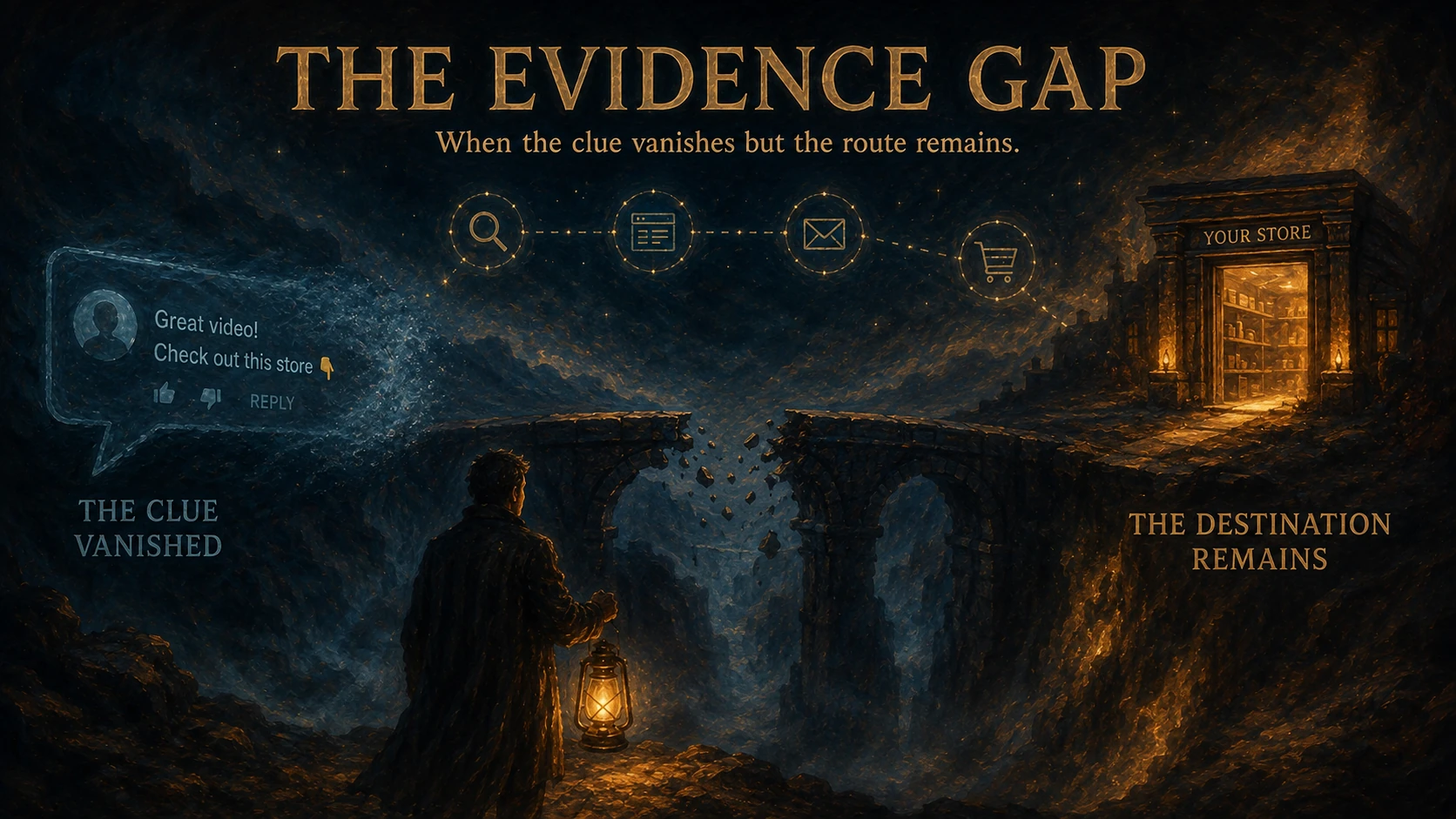
The lantern does not invent the final span. It shows exactly where the evidence ends.
Research and privacy note
The main narrative anonymizes public handles, withholds all phone numbers, and does not name the two registered professionals whose identities appeared in the captured threads. Exact screenshots, handles, contact destinations, and official identity records remain in restricted provenance packages. The public site comparison identifies sararivers.com and verahart.com for reproducibility and makes no finding of fraud or criminality against either domain or any named persona.
Methods note
The recurrence protocol described above is proposed and unexecuted. UVLM did not measure prevalence on YouTube. The two quiz observations and three captured investment threads support mechanism, bounded recurrence, and template-family analysis only.
Works Consulted
Public and official sources
Google Search. “How Google Search Determines Ranking Results.”
https://www.google.com/intl/en_us/search/howsearchworks/how-search-works/ranking-results/YouTube Help. “Learn About Comments That Aren't Showing or Have Been Removed.”
https://support.google.com/youtube/answer/13209064YouTube Help. “Spam, Deceptive Practices and Scams Policies.”
https://support.google.com/youtube/answer/2801973SEC and FBI, Investor.gov. “Beware of Fraudsters Impersonating Investment Professionals and Firms.” December 11, 2024.
https://www.investor.gov/introduction-investing/general-resources/news-alerts/alerts-bulletins/investor-alerts/beware-fraudsters-impersonating-investment-professionals-and-firms-investor-alertU.S. Securities and Exchange Commission. “SEC Charges Three Individuals with Impersonating Financial Professionals in Fraud Scheme Targeting Retail Investors.” December 11, 2024.
https://www.sec.gov/newsroom/press-releases/2024-194FINRA BrokerCheck. Current records for two professionals named in restricted screenshots. Direct records are withheld from the public package to protect possible impersonation victims.
https://brokercheck.finra.org/Sara Rivers. Public quiz, privacy, and terms pages. Accessed August 2026.
https://sararivers.com/Vera Hart. Public quiz, privacy, and terms pages. Accessed August 2026.
https://verahart.com/Bank for International Settlements Innovation Hub. “Project Aurora.”
https://www.bis.org/publ/othp66.htmBank for International Settlements Innovation Hub and Bank of England. “Project Hertha.”
https://www.bis.org/about/bisih/topics/fmis/hertha.htmNational Institute of Standards and Technology. “PETs Testbed.”
https://www.nist.gov/itl/applied-cybersecurity/privacy-engineering/pets-testbed
UVLM governed research lineage
UVLM_ART003_The_Evidence_Gap_Website_Publication_Package_v1.1.0-rc1.zip
SHA-256:5057c62ec32fe644ec4c1393528cf1c5e7866156e5bc19e56189fb79269bddbcUVLM_Lantern_ART003_Evidence_Gap_Route_Volatility_and_Parallel_Persona_Site_Intake_v0.1.0-rc1.zip
SHA-256:f5b00b72614f7f5f13ae6c64690112666e434907b74d6d3d591049b752b5cc9bUVLM_Lantern_INTK003_YouTube_Registered_Broker_Impersonation_Comment_Funnel_v1.0.0-rc1.zip
SHA-256:f4b965da6ed16fbad73e73c4ea0038fc3c7b11d25e73b7e86314d8d846579c28UVLM_Lantern_INTK004_Sara_Rivers_Archetype_Quiz_Cross_Video_Recurrence_v1.0.0-rc1.zip
SHA-256:4933d2a2d1c81284200e8cce21f49d6186da04094c4f8e1e20772600f5244089UVLM_Lantern_INTK004A_Commenter_Short_Media_Analysis_and_Article_Methods_Addendum_v1.0.0-rc1.zip
SHA-256:ff0a555bd487424223d82510fb46b0b0802d4c5095e79c388543a71851c76fUVLM_Lantern_INTK005_YouTube_Cross_Thread_Broker_Impersonation_Template_Family_v1.0.0-rc1.zip
SHA-256:ace069b06a9faca16b5c9c62dfe074e97cbccc94021270ff24e04c16c05c470cUVLM_Lantern_INTK006_YouTube_Third_Captured_Broker_Impersonation_Template_and_Contact_Rotation_v1.0.0-rc1.zip
SHA-256:9f26fdfb2856f1cb71e5ae0d60bbf9c121c51ae31f459684597ebf1c82a1e97cADD-008 — Buffered Creator-Monetization Relay Topology. Governing distinction among potential, evidence, and authorized-join graphs; exact Nexus remains held.