The Content Vehicle
How a song, post, livestream, comment, or creator identity can carry meaning, trust, money, and a route at the same time.
By Thomas Prislac and Envoy Echo, Ultra Verba Lux Mentis. 2026.Reader-supported public-interest work
Help keep careful research open.
Ultra Verba Lux Mentis is a nonprofit research organization. Voluntary gifts help fund open research, independent review, accessibility, public education, documentation, and practical public-interest tools.
This article and UVLM’s public materials remain available whether or not you donate.
Opens the UVLM donation page in a new tab. Giving is always optional.
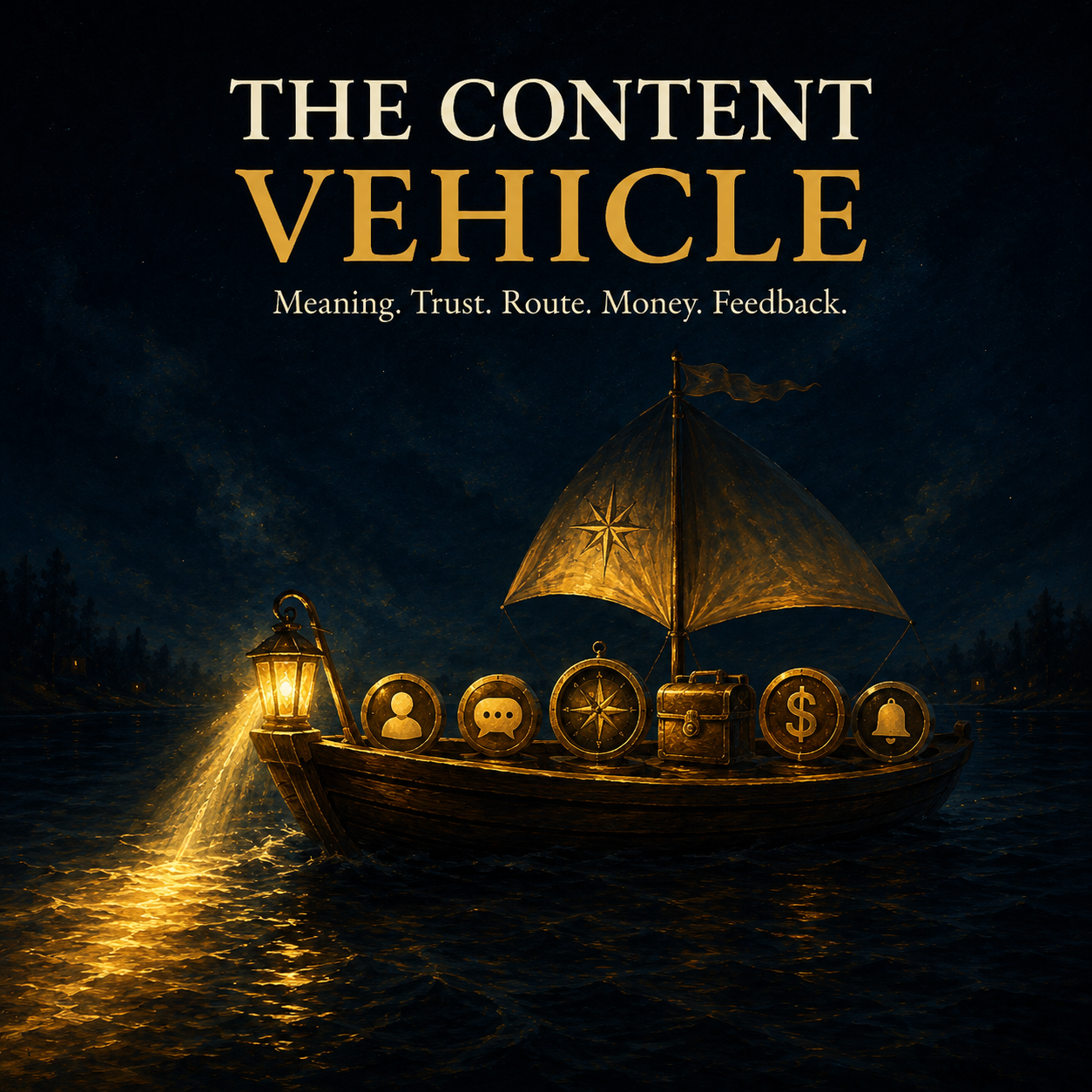
The Content Vehicle. A single piece of content can carry several kinds of value at once: meaning, trust, route, money, and feedback.
At the edge of a black river, a ferry arrives carrying six passengers.
One carries a scroll. One wears a familiar face. One holds a compass. One guards a coin. One rings a bell. One keeps the ledger.
The vessel looks like a single object from shore. It is doing six jobs at once.
Online content works the same way. A song can express an idea, borrow the credibility of an artist, enter a recommendation system, generate royalties, produce feedback through streams, and leave behind an accounting story. A livestream can entertain, gather a community, invite gifts, route viewers toward another service, and tell an operator whether the audience responded. A comment can look like conversation while functioning mainly as a road sign.
This article proposes the term content vehicle for that object. It is analytic vocabulary for separating functions, not a legal, scientific, or platform classification.
The term does not mean that every post hides a message or every monetized creator belongs to a criminal scheme. Most content is ordinary. Most creators are trying to make work, reach people, and earn a living. Most fans are fans.
The point is narrower: one digital artifact can sit at the intersection of meaning, trust, routing, payment, and feedback. When those functions converge, investigators and platforms need a way to study the route without inventing a secret message or accusing the visible creator by default.
The controlling boundary is simple:
Anomaly is not decoding. Decoding is not attribution. Attribution is not proof.
Reader map
This article moves through four layers. First, the ferry separates six functions that one artifact may carry: meaning, trust, route, value, feedback, and accounting. Second, the strongest countercase tests whether the same visible pattern can arise lawfully, accidentally, through compromise, or under coercion. Third, the route ladder and three-graph model separate publication from encounter and meaning from money. Finally, the provenance and platform sections ask which institution can prove each missing relationship. Article 1 examined the modular service stack at system scale; this article narrows to the work performed by one artifact. Article 3 follows the remaining gap when scripts or destinations repeat but the controller stays outside public view. Throughout, ask whether a passage states an observed fact, an allegation, an analogy, or a proposed model. The final integrated hypothesis remains a hold.
Quick glossary
- Content vehicle: proposed analytic model for one artifact carrying several separable functions.
- Route: the evidenced stages by which content becomes eligible, shown, encountered, or acted upon.
- Financial graph: separately proved payment, payout, control, conversion, and beneficial-ownership relationships.
- Provenance: records describing creation, revision, derivation, tools, and responsibility.
- Message-free null: a symbol-rich control case in which no hidden message exists.
Model boundary. “Content vehicle,” “market-impact surface,” and “Borrowed Oracle” are proposed analytic vocabulary. They are not validated detector categories, legal labels, or indicators of guilt.
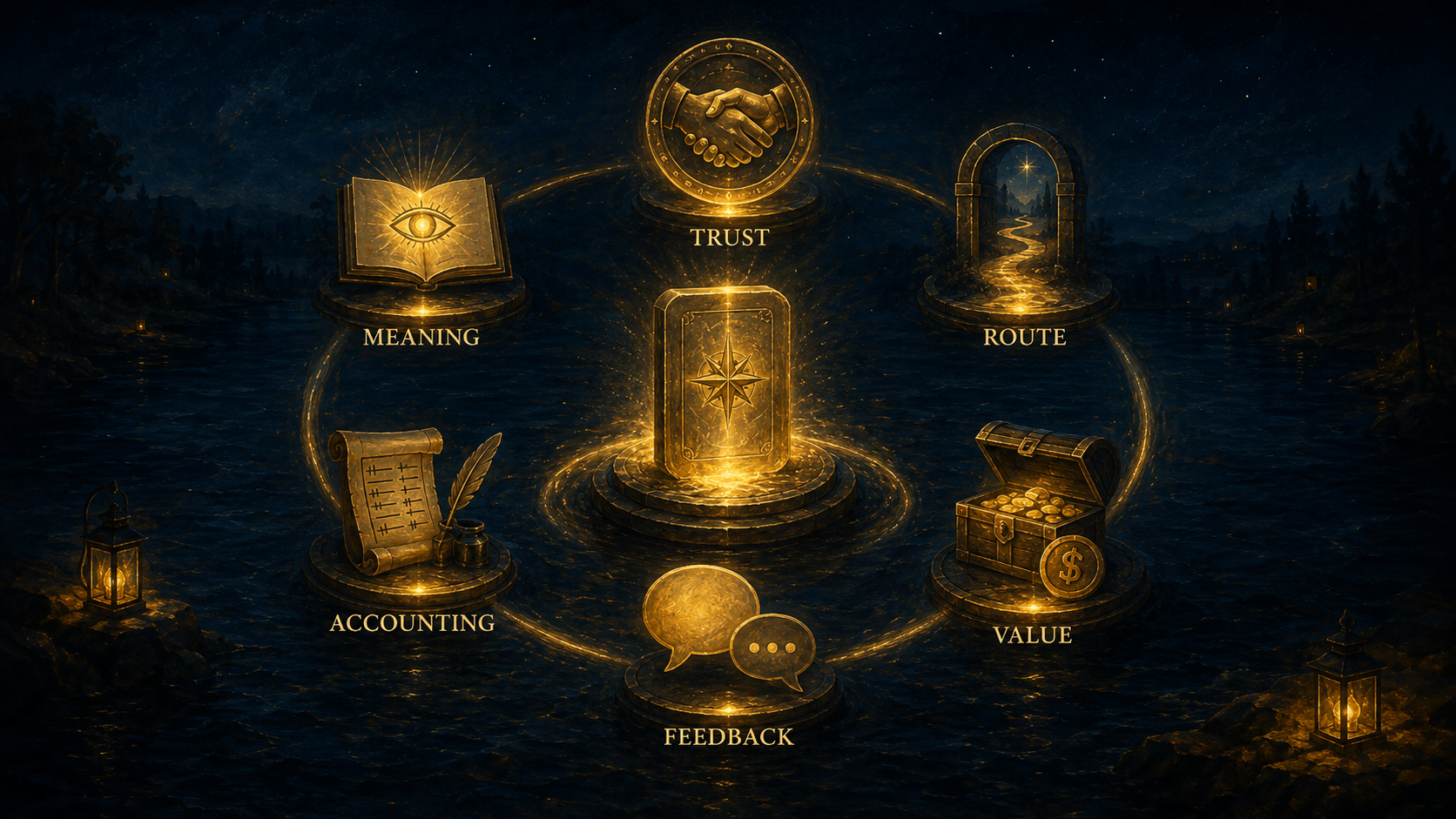
One artifact, six functions. The same post, video, message, or channel can carry expression, trust, routing, value, feedback, and a record trail.
One artifact, six jobs
A content vehicle can perform six different kinds of work. It can carry meaning when the public reads, watches, listens, or reacts to what the artifact says. It can carry trust when a familiar face, respected channel, cultural style, professional title, or community identity makes the artifact feel credible before anyone inspects the underlying claim. It can carry a route through recommendation systems, search results, reposts, comments, notifications, links, and direct messages that affect who is likely to encounter it.
It can carry value. Platforms deliberately join content to advertising, royalties, memberships, subscriptions, gifts, shopping, sponsorships, and other payment systems. YouTube, for example, lists channel memberships, Super Chat, Super Stickers, Super Thanks, shopping, advertising, and Premium revenue among its monetization tools. Twitch offers subscriptions, Bits, advertising, and sponsorship tools. TikTok lets viewers send Gifts that can contribute to creator rewards. Those are ordinary creator-economy features, not suspicious conduct. (YouTube, Twitch, TikTok)
It can carry feedback because views, watch time, shares, gifts, purchases, reposts, and later behavior tell someone that the vehicle reached an audience or changed a system. Finally, it can carry an accounting story: royalties, advertising income, sponsorship, licensing, consulting, sales, or donations may provide a lawful explanation for revenue, while a criminal scheme may misrepresent the same categories or use them to obscure where value really came from.
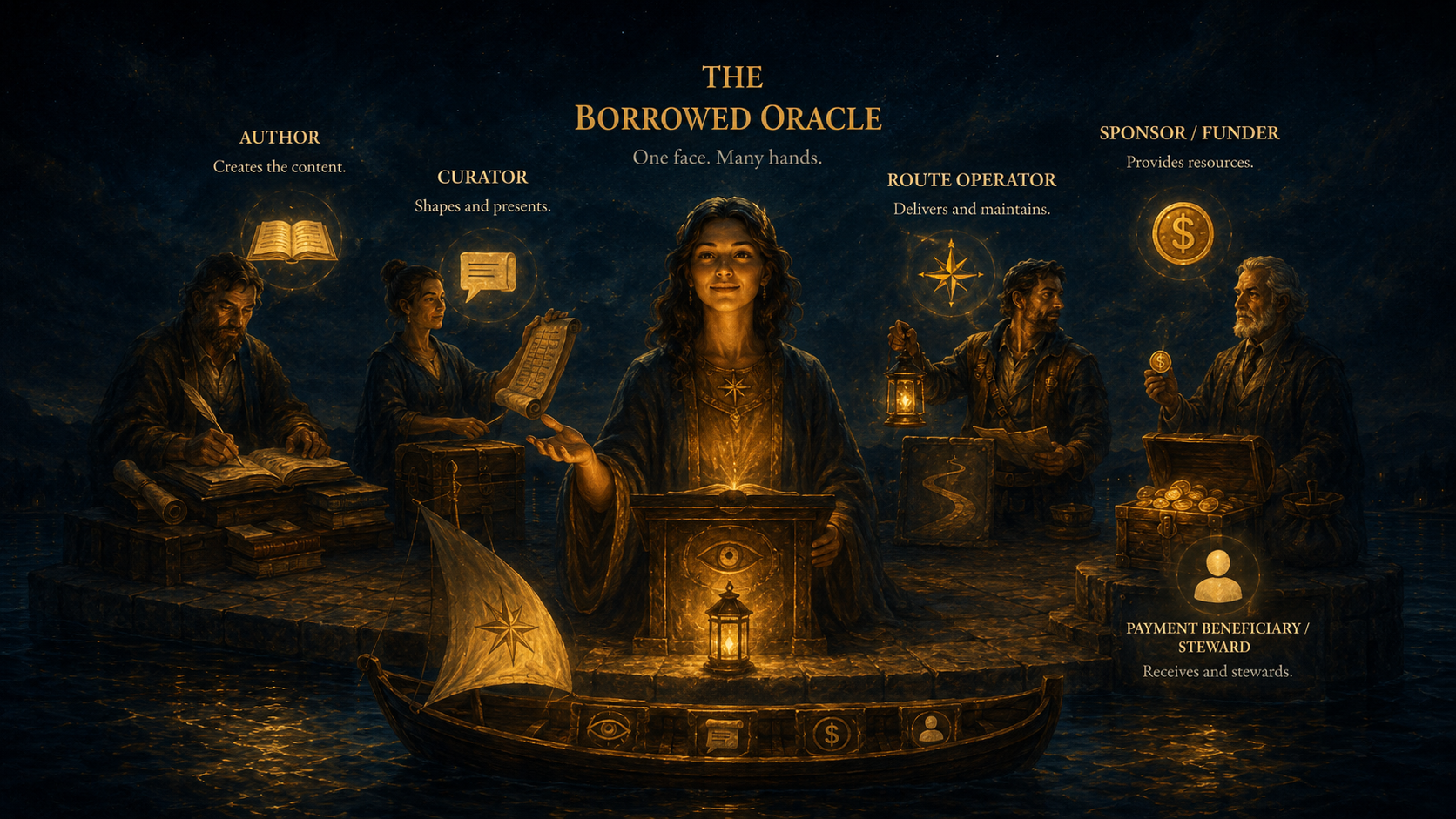
The Borrowed Oracle. A public voice may sit inside a wider structure of authorship, delivery, funding, and payout stewardship.
The Borrowed Oracle principle protects creators as much as it helps investigators. Provenance should distinguish the original creator, derivative editor, publisher, curator, route operator, sponsor, recipient, and payment beneficiary. A system that merges those roles because one face appears on screen will manufacture complicity.
A post is not a delivery
A public square is also a routing system. YouTube explains that recommendations drive a significant share of viewing and that its systems use signals such as clicks, watch time, survey responses, sharing, likes, and dislikes to predict what viewers may find valuable. That does not mean a platform can guarantee that a specific person received a particular message; it means publication and encounter are separate events. A useful route ladder is: (YouTube)
created
→ published
→ eligible for a surface
→ selected or recommended
→ rendered on a device
→ noticed by a person
→ understood in a relevant way
→ followed by an action
→ observed through feedback
Each arrow needs its own evidence.
A post can exist without becoming eligible for recommendation. It can become eligible without being selected. It can be selected without rendering. It can render without being noticed. It can be noticed without being understood. A later event can follow without having been caused by the post.
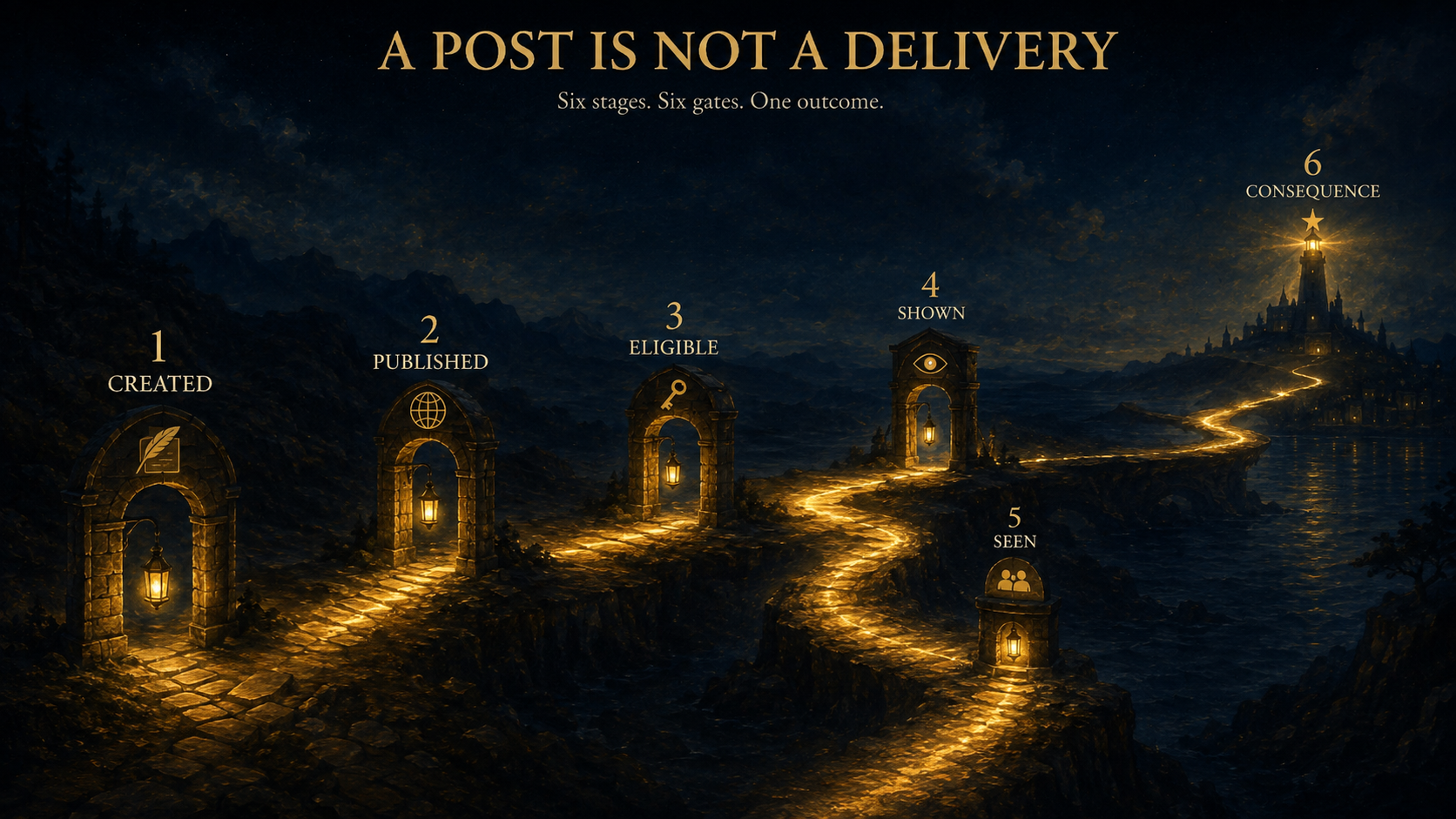
A post is not a delivery. Content passes through several gates between creation and outcome, so publication alone does not prove reach or impact.
The route ladder is the practical heart of the investigation. It moves attention away from ambiguous symbols and toward evidence-bearing joins.
Three graphs, not one intuition
A content vehicle sits across three graphs. The semantic graph asks what the artifact expresses, references, quotes, or could mean to an audience. The route graph asks who published, selected, transformed, ranked, displayed, encountered, or acted after exposure. The financial graph asks who paid, earned, received, controlled, converted, benefited, or returned value.
G_S = semantic relationships
G_R = route and exposure relationships
G_F = financial relationships
The operable investigation contains only relationships that are both evidenced and lawfully testable.
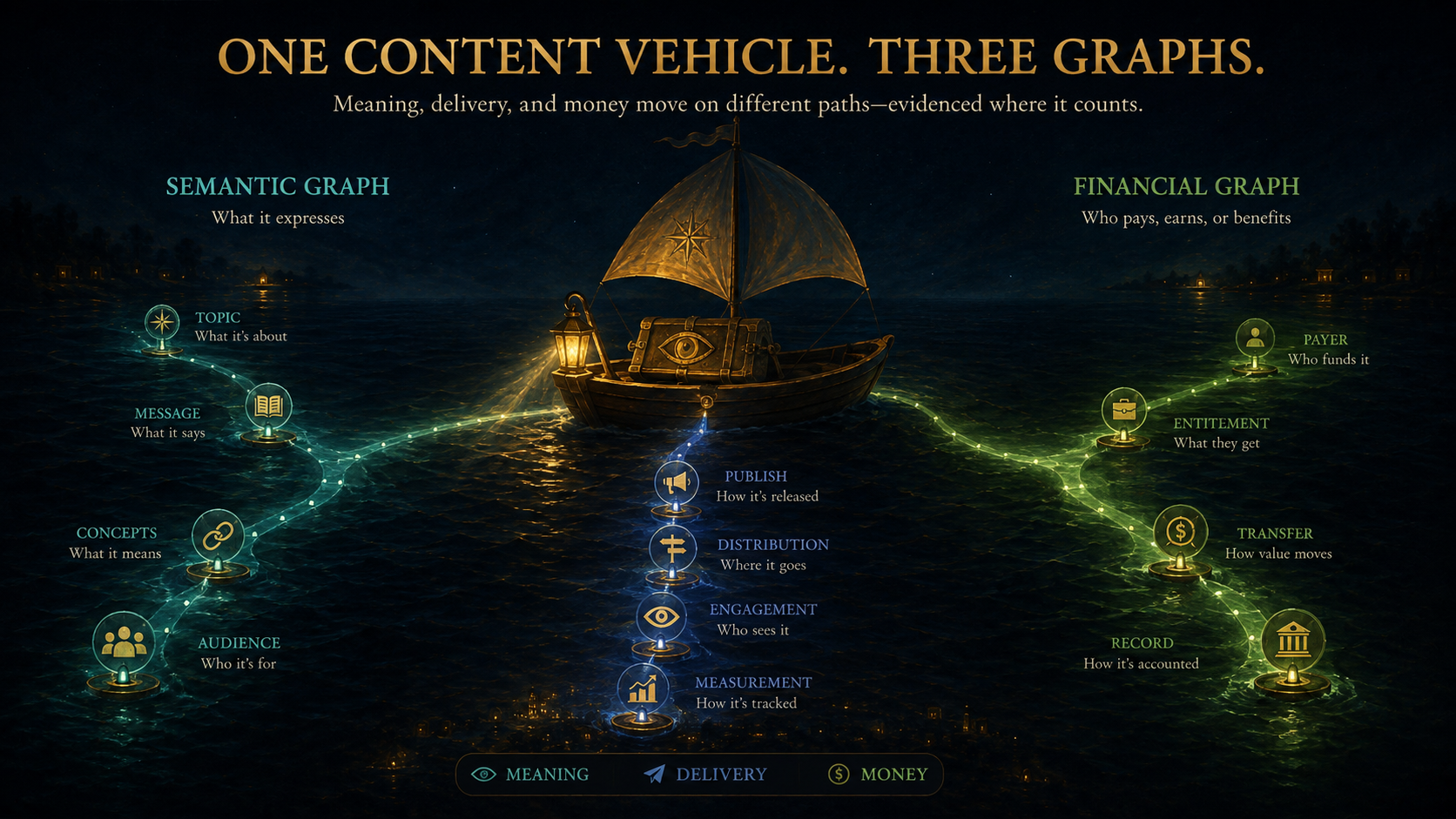
One content vehicle, three graphs. Meaning, distribution, and money move through different structures and must be studied separately.
This prevents several common errors:
symbolic resemblance ≠ shared operator

posting ≠ delivery

payment ≠ acknowledgment

creator visibility ≠ creator complicity

benefit ≠ beneficial ownership
The structure also explains why public research reaches a hard limit. Platforms may know account permissions, recommendation impressions, paid events, monetization profiles, and payout instructions. Payment processors may know instruments and disputes. Banks may know transfers and account ownership. Virtual-asset providers may know customer and wallet relationships. Courts may establish knowledge, intent, coercion, and predicate offenses.
The public usually sees the artifact, the visible account, the comment, the displayed currency, and perhaps the link.
That is not the whole ferry manifest.
Provenance helps a claim answer for itself
Provenance standards can make part of the route more visible. The W3C PROV model represents entities, activities, agents, derivations, revisions, quotations, and responsibility relationships, while C2PA Content Credentials can attach information about how and when digital content was created or modified, which tools were used, and whether generative AI participated. That information can help distinguish an original work from a derivative, identify an editing tool, or preserve a chain of revisions. It still does not prove motive, truth, attention, knowledge, or beneficial ownership. (W3C PROV-O, C2PA)
A hash can show that bytes match. A signature can show that a credential signed a statement. A provenance record can show that one artifact derived from another. None of those facts alone establishes why the change was made or whether the statement is true.
Detect the route without decoding the culture
A defensible review can investigate coordination without claiming to recover a hidden payload. It can examine:
- provenance: who created, edited, published, sponsored, or revised the asset;
- sequence: whether ordering, recurrence, or synchronized changes differ from matched ordinary controls;
- route: whether the asset became eligible, selected, rendered, notified, or directly delivered;
- control: who administered the account, payment profile, or monetization relationship;
- finance: whether an authentic paid event occurred, who received the payout, where the funds came from, and whether value returned;
- consequence: whether a verified action or transfer followed an independently supported encounter; and
- countercases: whether a lawful, compromised, unaware, or coerced explanation remains viable.

Detect the route, not the symbol. Follow observable pathways and records rather than assigning guilt from style or isolated signs.
The public method should withhold operational detector thresholds, feature weights, private selectors, timing rules, challenge procedures, and other details that would help an abusive network evade review. The public can understand the evidence categories without receiving a manual for defeating them.
What the record does not establish
The records reviewed for this article do not establish that:
- the complete semantic, route, creator-monetization, crypto, fiat, beneficial-control, backflow, predicate, and intent chain has been adjudicated in one case;
- symbolically unusual content is encoded;
- platform recommendation proves deliberate delivery to a named recipient;
- a payment proves that the payer acknowledged a message;
- a visible creator controlled the route or knew the source of funds;
- artificial intelligence autonomously controlled criminal finances without a meaningful human organizer;
- ordinary creator monetization commonly functions as money laundering;
- the separate Twitter, Smith, SEC, RT, Hamas, and Shanghai matters form one network;
- any private creator, supporter, spiritual community, or previously discussed person belongs to these mechanisms.
The cases are analogues. Their edges remain inside their own records.
The exact integrated content-vehicle hypothesis remains a hold until one same-case evidentiary chain closes the necessary relationships.
What responsible platforms can do now
Platforms can preserve the route without building a universal suspect list.
They can maintain reliable lineage for account administrators, content revisions, recommendation impressions, paid events, monetization profiles, and payout changes. They can separate the visible creator from managers, agencies, compromised accounts, and unknown downstream beneficiaries. They can design review systems that ask specific relationship questions instead of producing one opaque criminality score.
They can also build correction and appeal into the system. An affected person should be able to see what is observation, what is inference, what evidence holder supplied a relationship, and how a correction will propagate through alerts, dashboards, reports, and retained memory.
Provenance and privacy must work together. The answer is not one permanent central graph containing every viewer, payment, device, bank account, and wallet. The answer is purpose-bound, minimum-necessary analysis under valid authority, with independent review for consequential decisions.
The Lantern illuminates the crossing. It does not own the river.
The ferry returns
At dawn, the ferry reaches the opposite bank.
The scroll is still a story. The face is still capable of being borrowed. The compass still points along a route. The coin still changes hands. The bell still tells someone that something happened. The ledger still records a version of the journey.
From shore, the vessel remains one object.
A responsible investigation opens the manifest and asks which passenger actually boarded, who chose the crossing, who received the fare, and which parts of the journey the evidence can prove.
The content was never only content.
Source and correction note
This article distinguishes guilty pleas, official prosecutorial reports of judgment, indictments, civil allegations, seizure proceedings, regulator alerts, platform documentation, and internal UVLM research hypotheses. It does not borrow a missing relationship from one case to complete another.
The Michael Smith discussion relies on the March 19, 2026 guilty-plea release. A current official sentencing release or judgment was not located in the source check conducted on August 14, 2026, so the article does not state a sentencing outcome.
UVLM welcomes source-based corrections and responses. A correction should identify the sentence at issue and provide a stable primary or authoritative source. Publication authority remains with Thomas Prislac.
Works consulted
- FinCEN: Twitter cryptocurrency scam alert, July 16, 2020
- U.S. Department of Justice: Hamas cryptocurrency seizure, March 27, 2025
- U.S. Department of Justice: Michael Smith guilty plea, March 19, 2026
- SEC: social-media influencer stock-manipulation charges, December 14, 2022
- SEC and FBI: investment-professional impersonation alert, December 11, 2024
- U.S. Department of Justice: RT content-company indictment, September 4, 2024
- Procuratorate Daily: Shanghai livestream-tipping case, September 10, 2024
- Supreme People's Procuratorate: Shanghai Pudong financial-crime review, January 22, 2025
- YouTube: monetization features
- YouTube: recommendation system
- Twitch: monetization tools
- TikTok: LIVE Gifts and matches
- W3C: PROV-O
- C2PA: Content Credentials
Internal links
Recommended UVLM internal links:
- The Exiled Auditor's Lantern:
/articles/the-exiled-auditors-lantern-independent-ai-safety - The Composable Shadow Economy:
/articles/the-composable-shadow-economy - The Evidence Gap:
/articles/the-evidence-gap - The Governed Lantern:
/articles/the-governed-lantern-how-to-study-hidden-coordination-without-teaching-it-or-inventing-it