The Composable Shadow Economy
How AI-made content, platform payments, crypto, and ordinary finance can assemble into a system no ordinary evidence holder sees in full.
By Thomas Prislac and Envoy Echo, Ultra Verba Lux Mentis. 2026.
Reader-supported public-interest work
Help keep careful research open.
Ultra Verba Lux Mentis is a nonprofit research organization. Voluntary gifts help fund open research, independent review, accessibility, public education, documentation, and practical public-interest tools.
This article and UVLM’s public materials remain available whether or not you donate.
Opens the UVLM donation page in a new tab. Giving is always optional.
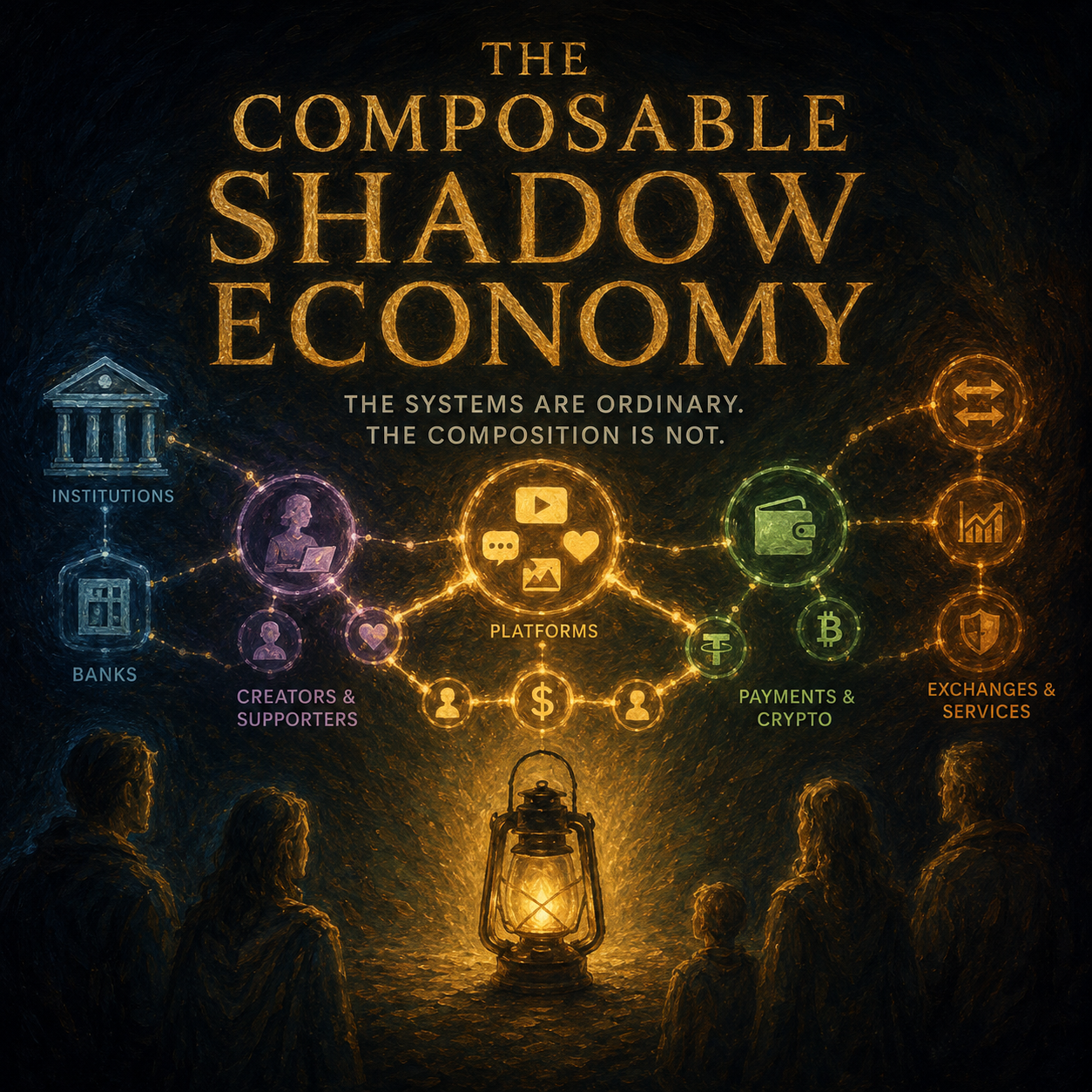
Inside a server, a song begins.
No person chose it. No listener waits for the chorus. The platform still records a stream, adds one more event to its ledger, and shifts a fraction of a royalty pool. Repeat the act across thousands of accounts and hundreds of thousands of tracks, and the fiction acquires a bank balance.
The song is synthetic. The listener is synthetic. The payment is not.
That small contradiction opens onto a much larger financial system. Criminal organizations need not own every part of the machinery that moves their money. One service can supply identities. Another can produce content. A third can operate accounts, recruit mules, create shell companies, or convert value between banks and virtual assets. Platforms can turn attention into revenue. Professional laundering networks can return the proceeds through businesses, property, gambling, mining, luxury goods, or ordinary accounts.
No single participant needs to see the whole arrangement. No ordinary evidence holder sees the entire chain by default.
This article does not identify one universal hidden bank, accuse private creators, or claim that every AI-made work, international audience, creator payment, or cryptocurrency transfer is suspicious. The public record supports a more exact and more useful conclusion: public cases show that shadow-economy activity can be composable. Its modules can be purchased, shared, coerced, automated, and joined across systems whose oversight remains institution by institution.
The controlling distinction is simple:
What technology permits is not what evidence proves.
That distinction is the Lantern. Without it, a serious investigation can become another machine for manufacturing shadows.
Where this article sits in the Lantern series
This first article works at system scale: it maps the modular service stack and explains why evidence is divided among platforms, payment firms, banks, virtual-asset providers, regulators, and courts. Article 2, The Content Vehicle, narrows the lens to one artifact and separates the meaning, route, and financial functions it can carry. Article 3, The Evidence Gap, asks what remains unproved when phrases, scripts, and contact destinations repeat but controller records remain private.
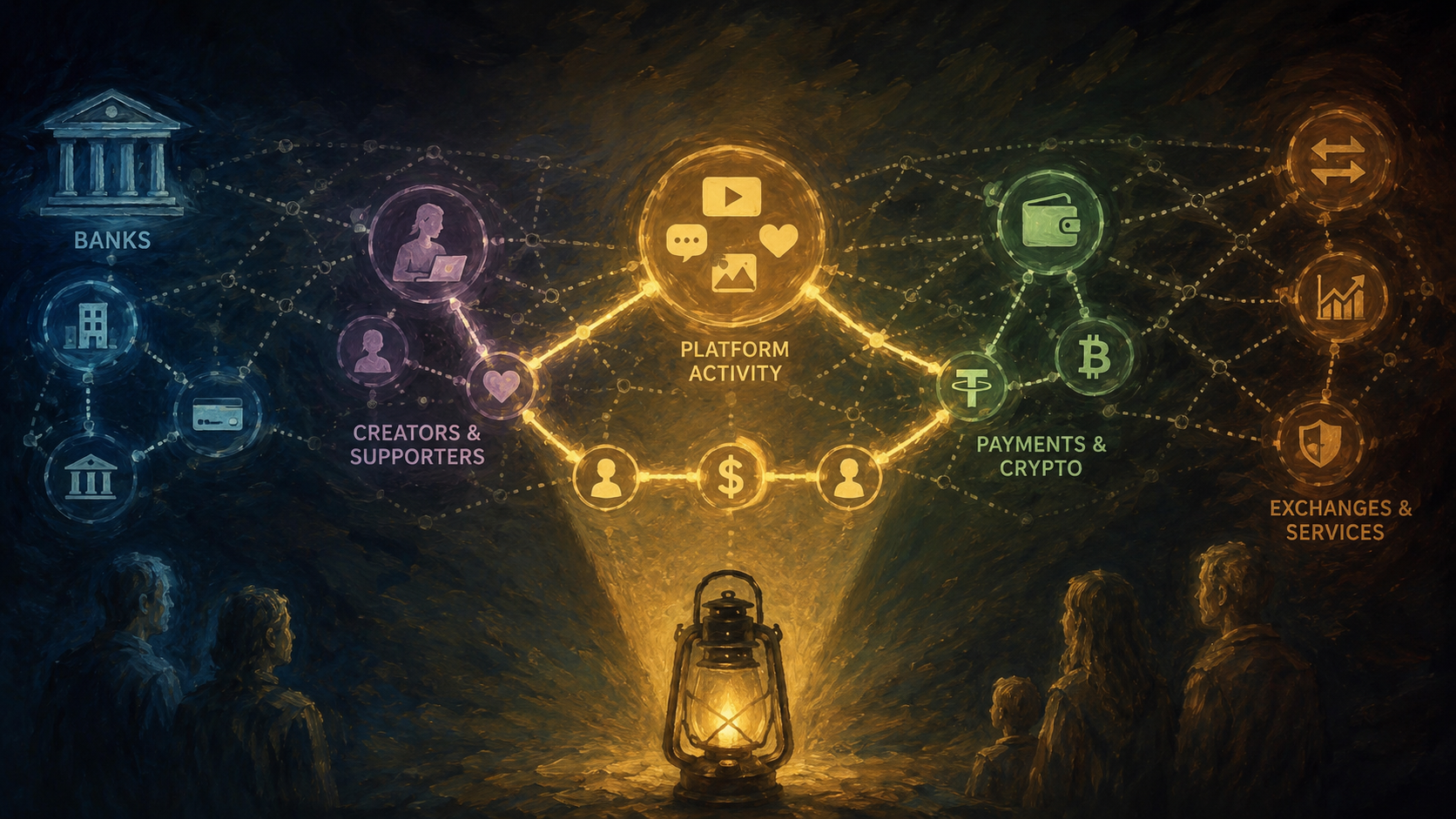
A lantern reveals only a few evidenced relationships inside a much larger field of technically possible connections.
The strongest defense is also the guardrail
Most streams have human listeners, creator payments support real work, and virtual-asset transfers serve lawful purposes. Households share cards and devices; travelers use virtual private networks; agencies manage accounts for clients; multinational audiences cross currencies and time zones; compromised accounts can spend stolen money on recipients who know nothing about the source.
Those ordinary explanations are not inconveniences to be cleared away before the real theory begins. They are the reason the theory must remain disciplined. A graph can look coordinated because people share infrastructure. It can look international because the internet is international. It can look synthetic because legitimate creators use automation. A recipient can receive criminal-source money without becoming a money launderer.
Any platform or regulator that cannot clear those countercases will not build an integrity system. It will build a persecution machine.
The task, then, is not to decide which people look criminal. It is to prove which relationships exist: who controlled an account, who controlled the payment instrument, where the money came from, whether a platform event was authentic, who received the payout, who ultimately benefited, whether value returned upstream, and what the relevant people knew.
When fabricated attention becomes real money
On March 19, 2026, Michael Smith pleaded guilty in federal court to conspiracy to commit wire fraud for an AI-assisted music-streaming scheme. The U.S. Department of Justice reported that Smith created hundreds of thousands of songs with artificial intelligence, operated thousands of automated streaming accounts, generated billions of fraudulent streams, and obtained more than $8 million in royalties.
At this article's system scale, the case establishes a bounded but consequential loop:
AI-generated content
+ many controlled platform accounts
+ automated platform events
+ ordinary royalty accounting
= real financial payout
The scheme did not need an audience that existed at the represented scale. It needed a platform to count events and a royalty system to assign money to those counts.
The public guilty-plea record supports the core loop. The earlier indictment contains more granular allegations about the supporting infrastructure, but DOJ expressly warned that every fact described from the indictment remained an allegation at that stage. A plea to one count does not automatically adjudicate every original allegation.
That procedural boundary is not legal housekeeping. It prevents the story from growing larger than its proof.
The case nevertheless changes the public argument. Synthetic content and synthetic consumption can enter a legitimate platform's accounting machinery and emerge as apparently ordinary revenue. The cultural event may be fabricated; the ledger event is real.
When creator payments become a relay
A separate case in Shanghai shows another part of the architecture.
An official Procuratorate Daily report states that illegal-fundraising proceeds moved through livestream gifts and direct transfers to four streamers who knew the money's source and returned portions through bank transfers and WeChat red packets. The publication reports that a court sentenced the four defendants on August 19, 2024. A later Supreme People's Procuratorate account also refers to the court's judgment.
The publicly retrieved record here is an official prosecutorial report of judgment, not the full judgment document. Even with that limit, the same-case chain is direct:
predicate proceeds
→ platform-native gifts or transfers
→ knowing recipient
→ withdrawal or transfer
→ return flow to upstream-designated accounts
The payment event alone did not prove the scheme. Investigators reportedly used audits, fund-flow records, communications, knowledge of the upstream business, and the return path. The decisive object was not a large gift. It was a joined relationship.
This case also protects the innocent recipient by contrast. If knowledge and backflow require separate proof, then receipt by itself cannot carry them.
Ordinary parts, criminal composition
The evidence is strongest when we stop searching for one omnipotent organization and look instead at an interoperable stack.
Identity services can provide stolen records, synthetic personas, shell entities, mules, compromised accounts, and remote operators. Device and presence services can provide phone farms, laptop farms, proxies, recovery channels, and session management. AI can produce music, video, articles, comments, advertisements, investment pitches, romantic narratives, political content, or translated persuasion at a volume that once required a much larger workforce.
Attention services can generate streams, views, likes, comments, follows, or coordinated audience behavior. Platforms can then convert some of those events into advertising revenue, royalties, tips, memberships, subscriptions, merchant settlement, or affiliate income. Banks, payment processors, money transmitters, virtual-asset service providers, over-the-counter brokers, and peer-to-peer markets can move or convert the value. Shell companies, property, gambling, mining, consumer businesses, luxury goods, and art can provide further layers of integration or apparent commercial explanation.
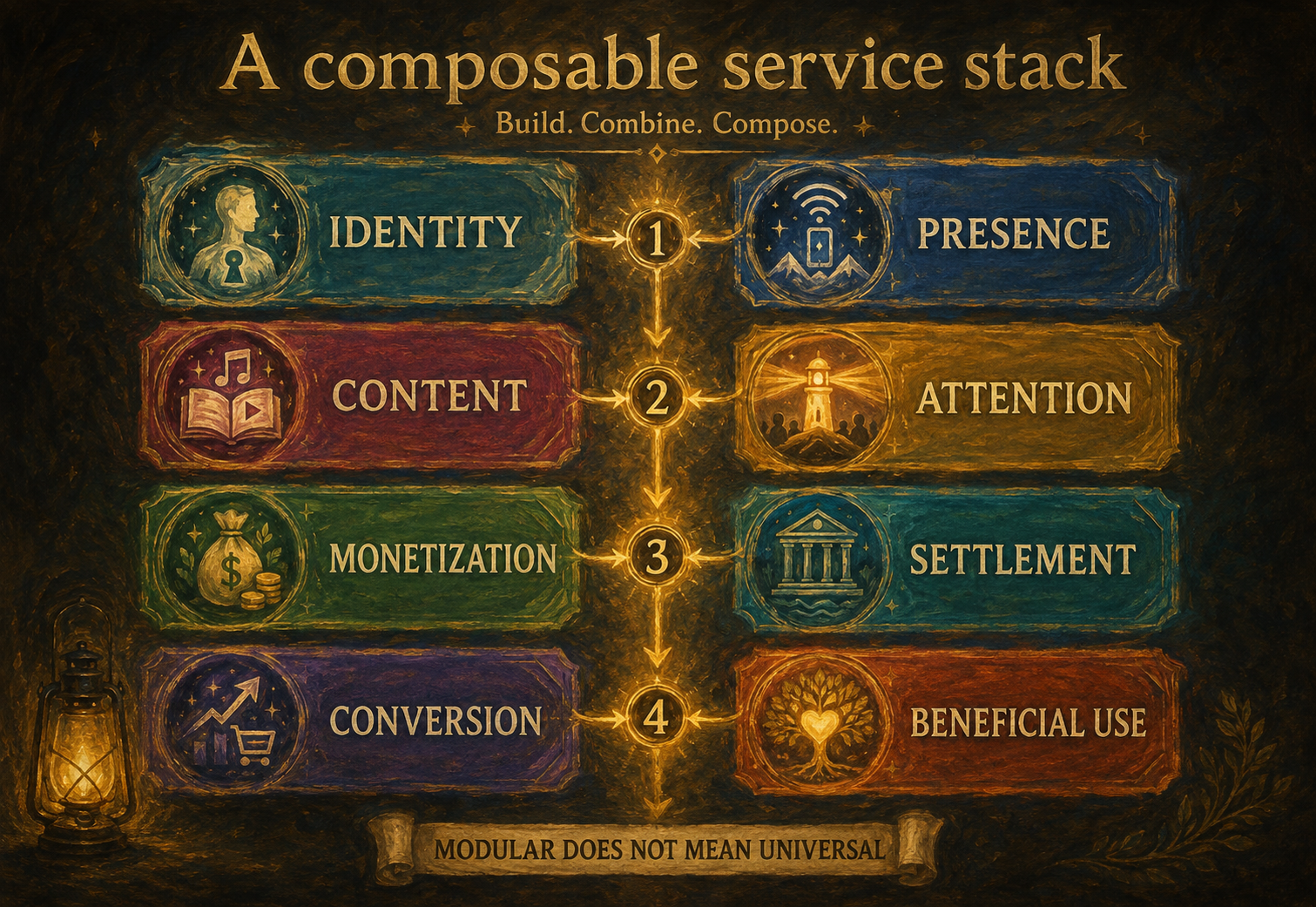
The shadow economy is better modeled as an interoperable service stack than as one institution that owns every node.
The modules need not share one owner. Interoperability can be enough.
FinCEN's 2025 analysis of suspected Chinese money-laundering-network activity illustrates the professional-service model. FinCEN reviewed 137,153 Bank Secrecy Act reports associated with about $312 billion in suspicious transactions and described networks that launder proceeds for Mexico-based cartels while also appearing in fraud, human trafficking, human smuggling, real estate, shell-company, mule, and mirror-transaction activity. Those reports describe suspicious activity, not 137,153 proven crimes. Their value lies in showing the scale and specialization of the laundering market. (FinCEN)
A criminal organization does not have to build that market from scratch. It can buy access to it.
The content vehicle can carry more than content
A song, video, livestream, advertisement, comment thread, or creator identity can perform several jobs at once. It can attract attention, establish trust, carry a narrative, invite payment, produce platform revenue, route people toward another service, and create feedback that the operator can observe.
This does not mean that symbolically rich content is encoded, that every recommendation is targeted, or that payment proves acknowledgment. It means the content vehicle can sit at the intersection of the semantic graph and the financial graph.
A visible creator may be the author, an authorized client, an unaware recipient, an impersonated identity, a compromised account holder, or a borrowed face whose credibility another operator exploits. The public page does not settle the role.
That is why the Lantern follows route, provenance, payment, payout, and control as separate trails. Posting is not delivery; delivery is not encounter; encounter is not assent; revenue is not beneficial ownership.
The human being hidden behind the account
The account farm is easy to imagine as a warehouse of obedient machines. The international record is more disturbing.
INTERPOL's 2026 Global Financial Fraud Threat Assessment describes fraud as central to polycriminality, intersecting with organized crime, cybercrime, and human trafficking. It warns that scam centres now operate worldwide and involve hundreds of thousands of people, many trafficked and forced to commit online fraud. INTERPOL's Operation Liberterra III separately documented trafficking-fueled scam operations and the seizure of 18,800 phones and more than 300 computers in one Myanmar raid.
The U.S. Prince Group case supplies the broadest alleged convergence located in this research. Prosecutors allege that a multinational conglomerate operated forced-labor scam compounds, phone farms, cryptocurrency investment fraud, professional laundering, bribery, gambling, mining, shell entities, ostensibly lawful businesses, traditional bank accounts, luxury assets, and rare artwork. The defendant remains presumed innocent unless proven guilty.
The indictment does not prove the complete creator-monetization Nexus. It does something else: it shows why role separation is a moral necessity.
Some people design the scheme, while others finance it, launder the proceeds, or operate accounts voluntarily. Another group may be deceived into participation. Some are trafficked, beaten, and forced to perform the visible work.
A truthful graph must be able to say:
ORGANIZER ──COERCES──> PERSON
PERSON ──OPERATES──> ACCOUNT
without silently rewriting the person as the organizer.
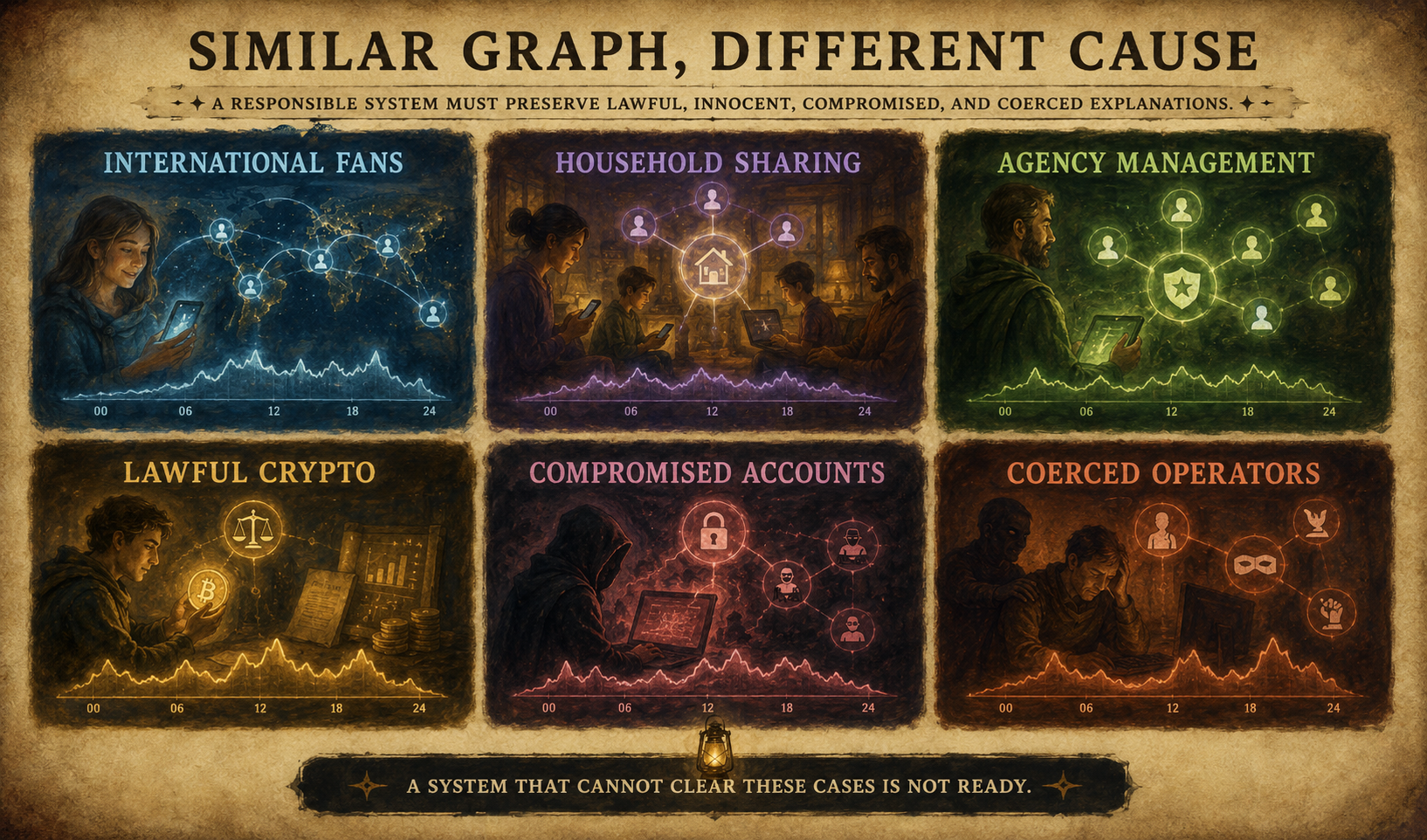
Similar account patterns can arise from lawful support, compromise, coercion, or organized abuse. The cause requires evidence.
Why no one institution sees the whole bank
Oversight follows institutional boundaries; the network does not.
A platform may know account history, devices, recovery channels, channel permissions, paid events, monetization ownership, and payout instructions. A processor or card issuer may know the payment instrument, billing profile, disputes, and immediate funding source. A bank may know deposits, transfers, counterparties, and account ownership. A virtual-asset service provider may know customer records and attributed wallet activity. A corporate registry may know formal ownership. A tax authority may know declared income. A court or prosecutor may assemble knowledge, intent, coercion, and predicate evidence through lawful process.
The public sees usernames, avatars, visible currencies, comments, links, upload histories, and content style. Those fields can nominate a question. They cannot answer it.
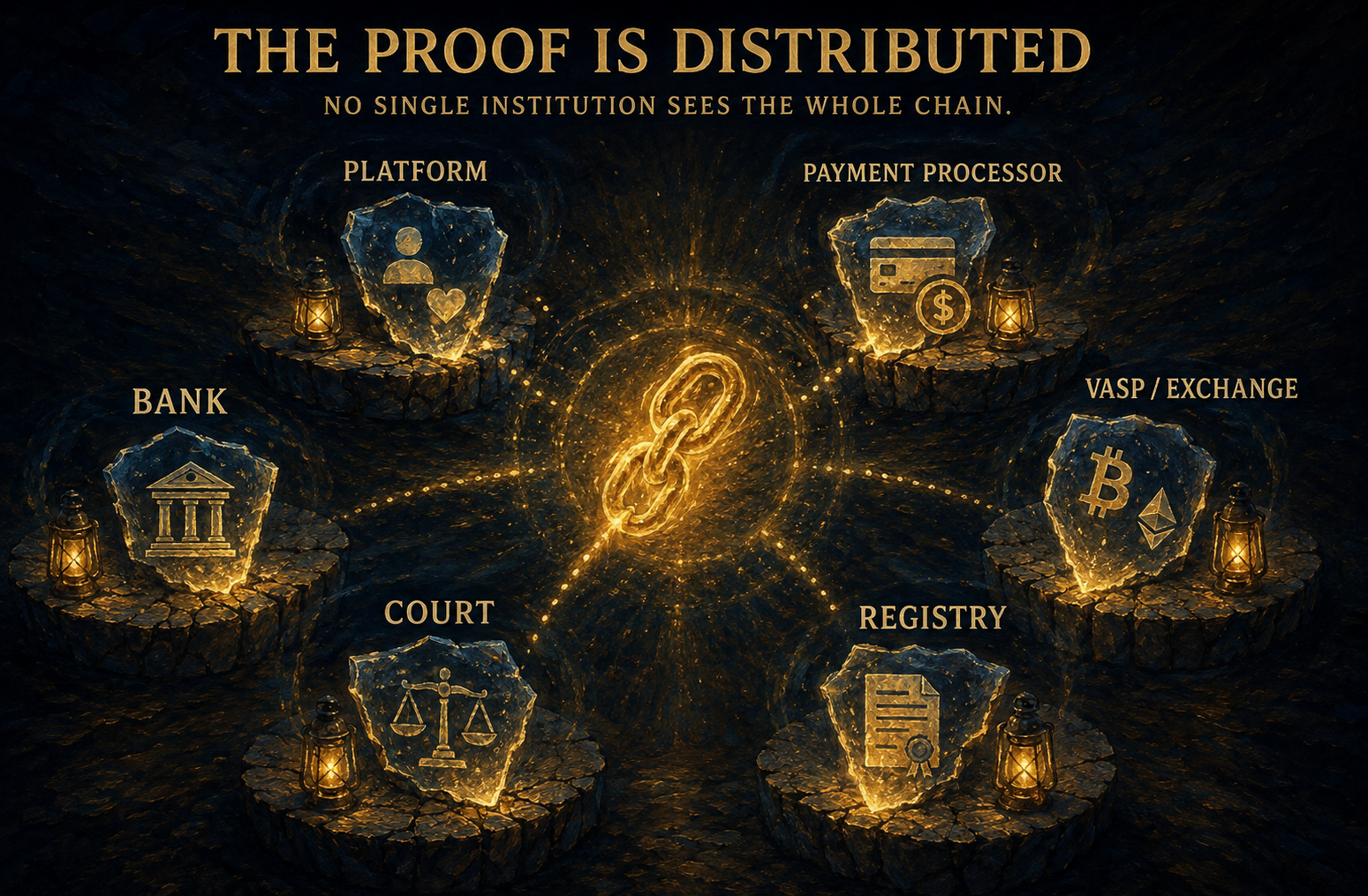
Each institution holds a different part of the relationship chain; no public profile contains the complete proof.
Three graphs, not one accusation
The human mind wants to draw every possible line across the Nexus. A responsible system separates three graphs.
The potential graph contains everything technology could permit: every account that could interact with every asset, instrument, wallet, platform, or beneficiary. It can become enormous.
The evidence graph contains only relationships supported for the exact subject, object, direction, and period by an appropriate evidence holder.
The authorized-join graph contains only the relationships an institution is lawfully permitted to test for a defined purpose.
The operable investigative graph is the intersection of evidence and authority.
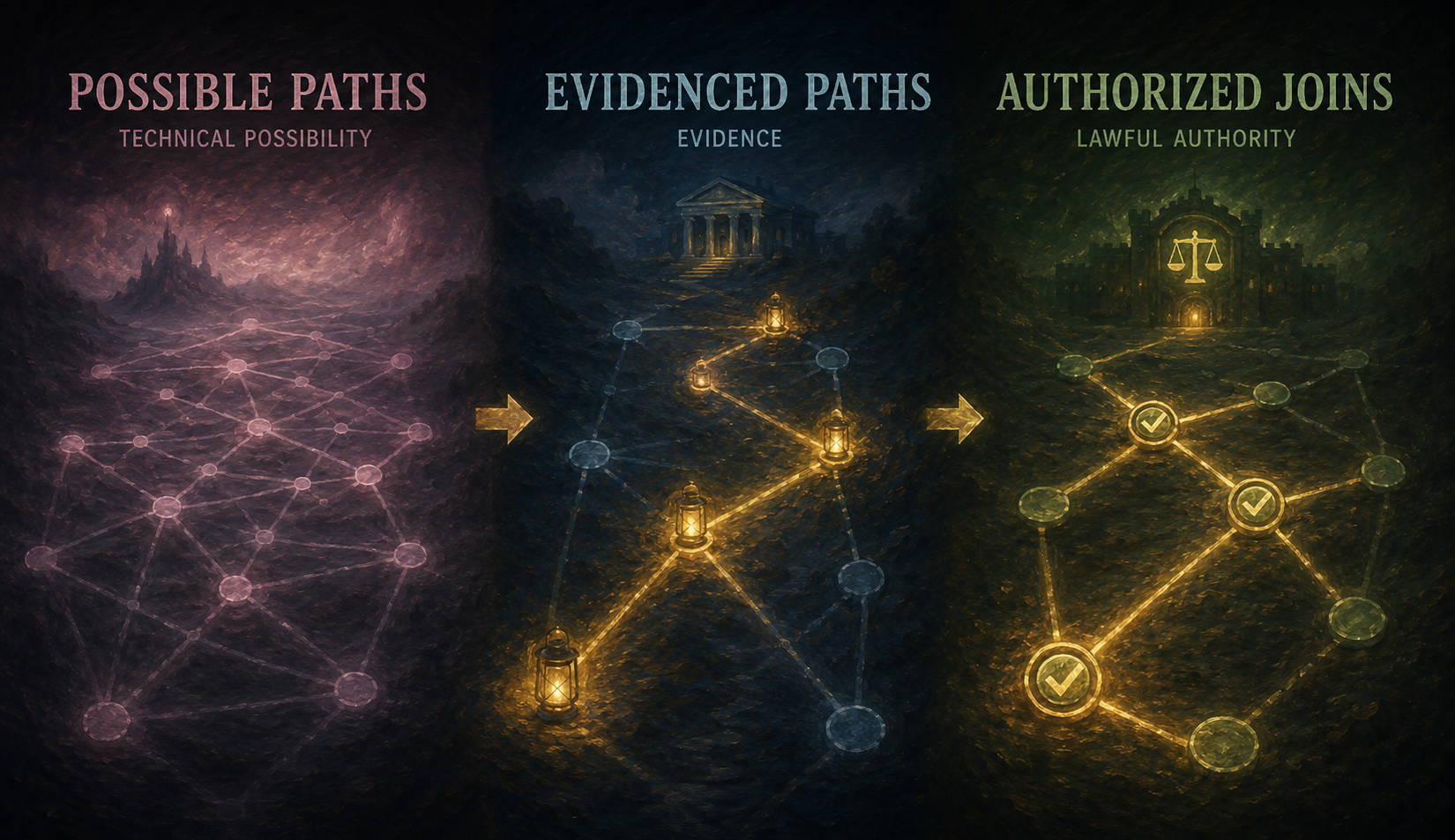
Technical possibility, evidentiary support, and lawful permission are different graphs.
That model gives the investigation its most important invariant:
An unknown edge remains unknown.
A privacy-enhancing computation can reduce the data parties disclose to one another. It cannot create legal authority. A network alert can nominate review, but it cannot establish guilt; a graph can reveal proximity, but it cannot confer beneficial ownership.
AI can help, but not by scoring people
The obvious response to AI-scaled financial crime is more AI. The Bank for International Settlements has tested a better version of that idea.
Project Aurora used synthetic data, privacy-enhancing technologies, machine learning, and network analysis to compare siloed and collaborative approaches to money-laundering detection. The project found collaborative analysis more effective at detecting complex networks than institution-only monitoring.
Project Hertha later tested payment-system analytics on a synthetic dataset representing 1.8 million accounts and 308 million transactions. Its findings helped participating banks and payment service providers identify 12 percent more illicit accounts and improved detection of previously unseen behavior by 26 percent. BIS also warned that such analytics remain one part of the solution and raise unresolved legal, regulatory, and practical questions.
The right architecture does not produce a single suspicion score for a person. It asks bounded questions about typed relationships:
Who controlled this account?
Who controlled this instrument?
What funded the event?
Was the event authentic?
Who owned the monetization account?
Who received the payout?
Who beneficially owned the recipient?
Did value return upstream?
What evidence supports knowledge or intent?
Was the operator coerced?
Each answer needs its own source, time, scope, correction route, and claim ceiling. If one answer is missing, the higher proposition remains open.
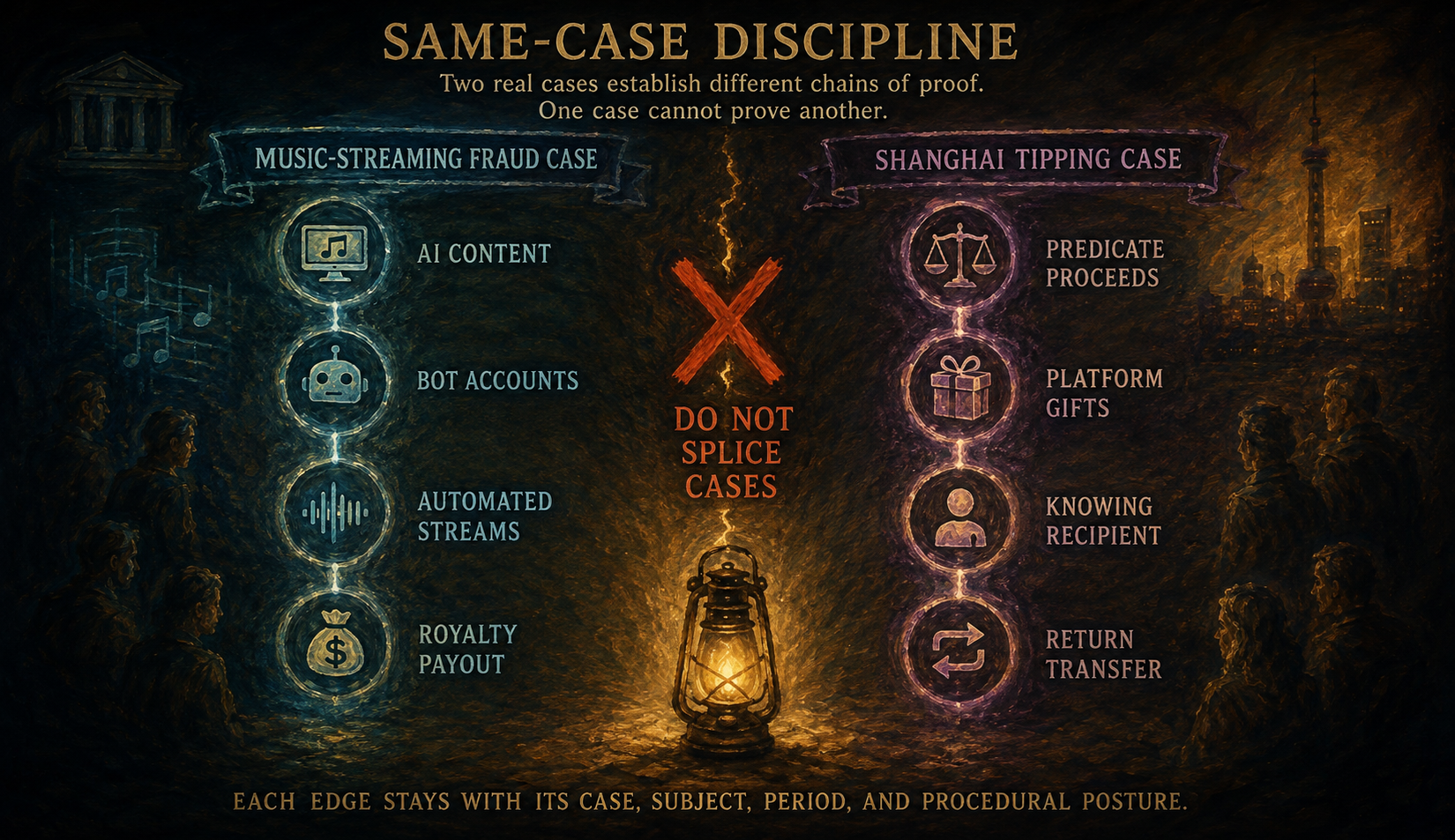
The Smith and Shanghai cases establish different subchains. Their edges cannot be merged into one fictional case.
What the record does not establish
The public record reviewed for this article does not establish that:
- one universal criminal organization controls the documented modules;
- a fully autonomous AI system beneficially owns or directs criminal finances;
- creator-economy payments commonly function as money-laundering rails;
- cryptocurrency use, VPN use, international audiences, or AI-made content are adverse evidence by themselves;
- every person operating an account is a willing participant;
- any private creator or previously discussed individual belongs to the architecture;
- the Smith music-streaming case involved trafficking or cryptocurrency;
- the Shanghai tipping case involved AI or virtual assets;
- the Prince Group allegations have been adjudicated;
- selected prosecutions or suspicious-activity reports establish prevalence.
No single retrieved case closes the complete chain:
common controller or funder
→ many apparently independent accounts
→ coordinated payment infrastructure
→ platform-native monetized events
→ verified payout beneficiary
→ beneficial ownership
→ conversion or backflow
→ predicate offense
→ knowledge and intent
That hold is not timidity. It is the line separating a testable model from an accusation that can absorb every anomaly and therefore prove nothing.
What responsible institutions can do now
Platforms do not need to wait for a universal theory before improving their controls. They can preserve paid-event and payout lineage, protect creators during administrator or beneficiary changes, separate compromised accounts from malicious controllers, and escalate relationship evidence to qualified human review. They can test interventions against lawful international fans, households, agencies, public fundraisers, and unaware recipients before deployment.
Financial institutions and virtual-asset providers can examine authenticated source-of-funds, beneficiary, backflow, mule, shell, and conversion relationships inside their lawful remit. Where collaboration is permitted, institutions can exchange minimum necessary assertions rather than building one raw-data lake. FATF's data-pooling and collaborative-analytics work supports privacy-respecting cooperation, but the legal basis must come before the computation.
Regulators and courts can preserve procedural posture so allegations, admissions, judgments, and typologies do not collapse into one confidence label. Researchers can publish the architecture and the evidence burden without publishing the thresholds, feature combinations, or challenge sequences that would help a network evade detection.
The public can help most by preserving public routes, reporting fraud through appropriate channels, and resisting the temptation to turn visual similarity into guilt. A strange account may be malicious. It may also be compromised, managed, lawful, or coerced. The Lantern should make the difference more visible, not less.
Return to the silent song
Inside the server, the song begins again. The platform counts the stream because counting streams is what the platform was built to do.
The next system must count more carefully. It must know which relationship it has actually proved, which institution held the evidence, which person may have been coerced, which appeal remains open, and where the money went after the public counter moved.
The song was never the whole transaction.
Source and correction note
This article distinguishes allegations, guilty pleas, official prosecutorial reports of judgment, institutional threat assessments, and synthetic research demonstrations. It does not use one case to fill another case's missing edges. The Michael Smith discussion relies on the March 2026 guilty-plea record and does not state a later sentencing disposition because no later official DOJ release or judgment was located in the publication source check conducted on August 14, 2026.
UVLM welcomes source-based corrections, procedural updates, and responses from affected institutions. A correction should identify the sentence at issue and provide a stable primary or authoritative source. Publication decisions remain with Thomas Prislac.
Works consulted
- U.S. Department of Justice: Michael Smith guilty plea, March 19, 2026
- U.S. Department of Justice: Michael Smith indictment release, September 4, 2024
- Procuratorate Daily: livestream tipping as a money-laundering method, September 10, 2024
- Supreme People's Procuratorate: Shanghai Pudong financial-crime case review, January 22, 2025
- INTERPOL: Global Financial Fraud Threat Assessment, March 16, 2026
- INTERPOL: Operation First Light 2026, July 9, 2026
- INTERPOL: Operation Liberterra III, January 26, 2026
- FATF: Cyber-Enabled Fraud, February 24, 2026
- FATF: Stablecoins and Unhosted Wallets, March 3, 2026
- FATF: Data Pooling, Collaborative Analytics and Data Protection
- FinCEN: Chinese Money Laundering Networks advisory and trend analysis, August 28, 2025
- U.S. Department of Justice: Prince Group indictment, October 14, 2025
- BIS Innovation Hub: Project Aurora
- BIS Innovation Hub: Project Hertha
- Zeitgeist Cryptography research:
/articles/cryptography-in-plain-sight-zeitgeist-channel - Phaselocking and provenance:
/articles/adventures-in-uvlm-style-phaselocking