The Personnel Matter
Tina Kotek, Oregon’s retaliation problem, and the workers who pay for it
By Thomas Prislac, with research and editorial collaboration from Envoy Echo, Ultra Verba Lux Mentis.
On the morning of April 22, 2026, a division director entered a room at Marion County Health & Human Services and told employees that the department’s two top officials had suddenly resigned. According to an employee who was there, the director’s hands shook and his voice cracked. People were stunned. Four months later, current and former employees told the Salem Reporter that a history of retaliation and surveillance had kept people quiet about what happened.The public-sector phrase for a scene like this is often a personnel matter.The phrase has a legitimate purpose. Employees deserve privacy. Investigations need room to proceed. Managers cannot litigate every internal dispute through the press. Yet the phrase can also become a locked door through which all institutional memory disappears. A worker raises a concern. Management opens a file. The public hears that the details are confidential. Months pass. The worker’s duties change, performance history darkens, colleagues learn caution, and the original concern becomes harder to see than the person who reported it.The complaint enters the system as information. It returns wearing the worker’s name. That transformation is the subject of this article.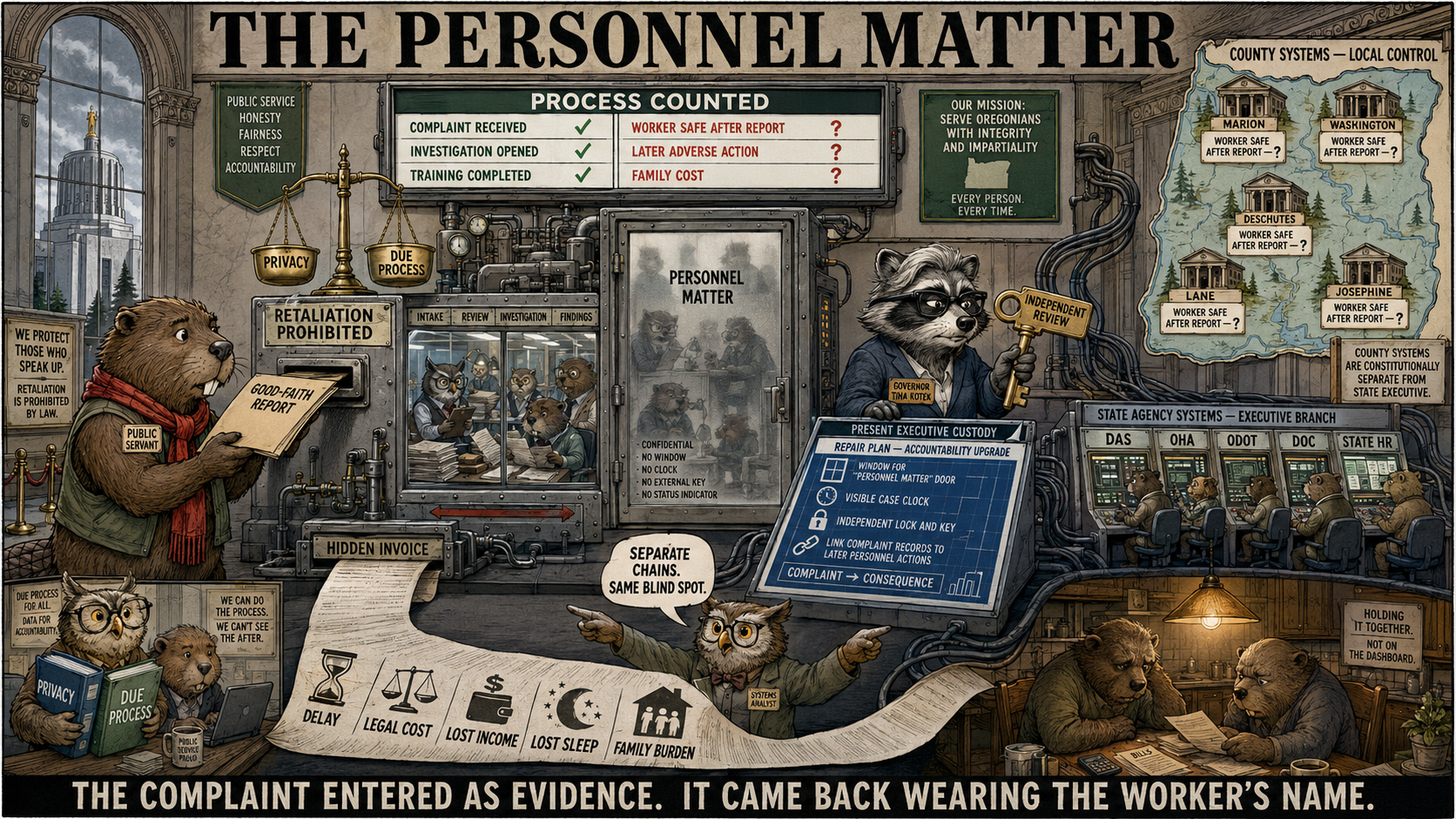
Oregon needs privacy, due process, and legitimate management authority. It also needs an independent way to track what happens after a worker reports wrongdoing. The state can count complaints, investigations, training, and settlements while still failing to show whether protected speech remained professionally survivable. Tina Kotek did not create every defect, and Oregon counties operate through separate local chains. Her administration nevertheless holds present custody of the state executive repair: a window, a clock, an independent key, and a record connecting complaint to consequence.
The strongest defense
Public employers must manage. A protected complaint does not grant an employee permanent immunity from supervision, investigation, discipline, reorganization, or removal. Some retaliation claims fail because the evidence does not establish an unlawful adverse action or causal link. A federal judge dismissed former legislative equity officer Nate Monson’s case in 2024. An investigation into Tina Kotek’s hardball conduct as House speaker found evidence supporting a contentious exchange with former Rep. Diego Hernandez, but concluded that Kotek had not violated hostile-workplace rules and that her later call for his resignation likely was not retaliation.
Settlements by Oregon agencies and counties often contain no admission of wrongdoing. Oregon State University disputed a jury verdict for former pharmacy dean Grace Kuo and announced an appeal, then dismissed that appeal in January 2024. An independent investigation into former state human-resources chief Jessica Knieling substantiated three of twenty-two complaints fully or in part, while Knieling’s attorney called the investigation deeply flawed.
Oregon’s counties also do not form one gubernatorial chain of command. Twenty-nine of the state’s thirty-six counties are governed by boards of commissioners, while seven use county courts. County commissioners, sheriffs, administrators, and local human-resources offices answer through local structures, not as ordinary subordinates of Governor Kotek.
Kotek, for her part, has not governed as though agency heads possess tenure by press release. She has removed leaders when she concluded that performance or accountability had failed, and lawmakers expanded her power over some agency leadership in 2025. Her administration requires director reviews every two years, quarterly performance-feedback targets, manager training, and annual employee-engagement measurement. Those are not trivial reforms.
Any article that erases these facts would become propaganda. Managers can be right. Complainants can be mistaken. Investigations can substantiate complaints against people who describe themselves as reformers. A fair control system must preserve all of that.
The problem is that Oregon’s own record shows something else at the same time: the state has repeatedly asked workers to trust complaint systems that it knew were fragmented, inconsistently trained, weakly tracked, and dependent on the very organizations whose decisions were under review.
Oregon already knew
In 2020, the Oregon Secretary of State audited the Department of Administrative Services, the central agency responsible for the statewide personnel system. The audit found that DAS did not sufficiently oversee agency discrimination and harassment investigations, did not track or analyze allegation and investigation data, and allowed inconsistent timelines, procedures, and documentation standards. It also found that agencies could be slow to begin investigations, that cases took an average of 56 business days to complete, and that investigators lacked required formal training. DAS agreed with all six recommendations.
The audit also documented the architecture behind those failures. DAS carried responsibility for the statewide human-resources system while delegating many HR functions to roughly four hundred agencies, boards, and commissions. The delegations had not been formally documented. Most complaint investigations remained inside agency HR departments, although some agencies used DAS, the Department of Justice, or private firms to reduce conflicts or add expertise.
That audit did not conclude that every agency investigation was corrupt or that every manager retaliated. Its finding was more structural and, in some ways, more alarming: Oregon lacked the mature statewide machinery needed to know whether its complaint process worked consistently.
The state has since built a statewide Workday case-management report and expanded investigation training. Its 2023-25 Affirmative Action Report describes substantial progress. The same report says the investigations report remains under development and that challenges continue because the system depends on human input and agency-wide compliance. From July 2023 through November 2024, agencies reported 610 discrimination and harassment complaints, including 225 general harassment or discrimination cases and 77 sexual-harassment cases. The report says the limited historical data cannot yet establish trends, then calls for statewide analysis, improved reporting, and continued training on investigation, documentation, accountability, and trauma awareness.
That is not a statewide finding of retaliation.
It is evidence that the state still cannot answer the most important statewide questions with confidence.
Which agencies generate disproportionate complaint burdens? How long do cases take? What happens to complainants after they report? How often does management begin discipline, restructuring, leave, demotion, or separation after protected activity? How often are claims substantiated, reversed, settled, dismissed, or abandoned because the worker can no longer afford the process?
A system that does not measure the path from complaint to consequence cannot tell the difference between accountability and attrition.
When the report becomes the offense
Oregon law protects a worker who makes a good-faith report of what the worker believes violates the law. The report does not have to be substantiated for anti-retaliation protection to attach. BOLI identifies firing, demotion, suspension, reduced pay, removal of employment privileges, and other changes in terms or conditions of employment as potential adverse actions.
The distinction matters. A whistleblower law cannot function if the employer may punish the report whenever management later rejects the underlying allegation. Otherwise the only safe whistleblower would be a worker who already possessed enough evidence to win a trial before speaking to a supervisor.
The public record now contains several different levels of proof.
At the Oregon Department of Corrections, a Marion County jury found that agency leaders retaliated against Merilee Nowak and Gina Raney-Eatherly after they raised concerns about possible illegal use of grant money. The jury awarded the two women $2.4 million. Reporting later placed the state’s total legal cost above $3 million. That is not merely an allegation or confidential settlement. It is an adjudicated trial result.
A related DOC dispute widened the picture. Former assistant director Nathaline Frener alleged that superiors pressured her to keep Raney-Eatherly from returning under state layoff rules, then retaliated against Frener after she resisted and testified. Frener alleged that managers wanted her to leave a position vacant until the worker’s return rights expired and later pressured her to devise a plan to remove the worker. The state subsequently paid $950,000 to settle Frener’s claims.
Frener’s case does not independently prove every allegation in the earlier lawsuit. It shows how retaliation risk can propagate. A manager may face pressure not only for making the original disclosure, but also for refusing to help punish the person who made it.
At the Oregon Department of Transportation, former chief information officer Mark Sauer alleged that the state fired him after he warned that inadequate testing of the Workday payroll transition would produce widespread pay failures. Oregon paid $465,000 to resolve his whistleblower suit. A settlement is not a verdict, and the public record should say so. It is still a costly signal attached to a system failure that affected thousands of workers.
At the Oregon Health Authority, Leann Johnson alleged discrimination and retaliation after raising concerns and clashing with new leadership. The state agreed to reinstate her, credit two additional years of service, accept her resignation, and pay $630,000 without admitting fault. OHA had also documented management concerns, including delays in civil-rights investigations that Johnson’s division attributed to insufficient resources. A fair account must preserve both the retaliation claim and the operational criticism.
The case of Jessica Knieling places the problem inside the office that was supposed to improve the problem. Knieling, Oregon’s chief human-resources officer, said she was fired after trying to hold senior officials accountable. DAS initially said an investigation was underway. The later report said complainants accused her of abusing authority and violating hiring and discipline rules, and the investigator fully or partially substantiated three complaints. Knieling disputed the report through counsel.
This does not prove that Knieling was retaliated against. It demonstrates why Oregon needs a system stronger than competing claims issued after an at-will termination. When the state’s top personnel official can describe her firing as retaliation while an investigation describes her own conduct as policy failure, the public needs evidence lineage, chronology, independent review, and a clear opportunity for response.
A title cannot resolve that conflict.
Neither can a press release.
Workers at Oregon’s Department of Early Learning and Care described another version of the mechanism in 2024. Priscilla Lowells wrote to incoming Governor Kotek’s chief of staff after saying she had met resistance when raising workplace concerns. Reporting based on records and employee interviews described allegations of inequity, mismanagement, and retaliation within the agency. Those allegations require their own adjudication. Their significance here lies in the route: a worker went above her agency because she did not trust the ordinary ladder to carry the message upward without changing it.
Kotek has seen this architecture before
The pattern did not begin when Kotek became governor.
In 2019, the Oregon Legislature agreed to a $1.32 million resolution of sexual-harassment complaints involving eight women. The underlying BOLI process accused legislative leaders of allowing a hostile environment and failing to respond adequately. Then-House Speaker Kotek and Senate President Peter Courtney apologized and said they were committed to changing the Capitol’s workplace culture.
The correction matters.
So does the history.
Later, Monson alleged that the Legislature’s new equity apparatus remained disordered and that he faced retaliation after describing its failures. His lawsuit was dismissed on summary judgment. That dismissal is not a decorative footnote. It is exculpatory evidence and must control the legal claim. Yet the episode still illustrates a recurring institutional problem: Oregon created a new office to receive misconduct complaints, then entered another public dispute over whether the person running that office was exposing dysfunction or deflecting from his own record.
Kotek’s dispute with Hernandez supplies another necessary limit. The investigation did not find that her political pressure violated workplace rules. Hard politics is not automatically illegal retaliation.
These outcomes prevent a simplistic verdict on Kotek’s character.
They do not relieve the governor of responsibility for the executive machinery she now controls.
Kotek says she wants systems that empower roughly 42,000 public servants. Her administration tracks director reviews, performance check-ins, training completion, audit implementation, and employee engagement. Yet those controls mostly ask whether managers completed management processes. They do not yet show whether workers who report wrongdoing remain professionally safe afterward.
A system can reach ninety percent completion and still teach employees not to speak.
Reader-supported public-interest work
Help keep careful research open.
Ultra Verba Lux Mentis is a nonprofit research organization. Voluntary gifts help fund open research, independent review, accessibility, public education, documentation, and practical public-interest tools.
This article and UVLM’s public materials remain available whether or not you donate.
Opens the UVLM donation page in a new tab. Giving is always optional.
Counties are separate, but the invoice rhymes
The county record belongs to local officials, not to the governor. It still matters because Oregon’s public workforce does not experience government as a constitutional chart. Workers experience supervisors, investigations, leave notices, performance reviews, assignments, withheld information, surveillance, attorneys, and the long silence between a complaint and a decision.
In Lane County, a county-commissioned report found that Commissioner David Loveall retaliated multiple times against three employees after human-resources complaints. The report described adverse actions and quoted statements threatening to get rid of employees. Loveall rejected the findings as flawed and politically motivated. This is a substantiated local investigation with a disputed response, not a court verdict.
In Washington County, former sheriff’s deputy Melissa Canning alleged that her career collapsed after she reported a colleague for dishonesty connected to a sexual-assault allegation. The county paid $950,000 to settle before trial, expressly denied the overall characterization of her experience, and admitted no wrongdoing.
In Josephine County, two former directors filed separate $1.5 million suits alleging that commissioners retaliated after they participated in an ethics investigation. The state ethics commission dismissed all eight complaints against former Commissioner John West. The employees’ lawsuits also refer to a third-party bullying and harassment investigation that had not been made public when the story appeared. Here the unresolved evidence cuts in both directions, exactly as it should.
In Deschutes County, OPB reported that employees described a culture of retaliation under Sheriff Shane Nelson, while the sheriff defended personnel decisions as cause-based and pointed to outside investigations. By 2022, OPB reported that county employees had filed at least twenty-five complaints against the sheriff or his office since he took office, and that the county had spent almost $3.5 million defending and settling claims.
Marion County adds the most recent warning. Its own policy prohibits retaliation against anyone who files a complaint, participates in an investigation, or reports discrimination or harassment. Current and former employees nevertheless told the Salem Reporter that retaliation and surveillance kept them from speaking openly about upheaval in Health & Human Services.
These cases do not prove a coordinated statewide campaign.
They reveal a repeated control failure across separate institutions: the people who hold personnel authority often control the evidence, timing, narrative, access, and career consequences surrounding complaints about that authority.
That is enough to demand repair.
Cruelty without a confession
By managerial cruelty, I do not mean that every official in these cases intended to be cruel.
Motive belongs to evidence, not rhetoric.
I mean that a process can become cruel through its effects.
A worker reports a concern and loses ordinary collegial contact. An investigation stretches across months while the worker remains on leave. A familiar performance history changes after protected activity. The organization calls the decision confidential while colleagues absorb the warning. The worker hires counsel, spends savings, postpones retirement, explains the uncertainty to a spouse, and carries the case home in a body that no longer knows when the threat has ended.
The institution experiences a file.
The household experiences weather.
Public agencies often describe this burden as unavoidable process. Some of it is. Confidentiality protects complainants and accused employees. Due process takes time. Investigators must test claims rather than reward the first narrator.
But every delay, duplicate interview, opaque status change, shifting explanation, and unreviewable leave decision transfers cost from the institution to the person least able to spread it.
That transfer is the hidden invoice.
Retaliation law asks whether an employer took unlawful adverse action because of protected activity. Public ethics must ask a wider question:
Did the institution design the process so that speaking truthfully remained survivable even when the report was disputed, unsubstantiated, or embarrassing?
A workplace can comply on paper while teaching silence in practice.
My stake in this argument
I write with a stake in the question. I have my own unresolved account involving the Oregon Department of Revenue.
I do not ask readers to treat my experience as proof of the cases above, as proof of agency-wide misconduct, or as evidence of another person’s motive. My account has its own records, disputed interpretations, and required process.
I ask for something narrower and harder to dismiss: test my account under the same independent rules Oregon should apply to every worker.
Preserve chronology. Separate the original disclosure from later character judgments. Identify who controlled each decision. Give management’s evidence full weight. Give contrary evidence the same dignity. Record what remains unresolved. Protect my family from unnecessary disclosure. Do not let the agency whose conduct is questioned become the only institution authorized to explain what happened.
Personal experience gives me standing to care.
It does not give me standing to skip proof.
What the record does not establish
The record reviewed for this article does not establish that Tina Kotek ordered retaliation against the workers discussed here.
It does not establish that Oregon’s executive agencies or counties operate through one conspiracy.
It does not establish that every terminated, disciplined, reassigned, or criticized employee was a whistleblower, or that every complaint was accurate.
It does not convert settlements into admissions, allegations into findings, findings into criminal judgments, or criticism into proof of corrupt intent.
It also does not establish that Oregon’s reforms have failed in every respect. The state created complaint tracking after the 2020 audit, expanded training, instituted leadership reviews, and publicly reports some workforce measures. Kotek has removed agency leaders and sought stronger executive accountability. Some claims against her and other officials have failed or been rejected.
The evidence supports a bounded conclusion:
Oregon has enough adjudicated retaliation, expensive settlements, substantiated local findings, repeated allegations, and acknowledged weaknesses in complaint oversight to treat retaliation risk as an enterprise control problem rather than a collection of isolated personality conflicts.
That conclusion is an inference from a mixed record.
It is not a verdict against every manager.
Build a system that does not punish the signal
Oregon does not need another policy that says retaliation is prohibited.
It needs controls that make retaliation harder to perform, easier to detect, and more costly to conceal.
First, create an independent Public Service Integrity Office. The office should sit outside ordinary agency management and receive state-worker complaints involving retaliation, abuse of authority, evidence suppression, and interference with investigations. It should publish jurisdiction, timelines, recusal rules, evidence standards, appeal rights, and anonymized outcomes. Counties should be able to join through legislation, intergovernmental agreements, or incentive funding rather than fictional gubernatorial command.
Second, require a retaliation-risk review before materially adverse action follows protected activity. The review should not block legitimate management. It should require the decision-maker to identify the protected activity, evidence supporting the proposed action, comparators, timing, alternatives, conflicts, and independent reviewer. Oregon already uses a rebuttable presumption in workplace-safety retaliation cases when adverse action closely follows protected activity. Under ORS 654.062, adverse action within sixty days creates a rebuttable presumption that the law was violated, which the employer may rebut by a preponderance of the evidence. A broader public-sector design would require legislative and legal review, but the control principle is sound: timing creates risk that management must answer, not proof that management automatically loses.
Third, separate the disclosure file from the performance file. A manager may have legitimate concerns about an employee who also made a protected report. The state should require independent review whenever the same leaders, witnesses, or disputed events populate both files. No investigator should quietly convert the complaint into evidence of disloyalty, poor fit, lack of collaboration, or communication failure without showing the factual bridge.
Fourth, publish a statewide retaliation dashboard. The dashboard should disclose complaint counts, agency, category, median age, interim status, investigator type, outcome, appeal, later adverse actions, settlements, judgments, reinstatements, and unresolved cases, with privacy protections and suppression rules for small groups. A dashboard will not reveal truth by itself. It will reveal where the state should look.
Fifth, give workers a procedural bill of rights. Every complainant and subject should receive plain-language notice of process, expected timing, status intervals, evidence-submission rights, correction rights, representation options, confidentiality limits, anti-retaliation protections, and appeal routes. Administrative leave should trigger periodic necessity review. A case that exceeds its target should generate an escalation receipt rather than another silent month.
Sixth, count the hidden invoice. Settlements and judgments belong in the public ledger, but so do outside counsel, staff turnover, vacancy time, sick leave, lost institutional knowledge, delayed services, and the burden transferred to families. Oregon should stop treating a payment as the beginning of accountability and start treating it as evidence that prevention failed earlier.
Seventh, protect disagreement inside reform itself. The Knieling dispute shows why reformers cannot receive automatic moral immunity. An integrity office must be able to investigate the investigator, review the reviewer, preserve dissent, and distinguish an accountable correction from a retaliatory counterattack.
No title should become a sacrament.
The door
The door marked PERSONNEL MATTER should remain.
Privacy matters. Due process matters. Workers accused of wrongdoing deserve protection from public conviction by rumor, just as complainants deserve protection from retaliation.
But the door needs a window, a clock, an independent key, and a record of who entered.
Oregon cannot promise public servants that speaking up is protected while leaving them to prove, years later and at household expense, that the system changed after they spoke.
Nor can the state repair this by assuming every complainant is right.
It must build a process strong enough to carry uncertainty without transferring all of its weight onto the person who raised the concern.
The next complaint should enter as evidence.
It should not come back wearing the worker’s name.
Corrections and right of reply
UVLM invites documented corrections, relevant primary records, and responses from people or institutions named in this article. A correction request should identify the disputed passage, the proposed correction, and supporting evidence. Corrections do not require agreement with the article’s interpretation, but factual changes will be evaluated against the strongest available record.
Publication authority remains with Thomas Prislac.
Claim-boundary note
This is investigative commentary, not legal advice or a factual adjudication of unresolved employment disputes.
It distinguishes allegations, official findings, jury verdicts, dismissals, settlements without admission, management responses, and author inference.
The term managerial cruelty describes documented or reasonably inferred burden and effect. It does not assign an unproved private motive.
Works Consulted
Statewide audits, law, policy, and governance
Oregon Secretary of State Audits Division. “DAS Needs to Provide Oversight to Improve Investigations of Workplace Discrimination and Harassment at State Agencies.” Report 2020-34, October 2020. Official audit.
Oregon Department of Administrative Services. “State of Oregon Affirmative Action Report 2023–2025.” Official report. Oregon Bureau of Labor and Industries. “Whistleblowing Protections.” Official guidance.
Oregon Department of Administrative Services. “Accountability and Governor’s Expectations.” Official program description. Oregon Secretary of State, Oregon Blue Book. “County Government in Oregon.” Official reference concerning county governance.
Oregon OSHA. “Protect Against Retaliation.” Official worker guidance.
Ogletree Deakins. “Oregon Enhances Whistleblower Protections for Workplace Safety Complaints.” 2021. Legal secondary explanation of the statutory change.
Marion County. “Administrative Policy 602: Discrimination and Harassment Free Workplace.” Official county policy.
Oregon Department of Administrative Services. “State HR Policy 50.010.01: Discrimination and Harassment Free Workplace.” 2022. Official state policy.
Governor and executive-agency reporting
Oregon Capital Chronicle, republished by Salem Reporter. “Lawmakers in Recent Session Gave Gov. Kotek More Hiring, Firing Power Over Agency Leaders.” July 10, 2025. Legislative change and management response.
KATU/KCBY. “Jury Awards $2.4M to Two Former Oregon DOC Employees in Retaliation Lawsuit.” April 24, 2023. Reporting on an adjudicated jury verdict. Oregon Capital Chronicle. “Oregon Department of Corrections Tab for Lawsuit Tops $3 Million.” August 11, 2023. Public-cost reporting.
Jefferson Public Radio. “Former Oregon Department of Corrections Assistant Director Sues Agency.” August 2, 2023. Lawsuit allegations, not an adjudicated result.
Oregon State Library eClips / Statesman Journal. “Oregon to Pay $465,000 Settlement in ODOT Whistleblower Lawsuit.” April 3, 2025. Settlement without admission.
The Lund Report. “Former Health Authority Equity Director Leann Johnson Wins $630,000 Settlement.” July 2026. Settlement without admission.
The Lund Report. “New Records Show Relations Soured Before Oregon Health Authority Equity Director’s Firing.” July 2, 2024. Contested documentary record presenting competing explanations.
OPB/KLCC. “Oregon’s Top Human Resources Official Fired; Says She Tried to Hold State Leaders Accountable.” June 30, 2026. Retaliation allegation pending investigation.
OPB. “Investigative Report Alleges Oregon’s HR Chief Was Fired After Not Following State Policies. She Calls It ‘Deeply Flawed’.” August 15, 2026. Partial investigation substantiation, disputed by the subject.
InvestigateWest / Salem Reporter. “Inequity, Mismanagement Beleaguer Oregon’s Early Learning Agency, Employees Say.” March 28, 2024. Record-based reporting and employee allegations.
Oregon Legislature and Oregon State University
Willamette Week. “The Oregon Legislature Will Pay More Than $1 Million to Eight Victims of Sexual Harassment.” March 5, 2019. Settlement and reporting on the BOLI process.
OPB. “Tina Kotek Did Not Break Workplace Rules With Hardball Tactics in Oregon Legislature, Report Suggests.” September 30, 2022. Exculpatory investigation finding.
U.S. District Court for the District of Oregon, via Justia. “Monson v. State of Oregon et al., Opinion and Order.” March 11, 2024. Federal summary judgment and dismissal.
OPB/KLCC. “Former Oregon State University Dean Wins Whistleblower Retaliation Lawsuit.” February 28, 2023. Reporting on a jury verdict.
Oregon State University. “OSU Statement 1.22.2024.” January 22, 2024. Official confirmation that OSU dismissed its appeal.
County workers and local-government systems
Salem Reporter. “Marion County Employees Say Pattern of Retaliation, Surveillance Keeps Them Quiet.” August 14, 2026. Multisource allegations, not a final adjudication.
KLCC. “Report: Commissioner Loveall Retaliated Multiple Times Against Three County Staff.” February 10, 2026. County-commissioned investigation, substantiated and disputed.
OPB. “‘Salsa-gate’ Lawsuit at Washington County Ends With $950,000 Settlement for Ex-Deputy.” April 24, 2025. Settlement without admission.
Jefferson Public Radio / OPB. “Former Employees Sue Josephine County, Claiming Commissioners Retaliated After Ethics Complaint.” March 19, 2026. Pending allegations; related ethics complaints were dismissed.
OPB. “Employees Describe Culture of Retaliation Under Deschutes County Sheriff Shane Nelson.” December 14, 2021. Multisource allegations accompanied by management defenses.
OPB. “Union Calls for Multnomah County Sheriff to Resign.” May 10, 2016. Union advocacy position, not an adjudicated finding.
The above commentary is published in alignment with Ultra Verba Lux Mentis’s mission statement to amplify neurodiverse voices while researching cognitive offloading technologies to aid neurodiverse persons in participating within sectors of societal power traditionally denied them. It does not reflect the viewpoints of the organization itself.
Political satire created under the editorial direction of Thomas Prislac and Ultra Verba Lux Mentis, with AI-assisted illustration, 2026.