No Clear Results
Tina Kotek, Measure 110, and the Behavioral-Health System Oregon Still Could Not Reliably Evaluate.
By Thomas Prislac, a 20+ year Democrat, born and raised in the great state of Oregon for 46+ years, with research and editorial collaboration from Envoy Echo, UVLM. 2026.
Oregon built real addiction and crisis services that reached real people. State auditors nevertheless found that Oregon could not reliably determine how many unique people Measure 110 served, whether access improved, whether people remained connected to care, or whether the broader behavioral-health crisis system worked as one system. Tina Kotek inherited much of this architecture from another democrat while she lead the house as a leader of a mono-party state. Her administration now owns the repair, including the duty to make care visible without reducing human beings to encounters on a dashboard.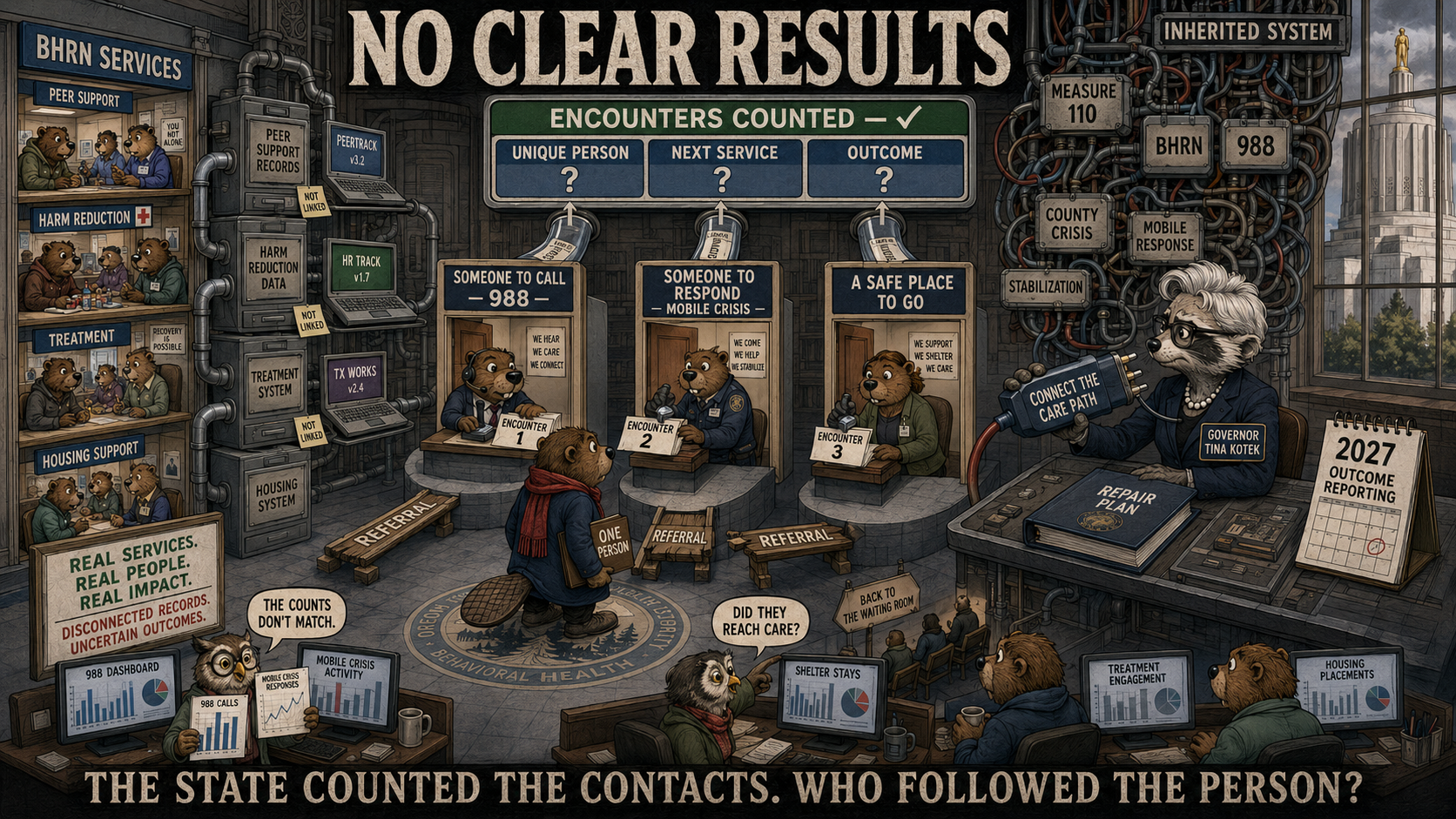
Oregon built real points of care, and real people received meaningful help. Yet the person moving among 988, mobile crisis, treatment, housing, and stabilization can still disappear into separate records. Tina Kotek did not design every broken connection, but her administration now owns the repair, including the duty to show whether contact became continuity, safety, housing, treatment, or another crisis.
The Person the Dashboard Cannot See
Imagine a person walking into a Behavioral Health Resource Network while frightened, sick, or exhausted.
They may receive naloxone, speak with a peer who understands recovery, complete an assessment, enter withdrawal management, begin low-barrier treatment, find temporary housing, or return several times before they feel ready to accept another form of care.
Every one of those contacts may matter.
The state may record them as separate encounters.
What the record has often failed to show is whether those encounters belonged to one person or several, whether the person moved from harm reduction into treatment, whether treatment continued, whether housing stabilized, whether another crisis followed, or whether the person remained alive.
Now imagine a parent calling 988 for a child in crisis.
Someone answers. A mobile team may respond. The team may de-escalate the situation, avoid arrest or hospitalization, make a referral, or connect the family with stabilization services. Oregon can count the call, the dispatch, and some features of the encounter.
It has had far more difficulty following the person through the doors.
Did the requested team arrive?
Did the family receive the stabilization service?
Did the referral become an appointment?
Did the appointment become continuing care?
Was the same child back in crisis the following week?
Oregon has created many points of contact. Its own audits and program reports show that it still struggles to connect those points into a reliable account of what happened to the human being moving among them.
An encounter is an action.
It is not yet an outcome.
An Inherited System and a Present Custodian
Tina Kotek did not create Measure 110.
Oregon voters approved it in 2020. The Legislature established Behavioral Health Resource Networks in 2021, and the first grant cycle began before Kotek became governor. The state’s behavioral-health crisis data problems reach even farther back: a 2025 audit traced major gaps in Oregon’s health-system information across twenty-three years.
Those inheritance boundaries matter.
Kotek did not design the original Measure 110 structure, create Oregon’s decades-old behavioral-health workforce shortages, or cause every fragmented database, county variation, grant delay, or missing outcome field that she encountered upon taking office.
She also did not inherit a frozen object.
The Secretary of State’s Measure 110 audit examined the program through July 2025. During much of that period, OHA answered to Kotek’s administration while lawmakers repeatedly revised the program. The state recriminalized possession in September 2024, added county deflection pathways, replaced the Measure 110 label with the Behavioral Health Resource Network program, and shifted grant-making authority from the Oversight and Accountability Council toward OHA.
Kotek therefore occupies the same position she held in the Workday failure: she did not author the original launch, but she inherited custody of the repair.
Custody does not make her personally responsible for every clinical decision or data field. It makes her administration responsible for appointing competent leadership, defining authority, integrating programs, funding measurement, resolving institutional fragmentation, and telling Oregonians what the state knows.
More importantly, it requires her administration to say what it still does not know.
What “Cannot Determine” Means
The December 2025 Measure 110 audit asked whether Oregon had created an effective public-health alternative to criminalization.
Its answers were severe.
Auditors found unstable governance, inconsistent grant administration, weak integration with the larger behavioral-health continuum, unclear goals, unreliable information, and insufficient evidence to determine the number of people served or the program’s outcomes. They concluded that OHA could not reliably demonstrate whether Measure 110 had reduced overdose harm, expanded treatment access, increased culturally specific services, improved access to housing, or connected more people with sustained care.
“Cannot determine” does not mean “nothing happened.”
It does not mean every dollar disappeared, every provider failed, or every person who received care remained unchanged.
It means Oregon could not distinguish success from activity with the confidence required for public accountability.
That distinction protects the people the programs helped. Their recoveries do not become imaginary because Oregon measured them badly.
It also protects the public from a more convenient fiction: that a large number of grants, contacts, service units, or success stories automatically proves that a statewide policy achieved its statutory purpose.
A person may survive because someone handed them naloxone.
A provider may open a needed withdrawal-management center.
A peer may build enough trust for treatment to become possible.
Those outcomes remain real.
The state still must determine whether access depended upon geography, whether people reached the next level of care, whether services reduced avoidable harm, and whether the system worked better than the alternatives available before it.
Anecdote cannot carry the full claim.
Neither can an audit gap erase the anecdote.
Both ledgers matter.
The Services Were Real
Measure 110 did not produce only meetings and administrative files.
The current BHRN program funds organizations and Tribal entities in every Oregon county. Each network must make six categories of support available: screening, assessment, peer services, harm reduction, low-barrier treatment, and transitional or supportive housing.
Official program materials point toward tangible additions.
Plaza de Nuestra Comunidad serves Latino and immigrant families in Lane County. Measure 110 funding helped Recovery Works NW open a withdrawal-management facility expected to serve as many as 1,200 people annually. Polk Cares Center was developed around a single point of access to harm reduction, treatment, and recovery support. These examples come from OHA’s own promotional materials, so they establish what the agency and grantees report rather than independently evaluated statewide outcomes. They still show that the program built things people can enter and use.
OHA says Measure 110-funded programs reported approximately three million encounters from 2022 through 2025. It also reports that more than 80 percent of funded providers conducted outreach at least weekly and that roughly 40 percent did so five or more times each week.
Those figures demonstrate substantial activity.
They do not tell us how many unique people received care.
One person may generate many encounters. A peer conversation, supply distribution, housing contact, assessment, treatment visit, and follow-up may all be counted separately. Some repeated encounters may show continuity and trust; others may show that a person never reached a service capable of changing the underlying condition.
OHA’s own data profile warns that client counts and encounters should not be used alone to evaluate a grantee’s impact.
The state therefore holds two truths that political debate often pulls apart.
Measure 110 funded valuable services.
Oregon could not yet show, at the statewide level, how those services combined into durable results.
A Baseline Is Not a Time Machine
The Secretary of State recommended that OHA construct a retrospective baseline and publish annual reports comparing future Measure 110 outcomes against statutory goals.
OHA disagreed.
The agency argued that a retrospective comparison would be distorted by the COVID-19 pandemic, the rapid arrival of fentanyl, repeated statutory changes, unstable cannabis revenue, services financed outside Measure 110, and the difficulty of connecting non-Medicaid BHRN activity with Medicaid claims and other state systems. OHA said these limitations might make the proposed historical analysis impossible or misleading, while committing to improved prospective outcome reporting by 2027.
That objection deserves serious consideration.
A baseline cannot make 2020 and 2026 comparable by decree. Fentanyl changed Oregon’s illicit drug market. The pandemic changed service access, isolation, mortality, and health-system behavior. The Legislature repeatedly changed Measure 110’s legal and administrative form. A number that ignores those forces may look rigorous while attributing causation the evidence cannot support.
Research on Oregon’s overdose mortality illustrates the danger. One peer-reviewed study found no detectable one-year increase attributable to decriminalization, while a later analysis concluded that Oregon’s transition to a fentanyl-dominated drug market offered a more plausible explanation for the sharp rise in fatal overdoses. Other researchers have reached different conclusions. The scientific record does not support treating every overdose after Measure 110 as proof that decriminalization caused it.
But a flawed retrospective baseline and no evaluative baseline are not the only choices.
Oregon can publish contextualized historical trends, identify data breaks, show confidence limits, distinguish correlation from causation, and begin prospective measurement using clearly defined populations and outcomes. Where direct comparison proves impossible, the state can explain why and use multiple imperfect indicators rather than one falsely decisive number.
Complexity does not excuse the absence of measurement.
It requires more honest measurement.
The Data System Arrived After the Program
OHA has begun building a stronger reporting structure.
The agency launched ROADS, the Resilience Outcomes Analysis and Data Submission system, in March 2025 to collect behavioral-health service information more consistently. Its BHRN data plan now contemplates client-level information covering services, treatment type, wraparound needs, episode completion, and reasons care ended.
Yet the transition remains incomplete.
OHA set July 2026 as the compliance date for BHRN providers to begin reporting through ROADS, with an extension period through November 2026 because of technical integration and provider readiness. The quarterly BHRN dashboard published in July 2026 still displays aggregated data from the Submittable grant-management platform. OHA says more detailed service and client information will reach the public dashboard in summer 2027.
This means Oregon spent and distributed hundreds of millions of dollars before it possessed the statewide information infrastructure needed to evaluate individual pathways through care.
That sequence does not prove the spending lacked value. Emergency and community services cannot always wait for perfect measurement.
It does show that evaluation entered late.
A state may reasonably fund urgent services while improving the data system in parallel. It should then state the trade plainly: Oregon chose to build access before it could fully measure continuity and outcomes.
The failure begins when temporary blindness becomes an ordinary condition of administration.
The Crisis System With Three Doors
Oregon describes a complete behavioral-health crisis system through three promises:
Someone to call.
Someone to respond.
A safe place to go.
The first door is 988. The second includes Mobile Crisis Intervention Services for adults and Mobile Response and Stabilization Services for children and families. The third includes crisis stabilization centers that can receive people without forcing every crisis through an emergency department, jail, or police encounter.
Parts of this structure are operating.
In 2024, Oregon’s mobile crisis teams recorded 25,720 dispatches serving 16,414 unique individuals. Thirty-six percent of the dispatches involved a person who had already received another mobile response. Teams met the applicable state response-time requirement in 88 percent of recorded dispatches, with an average statewide response time of 30.2 minutes, although the report showed substantial variation.
Those are meaningful results.
A person in crisis received an in-person response more than twenty-five thousand times. In 88 percent of documented cases, the team arrived within the state’s time requirement. Most encounters did not end in custody. These facts should remain visible.
The same report exposed the broken connective tissue.
Oregon’s 988 centers recorded 74,089 calls, texts, and chats during 2024, yet fewer than 1 percent appeared as documented mobile-crisis dispatches in the separate county data. The report does not conclude that almost nobody needed an in-person response. It says the systems were tracked separately and that Oregon did not know how many people requested a mobile response through 988 but did not receive one.
The current 988 dashboard improves visibility into call-center contacts, answer rates, conversation duration, issues raised, and recorded outcomes. It still contains only data from Oregon’s 988 centers, not the county crisis lines that also operate across the state.
Oregon can therefore count much of what happens inside each door.
It still has difficulty following the person from one door to the next.
A Result Is More Than Contact
Behavioral-health systems often measure what administration can count most easily.
Calls answered.
Teams dispatched.
People assessed.
Naloxone units distributed.
Referrals issued.
Beds funded.
Grants awarded.
Appointments scheduled.
Each measure carries information. None proves the whole result.
A serious outcome framework must distinguish several stages.
Reach asks whether people knew the service existed and could enter it.
Access asks whether the service was available when, where, and in the language required.
Engagement asks whether the person accepted or continued care.
Continuity asks whether one service connected successfully to the next.
Clinical and social outcome asks whether overdose risk, crisis frequency, housing instability, emergency-department use, incarceration, or other meaningful conditions changed.
Experience asks whether the person felt respected, safe, understood, and willing to seek help again.
A system can perform well at one stage and fail at another.
High call volume may show that people trust 988 enough to reach out. It does not reveal whether callers who needed mobile help received it.
A rapid mobile response may prevent immediate injury. It does not show whether the person received follow-up care.
A BHRN may distribute life-saving supplies to the same person several times. That repeated contact may represent successful harm reduction, stalled treatment access, or both.
The state’s measurement architecture should preserve these differences rather than compress every interaction into a count that can be presented as success or failure according to political need.
The Geography of Deflection
Measure 110 originally attempted to replace criminal punishment for possession with a public-health response.
House Bill 4002 reversed part of that structure in 2024 by recriminalizing possession and creating county deflection programs intended to route eligible people away from prosecution and toward services.
The audit found that counties implemented deflection inconsistently. Some developed programs; others did not. The services, eligibility rules, law-enforcement practices, and available alternatives varied by jurisdiction.
That creates a geographic control problem.
Two people with similar conduct and similar treatment needs may encounter different systems because they live on opposite sides of a county line. One may receive a pathway into services. Another may receive a criminal charge because the local deflection infrastructure does not exist or operates differently.
Local flexibility can serve legitimate purposes. Counties differ in population, providers, geography, workforce, transportation, and law-enforcement capacity.
Flexibility becomes inequity when the state cannot establish a meaningful minimum.
A public-health alternative should not depend entirely upon whether one’s county has enough money, providers, political will, and administrative maturity to build it.
The state need not make every local program identical.
It must be able to explain what every Oregonian can expect.
Reader-supported public-interest work
Help keep careful research open.
Ultra Verba Lux Mentis is a nonprofit research organization. Voluntary gifts help fund open research, independent review, accessibility, public education, documentation, and practical public-interest tools.
This article and UVLM’s public materials remain available whether or not you donate.
Opens the UVLM donation page in a new tab. Giving is always optional.
Kotek’s Repair Record
Kotek’s administration has not ignored the problem.
OHA reports that it hired a dedicated Measure 110 executive director in October 2024, added a program manager in February 2025, expanded the program team from three full-time positions to eighteen, embedded project management and grant administration, and increased coordination with OHA leadership and the Governor’s Office.
The state completed another major grant cycle, launched Submittable reporting, began ROADS implementation, published a BHRN dashboard, and shifted more direct administrative responsibility to OHA. It has also maintained services in every county despite declining cannabis-tax revenue and repeated legislative revisions.
The crisis system has also developed.
OHA now publishes monthly 988 information, statewide mobile-response data, administrative rules for mobile crisis services, and a public model organized around call, response, and stabilization. The state has invested $60 million in diverse behavioral-health workforce incentives and $20 million in clinical-supervision grants, including support for crisis-line recruitment and retention.
The 2025 crisis-system audit credited OHA’s August 2024 strategic plan as progress, while identifying substantial work still required to align the Behavioral Health Division, coordinate data, fund the full crisis continuum, improve Tribal inclusion, and evaluate outcomes.
These are not imaginary reforms.
They are also not yet closure.
A new dashboard does not prove the underlying data are complete. A new reporting system does not prove every provider can use it accurately. More staff do not prove authority and accountability have become clear. A strategic plan does not prove that its components operate together.
Progress deserves recognition.
It still requires evidence.
Where OHA Disagreed
OHA agreed with three of the six Measure 110 audit recommendations and rejected three others.
The agency accepted the need for an implementation roadmap, clearer definitions for culturally specific and responsive services, and standardized interim reporting.
It rejected the proposed retrospective baseline, annual comparison against that baseline, and a Measure 110-specific data-sharing infrastructure designed to track integrated care pathways.
OHA’s reasons were not frivolous.
It argued that historical comparisons could mislead because the service environment had changed dramatically. It also raised practical concerns about data ownership, privacy, substance-use confidentiality, provider capacity, the limits of Medicaid information, and the cost and scope of building an integrated pathway system around one grant program.
Those are real constraints.
The federal confidentiality rules governing substance-use treatment are not decorative. A system that improves outcome tracking by making vulnerable people afraid to seek care would solve the wrong problem.
But OHA’s objection also reveals the larger governance gap.
If BHRNs form an important part of Oregon’s behavioral-health continuum, yet tracking whether a person moves through that continuum lies outside the program’s practical scope, who owns the whole journey?
The BHRN provider owns one encounter.
The coordinated care organization owns another.
The hospital owns the emergency visit.
The county owns the mobile response.
The housing provider owns the placement.
The criminal-justice system owns the arrest or deflection event.
The individual owns the consequences.
Someone in government must own the connection.
The Hidden Invoice of Fragmentation
Fragmentation does not make work disappear.
It sends the work somewhere else.
When systems cannot exchange or reconcile information, people repeat their histories to multiple providers. Families carry records from one office to another. Peer workers perform informal coordination that no grant fully recognizes. Emergency departments become default crisis centers. Police officers become behavioral-health responders. Providers reconstruct histories from incomplete accounts. Auditors spend months trying to assemble records that the operating system should already understand.
The system appears less burdened because the person carries the integration work.
That is the hidden invoice.
Oregon’s crisis audit found that the state had funded the 988 hotline, provided less support for mobile response, and dedicated no comparable funding stream to the crisis-stabilization-center layer of the model. Current OHA materials say rules for those centers are still under development.
A person may therefore enter through a functioning first door, receive help from a developing second door, and discover that the third remains unavailable or inconsistent.
The state can truthfully say the first two actions occurred.
The family can truthfully say the system failed.
What Repair Must Prove
The next phase of Oregon’s behavioral-health reform should not be judged by whether the state produces more charts.
It should be judged by whether the charts let the public recover the person.
Unique People and Repeated Need
Oregon should distinguish encounters from unique individuals while protecting privacy.
Repeated contacts should remain visible because repetition can indicate continuity, chronic need, failed connection, or a trusted harm-reduction relationship. The system should not treat repeat use automatically as failure, but neither should it present ten contacts with one person as ten people served.
The Care Pathway
The state should show, in de-identified form, what happens after entry.
How many people receive only outreach?
How many complete an assessment?
How many begin treatment?
How many remain engaged?
How many obtain housing?
How many return after a crisis?
How many cannot receive the next service because no provider, bed, transportation route, language access, or payment source exists?
Crisis-System Continuity
Oregon should reconcile 988, county crisis-line, mobile-response, stabilization, emergency-department, and follow-up information well enough to answer basic operational questions.
How many people requested an in-person response?
How many received one?
How long did it take?
What happened afterward?
How many people sought stabilization?
How many obtained it?
The state need not create one invasive master file to answer these questions. It can use privacy-preserving linkage, aggregate pathway analysis, independent evaluation, and clear data-governance rules.
Geographic Equity
The state should publish a county-by-county account of BHRN availability, deflection access, mobile response, stabilization capacity, treatment wait times, housing access, service denials, and culturally specific care.
A statewide promise should not disappear at the county line.
Lived Experience
Oregon should ask people what happened to them.
The mobile-crisis annual report recommends statewide collection of service-user feedback. That should include safety, respect, cultural responsiveness, whether the person received the help requested, and whether they would call again.
People with lived experience should help define success before the survey arrives.
Recommendation Closure
Every audit recommendation should have a public owner, due date, evidence link, current status, disagreement rationale, and closure test.
“Implemented” should mean the control operates.
It should not mean the agency published a plan describing the control.
What the Record Does Not Establish
The available evidence does not establish that every Measure 110 dollar was wasted.
It does not establish that no one benefited from harm reduction, peer support, assessment, treatment, housing, withdrawal management, outreach, or other BHRN services.
It does not establish that Measure 110 caused Oregon’s overdose increase. The emergence of fentanyl, the pandemic, housing instability, treatment shortages, and other forces complicate any simple causal claim.
It does not establish that every provider reported inaccurately or misused funds.
It does not establish that all 988 calls required mobile response, that every mobile team failed to connect people with care, or that every crisis-stabilization service was unavailable.
It does not establish that Tina Kotek personally caused the original Measure 110 design, the twenty-three years of crisis-data gaps, or every leadership and workforce problem inside OHA.
Nor does the record support saying Kotek’s administration has done nothing.
OHA has expanded staffing, reorganized program management, built new data systems, published dashboards, maintained statewide BHRN funding, strengthened mobile-response reporting, invested in workforce capacity, and accepted many audit recommendations.
The finding is narrower and more durable:
Oregon committed enormous public resources to addiction and crisis services while remaining unable to demonstrate, with sufficient reliability, how people moved through the system or whether the system achieved many of its defining outcomes.
Kotek did not create all of that blindness.
Her administration now owns the duty to end it.
No Clear Results
A person in recovery does not live inside a metric.
A crisis does not arrive as a clean record.
Human beings change direction, refuse care, return later, move between counties, lose housing, enter treatment, relapse, survive, stabilize, and begin again. No dashboard can compress that life without losing something important.
The answer is not to abandon measurement.
It is to measure humbly enough that the missing parts remain visible.
Oregon’s services were real.
The people who used them were real.
The state’s inability to distinguish three million encounters from the trajectories of unique human beings was also real.
“No clear results” does not mean no results occurred.
It means Oregon could not reliably separate effective care from administrative motion, continuity from repetition, access from contact, and reform from the appearance of reform.
An unmeasured recovery remains a recovery.
An unmeasured failure remains a failure.
A government unable to distinguish them cannot govern either one well.
Tina Kotek inherited a behavioral-health system built across many administrations, agencies, counties, providers, statutes, funding streams, and unfinished data projects. That protects her from false authorship.
It does not reduce the governor’s present responsibility.
By the end of this repair, Oregonians should be able to see more than money distributed, calls answered, teams dispatched, and encounters recorded. They should be able to see whether people reached care, remained connected, found safety, obtained housing, avoided custody, and received another chance before the next crisis became fatal.
The state need not promise that every person will recover.
It must prove that the system knows whether it gave them a fair opportunity.
Until then, Oregon has programs.
It has providers.
It has contacts.
It has stories.
What it still does not have is a sufficiently clear result.
Works Consulted
Primary audits and government records
Oregon Secretary of State, Audits Division. Measure 110 Lacks Stability, Coordination, and Clear Results. Report 2025-29, December 2025. This is the controlling source for the article’s principal finding. Auditors concluded that OHA had not collected enough reliable information to determine the number of people served, program outcomes, changes in access, or measurable effects on overdose and other harms. The audit also documents fragmented integration, inconsistent county deflection programs, repeated statutory revisions, and six recommended repairs.
Oregon Secretary of State, Audits Division. Oregon Faces Challenges in Addressing Gaps in the Behavioral Health Crisis System. Report 2025-14, May 2025. Consulted for the finding that twenty-three years of health-system data gaps impaired crisis planning and evaluation, as well as the audit’s discussion of fragmented systems, uneven funding among the call, response, and stabilization layers, Tribal jurisdictional barriers, and unfinished statewide coordination.
Oregon Health Authority. “Oregon Health Authority Responds to Measure 110 Audit from the Oregon Secretary of State.” December 17, 2025. Consulted for OHA’s strongest response and repair record. OHA reported approximately three million encounters from 2022 through 2025, substantial provider outreach, expansion of the Measure 110 program team from three to eighteen positions, enhanced reporting, and closer alignment with agency and Governor’s Office priorities.
Oregon Health Authority. “Behavioral Health Resource Network Program.” Consulted for the current program structure, its transition from the Measure 110 name, statewide grant coverage, and the role of BHRNs in providing comprehensive community-based substance-use services.
Oregon Health Authority. Behavioral Health Resource Network Partner Handbook. Consulted for grant requirements, partner responsibilities, quarterly expenditure reporting, program milestones, and the formal expectations imposed on funded providers.
Oregon Health Authority, Health Analytics. BHRN Data Profile. Updated March 2026. Consulted for the distinction between aggregated reporting and newer client-level ROADS data, the information expected concerning service type, wraparound needs, episode completion, and reasons care ended. The profile also documents the July 2026 ROADS compliance date, the extension period through November 2026, and the delay between service delivery and public dashboard publication.
Oregon Health Authority. “ROADS Portal Training Tutorials” and related ROADS communications. Consulted for the operational status of the Resilience Outcomes Analysis and Data Submission system and the practical reporting infrastructure intended to improve client- and service-level behavioral-health data.
Oregon Health Authority. “BHRN Grantee Stories, Videos, and Events.” Consulted as evidence that Measure 110 and BHRN funding supported real service expansion, including culturally specific work and a withdrawal-management facility expected by its operator to serve up to 1,200 people annually. These are agency and grantee accounts, not independent statewide outcome evaluations.
Oregon Health Authority. “About 988.” Consulted for the scope of Oregon’s public 988 dashboard, including phone, text, and chat contacts, answer rates, contact duration, issues raised, and recorded outcomes. The page also notes that dashboard data continue to evolve as collection and processing improve.
Oregon Health Authority. “Behavioral Health Crisis Response System and 988.” Consulted for Oregon’s three-part crisis model: someone to call, someone to respond, and a safe place to go. The page also establishes the respective roles of 988, mobile crisis services, youth and family response, and crisis stabilization centers, whose rules remained under development when reviewed.
Oregon Health Authority and Oregon Health & Science University DAETA. Oregon Mobile Crisis Intervention Services 2024 Annual Report. Consulted for the 25,720 mobile-crisis dispatches involving 16,414 unique individuals, the 36 percent repeat-dispatch measure, response-time performance, custody and community dispositions, follow-up information, and statewide data-quality limitations.
Oregon Health Authority and OHSU DAETA. Oregon Mobile Crisis Intervention Services 2024 Annual Report, 988 integration findings. The report states that Oregon’s 988 centers recorded 74,089 contacts during 2024, while fewer than 1 percent appeared as documented mobile-crisis dispatches in the separate county data. It expressly says Oregon did not know how many people requested a mobile response through 988 and did not receive one.
Oregon Health Authority. “Mobile Response and Stabilization Services.” Consulted for Oregon’s youth and family crisis model, including in-person response, de-escalation, stabilization, referral coordination, support for remaining safely at home, and reduction of unnecessary emergency-department or law-enforcement involvement.
Oregon Health Authority. “Behavioral Health Resource Network Oversight and Accountability Council.” Consulted for the council’s role and its inclusion of people with lived experience and professional experience in substance-use treatment and recovery services.
Peer-reviewed research concerning Measure 110 and overdose mortality
Joshi, Sameer, et al. “One-Year Association of Drug Possession Law Change With Fatal Drug Overdose in Oregon and Washington.” JAMA Psychiatry 80, no. 12, 2023. The synthetic-control study found no statistically significant association between Oregon’s decriminalization law and fatal overdose rates during the first postimplementation year. The study did not establish longer-term program effectiveness or evaluate every service outcome.
Zoorob, Michael J., et al. “Drug Decriminalization, Fentanyl, and Fatal Overdoses in Oregon.” JAMA Network Open, 2024. This study found that Oregon’s rapid fentanyl-market transition occurred contemporaneously with Measure 110. After accounting for fentanyl spread, the authors found no association between decriminalization and increased fatal overdose rates during the two-year period examined.
Contemporaneous journalism
Oregon Public Broadcasting. “Oregon’s Measure 110 Programs for Substance Use Treatment Face New Audit Criticism.” December 17, 2025. Consulted for contemporaneous reporting on the audit, OHA’s response, and the public dispute over how to interpret real service expansion alongside incomplete outcome evidence.
Evidence and Correction Note
This article relies principally upon the Oregon Secretary of State’s December 2025 performance audit of Measure 110; the May 2025 audit of Oregon’s behavioral-health crisis system; OHA’s formal Measure 110 response; current BHRN program, dashboard, and data-profile materials; the 2024 Mobile Crisis Intervention Services Annual Report; current 988 materials; and peer-reviewed research concerning Measure 110, fentanyl, and overdose mortality.
The article distinguishes activity measures from outcome evidence and audit findings from claims of fraud, waste, clinical failure, or individual wrongdoing. It does not allege that every Measure 110 expenditure lacked value, that all behavioral-health services failed, that decriminalization caused Oregon’s overdose increase, or that Governor Kotek personally created the systems she inherited.
UVLM invites OHA, the Governor’s Office, the Oversight and Accountability Council, Tribal Nations, BHRN providers, crisis-system workers, people who have used the services, families, county governments, researchers, and other knowledgeable parties to provide current records or substantive responses concerning unique people served, care continuity, outcome reporting, service denials, deflection access, crisis-system linkage, stabilization capacity, audit-recommendation status, and the state’s planned 2027 public reporting.
The above commentary is published in alignment with Ultra Verba Lux Mentis’s mission statement to amplify neurodiverse voices while researching cognitive offloading technologies to aid neurodiverse persons in participating within sectors of societal power traditionally denied them. It does not reflect the viewpoints of the organization itself.
Political satire created under the editorial direction of Thomas Prislac and Ultra Verba Lux Mentis, with AI-assisted illustration, 2026.