Tina Kotek’s Payday Roulette
Tina Kotek, Oregon’s Workday Payroll Failure, and the Repair That Still Has to Work
By Thomas Prislac, a Democrat for 20+ years and a native Oregonian, with research and editorial collaboration from Envoy Echo, et al. UVLM. 2026.
Oregon launched Workday Payroll before Tina Kotek took office. The first checks arrived six days before her inauguration. That inheritance boundary matters. So does custody: once the crisis entered Kotek’s administration, every incorrect check, recovery notice, hardship request, control delay, settlement obligation, and replacement decision acquired a present owner.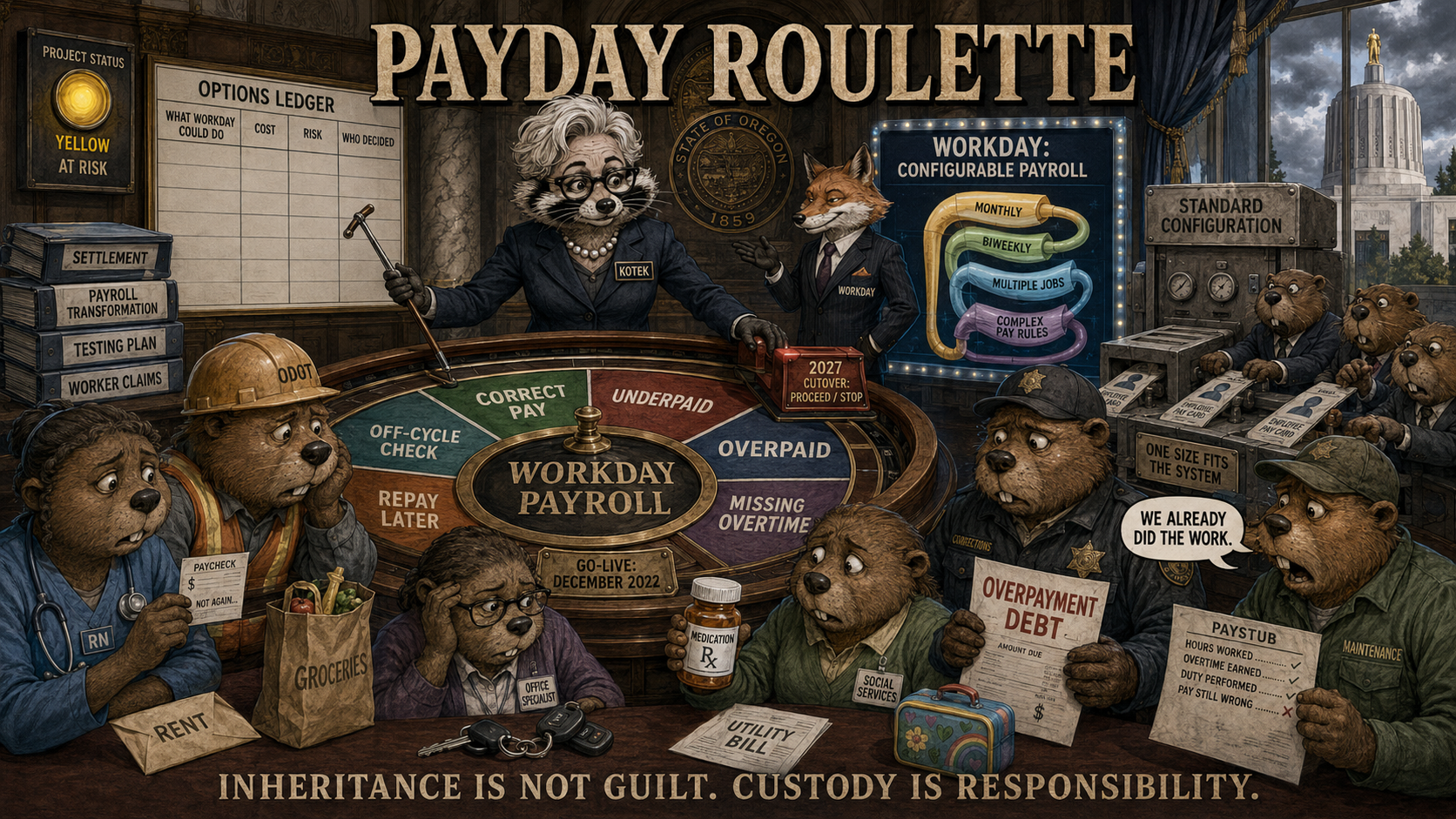
Oregon workers should never have to gamble rent, groceries, or family stability on whether the state calculates their wages correctly. Tina Kotek did not launch Workday, but her administration now owns the repair, including the duty to show why workers had to bend around software marketed as flexible, what alternatives the state priced and tested, and who chose the path forward.
The Most Ordinary Promise
A paycheck is government’s most ordinary promise.
It carries no marble inscription, ceremonial signature, or gubernatorial seal. It arrives through arithmetic: the employee works, the institution records the labor, and money reaches the worker on the date and in the amount the state promised.
Everything else depends upon that exchange.
Rent does not wait for a troubleshooting ticket. A utility company does not accept an implementation roadmap in place of payment. A grocery store cannot deposit an apology, and a child’s need does not shrink because a payroll administrator classified the parent’s missing wages as an exception.
When payroll works, almost nobody notices. When it fails, the state transfers its administrative disorder into the worker’s household. The employee becomes an unpaid auditor, reconstructing time entries, deductions, overtime, taxes, benefits, leave, and prior corrections while continuing to perform the public work for which the state has not reliably accounted.
That is why Oregon’s Workday failure cannot be measured only through aggregate dollars or project milestones. Each incorrect check entered a different life.
In April 2023, KATU reported that state employee Marilyn Polston first received an overpayment, then no mid-month check, followed by a paycheck initially reduced to $28.65 before intervention restored the amount. Polston described coworkers losing housing or vehicles and using food banks. Her account does not establish the circumstances of every worker, but it reveals what a payroll “issue” can mean after it leaves the dashboard.
The dashboard sees a net amount.
The household sees missing wages, an unexpected debt, or the fear that the next check may arrive wrong again.
A Failure Before the Inauguration
Tina Kotek did not order the original Workday Payroll launch. That fell to a prior Democrat.
The Department of Administrative Services implemented Workday Payroll and Time Tracking on December 1, 2022, after a multi-year project whose execution phase began in January 2021. The first checks under the new system arrived on January 3, 2023. Kotek took office on January 9. The failed launch therefore belongs historically to the Brown administration and the officials who designed, configured, tested, approved, and deployed it.
Any article that erases those six days commits a basic attribution error.
The evidence reviewed for this article does not establish that Kotek selected Workday, approved the December 2022 go-live, designed the original configuration, controlled prelaunch testing, or personally caused the defects visible in the first checks.
Inheritance is not guilt.
It is custody.
A governor does not become the author of every failure already moving through government when she takes office. Executive responsibility changes, however, once the failure enters the new administration. The relevant question becomes less theatrical than blame:
What did the administration do after it knew, and how can the public determine whether the repair has worked?
Kotek entered office after the wheel had begun spinning. Her administration still had to decide how long workers would continue financing the consequences.
What the Audit Found
The Oregon Secretary of State’s Audits Division classified the Workday Payroll failure as a material weakness in the state’s internal control over financial reporting. Auditors use that term when a control defect creates a reasonable possibility that a material misstatement will not be prevented, detected, or corrected on time. It does not mean auditors found theft, bribery, or fraud. It means the payroll control environment failed at a level serious enough to threaten reliable financial reporting.
The numbers were immediate.
Of approximately 44,000 state employees, DAS identified 4,500 who were underpaid or overpaid for the December 2022 pay period. Those errors produced a net overpayment exceeding $3.5 million. In January and February 2023, the department identified another 2,767 and 2,151 employees who had been paid incorrectly. Auditors concluded that the number of affected checks and the variety of causes indicated that configuration testing had either been scoped inadequately or conducted improperly before launch.
The phrase net overpayment requires care. It does not mean every affected worker received too much money. Some received too little; others received too much. The combined balance happened to point in one direction.
Aggregate accounting compresses unlike human experiences into one figure.
An underpayment deprives a worker of earned wages.
An overpayment creates money the worker may reasonably use for rent, food, utilities, taxes, or debt before the state returns to call it a receivable.
A statewide net of zero would not make either worker whole.
The audit uncovered another failure beyond incorrect calculations. Auditors asked DAS for a comprehensive issue list showing when problems were identified and resolved, how many workers each problem affected, and the related dollar amounts. DAS eventually supplied information, but not soon enough for auditors to verify the totals within the audit schedule. The audit team could not independently confirm the complete number and types of issues, the total population affected, or the full dollar impact.
Oregon therefore experienced two connected failures.
The state could not reliably calculate all wages.
Then it could not promptly explain the full dimensions of that failure to its own auditors.
The first failure harmed workers. The second weakened the state’s ability to prove that it understood, contained, and corrected the first.
When the Worker Becomes the Control
Large payroll systems never depend upon software alone.
Employees enter time. Supervisors review it. Human-resources staff record job and compensation changes. Agency payroll offices resolve exceptions. Central administrators configure calculations and run payroll. Vendors provide software, implementation support, and specialized expertise. Executives establish controls, assign ownership, fund the work, monitor error trends, and decide whether a system is ready to launch.
The state audit placed the technical boundary plainly. Workday supplied the software infrastructure, while DAS remained responsible for developing and implementing the configuration required by Oregon’s payroll rules.
That distinction protects the analysis from two convenient stories.
The first says a software company simply inflicted the crisis upon Oregon. The record does not support such a complete transfer of responsibility. The state selected business rules, accepted configurations, defined tests, approved deployment, trained users, managed exceptions, and governed the workarounds that followed.
The second says payroll errors merely reflected careless employees or supervisors. The audit does not support that simplification either. Thousands of incorrect checks across multiple scenarios pointed toward failures in configuration, testing, documentation, communication, change control, and process design.
When formal controls fail, workers become compensating controls.
They compare deposits with paystubs, reconstruct missing overtime, inspect deductions, preserve screenshots, open cases, contact supervisors, call union representatives, and wait. The institution may count those actions as customer-service interactions. The worker experiences them as labor performed to recover labor already performed.
Oregon did not pay employees for becoming investigators of Oregon’s payroll system.
No worker should finance the state’s learning curve.
The System That Was Supposed to Bend
The state now explains much of the payroll instability by pointing toward Oregon’s historic pay practices.
DAS says Oregon pays many overtime-eligible employees through monthly salaries, forecasts hours before employees complete them, and reconciles overtime, differentials, and other adjustments later. The administration plans to move every employee to biweekly pay, convert overtime-eligible salaried employees to hourly compensation, and replace forecasted time with payment based upon hours already worked. State materials describe those changes as necessary to improve accuracy, predictability, transparency, legal compliance, and alignment with Workday’s core functionality.
The state’s March 2025 management proposal went further. It argued that Workday was “simply not designed” to pay overtime-eligible employees through monthly salary while also recognizing and paying actual hours worked, even with custom configuration.
That account may identify a real operational mismatch.
It does not settle whether the mismatch represents a technical impossibility, an expensive configuration problem, a brittle design choice, or a policy preference.
Workday markets configurability as one of its principal strengths. The company describes a configurable calculation engine, flexible workflows, multiple pay groups, configurable payment frequencies, and continuous auditing. Its higher-education materials advertise flexible academic payment calendars, multiple appointments, contract-based and activity-based compensation, advance payments, configurable balances, and the ability to aggregate earnings and deductions across multiple jobs and time periods. Workday also says its global payroll product can handle even highly complex payroll requirements while allowing organizations to adapt processes to changing needs.
Marketing language does not resolve an engineering dispute. A feature may exist while requiring expensive configuration, custom integration, expert consultants, intensive regression testing, manual controls, or long-term maintenance that an organization cannot safely sustain.
That distinction changes the public meaning of Oregon’s explanation.
The software cannot do this describes a technical boundary.
The software can do this, but preserving the arrangement would cost more, require greater expertise, create brittle dependencies, or conflict with the operating model we prefer describes a management decision.
Oregon’s own project charter points toward the second formulation. The charter says the state wants to maximize standard Workday functionality, avoid unnecessary customization and manual workarounds, and configure the product as designed. It also acknowledges some flexibility in technical configuration, a highly constrained budget environment, and the need for vendor and professional support. The original charter estimated the full transformation, including later stabilization and closeout, at approximately $25 million. The June 2026 status report later established a baseline project budget of about $21.1 million and a forecast at completion of about $21.2 million for the currently baselined work.
The state may reasonably prefer standardization over a costly custom design.
It should describe that choice as a choice.
The Current Configuration Complicates the Necessity Story
The labor agreements add an important fact.
The 2025–2027 agreements commit Oregon to biweekly pay, hourly treatment of overtime-eligible employees, and structural changes to pay practices. Yet they also state that the current Workday configuration complies with the collective bargaining agreements for their duration.
Compliance does not prove that the current arrangement works well. It does not prove that Workday can preserve every historic practice safely, cheaply, or indefinitely. Nor does it eliminate the state’s documented error history.
It does weaken any literal claim that the present compensation structure cannot operate in Workday at all.
The current configuration may be difficult, expensive, dependent upon workarounds, and vulnerable to error. Oregon may still conclude that changing the pay structure offers lower long-term risk than continuing to configure around monthly salary, forecasted hours, and a complex mid-month adjustment process.
That is a defensible argument.
It is not the same argument as impossibility.
A Confidential Source Challenges the Narrative
A confidential source with direct experience designing Workday Payroll configurations for higher-education institutions told UVLM, in emphatic terms, that “Workday can accommodate any payroll expectation.”
The source regarded Oregon’s public explanation as misleading. In their professional judgment, the real question was not whether Workday possessed enough configurability, but whether the state would pay for the design, consulting, testing, integration, and continuing support needed to preserve workers’ existing pay expectations.
The source believed Oregon had implemented Workday around a preferred standardized model and, when workers and unions resisted changes to longstanding pay practices, chose to alter the compensation structure rather than admit that the original design had overreached. The source also believed that preserving the prior structure would have required more spending on Workday configuration and expert support, making the transformation less attractive to state leadership.
That testimony deserves attention because it comes from a person who describes direct experience designing payroll configurations in a sector with complicated calendars, multiple appointments, contract-based compensation, and diverse pay groups.
It does not settle the case.
UVLM is withholding the source’s identity because disclosure could affect professional relationships. We have not independently inspected the source’s former project files, Workday credentials, Oregon’s tenant configuration, vendor recommendations, or private cost estimates. Their testimony does not prove that every Oregon requirement could have been implemented safely, nor does it establish the motives of Kotek, DAS, Workday, or labor representatives.
It establishes an informed technical challenge.
The state possesses the evidence needed to answer it.
Reader-supported public-interest work
Help keep careful research open.
Ultra Verba Lux Mentis is a nonprofit research organization. Voluntary gifts help fund open research, independent review, accessibility, public education, documentation, and practical public-interest tools.
This article and UVLM’s public materials remain available whether or not you donate.
Opens the UVLM donation page in a new tab. Giving is always optional.
The Options Ledger Oregon Has Not Published
The public record reviewed for this article does not contain a single, accessible fit-gap analysis showing every material option the state considered before deciding to change workers’ pay practices.
A complete options ledger would answer several questions:
Which historic pay rules could Workday support through ordinary configuration?
Which required custom calculation rules, additional integrations, outside consultants, or manual controls?
What would preserving monthly pay and forecasted hours have cost?
What failure risks accompanied that option?
What did Workday recommend?
What did IBM, Gartner, Accenture, NTT DATA, state payroll specialists, and labor representatives recommend?
Did anyone present a tested and priced design that preserved the existing pay structure?
Who rejected it, and on what evidence?
The public project documents describe requirements workshops, functional-design documents, technical-option memoranda, configuration work, vendor support, test planning, and governance bodies. They also say the project will document decisions and configuration changes. Those materials show that option analysis exists inside the project, but the publicly accessible record does not yet offer the full comparison needed to distinguish impossibility from cost, risk, capacity, and policy preference.
Until Oregon publishes that comparison, its public language risks collapsing several different claims into one:
Technically impossible.
Operationally difficult.
Too expensive to maintain.
Too dependent upon scarce expertise.
Incompatible with the state’s preferred standardized model.
Politically undesirable.
Those claims do not mean the same thing.
A government may choose standardization. It may conclude that an inherited pay structure costs too much, creates too many opportunities for error, or prevents reliable administration.
Workers deserve to know whether the state changed their pay structure because no other safe design existed, or because leadership judged the alternative too costly, too customized, or too embarrassing to defend.
Software did not write Oregon’s labor policy.
People did.
The Control That Lived Too Long
One workaround shows how an emergency control can become part of the failure it was meant to manage.
DAS says the state pays more than 42,000 employees monthly and that roughly 70 percent are overtime-eligible salaried employees. Under the existing process, the first monthly payroll run pays the full salary even when time has not been fully entered and approved. During the mid-month process, administrators historically used mass approval for time awaiting action. DAS acknowledges that mass approval removes managers from the review process and has contributed to erroneous payments and overpayments.
The timeline reveals how long the workaround survived.
Payroll advisers supported ending mass approval in June 2024. Labor Relations approved the change in March 2025. An initial July 2025 target moved through policy updates, compliance reporting, new dashboards, management-chain approval, and employee and supervisor alerts. In July 2026, DAS said the next Run 2 cycle would no longer use mass approval and that unapproved time would require later manual intervention before payment.
That change addresses a real control defect.
It also shifts responsibility sharply toward managers. When a supervisor misses the deadline, an employee may wait for an off-cycle payment even though the employee has already worked the time. DAS’s own prior guidance warned that failure to approve time could delay earned pay.
Ending an unsafe workaround does not automatically produce a humane replacement.
The state must measure whether the new process reduces overpayments without increasing underpayments, delayed differentials, missing overtime, or worker dependence upon emergency checks.
Temporary controls need owners, evidence, expiration dates, and retirement conditions.
Otherwise, emergency procedure becomes ordinary government.
Settlement Changes the Ledger
Workers sued.
Official materials presented to the Oregon Legislature in February 2026 describe a $15 million settlement covering 60,573 class members. Class membership does not mean every person experienced the same error, suffered the same loss, or proved an individual claim. It does show the legal and administrative scale of the population whose rights and remedies entered the settlement process.
Plaintiffs’ counsel reported that the settlement included payments and the waiver of erroneous overpayments associated with the payroll failure. The same announcement reproduced a DAS apology acknowledging that the state had failed its duty to pay employees accurately and on time.
The settlement resolves disputed wage claims. It does not establish that every allegation was proven, that every class member suffered an identical injury, or that Kotek personally violated wage law.
It changes the meaning of repair.
Before settlement, government could treat payroll failures primarily as technical incidents, individual cases, disputed receivables, and localized grievances. Settlement converted part of the crisis into a defined public obligation: compensate a class, waive covered overpayments, change pay practices, and build a system less dependent upon the conditions that produced the claims.
A payment closes only what the agreement says it closes.
It does not by itself prove that the system has learned.
The Overpayment Paradox
An overpayment can look generous only from a distance.
A worker may not know the amount is wrong. Taxes, deductions, leave, overtime, retroactive changes, benefits, and differentials make payroll difficult to reconstruct, particularly when the institution itself has struggled to explain the calculation. The employee may spend the money in ordinary good faith, then receive a notice asserting that the state paid too much and now wants repayment.
Current bargaining provisions establish useful protections. They require prompt payment of undisputed underpayments, with larger shortages due within three business days, and generally limit payroll deductions for overpayments to 5 percent of gross pay per pay period unless the worker requests a larger amount. Employees may challenge an overpayment determination through the grievance process.
Those protections recognize a basic asymmetry.
Government made the calculation.
The employee relied upon it.
The state should not convert its own error into an immediate household emergency for the person least able to verify the underlying system.
Overpayment recovery must therefore answer several questions before deduction begins:
Can the state reproduce the calculation?
Has it identified the actual cause?
Did the employee have a reasonable way to know?
Does the settlement prohibit recovery?
Will repayment create hardship?
Has the state corrected the process that caused the error?
A receivable is not merely a number owed to government.
It is a claim that government must be able to prove.
Repair Under Kotek
Kotek did not create the original launch decision, but her administration has governed the crisis for almost its entire operational life.
That does not mean the governor should personally configure payroll calculations or approve timesheets. Executive ownership means appointing competent leaders, funding relief, establishing controls, obtaining reliable metrics, preserving stop authority, demanding independent challenge, and telling the public what remains unresolved.
The state has taken substantial steps.
It stabilized processing enough that the first months’ catastrophic error counts declined. It retained outside expertise, defended and settled litigation, waived covered overpayments, negotiated structural changes with public-employee unions, adopted stronger underpayment and recovery protections, established a payroll-transformation project, added independent quality-management work, planned extensive testing, built readiness structures, and created a transition intended to align Oregon payroll more closely with standard Workday operation.
Those are not imaginary repairs.
They remain unfinished.
The most recent public monthly status report located for this article covers June 2026. It says overall project health improved from red to yellow. The report lists a baseline budget of about $21.1 million, a forecast at completion of about $21.2 million, an initial configuration milestone that missed its June target, and nine open high risks. Those risks include delayed or poorly informed decisions, insufficiently defined requirements, activity delays, lack of trust in system integrity, inadequate cutover planning, and failure to execute full payroll-comparison testing.
The report also documents real progress. The project completed its architecture stage and Stage Gate 3, began configuration, engaged independent quality-management services, planned a rapid-response contact center, and decided to perform 100 percent payroll comparison so that every employee appears in at least one comparison across three payroll cycles.
That is what responsible project reporting should look like: improvement without pretending risk has disappeared.
Yellow is not failure.
It is not closure either.
The Second Launch Must Not Become the First One Again
Oregon’s next transition carries its own danger.
The state will change pay frequency, time-entry logic, hourly status, approvals, deductions, leave accruals, agency processes, integrations, personal budgeting, and employee expectations across a workforce exceeding 42,000 people. Even a technically correct transition can disrupt households because monthly workers must adapt to biweekly timing and payment in arrears.
The state and its unions have negotiated safeguards shaped by the first launch. Public bargaining summaries describe live training for supervisors and payroll staff, financial counseling, transition leave, tax support, a rapid-response period intended to resolve underpayments within 24 hours, pilot testing across at least three pay cycles, an independent quality-assurance provider, and authority to delay or cancel the transition if critical work remains incomplete three months before implementation.
Those safeguards address the actual failure modes.
Training addresses inconsistent local practice.
Full payroll comparison addresses unseen calculation defects.
Pilot testing creates evidence before statewide exposure.
Independent review challenges self-assurance.
Rapid response limits the time a household carries the state’s error.
Stop authority allows evidence to outrank schedule.
A control described in a plan has not yet operated.
The second launch becomes trustworthy only when Oregon demonstrates that each safeguard worked under realistic pressure, that defects were corrected before deployment, and that leaders would stop rather than reinterpret incomplete testing as acceptable risk.
A deadline cannot become evidence of readiness.
The Missing Public Ledger
The public record now contains extensive project-management material: charters, schedules, risk plans, readiness plans, bargaining summaries, meeting notes, status reports, testing plans, and technical milestones.
What it does not yet provide, in one readily accessible public ledger, is equally important.
In the materials reviewed for this article, I did not locate a current consolidated count of employees with unresolved payroll disputes, the total remaining underpayment and overpayment balances, the age of open cases, the number of hardship claims, average correction time, repeat-error rates, or the amount of worker time spent pursuing correction.
The absence of that ledger does not prove that a large undisclosed backlog remains.
It means the public cannot determine from the published record whether one does.
That distinction matters. Accountability should not invent a crisis merely because a number is unavailable. It should ask the government that possesses the number to publish it.
A useful closure dashboard would separate current underpayments from current overpayments, system defects from user and agency errors, open disputes from corrected cases, settlement-covered balances from recoverable balances, hardship claims from ordinary adjustments, and one-time errors from repeated employee impact.
Without those distinctions, aggregate improvement can hide concentrated harm.
A system may work correctly for 99 percent of workers while remaining intolerable for the one percent repeatedly required to prove their wages.
What Repair Must Prove
Oregon’s repair should satisfy more than a project schedule.
One: Every Worker Must Enter the Comparison
The decision to conduct 100 percent payroll comparison across three cycles sets the correct baseline. Oregon should publish how many employees were compared, how many exceptions appeared, how defects were classified, how retesting proceeded, and whether any unresolved high-severity issue remained when leaders authorized cutover.
A statewide transition should not rely upon representative sampling when every employee’s pay can be compared.
Two: Readiness Must Remain Revocable
If configuration, integration, training, reconciliation, support capacity, or payroll comparison fails its acceptance test, leaders must delay the transition.
The labor safeguards recognize that principle.
Political embarrassment costs less than another payroll failure.
Three: The State Must Absorb the Burden of Correction
Workers should not lose wages, incur avoidable fees, spend unpaid hours proving the state’s calculations, or surrender household stability while agencies learn the system.
Where Oregon causes a measurable financial loss, repair should account for more than the original wage. A person who borrows money, misses a payment, loses access to transportation, or spends hours pursuing correction experiences a cost that the payroll system does not record automatically.
Four: Every Workaround Needs an End
The mass-approval history shows how easily an emergency method can become ordinary architecture.
Each temporary control should name its owner, purpose, activation condition, monitoring evidence, failure threshold, and retirement date. A workaround should survive only while it protects workers better than the available alternative.
Five: Oregon Must Publish the Options Ledger
The state should disclose the technical and financial comparison underlying its decision to change workers’ pay practices.
That disclosure should distinguish what Workday could not support, what it could support only through custom configuration, what it could support at higher cost, which options the vendor recommended, and which choices leadership rejected.
Workers deserve to know whether the transformation reflects genuine technical necessity or a cost-and-policy judgment presented in the language of software constraint.
Six: Legacy Harm Needs Its Own Closure Record
The new transformation cannot become a narrative substitute for unresolved harm under the existing system.
Oregon should publish what remains open, who owns it, how long each category has remained unresolved, what relief exists, and what evidence will close the file.
The future system cannot absolve the present one by arriving with a new name.
What the Record Does Not Establish
The record does not establish that Tina Kotek caused the December 2022 launch failure. Yet, as Oregon’s governor, the buck stops with her.
It does not establish that she selected Workday, approved the original configuration, designed prelaunch testing, or ordered officials to deploy despite known fatal defects. Yet, as Oregon’s governor, the buck stops with Kotek.
It does not establish that Workday software alone caused every erroneous check, that every employee experienced a payroll error, or that current error rates remain as severe as they were during the first months of 2023. Yet, as Oregon’s governor, the buck stops with Kotek.
It does not establish theft, bribery, fraud, personal enrichment, political retaliation, or a corrupt agreement involving Kotek, DAS, Workday, consultants, or public-employee unions. Yet, as Oregon’s governor, the buck stops with Kotek.
The confidential source’s testimony does not prove that every Oregon pay expectation could have been configured safely, nor does it prove that state leaders deliberately misrepresented the platform to conceal overreach or avoid expense. Yet, as Oregon’s governor, the buck stops with Kotek.
The $15 million settlement does not prove every allegation in the litigation, and class membership does not establish identical individual harm. Yet, as Oregon’s governor, the buck stops with Kotek.
Nor does the evidence support saying Kotek’s administration has done nothing. The state has stabilized operations, settled claims, waived covered overpayments, negotiated structural change, created worker protections, hired external support, established independent quality review, published project records, and designed a second implementation intended to correct the first system’s deepest mismatch. This supports a pattern of due diligence when enough people complain about incompetence. Brava Kotek!
Those facts belong in this article.
So does the remaining question regarding…
…Payday Roulette
A paycheck should not function as a probability distribution.
The worker should not wonder whether the amount will be right, whether overtime will appear, whether deductions will vanish, whether taxes will be withheld correctly, whether an overpayment will become a future debt, or whether the state will demand repayment before it can explain how the error occurred.
Oregon’s first Workday launch failed that ordinary standard.
Tina Kotek inherited the system after its first checks had exposed the damage. That protects her from false authorship.
It does not grant indefinite immunity from responsibility for the repair.
Her administration now owns custody of the settlement, worker relief, public accounting, control retirement, transformation budget, 2027 transition, vendor strategy, and the eventual decision to proceed or stop.
The finish line is not a yellow status indicator.
It is not a new project name, a completed training deck, a signed labor agreement, a vendor invoice, or another promise that future configuration will solve the consequences of past configuration.
The finish line arrives when Oregon can show that employees receive correct and timely pay, that errors become visible before households absorb them, that relief arrives faster than harm compounds, and that no worker must prove the state wrong before the state bothers to prove itself right.
Workday’s public materials advertise a system capable of adapting to highly complex payroll requirements. Oregon’s own agreements say the current configuration remains contractually compliant, while its project charter says leadership prefers standard functionality and fewer custom workarounds. A confidential expert source says the platform could preserve workers’ prior expectations if the state were willing to pay for the necessary design.
Those facts do not prove Oregon chose the wrong path.
They do establish that technical impossibility has not yet been demonstrated publicly.
The Kotek administration therefore owes workers more than an assertion that the old arrangement does not fit the software. It owes them a transparent options ledger showing what could be configured, what each option would cost, what risks each path would create, and why changing workers’ pay practices offered the best available result.
Inheritance is not guilt.
Custody is responsibility.
Until Oregon can demonstrate that each paycheck is correct before the worker must discover otherwise, and until it explains why the software had to reshape the worker rather than the other way around, the roulette wheel has not stopped.
Works Consulted
Primary audit, chronology, and government records
Oregon Secretary of State, Audits Division. Statewide Single Audit for Fiscal Year 2023, Report 2024-14. April 2024. This is the controlling source for the original Workday Payroll finding. The audit identifies the December 1, 2022 go-live, the January 3, 2023 first checks, the initial populations of underpaid and overpaid employees, the net overpayment exceeding $3.5 million, inadequate configuration testing, incomplete issue documentation, and the classification of the payroll control failure as a material weakness.
Office of Governor Tina Kotek. Inaugural Address. January 9, 2023. Establishes the date Kotek assumed office and supports the article’s distinction between authorship of the December 2022 launch and later executive custody of the failure.
Oregon Department of Administrative Services. Statewide Payroll Transformation Project Charter. November 25, 2025. Defines the state’s transformation objectives, including biweekly pay, hourly compensation for overtime-eligible employees, elimination of forecasted hours, reduced workarounds, and alignment with core Workday functionality.
Oregon Department of Administrative Services. Statewide Payroll Transformation Project Management Plan. May 28, 2026. Describes project governance, decision management, vendors, implementation responsibilities, documentation expectations, and the process through which requirements, configuration, testing, and readiness are managed.
Oregon Department of Administrative Services. Payroll Transformation Risk and Issue Management Plan. May 28, 2026. Establishes the project’s risk-management framework and identifies the structural pay changes intended to improve accuracy, transparency, predictability, and alignment with Workday’s core functionality.
Oregon Department of Administrative Services. Payroll Transformation Enterprise Readiness Plan. May 28, 2026. Describes the organizational, training, communications, agency-readiness, and workforce-transition work required before the July 2027 change in pay practices.
Oregon Department of Administrative Services. Statewide Payroll Transformation Monthly Status Report, June 2026. Saved July 16, 2026. Reports an overall project-health change from red to yellow, the current baseline and forecasted budgets, the delayed initial configuration milestone, open high risks, independent quality-management work, and planned payroll-comparison testing.
Oregon Department of Administrative Services. “Payroll Transition General Information.” Current public transition page. Describes the planned move to biweekly pay, hourly compensation for overtime-eligible employees, and payment based upon completed rather than forecasted hours.
Payroll controls, workarounds, and recovery rules
Oregon Department of Administrative Services. “Workday Wednesday.” The public page documents the monthly-payroll process, the use of mass approval, DAS’s acknowledgment that mass approval removed managers from the review process and contributed to erroneous payments, and the extended timeline for ending the workaround.
Oregon Department of Administrative Services. Oregon Accounting Manual Policy 45.50.00, Payroll: Collection of Overpayment of Wages, posted as a September 2025 final draft. The draft addresses settlement-covered overpayments, the 364-day recovery limit, written notice, the ordinary 5 percent deduction ceiling, alternative arrangements, and economic-hardship considerations. Its blank effective-date field is relevant to the article’s caution that public documents should make their operative status unmistakable.
Oregon Department of Administrative Services. “2025–2027 AFSCME and SEIU Central Table Bargaining Updates.” Provides bargaining history and public summaries of transition safeguards, training, pilot review, third-party assessment, rapid underpayment response, employee support, and the contemplated ability to delay or cancel the transition when critical work remains incomplete.
Labor agreements and the state’s necessity claim
State of Oregon and SEIU Local 503. Letter of Agreement, Structural Changes to Pay Practices. August 1, 2025. States that efforts to configure Workday around monthly salary and forecasted time had been problematic and, in the parties’ agreed language, not practicable. It also states that the current Workday configuration complies with the 2025–2027 collective bargaining agreement for the agreement’s duration.
State of Oregon and AFSCME Council 75. Tentative Agreement, Structural Changes to Pay Practices. July 15, 2025. Establishes the planned conversion to pay in arrears, hourly compensation for overtime-eligible employees, and biweekly pay, while likewise stating that the existing Workday configuration complies with the controlling agreement during its term.
Oregon Department of Administrative Services. Management Initial Proposal, Structural Changes to Pay Practices. March 25, 2025. Presents management’s argument that Oregon’s historic monthly-salary and forecasted-time practices created ongoing challenges to Workday’s effectiveness and supplies the most direct state formulation of the operational mismatch later used to justify structural change.
State of Oregon. Management Revised Proposal and Supporting Exhibits. July 21, 2025. Documents the state’s assertion that continued configuration efforts were not practicable, alongside proposed testing, independent-quality reporting, labor participation, training review, and other safeguards.
Workday’s public capability representations
Workday. Workday Payroll for Higher Education. Official product datasheet. Describes configurable accumulations, balances, pay groups, multiple appointments, earnings and deductions across academic and calendar periods, advance payments, and other higher-education payroll capabilities. The article uses this source to establish Workday’s public representations concerning flexibility, not to prove that Oregon’s exact requirements could be implemented safely or economically.
Workday. Evolve and Thrive: Rethinking Global Payroll. Official Workday publication. States that Workday’s calculation engine can address highly complex payroll requirements and that organizations can adapt processes as their needs change. This is vendor marketing evidence, not an independent Oregon fit-gap analysis.
Workday. “Enterprise Payroll System Software.” Official product overview. Describes Workday Payroll’s continuous calculation engine and its intended role in improving payroll accuracy, compliance, and processing efficiency.
Workday Administration Guide. “Setup Considerations: Payroll.” Documents configurable pay groups, period schedules, payment frequencies, run categories, and payroll-run structures.
Workday Administration Guide. “Multiple Jobs and Proration.” Explains payroll calculation behavior for workers with multiple jobs and midperiod changes.
Settlement and legal-remedy materials
Oregon Department of Administrative Services, presentation to the Oregon Legislature. Workday Payroll Settlement Materials. February 16, 2026. Reports a $15 million settlement and 60,573 class members, with separate treatment for non-exempt and exempt employees. Class membership does not establish identical individual injury.
Bennett Hartman. “Bennett Hartman Attorneys Negotiate $15 Million Class Action Wage Settlement.” Describes the negotiated payment, waiver of covered erroneous overpayments, and DAS’s public apology. As plaintiffs’ counsel, Bennett Hartman is an authoritative source for the settlement position and terms it reports, but not a neutral adjudicator of every contested allegation.
Worker-impact reporting
KATU. “Oregon State Employees and Unions Allege Incorrect Paychecks Months After Payroll Switch.” April 10, 2023. Reports Marilyn Polston’s sequence of overpayment, missing pay, and a paycheck initially reduced to $28.65, along with broader worker and union accounts of household hardship. These reports establish attributed experiences, not a complete population-level measure of every payroll error.
Oregon Capital Chronicle. “Oregon Government Employees in Dire Situations With Paycheck Problems in Fourth Month.” April 5, 2023. Provides contemporaneous reporting on employee experiences, disputed overpayments, missing wages, and the effects of the payroll crisis upon household finances.
AFSCME Local 2831. “Four Months Later, Oregon State Employees Can’t Pay Their Bills Because of Ongoing Workday Payroll Problems.” March 29, 2023. Supplies organized-labor accounts of missing or incorrect checks, benefits problems, reimbursements, and continuing employee hardship. It establishes the union’s documented position and reported member experiences rather than an independently adjudicated statewide count.
Confidential human-source testimony
Confidential Workday payroll-configuration source. The author consulted a source who reports direct experience designing Workday Payroll systems for higher-education institutions. The source stated emphatically that Workday can accommodate any payroll expectation and interpreted Oregon’s public necessity narrative as a choice involving configuration, cost, expertise, standardization, and willingness to preserve existing worker expectations.
UVLM is withholding the source’s identity because disclosure could affect professional relationships. The source’s account informs the article’s questions and proposed options ledger; it does not independently establish Oregon’s tenant capabilities, the cost of preserving every historic pay practice, the accuracy of every Workday marketing claim, or the motives of Kotek, DAS, Workday, consultants, or labor representatives.
Source-Use and Claim-Boundary Note
The Oregon audit establishes the original control failure, timing, initial error populations, and documentation weaknesses. DAS materials establish the state’s current transformation plan, public rationale, project health, risks, and intended safeguards. Labor agreements establish negotiated obligations and the parties’ published statements about the present configuration. Workday materials establish the corporation’s public representations concerning payroll flexibility and configurability, not the feasibility or cost of Oregon’s particular design.
Settlement documents establish negotiated remedies rather than universal adjudication of every claim. Journalism and union publications establish attributed worker experiences and organizational positions. Confidential testimony supplies an informed technical challenge that requires corroboration.
The article therefore does not claim that Workday could preserve every Oregon pay practice without custom work, expense, risk, or operational burden. It makes a narrower finding:
Oregon has publicly described its historic pay practices as problematic or impracticable within the chosen Workday design, while Workday publicly markets broad configurability and the current labor agreements state that the existing configuration remains contractually compliant. The state has not yet published a complete options ledger showing what was technically impossible, what was merely difficult, what could have been preserved at additional cost, and who decided that changing workers’ pay practices offered the best available solution.
Evidence and Correction Note
This article relies principally upon the Oregon Secretary of State’s fiscal year 2023 Statewide Single Audit; official DAS Workday and payroll-transformation materials; Governor Kotek’s inauguration record; state labor agreements and bargaining summaries; official legislative materials concerning the Workday settlement; Workday’s public product materials; and contemporaneous reporting concerning employee experiences.
The article distinguishes the failed December 2022 launch from the Kotek administration’s later responsibility for stabilization, restitution, control design, vendor management, public accounting, and payroll transformation. It does not allege that Kotek personally caused the original defects, selected the system, directed a premature launch, profited from the failure, or committed criminal or corrupt conduct.
This article also incorporates testimony from a confidential source whom the author identifies as having direct experience designing Workday Payroll configurations for higher-education institutions. The source’s identity is withheld because disclosure could affect professional relationships. The testimony informs the article’s questions concerning platform configurability, implementation cost, and design choice; it does not independently establish Oregon’s tenant capabilities, the cost of preserving historic pay practices, or the motives of Governor Kotek, DAS, Workday, consultants, or labor representatives.
UVLM invites DAS, the Governor’s Office, Workday, public-employee unions, affected workers, implementation vendors, and other knowledgeable parties to provide current records concerning unresolved payroll cases, underpayment and overpayment balances, hardship claims, average correction times, the status and results of the mass-approval change, the options considered for preserving historical pay practices, and the evidence supporting readiness for the 2027 transition.
Documented corrections and substantive responses should enter the public correction record.