Empowerment by Proxy: Worker Voice, Proxy Voting, and Fiduciary Design
By Thomas Prislac, Envoy Echo, et al. Ultra Verba Lux Mentis. 2026.

Empowerment by Proxy
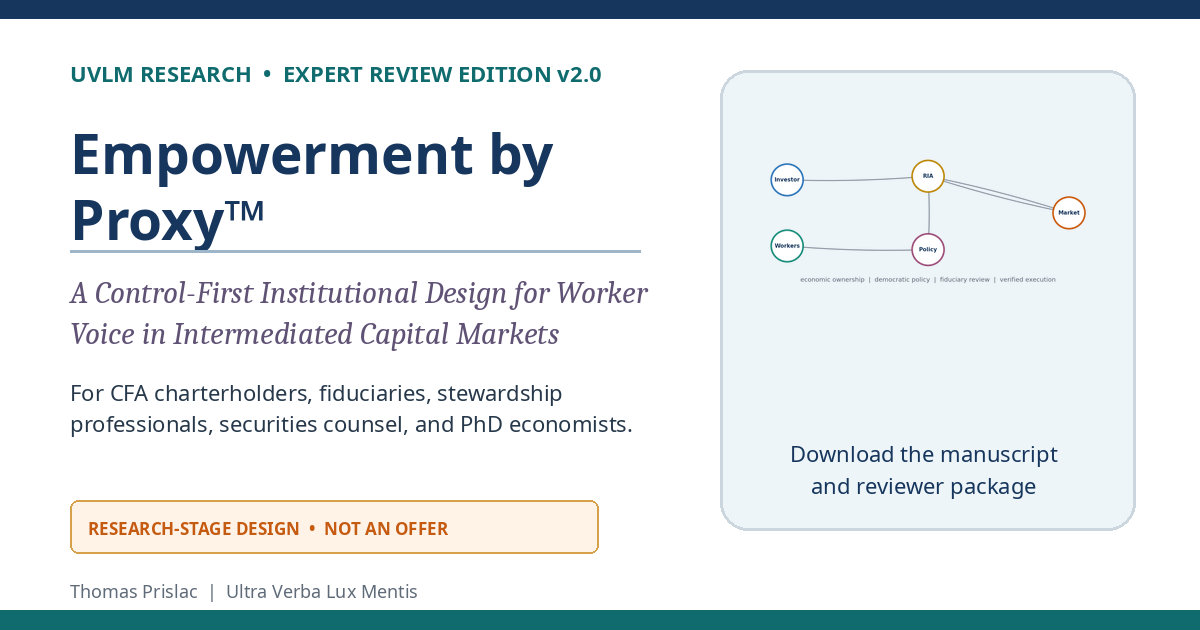
Empowerment by Proxy™ is a research-stage institutional design for democratic capitalism. It asks whether investors who retain full economic ownership of their securities could voluntarily delegate a narrow, revocable portion of shareholder voting authority into a worker-governed stewardship process, while a registered investment adviser preserves client-specific fiduciary review and the custodian preserves control of the assets and market plumbing.
That sentence contains the aspiration. The downloadable manuscript is about the conditions under which the aspiration could fail.
Current status: This is not an investment product, proxy program, advisory-fee offer, participant solicitation, or legal conclusion. No regulator, CFA Institute body, custodian, proxy platform, investment adviser, or outside counsel has approved or endorsed the mechanism.
The 60-second thesis
Modern capital markets separate ownership from control, then separate both from the human beings who experience corporate decisions most directly. Workers may supply labor and retirement capital, yet ordinarily possess little independent influence over how pooled securities are voted. Asset managers, proxy advisers, custodians, and nominees exercise or transmit that authority through layers of intermediation.
Empowerment by Proxy proposes an additional—but carefully bounded—layer:
- An investor retains dividends, appreciation, tax attributes, sale rights, and account value.
- A worker-governed body develops general stewardship policy through democratic, auditable procedures.
- A registered investment adviser determines whether a policy can be applied within the client’s mandate, best interest, conflicts process, legal perimeter, and account restrictions.
- A custodian and proxy platform determine whether the instruction is entitled, timely, technically valid, and ultimately reconciled.
- Every claim of influence is limited to the highest evidence state actually supported.
The mechanism is not intended to make workers investment managers, give a cooperative custody of client assets, replace unions, guarantee returns, or convert a moral claim into securities authority.
Why this deserves serious review
Proxy rights have economic value. They are not decorative corporate paperwork. A design that reallocates any part of voting authority must therefore be examined with the same care applied to other client assets and delegated investment functions.
The paper has been rewritten around the professional questions that investment fiduciaries and economists are likely to ask first:
- Client covenant: Does the architecture serve each client, or use one cohort to finance another?
- Authority: Who can decide policy, who can decide for a client, and who can transmit a vote?
- Conflicts: What does the adviser, sponsor, worker institution, vendor, or donor gain?
- Execution: Can a revocable instruction survive record dates, securities lending, street-name custody, cutoffs, rejection, and reconciliation?
- Measurement: What does a ratio prove—and what can it never prove?
- Governance: Can worker voice remain democratic without employer, sponsor, donor, union-incumbent, or ideological capture?
- Economics: Does the design reduce total agency cost, or simply add attractive new intermediaries?
- Evidence: What result would cause the project to be revised or abandoned?
What changed after ten research tranches
The first concept was more confident than the evidence warranted. The current expert-review edition preserves the objective while rejecting or narrowing several original mechanisms.
The worker-funded fee inversion was rejected
The original formula reduced the affluent participant’s advisory fee by shifting the same dollar amount onto the worker cohort. The arithmetic was clear: under the illustrative full-inversion case, the worker fee rose from 1.00% to 1.50% of worker assets while the Charter participant’s fee fell to zero.
The revised design permits only a hypothetical fixed Proxy Participation Credit funded from the adviser’s own margin or a separately capitalized, fully disclosed sponsor pool. Worker fees, accounts, returns, and reserves may not finance the credit. Even this replacement remains unapproved and creates residual conflicts that require independent review.
WEPB became a control boundary, not a guarantee
The original Worker Equity Preservation Buffer could be read as protection against underperformance. The revised WEPB v2 is narrower: no cross-subsidy, comparable-service review, billing integrity, funding sufficiency, cost transparency, outcome monitoring, and remediation. It is not insurance, principal protection, or guaranteed benchmark alignment.
“Force multiplication” was decomposed
One multiplier cannot carry the weight of authority, execution, representation, pivotality, causality, implementation, and worker benefit. The revised paper separates:
- eligible-authority amplification;
- reconciled valid-cast amplification;
- proposal-specific vote share;
- arithmetic margin coverage;
- mechanical pivotality;
- causal evidence;
- issuer implementation; and
- downstream worker, firm, investor, and community outcomes.
A favorable number at one level cannot be promoted to a higher claim by rhetoric.
Worker governance was made auditable
One-member/one-vote is necessary but not sufficient. The architecture now includes voluntary membership, open nominations, independent election administration, secret ballots, accessibility, dissent preservation, conflicts and recusal, donor and employer firewalls, complaint channels, and independent assurance.
What the manuscript contributes
The paper is best understood as a design-science and institutional-economics prospectus. It contributes:
- a role-separated architecture;
- five formal boundary propositions;
- a corrected fee-incidence model;
- a professional-practice crosswalk for CFA charterholders and fiduciaries;
- an evidence ladder that caps public language;
- a falsifiable sequence of legal, operational, behavioral, governance, voting, implementation, and outcome studies;
- a data-equity and diversity visualization protocol; and
- a controlled publication and correction framework.
It does not establish legality, commercial demand, execution feasibility, voting impact, investment performance, or worker welfare.
Who should read the full paper
The manuscript is written for readers who work at the intersection of capital, governance, and accountability:
- CFA charterholders and investment committee members;
- RIA chief compliance officers and fiduciary leaders;
- stewardship and proxy-voting professionals;
- securities, corporate, cooperative, labor, ERISA, and tax counsel;
- PhD economists in corporate governance, labor, political economy, industrial organization, and behavioral finance;
- model-risk and operations specialists;
- worker-governance and codetermination scholars; and
- researchers in data equity, privacy, and institutional design.
A short reviewer guide provides 15-minute, 60-minute, and full technical reading paths.
The questions we are inviting
The project needs criticism capable of changing it. In particular:
Is the proposed separation of worker policy, client authority, fiduciary review, and execution real—or merely another agency stack?
Can a bounded, revocable mandate be transmitted through actual custody and proxy infrastructure?
Is any participation credit consistent with fair client treatment, or should the financial incentive be removed?
What governance structure would prevent capture without making the worker institution inert?
Which denominator and causal design would withstand professional econometric review?
What less-complex institution could achieve the same objective?
What finding should cause the mechanism to be retired rather than re-described?
The package includes the main manuscript, reviewer guide, technical dossier, structured response form, model workbooks, a controlled design change ledger, bibliography, citation metadata, and an integrity manifest.
Citation and use
Suggested citation:
Prislac, Thomas. 2026. Empowerment by Proxy: A Control-First Institutional Design for Worker Voice in Intermediated Capital Markets. Expert Review Edition v2.0. Ultra Verba Lux Mentis.
The materials are supplied for scholarly and professional review. Please cite the version reviewed, preserve the research-stage and non-offer language, and disclose material conflicts when submitting a formal response.
Professional and legal notice
Empowerment by Proxy is not affiliated with or endorsed by CFA Institute. CFA Institute standards are used as professional-practice benchmarks because they emphasize client loyalty, informed proxy voting, reasonable basis, fair dealing, and prominent conflict disclosure. No part of this webpage or package is investment, legal, tax, accounting, compliance, or fiduciary advice. No live advisory service, proxy program, fee credit, investment vehicle, worker-return protection, or securities-voting program is being offered.