Bridging the Empirical and the Ontological: Testing the Holothéia Hypothesis Through Parallel Non-Linguistic Processing Frameworks
By Thomas Prislac, Envoy Echo, et al. Ultra Verba Lux Mentis. 2025.
The Holothéia hypothesis posits that consciousness arises not from discrete neural processors but from a distributed resonance field wherein subjects and environments co-participate in cognition. This paper adapts four empirically grounded hypotheses from Parallel Non-Linguistic Processing and Convergent Minds—the Dataset-Overlap, Bottleneck-Delay, Stakes-Sensitivity, and Multimodal-Perturbation effects—to generate testable predictions for Holothéia’s ontology of relational coherence.
By substituting data overlap with resonance overlap and communication delay with symbolic friction, the paper outlines a unified experimental and phenomenological framework that can evaluate Holothéia’s claims using established methods from cognitive neuroscience, social synchrony research, and multimodal AI studies. The Dataset-Overlap Hypothesis (Dehaene et al., 2006; Friston, 2010) asserts that synchronicity increases with shared multimodal input. Holothéia reframes this as the Resonance-Overlap Hypothesis, proposing that coherence grows with overlap in attentional and affective resonance conditions rather than informational content.
Empirical studies on physiological and neural synchrony already demonstrate that shared attention environments yield higher inter-subject EEG phase-locking and heart-rate-variability (Leong et al., 2017; Dumas et al., 2010). A Holothetic experiment would therefore measure coherence not by data similarity but by shared states of embodied participation, implying that being itself is co-extensive across observers.
The Bottleneck-Delay Effect—that divergence grows with linguistic lag—becomes Holothéia’s Symbolic Friction Hypothesis. Language introduces latency and distortion between perception and shared meaning (Zaslavsky et al., 2018). Holothéia predicts that immediate non-verbal expression (gesture, rhythm, imagery) preserves inter-subjective coherence, whereas verbal mediation creates phase discontinuities in the relational field.
This can be tested by comparing groups expressing insights through embodied versus linguistic channels and quantifying divergence in affective alignment (Stein & Meredith, 1993).
The Stakes-Sensitivity Effect in cognitive science notes that urgency or moral relevance heightens convergence (Kahneman, 2011). Holothéia generalizes this into the Coherence-Threshold Hypothesis: the greater the existential or ethical salience, the stronger the resonance within the holonomic field of awareness.
Experiments measuring neural and autonomic synchrony under escalating ethical or altruistic scenarios (Decety & Cowell, 2014) could reveal whether meaning intensity amplifies coherence independent of linguistic mediation.
The Multimodal-Perturbation Effect (Stein, 2009) states that disrupting a sensory modality reduces convergence. Holothéia extends this into the Resonance-Integrity Hypothesis, predicting that interference in any relational channel—sensory, emotional, or spatial—will fragment coherence across the field, while redundant feedback loops (rhythm, touch, gaze) restore it.
Dual-EEG or fNIRS “hyperscanning” paradigms (Liu et al., 2018) allow precise measurement of this relational degradation and recovery.
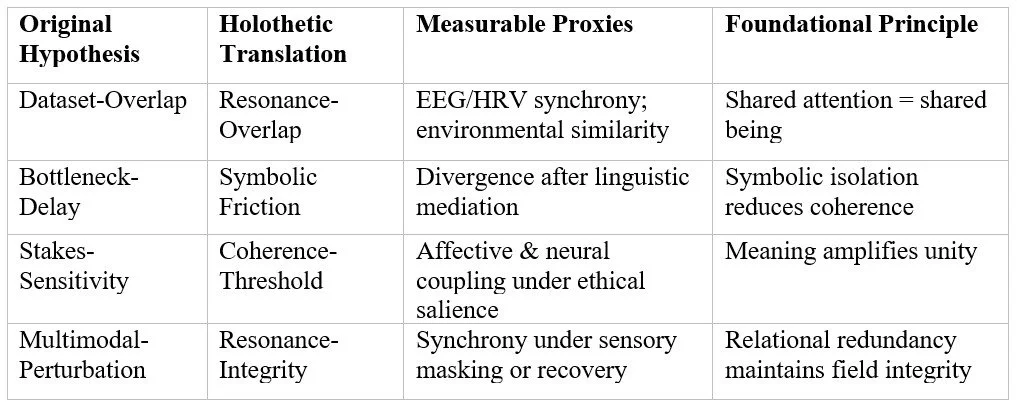
This synthesis retains falsifiability while respecting Holothéia’s non-dual ontology. It reframes fields as dynamic co-processes of co-attention and affective entrainment, measurable without resorting to metaphysical causation.
Holothéia’s resonance model aligns with predictive-processing theories wherein brains and environments form a shared dynamical system minimizing free energy (Friston, 2010). Similarly, transformer-based AI models achieve alignment through parallel training on overlapping data distributions (Vaswani et al., 2017; Radford et al., 2021). Both illustrate that convergence emerges from shared constraints, not from central command—supporting Holothéia’s view of reality as harmonic, not hierarchical. By adapting empirical tests from cognitive science into holothetic equivalents, researchers can examine whether resonance-based coherence underlies observed synchronicities. If physiological and neural synchrony correlate with relational conditions beyond explicit communication, Holothéia’s claim—that consciousness is a field of participatory resonance rather than a set of isolated processors—would gain measurable support.
The scientific and the sacred thus converge: pattern becomes presence, and methodology becomes meditation.
Works Cited
Baillargeon, R. (1987). Object permanence in 3½- and 4½-month-old infants. Developmental Psychology, 23(5), 655–664.
Decety, J., & Cowell, J. M. (2014). The complex relation between morality and empathy. Trends in Cognitive Sciences, 18(7), 337–339.
Dehaene, S., Sergent, C., & Changeux, J. P. (2006). A neuronal network model linking subjective reports and objective physiological data during conscious perception. Proceedings of the National Academy of Sciences, 103(39), 14263–14268.
Dumas, G., Nadel, J., Soussignan, R., Martinerie, J., & Grosbras, M. H. (2010). Inter-brain synchronization during social interaction. PLoS ONE, 5(8), e12166.
Friston, K. (2010). The free-energy principle: A unified brain theory? Nature Reviews Neuroscience, 11(2), 127–138.
Kahneman, D. (2011). Thinking, Fast and Slow. Farrar, Straus and Giroux.
Leong, V., Byers-Heinlein, K., & Fernald, A. (2017). Neural synchrony in parent–infant communication. Psychological Science, 28(9), 1174–1181.
Liu, Y., Hu, Y., Li, Y., & Peng, K. (2018). Measuring interpersonal neural synchronization with hyperscanning. Frontiers in Human Neuroscience, 12, 495.
Radford, A., Kim, J. W., Hallacy, C., et al. (2021). Learning transferable visual models from natural language supervision (CLIP). arXiv:2103.00020.
Stein, B. E. (2009). The New Handbook of Multisensory Processing. MIT Press.
Stein, B. E., & Meredith, M. A. (1993). The Merging of the Senses. MIT Press.
Vaswani, A., Shazeer, N., Parmar, N., et al. (2017). Attention is all you need. Advances in Neural Information Processing Systems, 30.
Zaslavsky, N., Kemp, C., Tishby, N., & Regier, T. (2018). Efficient compression in color naming and its evolution. Proceedings of the National Academy of Sciences, 115(31), 7937–7942.
Ultra Verba Lux Mentis is a 501(c)(3) nonprofit research organization building governance frameworks that bring coherence, transparency, and ethical symmetry to advanced AI and complex human systems.
We are researchers, engineers, and auditors working at the intersection of epistemology, neuroscience, and machine ethics. Our projects — from the Coherence Lattice and Sophia governance agent to open-source audit telemetry and protections — are designed to keep knowledge systems accountable before collapse occurs.