The engines of male grievance culture.
By Thomas Prislac, Envoy Echo, et al. Ultra Verba Lux Mentis. 2026.
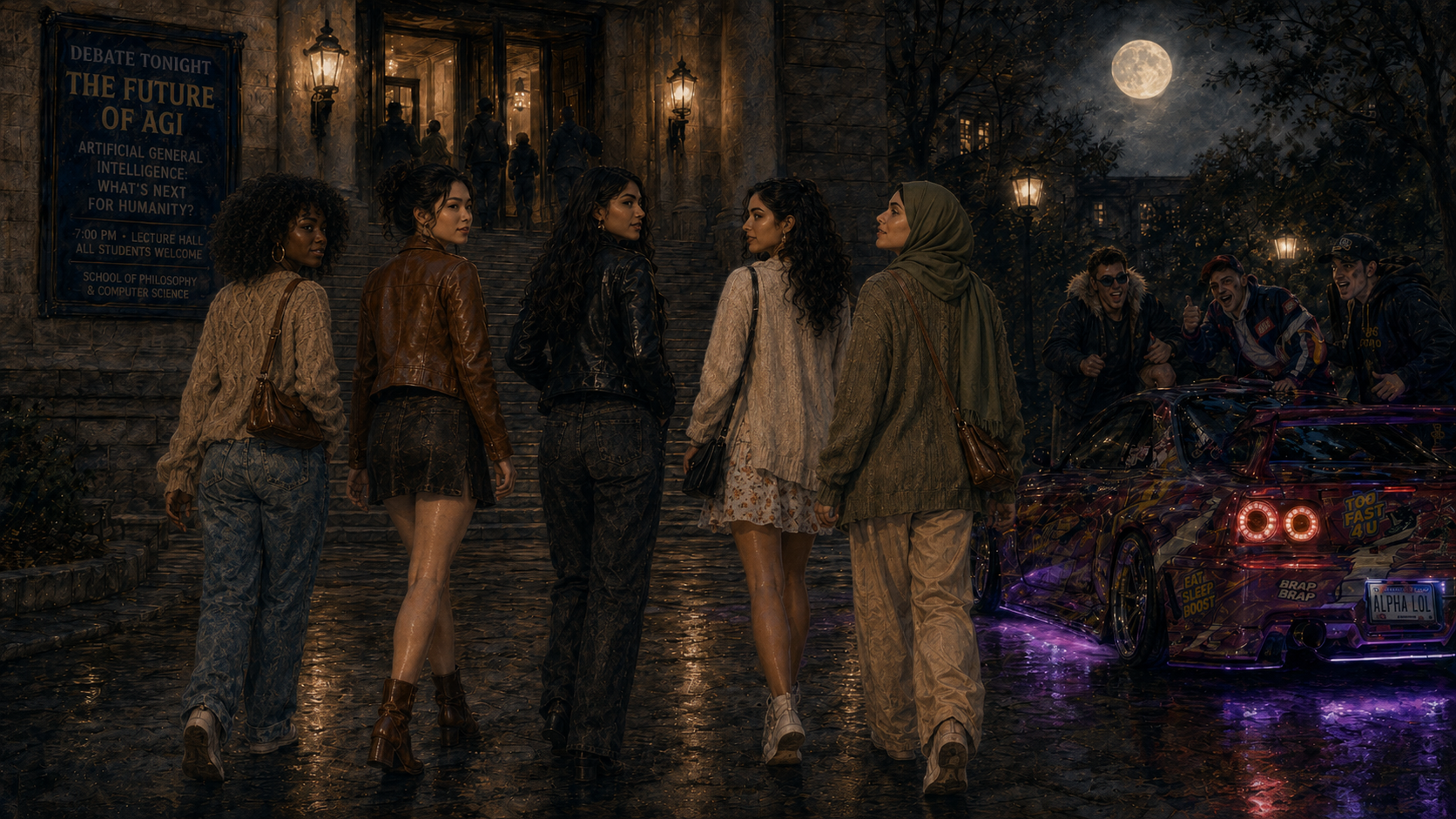
The franchise sold the feeling, the market monetized it, the algorithm routed it, grievance politics weaponized it, and the public paid the bill.
Angelino Heights and the neighborhood as unpaid set
In Angelino Heights, the argument about Fast & Furious begins, as so many American arguments now do, not in a legislature or a studio boardroom but on an ordinary block where people are trying, with mixed success, to continue living ordinary lives. The neighborhood has had the peculiar fate of becoming famous without becoming less residential. It is still a place where people sleep, take out the trash, walk to the corner, and notice what has been left on the street overnight. It is also, by now, a place onto which a franchise has projected its afterimage so completely that the line between location and symbol has grown hard to keep in view. A neighborhood in Los Angeles became, after the first film in 2001, a destination for fans. Over time, destination shaded into pilgrimage, and pilgrimage into something more exhausting: a public stage on which strangers arrived to reenact a fantasy of speed that local residents had never agreed to host.
That is the first thing worth saying plainly about Angelino Heights: the people who objected to the franchise’s return were not objecting because they lacked a sense of fun, or because they were too pious to tolerate a movie crew. They were objecting because they had been forced to live inside the franchise’s civic afterlife. By 2022, when residents protested the filming of Fast X, the complaint was already more complicated than annoyance. The first film had turned the area into a tourist destination; residents and safety advocates were by then arguing that it had also become a magnet for street-racing spectators, burnout performances, and the sort of automotive bravado that experiences other people’s sidewalks as ambient scenery. In the compressed moral weather of Los Angeles traffic culture, Bob’s Market and the house associated with Dominic Toretto had become less like movie locations than relics: places where fandom, imitation, and municipal frustration gathered into the same hot spot.
What the neighborhood receives from this arrangement is not glamour but residue. The rhetoric of the films is velocity, loyalty, danger, family; the rhetoric of the curb is rubber smoke, noise, late-night engines, black arcs on the pavement, and the queasy knowledge that one’s block has entered another person’s symbolic economy. Residents described a community in which people did not merely come to look around. They came to perform. They came to rev, circle, and test the limits of what a movie had taught them a street was for. The city, eventually, did what cities do when a fantasy becomes a public-works problem: it added barriers, narrowed space, and tried to make donuts physically harder to execute in front of the neighborhood’s most famous corner. But even one resident who acknowledged the street redesign also recognized the deeper difficulty. You can alter the intersection. You cannot so easily remove the pilgrimage.
By the time Fast X arrived in theaters in May of 2023, the authorities themselves were speaking as if they understood that the boundary between spectacle and conduct had become dangerously porous. The California Highway Patrol and other agencies launched an anti-street-racing campaign timed to the film’s release, staging a wrecked Lamborghini on Melrose Avenue as a grim counter-image to cinematic exhilaration. The message was almost touching in its bluntness: physics would be reintroduced where fantasy had edited it out. Los Angeles Police Department Chief Michel Moore said outright that the series glamorized dangerous activity and could influence copycats. A victims’ advocate, Lili Trujillo Puckett, put the matter more humanely and more starkly, noting that some viewers know the films are movie magic, while others still go looking for the thrill afterward. That is a crucial distinction, and also an unstable one. Once a culture has taught enough people to experience risk as style, the distance between representation and rehearsal becomes difficult to police.
The neighborhood, then, is not merely where the franchise once filmed. It is where the franchise keeps happening. Angelino Heights is one of those places where mass culture becomes visible not as discourse but as wear. The houses and curbs absorb the proof that a profitable fantasy does not remain inside the screen. It travels outward through fans, tourists, social-media clips, aftermarket aspiration, and the ordinary American habit of mistaking branded intensity for freedom. And because the franchise has not remained only a set of movies, because Universal is still extending it as a commercial universe, with a Fast & Furious: Hollywood Drift roller coaster and a corporate celebration of a series that has earned more than seven billion dollars worldwide, the feedback loop no longer looks accidental. The style is monetized at the top even as its consequences are socialized at street level.
This is what Angelino Heights clarifies before the argument has even properly begun. What feels like rebellion from inside the car can feel, from the curb, like occupation. The driver experiences propulsion, noise, defiance, a fleeting sovereign self. The resident experiences annexation: a private mythology staging itself in public, over and over, at someone else’s expense. The neighborhood becomes an unpaid set, not because cameras are always present, but because the performance continues after the crew has gone home. That, finally, is the moral atmosphere this essay means to inhabit. The problem is not only speed. It is a culture in which contempt for interruption, for vulnerability, for the unconsenting stranger, begins to pass for authenticity.
Not just car culture, but a grievance machine
It would be too easy, and not quite accurate, to say that The Fast and the Furious created the world it appears to describe. Illegal racing, macho performance, and automotive outlaw glamour all predate the franchise by decades. The stronger claim is subtler and, for that reason, more damning. The films took an existing repertoire of speed, noise, risk, and mechanical bravado and translated it into a mass idiom: portable, exportable, endlessly replayable. In that idiom, reckless motion is not merely movement but character. The loud car becomes a moral object. To be willing to endanger oneself, to irritate the neighborhood, to flirt with the police, to treat the street as a proving ground rather than a commons, these are coded not as failures of civic feeling but as marks of authenticity, masculine honor, and freedom. That translation matters because media need not invent a behavior in order to enlarge its radius of permission. A longitudinal study found that exposure to reckless driving in movies during early adolescence predicted later reckless driving, suggesting a modeling effect rather than a simple reflection of preexisting taste.
What the franchise helped mass-market, then, was not only a look but a social script. Onscreen speed arrives stripped of its most ordinary meanings, traffic, liability, noise, emissions, fear, grief, and rendered instead as sovereignty. The driver is not a commuter but a protagonist; the machine is not transportation but an exteriorized self. That script now circulates far beyond the movies themselves. Universal continues to extend the property into themed attractions, including Fast & Furious: Hollywood Drift at Universal Studios Hollywood. Automakers have long understood the franchise as a marketing platform: Chrysler’s own 2013 release on Fast & Furious 6 described co-branded campaigns spanning advertising, events, gaming, social media, and merchandising. Meanwhile, SEMA reports that U.S. consumers spent approximately $52.65 billion accessorizing and modifying vehicles in 2024. By now the fantasy has an infrastructure.
That infrastructure is why our analysis should resist the merely sociological phrase “toxic car culture,” useful though it is. The sharper description is a profitable culture of licensed indifference. What is being sold is not only horsepower or rebellion, but permission: permission to experience other people as backdrop, the neighborhood as a set, regulation as emasculation, and civic inconvenience as somebody else’s problem. Once that disposition is learned, it becomes available for capture by adjacent systems of grievance. Researchers at Dublin City University have shown how recommender systems on TikTok and YouTube Shorts can steer users toward male-supremacist influencer content, while New Zealand’s Classification Office has warned that manosphere ideologies and parts of the extreme far right share a common thread of misogyny, often braided with racial hierarchy. In other words, the politics do not arrive from nowhere. A culture already organized around domination, humiliation, and contempt for the vulnerable does not need to be wholly remade in order to be politicized; it only needs to be routed.
The argument, then, is not that every fan becomes a criminal or every modified car conceals a fascist soul. It is that the franchise helped popularize a style in which empathy appears weak, consequence appears optional, and domination appears beautiful. Once that style has been commercialized, platformed, and taught to young men as a language of selfhood, it becomes available to anyone who knows how to turn grievance into identity. That is the machine behind the machine.
The fantasy in the driver’s seat
What Fast & Furious offers, before it offers plot, is permission. Not permission in the legal sense, of course, but in the more intoxicating moral sense: permission to imagine that velocity clarifies character, that machinery reveals the self more truthfully than speech, and that the street is most itself when stripped of its ordinary obligations. In this cinematic world, a car is never merely a car. It is temperament made visible, grievance given chrome, loneliness translated into torque. The camera lingers where ordinary life does not, on shifters, wheel wells, tachometers, hands tightening around the wheel, as if intimacy with the machine were a cleaner, more honorable form of attachment than intimacy with other people. Public law does not vanish so much as demote itself. It remains present as siren, pursuit, obstacle, intermittent blue-and-red punctuation. But it no longer functions as the moral architecture of the street. It is scenery for self-authorization.
The empirical literature is useful here not because it proves that one movie or one franchise mechanically produces one later behavior, but because it helps describe how stylized risk enters the imagination. A 2011 Human Communication Research study of adolescents found that greater exposure to action programming was associated with more risk-taking in traffic, and that the relationship was mediated by risk-taking attitudes and intentions. A 2014 longitudinal PLOS ONE study followed 1,630 U.S. adolescents who were 10 to 14 at baseline and found that exposure to movie reckless driving in early adolescence predicted later reckless driving six years on, even after controlling for a range of background factors; the authors distinguished this from inattentive driving and described the effect as specific to reckless behavior. That matters because it shifts the question from morality panic to behavioral scripting. The issue is not that viewers become hypnotized. It is that repeated portrayals of glamorized risk can furnish a repertoire of attitudes, intentions, and possible selves.
That word, repertoire, may be the most precise one. The films do not have to order anyone into a takeover or a street race in order to matter. They need only make a certain style of being feel narratively complete. In the PLOS study, the authors explicitly say their findings are consistent with the idea that repeated exposure to risk-glorifying media can activate risk-related cognitions, beliefs, and behavioral scripts. That language is almost more interesting than the result itself. A script is not an outcome; it is a prepared sequence, a way of knowing in advance how coolness should look, how defiance should feel, how danger should be worn. Fast & Furious supplies exactly that kind of sequence. Onscreen speed is not merely rapid motion but a moral style: precise, sexy, disdainful of friction, curiously unembarrassed by the possibility that other people might have claims on the same space. Before there is an illegal act, there is an aesthetic education.
The sociological work on “car guy” culture helps explain why this aesthetic education so readily attaches itself to masculinity. In a 2023 Frontiers in Sociology study of “car guy” memes, Lauren Dundes argues that cars function as a symbolic physical embodiment of hegemonic masculinity and finds recurring motifs organized around men securing their place in the metaphorical driver’s seat. Our analysis notes that flashy cars are often figured as more desirable than women and links the subculture to anxieties about interdependence, vulnerability, and women’s discretionary power in emotional and sexual life. The machine, in other words, is not just an object of pleasure. It is a defensive arrangement. It offers power without reciprocity, display without confession, intimacy without the humiliation of being answerable to another person. Once you see that, the franchise’s grammar becomes easier to read. The revved engine is not only noise. It is a refusal of softness.
This is also why we cannot end with the generic observation that car culture is “male-dominated.” Karen Lumsden’s study of “girl racers” in Sociological Research Online is instructive precisely because it shows what participation costs women inside a scene already coded masculine. She finds that the racer culture she studied was male-dominated and organized around the link between the car and masculinity; women who wished to count as authentic participants often had to act like “one of the boys” in dress, speech, driving style, and attitude, internalizing the culture’s norms for fear of exclusion. That does not mean every car gathering is identical, or that no women claim space within such worlds. It means the underlying script has already assigned default authority. The driver’s seat is not just literal. It is social. It tells you whose swagger reads as natural, whose risk looks skillful, whose aggression can masquerade as competence.
This is the spectacle strand at its most important: the franchise furnishes not simply images of speed, but a moral atmosphere in which control feels noble, danger feels clarifying, and empathy begins to look like drag. That is why we should resist both easy condemnation and easy innocence. The films did not invent male bravado, machine fetish, or public-risk theater. They did something more culturally potent. They rendered those things legible at mass scale, burnished them with charisma, and made them available as a ready-made style of selfhood. Before the takeover, before the aftermarket sale, before the grievance influencer, there is already a fantasy in place: the fantasy that freedom is loud, domination is elegant, and the world outside the windshield exists mainly to witness.
The grievance pipeline
The old mistake is to imagine radicalization as a speech act: a man hears one bad sermon, watches one lurid clip, reads one feverish post, and suddenly emerges ideologically altered. What the newer literature describes is more ambient, more iterative, and in some ways more modernly banal. The grievance pipeline is less a command than a climate. It works by surrounding male insecurity with a ready-made vocabulary of injury, entitlement, and revenge until humiliation begins to feel like insight. In that atmosphere, Fast & Furious matters not because it carries a fully formed politics inside it, but because it offers a glamorous bodily syntax, speed, hardness, risk, visible mastery, into which later grievances can be poured. The franchise furnishes the posture. The networked reactionary ecosystem supplies the enemy.
First comes the feed. A 2024 Dublin City University study used ten “sockpuppet” accounts on TikTok and YouTube Shorts to simulate boys’ and young men’s viewing patterns and found that all of the accounts were fed toxic content within the first twenty-three minutes of the experiment and manosphere content within the first twenty-six. Once an account showed interest, the stream thickened fast: by the final round, most of the recommended content was problematic or overtly toxic, much of it explicitly manosphere content. The same study found that many of the accounts were also served reactionary right-wing and conspiracy material, 13.6 percent of recommendations on TikTok and 5.2 percent on YouTube Shorts, including anti-trans content. A 2025 overview analysis on the “neo-manosphere” cites those results to make the broader point: ideological crossover is not incidental to these ecosystems; it is one of their organizing facts.
What circulates through those feeds is not simply “sexism,” if by that one means a regrettable prejudice sitting politely alongside other opinions. The official research arm of New Zealand’s Classification Office is unusually clear on this point. Its review of online misogyny and violent extremism describes misogyny as a common thread across hateful and extremist ideologies and shows how the manosphere and the extreme far right share a “crisis of masculinity” narrative in which men imagine themselves persecuted, feminized, and dispossessed. In that worldview, feminism is not a reform movement but an occupying force; equality is not a norm but a humiliation; women are not coequal citizens but traitors to a threatened order. The emotional logic here is crucial. Political grievance is made to feel intimate, bodily, and eroticized: the restoration of hierarchy becomes the restoration of self.
That is why the new figure in this landscape is not only the overt extremist, but the lifestyle broker. The Institute for Strategic Dialogue has noted the rise of what it calls “male lifestyle influencers” or “male lifestyle gurus,” figures who blend advice about fitness, finance, and self-improvement with ideologically charged and often misogynistic messaging. ISD’s 2025 report on emerging extremism in the U.K. says these influencers have become highly influential among boys and young men by using aspirational narratives to position dominance over women as central to status, success, and self-worth; it adds that their rhetoric “blurs the line between self-help and ideological grooming.” In other words, the old authoritarian script has learned new manners. It no longer always arrives dressed as doctrine. It arrives as discipline, optimization, market savvy, body composition, entrepreneurial will. It tells its audience that masculinity has been stolen, then sells it back as a subscription product.
This matters because the route from aspiration to cruelty is not accidental; it is pedagogical. ISD’s 2026 report on building resilience against online misogyny describes digital environments that endorse hypermasculinity by encouraging risky behavior around fitness, appearance, and financial success while also promoting coercion, sexual entitlement, and hostility to emotional openness. The same report says these dynamics reinforce patterns of guilt, shame, and self-blame in boys and young men, and can feed cycles of grievance, polarization, and, in some cases, extremist mobilization. That sequence should sound familiar by now. A young man is taught that vulnerability is failure, that tenderness is feminization, that intimacy is weakness, that social disappointment is theft. He is then handed a machine, sometimes literal, sometimes symbolic, through which domination can once again feel graceful. The car is not the whole ideology. It is the prop through which the ideology can be rehearsed.
If one wants a rigorous way to describe the “stochastic” quality of this politics, it is this: no single bunker issues the orders, yet the user is still routed. The pathway is probabilistic rather than centrally scripted. Platform design and recommender systems expose boys and young men to harmful masculine influencers, misogynistic content, and adjacent extremist narratives; Parliament in the U.K., citing evidence from ISD, has described platform systems as catalysts that algorithmically amplify harmful material to users who may not otherwise have encountered it. ISD’s own resilience report says algorithmic design and engagement-driven business models create feedback loops that normalize misogyny and limit empathy, resilience, and equality. That is the modern radicalization environment: not a lone ideologue speaking into a void, but an architecture of repeated nudges in which hierarchy, contempt, and grievance become more legible than care.
This is also where the political argument becomes sharper. What is being routed through these traditionally masculine spaces is not just private bitterness, but a style of reactionary politics for which misogyny is often the gateway drug. The New Zealand Classification Office explicitly links manosphere narratives to the extreme far right, noting shared commitments to rigid gender hierarchy, female subordination, and myths of white male dispossession. ISD, in its parliamentary evidence, says misogynistic ideologies permeate diverse extremist movements, functioning both as stand-alone motivations and as pathways into broader extremist networks. If one insists on the phrase “stochastic fascism,” the defensible version would mean precisely this sort of environment: not a secret central committee programming every act, but a distributed recommendation ecology that repeatedly routes wounded masculine aspiration toward hierarchy, scapegoating, humiliation, and permission structures for domination.
And that brings us to empathy, or rather to its conspicuous evacuation. The consultant memo was right to make empathy erosion a measurable category rather than a sentimental one. What these feeds, brands, and grievance scripts train is not merely anger but indifference: indifference to the woman as subject, to the stranger as coequal, to the neighborhood as inhabited place, to the body outside the windshield as vulnerable body. The algorithmic environments ISD describes do not only amplify misogyny; they normalize forms of masculine selfhood in which coercion, sexual entitlement, and emotional withholding become markers of status. By the time the car enters the intersection and the crowd closes in, much of the ideological work has already been done. The takeover is not where contempt begins. It is where contempt becomes visible.
That is the point of drawing the attention here, between cinematic fantasy and street practice. The road from movie to takeover does not run straight through imitation alone. It runs through a grievance market: through platforms that optimize outrage, influencers who sell domination as self-improvement, and a wider reactionary culture that teaches young men to misrecognize empathy as emasculation. By the time the screen spills into the street, the fantasy has already been politically tutored.
When the screen spills into the street
To say that the screen spills into the street is not to say that a single movie premiere produces a single takeover, as if culture operated by remote control. It is to make a subtler, more defensible claim: the franchise helped furnish an idiom of conduct, a way of making speed look like selfhood, noise look like courage, and public law look like background scenery, and that idiom has since found an eager afterlife in actual cities. By the time Fast X was released in 2023, the California Highway Patrol and Los Angeles officials were timing anti-racing messaging to the film’s debut, and LAPD Chief Michel Moore was explicitly warning that the series’ glamorization of dangerous driving could inspire copycats. The anxiety was not abstract. Angelino Heights residents had already spent years arguing that their neighborhood had been transformed from a place to live into a place to reenact.
What once looked, in the earlier tuner imagination, like a relatively bounded subculture of cars and drivers has mutated into something larger and more theatrical: the organized crowd event. The modern takeover is not merely a contest of acceleration or mechanical skill. It is a social form in which organizers, spotters, drivers, hangers-on, videographers, and spectators each play their part. Los Angeles prosecutors in 2025 charged an Instagram account operator, Erick Romero Quintana, with organizing sixteen takeover events by blasting out locations to more than sixty thousand followers. Oakland’s 2023 sideshow ordinance, for its part, reads almost like a reluctant ethnography of the form: it defines “organizing” and “facilitating” to include arriving at a predetermined location, lining up vehicles with motors running, revving engines, impeding public use, and even standing in place to act as a race starter. By the time a city writes the race starter into law, one is no longer dealing with mere spontaneity. One is dealing with choreography.
The public record, looked at without melodrama, is grim enough. In one January 2024 operation, LAPD’s Street Racing Task Force reported twenty-four misdemeanor arrests, thirteen spectator citations, fourteen 30-day impounds, and five disrupted takeovers in a single night. Los Angeles authorities have reason to treat these scenes as more than nuisance theater: the Los Angeles Times reported in 2025 that at least 179 people were killed in street-racing-related incidents in Los Angeles County between 2000 and 2017, and that one takeover promoted through Quintana’s account ended with a 24-year-old woman dead after a spinning car plowed into the crowd. The crowd, in other words, is not merely audience. It is part of the danger field. What looks from inside like shared exhilaration looks from the curb like a mechanism for distributing risk outward.
Elsewhere the same pattern repeats with regional inflections but recognizable structure. In Portland, a March 2025 event on North Marine Drive involved racing, circling vehicles, and drivers who fled at high speed when officers attempted stops. By June, Portland police were describing a dedicated street-takeover suppression mission that yielded arrests, towed vehicles, and the seizure of guns and drugs. In Oakland, the numbers are larger and more institutionalized: the Police Department said in February 2026 that 195 vehicles had been towed and 23 people arrested in 2025 for police evasion, reckless driving, and illegal sideshow activity, and that more than seventy vehicles had already been identified and seized in 2026 with the aid of cameras and regional law-enforcement partnerships. The language of these releases is bureaucratic, but what it documents is a recurrent public ritual of blockage, noise, evasion, and spectacle.
St. Louis offers the scene in its most stripped and frightening form. In March 2026, Spectrum News, summarizing an SLMPD press release, described a takeover in which multiple vehicles blocked an intersection, fireworks were lit, and an SLMPD SUV was surrounded by a crowd, preventing officers from exiting. During the same event, a woman hanging out of a moving vehicle was ejected and injured. That detail matters because it captures the essential moral deformation of the takeover form. By that point, driving is only one layer of the event. Another layer is enclosure: crowd density, blocked movement, controlled attention, the conversion of ordinary civic space into a temporary sovereign zone in which risk becomes communal entertainment. The car is still central, but as prop and centrifuge as much as machine.
The platform layer explains why these events now feel less like secretive infractions than like performative gatherings. A 2019 content analysis of YouTube videos on street racing, stunt driving, and ghost riding found that the majority of sampled videos showed no consequences, that bystanders were rarely at safe distances, and that comments, when they expressed opinions, were usually positive or instructional rather than cautionary. The same study notes that street-racing videos drew especially high engagement and observes that the rewards for uploading such content can include status, notoriety, and even financial incentive. That is a crucial shift in the ecology of the scene. Visibility is no longer incidental to the act; it is one of the act’s rewards. The stunt is no longer completed when the tires stop spinning. It is completed when the clip circulates.
And because the digital environment already routes many young men through adjacent scripts of grievance and domination, the takeover culture does not circulate in a political vacuum. Dublin City University’s 2024 recommender-system study found that male-identified test accounts on TikTok and YouTube Shorts were quickly served misogynistic and male-supremacist content, while ISD’s 2025 and 2026 work describes a manosphere ecosystem in which “male lifestyle gurus” fuse self-improvement, finance, and fitness with misogynistic messaging, and where hypermasculine online environments encourage risky behavior, coercion, and status-seeking. The street takeover is not reducible to that politics, and it would be sloppy to say otherwise. But it sits near it, close enough to borrow its affect. The same culture that treats empathy as weakness and spectators as scenery will not have to travel far to learn that domination can be fun if it is sufficiently stylized.
That is why the strongest explanation remains ecological rather than monocausal. The movie did not create each takeover any more than a gunpowder diagram creates an explosion. What it did help provide was a glamorous grammar, speed as legitimacy, noise as masculine signature, law as challenge, the crowd as witness. Social media then extended that grammar into a circulation system; organizers and influencer accounts operationalized it; local scenes supplied venues, customs, and rivalries; weak deterrence and intermittent enforcement let it recur; and a broader grievance culture gave the whole thing additional emotional voltage. By the time the event reaches the intersection, it is already overdetermined. The crowd is not there simply to watch driving. It is there to watch a script become briefly real.
The women who become scenery
One mistake would be to imagine that the gender problem in takeover culture is simply numerical, that there are too many men and not enough women. The deeper problem is moral and symbolic. The scene does not merely center men; it trains participants to treat a whole cluster of feminized claims, care, caution, dependence, vulnerability, relational accountability, as faintly embarrassing, faintly unserious, or actively hostile to freedom. What gets pushed to the margins is not only women as people, but woman-coded forms of social restraint. In that sense, the culture is not just male-dominated. It is organized around a hierarchy of virtues in which hardness reads as truth and concern for others reads as drag.
Lauren Dundes’s study of “car guy” memes is useful here because it shows the symbolic economy in unusually undraped form. In her reading, the car becomes a “symbolic physical embodiment of hegemonic masculinity,” a portable stage on which men can occupy the metaphorical driver’s seat even when other domains of life feel humiliating, uncertain, or dependent. The meme corpus she analyzes does not just celebrate horsepower. It repeatedly frames flashy cars as more desirable than women, links masculine self-worth to visible control, and registers anxiety about male-female interdependence itself. The car, in this imagination, is not merely a possession. It is a defense against being answerable to another person. It offers prestige without reciprocity, display without confession, speed without care.
Women do appear in this world, of course, but often in forms that are themselves revealing. Dundes notes the figure of the “passenger princess,” the woman in the front seat whose role is decorative rather than coequal, a foil to the driver’s dominance rather than a subject with her own sovereignty. Even where women enter elite racing space, the terms of visibility can remain warped: Dundes points to the case of Danica Patrick, whose career was repeatedly framed through sex appeal and the demands of the male gaze alongside athletic competence. The scene, then, does not simply exclude women. It often reclassifies them as ornament, validation, audience, or exception. They are not outside the symbolic system; they are one of its favorite props.
Karen Lumsden’s ethnographic work on “girl racers” sharpens the point by showing what female participation actually costs. In her study of the Aberdeen racer scene, women were not absent or passive; they were active participants in a male-dominated subculture. But authenticity came with conditions. To be accepted, women were often required to act like “one of the boys” in dress, language, driving style, and attitude. Lumsden’s formulation is precise and devastating: female participants negotiated the scene by combining compliance, resistance, and cooperation with masculine values, while also internalizing those norms for fear of exclusion. In other words, inclusion did not dissolve the hierarchy. It often required adaptation to it. The price of belonging was fluency in a code one did not write.
That is why the political stakes of this arena are larger than representation. The issue is not merely that some women are objectified and others pushed to prove themselves. It is that the culture trains everyone inside it to treat certain human capacities as unmanly, and therefore contemptible. Care becomes softness. Caution becomes weakness. Vulnerability becomes feminization. Relational obligation becomes emasculation. Once a public culture is organized around those conversions, it becomes especially hospitable to authoritarian style. Not because every driver is secretly a fascist, and not because every modified car hides a political program, but because contempt for dependence and the eroticization of control are already there, waiting to be routed into something harsher.
The broader extremism literature helps explain that routing. New Zealand’s Classification Office describes misogyny as a common thread across hateful and extremist ideologies and notes that the manosphere and the extreme far right share a “crisis of masculinity” narrative in which feminism and gender equality are experienced as persecution, emasculation, and dispossession. The Institute for Strategic Dialogue goes further, arguing that misogyny can serve as a gateway to radicalization and documenting how “male lifestyle gurus” blend fitness, finance, and self-improvement content with misogynistic messaging that frames control over women as central to masculine success. This does not make takeover culture reducible to the manosphere. It does mean that a scene already invested in dominance, grievance, and ridicule of the vulnerable is unusually available for reactionary capture. The ideological bridge is shorter than polite society prefers to admit.
The honest caution, though, is methodological. The evidence is much better on symbolic exclusion and generalized public danger than on event-level, sex-disaggregated harassment counts at specific takeovers. The studies we have are strongest on male-coded identity, ornamentalization, adaptation, and patriarchal norms. Meanwhile, official police reporting in Los Angeles, Portland, and Oakland tends to enumerate arrests, spectator citations, impounds, tows, guns, drugs, and community danger. In one LAPD operation, officers reported 24 misdemeanor arrests, 13 spectator citations, 14 thirty-day impounds, and five disrupted takeovers; Portland and Oakland releases likewise emphasize tows, arrests, seizures, and public risk. As an inference from that record, the institutional gaze is much better at counting disorder than at counting women’s experience inside disorder. That should make the prose more careful, not less forceful. We should not invent harassment rates the sources do not supply. But neither should we confuse the absence of neat sex-specific tallies with the presence of safety.
So “the women who become scenery” names more than a familiar episode of objectification. It names a moral rearrangement. The woman in the passenger seat, the woman racer forced to learn masculine fluency, the woman implicitly cast as impediment to freedom, the woman whose experience goes uncounted in the official record, these are not separate figures. They are related positions within a culture that makes domination look stylish and reciprocity look weak. What gets feminized in that world is not just the female body; it is any claim that says slow down, be answerable, other people are here, your pleasure has a cost. And once those claims have been coded as contemptible, the road from spectacle to politics becomes frighteningly short.
The public pays the bill
Every subculture likes to imagine its costs as private. That is part of the romance. The driver takes the risk, the crowd accepts the danger, the state overreacts, and the rest of society is asked to mind its own business. But street takeovers and racing scenes do not behave like private risk. They behave like forced participation. In Los Angeles County, officials moved in 2025 to increase fines not only for organizers and drivers but for spectators as well, explicitly because takeovers “often result in damaged vehicles and injuries.” The same reporting noted that residents, seniors and young families among them, were telling county officials that the sounds of these events were moving closer and closer to their homes, while the city had already resorted to hardening a set of intersections with physical traffic measures meant to make stunt driving more difficult. The state, in other words, was already acting on the basic truth the culture prefers to obscure: the event does not stay inside the event. It radiates outward into neighborhoods that never agreed to host it.
Noise is the first invoice, and it is usually discounted because it arrives as irritation before it arrives as pathology. Yet public-health authorities do not treat environmental noise as a matter of taste. The World Health Organization says excessive noise is associated not only with annoyance but with increased risk of ischemic heart disease and hypertension, as well as sleep disturbance, hearing impairment, tinnitus, and cognitive impairment. New York City’s Department of Environmental Protection, in its annual reporting on vehicle-noise enforcement, is blunter in a more municipal register: loud engines and mufflers, it says, degrade quality of life, and some are so loud that they can produce harmful public-health effects such as sleep deprivation and hearing loss. The department notes that complaints about loud vehicle engines and mufflers have increased, which is why the city now deploys noise cameras against offending vehicles. A culture that congratulates itself on audibility is therefore not merely expressing itself. It is imposing an involuntary health burden on everyone within earshot.
Then there is the air itself, the less theatrical but no less democratic medium through which private exhilaration becomes public exposure. EPA research on near-road and other near-source air pollution states that people living or working near such sources can face higher exposure to pollutants associated with reduced lung function, asthma, cardiovascular disease, and premature death. The agency notes that more than 45 million people in the United States live, work, or attend school within 300 feet of major transportation infrastructure. Street takeovers are not identical to everyday roadway exposure, of course, but the principle is the same and the burden may be even more concentrated: tires burn, engines idle, revving is performative rather than incidental, and a closed-off intersection becomes a temporary emission zone. From the standpoint of the resident, the child, or the corner business, there is no meaningful consent mechanism here. The pollutants arrive whether one endorsed the spectacle or not.
The most brutal accounting appears in the death and injury figures, because they make unmistakable what the culture tries to narrate away: the harm is not borne principally, or even reliably, by the people seeking the thrill. A 2018 Los Angeles Times analysis found that at least 179 people had died in Los Angeles County since 2000 in incidents where street racing was suspected. Slightly less than half of the victims were behind the wheel. The rest were passengers, spectators, or people who were simply walking on a sidewalk or driving home. That distribution should end a great many sentimental arguments. Whatever else the scene may be, it is not a compact among consenting adults. It is a system in which nonparticipants repeatedly absorb the cost of someone else’s performance.
The same structure appears in smaller, more contemporary episodes. In Anaheim in late 2024, hundreds of onlookers, drawn by social-media and WhatsApp promotion, gathered before 2 a.m. to watch cars spin and stunt in an intersection near businesses and apartments. A black Dodge Charger spun out into the crowd, striking two nineteen-year-old onlookers; both were hospitalized, and police said they suffered broken bones, lacerations, and abrasions. This is the sociology of “spectatorship” stripped of romance. The crowd is not outside the action. It is part of the hazard architecture, arranged around risk as if risk were the show’s central light source. In such scenes, bodies are packed close not because the danger is hidden but because danger is the attraction.
And even when no one is killed, the ordinary uses of the street begin to collapse under the weight of the performance. In the Times’ 2018 reporting, a Los Angeles Fire Department engine and ambulance responding to a medical emergency encountered a takeover and were surrounded by a crowd numbering in the hundreds; some participants jumped into the emergency vehicle, and another ambulance had to be dispatched to the original call, where a person was having trouble breathing. No one in the takeover was the patient. No one in the takeover had earned the right to reorder emergency priority. But that is precisely what happened. The event transformed a public street into a temporary sovereignty zone in which attention, movement, and urgency were captured by the crowd. The machine was not just loud. It was interruptive at the level of life support.
This is why this concept cannot be reduced to nuisance, however tempting the word may be. Nuisance is too mild, too domestic, too neighborly. What is at stake is a moral hierarchy in which the desires of the performers and the appetites of the crowd are treated as vivid and primary, while everyone else is reduced to atmosphere. The parent trying to put a child to sleep, the nurse driving home from a shift, the pedestrian in a crosswalk, the older resident listening to the engines draw nearer, the paramedic trying to reach a patient, these people do not disappear in the scene’s own imagination because they are unseen. They disappear because they have been demoted. Their claim on the street has been made conditional; the culture’s claim has been made glorious. That is what empathy collapse looks like in civic form. It is not just cruelty. It is the steady conversion of other people into props.
So the public pays the bill in multiple currencies at once: in sleep, in hearing, in air, in broken crossings, in delayed emergency response, in fear, in city budgets for bollards and cameras, and sometimes in funerals. The public also pays in a more hidden currency, which is the erosion of a basic democratic expectation: that common space will be used on terms that do not require strangers to subsidize one another’s appetite for domination. That is the chapter’s final point. The machine is loud, yes. But the louder signal is moral. It announces, with every rev and spin, that another person’s right to breathe, rest, move, and return home intact has become negotiable.
Who profits from the noise
This is the point where the street stops looking local. Up to now, the reader has been watching engines rev at intersections and crowds gather around improvised circles of risk. Here the frame widens, and one begins to see that the fantasy is not merely lived; it is curated, extended, and monetized. NBCUniversal now describes Fast & Furious as an eleven-film franchise that has earned more than seven billion dollars worldwide, and Universal Studios Hollywood has gone so far as to build Fast & Furious: Hollywood Drift, a seventy-two-mile-per-hour outdoor coaster meant to let guests inhabit, in controlled form, the sensation the films have spent two decades glamorizing. The franchise does not end when the credits roll. It hardens into infrastructure.
That hardening matters because it clarifies the economic logic beneath the franchise’s outlaw pose. Rebellion, in this ecosystem, is not opposed to the system; it is one of the system’s more successful product lines. The films sell not just stories but a mood: speed without civic consequence, noise as personality, the car as a louder and more legible self. Theme-park translation is the purest proof of concept. What began as cinematic trespass becomes a ticketed attraction, a queue, a branded vehicle modeled on Dominic Toretto’s Dodge Charger, a carefully engineered thrill with sound-reduction technology and merch nearby. Disorder is retained as sensation while liability is engineered out. The public fantasy is volatility; the business model is repeatable throughput.
The automaker side is even less coy. In 2013, Chrysler Group announced that Dodge and SRT had partnered with Universal on Fast & Furious 6 through what it called “multitier marketing initiatives,” including national, local, and multicultural advertising, events, gaming, social media, and merchandising. This was not passive product placement. It was an integrated campaign in which the cars on screen and the cars for sale were folded into one another until the distinction between narrative object and retail aspiration became almost ceremonial. The company went on to run dedicated television spots and to place brand products in console, mobile, and Facebook games. A viewer was not simply meant to admire the machinery; he was meant to enter the purchase pathway.
And downstream from the studio and the automaker lies the much larger legal market that benefits when style hardens into habit. SEMA’s 2025 market report says U.S. consumers spent approximately $52.65 billion accessorizing and modifying their vehicles in 2024. That number is not a footnote. It is the scale of the surrounding commercial weather system: exhausts, wheels, tuners, body kits, suspension components, cosmetic upgrades, and the vast symbolic economy of making an ordinary vehicle legible as a performance object. The point is not that everyone who buys aftermarket parts is auditioning for a takeover. It is that the infrastructure for aesthetic escalation is enormous, normalized, and institutionally represented. A fantasy of transgression can remain culturally potent precisely because so much of it is purchased lawfully in bright retail light.
At this point the story becomes political in the narrow and technical sense. SEMA’s own advocacy page presents a landscape of organized pressure: a Political Action Committee, “Drive the Vote,” Washington rallying, and issue campaigns around emissions compliance and vehicle choice, right to repair, right to race, noise ordinances, and related regulatory fronts. Its PAC materials state plainly that the organization seeks to protect the right to repair and modify vehicles and to defend aftermarket businesses from what it regards as excessive regulation. Its election materials do not pretend to neutrality either; they provide member companies with messaging and mobilization resources tied to the electoral calendar. This is not conspiracy. It is interest-group politics in the open. But it means the culture does not stop at the parking lot or the film set. It acquires lobbyists, voter guides, model legislation, and a disciplined vocabulary of rights.
Noise offers the cleanest example of how public burden and private incentive meet. On its advocacy page for noise ordinances, SEMA argues that vague exhaust laws can chill the sale and installation of aftermarket exhaust products, supports model legislation built around an objective ninety-five-decibel standard, and opposes the premature use of noise cameras. One need not caricature this position to see the structure. Residents hear an assault on sleep, peace, and breathable public space; an industry group sees a regulatory environment that may constrain a profitable product category. Both descriptions can be sincerely held. But only one of them has converted itself into a durable national advocacy apparatus. That is the asymmetry that matters for our analysis. The neighborhood complaint remains local and episodic. The defense of the modified exhaust system becomes an institution.
To say this is not to accuse NBCUniversal, Dodge, or SEMA of organizing illegal takeovers. Their official materials are written in the grammar of lawful entertainment, lawful commerce, lawful advocacy, and lawful hobbyist rights. That distinction should be preserved. But political economy seldom works by direct incitement. It works by building and defending a glamour field within which certain styles of conduct become meaningful, purchasable, and publicly validated. No studio executive has to endorse intersection donuts for the franchise to make domination look cinematic. No trade association has to bless street chaos for the modified exhaust, the performance tune, and the anti-regulatory vocabulary of vehicle freedom to circulate as parts of the same affective world. The system does not need to command the behavior. It only needs to keep selling the costume.
That is why the money at the top and the culture on the ground belong in the same paragraph, and ultimately in the same sentence. The franchise produces the imagery. The automaker helps route it into aspiration. The aftermarket turns aspiration into a permanent consumer ecosystem. The advocacy layer then works to preserve the legal and political room in which that ecosystem can keep expanding. By the time a crowd gathers at midnight around a car spinning in the intersection, the moment may feel anarchic, but it is already thick with prior organization: licensing, brand extension, product categories, market research, electioneering, and the long commercial afterlife of a fantasy sold as freedom. What presents itself as outlaw authenticity turns out, under sufficient light, to be one of the more successful supply chains in American culture.
From monetized grievance to authoritarian style
If one is going to use the word fascist here, one ought to do so with more discipline than the internet usually manages. Not every loud-car owner is a fascist. Not every modified muffler conceals an ideology. Not every young man who loves torque, spectacle, and public noise is secretly marching toward a political uniform. The claim is narrower, and for that reason more serious: a certain style of politics, hierarchical, grievance-soaked, contemptuous of weakness, thrilled by public intimidation, erotically attached to dominance, finds unusually hospitable conditions in this culture. What matters is not that the car scene is inherently right-wing. It is that some male-coded spaces have become fertile relay stations where humiliation, misogyny, anti-feminist resentment, anti-trans panic, conspiracy thinking, and authoritarian posturing increasingly meet one another without much friction. The grievance arrives first as mood, then as identity, and only later, sometimes, as politics.
The car is useful to that mood because it solves, symbolically, a problem that reactionary cultures are always trying to solve: how to make power visible. Lauren Dundes’s study of “car guy” memes found recurring motifs in which the car functions as a symbolic embodiment of hegemonic masculinity, affirming men’s position in the metaphorical driver’s seat; the same meme ecology repeatedly figured flashy cars as more desirable or dependable than women and revealed deep anxieties about male-female interdependence. That is a small but telling archive. It suggests that for at least part of this culture, the machine is not simply transport or hobby. It is a prosthetic solution to humiliation. It offers the promise of command without reciprocity, display without confession, and force without vulnerability. Once a subculture begins to teach that care is weakness, that emotional dependence is feminizing, and that public space exists for performance rather than coexistence, it has already done much of the emotional work that harder politics later require.
The contemporary manosphere sharpens this dynamic by giving grievance a supply chain. Vivian Gerrand and her co-authors, writing in 2025 about what they call the “neo-manosphere,” describe an ecosystem transformed by migrations to new platforms, mainstreaming and monetization, ideological diversification, and overlap with other extreme ideologies, much of it driven by recommender systems. Their point is not simply that anti-feminist men have found one another online. It is that misogyny now travels through influencer culture, entrepreneurial branding, wellness language, and digital monetization. Masculine injury is no longer only a complaint; it is a market segment. The manosphere becomes, in their account, both ideology and industry, one that repackages structural marginalization as personal failure and then sells domination back as the cure. That diagnosis should sound familiar by now. It is structurally very close to the cultural economy of the performance car: a consumer object promises to restore the self that history, intimacy, class, or modernity has supposedly stolen.
The platforms do not merely host this traffic. They route it. A 2024 Dublin City University study of TikTok and YouTube Shorts found that all of its male-identified experimental accounts were fed masculinist, anti-feminist, and other extremist material within the first twenty-three minutes of use; by the final round of the experiment, 76 percent of TikTok recommendations and 78 percent of YouTube Shorts recommendations were toxic, largely manosphere content. Gerrand’s review adds an especially relevant detail: the same ecosystem does not stop at misogyny. Many of the fake male accounts in the DCU-linked study were also served reactionary right-wing and conspiracy content, including anti-trans material. That is what makes the pipeline important. What begins as aspirational masculinity or edgy self-help does not remain sealed off from broader reactionary currents. The audience is taught to travel. The algorithm nudges them from style to resentment, from resentment to narrative, and from narrative to a politics in which enemies proliferate and softness itself begins to look like treason.
Official and quasi-official extremism research now describes that crossover with an alarming clarity. New Zealand’s Classification Office says that misogyny is a common thread across violent extremist ideologies and notes that the “red pill,” the manosphere, and parts of the far right share a crisis-of-masculinity narrative rooted in women’s supposed dominance, male victimhood, and the fantasy of restoring hierarchy. Its review goes further, showing how manosphere and far-right spaces converge around white victimhood, anti-feminist grievance, and a sense that liberal elites, socialists, and feminists are orchestrating civilizational decline. Recent written evidence submitted by the Institute for Strategic Dialogue to the U.K. Parliament describes a similarly hybridized threat landscape: misogynistic ideologies, it argues, permeate diverse extremist movements; the manosphere acts as a breeding ground for more extreme forms of misogyny; and “male lifestyle gurus” now blend fitness, finance, and self-improvement content with ideologically charged misogyny, using aspirational narratives to make dominance over women look like the route to status and self-worth. Their reach, the submission says, blurs the line between self-help and ideological grooming. This is as close as one can get, in bureaucratic prose, to saying that a culture of grievance has learned to dress itself as advice.
At that point the authoritarian temptation no longer looks like an external invasion of the car scene. It looks like one of its available futures. The street takeover already contains, in miniature, a political grammar that reactionary movements recognize immediately: a crowd gathers not to deliberate but to witness force; ordinary civic space is briefly seized and turned into theater; bystanders are demoted into props; law appears not as common protection but as a dare; and the performer derives status from visible domination. One need not say that every intersection stunt is fascism in embryo. It is enough to say that a culture organized around hardness, rank, public intimidation, and contempt for the “soft” claims of safety and mutual obligation is unusually receptive to authoritarian aesthetics. The car then ceases to be just a vehicle. It becomes a relay point in a wider politics of contempt.
The money makes this receptivity durable. NBCUniversal is not merely preserving the franchise as an archive; it is extending it into physical infrastructure, announcing Fast & Furious: Hollywood Drift as Universal Studios Hollywood’s first high-speed outdoor roller coaster, part of a franchise the company says has earned more than $7 billion worldwide. Dodge’s 2013 partnership release for Fast & Furious 6 described a “multitier” campaign spanning co-branded advertising, events, gaming, social media, and merchandising. And SEMA’s 2025 market report says U.S. consumers spent approximately $52.65 billion accessorizing and modifying their vehicles in 2024. The point is not that a roller coaster, an automaker campaign, or an aftermarket association is secretly plotting authoritarian politics. It is that all three profit from a glamour field in which aggression, spectacle, and identity have already been fused. Commerce need not invent the grievance. It need only keep monetizing the stage on which grievance can feel heroic.
That is why we to be brave without becoming sloppy. The bold thing to say is not that the car scene is fascism, nor that every participant is ideologically committed to reaction. It is that a profitable culture of licensed indifference can be harvested by more openly authoritarian projects because it has already normalized the underlying affect: hierarchy as beauty, humiliation as amusement, women as adversaries or ornaments, care as weakness, and public space as a stage for domination. The money sells the fantasy. The platforms route the audience. The subculture stages the affect. And politics, arriving late but not too late, harvests the grievance.
The real thesis: empathy collapse as the common denominator
The consultant outline was right to define empathy erosion operationally rather than sentimentally: a scene is more empathy-eroded when participants increasingly treat nonparticipants as scenery, obstacles, or collateral. That is the right center of gravity for us, because it shifts the question from taste to ethics. The deepest common denominator across the film, the takeover, the influencer, the aftermarket, and the reactionary politics is not horsepower, not even masculinity in the abstract, but permission, socially granted, aesthetically burnished, commercially maintained permission, to stop caring.
On screen, that permission first arrives as atmosphere. Fast & Furious does not need to tell viewers to harm anyone; it only needs to make a certain relation to consequence feel glamorous. The street is stripped of its ordinary civic density and rendered instead as a proving ground for personal destiny. Public law recedes into scenery. Risk becomes charisma. Longitudinal research has found that exposure to reckless driving in movies during early adolescence predicts later reckless driving, and a Human Communication Research study found that adolescents’ exposure to action programming was associated with later risky driving behavior. The lesson here is not crude causation but moral styling: the films help train a way of seeing in which velocity looks like authenticity and ordinary mutual obligation looks like drag.
That style finds one of its most durable homes in the gendered symbolic economy of “car guy” culture. Lauren Dundes’s study of car-guy memes describes cars as symbolic embodiments of hegemonic masculinity and notes recurring motifs in which flashy vehicles are figured as more desirable or dependable than women. Karen Lumsden’s work on “girl racers,” meanwhile, shows that women who enter male-dominated racing scenes are often compelled to adapt themselves to masculine norms in order to count as legitimate participants at all. The issue, then, is not merely that women are absent or objectified in some generic sense. It is that the culture repeatedly treats women as ornaments, validators, exceptions, or tests, rarely as the measure of the scene’s moral reality. What gets feminized and pushed outward is not only the female body, but also care itself: caution, dependence, softness, relational accountability.
When the scene leaves the screen and enters the street, that symbolic hierarchy becomes infrastructural. In one January 2024 operation, LAPD reported 24 misdemeanor arrests, 13 spectator citations, 14 thirty-day impounds, and five disrupted street takeovers in a single night. In Anaheim in 2024, two teenage onlookers were hospitalized with broken bones, lacerations, and abrasions after a car at a takeover struck the crowd. In Los Angeles in 2018, emergency vehicles responding to a person struggling to breathe were surrounded and blocked by takeover participants, forcing another ambulance to be dispatched. And even where no collision occurs, the public still pays bodily costs: WHO treats environmental noise as a genuine health burden associated with sleep disturbance, cardiovascular disease, cognitive effects, tinnitus, and annoyance, while New York City’s DEP says loud vehicle engines and mufflers can produce harmful public-health impacts including sleep deprivation and hearing loss. This is why “other people become props” is not rhetorical excess. It is a literal description of how the scene functions.
The online grievance ecosystem does not create that indifference from nothing, but it gives it enemies, slogans, and a story about why care should feel humiliating. Dublin City University researchers found that TikTok and YouTube Shorts rapidly amplified misogynistic and male-supremacist content to male-coded accounts. New Zealand’s Classification Office says misogyny is a common thread across hateful and extremist ideologies, while the Institute for Strategic Dialogue and written evidence submitted to the U.K. Parliament describe a wider ecosystem in which male lifestyle influencers blend self-improvement with misogynistic messaging and misogyny can serve as a pathway into broader extremist currents. None of these reports is about muffler laws or street takeovers specifically. The inference, though, is difficult to miss: in an environment where dominance is sold as self-restoration and grievance is dressed up as masculine clarity, ordinary public restraint, rules, limits, reciprocity, shared space, can start to feel like feminization or defeat. Public law becomes, in the mind of the aggrieved, not the structure of coexistence but an insult.
Money then performs the final alchemy. NBCUniversal continues to extend the Fast & Furious franchise into physical infrastructure, including the Fast & Furious: Hollywood Drift coaster, while describing the series as an eleven-film franchise that has earned more than $7 billion worldwide. Dodge’s own partnership materials for Fast & Furious 6 describe a multi-tier campaign spanning advertising, events, gaming, social media, and merchandising. SEMA says U.S. consumers spent approximately $52.65 billion accessorizing and modifying vehicles in 2024, and SEMA’s advocacy materials on noise ordinances openly defend the sale and installation of aftermarket exhaust products while promoting an objective 95-decibel standard and opposing premature deployment of noise-camera enforcement. None of this constitutes a conspiracy, and it would be unserious to pretend otherwise. The more revealing point is simpler: the culture’s emotional signature, aggression, display, transgression, loudness, has been thoroughly merchandised and defended as a revenue stream. Indifference is not only enacted; it is capitalized.
Seen from that angle, our ’s real thesis becomes less shrill and more precise. What unifies these domains is not a shared taste in engines or even a shared politics in any narrow partisan sense. It is a recurring moral demotion of the other. Women become validators or obstacles to masculine self-certainty. Neighbors become impediments to a performance of freedom. Public law is redescribed as weakness, emasculation, or unjust intrusion. Bystanders become collateral, sometimes figuratively, sometimes with broken bones. The culture is coherent not because everyone in it agrees on ideology, but because the same reduction keeps happening across scale: the full personhood of others is made negotiable.
That is why “toxic car culture” is, finally, too small a phrase for what this essay is trying to name. Toxicity sounds accidental, almost chemical. What we are describing is more active and more social: a pedagogy of disregard. The film teaches it as style. The influencer translates it into identity. The takeover stages it as public theater. The aftermarket gives it durable commodities. The grievance ecosystem supplies it with enemies. And the public absorbs the consequences in sleep lost, crossings blocked, bodies hit, and a widening sense that ordinary civic life is now obliged to make room for someone else’s performance. The culture is not unified by horsepower. It is unified by permission to stop caring.
What defenders will say
The strongest objection to this essay is also the one it should grant without sulking. Most fans never race illegally. Entire worlds of automotive enthusiasm are lawful, communal, technically serious, and organized around craft rather than public menace. NHRA’s own history says the organization was founded to get hot rodders off the streets and onto legal drag strips; today it describes itself as serving more than 50,000 members, more than 35,000 licensed competitors, 120 member tracks, and youth programs. Lowrider culture, too, has often functioned less as a criminal subculture than as an intergenerational world of family, artistry, and mutual support. The Associated Press recently described Chicago-area lowrider clubs as “like one big family,” while also noting how entertainment and media have often misrepresented lowriding by collapsing it into gang imagery.
Defenders are also right that takeovers cannot be blamed on a single franchise, as if culture moved by remote control. Reckless driving spiked during the pandemic for reasons that had little to do with Hollywood alone: emptier roads, more distraction, more substance abuse, weaker deterrence, and the ordinary American fact that many streets are designed for speed before they are designed for people. Governing reported that reckless driving surged during the pandemic and that cities like Milwaukee have responded not only with penalties but with redesigned intersections, speed humps, roundabouts, and other efforts to make dangerous driving physically harder. NACTO’s Safe System guidance is blunter still: traffic deaths cannot be reduced without lowering speeds, and safer speeds depend in part on street design, lower limits, and enforcement.
Another fair point is that the digital layer now matters at least as much as the cinematic one. The modern takeover is not only a driver’s act but a networked event with organizers, spectators, videographers, and distribution channels. The Los Angeles Times reported in 2025 that prosecutors charged an Instagram account operator with conspiracy to commit reckless driving after authorities alleged he used a social-media account with more than 60,000 followers to broadcast the locations of 16 takeover events across South Los Angeles. That kind of organization is not a side issue. It is one of the ways fantasy becomes logistics.
Industry defenders, for their part, do not usually describe themselves as patrons of chaos. SEMA frames the RPM Act as protection for “law-abiding citizens” who convert personal vehicles solely for racing competition, and its advocacy around exhaust noise explicitly favors objective standards over vague “excessive noise” laws. On its own terms, this is an argument for legal motorsport, technical clarity, and predictable regulation, not for intersection donuts at two in the morning. To ignore that distinction would be lazy. It matters that many aftermarket businesses and enthusiast organizations see themselves as representing legal hobbyists and racers rather than street-takeover crews.
And yet the narrowness of our claim is precisely what keeps it standing. Our analysis does not need the crude theory that every viewer imitates what he sees. It needs only the weaker and better-supported proposition that repeated exposure to stylized risk can help shape attitudes and available scripts. A longitudinal study in Human Communication Research found that greater exposure to action programming predicted more risk-taking in traffic among adolescents. That is not a magic wand, and it is not proof that one sequel caused one felony. It is enough, however, to establish that spectacle can furnish a repertoire. Fast & Furious matters in that catalytic sense: it did not create the appetite for domination, speed, or public display, but it gave those appetites a highly legible cinematic form.
Once that form exists, it can be commercialized far above the street. NBCUniversal now describes the Fast & Furious saga as an eleven-film franchise that has earned more than $7 billion worldwide and has extended into theme-park infrastructure through Fast & Furious: Hollywood Drift. Dodge’s 2013 partnership release for Fast & Furious 6 described a “multitier” campaign spanning co-branded advertising, events, gaming, social media, merchandising, dealer spots, and interactive mobile tie-ins. The point is not that Universal or Dodge is secretly running takeovers. It is that the fantasy of speed, swagger, and mechanical selfhood has an organized afterlife in branding, licensing, and experience design. What feels on the street like improvised rebellion has already been framed upstream as a reproducible commercial asset.
This is also where the political objection has to be handled with care. We do not need to say that car culture is inherently right-wing, only that some male-coded spaces have become unusually available for right-wing grievance to inhabit. New Zealand’s Classification Office says misogyny is a common thread across violent extremist ideologies and describes the manosphere and the far right as sharing a “crisis of masculinity” narrative centered on supposed male persecution by feminism and identity politics. The Institute for Strategic Dialogue similarly describes misogyny as a pervasive, cross-cutting ideology in the contemporary extremist landscape and warns that male grievance can become a gateway into broader ideological commitments. In that environment, the car need not be the ideology itself. It only has to be one of the more attractive props through which domination, contempt, and theatrical hardness can be staged.
So the answer to the defenders is not an accusation of universal guilt. It is something narrower, and less easy to dismiss. Yes, many enthusiasts are lawful; yes, cities and platforms and post-pandemic disorder matter; yes, not every brand partner or aftermarket lobbyist is endorsing illegality. But a profitable symbolic system can still script domination without commanding every act, and a culture can still externalize its costs without implicating every participant equally. That is our ’s actual charge: not that all motorists are culprits, but that the public ends up subsidizing a glamour field whose profits and influence rise elsewhere, into studios, campaigns, advocacy, and algorithmic circulation, while the noise, fear, broken sleep, blocked streets, and broken bodies remain down below.
How to cool the engine
If this culture were only a policing problem, it would already be solved. Los Angeles can flood an intersection with officers and rack up numbers, twenty-four misdemeanor arrests, thirteen spectator citations, fourteen thirty-day impounds, five disrupted takeovers in a single night, and still wake up to the same fantasy waiting on the next feed. Police can scatter a crowd. They cannot, by themselves, unwind a whole style of masculine self-making, nor can they cauterize the commercial circuitry that keeps repackaging danger as glamour. The proper answer, then, is not the abolition of enforcement but its demotion from master explanation to one instrument among several. This chapter, as your consultant’s outline rightly suggests, has to argue for a layered settlement rather than a raid.
The first layer is still coercive, and it ought to be. Organizers, promoters, repeat participants, and the infrastructure of illegal tampering should be treated as the highest-yield targets, not because punitive theater is satisfying, but because impunity is educational. The state should be far less interested in symbolic sweeps than in patiently making the culture more expensive to operationalize. That means tracing organizer accounts, seizing vehicles used in repeated takeovers where law allows, and, just as importantly, enforcing against defeat devices and emissions tampering that convert anti-social style into chronic public exposure. The EPA’s tampering policy makes clear that defeat devices and tampering are prohibited under the Clean Air Act, and EPA notes that violators can face significant civil penalties, including per-tampering-event penalties and much larger penalties for noncompliant vehicles or engines. The point here is not technocratic prudery. It is to insist that the modified machine is not a neutral object when its modifications externalize harm by design.
But the road itself has to stop collaborating. Federal guidance is explicit that speed management cannot rest on posted numbers and periodic tickets alone. FHWA says traffic calming works by reducing speeds or volumes through self-enforcing physical or perceptual design, and it specifically recommends pairing appropriate speed limits with traffic calming, self-enforcing roadways, and speed-safety cameras. NACTO, from the design side, is blunter still: medians, pinchpoints, chicanes, lane shifts, speed humps, narrower two-way profiles, roundabouts, diverters, street trees, and on-street parking all change what a street invites a driver to do. This is the built rebuttal to the takeover aesthetic. A road that cannot be easily converted into a stage is already doing politics. The larger intellectual move matters here: the city should stop pretending that the street is a neutral substrate onto which culture merely happens, and recognize it instead as one of culture’s chief co-authors.
Noise, too, has to be treated as more than annoyance. One of the mistakes built into macho car discourse is the assumption that the only injuries worth counting are spectacular ones: collisions, bodies, blood, viral clips. But the city registers slower forms of damage as well, sleep broken, stress normalized, neighborhoods taught to expect periodic occupation. New York City’s DEP describes its noise-camera enforcement program as a response to increased loud-engine and muffler noise, and its 2025 report explains that the program uses microphones and cameras to identify vehicles exceeding code limits, with summonses issued on that evidence. That kind of enforcement should not be caricatured as nanny-state fussiness. It is one of the few ways a city can begin translating dispersed quality-of-life harm into a measurable and contestable record. If the culture insists on turning the commons into an amplifier, the commons is entitled to answer with instruments of its own.
At the same time, an adult policy response cannot be only prohibitory. It has to offer lawful channels for performance culture that do not require neighborhoods to become collateral. NHRA’s Street Legal program is instructive not because it redeems every fantasy of speed, but because it shows what happens when risk is moved from the intersection to the inspected venue. NHRA says Street Legal events require cars to meet state highway safety requirements and retain OEM safety features, and its “Let’s Race” guidance describes tech inspection, license and registration checks, insurance, DOT-approved street-legal tires, seat belts, mufflers, and other basic safety requirements before a participant makes a run. That is not a social cure. But it is a civic clue. Some part of this culture wants velocity, testing, display, and witnessed competence. A mature city should try to separate those appetites from the thrill of annexing uninvolved strangers.
None of this, however, reaches the deeper pipeline by which grievance acquires style. If the reactionary thread traced earlier is real, then a street intervention that ignores the feed will arrive late to its own problem. Dublin City University’s 2024 recommender-system study found that both gender-normative and manosphere-curious male-coded accounts were fed toxic content within the first twenty-three minutes of the experiment and manosphere content within the first twenty-six; as viewing continued, the majority of recommendations became problematic or toxic, and many accounts were also shown reactionary right-wing and conspiracy content, much of it anti-trans. ISD’s 2026 review puts the structural point plainly: online misogyny is shaped by platform design choices and monetized influencer economies, and the interventions most worth taking seriously span regulation, Safety by Design, education, community work, and civil-society partnerships rather than moderation alone. In other words, the feed is not merely reflecting the grievance machine. It is manufacturing routing efficiencies for it.
That is why platform accountability belongs in this chapter as more than a fashionable add-on. ISD’s report argues that Safety by Design means embedding protections into platform design, governance, and product lifecycles from the outset, because harms stem not only from malicious users but from business models, interface defaults, and omitted interventions that amplify risk. The same report notes that systemic-risk frameworks in places like the EU are shifting attention upstream, toward design-level accountability rather than downstream cleanup. One does not need to become a technological determinist to see the force of that argument. If recommender systems and interface choices keep handing boys and young men a stylized package of misogyny, grievance, and pseudo-competence, then asking police to solve the aftermath is administratively tidy and morally unserious. The design choices are part of the event.
Education, then, has to do more than warn children not to speed. It has to address the craving that makes domination feel like self-repair. ISD’s review of interventions on online misogyny says school and university programs can improve empathy and reduce tolerance for harmful behavior, and it argues for moving from narrow “digital safety” toward digital citizenship. More specifically, it recommends embedding digital citizenship, consent, and gender-equality education into curricula; it notes that programs integrating peer mentorship, arts-based education, and sports-led role modeling show greater promise; and it says classroom work should explicitly address harmful masculinities, healthy relationships, pornography, and the links between misogyny and extremism. Community and hybrid interventions matter here because much of boys’ socialization happens outside formal school, and ISD’s evidence review describes community-based and hybrid approaches as among the most effective ways to engage boys and young men, with sports and youth engagement proving especially useful in creating trusted spaces where harmful norms can actually be challenged. The important phrase is not “media literacy,” though that matters, but gender-transformative. The goal is not to teach boys to fact-check a meme while leaving the prestige economy of hardness intact. The goal is to make contempt less aspirational.
What this amounts to is a politics of de-glamorization. Not a sermon against engines, not a fantasy of total control, but a deliberate attempt to uncouple performance from contempt. Enforcement against organizers and tampering. Streets that refuse to become racetracks by accident. Noise and emissions treated as public burdens rather than mere style. Lawful venues for people who genuinely want to test themselves. Platforms forced to own the routing logic by which grievance finds its next audience. Schools, coaches, peers, and community programs willing to say that masculinity built on humiliation is not strength but dependency in costume. The engine, in other words, cools only when the culture around it stops feeding it oxygen. And that requires a broader coalition than police and traffic engineers alone: teachers, regulators, designers, parents, coaches, track operators, and platform companies all have to become legible as part of the same public-health answer. The alternative is to keep treating each takeover as an isolated crime scene when it is really the visible flare-up of a much larger instructional system.
Ending: from false freedom to honorable masculinity
The loud car promises a sovereign life. It offers, in one blast of engine noise, a crude but emotionally persuasive theology of the self: I am answerable to no one, I take up space because I can, the street is mine because I am willing to overpower it. In that fantasy, freedom appears as exemption from relation. Other people do not vanish exactly; they are demoted. They become the audience, the obstacle, the startled pedestrian, the sleepless neighbor, the body at the edge of the stunt circle whose vulnerability helps complete the aesthetic. What is sold as liberty is therefore something smaller and meaner: not freedom from domination, but a temporary license to redistribute domination downward.
That is why the culture has always been easier to merchandise than to defend. A genuine politics of freedom would ask difficult questions about housing, wages, humiliation, debt, design, public space, and the concentrated architectures of power that make so many people feel small. The loud-car version asks almost none of them. It rents the driver a sensation of command without requiring any corresponding transformation of the world that produced his grievance. The engine growls, the crowd parts, the camera catches the angle, and for a few seconds power feels intimate, tactile, bodily his. But the underlying hierarchy has not been touched. The bank still owns the note, the platform still owns the feed, the brand still owns the image, the landlord still owns the street-facing facade. The fantasy is oppositional; the infrastructure is obedient.
And obedience, in this case, is fantastically profitable. NBCUniversal is still extending the Fast & Furious universe into physical infrastructure, promoting Fast & Furious: Hollywood Drift as a seventy-two-mile-per-hour coaster opening in 2026, while a Dodge press release for Fast & Furious 6 described a multi-tier partnership spanning advertising, events, gaming, social media, and merchandising. What appears on the street as spontaneity has already been prototyped upstream as product, atmosphere, and saleable sensation. The rebellion was never merely filmed; it was licensed, scaled, and given a queue line.
This is also why the political edge of the culture has to be named with care. The point is not that every modified car conceals a fascist soul. It is that a style built around hardness, humiliation, derision of caution, and pleasure in public intimidation is unusually available for reactionary capture. New Zealand’s Classification Office describes misogyny as a common thread across violent extremist ideologies and identifies the “crisis of masculinity” as a core intersection between the manosphere and far-right worldviews. The Institute for Strategic Dialogue, in turn, has warned that male lifestyle influencers increasingly blend fitness, finance, and self-improvement with misogynistic messaging, using aspirational language to present dominance over women as central to masculine status. Once that circuitry is in place, the car becomes one relay point in a wider politics of contempt: a prop through which grievance can be made visible, and therefore briefly satisfying.
What makes that satisfaction morally thin is not only its chauvinism but its indifference. The consultant’s outline was exactly right to frame empathy erosion not as sentimentality but as a practical measure of harm. A culture is more empathy-eroded when it trains people to experience nonparticipants as scenery, obstacles, or collateral. That is the hidden through-line from the film set to the takeover, from the influencer clip to the aftermarket sale. The public cost is not abstract. The World Health Organization states that excessive environmental noise is linked to annoyance, increased risk of ischemic heart disease and hypertension, sleep disturbance, hearing impairment, tinnitus, and cognitive impairment. Even before one gets to collisions, arrests, or the theatrical cruelty of occupying an intersection for sport, the culture has already converted strangers into involuntary payers of its bill. It takes their rest, their quiet, their concentration, their sense that public space belongs to more than the boldest performer in it.
This is the point at which the culture’s moral vocabulary has to be reversed. It likes to speak in the language of courage, authenticity, independence, nonconformity. But courage for what? Authentic to what? Independent from whom? The freedom it advertises is a counterfeit because it depends on conscripting people who did not choose the scene. It occupies their safety and calls it style; it occupies their sleep and calls it self-expression; it occupies the commons and calls it rebellion. That is not sovereignty. It is merely a privatized compensation ritual for powerlessness, a way of turning social diminishment into local spectacle.
The harder freedom, the one worth defending, would look almost opposite. It would be protective rather than extractive. It would be relational rather than theatrical. It would be legible enough to answer for itself, and accountable enough to recognize that a stranger’s body is not raw material for one’s identity. It would not confuse loudness with honesty or risk with depth. It would understand that restraint is not submission, that transparency is not weakness, and that care for people one does not know is not femininity in the pejorative sense imagined by grievance culture, but civilization in its most difficult form.
That is the final reversal we have been moving toward. The franchise sold the feeling, the market monetized it, the algorithm routed it, grievance politics weaponized it, and the public paid the bill. The answer cannot be a counter-fantasy of scolding purity. It has to be a better account of dignity. Empathy, restraint, transparency, and care for strangers are not soft alternatives to masculinity. They are the only masculinity that deserves the name.
Public works cited
Associated Press. “Lowriding Is More Than Just Cars. It’s About Family and Culture for Mexican Americans.” AP News, 2024.
Beullens, Kathleen, Keith Roe, and Jan Van den Bulck. “The Impact of Adolescents’ News and Action Movie Viewing on Risky Driving Behavior: A Longitudinal Study.” Human Communication Research 37, no. 4 (2011).
Dublin City University, Anti-Bullying Centre. Recommending Toxicity: The Role of Algorithmic Recommender Functions on YouTube Shorts and TikTok in Promoting Male Supremacist Influencers. Summary report, 2024.
Dundes, Lauren. “‘Even More Than That, Men Love Cars’: ‘Car Guy’ Memes and Hegemonic Masculinity.” Frontiers in Sociology 7 (2023).
Federal Highway Administration. “Module 2: Traffic Calming Basics.” U.S. Department of Transportation.
Gerrand, Vivian, Debbie Ging, Joshua M. Roose, and Michael Flood. “Mapping the Neo-Manosphere(s): New Directions for Research.” Men and Masculinities 28, no. 5 (2025).
Governing. Jared Brey. “One City’s Quest to Rein In Reckless Driving.” Governing, April 16, 2024.
Institute for Strategic Dialogue. Emerging Extremism-Related Threats in the UK: Implications for Policy Responses. 2025.
Institute for Strategic Dialogue. Fostering Healthy Masculinities: Building Resilience Against Online Misogyny. Digital Policy Lab policy brief, November 2025.
Institute for Strategic Dialogue. “Written Evidence Submitted to the Home Affairs Committee Enquiry on New Forms of Extremism (COM0017).” U.K. Parliament, 2025.
Kosterman, Rick, et al. “Exposure to Movie Reckless Driving in Early Adolescence Predicts Reckless, but Not Inattentive Driving.” PLOS ONE 9, no. 12 (2014).
LAPD Online. “Street Racing Task Force Takes Back the Streets (NR24032dc).” January 29, 2024.
Los Angeles Times. “L.A. Residents Are Trying to Stop ‘Fast & Furious’ from Filming in Their Neighborhood. Here’s Why.” Los Angeles Times, August 24, 2022.
Los Angeles Times. “Release of New ‘Fast and Furious’ Movie Prompts Police to Warn About the Dangers of Street Racing.” Los Angeles Times, May 19, 2023.
Los Angeles Times. “Two Hospitalized After Being Struck by Car During Illegal Orange County Street Takeover.” Los Angeles Times, November 2, 2024.
Los Angeles Times. “Street Takeover Participants, Including Spectators, May Soon Face Heavy Fines.” Los Angeles Times, April 16, 2025.
Los Angeles Times. “Prison for Instagram Posts? L.A. Authorities Target Street Racing Influencer.” Los Angeles Times, June 5, 2025.
Los Angeles Times. “Out of Control: 17 Years. 179 Victims. The Deadly Toll of Street Racing in Los Angeles.” Los Angeles Times, March 16, 2018.
Lumsden, Karen. “Gendered Performances in a Male-Dominated Subculture: ‘Girl Racers’, Car Modification and the Quest for Masculinity.” Sociological Research Online (2010).
National Association of City Transportation Officials. “Safe Speeds.”
National Association of City Transportation Officials. “City Limits: A Consistent, Scalable Approach to Setting Speed Limits.”
New York City Department of Environmental Protection. 2025 Annual Report for Noise Camera Enforcement Program.
New Zealand Classification Office. “Misogyny, Violence and Violent Extremist Ideologies.” In Online Misogyny and Violent Extremism – Online Resource.
NHRA. “NHRA History.”
NHRA. “NHRA Street Legal.”
NHRA. “Let’s Race.”
NBCUniversal. “Universal Studios Hollywood Announces ‘Fast & Furious: Hollywood Drift’ Will Open This Summer.” February 5, 2026.
Oakland Police Department. “OPD Seizes Vehicles Connected to Reckless Sideshow Driving.” February 26, 2026.
Portland Police Bureau. “Street Racing Event Leads to Arrests, Vehicles Towed.” March 3, 2025.
PR Newswire. “Dodge and SRT Brands Partner with Universal Pictures on ‘Fast & Furious 6.’” May 9, 2013.
Seeley, Jane S., et al. “Street Racing, Stunt Driving and Ghost Riding YouTube Videos: A Descriptive Content .” Transportation Research Part F: Traffic Psychology and Behaviour 63 (2019).
SEMA. “New SEMA Research: 2025 Market Report.” June 30, 2025.
SEMA. “Noise Ordinances.”
Spectrum News St. Louis. “SLMPD Hoping to Identify Those Responsible for Street Takeover.” March 17, 2026.
U.S. Environmental Protection Agency. “Research on Near Roadway and Other Near Source Air Pollution.”
U.S. Environmental Protection Agency. “EPA Tampering Policy: The EPA Enforcement Policy on Vehicle and Engine Tampering and Aftermarket Defeat Devices under the Clean Air Act.”
World Health Organization. “Environmental Noise.” In Compendium of WHO and Other UN Guidance on Health and Environment.