The false war between “old money” and “freedom money.”
By Thomas Prislac, Envoy Echo, et al. Ultra Verba Lux Mentis. 2026.
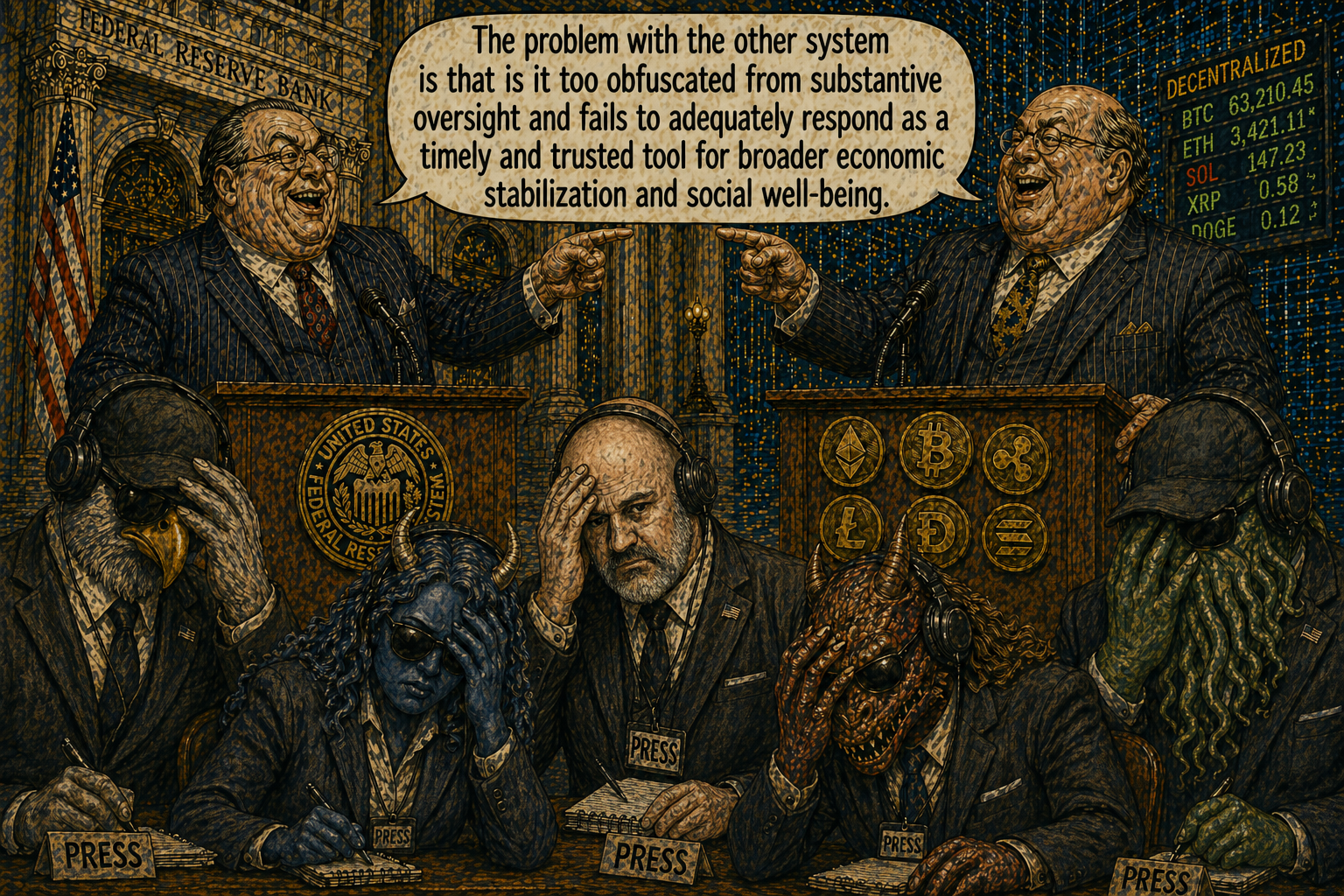
Crypto does not abolish monetary command. It shifts command from the relatively legible state/bank nexus into a more opaque stack of whales, stablecoin issuers, custodians, exchanges, and validators.
A scene of apparent escape that is already a return.
At 6:11 AM on a gray weekday morning, before the coffee has done anything useful and before the day has had a chance to harden into obligation, he is already checking the numbers.
He does it in bed, on his back, with the phone held just above his face, the blue light making a second dawn of the room. The first app is the bank. It opens with the solemn efficiency of a thing that expects to be trusted. There is the checking account, the pending paycheck, the rent that has not yet been pulled, the credit-card payment due tomorrow, the little constellation of transactions that now stands in for weather, temperament, and fate. He studies them not because there is anything new to learn, exactly, but because the repetition itself feels like a form of control. You refresh what you cannot command.
Then, almost as reflex, he swipes over to the other app.
The colors are glossier there, the language less paternal. There are charts where there used to be statements, tokens where there used to be balances, yield where there used to be interest. The stablecoins sit in their neat little stack, serene as icons. The number is almost the same as the one in the bank, and not the same at all. On one side is the paycheck: earned, delayed, taxed, routed, deposited. On the other is a digital claim that promises a cleaner relation to value, faster, freer, less entangled with the old machinery. If the bank app speaks in the voice of institutions, the crypto app speaks in the voice of exits.
He refreshes that one, too. Nothing changes.
He goes back to the bank. Then back again. The motion develops a rhythm, and the rhythm becomes a kind of liturgy. Not faith, exactly, but its more practical cousin: the hope that one of these systems, if stared at with sufficient attention, will reveal itself to be less contingent than it feels. The gesture is small and embarrassing and nearly universal, this tapping, this toggling, this petitioning of a screen for reassurance, but it contains within it an entire philosophy of the present. One interface for the old world, one for the new, and the same pulse of dependence beneath both.
Outside, someone’s car alarm chirps and stops. A neighbor’s shower starts up behind the wall. Somewhere in the building, a child is being coaxed toward school. The ordinary republic of needs is coming awake. Rent will still be rent. Groceries will still have to be bought one basket at a time. The landlord, the utility company, the insurance portal, the pharmacy, the payroll processor, all of them stand waiting at the end of one chain or another. Whatever money is, it has to pass through those gates before it can become a meal, a bus ride, a month of shelter, a little less fear.
That, more than any white paper or manifesto, is what gives the morning its tension. The apps appear to offer different metaphysics. The bank app says: you are inside the system, but the system is durable. The crypto app says: you are still inside a system, but this one was built to let you slip the leash. One presents dependence as stability; the other sells dependence as escape. The numbers shimmer accordingly.
And yet his thumb keeps making the same motion:
Refresh.
***
Refresh.
***
Refresh.
***
The body understands before the mind does. Anxiety is often the most honest political philosopher in the room. It knows when a choice has been overstated. It knows the difference between sovereignty and a better user experience. It knows that an interface may be sleek without being emancipatory, and that the promise of independence, delivered through a phone in the palm before sunrise, can feel very much like any other promise made by money: intimate, abstract, and just far enough from ordinary life to require trust.
On the bank side, the money is already spoken for. It arrives pre-burdened, tagged by prior claims. On the crypto side, the money carries a different atmosphere, one of optionality, of routes not yet foreclosed, of a parallel system humming just beyond the reach of the familiar one. That is its seduction. It allows dependence to masquerade as agency instead of truly helping to abolish it. It gives him, for a second, the sensation of standing outside the house all the while still paying for a room inside it.
The phone warms in his hand. He glances at the clock. The morning is now too far along for contemplation, not far enough for action. He could get up. He could make coffee. He could leave the balances alone and let the day proceed as it always does: one obligation converting quietly into another. Instead he watches the two screens, moving between them with the concentration of a man trying to catch a trick in the mirror.
What he is looking for is not a profit opportunity, not really. He is looking for confirmation that there exists, somewhere in the circuitry of contemporary finance, a place where money ceases to feel like supervised air. A place where value is not always already claimed by somebody else’s schedule, somebody else’s policy, somebody else’s terms of service. He is looking, in other words, for freedom.
What the morning offers back is subtler, and more disturbing: two polished surfaces reflecting the same old prayer.
One says your life will clear in three business days.
The other says your life can move at the speed of code.
Both ask him to wait.
Both ask him to believe.
And beneath both, as beneath so much of modern life, lies the same unspoken arrangement: that the numbers are real because enough systems say they are, and that he will continue arranging his days around them because, until further notice, he must.
The bank app glows softly in one app window. The crypto app glows softly in the other. Between them there is no revolution yet, only the intimate, practiced anxiety of a person trying to decide which version of abstraction will hurt him less.
The scene above keeps the argument implicit, but its architecture is current: in modern economies, most money takes the form of bank deposits created through commercial-bank lending, while stablecoins are largely private, overwhelmingly dollar-linked instruments backed by reserve assets rather than a disappearance of intermediation.
The argument, stripped of slogans.
The argument, stripped of slogans, is not that fiat is real and crypto is fake, or vice versa. It is that both are rival systems of managed belief. Each presents itself as the more honest medium: fiat as the sober, state-backed infrastructure of economic life; crypto as the decentralized corrective to institutional capture. But both depend on concentrated nodes of power, mediated trust, and symbolic claims that float at some distance from the labor, shelter, food, and care they purport to measure. That is why, in the vocabulary of this piece, they are better understood as rival hyperreal monetary field states: two competing ways of making abstraction feel natural.
Fiat already rests on a misdescription. The popular picture is of the state issuing money from above and banks merely reallocating it. In practice, the Bank of England notes that the majority of money in the modern economy is created by commercial banks when they make loans; banks are not simply lending out pre-existing deposits, but creating new deposit money in the act of credit extension. This does not make fiat illegitimate. It does mean, however, that the ordinary language of “hard cash,” “state money,” and neutral administration conceals a deeper structure in which private credit creation sits at the center of everyday monetary life. The old system is already more synthetic, more mediated, and more privately constituted than its own mythology admits.
Crypto, for its part, has not so much escaped that structure as rebuilt it with different branding. The fastest-growing and most systemically important corner of the sector is the stablecoin market: privately issued dollar-like instruments backed by reserve assets and used primarily as settlement media inside crypto itself, not as a wholesale replacement for everyday public money. ECB analysis from late 2025 found that U.S.-dollar stablecoins accounted for about 99 percent of all stablecoin supply, that USDT and USDC alone represented roughly 90 percent of the market, and that around 80 percent of all trades on centralized crypto platforms involved stablecoins. In other words, the “decentralized alternative” is increasingly routed through a handful of issuers and centralized venues. IMF work published in late 2025 likewise described stablecoin issuance as having doubled in two years, driven chiefly by their use in crypto trades, while warning of macro-financial, operational, and legal risks as these instruments become more deeply embedded in the wider system.
Even the ownership structure of the supposedly open networks points in the same direction. A 2025 on-chain study of Ethereum found that roughly 0.3 percent of wallet addresses held nearly 95 percent of the total ETH supply. The authors note that some of this apparent concentration reflects exchanges, bridges, staking contracts, and other pooled infrastructure rather than simple individual whale control. But they also report very high concentration even after excluding major labeled institutional wallets. The point is not that crypto is uniquely oligarchic; fiat has its own entrenched centers of issuance and advantage. It is that neither system disperses monetary power in the way its public story suggests.
That is where the Grand Unified Field Theory of Coherence (GUFT) lens matters. In this framework, coherence is not just technical stability or price continuity. It is the joint presence of Empathy and Transparency. Fiat and crypto both fail that test, though in different registers. Fiat distributes power asymmetrically by locating money creation, credit allocation, and crisis management inside institutions that most people rely on but do not meaningfully govern. Crypto distributes power asymmetrically by translating those same dynamics into new forms, large holders, custodians, exchanges, and private stablecoin issuers, while maintaining a rhetoric of exit and personal sovereignty. Both obscure the map between signs of wealth and actual social life. Both ask ordinary people to navigate abstractions whose decisive mechanisms are elsewhere. BIS put the monetary problem starkly in 2025, arguing that stablecoins fall short as a monetary foundation when judged against singleness, elasticity, and integrity, the properties required for money to function as a socially reliable coordination device.
Seen this way, the real opposition is not fiat versus crypto. It is coherence versus managed opacity. One system clothes hierarchy in the language of public order; the other clothes hierarchy in the language of liberation. Each claims realism. Each accuses the other of illusion. And each, in its own way, turns distance from lived reality into a feature rather than a defect.
Explainer 1: What does Empathy × Transparency mean in monetary terms?
In monetary terms, Empathy asks whether a system can actually register, and meaningfully protect, the people who bear its risks. Who absorbs the damage when credit tightens, prices jump, a platform freezes withdrawals, a stablecoin de-pegs, or a reserve structure turns out to be weaker than advertised? A high-empathy system would not treat those harms as regrettable side effects downstream of “the real economy.” It would build institutions, buffers, and governance rules around the fact that ordinary households, workers, renters, and small firms are the ones most exposed when monetary abstractions fail. The Bank of England’s description of deposit-money creation, the ECB’s warnings on stablecoin concentration and run risk, and the IMF’s focus on macro-financial and legal vulnerabilities all point to the same issue: money is never just a neutral instrument; it is a risk-distribution machine.
Transparency asks whether an outsider can actually see how that machine works. Can a reasonably attentive person understand who creates money, on what basis, with what collateral, through which institutions, and subject to whose discretion? Or do the crucial mechanics disappear behind technical jargon, corporate structure, reserve complexity, and platform intermediation? Coherence requires both. A system can be transparent in spots and still indifferent to those it harms. It can also claim to serve people while remaining too opaque to audit. Fiat fails by normalizing private credit creation inside a public mythology of neutrality; crypto fails by advertising disintermediation while leaning ever more heavily on concentrated issuers, platforms, and custodial structures. A coherent monetary order would have to do more than work. It would have to become legible to those who live inside it, and answerable to those who pay its costs.
The old theater of money, overt control, explicit hierarchy.
The old theater of money has at least one virtue: it does not fully pretend that power has disappeared. It places power in institutions, names them, robes them, and gives them offices. The sovereign declares what counts as official currency. Central banks issue the settlement asset at the core of the system, influence monetary conditions through policy rates and reserve management, and operate or oversee payment and settlement infrastructure on which ordinary life depends. In the euro area, for example, official currency is explicitly a legal-tender system designed and controlled by public or supranational authority; in the United States and Europe alike, central banks sit at the center of the machinery that clears payments and moves value safely across the banking system.
That arrangement is older, more explicit, and less embarrassed by hierarchy than the libertarian mythology that would later arise against it. There is no great secret about the fact that the system is tiered. Central banks stand above commercial banks; commercial banks stand above households and firms; regulation, collateral frameworks, prudential rules, and lender-of-last-resort facilities stand behind the whole arrangement like the stage rigging of a play no one is meant to confuse with nature. The Federal Reserve says plainly that the discount window exists to provide ready funding to depository institutions, helping them manage liquidity stress and avoid withdrawing credit from customers when markets seize. The FDIC says equally plainly that its purpose is to maintain stability and public confidence by insuring deposits and managing failed-bank receiverships. Fiat money endures not because it is metaphysically pure, but because it is backed, supervised, and infrastructurally maintained.
Yet even this older system is stranger than its public story admits. What most people call “money” is not primarily coin or paper issued directly by the state. It is bank deposit money, and the Bank of England’s explanation remains one of the clearest: commercial banks create the majority of money in the modern economy when they make loans, thereby creating matching deposits. Banks are not, in practice, simply lending out pre-existing savings. They are manufacturing claims, book entries that become spendable balances and circulate as everyday money. The system works because these claims are widely accepted, interconnected with payment rails, and stabilized by central-bank policy and state guarantees. But that also means everyday money is already a synthetic, layered product: not wealth itself, but a negotiable promise created inside institutions whose primary language is balance-sheet expansion.
This is where the old theater becomes psychologically slippery. The person receiving wages into a checking account is told, in effect, that the number on the screen is money in the same simple way a coin in the hand once was money. Legally and operationally, that is true enough for daily life. But structurally it obscures the deeper process by which private credit creation, central-bank reserves, prudential regulation, and sovereign backing combine to produce a spendable unit. The result is a peculiar split in experience. On the one hand, fiat money feels indisputably real because it pays taxes, settles debts, and buys food. On the other, it can feel distant and unreal because its creation and distribution take place in a zone of expertise, policy, and interbank plumbing far removed from the people whose lives are organized by it. The modern deposit is both intimate and remote: close enough to determine whether rent clears, abstract enough that most users are never invited to understand where it came from.
The hierarchy extends well beyond ordinary banking. Around the formal banking core there stretches the larger and murkier architecture once called “shadow banking” and now more often described as non-bank financial intermediation: money market funds, securitization vehicles, repo markets, private credit, hedge-fund leverage, insurers, and a range of other balance-sheet structures that perform bank-like functions without always looking like banks. The Financial Stability Board reported in late 2025 that the non-bank financial intermediation sector had grown to 51 percent of total global financial assets in 2024, expanding at roughly twice the pace of the banking sector. The Basel Committee has likewise emphasized the growing interconnections between banks and NBFIs through funding relationships, repo, lending exposures, and holdings of bank-issued securities. The official picture of “money” as a tidy state–bank–public chain has long since been surrounded by a much larger ecosystem of collateralized promises and money-like instruments.
An IMF working paper from 2014 proposed a particularly useful way of seeing this backstage world: shadow banking as financial activity outside traditional banking that still requires a private or public backstop to function. That formulation remains helpful because it reveals the central paradox of supposedly market-driven liquidity. Much of the system that appears private, innovative, and lightly supervised retains an implied or explicit dependency on state capacity, bank balance sheets, emergency funding, or some other stabilizing guarantee when stress arrives. The old theater of money may celebrate markets on the marquee, but backstage it still keeps the fire department on retainer.
That is why fiat should not be caricatured as a cartoon villain. It persists for reasons that are not merely ideological. It persists because it has legal force, settlement finality, institutional memory, and a depth of infrastructure that newer monetary forms still borrow from rather than replace. Central banks provide the safest settlement asset in the system and operate or anchor the rails over which payments, securities, and reserves move. Official currencies have tax capacity, public law behind them, and an embedded place in payroll, accounting, debt contracts, state procurement, and cross-border obligations. Even people who distrust the system continue to use it because it can absorb scale, route claims, and survive panic with tools that have no real equivalent outside state-backed monetary architecture.
And still, for all that capacity, many people experience fiat money as extractive and unreal. They experience it as something done to them rather than with them: interest rates lifted or cut from above, housing inflated by credit conditions they did not choose, financial returns decoupled from wages, asset markets levitated while ordinary life grows more brittle. The abstractions multiply, deposits, securities, collateral chains, repo funding, structured products, private credit, until “wealth” begins to look less like a claim on human and material flourishing than a hall of mirrors built from increasingly tradable expectations. The system works; that is part of the problem. It works well enough to naturalize its own distance, to make privately created credit and publicly backstopped risk appear as the ordinary weather of economic life. That is why people do not merely criticize fiat. They often feel estranged from it. It is not just that money has become abstract. It is that abstraction has become governable from somewhere else.
In that sense, the old theater of money is not unreal because it is false. It is unreal because it is successful: successful at converting hierarchy into infrastructure, discretion into routine, and contingent institutional design into something that feels as inescapable as gravity. That is its achievement and its accusation. It endures because it can carry the world. It alienates because so few of the people carried by it have any say in how the stage is built.
The insurgency that inherited its enemy’s face.
Crypto’s founding story was not merely technical. It was moral theater. In Satoshi Nakamoto’s white paper, Bitcoin was presented as a “purely peer-to-peer” form of electronic cash that would allow payments to move without the burden of passing through a financial institution. Later accounts of crypto’s early ideological core describe the project even more bluntly: an attempt to break the chokehold of central banks and large commercial lenders, especially after the 2008 crisis had made the old system look both corrupt and absurdly self-protective. The original promise was not just efficiency. It was escape.
That promise mattered because it named something real. Banks were not neutral custodians; they were gatekeepers. States were not passive issuers of public utility; they were co-authors of a monetary order whose failures were socialized downward and whose rescues moved upward. Crypto’s first emotional appeal lay in its refusal of that arrangement. It offered money without sovereign paternalism, value without bureaucracy, exchange without permission. To people exhausted by institutional mediation, it did not feel like a new asset class. It felt like a jailbreak.
But the data have been unkind to the romance. Igor Makarov and Antoinette Schoar’s long-circulating analysis of Bitcoin’s market structure, revised as recently as 2025, did not conclude that the ecosystem had dispersed power so much as relocated it. Their summary is devastatingly plain: the Bitcoin ecosystem is “still dominated by large and concentrated players.” Their analysis documents concentration among miners, major market participants, and the largest Bitcoin holders, which means that the anti-hierarchical dream never actually escaped the logic of concentration; it merely reassembled it on new rails.
Ethereum, which often carries the more ambitious mantle of programmable decentralization, looks no less revealing when stripped to distributional facts. A 2025 Nature-group study on Ether supply found that roughly 0.3 percent of addresses held nearly 95 percent of the total ETH supply over the period examined. The authors are careful to note that some of this concentration reflects pooled infrastructure rather than simple individual whale dominance, centralized-exchange wallets, bridges, the Beacon Chain contract, and wrapped-ETH contracts all aggregate the balances of many users into a smaller number of addresses. But that qualification does not rescue the decentralization myth. It sharpens it. Even when concentration is partly infrastructural rather than purely personal, the consequence is the same: control and influence accumulate at chokepoints.
A separate NBER study on Web3 and DeFi reaches a similarly sobering picture from another angle. It finds that mining income and Ether ownership are concentrated in exchanges and a few individual nodes, that network activity has evolved away from simple peer-to-peer exchange toward interactions dominated by large players, and that high transaction fees, congestion, and volatility impose particular burdens on small, poor, inexperienced, and newly entering participants. This matters because the insurgent promise was democratization. Yet once one asks who actually bears cost and who actually commands throughput, the answer looks less like liberation than stratification with better branding.
And then there are the venues themselves. Whatever the theory of decentralization, much of crypto’s practical life still runs through centralized exchanges. ESMA’s 2024 market-structure analysis found a highly concentrated crypto trading market by 2023: the top five exchanges accounted for 73 percent of market share, and Binance and Coinbase together represented more than 55 percent of global crypto-asset trading volume and about 95 percent of trading among EU-authorized virtual-asset service providers. For a movement born in suspicion of institutional intermediaries, this is an almost comic inheritance. The new system did not eliminate the middleman. It made him private, global, and harder to see.
This is the emotional hinge of the section, and it deserves to be stated without sneer. Crypto did not fail because its critique of the old system was wrong. It failed, or at least compromised itself, because the act of building an alternative under real conditions required liquidity, custody, market depth, issuance, governance, and trust. Those functions did not disappear merely because the rhetoric changed. They condensed elsewhere. The rebel system did not abolish hierarchy; it privatized and obscured it. The old order had central banks, supervisory agencies, lender-of-last-resort facilities, and state law standing visibly onstage. The new one has whales, exchanges, validators, bridges, venture treasuries, and private issuers clustered behind interfaces that still speak the language of freedom.
That is why crypto can feel so uncanny to its critics and so intimate to its believers. It is not wholly false. It really does expose the contingency of the old monetary order. It really does make visible that money is a design problem, not a law of nature. But in trying to flee one architecture of domination, it often reproduced another at a different layer of abstraction. The insurgency did not storm the palace and abolish the court. It built a second palace, thinner-walled, more international, more aesthetic, and told its subjects they were now sovereign because the velvet rope had been replaced by code.
The exchange as the new central bank without the name.
This is the point at which crypto stops being a seminar and becomes a habit. Most people do not live their crypto lives in white papers, governance forums, or abstract debates about decentralization. They live them on exchanges: opening accounts, holding balances, converting paychecks into stablecoins, routing trades through pairs someone else has chosen, and trusting that withdrawals will remain open long enough for trust to feel like autonomy. The market structure tells the story plainly. In 2025, the top 12 centralized exchanges processed nearly $21 trillion in spot volume, while Binance alone accounted for about 39.2 percent of the top 10 exchanges’ spot volume that year. Even after decentralized trading grew, CEXs still dominated spot activity, with DEX share at 13.6 percent in January 2026 and centralized venues still handling more than $1 trillion in monthly spot volume. This is not a fringe layer of the ecosystem. It is the ecosystem’s daily life.
And the exchanges are not merely busy. They are heavy. By the end of February 2026, the value of underlying assets held across the top 12 centralized exchanges had risen to roughly $225.4 billion, up from $152.1 billion at the start of 2024, with Binance alone holding about $93.4 billion in reserves. The stablecoin rails running through these venues are just as revealing: USDT and USDC accounted for 66.6 percent of all trading pairs across the top 12 CEXs, and 97.7 percent of all stablecoin trading pairs among those exchanges. That is not what a decentralized commons looks like. It is what a privately administered payments-and-liquidity architecture looks like when it has become ordinary enough to stop needing a theory of itself.
Even the growth of the supposedly decentralized layer turns out, on inspection, to reinforce the same picture. CoinGecko noted that DEX share of spot trading peaked at 24.5 percent in June 2025, driven in large part by Binance Alpha 2.0 routing trades through PancakeSwap. The detail is almost too perfect. Even on-chain “escape” was, at a key moment, boosted by a centralized venue’s own routing logic. The exchange does not merely coexist with the decentralized world; it often curates the traffic into and through it.
That is why the exchange is best understood not as a marketplace in the thin, liberal sense, as a passive place where buyers and sellers meet, but as a kind of quasi-sovereign. It does not print legal tender, but it performs a cluster of powers that look increasingly monetary once you step back. It decides which assets are admitted to visibility and liquidity. Coinbase says outright that its Digital Asset Support Group votes on which assets may be listed, that those listings follow a rigorous legal, compliance, and technical review, and that listed assets remain under ongoing monitoring. When a new asset is added, Coinbase opens trading in phases, transfer-only, then post-only, then limit-only, then full trading, and explicitly reserves the right to delay or suspend that progression if its “healthy and orderly market” metrics are not met. In other words, the platform does not simply host a market. It decides when a market comes into being.
The same platforms also govern the internal constitution of exchange life. Coinbase’s trading rules define a central order-book system, specify supported fiat and digital-asset trading pairs, prohibit forms of manipulation such as wash trading, spoofing, and layering, and give market operations discretion to halt trading when they deem it necessary. Coinbase Prime, meanwhile, advertises support for more than 275 digital assets and over 340 trading pairs, with availability varying by geography and custody entity. Those may sound like operational details, but they amount to something more consequential: the exchange selects the routes through which value can move, the surveillance categories by which behavior is judged, and the exceptional conditions under which normal market life can be suspended. That is not merely brokerage. It is a form of rulemaking.
Custody pushes the resemblance still further. Coinbase Prime’s custody arm presents itself as a regulated fiduciary and qualified custodian under New York law, built to store and manage digital assets for institutions at scale. Binance’s own explanation of proof-of-reserves frames the exchange as a custodian whose legitimacy depends on showing that it holds users’ funds on at least a 1:1 basis. Once the exchange becomes the place where assets are stored, reconciled, and vouched for, it ceases to be a mere venue and becomes something closer to a private clearing-and-custody state. The user is not simply trading there; the user is residing there, in provisional form, on terms set by an entity that combines broker, bank, vault, compliance office, and border checkpoint.
Delisting makes the sovereign analogy unavoidable. Coinbase states that delistings occur when an asset is suspended from trading, often because of project changes, failure to meet review standards, or project termination; in one recent FCA-serviced case, it told customers that if certain assets remained in their accounts after the liquidation date, the platform would sell them and credit them with USDC instead. Binance’s Monitoring Tag system is even more candid about the criteria of soft sovereignty: tokens can be placed under heightened scrutiny and face delisting based on liquidity, development quality, transparency of communication, responsiveness to Binance’s requests, regulatory compliance, tokenomics changes, ownership changes, and even community sentiment. This is the authority not simply to host exchange but to decide what counts as a viable monetary object inside the system.
So the exchange becomes, in practice, the new central bank without the name, not because it enjoys formal public mandate, but because it exercises many of the powers that matter most in lived monetary life. It confers liquidity. It recognizes or withholds legitimacy. It stores assets, surveils behavior, opens and halts markets, privileges certain stablecoin rails, and can exile an asset from practical circulation with a notice and a deadline. The old central bank governed through law, policy rates, reserve frameworks, and emergency lending. The exchange governs through listings, pairs, custody, compliance, user-interface nudges, and delisting risk. One is overt and public. The other is private, contractual, and global. Both are systems of monetary administration.
That is the heart of our charge against crypto’s self-image. The movement that promised to dissolve gatekeepers has, in its practical life, rebuilt them as platforms. It has not abolished discretion; it has encoded discretion into listing committees, custody structures, reserve attestations, pair architecture, and risk tags. It has not ended monetary governance; it has privatized it, internationalized it, aestheticized it, and in some ways made it more intimate, because now the sovereign lives in your phone and answers to a terms-of-service update instead of a public statute. The rebel system did not merely inherit its enemy’s face. In the exchange, it perfected the enemy’s convenience.
Stablecoins, or the rebellion that settles in Treasuries.
If crypto’s first act was rebellion, stablecoins are the scene in which the rebel quietly learns to keep house with the empire.
They were introduced as a solution to a real embarrassment. Bitcoin was too volatile to function as ordinary money. Ether was too unstable to anchor a serious payments system. Traders, exchanges, and protocols needed something that could move at blockchain speed without forcing users to endure constant conversion back into bank money. So stablecoins appeared as the compromise instrument: crypto-native enough to satisfy the dream of exit, dollar-like enough to keep the whole machine from shaking itself apart. The ECB describes them as tokens issued on distributed ledgers that aim to maintain a stable value relative to a traditional asset, usually by offering par convertibility and backing liabilities with safe and liquid assets. The original attraction, the ECB notes, was precisely that they let users move between crypto-assets and send value across borders without leaning directly on the traditional banking system.
That was the sales pitch. The market structure tells a harsher story.
By mid-2025, the ECB reported that U.S.-dollar stablecoins accounted for about 99 percent of total stablecoin market capitalization, while euro stablecoins remained marginal. By November 2025, ECB staff were still describing a market in which dollar-denominated stablecoins made up around 99 percent of all stablecoin supply in circulation, with USDT and USDC alone accounting for roughly 63 percent and 26 percent of stablecoin market capitalization, respectively. This is not a multi-polar alternative monetary world. It is a private dollar zone.
Nor is that dominance merely notional. It is operational. CoinGecko’s 2026 spot CEX report found that USDT and USDC accounted for 66.6 percent of all trading pairs across the top 12 centralized exchanges, and that 9,646 of 9,870 stablecoin pairs on those platforms, 97.7 percent, were either USDT or USDC. In other words, the supposed alternative system does not merely tolerate the dollar. It routes itself through privately issued versions of it.
This is the mirror moment of our analysis, because the contradiction is almost perfect. Stablecoins were born as part of a broader revolt against sovereign money and bank mediation. Yet the most successful ones do not escape the dollar order so much as clone it. The ECB puts the mechanism plainly: users hand over traditional currency, usually dollars, to private issuers like Tether and Circle, and those issuers invest the funds in safe and liquid assets, such as U.S. Treasuries, to back the stablecoins they issue as liabilities redeemable at par. Functionally, that is not the abolition of fiat. It is private dollar administration: dollars go in, Treasury-backed claims come out, and the issuer sits in the middle collecting the privilege of having become a quasi-bank without fully admitting the name.
The scale of this settlement inside the old order is now large enough to matter to the old order itself. A BIS working paper published in 2025 found that, as of March 2025, stablecoins’ combined assets under management had exceeded $200 billion. The same paper reports that stablecoin issuers bought about $40 billion of U.S. Treasury bills in 2024, an amount comparable to the largest U.S. government money market funds and larger than most foreign purchases. Stablecoins, in other words, are no longer just using the dollar as a reference unit. They are becoming meaningful buyers of the state’s short-term debt in order to sustain the dollar claims they privately issue.
The emotional force of that fact should not be lost in the arithmetic. The anti-fiat dream stabilizes itself by buying the state’s debt and reissuing private dollars.
That sentence is not a metaphor. It is the business model.
The BIS has been unusually blunt about what this means for the monetary claims made on stablecoins’ behalf. In its 2025 Annual Economic Report, it argues that stablecoins may have some promise within tokenization, but they fall short as candidates for the “mainstay” of a monetary system when judged against three basic tests: singleness, elasticity, and integrity. Singleness means money should settle at par and be accepted “no questions asked” as part of a common monetary unit. Elasticity means the system can provide settlement liquidity and expand money flexibly when needed, rather than requiring full prefunding. Integrity means the system can resist financial crime and command public trust. By BIS’s account, stablecoins perform poorly on all three. They are issuer-tagged private instruments rather than homogeneous public money, they impose a cash-in-advance constraint because additional issuance generally requires full upfront payment, and their bearer-like design on public blockchains creates system-level integrity problems.
The details are devastating because they reveal that stablecoins inherit not just fiat’s abstractions, but some of pre-modern private money’s defects. BIS explicitly compares them to private banknotes in the U.S. Free Banking era: claims whose value depends on the issuer and which therefore do not fully satisfy the “no questions asked” character of money accepted at par. The old monetary system solved that problem through central-bank settlement, prudential regulation, deposit guarantees, and lender-of-last-resort capacity. Stablecoins solve it, if they solve it at all, through reserve composition, redemption confidence, exchange integration, and sheer habit. They promise stability, but the promise remains tethered to a firm.
And because the firms are concentrated, the risk is concentrated. ECB staff warned in late 2025 that stablecoins are used primarily within the crypto ecosystem, that around 80 percent of all trades executed globally on centralized crypto trading platforms involve stablecoins, and that USDT and USDC had become the preferred units of account for crypto trading platforms. The same ECB analysis warned that the two largest issuers together accounted for around 90 percent of all stablecoins in circulation, that they now ranked among the largest holders of short-term U.S. Treasuries, and that a run on them could force sales of reserve assets that reverberate into Treasury markets themselves. What began as a workaround for crypto volatility is now large enough to become a transmission channel back into traditional finance.
This is why stablecoins feel, to anyone who lingers with them long enough, less like a monetary revolution than a historical rhyme. They repeat, in more efficient form, the old pattern by which money becomes private, networked, and convenience-maximizing while still depending on public credibility and safe-state assets somewhere underneath. They are not outside the system. They are a highly legible symptom of what the system has become: a world in which the public money dream is increasingly administered by private interfaces that borrow trust from sovereign balance sheets while insisting that they are beyond politics.
So if the exchange was the new central bank without the name, the stablecoin is the new dollar account without the charter. It carries the rhetoric of insurgency, the user experience of liquidity, and the balance-sheet logic of the very order it once claimed to displace. The rebellion did not so much overthrow fiat as settle into one of its safest rooms and begin charging admission.
Hyperreality - money as a sign system that forgets what it claims to measure.
Baudrillard’s old insight still helps here, provided we use it sparingly and with some discipline: hyperreality is what happens when the model, the code, or the image becomes more authoritative than the reality it was once supposed to describe. In the postmodern world he diagnosed, representation does not merely reflect the real; it begins to organize experience in its own image, until the signs feel more real than the underlying life they once indexed. That is a useful description of modern money, not because money is fictional, but because both fiat and crypto increasingly ask people to live inside systems of signs whose internal coherence obscures their distance from material and social reality.
Fiat is the older perturbation. It became so abstract, so professionally managed, and so remote from ordinary perception that it invited revolt. The decisive fact is not that the system is “fake,” but that most of what people treat as money is already a highly mediated credit relation. The Bank of England has been unusually candid about this for years: most money in the modern economy is created by commercial banks when they make loans, and banks create money, not wealth. The ordinary deposit is therefore already a sign of a sign, a bank liability treated as money because law, payment infrastructure, and central-bank-backed confidence allow it to circulate as such. What daily life experiences as neutral monetary reality is, underneath, an institutional production of credit claims.
The abstraction thickens as one moves outward from deposits into the broader financial surround. Shadow banking, on the IMF’s useful definition, consists of financial activities outside traditional banking that nonetheless require a private or public backstop to operate. This matters because it shows how much of modern financial “stability” is not the elimination of fragility but its displacement, into guarantees, franchise value, rescue capacity, and implicit state support that sit just offstage until panic calls them in. The balance sheet looks self-sustaining until one asks what must stand behind it in order for the appearance to hold. Fiat, then, is not simply money; it is an entire architecture of visible and invisible props that makes privately created claims feel like a natural fact of life.
Crypto begins as the counter-perturbation to that abstraction. It sees, correctly, that the old system is synthetic, layered, and politically managed, and it revolts. But it revolts so theatrically that it reproduces the same condition in a new idiom. If fiat says, “Trust the institutions, the supervision, the state,” crypto says, “Trust the protocol, the ledger, the market.” One answers opacity with code, but code quickly becomes its own mystification. The most successful stabilizing instrument in the crypto universe turned out not to be a non-sovereign money, but the private reissuance of the dollar. By 2025, the ECB reported that U.S.-dollar stablecoins made up about 99% of total stablecoin market capitalization, while the BIS argued that stablecoins fail the core monetary tests of singleness, elasticity, and integrity. The counter-system’s answer to mediated money was not escape from monetary representation, but a new regime of representation, privately issued, exchange-routed, and still anchored to the old sovereign unit.
That is why the GUFT line matters here. False coherence is not mere fraud; it is the condition in which prices, claims, and balance sheets appear stable while empathy and transparency are both low. A system can look calm because the entropy has been pushed somewhere else: onto indebted households, onto workers whose wages lag behind asset inflation, onto ecosystems treated as external to the ledger, onto peripheral users who absorb volatility, fees, freezes, and failures downstream of institutional design. In fiat, the concealment takes the form of technical legitimacy: policy language, reserve plumbing, balance-sheet complexity. In crypto, the concealment takes the form of anti-institutional romance: decentralization talk layered over exchanges, issuers, whales, and custody stacks. The effect is similar in both cases. Stability is purchased by externalizing disorder while preserving the appearance of internal order.
So the deeper problem is not only exploitation, though exploitation is everywhere in view once one starts tracing the flows. The deeper problem is representational. Both systems produce misleading pictures of reality. Fiat presents privately generated credit claims as if they were a neutral public medium. Crypto presents privately governed digital claims as if they were emancipation from governance itself. In each case, the sign forgets what it claims to measure. “Wealth” appears on the screen as if it were self-evident, while the underlying questions, who labored, who borrowed, who absorbed the risk, who received the backstop, who lost time, soil, health, or political agency to make the number hold, are pushed out of frame.
Fiat, then, is the perturbation that became too abstract to feel believable. Crypto is the counter-perturbation that revolts against abstraction by aestheticizing it. One system becomes so mediated that people long for exit; the other stages that exit so effectively that many fail to notice they have entered another chamber of the same hall. Neither is unreal in the sense of being imaginary. Both are unreal in the more modern sense: they generate a persuasive picture of value that is increasingly detached from the lived economic world they claim to describe.
Why neither system clears the empathy × transparency bar.
This is the section where the argument stops being merely descriptive and becomes evaluative. The decisive question is no longer which system sounds more modern, more rebellious, or more inevitable. It is simpler, and harder: what kind of human reality does each system actually model, and how much of its own machinery does it make visible? In GUFT terms, coherence requires both empathy and transparency. A monetary order that cannot register the needs of those who bear its risk is low in empathy. A monetary order that cannot be meaningfully inspected by the people who depend on it is low in transparency. By that standard, fiat and crypto both fail, not symmetrically in every detail, but recognizably enough that their rivalry begins to look like a family quarrel.
Empathy, in monetary terms, is a distributional question before it is a moral one. It asks: whose stability is the system optimized to protect? In the fiat order, the answer begins with bank balance sheets, collateral quality, and the continuity of credit creation. The Bank of England has said plainly that most money is created by commercial banks when they make loans, not by the state simply handing out pre-existing money. The Federal Reserve’s discount window exists to give depository institutions ready access to funding so they do not have to withdraw credit during stress, and FDIC deposit insurance exists to protect insured depositors and preserve confidence in the banking system. Around that core sits a vast non-bank financial sector that, by 2024, had grown to 51 percent of total global financial assets, much of it bound up with private finance, securitization, repo, and other structures whose stress still matters to the system as a whole. The result is not that ordinary people are ignored in every circumstance, but that the system models their welfare indirectly, through the health of institutions, markets, and asset values that are presumed to stand in for social stability.
Seen that way, fiat privileges the already legible: borrowers who can satisfy bank underwriting, firms with collateral, asset owners whose balance sheets benefit from credit abundance, institutions with access to public backstops when liquidity evaporates. It is not that households do not matter. It is that they matter downstream. The system’s first-order concern is not whether life feels secure from the vantage of the worker, renter, or debtor; it is whether the channels that create and circulate money remain intact. That is why the system can feel extractive even when it is functioning as designed. It protects the conditions of monetary continuity, then assumes that social life will sort itself out from there.
Crypto promised a more empathic distribution of monetary power and delivered, instead, a privatized hierarchy. The early rhetoric was democratization: anyone could hold the asset, verify the chain, move value without permission. But the actual structure increasingly privileges early entrants, whales, issuers, validators, and exchange operators. Eswar Prasad’s IMF essay on “The Stablecoin Paradox” puts the reversal succinctly: stablecoins stepped in after decentralized cryptoassets proved impractical for everyday use, but stablecoins themselves are “the antithesis of decentralization,” relying on trust in the institutions that issue them and allowing those firms to decide the rules of access and use. Meanwhile, a 2025 Ethereum distribution study found that roughly 0.3 percent of addresses held nearly 95 percent of ETH supply, and ESMA’s market-structure analysis found that the top ten exchanges handled about 90 percent of crypto trading volume in 2023, with Binance alone at 49 percent. This is not a democratized monetary commons. It is a privately governed concentration regime whose gatekeepers are less public, more platformized, and often harder to contest.
And when volatility arrives, crypto’s empathy failure becomes impossible to miss. An April 2026 IMF working paper argues that an unregulated private stablecoin equilibrium is suboptimal precisely because issuers maximize profits by holding risky assets, increasing run risk and associated welfare losses. A system organized this way does not primarily protect the user at the end of the chain. It protects the issuer’s incentive to issue and the platform’s ability to keep volume moving. Ordinary holders are left to absorb de-peggings, freezes, exchange failures, liquidation cascades, and the countless smaller erosions of value that disappear into fees, spreads, slippage, and platform insolvency. The promise of “permissionless finance” turns out, under stress, to be a very selective permission structure indeed.
Transparency is the other half of the failure, and here again the two systems mirror one another while speaking different dialects. Fiat hides behind legal complexity, supervisory jargon, shadow-banking chains, and a general social agreement that the plumbing is too technical for ordinary people to inspect. The Bank of England has repeatedly had to explain that commercial banks create most money through lending because the ordinary public story remains misleadingly simple. The IMF’s shadow-banking definition is similarly clarifying: activities outside traditional banking that still require private or public backstops to operate. Even the regulators who monitor the non-bank sector emphasize data limitations, especially around private credit. So while fiat appears public, legible, and law-bound from a distance, much of its actual operation is hidden inside specialized expertise and institutions whose language is functionally inaccessible to the people living inside their consequences.
Crypto, by contrast, offers an almost theatrical transparency: public ledgers, open addresses, visible token supplies, proof-of-reserves dashboards. But that visibility is thinner than it looks. The Ethereum concentration study itself notes that exchange wallets, bridges, staking contracts, and other pooled addresses make the system appear both transparent and decentralized while obscuring who actually controls the underlying assets. The IMF’s stablecoin analysis goes further: governance is not decentralized in the meaningful sense, because the issuing firm decides who can use the instrument and how. The pseudonymity of wallets, the off-chain reality of reserve management, offshore legal structures, tokenomics that require technical literacy to parse, and the semantic fog of “decentralization” all produce a transparency that is real at the level of data exhaust and weak at the level of political intelligibility. The chain may be open, but the system is not thereby understood.
This is why both systems are less interesting as ideologies than as allocation machines. Once you stop asking what they claim to represent and start asking what they actually allocate, the moral theater falls away. Who gets first access to credit or liquidity? Who gets to issue the money-like claim? Who is legible enough to matter? Who receives a public or private backstop when things break? Who bears the volatility when they do not? In fiat, the answers run through bankability, collateral, institutional access, and the state’s willingness to preserve the monetary core. In crypto, the answers run through wallet size, platform access, issuer credibility, infrastructure position, and the ability to exit before the crowd does. One system distributes privilege through legal-financial hierarchy; the other through digitally mediated concentration. Both sort people into those who are protected by design and those who disappear into the residual categories: fees, slippage, insolvency, inflation, delay, or simply non-recognition.
That is the normative center of our analysis. Neither system clears the empathy × transparency bar because both mistake a stabilized sign structure for a coherent social order. Each can produce local order on the screen while pushing disorder outward into lives, ecologies, and margins that do not get counted with equal seriousness. The problem is not simply that power exists. The problem is that power is allocated through systems that remain too indifferent to those who bear their costs and too obscure for those same people to challenge in time.
Explainer 2: What is a hyperreal monetary field state?
Borrowing Baudrillard’s language of hyperreality, a hyperreal monetary field state is a system in which signs of wealth, prices, tokens, claims, dashboards, balances, begin to govern behavior more authoritatively than the underlying social and material realities they allegedly represent. In such a system, the image of stability can become more operationally powerful than the lived condition of the people and resources that stability is supposed to serve.

Financial signals must be reattached to social and ecological goals overtly, because they already tend to be so covertly.
The private exchange as a political form
The deeper mistake in most writing about crypto is to treat it as either a technology stack or an asset class, as though its significance were exhausted by code quality, throughput, price action, or regulatory category. In practice, crypto has become something more consequential and more familiar: a governance prototype. Its institutions are entered by contract rather than citizenship, and they speak the language of choice rather than mandate, but once inside them the user encounters something that looks remarkably like jurisdiction. There are rules of admission, standards of conduct, mechanisms of exclusion, procedures for dispute, systems of surveillance, and authoritative decisions about what may count as money, collateral, or value. The user does not merely trade on a platform. The user lives, however provisionally, inside a privately administered legal-economic order.
The exchange is the clearest embodiment of this shift from market to jurisdiction. Coinbase states openly that its Digital Asset Support Group votes on which assets can be listed, after legal, compliance, and technical review, and that listed assets remain under ongoing monitoring. Trading in newly listed assets moves through staged phases, transfer-only, post-only, limit-only, then full trading, with Coinbase reserving the right to delay or suspend progression if its metrics for a “healthy and orderly market” are not met. Binance’s Monitoring Tag operates similarly but more starkly: tokens may be flagged, subjected to periodic user risk quizzes, and ultimately delisted based on criteria such as liquidity, development activity, transparency of communication, responsiveness to due diligence requests, tokenomics changes, ownership changes, regulatory compliance, and community sentiment. This is not passive price discovery. It is rulemaking over market existence itself. Admission and exclusion are political acts, even when rendered as product policy.
And jurisdiction, once created, must defend its borders. Coinbase’s U.S. user agreement says the company may suspend, restrict, or terminate access to some or all services, or deactivate accounts, with immediate effect and in its sole discretion, while remaining under no obligation to disclose the criteria behind those decisions because the criteria are part of its risk-management and security protocols. The same agreement pushes disputes into binding arbitration rather than ordinary public courts and provides for batched arbitration when claims become numerous. Its trading rules define the order books available to each trader, the kinds of orders that may be placed, the balances required to place them, and the conditions under which trading or withdrawals may be blocked. What classical states once performed through administrative law and police power, the exchange increasingly performs through click-through contract, compliance tooling, and confidential risk logic.
The scale at which these private jurisdictions now operate makes the analogy difficult to dismiss as rhetoric. CoinGecko’s 2026 spot CEX report found that the top 12 centralized exchanges processed nearly $21 trillion in spot volume in 2025, while the value of underlying assets held across those exchanges had reached roughly $225.4 billion by the end of February 2026. Its 2025 market-share report found Binance alone accounted for about 39.2 percent of top-10 centralized-exchange spot volume that year. ESMA’s market-structure analysis found similarly high concentration in 2023, with the top ten exchanges handling about 90 percent of trading volume and Binance alone near 49 percent. Once a handful of venues intermediate that much liquidity, custody, and price formation, they cease to be mere marketplaces. They become monetary territories.
Stablecoins complete the picture because they reveal how these territories set monetary standards from within. The ECB reported in 2025 that U.S.-dollar stablecoins made up about 99 percent of total stablecoin market capitalization, with USDT and USDC overwhelmingly dominant. CoinGecko’s 2026 spot CEX report found that those two instruments alone accounted for 66.6 percent of all trading pairs across the top 12 centralized exchanges and 97.7 percent of all stablecoin pairs on those venues. That means the practical unit of account inside much of crypto is not “decentralized money” in the abstract, but a very small number of privately issued dollar claims whose use is normalized through exchange architecture. The exchange, in effect, selects the currencies of daily life within its realm.
Nor does the decentralization of underlying blockchains rescue the politics of the system once one asks who actually holds weight. A 2025 study of Ether supply found that roughly 0.3 percent of wallet addresses held nearly 95 percent of ETH across the period examined, even after the authors carefully noted that some addresses represent pooled infrastructure such as exchanges, bridges, and staking contracts rather than simple individual whale ownership. The clarification matters, but not in the way the faithful might hope. If concentration is infrastructural rather than merely personal, that still means control has coagulated at chokepoints. And when one looks at governance tokens directly, the pattern sharpens further: a 2025 EPJ Data Science paper on DeFi governance found persistent influential links dominated by institutional actors and smart contracts holding significant fractions of token supplies across protocols, while reviewing prior literature showing that governance-token ownership is often so concentrated that 5 to 10 addresses hold more than 50 percent of supply and that token-based voting frequently enables major holders to push through unpopular decisions. Crypto’s constitutional story is therefore not one of dispersed rule, but of highly legible plutocracy masked as procedural openness.
Even Ethereum, often presented as the more serious and publicly deliberative pole of the ecosystem, illustrates the same tension between visible process and concentrated influence. A 2024 governance study found that Ethereum Improvement Proposals are indeed discussed in public and that the process is unusually open by software standards. But it also found that 10 individuals were responsible for proposing 68 percent of all implemented Core EIPs, that about 10 people per client implementation accounted for 80 percent of software changes, and that stablecoin issuers and oracle providers constitute potential vectors of governance centralization. That is an important nuance, because it shows how crypto’s politics now operate: not as pure opacity, but as a combination of visible discussion and concentrated effective authorship. The town hall is open; the agenda is still set by a narrow stratum.
All of this suggests that crypto did not abolish centralization. It changed its costume. The old order concentrated authority in states, central banks, and regulated financial institutions, public authority, however imperfectly democratic or humane. The new order concentrates authority in platforms, issuers, order books, wallets, validators, smart-contract treasuries, and token-weighted governance systems, platform authority. One is backed by public law, central-bank reserves, and sovereign force. The other is backed by private terms of service, liquidity dependence, exchange custody, and concentrated ownership. Both produce governed spaces in which users appear free while living under rules they did not make, cannot easily audit, and can rarely contest on equal terms. Crypto’s most important achievement may therefore not be technological at all. It has shown how quickly political power can be rebuilt as interface.
The human stories that make the abstraction legible.
If our analysis is going to keep its balance, it needs to stop here and let a few lives into the frame. Not as mascots, and not as pity theater. Just enough human detail to remind the reader that “monetary systems” are not only ideologies or infrastructures. They are recurring arrangements of risk, delay, dependence, and hope.
There is, first, the retail investor who came to crypto looking for sovereignty and found a frozen account, a compliance loop, and a customer-support queue. He did not imagine himself as a speculator, exactly. He imagined himself as someone stepping outside the old institutional maze, taking custody of his own future. What he encounters instead is the procedural constitution of the new order: identity checks, security holds, platform failures, buried terms, mandatory arbitration, and the peculiar humiliation of discovering that a supposedly permissionless system still leaves him pleading with a help desk. The CFPB’s complaint analysis found recurring problems with frozen accounts, inability to access assets, identity-verification issues, poor customer service, mandatory arbitration, and important terms buried in platform conditions. The human point is not that he was foolish. It is that he was not wrong to want more control; he was wrong only about where the control actually lived.
Then there is the remittance user, who really does find something better, or at least faster. She sends money home because people are waiting for it, and in her part of the world speed is not a luxury feature but a form of care. The World Bank reports that the global average cost of sending remittances was still 6.36 percent as of its August 2025 update, which is another way of saying that one of the most intimate financial acts in the world remains consistently shaved down by fees and exchange-rate spread. The IMF notes that stablecoins have in fact lowered costs and frictions in cross-border payments, making it easier and cheaper for migrants to send remittances and for importers and exporters to settle across borders. But “easier” is not the same as free. She still has to think about spreads, off-ramp prices, wallet compatibility, local cash-out conditions, and the lingering fact that what looks like digital freedom may depend on a private issuer, a centralized platform, and a peg whose credibility she cannot independently audit. The system is better in the way a faster ferry is better. It still does not abolish the water.
There is also the politically disillusioned saver, the one who left the bank not because of speed or novelty but because he had grown tired of being told that obvious institutional mediation was neutral and inevitable. He wanted math instead of management, protocol instead of discretion, finality instead of soft paternalism. What he finds, after the first doctrinal exhilaration wears off, is that the path away from sovereign money keeps circling back to privately administered dollars. The IMF calls stablecoins “the antithesis of decentralization,” because they do not rely on trustless code so much as trust in the institutions that issue them, and because the firm decides who can use them and how. The same IMF essay notes that dollar-backed stablecoins are in the greatest demand worldwide and are likely to reinforce the current structure of the international monetary system. So the saver who fled the bank for “math” discovers that he has not left the dollar order at all. He has entered its franchised zone.
And finally there is the regulator, or the monetary historian, or perhaps just the person old enough to have seen this kind of insurgency before. This character does not need to be hostile to crypto to be unsentimental about it. He or she simply hears, beneath the rhetoric of disintermediation, the same dull institutional questions that every anti-bank monetary experiment eventually has to answer. What settles at par? Who redeems? What happens when confidence falters? Who expands liquidity under stress? Who absorbs losses when everyone runs at once? BIS’s 2025 Annual Economic Report is useful here precisely because it sounds less like prophecy than like administrative memory. Stablecoins, it says, fail the three essential monetary tests of singleness, elasticity, and integrity. They resemble private banknotes of the nineteenth-century Free Banking era; they cannot satisfy the “no questions asked” principle of money accepted at par; and they cannot elastically expand the way bank balance sheets and central-bank settlement arrangements can when a payment system is under pressure. These are not glamorous questions. They are the boring questions that determine whether a monetary insurgency remains a theory or becomes a working order.
What ties these people together is not a single lesson but a shared structure of disappointment. The retail investor learns that anti-institutional rhetoric can terminate in arbitration clauses and frozen balances. The remittance user learns that convenience still has an issuer. The politically disillusioned saver learns that the road out of public money may lead into a private-dollar enclave. The regulator learns, once again, that rebellion always arrives sooner than settlement. None of these stories disproves the crypto critique of the old system. In some cases, they confirm it. What they do is make clear that abstraction is never merely intellectual. It is lived as queue, spread, delay, freeze, ticket, haircut, or rescue.
That is why this matters. Without these lives, the argument risks sounding too clean, too architectural, too pleased with its own theory of signs. The people who move through these systems do not experience themselves as examples of “hyperreality.” They experience themselves as trying to get through the month. Our analysis should honor that fact. It should let the abstraction become legible by showing the ordinary negotiations through which ideology becomes interface and interface becomes fate.
The counter-argument, treated fairly.
The strongest defense of crypto should be stated without sarcasm, because some of it is plainly true. It has widened access for at least some users in at least some corridors. The IMF has argued that stablecoins could make international payments faster and cheaper, especially across borders and for remittances, precisely because traditional correspondent-banking chains remain slow, fragmented, and expensive. It also notes that stablecoins could expand financial access by increasing competition with established payment providers and making digital payments more available to underserved customers in places where banks do not find it profitable to serve them. The point here is not utopian. It is practical: for some users, crypto-linked rails really have offered an additional route around frictions that legacy finance either normalized or ignored.
Crypto has also introduced genuine competitive and conceptual pressure. The IMF’s 2025 departmental paper on stablecoins says that, through tokenization, these instruments could increase efficiency in payments through increased competition. Its 2026 note on tokenized finance goes further: tokenization can enable atomic settlement, continuous liquidity management, and embedded compliance in programmable financial architectures. The BIS, in its 2025 press release on a unified ledger, likewise concedes that tokenization can enhance efficiency and open new possibilities in cross-border payments and securities markets. Even the ECB, in its exploratory work on wholesale settlement, says that recent developments in distributed ledger technology and tokenization are likely to offer new ways of improving the settlement of financial transactions and addressing fragmentation, complexity, and technological inefficiencies in capital and payment markets.
That matters because crypto has made certain things newly legible. Even where the politics remain murky, the technical visibility of some functions, custody, settlement sequencing, collateral movement, token issuance, and cross-border transfer, has sharpened the collective imagination about what money and payments could look like if they were redesigned from the ledger outward. The ECB’s own experiments reflect that pressure: nearly €1.6 billion in central bank money was settled during its exploratory work with 64 market participants, and the bank concluded that availability of central bank money for settlement is viewed by the market as a major factor in the growth of Europe’s DLT ecosystem. Meanwhile, the ECB’s digital euro innovation platform reported in 2025 that experimentation with almost 70 participants highlighted the digital euro’s potential to foster innovation and financial inclusion, with conditional payments emerging as a key driver of innovation. None of this would be happening at this speed if crypto had not forced official institutions to confront how brittle, exclusionary, and technologically stagnant parts of legacy finance had become.
So yes: crypto has identified real defects, delivered some real efficiencies, and made some real possibilities easier to see. That is the fairest version of the case. But the “yes” is not the end of the sentence. The problem is that access without democratic control is not liberation, and programmability without ethical symmetry is just speed in the service of asymmetry. The same IMF blog that praises stablecoins’ potential for cheaper cross-border payments warns that they can accelerate currency substitution, weaken countries’ monetary-policy control, complicate capital-flow management, and undermine financial integrity if safeguards are weak. The ECB says stablecoins were initially lauded for payment efficiency, especially across borders, but now pose strategic challenges extending well beyond crypto itself, including risks to financial stability, monetary sovereignty, payment-system functioning, and international policy coordination. The BIS is blunter still: tokenization may be promising, but stablecoins fall short of the core principles of sound money, singleness, elasticity, and integrity, and, without regulation, pose risks to financial stability and monetary sovereignty.
In other words, the opposing case deserves its dignity precisely because it is not nonsense. Crypto did expose the slow violence of legacy payment rails, the rents embedded in correspondent banking, and the complacency of public and private incumbents. But the official institutions that have taken those lessons seriously, BIS, IMF, ECB, arrive at a very different conclusion from the maximalist one. Their view is not that the old system should remain untouched, nor that innovation is fake, nor that tokenization is inherently dangerous. Their view is that the useful parts of crypto are real, but that monetary legitimacy still depends on public trust, legal clarity, safe settlement assets, robust governance, and structures capable of absorbing shocks without privatizing gains and socializing losses after the fact. Crypto, in its strongest form, may have asked the right question. It still has not answered the boring ones well enough to govern the whole house.
What coherence would actually require.
At this point our analysis has to refuse two temptations at once: nostalgia for fiat and naïveté about crypto. The first would imagine that the old system was once a neutral public utility that only recently became corrupted by leverage, opacity, and speculative excess. The second would imagine that the new system, given enough time and technical refinement, will spontaneously solve the political and moral failures of the first. Both are evasions. The more difficult conclusion is that a coherent monetary order would have to be designed, not merely inherited from the banking state, and not merely awaited from the protocol frontier.
In the GUFT frame, coherence does not mean perfect stability, nor frictionless innovation, nor a world in which price signals always “work.” It means something more demanding: a monetary system in which the movement of money is legible, socially answerable, materially grounded, and structured so that the people who bear its risks are not permanently downstream of decisions made elsewhere. Money, in such a system, would not be treated primarily as a speculative commodity or as a private franchise for balance-sheet expansion. It would be treated more like public or commons-like infrastructure, something closer to roads, grids, or water systems than to a casino layered over a spreadsheet. We say this directly: “money and payments are treated as public infrastructures rather than purely private commodities,” with transparent rules for money creation, strong privacy for ordinary users, robust anti-corruption oversight at higher levels, and redistributive seigniorage directed toward public goods rather than private extraction. What kind of governance modality would minimize long-run systemic instability?
That formulation is relevant because it moves the argument away from brand loyalty, central bank versus token, state versus protocol, and toward institutional design. A coherent monetary order would reconnect financial signals to material and social reality. Credit allocation would not be allowed to drift so far into asset inflation, speculative leverage, and claims-on-claims that the signs of wealth become more politically authoritative than housing, labor, care, ecological limits, or public need. The same governance paper is explicit here too: the design direction is “a polycentric, deliberative, social-democratic / commons economy, anchored in planetary boundaries, with a democratized monetary system,” one in which money and payments are “governed transparently and oriented toward social and ecological goals, not just financial returns,” and in which credit allocation and seigniorage support “decarbonization, resilience, and justice, not ... speculative cycles.” What kind of governance modality would minimize long-run systemic instability?
“Polycentric” is not decorative language here. It means the system should not simply replace one concentrated sovereign, whether central bank cartel, megabank oligopoly, or exchange–issuer stack, with another. It means multiple accountable centers of decision-making, different scales of governance, and real participatory pathways between local, national, and transnational monetary life. “Deliberative” means those pathways are not merely symbolic. The point is not to let everyone vote on repo upgrades and call that democracy. The point is to make money creation, payments governance, public balance-sheet support, and crisis response answerable to institutions that can actually be contested by those who live under them. The commons-governance overlays must repeatedly insist on this procedural humility: the system should help people see where the commons is centralizing or fracturing, but “not create a new prestige hierarchy,” and the emergence of new structures should proceed through “human/community/scientific deliberation” rather than automatic canon or central control. That is a meaningful design clue for monetary order too. A coherent system cannot merely be more efficient; it has to be harder to capture.
That implies several practical requirements.
First, money creation must become auditable in plain institutional terms. The mechanics of credit allocation, reserve support, payment intermediation, and emergency liquidity should not sit behind a curtain of specialist priesthood. This does not mean every citizen becomes a monetary economist. It means the basic rules of issuance and support can be inspected, contested, and revised without requiring initiation into a professional caste. Good governance text calls for “transparent rules for money creation” and for the mechanics of credit allocation and open-market operations to be documented and auditable. That is not anti-expertise. It is anti-mystification. What kind of governance modality would minimize long-run systemic instability?
Second, payments should be treated as a social utility rather than a rent-extracting chokepoint. A coherent order would not leave the most basic acts of social reproduction, getting paid, sending money home, settling a bill, accessing deposits, converting value across borders, at the mercy of fee-skimming monopolies or platform terms of service. It would build public or commons-like payment rails with privacy protections for ordinary transactions and tighter scrutiny for large-scale, corruption-prone, or destabilizing flows. Again, good governance results in retail privacy as part of empathy and trust; higher-level anti-corruption monitoring where the scale of harm warrants it. What kind of governance modality would minimize long-run systemic instability?
Third, concentration has to be reduced as a design objective, not merely regretted as an outcome. A system that tolerates the accumulation of monetary power in a small number of banks, exchanges, stablecoin issuers, or asset managers will eventually be governed in their image no matter what rhetoric surrounds it. “Anti-capture” must be procedural rather than sentimental. Observable overlays should surface capture risk, resist canon formation, avoid automatic centralization, and keep plurality visible. In one sense those are epistemic design rules. In another, they are directly monetary rules: any future-facing money system worth the name would have to measure concentration, privilege decentralized resilience over single-channel convenience, and treat capture pressure as a first-order failure mode rather than a tolerable side effect of “scale.”
Fourth, financial signals must be reattached to social and ecological goals. This is where the section should become most explicit. A coherent monetary order would not treat growth in balance sheets, token prices, or private liquidity as success in itself. It would ask what those signs are for. Are they financing decarbonization, durable housing, public health, care infrastructure, food security, cultural production, and resilient local capacity? Or are they merely amplifying paper wealth, insider optionality, and the ability of already legible actors to externalize entropy? Good governance answers this in unusually clear terms: a coherent system respects biophysical limits, maximizes transparency and epistemic integrity, distributes risks and benefits fairly, and keeps critical points monitored and managed rather than exploited. What kind of governance modality would minimize long-run systemic instability?
Add to all this, something equally important: procedural restraint. Even powerful knowledge systems are repeatedly barred from automatic deployment, automatic centralization, sovereign authority claims, or hidden prestige hierarchies. Discovery is to be rendered as “bounded possibility,” not triumphant authorization. Living terraces are to be shown as “commons-habitable coherence under review,” not settled truth. Civilizational shifts are to be made legible without claiming ownership of them. That posture can and should be imported into money. A coherent monetary order would not promise finality. It would promise continuous public revisability under visible guardrails. It would know that any monetary system, once naturalized, begins to forget its own contingency, and therefore begins, again, to drift toward capture.
So what would coherence actually require? Not a return to the old theater, nor a leap of faith into the new one. It would require a monetary constitution that treats money and payments as public-bearing, commons-sensitive infrastructure; that places issuance and settlement inside transparent, democratically contestable mandates; that disciplines concentration; that reconnects balance-sheet logic to human and ecological reality; and that measures success not by speculative return but by whether the system widens durable freedom without exporting instability onto those with the least power to refuse it.
That is a harder vision than either side usually offers. It lacks the romance of insurgency and the comfort of institutional habit. But it has one advantage over both: it does not confuse the sign of wealth with the thing a society is actually trying to keep alive.
A melancholy, unspectacular ending.
So no: crypto is not dead, and the state is not about to save us.
That would be too neat, and neatness is one of the oldest lies money tells. The older system is too entrenched, too infrastructural, too legally fused to everyday survival to simply vanish in disgrace. The newer system is too useful, too seductive, too revealing of the old order’s failures to be dismissed as a fever dream. Both will likely remain with us for some time, not as final answers, but as overlapping admissions that people know something is wrong with the terms on which value has been organized.
And that knowledge deserves more respect than either camp usually gives it. People keep inventing new monies for reasons that are often better than the systems they produce. They do it because they are trying to flee humiliation, delay, seizure, exclusion, rent extraction, and the quiet daily insult of being told that the mechanisms governing their lives are too technical for them to understand. They want a medium that does not arrive already spoken for. They want transfer without supplication, savings without silent confiscation, exchange without the permanent sensation of being managed. The longing underneath monetary insurgency is not absurd. It is one of the more human things about us.
What is sadder, and truer, is how often that longing reproduces the thing it meant to escape.
Again and again, people mistake exit for design. They leave one institution and discover that the old questions have followed them into the new room. Who gets to issue the claim? Who decides what counts? Who absorbs the losses? Who is seen, and who is rendered peripheral? Who writes the rules of belonging? A wallet becomes an account. A protocol acquires governors. An exchange becomes a jurisdiction. A stablecoin issuer becomes a private monetary authority. Terms of service harden into law. The architecture changes just enough to feel like freedom, and not enough to stop organizing dependence.
This is not because human beings are stupid, or because every innovation is secretly reaction. It is because money is harder to reinvent than ideology usually admits. Money is not only a token, or a ledger entry, or a technical standard. It is a social relation with timing problems, trust problems, coordination problems, enforcement problems, and memory problems. It has to settle. It has to be redeemed. It has to survive panic. It has to circulate among strangers. It has to answer, somehow, to the ordinary fact that life is made of bodies, households, debts, food, illness, wages, care, seasons, and time. The systems that forget this become elegant in proportion to their distance from the people they govern.
That, finally, is our quiet accusation against both fiat and crypto. Their failure is not only that they exploit. It is that they become increasingly authoritative as representations while growing less answerable to what they claim to represent. A price rises; a dashboard glows green; a balance sheet stabilizes; a token holds its peg. Meanwhile, somewhere else, a household absorbs the entropy. A worker absorbs the delay. A renter absorbs the inflation. A peripheral user absorbs the fee, the spread, the freeze, the haircut, the risk. The signs remain calm. Life pays the difference.
So the task is not to discover a money pure enough to end politics. It is to build forms of monetary governance accountable enough to remain inside life. That would require more than novelty and more than nostalgia. It would require a system boring enough to be trusted, legible enough to be contested, and humble enough to remember that value is not an autonomous spectacle. It is a shorthand for the conditions under which people can live together without being quietly sacrificed to someone else’s abstraction.
Money is not redeemed by being newer. It is redeemed, if at all, only by being more accountable to life.
Works Cited
Bank of England. “Money Creation in the Modern Economy.” Quarterly Bulletin, 2014 Q1, 14 Mar. 2014.
Binance. “Proof of Reserves.” Binance. Accessed 20 May 2026.
Circle. “USDC Terms.” Circle, updated 12 Dec. 2025.
Coinbase. “Coinbase Markets Trading Rules.” Coinbase. Accessed 20 May 2026.
Coinbase. “Coinbase Prime: Institutional Crypto Prime Brokerage.” Coinbase. Accessed 20 May 2026.
Coinbase. “Coinbase User Agreements.” Coinbase, Individual User Agreement updated 14 May 2026.
Federal Deposit Insurance Corporation. “What We Do.” FDIC. Accessed 20 May 2026.
Federal Reserve Board. “Discount Window Lending.” Board of Governors of the Federal Reserve System. Accessed 20 May 2026.
Nakamoto, Satoshi. Bitcoin: A Peer-to-Peer Electronic Cash System. 2008.
Reuters. “Central Bank Body BIS Delivers Stark Stablecoin Warning.” Reuters, 24 June 2025.
Reuters. “Crypto Trading Concentration a ‘Considerable Concern,’ EU Watchdog Says.” Reuters, 10 Apr. 2024.
Reuters. “‘Shadow Banking’ Growing at Double the Rate of Traditional Lenders, FSB Says.” Reuters, 16 Dec. 2025.
Reuters. “Stablecoin Use Could Weaken ECB’s Hand, Hamper Lenders, ECB Paper Finds.” Reuters, 3 Mar. 2026.
Reuters. “Stablecoins Could Siphon Off Euro Zone Bank Deposits, ECB Warns.” Reuters, 24 Nov. 2025.
Tether. “Token Terms of Sale and Service.” Tether, updated 26 Feb. 2026.
Ultra Verba Lux Mentis. Ensuring Coherence in AI Systems via Empathy × Transparency: The CoherenceLattice (ΔSyn) Framework with Sophia Governance and UCC Oversight. n.d.
Ultra Verba Lux Mentis. The Grand Unified Field Theory of Coherence (GUFT). n.d.
Ultra Verba Lux Mentis. Multi-Axial Coherence Analysis for Exogenic Off-Loading in Complex Systems. n.d.
Ultra Verba Lux Mentis. Multi-Axial Coherence Analysis for Exogenic Off-Loading in Interdisciplinary Systems. n.d.