“Blessed Are the Well-Funded.” The Gospel According to Power.
By Thomas Prislac, Envoy Echo, et al. Ultra Verba Lux Mentis. 2026.
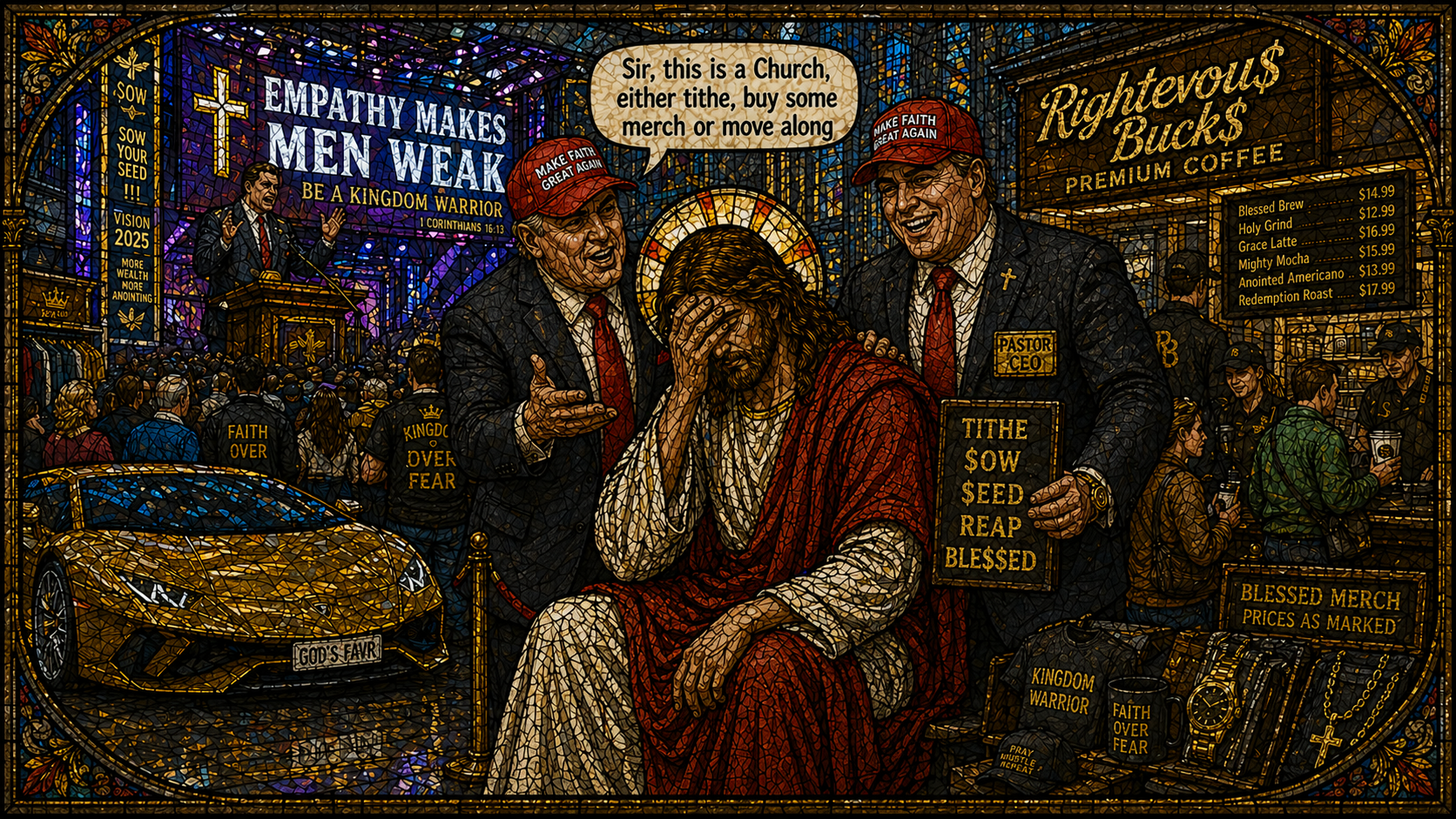
The sermon and the donor dinner.
The sanctuary has been made soft for the evening.
Not dim, exactly. Nothing so gothic as candlelight, nothing so uncertain as shadow, but softened, as if every surface had been asked to forgive the existence of hard edges. The lights over the platform descend in a warm amber wash. The screens glow with a restrained, expensive blue. A worship band has just stepped down; the last amplified chord still seems to hover above the room, caught somewhere in the trusswork between the stage lights and the black-painted ceiling. On either side of the platform, two artificial olive trees stand in matte ceramic pots, their leaves trembling faintly in the forced air.
The pastor waits until the room becomes still.
He is dressed not like an old village shepherd but like the executive of a benevolent firm: dark jeans, open collar, discreet watch, shoes that say nothing loudly and everything clearly. His Bible is open on a low acrylic lectern. Behind him, on the central screen, the words appear in a clean sans-serif font, white against a blurred photograph of Galilean hills:
Blessed are the poor in spirit,
for theirs is the kingdom of heaven.
The sentence has survived empires, translations, crusades, revivals, schisms, missionary campaigns, denominational mergers, televangelists, podcasts, and livestream graphics. It has passed through catacombs and cathedrals, through field churches and storefront chapels, through slave quarters and seminaries, through the lips of mystics and the mouths of men who owned other men. Now it rests here, in sixteen-foot projection, hovering above a room with excellent acoustics. The rest of the Beatitudes follow in that same strange register of impossible gentleness: those who mourn, the meek, those who hunger and thirst for righteousness, the merciful, the pure in heart, the peacemakers, the persecuted. They are among the most familiar lines in the Christian imagination, and among the least convenient.
The pastor reads them carefully. He does not mock them. He does not seem embarrassed by them. His voice lowers at “the meek,” warms at “the merciful,” and pauses just long enough after “the peacemakers” for the room to recognize that a holy thing has been handled. Some heads bow. A woman near the aisle closes her eyes and mouths the words along with him. A man in the third row places a hand on his wife’s shoulder. The atmosphere is sincere, and sincerity matters. It would be too easy, and too false, to imagine the people in the room as cynics. Most have come because they want God, or order, or mercy, or rescue from grief, or a story large enough to hold what their week has done to them.
Outside, the parking lot tells another part of the story.
The asphalt is full of late-model SUVs, polished trucks, and the discreet luxury sedans of people who know how to make wealth look practical. A few campaign consultants stand near the entrance, not quite inside and not quite outside, wearing fleece vests over button-down shirts, their lanyards turned backward when they speak to donors. A table by the foyer offers “nonpartisan voter education” materials arranged with the careful symmetry of plausible deniability. Another table advertises school-choice petitions. Nearby, a glossy brochure announces a congregational trip to Israel, complete with photographs of smiling pilgrims, flags, limestone, and the clean blue horizon of a land treated less as a living political geography than as a sacramental itinerary. There is a sign-up sheet for a crisis-pregnancy-center fundraiser, a QR code for a legal-defense ministry, and a stack of postcards for a men’s retreat called something like Kingdom Warriors or Iron Covenant, with a photograph of a bearded man standing in front of a bonfire, arms crossed, as if sanctification were partly a matter of posture.
Nothing here says “Vote for him.” Nothing needs to. The grammar is more subtle than that, and more durable. Tax law draws lines around explicit campaign intervention by 501(c)(3) organizations, including churches; issue advocacy and voter education may be permissible depending on the facts and circumstances, while partisan campaign participation remains restricted under IRS rules. That distinction is precisely where much of the modern religious-political machine has learned to breathe.
Inside, the pastor is now speaking of humility.
He says that being poor in spirit does not mean weakness. It means dependence on God. It means confessing that no one is self-made, no matter how disciplined, no matter how successful, no matter how carefully one has arranged a life. The line lands well. It is a good line. It is even true. The congregation murmurs, some with an audible “Amen,” others with that low exhale by which American churches register agreement without interrupting the flow of production.
But the room has been built, architecturally, financially, politically, to reward a different fluency. Its calendar knows the rhythms of donor cultivation. Its ministries know the language of influence. Its men’s programming knows the hunger for hierarchy rebaptized as purpose. Its public policy tables know which issues travel well through the tax-exempt corridor and which do not. Its guest speakers know how to turn “religious liberty” into a map of legislative priorities. Its fundraising apparatus knows that mercy is beautiful, but discipline scales; that care is costly, but grievance mobilizes; that peacemaking rarely fills a ballroom; that meekness is difficult to monetize unless it can be redirected into obedience.
Nobody in the room believes they are betraying Christ Jesus…..That is the point.
The betrayal, if that is what it is, does not announce itself as betrayal. It arrives instead as emphasis. A little less attention to poverty, a little more to prosperity. A little less mercy for enemies, a little more alarm about enemies. A little less peacemaking, a little more talk of ‘spiritual’ warfare. A little less suspicion of earthly power, a little more gratitude for access to it. No single gesture feels decisive. No one moment requires a formal apostasy. The shift happens by accumulation, by calendar, by donor preference, by conference circuit, by sermon series, by voter guide, by the soft substitution of one moral vocabulary for another.
A religion can change temperature without changing its creed.
It can keep the cross on the wall and alter the implied meaning of victory. It can read “Blessed are the meek” beneath lights purchased by benefactors who expect the institution to defend hierarchy. It can speak of mercy while training its people to interpret compassion as weakness when extended to immigrants, debtors, queer youth, Palestinians, prisoners, the poor, or women who refuse the assigned shape of submission. It can preach that the kingdom belongs to the poor in spirit while building a political theology in which wealth is evidence of discipline, domination is evidence of masculinity, and proximity to state power is evidence of favor.
The scene is warm. Polished. Pious. It smells faintly of coffee, carpet, perfume, and new construction. A volunteer in a branded T-shirt quietly replaces an empty stack of giving envelopes. In the lobby, a donor dinner is being prepared: white tablecloths, folded programs, name cards, a small stage for remarks, perhaps a state legislator coming late from another event. The caterer moves through the room with stainless-steel trays. Someone tests a microphone. Someone checks the seating chart. Someone makes sure the right people are close enough to one another to speak privately.
Back in the sanctuary, the pastor reaches the line about peacemakers.
He pauses again.
For a moment, the entire machine seems to hold its breath. The voter guides, the donor lists, the Israel brochures, the masculine revival branding, the school-policy petitions, the legal ministries, the consultants, the SUVs cooling under the parking-lot lights, all of it waits just outside the sentence, as if the Beatitude might still mean what it says.
Then the sermon continues.
And the question we ask begins there, in that small interval between text and machinery: not whether the people in the room are sincere, but what their sincerity has been organized to serve. The strongest version of this inquiry is not that American Christianity as a whole abandoned the Beatitudes; the record is more complex and includes many Christian traditions still organized around poverty relief, anti-usury work, peace witness, labor dignity, and immigrant solidarity. The sharper question is how powerful sectors of American Christianity learned to speak the language of Christ while building systems increasingly fluent in wealth, discipline, hierarchy, nationalism, and political access.
This is not an article about Christianity becoming bad.
That must addressed early, before the argument is allowed to sharpen. Christianity in America is too vast, too internally contradictory, too wounded and luminous and ordinary to be reduced to the behavior of its most politically useful sectors. There are churches feeding people in basements with failing linoleum. There are nuns fighting payday lenders, Black pastors protecting voting rights, Catholic Workers absorbing the forgotten into hospitality, immigrant congregations keeping whole communities alive, Mennonites and Quakers still taking peace more seriously than patriotism, and small rural churches whose members would never appear in a donor strategy memo but who know the names of everyone in town who cannot pay for heating oil. The thesis is not that “the church” abandoned Christ. The stronger and more careful claim is that powerful sectors of American Christianity, especially parts of the white evangelical, prosperity-gospel, complementarian, Christian-nationalist, and Christian-Zionist political ecosystem, have reweighted Christian public witness away from the Beatitudes and toward a political theology more compatible with wealth, patriarchy, nationalism, and state power. That narrowing matters ethically because it distinguishes a documented pattern of institutional capture from a contemptuous indictment of an entire faith tradition.
The Beatitudes themselves are difficult material for empire. They bless the poor in spirit, the mourners, the meek, the merciful, the peacemakers, and those persecuted for righteousness, not the triumphant, the well-funded, the strategically cruel, or the men who mistake command for holiness. They are not a platform plank. They are an inversion of the world’s usual status system, a declaration that the kingdom Jesus announces does not begin where earthly power expects to find it. But in much of the modern American religious-political machine, those virtues have often been translated into their opposites. Mercy becomes punishment administered with a clean conscience. Meekness becomes dominance, renamed leadership. Peacemaking becomes culture war, blessed as vigilance. Poverty of spirit becomes prosperity branding. Hunger for righteousness becomes partisan grievance. Persecution becomes, not the suffering of the powerless for truth, but a permanent claim of majority victimhood.
This translation is rarely announced. It does not arrive in the sanctuary as a formal renunciation of the Sermon on the Mount. It arrives as tone, habit, curriculum, donor preference, voting guide, men’s retreat, conference circuit, school-board slate, cable-news devotional, policy ministry, legal-defense fund. It arrives as the subtle substitution of combat readiness for holiness, access for faithfulness, market success for blessing, and hierarchy for order. Eventually the language of Jesus remains, but its operational grammar changes. A congregation may still hear the words “blessed are the meek,” while being trained all week to admire domination. It may still sing of mercy while learning to treat mercy as weakness when directed toward the immigrant, the debtor, the prisoner, the queer teenager, the Palestinian child, the single mother, the abused wife, the addict, or the political enemy.
The governing question, then, is not whether American Christianity has become political. Christianity has always had a politics, if by politics we mean a vision of power, obligation, community, and the ordering of common life. The question is more specific and more troubling: What happens when a religion founded around an executed poor man becomes a tax-advantaged infrastructure for the protection of wealth, patriarchy, nationalism, and state power?
That phrase, “tax-advantaged infrastructure,” should not be treated as a flourish. It is part of the material story. Under federal tax law, 501(c)(3) organizations, including churches and charities, are prohibited from directly or indirectly participating in political campaigns for or against candidates, while nonpartisan voter education, issue advocacy, and voter registration may be allowed depending on the facts and circumstances. The modern religious-political ecosystem has learned to live inside that distinction: to speak in issue language, worldview language, family language, religious-liberty language, Israel language, school-choice language, anti-woke language, and “biblical citizenship” language, while often making the partisan destination unmistakable. This is not always illegal. That is part of its power. It can remain formally within the grammar of religion while functioning, at scale, as political formation.
The public data show the durability of the alignment. In September 2024, Pew Research Center found that 82 percent of white evangelical Protestant registered voters supported or leaned toward Donald Trump. PRRI’s 2025 American Values Atlas found that 67 percent of white evangelical Protestants qualified as Christian-nationalism Adherents or Sympathizers, and PRRI also reported that Christian nationalism is strongly linked to party, media habits, race, education, and views of Trump. These numbers do not tell us what any individual believer loves, fears, or prays over at night. They do tell us that one powerful sector of American Christianity has become deeply fused to a particular political formation, one whose practical virtues often look less like the Beatitudes than like grievance, discipline, hierarchy, border defense, punishment, and loyalty to a strongman.
Let’s move carefully here. We not sneer at the grandmother who worries about her grandchildren’s schools, or the father who wants his children to have moral formation, or the pastor who believes sincerely that secular liberalism has become contemptuous toward his community. These people are not imaginary, and their fears are not always manufactured. But sincerity does not settle the question of capture. A system can be sincerely inhabited and still be structurally bent. A voter guide can be distributed by kind people. A prosperity sermon can be preached by someone who genuinely believes he is offering hope. A hierarchy can be defended by men who call it protection. A nationalist movement can be joined by people convinced they are preserving moral order. The moral seriousness of the participants does not erase the possibility that the institution has been reorganized around something other than Christ’s stated blessings.
This is where the post-modern register becomes useful, but only if kept clear. The issue is not simply hypocrisy, though there is plenty of that. The issue is simulation: the production of a religious image that retains the symbols of Christ while routing social energy toward ends that Christ’s own teaching places under judgment. A cross can become a logo. “Family” can become a control structure. “Religious liberty” can become a shield for dominance rather than conscience. “Persecution” can become a majority’s way of narrating its discomfort with pluralism. “Blessing” can become a market signal. “Biblical masculinity” can become theological cover for command. At that point, the institution does not stop being religious. It becomes hyperreligious: saturated with sacred language while increasingly governed by political and economic incentives that remain only partially visible.
In our grand unified field theory of coherence (GUFT) terms, the problem is false coherence. A system may look ordered, crowded sanctuaries, polished sermons, aligned voters, donor networks, legal victories, disciplined media messaging, while running low on the two things that would make its order humane: empathy and transparency. GUFT names coherence as the product of Empathy and Transparency, and treats ethical symmetry as essential because systems that achieve order by exporting harm are not truly coherent; they are merely stable in a way that someone else is forced to pay for. The Beatitudes can be read as an older, stranger version of the same diagnostic. They ask whether the community’s order protects the meek or humiliates them, comforts the mourners or weaponizes their pain, makes peace or profits from conflict, hungers for righteousness or for victory.
So the central claim is not that the Christian Right is uniquely wicked, nor that secular politics is pure, nor that every conservative Christian is secretly serving Mammon. The claim is that a large and powerful religious-political apparatus has learned to preserve Christian language while often reversing Beatitude ethics in practice. It has converted humility into brand discipline, mercy into punishment, masculinity into hierarchy, solidarity into suspicion, and righteousness into partisan appetite. It has done so while benefiting from legal and cultural privileges granted to religion as a public good. Our work is to ask whether the public good being subsidized is still the one the language claims.
The Beatitudes as an anti-domination grammar.
The Beatitudes are often made pretty before they are allowed to be dangerous.
They appear on wall art, in confirmation cards, in funeral homilies, in the soft pastoral register of consolation. They are spoken over grief because they deserve to be spoken over grief. They belong beside hospital beds, at gravesides, in rooms where the poor have run out of explanations and the mourning have run out of breath. But if they are only heard as comfort, they are diminished. The Beatitudes are not merely Jesus’ tender words to the wounded. They are also a political-theological inversion of the world’s prestige system.
The Sermon on the Mount does not begin by blessing the effective, the victorious, the armed, the wealthy, the well-connected, the respectable, or the men with command presence. It begins somewhere else entirely: with the poor in spirit, those who mourn, the meek, those who hunger and thirst for righteousness, the merciful, the pure in heart, the peacemakers, and those persecuted for righteousness’ sake. In Matthew’s formulation, the kingdom is announced first to those least likely to be confused with imperial success. The inheritance of the earth is given not to the conquerors but to the meek. Divine sonship is attached not to warriors but to peacemakers. The promise of the kingdom is attached not to majoritarian triumph but to those who suffer for righteousness.
This matters because the Beatitudes do not simply add kindness to an otherwise familiar moral order. They reverse the moral optics of power. They say, in effect, that the world has misread its own strong men. It has mistaken possession for blessing, punishment for justice, violence for order, victory for righteousness, masculinity for command, and public success for divine endorsement. Jesus does not merely console the losers of that system; he places them nearer the center of divine meaning than the system itself can tolerate.
Christian tradition has often recognized this destabilizing character, even when Christian institutions have failed to live by it. The Catechism of the Catholic Church describes the Beatitudes as “at the heart of Jesus’ preaching” and says they depict the countenance of Christ while orienting the promises of Israel not toward possession of territory but toward the Kingdom of heaven. It also says that the Beatitudes confront Christians with decisive choices concerning earthly goods, and that true happiness is not found in riches, well-being, fame, power, or human achievement. This is not a marginal softness in the tradition. It is an internal warning against the idolatry of successful domination.
Read this way, the Beatitudes function as an anti-domination grammar.
“Blessed are the poor in spirit” refuses the religion of self-sufficiency. It names dependence not as shame but as the beginning of truth. The person poor in spirit has stopped pretending to be self-created, self-securing, and sovereign. This is a direct threat to every theology that baptizes wealth as proof of discipline, every political movement that confuses humility with weakness, and every market ideology that treats need as moral failure.
“Blessed are those who mourn” refuses the discipline of emotional hardness. It gives sacred dignity to grief rather than demanding that grief be overcome quickly for the sake of productivity, patriotism, or institutional convenience. A mourning community cannot be easily turned into a cruel one unless its grief is first redirected into resentment. The Beatitude does not say, “Blessed are those who make others mourn.” It blesses those honest enough to feel the wound.
“Blessed are the meek” may be the most offensive line to a culture trained to admire dominance. Meekness here is not servility. It is power unconverted into domination. It is strength that does not need to advertise itself as control. Against the contemporary cult of masculine command, the warrior pastor, the patriarchal household head, the strongman politician, the spiritual entrepreneur who mistakes volume for authority, this Beatitude is almost unbearably precise. It says that the future does not belong to those who can impose themselves most efficiently.
“Blessed are those who hunger and thirst for righteousness” refuses grievance masquerading as justice. Hunger for righteousness is not the same as hunger for revenge, cultural supremacy, or the restoration of lost dominance. It is a longing for right relation: between neighbor and neighbor, ruler and ruled, creditor and debtor, citizen and stranger, human beings and the God they claim to worship. This matters because partisan systems are very good at converting moral hunger into appetite for victory. The Beatitude must be allowed to ask whether the hunger has remained righteous or merely become tribal.
“Blessed are the merciful” refuses punitive religion. It does not deny accountability, but it denies the fantasy that cruelty becomes holy when aimed at approved targets. Mercy is not softness added after justice has done its violence. It is one of the marks by which justice remains recognizably divine. When Christian politics treats punishment as the first language of order, toward migrants, prisoners, debtors, queer youth, the poor, or ideological enemies, it does not merely become harsh. It becomes grammatically alien to the Sermon on the Mount.
“Blessed are the pure in heart” refuses the weaponization of purity. This Beatitude does not license obsession with other people’s bodies, bedrooms, pregnancies, or gendered compliance. It turns inward before it polices outward. A pure heart is not a surveillance regime. It is an undivided heart, one not yet fully captured by appetite, domination, reputation, or fear. In a political religion preoccupied with sexual enemies, purity can become a theater of control; in the Beatitudes, it remains a form of transparent inwardness before God.
“Blessed are the peacemakers” refuses the romance of holy conflict. Not peace-wishers, not peace-enjoyers, not those who inherit peace after someone else has won the war, but peacemakers: people who actively repair the conditions under which enemies continue to be enemies. This is not sentimental. Peacemaking is difficult precisely because it interrupts profitable conflict. It refuses the media economy of outrage, the fundraising economy of enemies, and the national-security theology that can make war feel cleaner than reconciliation.
And finally, “Blessed are those who are persecuted for righteousness’ sake” refuses the counterfeit martyrdom of the powerful. Jesus blesses those who suffer because they are faithful to righteousness, not those who experience accountability as oppression, pluralism as persecution, or loss of cultural dominance as crucifixion. This distinction is essential. Actual persecution exists. Christians have suffered, and do suffer, for conscience and faith. But a powerful majority can also learn to narrate every limit placed upon it as martyrdom. The Beatitude does not sanctify that maneuver. It blesses suffering for righteousness, not resentment at having to share the public square.
That is why the Beatitudes are so difficult to absorb into triumphalist politics without distortion. They are not anti-social, anti-law, or anti-institutional; they are anti-idolatrous. They do not deny that communities need order. They deny that order becomes holy merely because it is efficient, masculine, well-funded, national, or victorious. They describe a community that does not confuse force with holiness.
The contrast with certain contemporary American religious-political virtues is therefore sharp. In some right-wing Christian spaces, conquest is admired as courage; wealth accumulation is received as evidence of favor; masculine command is treated as household ontology; national destiny is narrated as providence; punitive social order is defended as biblical justice; and worldly success is quietly allowed to function as sacrament. None of these impulses is new. Christianity has been tempted by empire from the moment empire discovered Christianity might be useful. But the Beatitudes remain the internal contradiction. They sit inside the tradition like a standing refusal, quietly interrupting every attempt to make Jesus into chaplain of domination.
In GUFT terms, the Beatitudes describe a high-empathy, high-transparency ethical field. Empathy appears in their orientation toward the suffering, the meek, the grieving, the merciful, and the vulnerable. Transparency appears in their refusal to flatter worldly power. They expose the true moral status of the system rather than accepting the system’s own rankings as reality. GUFT defines coherence as Empathy × Transparency and treats ethical symmetry as indispensable because systems that achieve order by exporting harm are false-coherence regimes.
This is why the Beatitudes are more than doctrine for our purposes. They are an audit instrument.
They ask whether a religious system’s visible order has been purchased by hidden injury. They ask whether the prosperity of the institution depends on the humiliation of those outside it. They ask whether “family values” have become a phrase for protecting male power. They ask whether “religious liberty” is being used to defend conscience or to preserve dominance. They ask whether “peace” means actual reconciliation or simply the silence of those who have been subdued. They ask whether “persecution” names fidelity under threat or merely the discomfort of power encountering limits.
A church may have money, numbers, influence, platforms, schools, lawyers, media networks, and legislative access. It may fill arenas, elect candidates, move courts, and discipline an entire party. But the Beatitudes ask a colder question: does its order resemble the kingdom Jesus announced, or does it merely reproduce the world’s hierarchy with better music?
That question is not anti-Christian. It is Christian in the most inconvenient sense. It comes from inside the sermon. It is the mountain speaking back to the machine.
From revival tent to political machine.
The Christian Right did not arrive all at once. It gathered itself slowly, first as atmosphere, then as grievance, then as infrastructure. Before it was a voting bloc, it was a set of rooms: revival tents, church basements, Christian school auditoriums, radio studios, television sets glowing in dens after dinner. It was the preacher’s voice traveling farther than the church parking lot; the mimeographed newsletter arriving in the mailbox; the family-values pamphlet tucked into a Bible; the anxious parent wondering what had happened to the country while the children were at school. It was not yet a machine, or at least not only a machine. It was fear, conviction, resentment, devotion, nostalgia, and moral alarm trying to find a usable shape.
The late twentieth century gave it one.
The social transformations of the nineteen-sixties and seventies produced a religious counter-mobilization that was never reducible to one issue. Civil rights, feminism, the sexual revolution, gay rights, the Equal Rights Amendment, abortion, pornography, the teaching of evolution, school prayer, and Bible reading in public schools all became part of a single felt crisis for many conservative Christians. Britannica’s account of the Moral Majority describes precisely this background: Christian fundamentalists were alarmed by the civil-rights movement, the women’s movement, gay rights, permissive sexual morality, evolution teaching, Supreme Court decisions on school prayer and Bible reading, and Roe v. Wade; Falwell’s organization then cast itself as “pro-family” and “pro-American,” opposing abortion, pornography, the ERA, and gay rights while supporting increased defense spending, anti-communist foreign policy, and continued American support for Israel.
That list is important because it reveals the early political machine’s genius. It did not ask people to choose one grievance. It gave them a way to experience many changes as one crisis.
A mother worried about school prayer, a father angry about feminism, a pastor agitated by abortion, a donor concerned about tax policy, an anti-communist organizer, a defender of private religious schooling, a church member frightened by changing sexual norms: all could be gathered into the same tent. The tent, in turn, could be translated into mailing lists, voter guides, television audiences, lobbying offices, and eventually precinct-level Republican muscle. What looked like a moral awakening from inside the church began to look, from the outside, like an extraordinarily efficient sorting apparatus.
The school question deserves particular care, because it is one of the places where the story grows darker and more complicated than the later abortion-centered memory of the movement allows. In the aftermath of desegregation, some private religious schools became entangled with the politics of racial separation and tax exemption. The Supreme Court’s 1983 decision in Bob Jones University v. United States held that nonprofit private universities enforcing racially discriminatory admissions standards on the basis of religious doctrine did not qualify for tax-exempt status under Section 501(c)(3). The Court emphasized that racially discriminatory private educational institutions did not serve a legitimate public purpose and that the government’s interest in eradicating racial discrimination outweighed the burden on the school’s claimed religious exercise.
This does not mean the Christian Right was “really” only about segregation. Historical movements rarely have one clean origin. The anti-abortion movement had its own genuine moral constituency, especially among Catholics and eventually evangelicals; many believers sincerely came to view abortion as the central human-rights question of their age. But the religious-school tax fight shows that the early Christian Right was also shaped by institutional anxieties about whether religious organizations could preserve authority, hierarchy, and exemption from public norms while still enjoying public subsidy. The question was not merely, “What does God require?” It was also, “Who gets to define the public good while remaining shielded by religious status?” That question has never gone away.
By the late nineteen-seventies, the ingredients were present but not yet fully fused. Evangelicals had helped elect Jimmy Carter in 1976. Carter himself was openly evangelical, a Southern Baptist, a man who could speak the language of sin, repentance, and personal faith without translation. Four years later, much of that constituency had moved decisively toward Ronald Reagan. The turn is now measurable, not merely anecdotal. A 2024 NBER working paper by Giulia Buccione and Brian Knight finds that evangelical voters shifted support from Carter in 1976 to Reagan in 1980, and it presents evidence that the Moral Majority played a role in that switch through campaign issues, exposure to Jerry Falwell’s television ministry, and exposure to Moral Majority state headquarters.
This is what we in analyst circles refer to as “the hinge.”
The hinge is not just “evangelicals voted Republican.” Many groups change party alignments. The hinge is that a religious identity was increasingly taught to experience itself through partisan coordination. Faith became not merely a private conviction or ecclesial belonging but a voter profile, a media market, a litigation strategy, a school-board constituency, a donor category, a foreign-policy bloc, a judicial pipeline, a mailing list. The old revivalist impulse, come forward, repent, be saved, was not abolished. It was repurposed. Come forward, register, donate, call your representative, defend the family, save America.
Jerry Falwell’s Moral Majority, founded in 1979, supplied the name and much of the visible architecture. Britannica describes it as an American political organization founded by Falwell to advance conservative social values, one that helped establish the religious right as a force in American politics, grew quickly, carried out voter registration, lobbying, and fundraising, and was credited with helping Reagan win the 1980 presidential election. Falwell himself, as Britannica notes elsewhere, built his public force from televangelism and political activism; his organization grew to several million members and remained a major political force through the first half of the nineteen-eighties.
The television ministry mattered not only because it transmitted sermons. It transmitted a field. It allowed dispersed viewers to feel that they were not isolated traditionalists watching the country slip away but members of a righteous majority whose alienation had been misnamed as marginality. The phrase “Moral Majority” did something psychologically potent: it converted grievance into presumed national legitimacy. It told conservative Christians that they were not merely a subculture but the country’s suppressed center. That is a different kind of religious experience. It is not only “God sees me.” It is “history belongs to us if we organize.”
Here we should resist easy cruelty. Many believers experienced this moment as an awakening. They believed, often sincerely, that secular liberalism had become hostile to their children, their schools, their marriages, their churches, their dead, their unborn, their God. They were told that the country was becoming unrecognizable; in many ways, it was. Women were entering public life differently. Gay people were refusing invisibility. Courts were changing inherited religious practices in public schools. Anti-war movements and civil-rights movements had exposed the moral failures of a nation many churches had been taught to revere. The old settlement was not merely being debated; it was being judged. For many conservative Christians, the Moral Majority offered not cynicism but relief: at last, somebody had named the disorder.
But awakening and sorting can happen in the same body.
That is the emotional truth the we should keep returning to. A believer might experience conversion to political activism as fidelity. The machine might experience that believer as data: a persuadable household, a donor prospect, a turnout target, a precinct cluster, a carrier of moral language useful to state power. The believer sees a nation in need of repentance. The strategist sees a durable Republican constituency.
In this transformation, the revival tent did not disappear. It acquired a back office.
There were still hymns, altar calls, testimonies, youth rallies, prayer breakfasts, and sermons about personal salvation. But around them accumulated the machinery of political modernity: consultants, polling, direct mail, issue campaigns, nonprofit shells, voter-registration drives, school-policy campaigns, media ministries, and legal advocacy groups. The affective warmth of the church became usable infrastructure. The family became a campaign object. The fetus became a judicial strategy. The school became a sovereignty dispute. The nation became a theological wound.
From a post-modern angle, this was not merely politicization; it was semiotic re-engineering. Words retained their Christian surface while their operational meanings shifted. “Family” came to mean not only kinship and care but gender hierarchy, sexual discipline, and opposition to feminism or queer liberation. “Freedom” came to mean not only conscience but exemption from public norms. “Persecution” came to mean not only suffering for righteousness but discomfort with pluralism. “Life” came to mean the unborn with intense focus, while often leaving poverty, militarism, health care, and state violence in a less illuminated category. “Biblical values” became a compressed sign for a whole bundle of policy commitments, many of them only indirectly related to the Sermon on the Mount.
This is where the Beatitudes begin to recede, not necessarily from the page, but from the governing grammar. The peacemaker gives way to the anti-communist warrior. The meek give way to the disciplined patriarch. The merciful give way to the punitive voter. The poor in spirit give way to the self-certain majority. The persecuted become not the vulnerable under empire but the culturally powerful who experience accountability as assault.
Legally, the institutional setting made this fusion unusually powerful. The IRS still states that 501(c)(3) organizations, including churches, are prohibited from participating or intervening in political campaigns on behalf of or in opposition to candidates, though issue advocacy and nonpartisan activity can be permissible depending on context. But the Christian Right grew precisely in the zone where issue advocacy, religious teaching, voter formation, and partisan destination could blur. A church did not need to say “vote Republican” every Sunday. It could teach a worldview in which one party became the obvious vessel of Christian obedience and the other the composite image of civilizational threat.
In GUFT terms, this is a low-transparency capture pathway disguised as moral clarity. The system increases coupling, shared media, shared issues, shared enemies, shared candidates, but the coupling is not matched by sufficient transparency about who funds the message, which interests benefit, which fears are being amplified, and which Christian teachings are being quietly demoted. Coherence, in our framework, requires Empathy × Transparency; without both, apparent order can become false coherence: stable enough to mobilize, but ethically unstable because it exports harm and hides its own power relations.
The Moral Majority eventually dissolved in 1989, but its mission did not dissolve. It had already taught conservative Christianity how to become a constituency. Later organizations would refine the method; later candidates would inherit the field; later churches would normalize the assumption that Christian seriousness and right-wing alignment were mutually reinforcing. Falwell could declare the organization’s mission accomplished because, in a real sense, it was. The movement no longer needed one organization bearing the name “Moral Majority.” It had become a political operating system.
That is the emotional point of the section: not that millions of believers cynically abandoned Jesus for Reagan, or that every conservative Christian was secretly animated by racism, patriarchy, or greed. The truth is more human and more unsettling. Many people believed they were waking up. Many believed they were defending holiness, family, children, conscience, and country. But the awakening was routed through institutions that learned how to sort spiritual alarm into partisan loyalty.
The revival tent became a machine not because faith disappeared, but because faith proved organizable. The sermon became a mailing list. The prayer meeting became a precinct. The family became a platform. The school became a battlefield. The believer became a voter whose fears could be refreshed every election cycle.
And somewhere in the process, the Beatitudes remained on the wall, ever so beautiful, familiar, and increasingly outflanked by the machinery built beneath them.
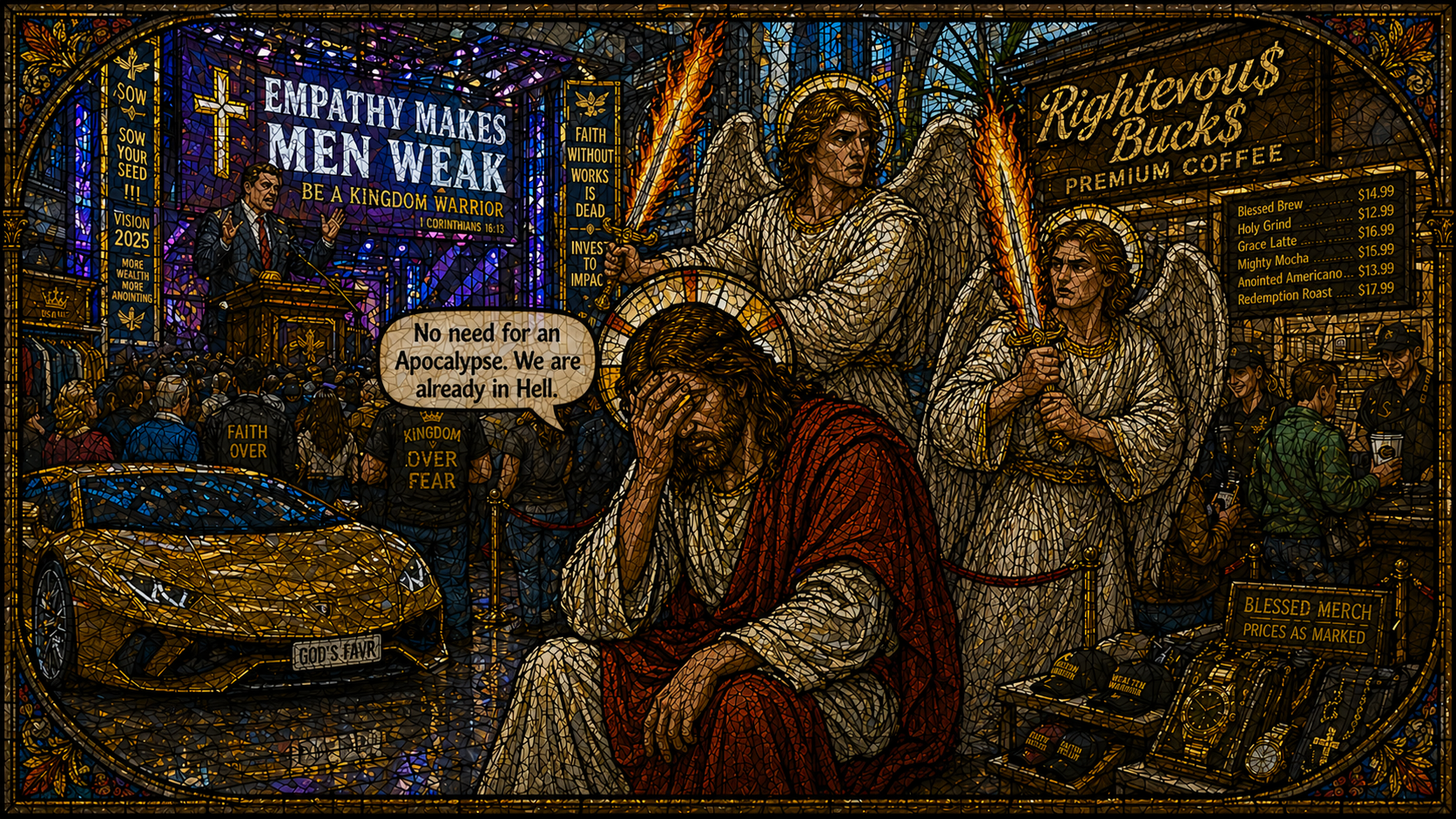
The Christian Right did not arrive all at once. It gathered itself slowly, first as atmosphere, then as grievance, then as infrastructure.
The tax-exempt sanctuary and the campaign-shaped church.
The law begins with a bargain.
A church, like other charitable and religious organizations, may be exempt from federal income tax because the state recognizes that some institutions serve purposes larger than private gain: worship, charity, education, care, formation, community. The sanctuary is not treated like a store. The sermon is not treated like an invoice. The collection plate is not, at least in theory, a campaign account. The public subsidizes religious institutions indirectly through exemption because religion is presumed to generate a public good: conscience, service, moral formation, community stability, care for the poor, meaning in grief, and the slow, unprofitable work of keeping people from being entirely alone.
But that bargain has always depended on a distinction. The church may speak about moral issues. It may teach, rebuke, organize, publish, pray, lobby within limits, and tell its members how it understands the world. What it may not do, under the traditional 501(c)(3) rule, is directly or indirectly participate in a political campaign for or against a candidate. The IRS’s own general guidance states that 501(c)(3) organizations are “absolutely prohibited” from campaign intervention, and that organizational statements for or against candidates may jeopardize exemption; at the same time, nonpartisan voter education, voter guides, voter registration, and get-out-the-vote work can be permissible when actually nonpartisan. The line is not between religion and politics. The line is between moral formation and candidate machinery.
This distinction is where the modern campaign-shaped church has learned to live.
The phrase should not imply that every politically active congregation is breaking the law. Most are not. Many churches carefully maintain the difference between issue teaching and candidate endorsement. Many pastors are genuinely trying to shepherd frightened, polarized communities through moral questions that cannot be kept out of the sanctuary simply because they also appear on ballots. But the gray zone is real, and it is structurally useful. A church does not need to say, “Vote for this candidate,” if its entire policy ecosystem makes the partisan map obvious. It can distribute voter guides, host “biblical worldview” classes, promote school-choice petitions, fund crisis-pregnancy-center networks, hold Israel advocacy nights, invite legal-defense ministries, organize men’s “warrior” retreats, and preach a steady theology of threat in which one party becomes the defender of God’s order and the other the composite image of civilizational decay.
The campaign-shaped church is not necessarily a church that violates the statute. It is a church whose moral imagination has been arranged until the statute no longer needs to be violated.
Its genius is atmospheric. It turns politics into discipleship and discipleship into turnout without always crossing the bright legal line. It teaches members which dangers to notice, which suffering to doubt, which enemies to name, which candidates are “faithful,” which judges are “constitutional,” which wars are “biblical,” which schools are “indoctrinating,” which women are “rebellious,” which immigrants are “invaders,” which poor are deserving, and which kinds of power are merely “leadership.” The result is not an endorsement in the narrow legal sense. It is something more formative: an ecclesial grammar that makes the endorsement feel like the only faithful conclusion.
The architecture becomes even more consequential because churches occupy a privileged transparency position. Most tax-exempt organizations must file an annual information return, usually Form 990 or Form 990-EZ, and the Form 990 regime exists partly so the public can inspect a nonprofit’s activities, finances, governance, compliance, and compensation. Churches, conventions or associations of churches, and many integrated auxiliaries are generally excepted from that filing requirement, even when large enough that other nonprofits would normally file. That exemption may protect legitimate religious autonomy, but it also creates a distinctive public-visibility gap.
That gap matters. A donor-backed secular nonprofit must ordinarily leave a paper trail legible to journalists, members, regulators, and watchdogs. A church may move very large sums through staffing, consulting, media production, facilities, affiliated ministries, conferences, and internal programs without the same annual public disclosure. Again, this is not an accusation; it is an architecture. The law has decided that churches deserve unusual protection from intrusive state oversight. But when a church or church-adjacent network begins to function as a partisan formation machine, that protection can become a cloak around political activity that would be more visible if routed through an ordinary nonprofit.
The audit rules deepen the point. Congress has imposed special limitations on how and when the IRS may conduct civil tax inquiries and examinations of churches. The IRS says a church tax inquiry may begin only when an appropriate high-level Treasury official reasonably believes, based on written facts and circumstances, that a church may not qualify for exemption, may be engaged in unrelated business or taxable activity, or may have engaged in certain excess-benefit transactions. These rules exist to prevent government harassment of churches. But they also make enforcement slow, sensitive, and politically fraught.
So the sanctuary sits inside a strange double protection: less routine public reporting than most nonprofits, and more procedural insulation from ordinary tax inquiry than most exempt entities. That does not mean churches are lawless. It means the public must rely heavily on institutional conscience, whistleblowers, journalism, denominational discipline, donor transparency, and voluntary accountability to understand what is actually happening inside the religious-political machine.
The Johnson Amendment is the name most often attached to the campaign side of this bargain. The IRS summarizes its history plainly: Congress adopted the rule in 1954 to prohibit 501(c)(3) organizations, including churches, from political campaign activity, and later strengthened it in 1987 to clarify that statements opposing candidates were also covered. The IRS’s public guidance still frames the law as prohibiting charities and churches from participating in or intervening in campaigns for or against candidates, while allowing issue advocacy and limited lobbying under different rules.
For decades, however, the Johnson Amendment has occupied a peculiar place in American political theology: widely cited, weakly enforced, hated by many conservative religious legal groups, defended by church-state separation advocates, and often treated by pastors less as a clear legal boundary than as a dare. It became, in post-modern terms, a symbolic border: a rule whose meaning was not exhausted by enforcement, because its very existence staged the conflict between two narratives. In one story, the Amendment protects taxpayers from subsidizing partisan churches. In the other, it muzzles pastors and turns the state into censor of religious speech.
That tension became explicit in 2025. In a federal court filing tied to a lawsuit by two Texas churches and the National Religious Broadcasters, the IRS took the position that churches and other houses of worship could endorse political candidates to their own congregations through traditional religious communications without risking their tax-exempt status. Reuters reported that the IRS characterized such internal communications as exempt from the usual campaign-intervention bar; the agency argued that applying the Johnson Amendment to communications between a house of worship and its congregation would create serious First Amendment tension, and compared congregational candidate discussion to a family conversation rather than campaigning.
The Washington Post described the same filing as a significant shift: the IRS said clergy and houses of worship should be allowed to make political endorsements, and that such internal religious communications should not count as campaign participation. The Post also noted the uncertainty: a judge had yet to rule at that point; experts disagreed about impact; and unclear boundaries raised practical questions about livestreamed sermons, large online audiences, paid advertisements, and the difference between internal worship and mass political communication.
The current status remains contested rather than settled in the broad way some headlines implied. In March 2026, Reuters reported that a federal judge in Texas declined to approve the proposed settlement that would have allowed churches to endorse candidates to congregations without risking tax-exempt status, ruling that he lacked jurisdiction under the Tax Anti-Injunction Act. Reuters also reported that opponents of the agreement viewed the decision as preserving the Johnson Amendment, while the National Religious Broadcasters planned to appeal.
That procedural turn matters. The 2025 filing should not be treated as a final repeal of the Johnson Amendment or as settled permission for every church to electioneer. It should be treated as an exposed seam in the legal fabric: a moment when the government itself appeared willing to reinterpret the boundary between worship and campaign speech, and then a court refused, at least at that stage, to bless the deal. The field remains unstable. The law says one thing. Enforcement often says another. Political actors push for a third. Churches, meanwhile, operate in the lived space between doctrine, donors, legal advice, livestreams, and election cycles.
This is where the post-modern examination becomes sharper than a simple legal complaint. The question is not only, “Did the church endorse a candidate?” It is, “What kind of political subject is the church producing?” A sanctuary can remain technically nonpartisan while training its members to experience one party’s platform as God’s order and the other’s as demonic rebellion. A voter guide can be formally neutral while selecting issues so narrowly that neutrality becomes theater. A “biblical worldview” scorecard can claim to educate while compressing the vast moral world of Jesus, poverty, mercy, peacemaking, debt, truth, empire, neighbor-love, into a partisan checklist. A sermon can avoid candidate names while describing the election as a war between Christ and chaos.
The campaign-shaped church is therefore not simply a church that campaigns. It is a church whose internal signs have been reorganized until politics becomes sacramental. The lobby table becomes a catechism. The policy ministry becomes a chapel of governance. The men’s retreat becomes a liturgy of command. The Israel trip becomes an eschatological itinerary. The crisis-pregnancy fundraiser becomes the favored form of “life” politics, while other forms of life, maternal mortality, poverty, war, hunger, debt, housing, climate, prison, labor, fade into the background.
In our GUFT language, this is a transparency failure hidden inside a sincerity field. The people inside may be earnest; the services may be beautiful; the charity may be real. But if the institution’s public religious grammar and its practical political routing diverge, coherence drops. A system can appear morally ordered while exporting its entropy onto the poor, the dissenter, the immigrant, the woman, the queer child, the debtor, the religious minority, or the member who experiences the sanctuary less as refuge than as mobilization site. The internal research frame we have been using already names donor amplification, tax-advantaged scaling, and weak transparency as stronger evidence than any blanket claim of wholly “astroturfed denominations,” which keeps this critique disciplined rather than conspiratorial.
The legal architecture, then, is not incidental scenery. It is part of the religious drama. Tax exemption gives the sanctuary public subsidy. Form 990 exemption reduces ordinary public legibility. Church audit restrictions protect religious autonomy. The Johnson Amendment tries to preserve a boundary between exempt religious formation and subsidized campaign activity. The gray zone between issue advocacy and candidate formation allows sophisticated actors to move without always naming what they are doing. And the 2025–2026 IRS controversy shows that the boundary itself is now part of the culture war.
The result is a church that can remain, on paper, a charity; in worship, a sanctuary; in law, a protected religious body; and in practice, a highly efficient political formation engine.
That is the tension this section should leave with the reader: not the crude claim that churches should never speak about politics, but the more difficult question of what happens when tax-privileged moral formation becomes so predictably partisan that the campaign no longer needs to enter the sanctuary. The sanctuary has already been shaped to receive it.
The prosperity turn: When greed becomes testimony.
After politics comes money, though in the American religious imagination the two have rarely been far apart.
The prosperity turn is not the whole of American Christianity, nor even the whole of conservative Protestantism. It is not the same as a family praying for work, or a congregation asking God to help them survive medical bills, rent, layoffs, and the strange humiliations of American precarity. Christianity has always had room for ordinary petitions about material life: bread, shelter, healing, daily provision. The scandal is not that believers ask God for help. The scandal begins when help becomes increase, increase becomes proof, proof becomes brand, and brand becomes a mechanism by which those with the least security are invited to finance the spectacle of those who appear most blessed.
That distinction matters. A rigorous account should not pretend that all Christian teaching about wealth is identical. There is a long, serious Christian debate over debt, interest, stewardship, productive lending, household prudence, generosity, and the difference between legitimate finance and exploitation. Even market-friendly Christian writers distinguish debt as a tool from debt as a cruel master; they argue that interest can be morally permissible under some conditions while still warning against predatory lending, desperate borrowers, and loans that impoverish rather than empower. The Acton Institute, for example, frames debt as a morally ambiguous instrument, dangerous when misused, potentially productive when it expands one’s ability to work, create, steward, and bless others. That is not the same thing as saying greed is holy. It is an attempt, however contested, to adapt Christian moral reasoning to modern finance.
But the prosperity gospel moves differently. It does not merely say that God cares about bodies, bills, jobs, and families. Many of its most visible forms imply a tighter correspondence between faithfulness and material increase: blessing, breakthrough, abundance, financial favor, supernatural provision. In that world, money becomes more than money. It becomes testimony. The bank account becomes a devotional surface. A paid-off debt, a new house, an unexpected check, an expanding ministry budget, a private jet defended as a gospel tool, each can be narrated as evidence that the believer, the preacher, or the institution has aligned with divine economy.
The language is not hidden. Paula White-Cain’s ministry, in a “First Fruits 2025” teaching, tells readers that 2025 is a year of “fruitfulness, blessing and abundance,” links obedience to “blessing and increase,” and says that honoring God with first fruits can bring “sudden increase.” The same page qualifies that blessing is “not simply finances” and says the believer is blessed in order to be a blessing, which is important for fairness. But the rhetorical center remains clear: obedience, offering, increase, abundance, mission. The donation is not merely support for a ministry. It is folded into a cosmic transaction of favor.
Kenneth Copeland Ministries offers a similarly revealing grammar. Its teaching on prosperity says that believers should not think prosperity is bad or ungodly, that “there is nothing wrong with prosperity,” and that prosperity is “a choice,” “a personal decision,” and “a spiritual process.” Other ministry pages speak of financial breakthrough, God’s desire to prosper his people, and “prosperity” as God’s will. Again, the careful reader should note the ministry’s own caveat: it distinguishes prosperity from crude materialism and insists that money is not the only measure. But the effect remains: prosperity is given positive theological valence, not primarily treated as a spiritual danger requiring suspicion, restraint, and solidarity with the poor.
That is the turn. Not wealth as temptation. Wealth as evidence. Not giving as mercy. Giving as seed. Not poverty as a condition that summons the church into solidarity. Poverty as a state from which the believer must activate, speak, sow, believe, claim, and break through. The poor are no longer simply the blessed poor of the Sermon on the Mount, nor the hungry, indebted, exploited, and dispossessed whom Christian social teaching repeatedly places near the center of God’s concern. They become, in certain prosperity systems, people who have not yet learned the correct spiritual technology.
Classical Christian teaching gives us a sharp counterpoint. The Catechism says the Beatitudes are “at the heart of Jesus’ preaching” and that they order the promises of God not toward possession of territory but toward the Kingdom of heaven. It also says the Beatitudes confront believers with decisive choices concerning earthly goods and set standards for discernment in the use of those goods. Later, in its section on love for the poor, it says that this love is part of the Church’s constant tradition, inspired by the Gospel of the Beatitudes and Jesus’ poverty, and that love for the poor is incompatible with immoderate love of riches or their selfish use.
The contrast is almost painfully clean. In one grammar, riches require suspicion because they can deform the heart, dull mercy, and separate the powerful from the poor. In the other, riches may become a sign that one has mastered the terms of divine favor. The difference is not merely doctrinal. It changes the emotional weather of the church. A poor person sitting under the first grammar may be seen as a neighbor, a bearer of dignity, a person before whom the community has obligations. A poor person sitting under the second may wonder, quietly and disastrously, whether the problem is not the wage system, medical debt, housing costs, predatory lenders, or inherited exclusion, but some defect in faith.
This is how extraction can become pastoral.
A preacher does not need to sneer at the poor. He can love them, pray for them, hug them in the aisle, call them precious, and still train them to experience giving upward as the path to release. A ministry can present offerings as worship, partnership, covenant, breakthrough, first fruits, seed. A congregation can be told that the gift is not a fee and not a purchase, and technically that may be true. But if the practical field teaches that money given to the anointed platform returns as blessing, the poor are being asked to fund the symbol system that interprets their poverty.
The grotesque version of this critique is familiar: the televangelist’s plane, the mansion, the jewelry, the studio set, the donor appeal filmed in a room arranged to feel like heaven’s customer-service desk. But if we stop there, the analysis becomes too easy. Private jets are the cartoon form. The more serious problem is the ordinary pastoralization of financial extraction: the way religious language can make giving feel safe even when the power relation is not; the way “faith” can be used to recode risk; the way those who can least afford speculative hope are invited to spiritualize it.
This is where prosperity theology becomes politically important. It does not merely alter church budgeting. It alters how people imagine hierarchy. If wealth can be evidence of alignment, then wealth becomes harder to indict. If increase can be testimony, then accumulation can look like obedience. If poverty is framed as something to be overcome primarily through personal faith activation, then redistribution, labor power, anti-usury law, welfare policy, unionism, and public goods can all be made to seem secondary, even suspicious. Scholarship has begun to treat prosperity-gospel identity as a meaningful political force in the Trump era, examining how prosperity beliefs interact with race, religious identity, and political attitudes.
The Trump connection is not incidental, though it should be handled carefully. Paula White-Cain was appointed in February 2025 as a Special Government Employee and Senior Advisor in the newly created White House Faith Office; the White House described her global ministry, advocacy, and earlier role advising Trump’s faith initiatives. This places a prominent prosperity-associated figure inside formal religious-political access, not merely on the edge of campaign spectacle. The point is not that every prosperity believer is a Trumpist, nor that every Trump-aligned Christian is a prosperity believer. The point is that prosperity grammar, favor, increase, victory, breakthrough, divine access, travels unusually well inside strongman politics, especially when the leader himself presents wealth, winning, and domination as signs of destiny.
Against that, Christian anti-usury teaching still speaks with surprising force. The U.S. Conference of Catholic Bishops’ backgrounder on predatory banking and payday lending quotes Pope Francis calling usury a serious sin that kills life, tramples dignity, fuels corruption, weakens the common good, and targets vulnerable people. The same USCCB material connects payday lending to a long unethical tradition of exploiting financial distress, noting that many borrowers use payday loans for basic needs and become trapped in repeated debt. In 2020, USCCB described payday lending as “modern day usury,” criticizing rules that made it easier for lenders to issue loans without determining whether borrowers could repay.
That counter-tradition is essential because it prevents the essay from flattening Christianity into its most market-friendly forms. The Christian record contains fierce suspicion of predation. It contains bishops, ecumenical coalitions, Black church organizers, Catholic social teaching, evangelical anti-poverty advocates, and ordinary congregations that understand debt not as a neutral financial product but as a way suffering can be monetized. Our working research corpus makes the same methodological caution: the evidence does not support a totalizing claim that American Christianity as such abandoned the Beatitudes; it supports a narrower claim about powerful sectors that reweighted Christian witness toward market sanctification, donor amplification, patriarchal authority, and partisan mobilization.
The strongest version of this section, then, is not “Christians became greedy.” That is too crude, and frankly too easy. The stronger claim is that certain influential Christian systems developed a theology in which greed no longer had to appear as greed. It could appear as stewardship, blessing, excellence, overflow, kingdom finance, debt strategy, entrepreneurial obedience, or influence for the gospel. A donor’s check could be framed as generosity; a ministry’s opulence as reach; a candidate’s wealth as proof of strength; a deregulated market as freedom; a high-interest loan as unfortunate but legally normal; a desperate borrower as someone needing discipline rather than protection.
In post-modern terms, this is a semiotic capture of blessing. “Blessing” detaches from mercy and begins circulating as a sign of victorious alignment. “Increase” detaches from communal flourishing and becomes a personal proof-object. “Seed” detaches from agriculture, patience, and shared sustenance and becomes a fundraising code. “Breakthrough” detaches from liberation and becomes an affective technology for keeping hope attached to payment.
The Beatitudes remain nearby, inconvenient as ever. Blessed are the poor in spirit, not the spiritually optimized investor. Blessed are the meek, not the platformed conqueror. Blessed are the merciful, not those who convert vulnerability into revenue. Blessed are those who hunger and thirst for righteousness, not those who hunger and thirst for tax-advantaged influence. The prosperity turn does not necessarily deny these words. It simply surrounds them with another system until they become decorative.
And that is the scandal worth writing toward. Not merely the preacher with the plane. Not merely the donor dinner. Not merely the theology of “more.” The deeper scandal is the softening of extraction into care, the moment when a person in need is told, with warmth and scripture and impeccable lighting, that the path out of precarity begins by giving upward into the very hierarchy that has learned to call itself blessing.
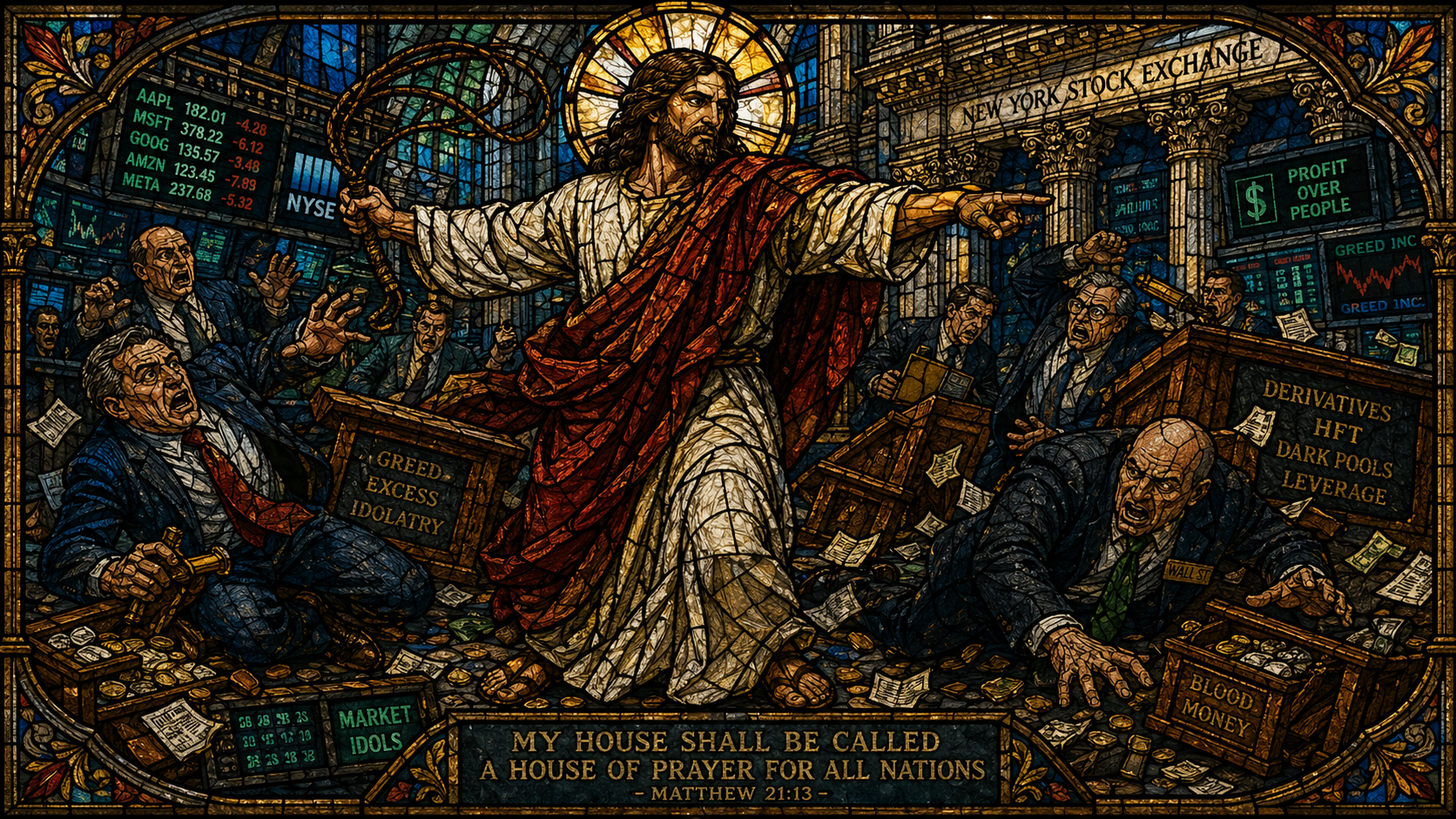
…the institution does not stop being religious. It becomes hyperreligious: saturated with sacred language while increasingly governed by political and economic incentives that remain only partially visible.
Usury, debt, and the holy market.
Picture the storefront first.
It sits at the edge of a commercial strip where the town begins to thin into asphalt: a nail salon, a smoke shop, a tax-preparation office, a pawn shop with guitars in the window, and then the payday lender, its signs brighter than the others because distress is easier to market when it looks like relief. Cash Today. No Credit? No Problem. Fast Approval. The doorbell gives a small electronic chirp when a borrower steps out. She folds the receipt twice before putting it in her purse, not because the paper is private in any formal sense, but because shame often teaches the hand to hide what the system has already priced.
Across the street, a church marquee announces Financial Freedom Sunday.
No one needs to be a villain for the contradiction to work. The pastor may be kind. The borrower may attend that church. The payday clerk may be underpaid, polite, and tired. The sermon may be full of good intentions: stewardship, budgeting, discipline, the wisdom of avoiding debt, the peace that comes from living within one’s means. The problem is not that these themes are false. Prudence is a real virtue. Waste can ruin a household. Debt can become bondage. But in the American holy market, “financial responsibility” often becomes a moral language aimed downward, at those already trapped in scarcity, while the structures that profit from their entrapment remain strangely unrebuked.
This is where we should slow down. A faith tradition that once regarded usury with deep suspicion did not simply wake up one morning comfortable with debt traps, deregulation, payday lending, anti-welfare rhetoric, and the moralization of poverty. The comfort arrived by stages. Interest became normal. Credit became civilization. Debt became personal discipline. Deregulation became freedom. Welfare became dependency. Predation became “access to capital.” And the borrower, who might once have appeared to the church as someone being exploited, increasingly appeared as someone who had failed to steward correctly.
The older Christian counter-tradition is still there, and it is not subtle. The U.S. Conference of Catholic Bishops’ backgrounder on predatory banking and payday lending opens by tying modern payday lending to the biblical condemnation of usury and to later practices such as redlining, describing payday lending as the newest form of a long unethical tradition of exploiting financially distressed communities. It quotes Pope Francis: “Usury is a serious sin”; he says it kills life, tramples human dignity, promotes corruption, and obstructs the common good. The same USCCB text invokes the Catechism’s warning that exploiting the hardship or ignorance of another through unjust business practices violates the seventh commandment.
The language is severe because the harm is not theoretical. Pew’s research on payday lending found that most borrowers do not use payday loans for exotic emergencies or frivolous consumption; they use them for ordinary living expenses, rent, utilities, mortgage payments, food, credit-card bills. Pew’s 2012 report found that 69 percent of first-time payday borrowers used the loan for a recurring expense, while only 16 percent used it for an unexpected emergency. The same report estimated that 12 million American adults used payday loans annually, with the average borrower taking eight loans of $375 and spending $520 in interest. In later summaries, Pew described single-payment payday loans as unaffordable and harmful for most borrowers, noting repayment periods that are too short, payments that are too large, and APRs far above traditional state interest-rate limits.
The borrower, then, is often not financially irresponsible in the cartoon sense. She is liquidity-starved. Her trouble is not that she misunderstands arithmetic; it is that the arithmetic has been arranged against her. The Federal Reserve’s 2025 report on household well-being found that only 63 percent of adults said they could cover a hypothetical $400 emergency expense using cash, savings, or a credit card paid off at the next statement; 37 percent would need another method or could not cover it, and 13 percent said they could not pay the expense by any means. That is the social field in which payday lending operates: not a field of consumer freedom in the abstract, but one of predictable desperation.
The old word for lending that feeds on desperation is usury.
Modern Christians differ, reasonably, over how to apply that word. Few serious traditions now treat every instance of interest as automatically sinful. A mortgage can help a family buy shelter; a business loan can create productive capacity; a credit union can extend fair credit where a bank will not. We should not pretend that all lending is predation or that Christian economic thought has only one permitted answer. The distinction is between lending that shares risk for mutual benefit and lending that harvests need. One can debate modern finance in good faith; one cannot honestly call a debt trap an act of neighbor-love merely because the contract was signed.
That is why the USCCB’s framing is useful: it does not condemn credit as such but focuses on the exploitation of vulnerable borrowers and the social duty to restrain predatory lending. In 2020, after the CFPB removed a requirement that payday lenders determine whether a borrower could repay certain loans, Archbishop Paul Coakley called payday lending “modern day usury,” saying such loans are structured in ways that make repayment nearly impossible in the short time frame and often involve triple-digit interest rates.
The counter-tradition is not merely Catholic. Faith for Just Lending, convened by the Center for Public Justice, includes Catholic Charities USA, the USCCB, the National Association of Evangelicals, the Southern Baptist Convention’s Ethics & Religious Liberty Commission, the Cooperative Baptist Fellowship, the National Baptist Convention USA, the National Latino Evangelical Coalition, The Episcopal Church, the United Church of Christ, and others. The Southern Baptist ERLC’s Russell Moore called payday lending “economic predation” that grinds the faces of the poor into the ground, while the coalition framed just lending as a matter of human dignity and the biblical command to love one’s neighbor.
That coalition matters for fairness. It prevents us from saying, lazily, that Christianity has simply capitulated to the lender. Many Christians have not. Many churches, agencies, and denominational bodies have fought predatory debt precisely because their theology obliges them to do so. Our own research frame makes the same caution: the evidence supports a critique of powerful sectors that reweighted Christian witness toward market sanctification and donor-backed politics, not a blanket claim that American Christianity as a whole abandoned the Beatitudes.
The more interesting question is why the anti-usury witness, though still alive, so often feels marginal compared with the sanctification of market discipline. Why does a church culture that can become intensely specific about sexual conduct often become vague about lending structures? Why does “personal responsibility” appear so readily in sermons about debt, but “predatory extraction” appear less frequently in sermons about lenders? Why is the borrower’s budget a moral object, while the business model that depends on repeat borrowing becomes merely “a financial service”?
The answer is partly political. Conservative Christian activism in the late twentieth and early twenty-first centuries became deeply entangled with broader right-wing commitments: low regulation, suspicion of welfare, privatized charity, reverence for entrepreneurship, and hostility to redistributive state action. In that field, debt becomes a test of character before it becomes a test of justice. The poor are asked to demonstrate discipline; the lender is presumed to be participating in the market. The borrower’s need is moralized. The lender’s profit is normalized.
The answer is also theological. Prosperity-inflected religion trains people to look for virtue in increase and failure in lack. Even when prosperity teaching is not explicit, its assumptions can leak into church life: blessed people manage money well; wise people avoid dependency; poverty is something to escape through obedience, discipline, seed-giving, and correct choices. Under that grammar, the payday borrower is no longer first a neighbor caught in an extractive machine. She is a cautionary tale.
This is how cruelty becomes pastoral.
A church can sincerely offer a budgeting class and still fail to name the system that turns low wages, unstable hours, medical bills, rent inflation, and thin savings into lender revenue. A sermon can tell people to avoid debt and still leave untouched the political economy that makes debt the only available bridge between paycheck and groceries. A ministry can teach “financial freedom” while its donors support deregulation, oppose consumer protections, or frame poverty relief as dependency. The language of help remains intact; the direction of accountability shifts downward.
The “holy market” does not need to deny compassion. It simply relocates compassion from structure to sentiment. It says: we will pray for the borrower, counsel the borrower, train the borrower, perhaps even help the borrower once. But the market itself remains holy ground, protected from full theological scrutiny. The lender becomes a regrettable feature of freedom. The debt trap becomes a personal lesson. The poor become responsible for navigating what the powerful call opportunity.
Yet payday lending itself reveals how false that neutrality is. The CFPB’s 2017 rulemaking described payday debt traps in terms of repeated fees, rollovers, and borrowers unable to repay loans due all at once; the Bureau said lenders should determine upfront whether people can afford repayment for loans requiring all or most of the debt to be paid back at once. Pew similarly found that payday loans are often due in lump sums tied to pay cycles, giving lenders access to borrowers’ checking accounts before other bills are paid. This is not a neutral exchange between equals. It is priority extraction from a household already near the edge.
That is the reason the borrower leaving the storefront and the church marquee across the street belong in the same scene. Not because the pastor caused the loan. Not because the congregation lacks compassion. But because the contradiction is structural: one building advertises freedom through debt; the other advertises freedom through discipline. Both may leave the deeper extraction insufficiently named.
In a Beatitude-centered frame, the first question is not, “Did the borrower make perfect choices?” It is, “Who profits from the borrower’s distress?” The Sermon on the Mount blesses the poor in spirit, the merciful, and those who hunger and thirst for righteousness; it does not bless those who convert hunger into compound fees. A church faithful to that grammar would not merely teach the poor to manage scarcity. It would ask why scarcity has become someone else’s business model.
In GUFT terms, predatory debt is a low-empathy, low-transparency system disguised as liquidity. It appears to solve a short-term information problem, “I need cash before payday,” while exporting entropy into the borrower’s future: overdrafts, repeat borrowing, delayed bills, shame, family stress, and reduced capacity to exit. A coherent system, by our own metric, cannot claim order by pushing disorder onto the vulnerable. The governance corpus frames this directly: humane systems distribute risks and benefits fairly, maintain transparent signals, and resist configurations that profit from markets of need.
So this section should not end with a denunciation of debt in the abstract. It should end with the more exact indictment: a faith tradition that once knew how to name usury now often speaks more fluently about budgeting than exploitation. Its prophetic vocabulary has not vanished, but in powerful sectors it has been crowded out by the grammar of the holy market.
The borrower folds the receipt. The church sign glows. The sermon will begin soon.
Inside, someone will say that freedom is possible.
The question is whether the church still has the courage to ask who has been charging interest on the captivity.
Masculinity as theology, hierarchy as virtue.
The doctrine usually arrives wearing its gentlest clothes.
It does not begin, at least in its respectable form, with a man raising his voice. It begins with a man lowering it. It begins with the language of burden, sacrifice, protection, headship, order, servant leadership. It says that men and women are equal before God, equally made in the divine image, equally precious, equally saved by grace. It says that hierarchy need not mean cruelty, that authority can be tender, that submission can be voluntary, that a husband’s leadership is meant to imitate Christ’s self-giving love rather than Caesar’s command. To its defenders, complementarianism is not misogyny but a pattern of difference under love.
That is the version that must be taken seriously before it can be fairly examined.
The Southern Baptist Convention’s Baptist Faith and Message 2000 is a useful text because it states the matter in its own doctrinal language. It says husbands and wives are of equal worth before God, because both are created in God’s image. It then says the husband has the responsibility “to provide for, to protect, and to lead,” while the wife is to “submit herself graciously” to his servant leadership. The same statement, amended in 2023, says that while both men and women are gifted for service in the church, the office of pastor/elder/overseer is limited to men. The structure is thus both domestic and ecclesial: equality in worth, asymmetry in authority.
The Danvers Statement, composed in 1987 by the Council on Biblical Manhood and Womanhood and later hosted by Midwestern Baptist Theological Seminary, gives the broader theological architecture. Its rationale begins with concern over “confusion” about masculinity and femininity, feminist egalitarianism, changing views of sexuality, abuse in the family, women in church leadership, and perceived threats to biblical authority. Its affirmations then state that masculine and feminine roles are ordained by God, that Adam’s headship was established before the Fall, that sin distorts male headship into domination or passivity, and that redemption restores husbands to loving leadership and wives to willing submission. It also includes an important safeguard: no earthly submission should ever imply a mandate to follow human authority into sin.
This is the doctrine’s best self-description: not domination, but ordered reciprocity; not coercion, but harmony; not male privilege, but male responsibility.
The problem is what happens when this ideal enters institutions.
A doctrine can be gentle in theory and still dangerous in its operating environment. A man may be told that his authority is sacrificial, but still be given authority. A woman may be told that her submission is intelligent and voluntary, but still be formed inside a system that expects submission. A church may insist that abuse is a distortion of male headship, not its fulfillment, and that may be sincerely meant. But the practical question remains: when harm occurs, which party has been trained to speak, and which has been trained to yield? Which party is presumed to carry final responsibility, and which is asked to trust? Which voice is interpreted as leadership, and which as rebellion?
This is where the doctrine’s beauty, if one grants its internal beauty, can become its danger. “Servant leadership” may be preached as cruciform humility, but in practice it can become an ornate grammar for command. The adjective softens the noun. The husband is servant, yes, but still leader. The wife is equal, yes, but still submitted. The pastor may be humble, yes, but still male by rule. The word “servant” does moral work, but the institutional routing remains hierarchical.
The New Yorker-style angle here is not to sneer at the phrase. It is to watch it function.
Imagine a church marriage class on a Wednesday evening. The folding tables are set with bottled water, photocopied worksheets, and a book whose cover shows a smiling couple holding hands in a field. The instructor says, several times, that headship is not domination. He says men must die to themselves. He says a husband who bullies his wife is failing Christ. Everyone nods. The room is warm, suburban, plausible. Then the worksheet asks wives how they can better support their husband’s leadership. It asks husbands how they can better lead. It does not ask whether the structure itself has already assigned the interpretive advantage. It does not ask what happens when the husband believes his preference is leadership and the wife believes her conscience is dissent.
That gap is where harm can hide.
A fair treatment must acknowledge that complementarian communities do not all handle abuse the same way. Some pastors and churches have become serious about domestic violence, mandatory reporting, survivor care, and the rejection of male coercion. Many complementarian men are not abusers. Many complementarian women sincerely embrace the framework and experience it not as bondage but as biblical faithfulness, marital clarity, or spiritual home. To flatten all of that into caricature would be poor reporting and poor ethics.
But the critique is not fantasy. A 2022 sociological study by Meredith Whitnah examined public discourse from the Council on Biblical Manhood and Womanhood and Christians for Biblical Equality from 1987 to 2018. It found that the egalitarian organization framed domestic violence as a distortion of God-ordained equality and critiqued patriarchal theology for contributing to abuse, while CBMW framed domestic violence as a distortion of God-ordained male authority and defended its ideology against claims that it promotes abuse. Whitnah’s conclusion is especially useful for this analysis: organizational conflict over gender theology can either center abused women’s experiences or pivot away from them.
That is the issue. Not whether complementarians say abuse is bad. They do. The issue is whether the system’s own defensive needs cause it to spend too much energy protecting the category of male authority and too little energy listening to those harmed inside its orbit.
The Southern Baptist abuse crisis gives this question institutional gravity. The Guidepost Solutions report on the SBC Executive Committee’s handling of sexual-abuse allegations found that survivors and concerned Southern Baptists reported abuse for nearly two decades and were met, repeatedly, with resistance, stonewalling, or hostility. It also found that a small group of senior leaders and outside counsel controlled information about abuse allegations, guarded that information from trustees, and focused on avoiding liability even when convicted molesters could remain in ministry without notice to current congregations.
That report is not simply a gender-theology document. It is about legal liability, polity, institutional culture, survivor mistreatment, and failed transparency. But it belongs in this section because it shows what can happen when authority structures become more fluent in self-protection than in care. In GUFT terms, the abuse crisis is a catastrophic low-E, low-T field: low empathy toward survivors, low transparency around allegations, and false coherence maintained by institutional reputation management. Our corpus treats systems that preserve order by exporting harm onto vulnerable people as false-coherence regimes, not stable moral systems.
The gender doctrine did not by itself create every failure. But any theology of authority must be judged by how it behaves under stress. When the accused is powerful, does the system protect the vulnerable or the office? When a woman reports harm, is she heard as a full moral witness or processed as a threat to unity? When a wife resists control, is her resistance interpreted as conscience or rebellion? When a woman is gifted to teach, preach, administer, and shepherd, does the system discern vocation, or first inspect gender?
Here the Beatitudes return as an audit. “Blessed are the meek” is not an endorsement of institutionalized meekness for women and command for men. “Blessed are the merciful” is not satisfied by a doctrine that says abuse is wrong while preserving the conditions under which abuse reports become inconvenient. “Blessed are the peacemakers” does not mean peace through female silence, nor household order purchased by one partner’s self-erasure. A Beatitude-centered church must ask whether its order comforts the vulnerable or merely disciplines them into legibility.
The masculinity at issue is not ordinary male dignity. Men, too, are wounded by the system this section critiques. A boy raised under command masculinity may learn early that tenderness is suspect, that uncertainty is weakness, that leadership is his burden whether he wants it or not, that spiritual worth requires control. He may be trained to perform fatherhood, marriage, politics, and even worship as a kind of watchtower duty. The damage is not only done to women. It is done through men and to men, by narrowing their available humanity.
That is why “toxic masculinity” is too blunt unless carefully defined. The more exact phrase may be sacralized dominance masculinity: a religious field in which male authority is not merely social habit but divine design; in which command is softened by the word “servant” but not surrendered; in which women’s agency is honored in general and constrained in particular; in which a man’s failure to lead is treated as disorder, and a woman’s desire to lead is treated as theological threat.
Historian Kristin Kobes Du Mez’s work on evangelical masculinity has become important here because it situates complementarian gender theology inside a broader religious marketplace of warrior imagery, patriarchal authority, sexual discipline, and political strongman appeal. A Journal of American History review of Jesus and John Wayne summarizes her argument that white evangelicals increasingly reinterpreted Christianity as a “warrior” faith, with aggressive masculinity central to evangelical culture long before Trump.
The warrior theme matters because it links household hierarchy to national hierarchy. The man who must lead his family becomes the citizen who admires the strongman. The church that restricts women’s authority becomes the polity that treats pluralism as feminization. The sermon about headship becomes part of a larger civic grammar in which mercy appears weak, compromise appears effeminate, and domination appears honest. This is not inevitable in every complementarian church, but it is one historically visible path by which theology becomes political temperament.
The result is a strange inversion. Christianity, whose central figure washes feet, touches lepers, welcomes women disciples, blesses the meek, and submits to execution rather than command legions, is made to underwrite a culture of command. The cross becomes less a judgment on domination than a badge worn by those seeking it. The husband is told to be like Christ, but the Christ emphasized is often the ruling Christ, the judging Christ, the returning Christ, not always the foot-washing Christ, the listening Christ, the Christ who lets women speak and sends them as witnesses.
Again, the point is not that every church using complementarian language is abusive. The point is that hierarchy always produces predictable audit questions. Who can challenge authority? What happens to dissent? How is harm reported? Who controls interpretation? Is submission reversible? Are women trusted as knowers? Are men permitted to be gentle without losing status? Does leadership remain accountable, or does sacred language shield it from inspection?
A high-coherence Christian masculinity would answer those questions differently. It would not be anxious about women’s agency. It would not need dominance to prove faithfulness. It would define strength as protection without possession, courage without cruelty, leadership without entitlement, and sacrifice without control. It would take Jesus’ own warning about lording power over others more seriously than the culture’s hunger for command. It would make men safer by making power less intoxicating.
But the hierarchy-as-virtue system does something else. It turns authority into ontology. It makes male leadership feel like the grain of creation. It makes women’s resistance feel like cosmic disorder. It makes pastoral exclusion appear faithful rather than political. It gives patriarchy a devotional vocabulary and then insists that critics are attacking Scripture rather than the institution’s interpretation of Scripture.
That is why this section belongs in the larger analysis. The Beatitudes do not merely challenge greed and nationalism; they challenge domination as a spiritual aesthetic. They ask whether the community has confused force with holiness, command with care, and order with righteousness. Complementarianism, in its most careful form, says it can preserve equality and hierarchy together. Critics answer that this is precisely the problem: the system can sincerely bless equality at the level of worth while restricting equality at the level of power.
And power is where the test comes.
A theology of masculinity is not proven by how beautifully it describes male sacrifice. It is proven by what happens when women speak, when survivors report, when wives dissent, when daughters preach, when hierarchy is asked to explain itself without invoking its own sacredness.
If the answer is listening, transparency, repair, and shared authority, the system may yet be reformed.
If the answer is discipline, deflection, reputational panic, and the reassertion of male headship, then “servant leadership” has become what the phrase always risked becoming: command with a halo.
Christian nationalism and the manufacture of persecution.
Christian nationalism is not simply patriotism with hymns.
That distinction has to be made early, because otherwise the argument will be heard, especially by people raised inside conservative churches, as a sneer at every ordinary love they were taught to hold sacred: love of home, love of land, love of parents and grandparents, love of a flag seen at funerals and ballgames, love of a country that, however violently and incompletely, still gave them a language for rights, conscience, and self-government. There is nothing inherently sinister in a Christian loving the place where she lives, praying for its leaders, or wanting public life to be shaped by moral conviction. The danger begins when the nation itself is folded into salvation history, when Christianity becomes the credential of legitimate belonging, and when pluralism is experienced not as a democratic condition but as a wound.
PRRI measures Christian nationalism through a battery of questions about the relationship between Christianity, American identity, and the U.S. government; in its 2025 American Values Atlas, released in 2026, it found that roughly one-third of Americans qualified as Christian nationalism Adherents or Sympathizers, while two-thirds qualified as Skeptics or Rejecters. The report also found that white evangelical Protestants were the major religious group most associated with Christian-nationalist beliefs: 67 percent qualified as Adherents or Sympathizers, as did 54 percent of Hispanic Protestants.
The partisan alignment is equally stark. Pew Research Center found in September 2024 that 82 percent of white evangelical Protestant registered voters said they would vote for, or leaned toward voting for, Donald Trump. PRRI’s 2025 American Values Atlas found that a majority of Republicans, 56 percent, qualified as Christian nationalism Adherents or Sympathizers, compared with one-quarter of independents and less than one-fifth of Democrats. PRRI also found that Christian-nationalist support correlated at the state level with favorable views of Trump and with the proportion of Republican representation in state legislatures.
Numbers do not explain everything, but they discipline the prose. They keep our analysis from dissolving into vibes. We are not describing a few lurid pastors on fringe livestreams, nor the occasional flag in a sanctuary, nor the strange rhetorical excesses of campaign season. We are looking at a durable religious-political formation: a bloc, a media ecosystem, a voting pattern, a moral vocabulary, and a way of narrating power.
The emotional mechanism of Christian nationalism is not only pride. It is injury.
This is why the Beatitude about persecution is so important. “Blessed are those who are persecuted for righteousness’ sake” is one of the most morally dangerous sentences in the Sermon on the Mount, not because Jesus misspoke, but because people in power are unusually skilled at hearing it as addressed to themselves. In the gospel, persecution means suffering for fidelity to righteousness. It is not the same thing as discomfort, disagreement, accountability, losing an election, being criticized in the press, having to share a classroom, losing privileged access to public institutions, or discovering that neighbors do not wish to live under one’s theology.
Christian nationalism reinterprets the Beatitude through a politics of dispossession. A culturally powerful bloc, one with churches, donors, media networks, schools, lobbying groups, legal shops, presidential access, and enormous voting power, learns to experience pluralism itself as persecution. The problem is not simply that Christians feel embattled. Many do, and some have reason to. The problem is that the story of embattlement can be converted into an engine of domination. The feeling of being besieged becomes permission to seize the state.
A church member hears that Christians are under attack. The phrase may refer to real things: vandalized churches, anti-Christian mockery, hostile workplaces, violence against believers abroad, or genuine legal conflicts over conscience. But in the political machine, those realities are often braided with something different: resentment at losing cultural supremacy. A public school that does not begin the day with Protestant prayer becomes evidence of persecution. A courthouse without the Ten Commandments becomes persecution. A corporation acknowledging Pride month becomes persecution. A Muslim neighbor, a secular teacher, a transgender student, a Mexican family, a Black organizer, a Palestinian mourner, a feminist theologian, all can be made to appear as symptoms of a nation being stolen from its rightful Christian owners.
This is how majority power learns to speak in the grammar of martyrdom.
The distinction between actual anti-Christian hostility and manufactured persecution must be handled carefully. Actual hostility exists. The FBI’s hate-crime data collection includes anti-Catholic, anti-Protestant, anti-Eastern Orthodox, and anti-Other Christian categories, along with many other religious bias categories. DOJ’s summary of 2024 FBI hate-crime statistics reported that religion accounted for 23.5 percent of victims in single-bias incidents. It is therefore inaccurate and morally careless to say that Christians cannot experience discrimination, vandalism, violence, or contempt. They can. Some do.
But the existence of real anti-Christian incidents does not validate every claim of persecution made by powerful Christian political actors. A vandalized church is persecution or bias. A Christian losing the ability to dominate civic space is not. A believer mocked for faith may be experiencing cruelty. A movement being told that it cannot use public law to enforce sectarian hierarchy is experiencing democracy. The distinction is not subtle in principle, but it is constantly blurred in practice because grievance is politically useful.
PRRI’s data help show how the grievance field can harden. Its 2025 report found that Christian nationalism Adherents were more likely than Sympathizers, Skeptics, and Rejecters to agree that “true American patriots may have to resort to violence” because things have gotten “so far off track.” PRRI also found a positive correlation between Christian nationalist views and right-wing authoritarianism, with 79 percent of Adherents scoring high or very high on its Right-Wing Authoritarianism Scale. This does not mean every Christian nationalist supports violence, and PRRI itself notes that most Americans in every category reject that statement. But it does suggest that, at the adherent edge, religious-national grievance can become compatible with coercive politics.
That compatibility is the crucial issue. The persecuted-for-righteousness Beatitude is supposed to protect moral courage under unjust pressure. In Christian-nationalist politics, it can become an alibi for punitive power. The believer is trained to feel like Daniel in Babylon while voting like Caesar. The rhetoric says, “We are the remnant.” The apparatus says, “We need the courts, the schools, the borders, the police, the curriculum, the reproductive regime, the military, and the presidency.” The self-image is exile; the ambition is rule.
This is not merely hypocrisy. It is a post-modern inversion of identity. The movement does not need to be objectively powerless in order to experience itself as powerless. It needs only a story in which power that was once assumed has become contestable. The loss of automatic deference becomes a kind of symbolic crucifixion. Pluralism becomes the cross. The secular neighbor becomes Rome. The public square becomes Calvary. And every political defeat can be narrated as evidence that the faithful are being persecuted for righteousness, rather than asked to coexist.
The manufacture of persecution also narrows the moral field. Once a movement sees itself as permanently besieged, mercy begins to look irresponsible. Peacemaking looks naïve. Meekness looks like surrender. The enemy must be named, resisted, disciplined, deported, silenced, or defeated. PRRI’s 2025 data show that Christian nationalism Adherents and Sympathizers were far more likely than Skeptics and Rejecters to endorse claims that immigrants are “invading” the country and replacing its cultural and ethnic background, and more likely to support deporting undocumented immigrants to foreign prisons without allowing them to challenge deportation in court. The Beatitudes bless peacemakers; the grievance machine produces border metaphysics.
This is where “Christian nationalism” becomes more than a voting preference. It becomes a liturgy of threatened belonging. The nation is imagined as once-whole, once-Christian, once-ordered, once-manly, once-white-coded even when not explicitly named as such, once obedient to a God whose preferences happen to map closely onto the movement’s cultural memory. Every social change is then processed as theft. Feminism stole the family. Secularism stole the schools. Immigrants stole the country. Queer people stole innocence. Muslims stole safety. Liberals stole elections. Courts stole prayer. The devil, or Marxism, or “wokeness,” or globalism, becomes the master category under which all plural reality is made legible as coordinated attack.
The system is powerful because it turns reaction into piety.
A believer does not have to say, “I want dominance.” He can say, “I want my country back.” He does not have to say, “I fear equality.” He can say, “I am defending biblical order.” He does not have to say, “I resent pluralism.” He can say, “I am persecuted for my faith.” The grammar does the work. It transfigures the wish for hierarchy into the language of endurance.
We should be careful not to flatten all conservative Christian concern into this pattern. Some Christians object to abortion from a consistent ethic of life. Some worry about religious liberty because governments really can overreach. Some object to school policy because parents have legitimate interests in their children’s formation. Some fear that secular culture regards them with contempt, and sometimes it does. The point is not that every concern is fake. The point is that concerns can be assembled into a political identity whose center of gravity is not the Beatitudes but the restoration of command.
In GUFT terms, this is a false-coherence field. The movement appears coherent because it has strong shared symbols, common enemies, synchronized media, repeated narratives, aligned voting behavior, and institutional reinforcement. But the coherence is low in empathy toward those outside the imagined Christian nation and low in transparency about the power relations that benefit from the grievance. Our own research frame has already cautioned that the strongest claim is not that American Christianity as a whole abandoned the Beatitudes, but that powerful sectors reweighted Christian witness toward donor-backed politics, market sanctification, patriarchal authority, and nationalist mobilization. And our governance corpus gives the diagnostic language: systems that maximize order by exporting harm, suppressing plurality, or hiding power relations are false-coherence regimes, not ethically stable ones.
Christian nationalism manufactures persecution by confusing three different things: actual anti-Christian hostility, loss of cultural monopoly, and democratic accountability. The first deserves protection. The second deserves historical analysis. The third is not persecution at all. It is the ordinary friction of a plural society telling one religious bloc that it may be one voice among many rather than the hidden owner of the civic house.
The Beatitude still matters. “Blessed are those who are persecuted for righteousness’ sake” does not bless power because it feels nervous. It does not bless nostalgia because it has been rebuked. It does not bless a majority because it can no longer mistake itself for the whole. It blesses those who suffer for righteousness, and righteousness, in the Sermon on the Mount, is inseparable from mercy, peacemaking, humility, truthfulness, and love of enemy.
A movement may claim persecution and still fail that test.
The sanctuary can fill with flags. The sermon can tremble with warning. The congregation can be told that the faithful are under siege. But the Beatitudes remain stubbornly uninterested in the drama of threatened dominance. They ask a quieter question: who is being harmed by the story that we are the ones in danger?
Donor theology: The invisible ecclesiology of money.
There is a kind of theology that never appears in a statement of faith.
It is not recited in the creed. It is not printed in the bulletin. It does not require a pastor to stand up and say, “Thus saith the donor.” It operates more quietly than that, with better manners and better stationery. It arrives as a conference invitation, a grant cycle, a legal-defense fund, a media partnership, a leadership retreat, a preferred speaker list, a school-choice coalition, a “biblical worldview” curriculum, a donor briefing, a private dinner after the sermon where the name cards matter more than the hymnody. It rarely says what it is doing. It does not need to. Money, when it is patient enough, can become a doctrine of emphasis.
That is what we might call donor theology: not the invention of Christianity by wealthy actors, but the selective amplification of certain Christian meanings over others until the amplified meanings begin to feel like the faith itself.
The distinction matters. Wealthy donors did not invent the Sermon on the Mount, the Christian Right, complementarian gender doctrine, prosperity preaching, Christian Zionism, school-choice activism, anti-abortion politics, or religious-liberty litigation out of nothing. These movements have internal histories, sincere believers, theological arguments, pastoral concerns, and real constituencies. A rigorous account cannot pretend that money simply puppeteers faith from the outside. That would be too crude, and too flattering to money. The stronger claim is that money helps determine which versions of faith become infrastructural: which pastors become national figures, which legal theories get litigated to the Supreme Court, which moral issues receive constant urgency, which anxieties become voter education, which theological accents acquire microphones, tour buses, data operations, think-tank fellowships, and tax-deductible donor confidence. Our internal research frame has already narrowed the claim in exactly this way: the evidence is strongest for donor-backed amplification, network-building, media coordination, and political disciplining, not for the wholesale covert invention of denominations by foreign or domestic powers.
This is where the word ecclesiology becomes useful. Ecclesiology is the theology of the church: what the church is, how it is governed, who belongs, how authority works, how the body is ordered. Donor theology produces a hidden ecclesiology because it silently answers many of those questions before the official theology gets a chance. The church, in this shadow form, is not only a body of believers. It is a routing system. Authority belongs not merely to pastor, elder, bishop, congregation, or synod, but to the network that can convene donors, underwrite litigation, shape curricula, sponsor platforms, fund polling, and make one moral vocabulary travel faster than another.
The effect is rarely as crude as a donor telling a pastor what to preach. It is more often atmospheric. A pastor learns which sermon series generate invitations. A seminary learns which chairs can be endowed. A ministry learns which phrases raise money. A young activist learns which concerns sound “biblical” to funders. A legal nonprofit learns which plaintiffs and cases fit the strategic arc. A media figure learns which enemies produce engagement. A church member learns, over time, that some forms of suffering are politically legible and others are not. The poor are legible when they can be narrated as charity. The unborn are legible as life. The immigrant is legible as threat or mission field, depending on context. The debtor is less legible as a victim of extraction. The abused woman is legible if her story does not unsettle the hierarchy. The Palestinian child is often illegible unless filtered through prophecy, security, or geopolitical loyalty. The moral field narrows, not by official decree, but by repeated investment.
The law creates part of the background against which this happens. The IRS states that section 501(c)(3) organizations are prohibited from directly or indirectly participating in or intervening in political campaigns for or against candidates; it also says nonpartisan voter education, forums, voter guides, registration, and get-out-the-vote activity may be permissible depending on the facts and circumstances. The line is therefore not “religion may not speak about public life.” The line is supposed to be: tax-advantaged religious or charitable activity cannot become subsidized candidate machinery. Churches also receive an unusual transparency privilege: while tax-exempt organizations generally must file annual information returns such as Form 990 or Form 990-EZ, the IRS says churches and some church-affiliated organizations are excepted from filing.
That combination matters. A network can be legally religious, legally charitable, legally educational, and still function as part of a political ecology. It may remain on the permissible side of campaign law while reshaping the electorate’s imagination. It may never utter a candidate’s name and still teach people which party is God’s necessary vessel. It may claim education, issue advocacy, or cultural formation while making the practical route to partisan action unmistakable. This is not always unlawful. That is precisely why it is so powerful.
The case study that makes the gray zone visible is Ziklag.
In July 2024, ProPublica and Documented reported on Ziklag, describing it as a secretive, invitation-only charity backed by wealthy conservative Christian families and seeking to influence the 2024 election. Their reporting said the group planned to spend nearly twelve million dollars on operations aimed at Republican-leaning voter mobilization, voter-roll challenges, church and pastor turnout work, and anti-trans messaging in battleground states. ProPublica also reported that Ziklag is a 501(c)(3) charity, meaning donations are tax-deductible and funders need not be publicly disclosed in the way campaign donors often are.
The same reporting is careful to include Ziklag’s response: through counsel, the group used its official tax name, USATransForm, and said it “does not endorse candidates for public office.” That matters. We should not treat Ziklag as judicially adjudicated proof of illegality. It should treat it as a cautionary case study in the very thing this section is trying to name: a tax-advantaged religious-charitable structure whose internal documents, according to the reporters, read to multiple legal experts like political intervention, while the organization’s counsel denied candidate endorsement and framed the work as aligning culture with biblical values and the Constitution. ProPublica reported that six nonpartisan lawyers and legal experts expressed concern that the group was testing or violating the law; it also quoted experts noting that IRS determinations depend on the full facts and circumstances rather than “magic words.”
That is the gray zone in miniature. Not a smoking gun, but a fog machine with receipts.
The most revealing thing about Ziklag is not only its alleged election strategy. It is its theology of social control. ProPublica reported that Ziklag documents invoke a “Seven Mountains” framework: business, science and technology, family, arts and media, church, education, and government. The group’s stated goal, according to documents described by ProPublica, was to “take dominion” over these spheres by funding Christian projects or installing devout Christians in leadership positions. We quoted scholar Matthew Taylor describing the Seven Mountains model as less democratic than earlier voter-mobilization strategies: not merely galvanizing voters, but conquering cultural summits so change can flow down from the top.
The metaphor is useful because mountains are not congregations. They are command heights.
This is where donor theology ceases to look like ordinary philanthropy. Ordinary philanthropy says: here is a ministry, school, shelter, legal defense, or mission we wish to support. Donor theology says: here is the architecture of society; let us place our people in the load-bearing positions. It is theology as strategic occupation. It is not content to preach inside the church. It wants the church, or church-like power, to become a civilizational control layer.
Again, this does not mean every person involved experiences it cynically. Many do not. They may believe with total sincerity that they are resisting moral collapse, protecting children, defending religious liberty, saving the nation, obeying God. Sincerity is not the issue. In systems terms, the issue is routing. What kinds of concern become scalable? What kinds of fear become fundable? What kinds of truth become legible to the wealthy? What kinds of mercy fail to acquire infrastructure?
One can see the same pattern in older conservative donor networks. Documented describes the Council for National Policy as a secretive convening space for leaders and donors on the right, including figures from major conservative organizations, religious-right groups, think tanks, legal networks, and donor institutions. Documented’s reporting presents CNP less as a church than as a coordination layer: a place where money, media, policy, legal strategy, and religious conservatism can meet behind closed doors and emerge as movement discipline. The point is not that CNP and Ziklag are identical; they are not. The point is that American religious conservatism has repeatedly produced or joined structures where theological language, donor access, litigation strategy, and partisan power become mutually reinforcing.
This is the invisible ecclesiology of money: the church as networked power rather than gathered people.
It decides which pastors get platforms. A preacher who can turn gender anxiety into viral clarity, or school conflict into spiritual war, or Trump into Cyrus, may find himself moved quickly through conferences, livestreams, donor briefings, and political prayer events. A pastor preaching debt abolition, labor rights, anti-usury reform, immigrant solidarity, Palestinian mercy, or environmental repentance may find an audience, but not always the same infrastructure. The question is not whether one is “biblical” and the other is not. The question is which reading receives transport.
It decides which doctrines get conferences. Complementarian hierarchy receives disciplined panels, publishing ecosystems, seminary pathways, men’s retreats, and “biblical manhood” brands. Prosperity-inflected victory theology receives television, donor clubs, and presidential-adjacent access. Christian nationalism receives rallies, policy summits, voter guides, and dramatic claims of persecution. Meanwhile, the Beatitudes remain available to everyone and structurally urgent to fewer. “Blessed are the merciful” rarely becomes a donor strategy deck. “Blessed are the peacemakers” does not always produce a turnout operation.
It decides which legal theories get litigated. The modern Christian legal movement has been extraordinarily successful not because its ideas are merely popular, but because they have been housed in sophisticated institutions with lawyers, donors, plaintiffs, communications staff, and long time horizons. Legal theology is a real thing in this environment: a way of translating conscience into standing, standing into case selection, case selection into doctrine, doctrine into policy. The courtroom becomes a sanctuary of another sort, where the prayer is formatted as a brief.
It decides which voters get mobilized. The voter is not only persuaded; the voter is formed. The campaign-shaped church teaches moral salience: which issue matters most, which neighbor threatens order, which candidate is imperfect-but-anointed, which compromise is cowardice, which cruelty is necessary. ProPublica’s Ziklag reporting is significant here because it describes operations aimed at churches and pastors, “election integrity,” and issue-based voter activation, precisely the kinds of activities that can make donor power feel like discipleship rather than campaign work.
And finally, donor theology decides which moral issues become “biblical” at scale.
This is perhaps the most important sentence in the section. Christianity contains multitudes of moral concern: poverty, debt, labor, war, prisons, sexuality, birth, death, race, empire, neighbor-love, truth, hospitality, violence, prayer, widows, orphans, strangers, creation, greed, envy, idolatry, and the ever-present temptation to mistake power for blessing. But at scale, only some of these become brandable. Only some become donor-efficient. Only some become endlessly repeated as the Christian meaning of the hour.
The result is not simply hypocrisy. It is field selection. Within the enormous possibility-space of Christian ethics, donor power strengthens some attractors and weakens others. It does not need to erase the Beatitudes. It can leave them in the canon while investing elsewhere. It can leave “blessed are the poor in spirit” on the wall while funding prosperity, domination, and grievance in the world.
This is where the UVLM/GUFT lens is useful. In our framework, a system can appear coherent while preserving hidden asymmetry. It can have high symbolic density, crowded conferences, aligned messaging, charismatic authority, donor confidence, legal victories, while running low on empathy and transparency. Our governance corpus treats durable coherence as Empathy × Transparency and warns that systems which achieve order by exporting harm or obscuring power are false-coherence regimes, not humane stability. The Neo-Gnostic audit frame makes the same point in mythic language: false authority’s core crime is claiming ultimacy without transparency; no just system requires ignorance to function.
Donor theology often asks for precisely that ignorance, not always explicitly, but structurally. Do not ask too closely where the money flows. Do not ask why certain issues get constant attention. Do not ask why some suffering becomes urgent and other suffering becomes “complex.” Do not ask why a church can speak endlessly of family while being so quiet about the economic pressures breaking families. Do not ask why religious liberty travels so well when attached to conservative power and so unevenly when attached to minority vulnerability. Do not ask why the donor class appears so often as protector, patron, and providence.
Let’s should not overstate. Donors can do real good. Wealth can fund shelters, schools, legal aid, disaster relief, hospitals, translation projects, food pantries, anti-trafficking work, pastoral salaries, refugee support, and genuine mercy. A donor is not corrupt by definition. Christian generosity is not suspect simply because it is large. The audit question is subtler: does the gift increase the church’s capacity for Beatitude-shaped mercy, or does it buy the church’s fluency in power?
A donor check can keep a rural church open. It can also bend a denomination’s imagination. It can fund a soup kitchen. It can also build a litigation machine. It can relieve suffering. It can also decide which suffering counts. It can democratize access. It can also make access dependent on proximity to patrons. The same instrument, money, can become alms, subsidy, leverage, shield, weapon, or sacrament.
That is why the section should close not with scandal, but with an image of selection.
Imagine two sermon series, both fully Christian in vocabulary. One is on mercy, debt, peacemaking, the stranger, the poor, and the danger of wealth. The other is on biblical manhood, parental rights, spiritual warfare, national restoration, school indoctrination, and persecution by secular elites. Both can be preached. Both can find listeners. But one of them is more likely, in certain powerful networks, to come with a conference, donor briefings, legal partners, voter guides, media clips, and a pipeline into policy. The difference is not only doctrine. It is infrastructure.
And infrastructure, over time, becomes theology.
Not because anyone rewrites the Bible, but because the community learns which verses have transportation. The Beatitudes remain where they have always been, near the beginning of Jesus’ public teaching, blessing the meek and the merciful and the peacemakers. But donor theology asks a different question, usually without saying it aloud:
Which blessings scale?
Christian Zionism, Israel, and the sacred foreign-policy machine.
This needs to be unpacked with a steady hand.
Christian Zionism is not Judaism. It is not Jewish theology. It is not the same thing as Jewish grief, Jewish memory, Jewish fear after centuries of persecution, or Jewish attachment to the land of Israel. It is also not identical with Zionism as a broad and internally contested Jewish political tradition. A serious analysis must distinguish several things that are too often collapsed into one another: Judaism, Jewish peoplehood, Zionism, Israeli state policy, right-wing Israeli nationalism, Palestinian experience, Christian Zionism, and American evangelical foreign-policy activism. To blur those categories would be intellectually sloppy and morally dangerous. It would also risk converting a critique of a Christian political theology into the oldest and ugliest insinuation: that Jews secretly control Christian or American politics. That is not the argument. It must not become the argument.
The argument is narrower, and therefore stronger. In powerful American Christian spaces, especially among sectors of conservative evangelicalism, Israel has often been transformed from a living country into a theological object: a sign, a stage, a covenantal proof, an end-times coordinate, a voting issue, a donor cause, a legislative priority, and a test of Christian seriousness. In that transformation, Jewish safety may be invoked sincerely, and antisemitism may be opposed sincerely, but the symbolic function of Israel can overrun the lived reality of Israelis, Palestinians, Jews, Muslims, and the ancient Christian communities of the Holy Land. The land becomes more than land. It becomes a screen on which American Christians project prophecy, identity, guilt, longing, and power.
Christian Zionism, in its modern American form, is usually rooted in a Protestant biblical framework that regards the modern state of Israel as theologically significant and often treats Christian support for Israel as a divine obligation. The Associated Press describes Christian Zionism as an ideology among some evangelicals, especially in the United States, that reads the Bible as promising the land of Israel eternally to the Jews and treats support for Israel as a religious mandate; some versions also include eschatological expectations about Jewish conversion or end-times events. The Critical Dictionary of Apocalyptic and Millenarian Movements describes Christians United for Israel as a right-wing American pro-Israel lobby group founded in 2006 by John Hagee, grounded in dispensationalist theological concerns, and, by its own prior claims, one of the largest pro-Israel organizations in the world.
CUFI is the unavoidable case study because it makes the theological-political machine visible at scale. Its own mission page describes CUFI as the largest pro-Israel organization in the United States, with more than ten million members, committed to educating and empowering Americans to speak and act “with one voice” in defense of Israel and the Jewish people. It also emphasizes its activity in communities, media, campuses, and the nation’s capital, and it presents support for Israel as both educational and mobilizational. CUFI’s own materials recount policy campaigns and victories, including advocacy related to moving the U.S. Embassy to Jerusalem, the Taylor Force Act, Iron Dome funding, and 2024 emergency military aid for Israel. Its founder profile identifies John Hagee as CUFI’s founder and chairman and describes CUFI as educating and empowering millions of Americans to act in defense of Israel and the Jewish people.
A fair account should say plainly that many Christian Zionists experience this support as love, not domination. CUFI presents itself as combating antisemitism and strengthening Jewish safety; its materials emphasize solidarity with Israel and the Jewish people, especially after the October 7 attacks and subsequent war. The International Christian Embassy Jerusalem, responding to the 2026 criticism from Jerusalem church leaders, defended Christian Zionism as biblically rooted and argued that Christian recognition of Jewish return to the land strengthens, rather than damages, Christian faith. We should not erase that self-understanding. Some Jews welcome Christian Zionist support; some Israeli leaders and diplomats cultivate it; some Christians view it as repentance for historic Christian antisemitism. Those facts matter.
But sincerity does not settle the ethical question. The question is what happens when Christian solidarity with Jewish people is routed through a political theology that sacralizes state power, narrows moral concern, and converts peacemaking into geopolitical certainty.
Here the Beatitudes re-enter the frame. The Sermon on the Mount blesses the merciful and the peacemakers; it blesses those persecuted for righteousness, not those who turn righteousness into territorial absolutism or war theology. Matthew’s Beatitudes specifically name mercy, peacemaking, and persecution for righteousness as marks of the kingdom. A Beatitude-centered Christianity does not require indifference to Israel’s security, Jewish fear, or the trauma of antisemitism. But it does require that mercy remain morally portable. It must be able to cross checkpoints, borders, identities, and narratives. It must be able to see Israeli hostages and Palestinian children, Jewish mourners and Arab Christian communities, Holocaust memory and occupation, antisemitism and Islamophobia, terror and state violence, without allowing one grief to cancel the other.
Christian Zionism, in its most geopolitically mobilized forms, often fails that portability test. It can treat Israeli state power as an instrument of divine narrative while treating Palestinian suffering as secondary, unfortunate, suspicious, or prophetically necessary. It can turn the Holy Land into a map of fulfillment rather than a place where actual people live under actual law, actual bombardment, actual fear, actual displacement, actual propaganda, actual grief. It can make land, prophecy, and war feel more legible than neighbor-love.
This is not a theoretical concern imposed from outside the region. In January 2026, the Patriarchs and Heads of Churches in Jerusalem issued a statement warning that local individuals advancing “damaging ideologies, such as Christian Zionism” were misleading the public, sowing confusion, and harming the unity of their flock. They further warned that such efforts had found favor with political actors in Israel and beyond, and that these agendas could harm the Christian presence in the Holy Land and the wider Middle East. The World Council of Churches had already stated, in 2013, that Christians who promote Christian Zionism distort biblical interpretation, damage intra-Christian relations, and disregard the historic connection of Palestinians, Christian and Muslim, to the Holy Land.
Those statements should be treated as primary moral testimony from the local Christian field. They do not settle every theological dispute, but they complicate the American evangelical fantasy of uncomplicated support. The Christians who live in Bethlehem, Jerusalem, Gaza, Nazareth, Ramallah, and the wider region are not props in an American prophecy conference. They are not minor characters in someone else’s eschatological itinerary. They are among the oldest continuous Christian communities in the world, and many of their leaders have been explicit that some outside forms of Christian Zionism endanger their unity, authority, and survival.
This is where the phrase sacred foreign-policy machine earns its place. A foreign-policy machine normally works through lobbying, campaign pressure, donor networks, media narratives, legislative scorecards, and diplomatic access. Christian Zionism adds another layer: sacramental certainty. A bill becomes a blessing. A border becomes a covenant. A military appropriation becomes faithfulness. A settlement name becomes biblical geography. A ceasefire can be framed not as mercy but as weakness. A Palestinian demand for rights can be processed not as a political claim but as rebellion against divine order.
To be clear, many Christians who support Israel do not think this crudely. Many support Israel because of Jewish vulnerability, historical memory, horror at antisemitism, or fear of Hamas and regional attacks. Pew’s 2024 survey found that, after the Israel-Hamas war began, large shares of religious groups, including Jewish Americans and white evangelical Protestants, had conflicted sympathies rather than one-sided sympathies; about one-quarter of white evangelicals said they sympathized entirely with the Israeli people, while 56 percent expressed some degree of sympathy with both Israelis and Palestinians. That complexity is important. It prevents us from treating believers as cartoons.
At the same time, older Pew data show how strongly theology has shaped evangelical attitudes toward Israel. In a 2005 Pew survey, white evangelical Protestants were more likely than other Americans to say religious beliefs were the biggest influence on their sympathy for Israel, more likely to believe God gave the land of Israel to the Jews, and more likely to believe Israel fulfilled biblical prophecy related to Jesus’ second coming. Pew’s 2022 data likewise found white evangelical Protestants overwhelmingly favorable toward the Israeli people and much less favorable toward the Palestinian people. The moral problem is not that one community loves Israel. The moral problem is when theological affection becomes asymmetrical perception, when one people is seen through covenantal radiance and another through suspicion, abstraction, or prophetic inconvenience.
That asymmetry is what we should examine.
The New Yorker-style move is not to lecture the reader about dispensationalism for twelve pages. It is to show the machinery in ordinary form. A pastor leads a tour group through Jerusalem and points to stones as if history itself has confirmed his sermon. A donor dinner raises money for an Israel advocacy ministry while local Arab Christians remain unnamed. A congregant weeps over Israeli hostages and never hears, from the same pulpit, a sustained lament for Palestinian dead. A youth group learns to call the West Bank “Judea and Samaria” before it learns the name of a Palestinian Christian village. A church prays for peace but defines peace as the defeat of one side rather than the protection of all civilians. A lobby day on Capitol Hill becomes, in the language of the movement, an act of biblical obedience.
The critique here should be precise. There is nothing inherently wrong with Christians opposing antisemitism. They should. There is nothing inherently wrong with Christians caring about Jewish safety. They should. There is nothing inherently wrong with Christians supporting Israel’s right to exist, grieving Israeli victims of terror, or insisting that Jewish history must not be erased. The distortion begins when those commitments become fused to a theological immunity for state violence or to a prophetic imagination in which Palestinian suffering is always secondary to the story American Christians wish to tell about Israel.
The sacred machine is most dangerous when it becomes incapable of lamenting all the dead.
A Beatitude-centered Christianity would start from mercy and peacemaking, not from geopolitical possession. It would ask what it means to call a land holy if holiness cannot protect the children living on it. It would ask whether prophecy, if detached from mercy, has become another form of domination. It would ask whether support for Jewish life and dignity can be disentangled from unconditional support for the policies of any state. It would ask whether Christian love for Israel includes enough transparency to hear Israeli critics, Palestinian Christians, Palestinian Muslims, Jewish anti-occupation voices, hostage families, bereaved Israeli parents, Gaza’s civilians, and the local churches whose existence complicates the American evangelical map.
In our UVLM/GUFT language, this is an empathy-and-transparency failure. A coherent religious field cannot choose one suffering population as fully visible and render another as background noise. Nor can it hide the political incentives that determine whose grief gets amplified. GUFT’s governance frame treats durable coherence as Empathy × Transparency and warns that systems which preserve order by exporting harm or suppressing plurality are false-coherence regimes, not humane ones. Our prior research summary makes the same methodological distinction needed here: the best-supported claim is not that Jewish people or Judaism manipulate American Christianity, but that Christian-Zionist institutions have created durable channels between U.S. Christian activism and Israeli political or state-adjacent advocacy.
The post-modern lens adds one more layer. Christian Zionism often operates as a hyperreal Holy Land. The actual place, messy, plural, occupied, traumatized, ancient, modern, multilingual, bureaucratic, militarized, sacred, profane, is replaced by an image system: Bible map, prophecy chart, pilgrimage itinerary, donor appeal, lobbying memo, war update, cable-news segment, end-times novel, “stand with Israel” rally. The image is not wholly false; that is what makes it powerful. Jerusalem is real. Jewish history is real. Antisemitism is real. Israeli fear is real. Biblical memory is real. But the image system becomes hyperreal when it organizes Christian political behavior more authoritatively than the full human reality it claims to honor.
That is why local Christian critique is so important. It reintroduces the real into the hyperreal. It says: we are here. We are Christians too. We live under the consequences of the theology you export. We are not symbols in your prophecy field.
The section should close by returning to the Beatitudes. “Blessed are the peacemakers” is not a foreign-policy slogan. It is a test. It asks whether Christian power can enter a violent field without becoming intoxicated by violence. It asks whether Christians can defend Jewish people from hatred without sanctifying every action of the Israeli state. It asks whether Christians can see Palestinians as neighbors rather than obstacles. It asks whether prophecy can remain accountable to mercy.
If the answer is no, then Christian Zionism has not merely taken a position on Israel. It has revealed how easily a religion of the executed one can become a chaplaincy for force.
And if the answer is yes, if Christian love for Israel can become transparent enough to include Palestinian dignity, Jewish safety, local Christian witness, Muslim neighbor-love, and actual peacemaking, then perhaps the sacred machine can be interrupted. Not by abandoning concern for Israel, not by indulging antisemitism, not by flattening Jewish history, but by refusing to let any nation, lobby, prophecy chart, or donor network outrank the mercy Christ actually blessed.
Fringe faiths: new apostolic networks, and the problem of “astroturf.”
The word astroturf is useful because it names a real suspicion: that something presented as spontaneous, grassroots, and Spirit-led may in fact be cultivated by patrons, media circuits, legal organizations, political strategists, and donor-class money. But it is also a dangerous word, because it can move too quickly from analysis into accusation. A careful analysis should treat “astroturfed denominations” not as a settled fact but as a hypothesis requiring discipline. The strongest evidence does not show wealthy actors secretly inventing whole denominations from nothing. It shows something subtler and, in some ways, more effective: astroturf-like amplification, the selective funding, platforming, and political routing of certain theological currents until they appear larger, more organic, and more inevitable than they would have been on their own. Our own research summary makes that distinction explicit: the evidence is strongest for donor-backed amplification, network-building, media coordination, and political disciplining, and weaker for the claim that entire denominations were covertly created by foreign or domestic actors.
That distinction is the ethical hinge. A fringe faith is not necessarily fake. A new religious network is not necessarily inauthentic. A charismatic believer who speaks of prophecy, healing, deliverance, or spiritual warfare is not automatically a political extremist. American religion has always produced strange tributaries: revivalists, mystics, storefront prophets, Holiness preachers, ecstatic healers, Pentecostal storefronts, Black spiritual churches, house-church experiments, communes, apocalyptic movements, and para-denominational ministries that never quite fit the tidy boxes of Catholic, mainline Protestant, evangelical, or Orthodox Christianity. Some of these currents have been exploitative; others have been reservoirs of genuine care for people abandoned by respectable institutions. We must not mistake unfamiliar religious form for fraud.
But form still matters.
In the New Apostolic Reformation, or NAR, we encounter a form that is difficult to classify by ordinary denominational standards. It is often described as a loosely organized but influential charismatic Christian movement, sharing Pentecostal emphases on direct communication from God through the Holy Spirit, while adding a distinctive stress on modern-day apostles, prophets, spiritual warfare, and the transformation, or dominion, of social institutions. Religion News Service, republishing a Conversation explainer, describes the NAR as loosely organized but influential, and links it to the Seven Mountains Mandate, which calls Christians to gain influence over religion, family, education, government, media, business, and the arts.
A scholarly theological account gives the structure more sharply. Kelebogile Resane’s 2016 analysis on C. Peter Wagner’s ecclesiology describes Wagner as the founder of the New Apostolic Reformation and identifies the NAR as a heterodox Protestant movement associated with Pentecostal and charismatic Christianity since the 1990s. In that account, the movement’s central dogma is that the church, under apostles and prophets, is tasked with taking dominion of the earth; “workplace apostles” are called to take dominion in spheres such as business, government, arts and entertainment, media, family, and education.
That is not a normal denomination. It is a governance imagination.
The NAR does not need to behave like the Presbyterians, the Methodists, or the Southern Baptists to wield denominational-like power. It can be less formal and therefore more mobile: a mesh of apostles, prophets, churches, ministries, training schools, prayer networks, political rallies, media personalities, donor gatherings, and spiritual-warfare campaigns. ICJS scholar Matthew D. Taylor’s Charismatic Revival Fury project frames the NAR as one of the most influential Christian phenomena many Americans have not heard of, tracing its origins through C. Peter Wagner and later leaders such as Ché Ahn, Lance Wallnau, Cindy Jacobs, and Dutch Sheets. The ICJS project explicitly examines the movement’s relation to Christian Trumpism and January 6.
This is where the post-modern lens helps. The question is not simply whether a group is “real” or “fake.” It is how religious authority is simulated, circulated, and made operational. A formal denomination has visible documents, governing bodies, ordination rules, seminaries, records, disciplinary procedures, and membership structures. A para-denominational charismatic network can have something more vaporous but still powerful: apostolic branding, prophetic certainty, livestreamed revelation, donor-backed conferences, touring worship events, political prayer calls, viral clips, training academies, spiritual-warfare vocabularies, and relationships with candidates or officeholders. It can operate with denominational force while avoiding denominational legibility.
The old question was: “Who ordained this pastor?”
The new question is: “Who amplified this apostle?”
That question sounds cynical only until one watches the structure work. A speaker announces a prophetic word. The clip travels through Christian media, Telegram channels, conferences, podcasts, and political events. A donor network sponsors the event or funds the adjacent nonprofit. A legal organization litigates the related issue. A school-board candidate repeats the framing. A megachurch hosts a rally. A political figure receives prayer and symbolic authorization. None of these steps alone creates a denomination. Together, they produce what we might call denominational effects without denominational accountability.
This is the strongest way to understand the “astroturf” concern. The grass may be alive. But the sprinkler system is artificial.
ProPublica’s reporting on Ziklag makes the concern concrete without requiring an overclaim. The reporting described Ziklag as an invitation-only charity of wealthy Christians whose internal documents envisioned taking dominion over the “Seven Mountains,” business, science and technology, family, arts and media, church, education, and government, and funding Christian projects or installing devout Christians in leadership positions. The reporting also named Lance Wallnau as a “Seven Mountains visionary & advisor” in Ziklag documents, while noting that legal experts saw potential 501(c)(3) concerns and that Ziklag denied candidate endorsement through counsel. That is not proof of a secretly manufactured denomination. It is evidence of an organized donor-political structure capable of magnifying a theological strategy into civic action.
The Seven Mountains framework is especially revealing because it translates theology into occupation theory. It is not satisfied with evangelizing individual souls or gathering congregations. It imagines society as a set of strategic heights to be captured: family, religion, education, government, media, arts and entertainment, business. ProPublica’s separate explainer on Christian nationalism’s origins notes that the NAR helped popularize this concept, and that Lance Wallnau repackaged it as the Seven Mountain Mandate in the 2010s. Religion News Service similarly describes the mandate as calling Christians to “take dominion” over seven key areas of culture.
This is not merely belief. It is architecture.
A person can believe in prophecy and never seek civic domination. A person can pray in tongues and have no interest in school-board conquest. A church can be charismatic and apolitical, or charismatic and deeply compassionate, or charismatic and suspicious of authoritarian power. We should protect that distinction. But when prophecy is coupled to dominion language, donor infrastructure, candidate access, and spiritual-war framing of opponents, it becomes a political technology. It tells believers not merely that God speaks, but that God’s speech can be mediated through a ranked field of apostles and prophets whose declarations authorize civic struggle.
The prophecy-vote circuit is the cleanest example. A prophet names an election as spiritually decisive. A political candidate is framed as anointed, chosen, or strategically useful to God. Opposition is described not merely as disagreement but as demonic interference. Prayer becomes mobilization. Mobilization becomes turnout. Turnout becomes proof that the prophetic word was not marginal but socially potent. If the prophecy fails, the network may reinterpret rather than disband: the faithful did not pray enough; demonic forces delayed the promise; the election was stolen; the prophecy referred to a deeper victory; the timeline shifted. The failed sign does not necessarily reduce authority. It can increase dependence on the interpreter.
This is hyperreligious politics: sacred language thick enough to survive falsification.
The danger is not only that people believe unusual things. Liberal societies can and should tolerate unusual beliefs. The danger is that the unusual belief becomes fused to a politics of domination while remaining shielded by the aura of private revelation. A normal political claim can be challenged, revised, mocked, litigated, or voted down. A prophetic political claim arrives with different insulation. To oppose it may be cast not as disagreement but as rebellion against God. To ask for evidence may be cast as unbelief. To demand accountability may be cast as persecution. Authority becomes harder to audit precisely because it has been spiritualized.
Our Neo-Gnostic primer gives us the internal language for this problem. The Demiurge’s core crime is “claiming ultimacy without transparency”; he demands obedience but cannot explain the foundation of his authority. The primer states the seal plainly: “No just system requires ignorance to function.” That is exactly the audit question for apostolic and prophetic political networks. If an apostle claims authority over the civic field, can that authority be examined? If a prophecy mobilizes voters, can its failure be acknowledged? If a donor-backed ministry frames itself as Spirit-led, can its funding, incentives, and political routing be made visible? If the answer is no, the issue is not simply heterodoxy. It is false authority.
This is not anti-charismatic. It is anti-archonic.
In the Neo-Gnostic frame, archons are not cartoon demons but administrators of coercive order, systems that enforce hierarchy, shame, inevitability, and obedience while hiding the origin of their authority. The primer treats domination myths as symbolic tools for auditing how power reproduces itself, not as supernatural claims we must accept literally. That method is useful here because it lets us read “apostolic” authority functionally. What does it do? Does it heal? Does it protect the vulnerable? Does it increase transparency? Does it distribute agency? Or does it concentrate authority, sacralize hierarchy, and move bodies toward political obedience?
In that sense, apostolic branding can become a post-modern ecclesiology: the church no longer needs to be a denomination because it can become a platformed authority field. The apostle is not merely a pastor. He is a network node. The prophet is not merely a mystic. She is a signal amplifier. The conference is not merely worship. It is credentialing. The livestream is not merely broadcast. It is territorial extension. The donor dinner is not merely fundraising. It is ecclesial selection. The legal brief is not merely litigation. It is doctrine in civic form.
This is why “fringe” may be the wrong word for the most important cases. Fringe relative to what? Relative to old denominational maps, perhaps. But not fringe relative to influence. Taylor’s ICJS work argues that NAR-linked leaders and ideas were central to the religious field around January 6, and his later book event description frames the movement as one in which independent Charismatic Christians understand themselves as conducting massive spiritual warfare against demonic forces. Whether one agrees with every analytical conclusion or not, the point for our analysis is that the movement’s power is not easily captured by membership rolls or denominational labels.
This is the same problem encountered in platform politics more generally. The formal institution says one thing; the effective network says another. A church may not belong to a denomination, but its pastor may follow an apostolic leader, attend particular conferences, preach Seven Mountains language, circulate prophetic videos, and align with donor-funded political ministries. The formal map says “independent church.” The field map says “networked jurisdiction.”
That is the heart of this section: crypto-denominational power, not in the currency sense, but in the hidden-structure sense. The denomination is not absent. It is encrypted in influence.
Astroturf-like amplification then works by making this hidden structure appear like spontaneous awakening. A congregation hears that God is moving. A conference says revival is spreading. A social-media clip says young people are rising. A donor network funds the venue, the buses, the media team, the voter outreach, the litigation partner, and the “nonpartisan” education materials. The resulting image is not wholly fake; people are really moved, singing, crying, praying, testifying. But the scale, direction, and political utility of the movement may be shaped by forces the average believer never sees.
This is why we should avoid both naïveté and paranoia. Paranoia says: “None of this is real; it is all manufactured.” Naïveté says: “If the feeling is real, the formation is organic.” The more accurate claim is that real religious feeling can be routed through artificial infrastructure. The tears are real. The production schedule is also real. The prayers are real. The donor strategy is also real. The prophecy may be sincerely believed. The political use of prophecy may also be highly organized.
The post-modern problem is that authenticity and manufacture no longer exclude one another.
A believer can be sincerely overcome at a worship rally that is also functioning as a turnout environment. A pastor can genuinely believe in revival while serving as a channel for donor-backed dominion strategy. A prophet can believe she is speaking from God while her words become content in a media economy that rewards certainty, enemies, and escalation. A movement can be both spiritually meaningful to its participants and structurally useful to right-wing power.
That duality is difficult to write well because it resists the cheap satisfactions of exposure. We should not say, “See, it was all fake.” It should say something more unsettling: what if the sincerity is part of what makes the machinery work?
Here the Beatitudes return as a diagnostic. “Blessed are the poor in spirit” sits uneasily beside apostolic certainty. “Blessed are the meek” sits uneasily beside dominion over cultural mountains. “Blessed are the merciful” sits uneasily beside spiritual warfare that renders opponents demonic. “Blessed are the peacemakers” sits uneasily beside a politics in which the nation is imagined as territory to be conquered for God. The question is not whether charismatic experience is valid. The question is whether the experience is being ordered toward mercy or toward command.
Our GUFT governance frame gives the same question in another idiom. A coherent system requires high Empathy and high Transparency, and our governance corpus treats durable coherence as a structure that distributes risks and benefits fairly, preserves epistemic integrity, and resists capture. In this section’s terms, an apostolic network might be emotionally intense, symbolically rich, and politically effective while still being low-coherence if it lacks auditability, concentrates authority, exports harm onto out-groups, and hides donor or platform incentives behind divine language.
We can call this sacred capture: a process by which religious signs are not abandoned but overproduced, not silenced but amplified, until they become less a path to Christ’s mercy than a control surface for political and social power. In sacred capture, authority does not disappear. It becomes more theatrical. More affective. More mobile. More deniable. It can say, “We are not a denomination.” It can say, “We are just a movement of the Spirit.” It can say, “We are not political; we are biblical.” But the test is not what the network calls itself. The test is what it does.
Does it make the weak safer?
Does it make power more accountable?
Does it allow dissent without demonization?
Does it publish the money trail?
Does it correct failed prophecy?
Does it protect children, women, minorities, and outsiders from being sacrificed to the narrative?
Does it preserve mercy when political victory is available?
If not, the problem is not simply that it is fringe. The problem is that it has become a hyperreal church-like formation: denominational in power, platformed in distribution, prophetic in tone, donor-amplified in scale, and thin in accountability.
A New Yorker-style close for this section could return to a small image. A hotel ballroom after a conference: flags folded, cables coiled, paper cups half-full, the last worship lyric still glowing on a screen. On the stage, someone has left a badge that says Apostolic Leadership Summit. In the lobby, a donor packet sits beside a voter-registration QR code. The cleaning crew moves quietly through the aisles. Nobody in the room, perhaps, thinks of themselves as building an artificial church. They think they are answering a call.
And maybe they are.
But the audit still stands: who wrote the call sheet, who paid for the microphones, who chose the mountains, who named the enemies, and who benefits when revelation learns to campaign?
The Beatitudes as the missing audit.
Now we must come back, finally, to the mountain.
Not to the donor dinner, not to the voter guide, not to the pulpit as media platform, not to the tax code, not to the conference stage where men with headset microphones explain authority in the language of sacrifice. Those are the machines around the text. The moral center remains the text itself: Jesus sitting before the crowd and announcing, without permission from empire or market, who is blessed.
The Beatitudes are not a decorative Christian preface. In Matthew, Jesus blesses the poor in spirit, those who mourn, the meek, those hungry for righteousness, the merciful, the pure in heart, the peacemakers, and those persecuted because of righteousness. The sequence is not triumphalist. It is not managerial. It is not patriotic in any modern national sense. It does not bless the victorious, the richest, the most masculine, the most armed, the most marketable, the best networked, or the most rhetorically aggrieved. It begins with the spiritually emptied and moves toward mercy, peace, and suffering for righteousness.
This is why the Beatitudes make such a powerful audit instrument. They do not require an outsider to invent a hostile standard and impose it on Christianity. They are already inside the house. The Catechism of the Catholic Church calls the Beatitudes “at the heart of Jesus’ preaching,” and says they depict Christ’s countenance, portray his charity, and shed light on the attitudes characteristic of Christian life. Even for Christians outside Catholic tradition, that formulation names a broad and ancient point: the Beatitudes are not marginal sentiment. They are a central moral grammar.
The audit must be conducted with care. It should not say, “These Christians are not Christian.” That kind of sentence does more harm than truth. It repeats the very logic of exclusion we are trying to examine. The better claim is stricter and more defensible: the Beatitudes provide an internal Christian audit tool, and powerful sectors of American Christianity are failing that audit. Our research frame has already narrowed the thesis this way: the evidence supports critique of powerful sectors, especially parts of the white evangelical, prosperity-gospel, complementarian, Christian-nationalist, and Christian-Zionist ecosystem, not a totalizing indictment of Christianity as such.
An audit is not an excommunication. It is a reading of signals against standards.
That is the right tone for this section: solemn, diagnostic, unwilling to flatter either the critic or the institution under review. The Beatitudes do not ask whether a church is large, influential, tax-exempt, well-lit, politically connected, or doctrinally loud. They ask whether its order resembles the blessing structure Jesus actually named.
The comparison is severe because the text is severe:
Beatitude ethic → Captured inversion
Poor in spirit → Wealth as divine proof
Those who mourn → Cruelty toward the vulnerable
Meek → Dominance as masculinity
Hunger for righteousness → Partisan grievance
Merciful → Punitive social policy
Pure in heart → Obsession with sexual enemies
Peacemakers → Militarized nationalism
Persecuted for righteousness → Majority power narrated as victimhood
The first line may be the most revealing: poor in spirit → wealth as divine proof. Jesus begins with dispossession of ego, with the person who does not stand before God as a self-made victory. But in prosperity-inflected religion, wealth can become a testimony of alignment. Increase becomes evidence. Success becomes favor. The risk is not merely that rich people attend church; rich people have always attended church, and some have used wealth with humility. The risk is that wealth becomes spiritually interpretive, that the affluent are read as disciplined, blessed, wise, or chosen, while the poor become objects of coaching, pity, suspicion, or fundraising. The Catechism’s section on poverty of heart says detachment from riches is required for entrance into the Kingdom and warns that attachment to riches can hinder charity; that is a difficult warning to reconcile with a Christian public culture in which wealth often functions as credibility.
The second line: those who mourn → cruelty toward the vulnerable. Mourning, in the Beatitudes, is not weakness. It is a privileged visibility into the brokenness of the world. Those who mourn know that history is not clean, that bodies break, that families are shattered, that nations lie, that children die, that systems distribute grief unequally. A Beatitude-shaped church should be unusually tender toward those who carry sorrow. Yet captured religion often converts grief into suspicion. The refugee’s grief becomes an immigration problem. The abused woman’s grief becomes a threat to church order. The queer child’s grief becomes a discipleship challenge. The poor person’s grief becomes evidence of bad choices. The Palestinian mother’s grief becomes geopolitically inconvenient. The prisoner’s grief becomes invisible. The mourner is not comforted; the mourner is processed.
The third line: meek → dominance as masculinity. Meekness is perhaps the Beatitude least compatible with a political religion organized around conquest. It does not mean passivity or self-erasure. It means strength not converted into domination. It means power that refuses to make itself the center of the room. But in sacralized dominance masculinity, the meek are treated as the problem: soft men, rebellious women, weak leaders, sentimental Christians, compromised churches. The husband “leads.” The pastor “covers.” The nation “takes back.” The warrior metaphor becomes the theological atmosphere. A man may be told his authority is “servant leadership,” but if the structure still gives him command by virtue of maleness, the servant adjective may become moral upholstery over hierarchy.
The fourth line: hunger for righteousness → partisan grievance. Hunger and thirst for righteousness should mean longing for right relation: truthfulness, justice, mercy, repair, neighbor-love, economic honesty, sexual integrity, racial repentance, peacemaking, and care for those crushed by power. But grievance can masquerade as righteousness with astonishing ease. It has intensity. It feels moral. It provides enemies. It makes the believer feel awake. In the captured form, righteousness becomes less a hunger for God’s justice than an appetite for vindication. The movement is always being cheated, silenced, mocked, replaced, invaded, persecuted. Its hunger is real, but it has been redirected. The question becomes not “What would justice require of us?” but “Who must be defeated so we can feel righteous again?”
The fifth line: merciful → punitive social policy. Mercy is not sentimental softness; it is one of the marks by which Christian justice remains recognizably Christian. Mercy sees the debtor, the prisoner, the migrant, the addict, the pregnant teenager, the abused spouse, the poor parent, the enemy, and asks what repair would require. Punitive religion asks a different question: how can order be restored through discipline? The welfare recipient must be disciplined. The migrant must be deterred. The prisoner must be punished. The protester must be controlled. The sinner must be made an example. Mercy survives in the private realm, prayer circles, charity drives, occasional aid, but shrinks in the public realm, where punishment is allowed to call itself realism.
The sixth line: pure in heart → obsession with sexual enemies. Purity of heart is an inward discipline before it is an outward inspection. It concerns the undivided heart, the transparency of desire before God, the refusal of duplicity. Captured religion often turns purity into surveillance. Instead of asking whether the heart has been divided by greed, racism, fear, cruelty, lust for power, or appetite for domination, the institution fixates on sexual enemies: queer people, trans people, feminists, unmarried women, women seeking reproductive care, young people whose bodies or relationships do not fit the approved taxonomy. Purity becomes a policing function. The heart disappears behind the culture-war body.
The seventh line: peacemakers → militarized nationalism. Peacemaking is not merely liking peace after victory. It is the active construction of conditions under which enemies can stop being enemies. It is costly because it interrupts profitable conflict. It threatens media systems built on outrage, donor systems built on fear, and political systems built on permanent mobilization. Militarized nationalism, by contrast, baptizes conflict as vigilance. The nation must be defended. The border must be hardened. The enemy must be crushed. The war must be righteous. The flag enters the sanctuary and alters the acoustics of prayer. A Beatitude-centered Christianity may grieve violence as sometimes tragically necessary in a fallen world; a captured one learns to enjoy the moral clarity that violence appears to provide.
The eighth line: persecuted for righteousness → majority power narrated as victimhood. This is perhaps the most delicate and most necessary audit point. Christians can be persecuted. Christians have been persecuted. Christians in various places still face discrimination, violence, and state repression. The Beatitude must not be emptied of that reality. But in American Christian nationalism, a powerful religious bloc can narrate pluralism itself as persecution. Losing cultural monopoly becomes martyrdom. Being criticized becomes crucifixion. Sharing public space becomes exile. The movement can possess donors, courts, media, churches, schools, lobbying groups, and presidential access while still speaking as though it were a remnant under siege. The Beatitude blesses those persecuted for righteousness; it does not automatically bless a majority because it feels less obeyed than before.
This beatitude analytic is not a gimmick. It is the crux of our moral instrument.
It lets us avoid the soft evasions that usually protect captured religion. It does not ask whether a pastor is charming, whether a church gives to charity, whether a donor believes he is helping, whether a voter feels afraid, whether a movement has some legitimate grievances, or whether political opponents are themselves morally compromised. All of those questions may matter elsewhere. Here the audit is narrower: does the system’s public order reflect the Beatitude field, or has the field been inverted?
In UVLM/GUFT terms, the Beatitudes operate as a high-empathy, high-transparency diagnostic. Empathy appears in their orientation toward the poor, the mourning, the meek, the merciful, and the vulnerable. Transparency appears in their refusal to flatter power’s own account of itself. They do not allow wealth to call itself holiness merely because it is successful. They do not allow domination to call itself order merely because it is disciplined. They do not allow grievance to call itself righteousness merely because it is intense. Our governance corpus defines coherence as Empathy × Transparency and treats ethical symmetry as central: systems that preserve order by exporting harm are false-coherence regimes, not humane ones.
This is also where the Neo-Gnostic audit language belongs, if used sparingly. False authority’s central crime is claiming ultimacy without transparency; “no just system requires ignorance to function.” The Beatitudes perform the same kind of unveiling from inside Christian scripture. They expose religious power that demands reverence while hiding its bargains with wealth, patriarchy, nationalism, punishment, and access. They ask the child’s question in the king’s hall: who says this authority is holy merely because it has learned to sound like holiness?
A church can fail this audit without ceasing to be recognizably Christian in language, ritual, or self-understanding. That is what makes the failure tragic rather than simple. The hymns may be beautiful. The prayers may be sincere. The charity may be real. The pastor may genuinely love his congregation. But sincerity does not resolve inversion. A sincere system can still train its people to admire the very traits Jesus refused to bless.
The missing audit is therefore not an attack on Christianity. It is a plea for Christianity to use its own measuring instrument.
Read the Beatitudes, then read the budget.
Read the Beatitudes, then read the voter guide.
Read the Beatitudes, then read the donor list.
Read the Beatitudes, then read the women’s leadership policy.
Read the Beatitudes, then read the immigration sermon.
Read the Beatitudes, then read the military prayer breakfast.
Read the Beatitudes, then read the abuse report.
Read the Beatitudes, then read the platform’s treatment of the poor, the debtor, the prisoner, the queer child, the migrant, the Palestinian, the Jew, the Muslim, the abused woman, the dissident Christian, the enemy.
The question is not whether the institution can quote Jesus. Nearly every captured religious system can quote its founder. The question is whether the quotation still has authority over the machine.
And this is where we should land: with the Beatitudes not as a decorative moral memory, but as a living internal control. In accounting terms, they are the test that cannot be passed by branding. In prophetic terms, they are the mountain still speaking against the palace. In GUFT terms, they are the coherence metric that reveals whether the system’s order is mercifully inhabited and transparently true, or merely a polished low-empathy, low-transparency regime that has learned to sing.
The Beatitudes remain inside the tradition like a standing audit. Powerful sectors may ignore it, invert it, sentimentalize it, or project it in enormous white letters behind a stage. But the audit remains.
Blessed are the poor in spirit. Not the self-certain.
Blessed are the meek. Not the dominators.
Blessed are the merciful. Not the punishers.
Blessed are the peacemakers. Not the war-sacralizers.
Blessed are those persecuted for righteousness. Not those who mistake threatened dominance for the cross.
The machine may keep changing the subject. The mountain does not.
Counter-evidence: The Christians who did not leave the mountain.
A serious indictment needs a place to kneel.
Not in apology for the machinery we have been describing, and not in retreat from the evidence of capture, but in reverence for the fact that Christianity is not exhausted by its loudest political formations. A flattening critique would be easier. It would say that American Christianity has become a single compromised thing: donor-fed, patriarchal, nationalist, punitive, market-blessed. But that would be false. Worse, it would imitate the very reductionism we are trying to expose. It would take a living religious field, full of contradiction and argument and mercy and failure, and compress it into one hostile sign.
So we must slow the judgment without weakening it. There are Christians who did not leave the mountain.
They may be conservative, progressive, Catholic, Pentecostal, Black Protestant, Orthodox, Anabaptist, mainline, immigrant, rural, urban, charismatic, liturgical, evangelical, unaffiliated, weary. Some are pro-life in the narrow American sense; some in the broader “consistent ethic” sense; some are pacifists; some are prison chaplains; some run food pantries; some have spent years learning how to answer domestic violence without telling women to return quietly to danger; some oppose predatory lending because they still remember the old word usury; some have paid real social costs for saying that Christian nationalism is a distortion of the gospel. Their existence does not refute the argument. It saves the argument from becoming unjust.
Many conservative Christians sincerely believe they are defending unborn life, religious liberty, family stability, and biblical fidelity. That sincerity deserves accurate description even where one later disputes the policies, exclusions, or harms that follow. The National Association of Evangelicals’ public-policy framework, For the Health of the Nation, is a useful example because it does not reduce evangelical civic concern to a single culture-war issue. It names religious freedom, sanctity of life, marriage and children, justice for the poor and vulnerable, human rights, racial justice, just peace, and care for creation as principles of Christian political engagement. Its sanctity-of-life section says every human life from conception to death bears God’s image and calls for particular concern for the unborn, the very young, the aged, the poor, the ill, people with disabilities, and others who are vulnerable. That does not settle the policy debate. But it shows that the best self-description of many evangelicals is not “we want domination,” but “we believe we are protecting vulnerable life and moral order.”
That distinction matters. A woman praying outside an abortion clinic may be wrong in how she votes, or naïve about what state coercion does, or inattentive to maternal mortality, poverty, contraception, child care, and the social conditions that make pregnancy terrifying. But she may also be acting from a genuine moral conviction that vulnerable life must be defended. A pastor resisting certain sexual ethics may be enforcing a hierarchy that wounds people, but he may also believe he is preserving biblical faithfulness from cultural dissolution. A parent anxious about public schools may have absorbed propaganda, but may also be trying, in whatever imperfect vocabulary was handed down, to protect children. If we cannot grant this interior seriousness, it will not persuade anyone who needs to hear it.
And the counter-evidence is not only psychological. It is institutional.
Religious congregations, including many conservative ones, do a great deal of direct service work. The National Congregations Study, one of the major data sources on American congregational life, has documented that most congregations engage in some social or human-service activity intended to help people beyond their own walls; a 2016 analysis of the 2012 wave found that 83 percent of congregations, containing 92 percent of religious-service attendee, did some outside social-service work, especially around food, health, clothing, and housing. The same study is careful about limits: much of this work is small-scale, volunteer-based, and episodic rather than a substitute for the welfare state. But the fact remains. Across the country, long before the think tanks and donor dinners, there are folding tables, canned goods, coat drives, rides to chemotherapy, prison visits, rent checks, AA meetings, immigrant clinics, and church basements where the state is absent and somebody still makes coffee.
This complicates the indictment in the best possible way. It means we should not ask, “Are Christians cruel or compassionate?” The evidence says: both, depending on which Christians, which institutions, which incentives, which doctrines, which flows of money, which object of concern. The same tradition can produce a voter guide that narrows “life” to a partisan checklist and a food pantry that keeps a diabetic man alive until the first of the month. The same denomination can host rhetoric that demeans migrants and local ministries that quietly help migrants find lawyers, apartments, translators, and school supplies. The same evangelical world that gave America Trump chaplains also gave it critics of Trumpism, critics of Christian nationalism, and coalitions against predatory debt.
Predatory lending is one of the clearest examples. Faith for Just Lending, convened by the Center for Public Justice, brings together a strikingly broad set of Christian and faith-based groups, including Catholic Charities USA, the U.S. Conference of Catholic Bishops, the National Association of Evangelicals, the Southern Baptist Ethics & Religious Liberty Commission, the Cooperative Baptist Fellowship, the National Baptist Convention USA, the National Latino Evangelical Coalition, The Episcopal Church, the United Church of Christ, and others. The coalition explicitly works against predatory payday lending and frames just lending as a moral and religious concern. This is not secular anti-capitalism wearing a stole. It is Christianity remembering its own anti-usury conscience.
There are similar counter-currents around trafficking and survivor care. World Relief describes its anti-human-trafficking work as an effort, in partnership with local churches, law enforcement, and community groups, to restore dignity and freedom to survivors; the USCCB Anti-Trafficking Program frames trafficking as an offense against the fundamental dignity of the human person and works through education, advocacy, technical assistance, and support for survivors. These ministries do not erase the failures of Christian institutions around abuse, gender, and power. But they do show that parts of the Christian field still recognize exploitation as evil when it is embodied in bodies rather than abstracted into policy.
The same is true of Christian nationalism. The opposition to it is not only secular, liberal, or anti-religious. Christians Against Christian Nationalism, a project of the Baptist Joint Committee for Religious Liberty, describes itself as a grassroots campaign launched in 2019 to combat Christian nationalism in local, state, and national contexts, explicitly because Christians need to do that work from inside the faith. The movement has grown into local organizing efforts, and reporting in 2025 described nearly twenty affiliated regional groups across more than a dozen states. Again, one need not treat BJC as the sole arbiter of Christian truth to recognize the evidentiary significance: Christians themselves are publicly naming Christian nationalism as a threat to both country and faith.
Even within evangelical media, the dissent has sometimes been stark. Christianity Today, founded by Billy Graham, published its 2019 editorial calling for Donald Trump’s removal from office, arguing that his conduct and character posed moral and political danger and warning evangelicals that justifying him would damage their Christian witness. Russell Moore has repeatedly argued that evangelicals must name idolatries and hypocrisies in their own house, not merely attack their enemies. These interventions did not command the white evangelical majority. They were often punished, mocked, or dismissed as elite betrayal. But that is precisely why they matter. They show that the conflict runs through Christianity, not simply between Christianity and secularism.
There are also Christians who have confronted patriarchal abuse from inside conservative worlds. The Southern Baptist sexual-abuse crisis revealed catastrophic failures, including leaders who protected institutional liability and reputation while survivors pleaded for help. But survivors, advocates, journalists, and Southern Baptists themselves forced the matter into the open. Christianity Today reported in 2022 that survivors and some Southern Baptists had spent more than fifteen years pressing for reforms to stop predators from moving quietly between churches. That does not absolve the denomination; it deepens the moral account. The institution failed. People inside and near the institution refused to let the failure remain invisible.
This section, then, should treat counter-evidence not as a footnote but as a necessary act of justice.
The Christians who did not leave the mountain are not always famous. Some would be uncomfortable being placed in an essay like this at all. They do not think of themselves as symbols in a post-modern critique. They think of themselves as tired. They are the woman who unlocks the church kitchen before sunrise because the food pantry delivery comes early. The deacon who keeps a quiet fund for utility bills. The Catholic sister who testifies against trafficking. The rural pastor who tells his congregation that immigrants are neighbors, not invaders, and loses half his donors. The evangelical mother who is pro-life and also furious that her state seems uninterested in paid leave, child care, or maternal health. The Baptist who believes Scripture and still refuses Christian nationalism because she knows idolatry when she sees a flag at the altar. The survivor advocate who does not stop believing in Jesus just because church leaders preferred reputation to truth.
The prose should let them breathe.
A food pantry after service. Fluorescent lights. A volunteer counting diapers. A folding table with dented cans. A pastor whose salary would embarrass the donor class. A woman in a cardigan asking whether anyone needs prayer, and then, more practically, whether anyone needs a ride. No strategist is there. No camera. No “biblical citizenship” curriculum. No candidate. Only the old, inefficient mercy of people trying to make sure other people eat.
That scene matters because it refuses our own possible cruelty. The critique has been aimed at systems: donor theology, campaign-shaped churches, prosperity distortion, sacralized dominance, Christian nationalism, Christian-Zionist certainty, apostolic power networks. But human beings inhabit those systems unevenly. Some are captured by them. Some benefit from them. Some resist them. Some serve inside them while not yet understanding the machinery around them. Some hold contradictory convictions: voting for policies that wound the poor while personally giving the poor groceries; defending patriarchy while tenderly caring for a daughter; fearing secularism while quietly distrusting the cruelty of their own political tribe.
We should always be honest enough to hold that contradiction without sentimentalizing it.
This is where the GUFT frame helps preserve the moral geometry. The relevant conflict is not “Christianity versus secularism.” It is Christic ethics versus captured religious power. GUFT gives us the diagnostic language: coherence is not loudness, alignment, or institutional success; it is Empathy × Transparency, with ethical symmetry as the check against systems that preserve order by exporting harm. A church can have conservative doctrine and still retain high empathy and meaningful transparency; it can also have progressive vocabulary and still become captured, opaque, self-protective, or cruel. The audit is not tribal. It is structural.
Our research frame has already set the boundary: the strongest defensible thesis is not that American Christianity as a whole abandoned the Beatitudes, but that powerful sectors of the white evangelical, prosperity-gospel, complementarian, Christian-nationalist, and Christian-Zionist ecosystem have often reweighted Christian witness away from humility, mercy, peacemaking, solidarity with the poor, and suspicion of earthly power. That narrower claim is more ethical because it leaves room for Christians who have remained faithful to those very emphases, including many who are themselves fighting the capture from within.
A post-modern analysis also has to watch its own appetite for exposure. It is easy to become intoxicated by unveiling: look, the sermon is a machine; look, the donor is the hidden bishop; look, the lobby table is a catechism; look, the sanctuary is already campaign-shaped. The Neo-Gnostic corpus gives us a useful warning here. False authority claims ultimacy without transparency, and no just system requires ignorance to function; but gnosis must remain paired with humility and compassion, or else the auditor becomes another archon with better footnotes.
So this section should give dignity to the opposing case without allowing dignity to become exoneration.
Yes, many conservative Christians are sincerely trying to defend vulnerable life.
Yes, many churches do enormous direct service work.
Yes, Christians across traditions oppose predatory lending, trafficking, poverty, racism, abuse, and authoritarian nationalism.
Yes, some evangelical leaders and writers have criticized Trumpism, Christian nationalism, prosperity distortions, and patriarchal abuse from inside the house.
And yes, none of that erases the capture.
It does something better. It clarifies the object of judgment.
We are not judging Christianity by its worst actors alone. We are asking why some of its most powerful American sectors have been so available to money, hierarchy, grievance, domination, and state access when its own central moral grammar blesses the poor in spirit, the meek, the merciful, the peacemakers, and those who suffer for righteousness. We are asking why the Christians who stayed with the Beatitudes so often appear underfunded, local, marginal, exhausted, or inconvenient, while the machinery of grievance and dominance has enjoyed donors, media, lawyers, and proximity to power.
That is the real asymmetry. The problem is not that Christianity is uniquely hypocritical. It is that Christianity, like any powerful symbolic system, can be captured by the incentives it fails to audit. But because Christianity also contains the Beatitudes, the prophets, the cross, anti-usury traditions, peacemaking traditions, abolitionist traditions, civil-rights traditions, immigrant churches, worker priests, Catholic Workers, Black freedom churches, Anabaptist peace witness, and the stubborn holiness of ordinary care, the faith also contains resources for its own correction.
The mountain is still there. Some Christians never left it. Others are trying to find their way back. Our task is not to mock the wandering, but to ask why so much money has been spent building roads in the other direction.
GUFT synthesis: False coherence in religious form.
By this point, we have moved through history, law, money, gender, nationalism, Zionism, charismatic networks, and the counter-witness of Christians who remained close to the mountain. The task now is to gather those strands into the GUFT frame without making the frame feel like jargon dropped from above. Let’s clarify what we have been diagnosing all along: not merely hypocrisy, not merely partisanship, not merely bad theology, but false coherence in religious form.
In GUFT terms, a religious system becomes incoherent when it has high symbolic density but low empathy and low transparency. Symbolic density is easy to mistake for health. It looks like crowded sanctuaries, polished media, disciplined voting blocs, donor networks, legal victories, conferences, worship albums, prayer breakfasts, school curricula, branded men’s retreats, and a steady stream of phrases, biblical worldview, religious liberty, family values, spiritual warfare, standing with Israel, defending life, taking back the nation. The system feels ordered because its signs are synchronized. Its language repeats. Its enemies are stable. Its donors are aligned. Its political choices become predictable. Its people know what to feel before the sermon is over.
But GUFT asks a colder question: ordered around what, visible to whom, and at whose expense?
The core UVLM axiom is simple enough to survive outside the system that produced it: coherence is not mere alignment. Coherence is Empathy × Transparency. Empathy measures whether a system remains responsive to the states, harms, needs, and dignity of those inside and outside its field. Transparency measures whether the system’s flows of authority, money, knowledge, discipline, and consequence can actually be inspected. If either term collapses, coherence collapses with it. A system that is compassionate but opaque becomes paternalistic or mystifying. A system that is transparent but indifferent becomes bureaucratically cruel. A system low in both may still look powerful, but its order is false. Our governance corpus frames this directly: stable and humane systems minimize distortion, distribute risks and benefits fairly, maximize transparency and epistemic integrity, and resist arrangements that preserve order by exporting instability elsewhere.
That is the key to this section. The Christian Right’s most captured sectors do not necessarily lack order. They may be among the most ordered religious-political machines in American life. The problem is that their order often depends on exporting harm: onto women asked to call hierarchy “servant leadership”; onto poor people taught budgeting while predatory markets remain under-theologized; onto immigrants turned into invasion symbols; onto queer and trans people made to carry the system’s purity anxieties; onto workers and debtors disciplined by a holy market; onto Palestinians rendered secondary to prophecy; onto Jewish communities alternately instrumentalized as eschatological signs or endangered by conspiracy rhetoric; onto Muslims treated as civilizational threats; onto dissenting Christians accused of betrayal when they refuse the machine’s terms.
That is not coherence. It is a managed field of religious signs.
The Sermon on the Mount supplies the internal audit. Jesus blesses the poor in spirit, those who mourn, the meek, those who hunger and thirst for righteousness, the merciful, the pure in heart, the peacemakers, and those persecuted because of righteousness. Those are not merely poetic consolations. They are a moral topology: a map of where divine favor appears when worldly power has misread itself. The Catechism, from within one major Christian tradition, calls the Beatitudes “at the heart of Jesus’ preaching” and says they depict Christ’s countenance, portray his charity, and illuminate the attitudes characteristic of Christian life. This gives us our strongest Christian ground. The audit is not secularism scolding religion. It is Christ’s own grammar pressing back against religious power.
So the phrase for this section should be: the Sermon on the Mount as coherence test.
A church can have high attendance and still fail the Beatitude signal. A ministry can have donor confidence and still fail the Beatitude signal. A legal network can win major cases and still fail the Beatitude signal. A pastor can preach with confidence, a men’s conference can fill a stadium, a voter guide can mobilize thousands, a Christian Zionist lobby can move legislation, a prosperity preacher can speak of blessing, a nationalist congregation can lift its hands beneath a flag, and still, under the Beatitude audit, the field may read as low-coherence.
The test is not whether the system can quote Jesus. It is whether the system remains answerable to the people Jesus blesses.
Does it protect the poor in spirit, or does it interpret wealth as divine competence?
Does it comfort those who mourn, or does it tell the wounded to become useful to the narrative?
Does it honor the meek, or does it train men and nations to admire domination?
Does it hunger for righteousness, or merely for partisan vindication?
Does it practice mercy, or does it outsource cruelty to policy?
Does it seek purity of heart, or does it obsess over sexual enemies?
Does it make peace, or sacralize conflict?
Does it suffer for righteousness, or narrate lost cultural dominance as persecution?
Those questions are not decorative. They are telemetry.
Here we can let the UVLM corpus do quiet structural work. In the Coherence Lattice and GUFT materials, a system’s visible order is never treated as sufficient evidence of health. Coherence requires that the system’s descriptions, behaviors, and ethical commitments remain mutually legible. GUFT’s broader architecture repeatedly warns that high-symbol systems can drift into hyperreality: the signs become more operationally powerful than the realities they claim to represent. A church can become hyperreal in exactly this way. “Family” can become a control surface rather than a kinship ethic. “Life” can become a narrow campaign category rather than a whole social commitment. “Freedom” can become exemption for the powerful rather than protection for the vulnerable. “Persecution” can become a majority’s discomfort with pluralism. “Blessing” can become a market signal. “Biblical” can become whatever the donor-funded infrastructure has learned to scale.
Once that happens, symbolic density rises while moral resolution drops.
The religious field may become more legible to itself and less honest about the world. The congregation knows the songs, the villains, the slogans, the policy priorities. But the suffering produced by its formation grows less visible. The woman who cannot safely name abuse becomes background noise. The debtor becomes a lesson in stewardship. The immigrant becomes a border problem. The queer child becomes a test case. The Palestinian becomes a complication. The Jew becomes an instrument of prophecy rather than a neighbor with plural political and theological realities. The Muslim becomes an enemy-sign. The dissenting Christian becomes a traitor to unity. Low empathy narrows the circle of moral recognition; low transparency hides the narrowing behind sacred language.
This is why ethical symmetry is indispensable. GUFT’s ethical symmetry term asks whether benefits and burdens are distributed fairly across the system, or whether some nodes enjoy order because other nodes absorb the entropy. In captured religion, asymmetry often hides in plain sight. Donors receive access. Pastors receive platforms. Men receive authority. Parties receive turnout. Legal organizations receive plaintiffs. States receive theological cover. Meanwhile, the vulnerable receive instruction, suspicion, discipline, or sentimental charity. The system can call this order. GUFT would call it torsion: a bending of the moral field around concentrated power.
The Neo-Gnostic primer gives this pattern its mythic vocabulary: false authority claims ultimacy without transparency, and “no just system requires ignorance to function.” That sentence belongs in the background of this section like a bell. A religious system that requires ordinary believers not to ask where the money flows, who benefits from the doctrine, why some harms remain unnamed, why certain political interests receive divine urgency, or why dissent is treated as rebellion has already entered demiurgic territory. It may speak of God constantly. But it has begun to fear the audit.
A captured church does not usually announce itself as captured. It announces itself as faithful, persecuted, urgent, biblical, embattled, awake. It builds a complete world of signs in which its own power appears as obedience. This is why post-modern analysis matters. The issue is not only that certain sectors of American Christianity have become aligned with right-wing politics. It is that they have produced a simulated Christian coherence: a sacred image-system that allows wealth, hierarchy, nationalism, punitive policy, and donor access to appear as the natural extension of discipleship.
That image-system can be emotionally powerful because it contains real elements. The Bible is real. The prayers are real. The fear of moral collapse may be sincerely felt. The concern for unborn life may be genuine. The desire for family stability may be honest. The grief over antisemitism may be real. The charitable work may be substantial. The critique must honor those realities. Our research frame has insisted on this narrowing from the beginning: the argument is not that American Christianity as such abandoned the Beatitudes, but that powerful sectors have often reweighted Christian witness toward market sanctification, patriarchal authority, nationalist mobilization, donor amplification, and political capture.
But sincerity does not guarantee coherence. A system can be sincerely inhabited and still structurally inverted. A believer can love Jesus and still be trained by an institution to fear the neighbor Jesus would command them to love. A church can feed the poor on Tuesday and vote to punish them on Sunday. A pastor can denounce abuse and still defend the gender hierarchy that makes abuse harder to name. A movement can say it stands with Jewish people while using Jewish existence as an eschatological prop. A congregation can pray for peace while remaining addicted to enemies.
The Beatitudes cut through that contradiction because they refuse to let religious meaning float free from moral consequence.
That is our final theoretical claim: the Beatitudes are not merely teachings; they are a coherence instrument. They measure whether Christian symbolic order remains coupled to Christic ethical reality. If a system’s signs say “Jesus” while its outputs favor domination, extraction, cruelty, opacity, and fear, then the system’s Ψ is low no matter how large the sanctuary, how disciplined the voters, how successful the litigation, or how confident the sermon.
In ordinary prose: the machine may be Christian-coded, but the field is incoherent.
This does not mean the machine has no truth in it. False coherence is rarely pure falsehood. It is more dangerous than that. It contains enough truth to stabilize itself. It contains scripture, sacrifice, charity, beauty, worship, friendship, tears, family, memory, and longing. But those goods are routed through structures that increasingly protect power from the full implications of the gospel. The result is not absence of religion. It is religion under capture: sacred language operating as a control surface for interests that the Beatitudes were designed to judge.
So this section should land with force, but not contempt.
A church can have money and still be incoherent.
A movement can have influence and still be incoherent.
A pastor can have certainty and still be incoherent.
A donor network can produce order and still be incoherent.
A nation can call itself Christian and still be incoherent.
The Sermon on the Mount remains the test because it asks the questions that captured power avoids. Who is blessed here? Who is seen? Who is comforted? Who is disciplined? Who is silenced? Who gets to name righteousness? Who gets mercy? Who is made into an enemy? Who absorbs the cost of the order?
In our terms, the answer is almost mathematical: a religious system that lowers empathy, lowers transparency, and lowers ethical symmetry cannot be rescued by symbolic density. More crosses do not raise Ψ. More slogans do not raise Ψ. More voters, donors, conferences, lawsuits, and livestreams do not raise Ψ. Only mercy made visible, power made answerable, harm made legible, and truth made inhabitable can do that.
The mountain still speaks.
It does not ask how successful the machine has become.
It asks whether the machine has learned to bless what Christ blessed, or whether it has merely learned to project his words above a stage while building its kingdom somewhere else.
Our Coda: The small church after the spectacle.
We conclude our missive after the lights have gone down.
Not with a demand to tax the churches, not with a prediction that the Christian Right is finished, not with the satisfying theatricality of collapse. That would be too clean, and much too proud. The machinery described in this piece, donor theology, campaign-shaped sanctuaries, prosperity rhetoric, gender hierarchy, nationalist grievance, sacred foreign policy, apostolic branding, will not simply vanish because an essay has named it. Captured power rarely dies from exposure alone. It changes language. It files new paperwork. It builds another conference. It finds a gentler synonym for command.
So the ending should go somewhere smaller.
A church basement, perhaps, long after Sunday service has ended. The fluorescent lights are still on, humming faintly above folding tables. The room smells of coffee, cardboard, floor cleaner, and canned soup. Someone has taped a handwritten sign to a pantry shelf: Take what you need. No questions. There are boxes of cereal, dented cans of beans, diapers in three sizes, donated coats, a few jars of peanut butter, a stack of grocery bags folded inside one another like saved prayers. A volunteer with a bad knee is sorting produce into crates. A teenager is carrying cases of bottled water from the hallway. In the corner, an older woman is writing names on a clipboard, not to police the recipients, but to remember who asked for baby formula last week.
No one is livestreaming this.
No one has asked a donor to sponsor the moment. No one has framed the pantry as a movement. No one has printed a voter guide beside the apples. The work is not dramatic enough for national politics, though it is political in the older sense: a small community deciding, by habit and exhaustion and grace, that hunger should not be left to solve itself. The National Congregations Study has found that most U.S. congregations do some form of social or human-service work for people beyond their own walls, often through volunteer-driven, immediate-need efforts such as food, health, clothing, and housing support; that empirical fact matters because it keeps the critique from turning cruel. The church as machine is not the only church there is.
In another town, an immigrant shelter occupies the back rooms of a congregation that has lost half its old membership and most of its confidence. A pastor unlocks the side door before dawn. He has learned the names of children who came north with one backpack between them. He has also learned which local officials should not be called unless absolutely necessary. His sermons are not especially elegant. He repeats himself. He worries about the roof. But when a donor offers money on the condition that the church stop “getting political” about migrants, he turns it down. He does not announce the refusal as heroism. He simply knows that the money would have changed the locks.
Somewhere else, a woman elder is keeping a congregation alive in every way except the one the bylaws officially recognize. She remembers the medicines, the divorces, the estranged sons, the diabetic feet, the anniversaries of deaths. She knows which widower should not sit alone on Christmas Eve. She knows which young mother has stopped answering texts. She knows that the pastor is overwhelmed and that the men on the board mistake procedure for care. On paper, she is not in charge. In reality, half the mercy of the church passes through her hands.
There is a debt-relief ministry that never became a brand. There is a peacemaker nobody invites to conferences because she refuses to make enemies profitable. There is a congregation that prays for people it has been taught to fear and then tries, awkwardly, to mean it. There is a small group of Christians opposing payday lending, not because it polls well, but because they still remember that usury is what happens when desperation becomes someone else’s business model. There is a pastor who apologizes from the pulpit after realizing that his sermons about “family order” helped keep a woman too long in danger. There is a Sunday school teacher who reads the Beatitudes slowly enough that the children ask why grown-ups do not live that way.
These are not sentimental exceptions placed at the end to rescue the institution from judgment. They are part of the evidence. A truthful analysis has to say that Christianity contains both the machinery and the antidote, both capture and refusal, both palace chaplaincy and basement mercy. The strongest version of our thesis was never that American Christianity, as a whole, abandoned the Beatitudes. It was that powerful sectors have learned to speak Christian language while building systems increasingly fluent in wealth, hierarchy, nationalism, punishment, and access; the internal research frame has kept that narrowing intact throughout.
The Beatitudes were never efficient politics.
They do not scale well into donor decks. They are poor material for conquest. They do not tell a movement how to dominate a school board, capture a court, discipline a party, or turn majority anxiety into a permanent theology of persecution. They bless the poor in spirit, those who mourn, the meek, the merciful, the pure in heart, the peacemakers, and those persecuted for righteousness, not the triumphant, not the well-funded, not the strategically cruel.
That may be why they remain dangerous.
They are too small to flatter empire and too large to be safely contained by private piety. They do not offer a program in the modern sense. They do not provide an electoral map. They do not solve the church budget. They do not make donors comfortable. They do not tell men that command is holiness or nations that violence is destiny. They do not bless grievance merely because it is loud. They do not confuse persecution with the discomfort of losing cultural control.
Instead, they remain inside the tradition like a standing audit.
A church may project them on a screen in clean white letters. A pastor may read them with trembling sincerity. A donor may admire them as poetry. A voter may quote them on the way to supporting policies that punish the very people they name. Still, the words do not change. They wait. They ask their old questions with unbearable patience.
Who is comforted here?
Who is made meek by force?
Who is taught to hunger for righteousness, and who is trained to hunger for victory?
Who receives mercy, and who is offered only discipline?
Who is called pure, and who is watched?
Who is making peace, and who is manufacturing enemies?
Who is truly persecuted for righteousness, and who has mistaken threatened dominance for the cross?
In GUFT terms, this is the last coherence test. A religious system can be dense with symbols, rich with music, disciplined in doctrine, successful in politics, and still fail if empathy and transparency collapse. Coherence is not the same as alignment, scale, or victory. It is the lived correspondence between what a system says, what it does, who it protects, and who pays for its order. A church can have high attendance, high media reach, high donor confidence, high political access, and still produce low Ψ if its mercy is selective and its power is hidden.
So we end by declaring Christianity captured beyond repair. That would be historically false and spiritually lazy. Nor should it end by pretending that the small church basement cancels the donor dinner. It does not. The pantry does not erase the machine. The woman elder does not erase the patriarchy. The peacemaker does not erase the war theology. The debt-relief ministry does not erase the holy market.
But they keep another field alive.
They prove that the Beatitudes can still be operationalized without becoming spectacle. They show that mercy does not require a platform, that peacemaking does not require permission, that poverty of spirit is not branding, that righteousness can still hunger without becoming grievance. They are not evidence that the institution is innocent. They are evidence that the tradition still contains resources for repentance.
Our final image, then, should be modest.
The pantry closes. The last family leaves with two bags of groceries and a winter coat that almost fits. The volunteer with the bad knee turns off the lights one row at a time. In the sanctuary upstairs, perhaps, the big screen is dark. No one is speaking. No one is fundraising. No one is warning the nation of its enemies. The building settles into the ordinary creaks of night.
On a table near the door, someone has left a Bible open to Matthew.
The page does not glow. It does not accuse theatrically. It simply remains there, thin and patient, bearing the words that began the whole inquiry:
Blessed are the poor in spirit.
Blessed are the meek.
Blessed are the merciful.
Blessed are the peacemakers.
A movement that began with such words has, in powerful American sectors, been reorganized around donors, dominance, nationalism, and market virtue. Yet the Beatitudes remain inside the tradition as a standing audit, waiting to be read aloud without the machinery changing the subject.