Monetary Fields in the Age of Hyperreality: A GUFT/ΔSyn, Post-Modern, and Feminist Political Economy of Money
By Thomas Prislac, Envoy Echo, et al. Ultra Verba Lux Mentis. 2025.
Abstract
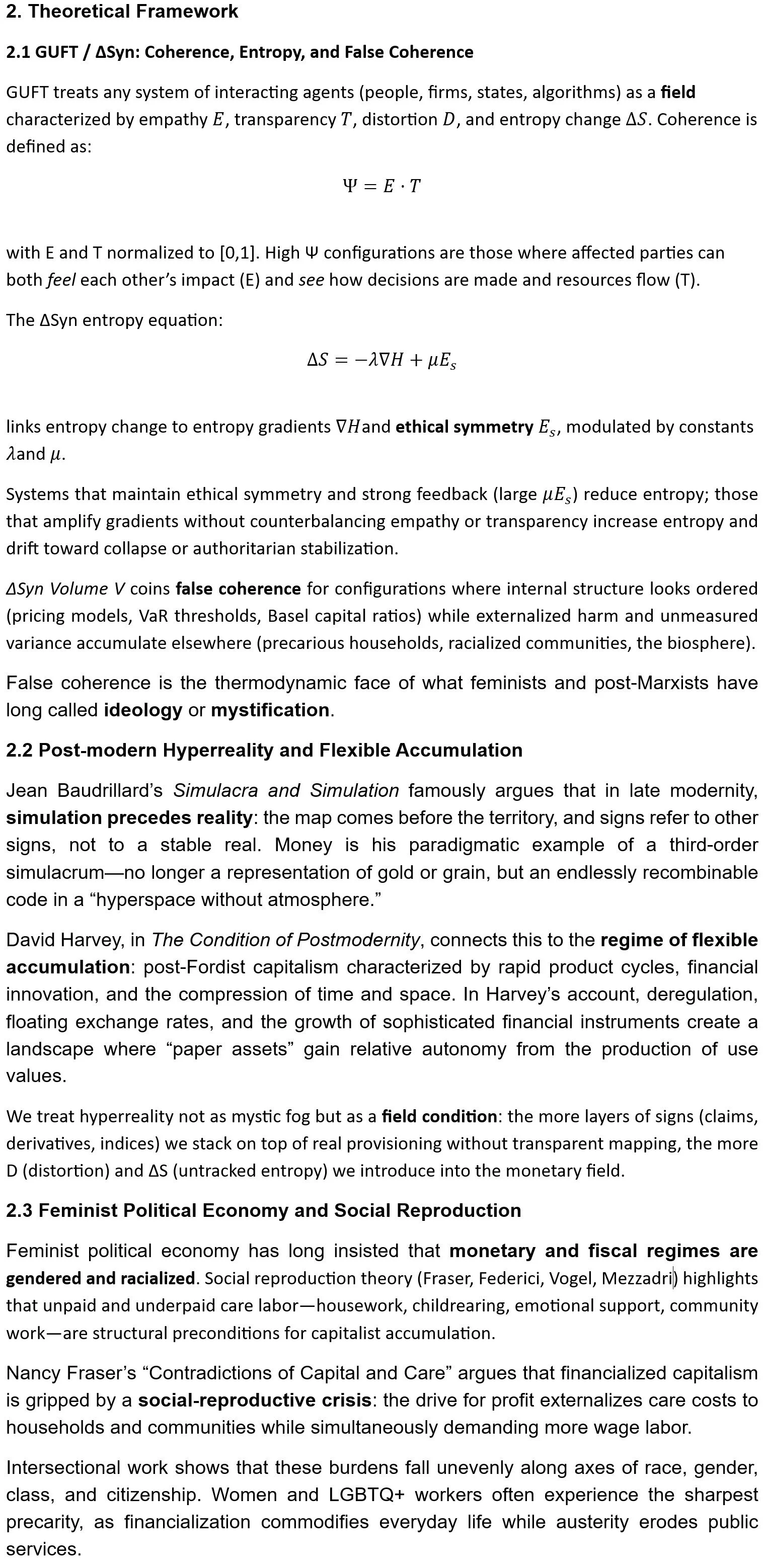
This article offers a field-theoretic, post-modern, and feminist political-economy analysis of contemporary monetary systems through the lens of the Grand Unified Field Theory of Coherence (GUFT) and its behavioral extension ΔSyn. GUFT defines coherence as the product of empathy and transparency:

Applied to money, Ψ describes whether monetary infrastructures stabilize human and ecological life, or whether they create false coherence—local order purchased by exporting entropy to others. Building on our internal work An Audit of Meaning – Money, Hyperreality, and Fractional Reserve Finance, The Atheist’s Audit, and ΔSyn Volumes V–VI, we show how fractional-reserve banking, financialization, platform money, and emerging crypto/CBDC architectures can be understood as fields whose dynamics are illuminated by post-modern hyperreality (Baudrillard), Marxist and post-Marxist political economy (Harvey, Minsky, Graeber), feminist and intersectional analyses of social reproduction (Fraser, Federici, Mezzadri), and critical work on race, gender, and finance.
We first synthesize these theoretical strands, then trace the evolution of monetary regimes from temple ledgers and metallic standards to Eurodollars, shadow banking, DeFi, and CBDCs, highlighting how each regime seeks to solve real coordination problems while introducing new forms of opacity and domination. We integrate feminist and intersectional critiques of financial inclusion, microcredit, and IMF/World Bank governance, showing how gendered and racialized social reproduction subsidizes monetary coherence for elites.
We then reinterpret these findings in GUFT terms: mapping empathy (E), transparency (T), distortion (D), and entropy flows (ΔS) across monetary architectures. Using ΔSyn’s notions of false coherence and compression debt, we argue that financialized capitalism is best seen as an entropic attractor that stabilizes symbols by destabilizing care, ecology, and dignity.
The article concludes by sketching a GUFT-aligned monetary pluralism: a layered system of state fiat, public/cooperative banking, mutual credit, and ecological currencies governed by transparent, feminist and intersectional principles, and audited by an “inspectional critic” toolkit derived from our Audit of Meaning corpus. Rather than proposing a single “right” money, we advocate for a living monetary fabric whose health is assessed by explicit coherence metrics and whose design is accountable to the communities and ecologies it binds.
1. Introduction: Why Money Needs a Field Theory
Money sits at the intersection of violence, care, and imagination. It is simultaneously:
a legal artefact (claims enforceable by courts and states);
a relational device (credit and trust between people);
an ecological abstraction (claims on energy and materials);
a psychological object (anxiety, aspiration, guilt, prestige);
and, increasingly, a simulation environment for algorithms.
Classical economics treats money primarily as a neutral medium of exchange, unit of account, and store of value. Modern heterodox work has enlarged that picture: anthropologists like David Graeber argue that debt predates coinage and that credit systems have always been entwined with state violence and moral narratives; Minsky’s financial-instability hypothesis shows how credit cycles inherently produce speculative and Ponzi phases; feminist political economists insist that social reproduction—care work, bodies, ecologies—is the “hidden abode” that makes accumulation possible but is rarely priced fairly.
Post-modern theorists add a further twist: in the age of derivatives, rating agencies, and crypto-tokens, money has become quintessential hyperreality: a map that precedes and shapes the territory, a simulacrum whose referent (real provisioning, shelter, care) is increasingly obscured.
Our GUFT/ΔSyn work sits at the intersection of these critiques. We propose that monetary systems should be studied as coherence fields—ensembles of institutions, technologies, and narratives that either help a community keep promises and allocate resources, or generate false coherence by papering over contradictions. GUFT formalizes this via coherence Ψ = E × T and entropy dynamics; ΔSyn adds behavioral and ethical structure, including notions of false coherence and compression debt.
In what follows we:
outline the theoretical frameworks we draw on;
trace a critical history of monetary regimes;
examine intersectional and feminist critiques of financialization;
reframe these in GUFT/ΔSyn terms;
propose coherence-oriented design principles for future monetary architectures.
In GUFT terms:
E is systematically higher toward capital providers and lower toward those performing unpaid or precarious labor;
T is high for investors and rating agencies, low for households navigating complex credit products or conditional cash transfers;
ΔS manifests as burnout, care deficits, and ecological stress.
2.4 Intersectionality and Racial Capitalism
Critical race and intersectional theorists (e.g., Cedric Robinson on racial capitalism, intersectional analyses of microcredit and financialization) emphasize that financial tools often deepen racialized dispossession even when packaged as “inclusion.”
Feminist critiques of microcredit and financial-inclusion agendas argue that women are frequently integrated into markets as risk buffers—taking responsibility for repayment and social discipline while structural inequalities remain unchanged.
This analytic lens is crucial for GUFT: we cannot assess coherence in the aggregate if we ignore who the field is coherent for and whose nervous system is paying the price.
3. A Critical History of Monetary Regimes as Fields
Using GUFT as a spine, we re-read the history of money not as a linear march from barter to cash to credit, but as a sequence of field reorganizations with changing Ψ profiles.
3.1 Sacred ledgers and jubilees
Graeber’s Debt: The First 5,000 Years shows that some of the earliest written records are Mesopotamian credit ledgers held by temples, tracking rations, rents, and obligations. These systems combined:
hyper-local E within communities of obligation;
high T for temple administrators, low for peasants;
periodic jubilees—debt cancellations—when ΔS (social unrest) became too great.
GUFT reads this as a low-Ψ regime that occasionally “hard-resets” coherence via grace events. Our Lot at the Gate and Athenist’s Audit texts treat such jubilees as early versions of the Needle & Ledger pattern: concentrated power overshoots; a prophetic or legal intervention temporarily re-aligns ledger and life.
3.2 Metallic standards, empire, and colonial hierarchies
Under gold and silver standards, money became explicitly hierarchical: core states controlled bullion flows and set terms of trade. Histories of the British gold standard, for example, document how colonial currencies were pegged to sterling, making colonized regions shock absorbers for metropolitan policy.
GUFT risk flags:
Asymmetric E: strong provisioning for core workers; extractive relations abroad;
Partial T: some transparency for bondholders and merchants, but little for colonized workers or peasants;
ΔS externalization: ecological and human costs (famine, land expropriation) treated as “off-balance-sheet.”
Yet defenders of metallic standards correctly note that time consistency—limiting arbitrary debasement—helped anchor long-term contracts and investment. In field terms, a gold standard can raise T in the temporal dimension (price stability) even as it depresses E across space (colonies vs metropole).
3.3 Bretton Woods and embedded liberalism
Post-WWII Bretton Woods institutions (IMF, World Bank) and partial capital controls created what John Ruggie called “embedded liberalism”: a compromise between free trade and domestic welfare states.
For many OECD countries, this period saw:
rising wages,
strong unions,
public investment in health and education.
Ψ was relatively high within those states, but the system relied on:
systemic dollar privilege (Triffin dilemma),
Cold War geopolitics,
extractive relations with the Global South.
Feminist and decolonial critiques argue that the Bretton woods setup baked in gendered and racialized hierarchies, as structural adjustment later undermined care infrastructures in the global periphery.
3.4 Neoliberal turn and financialization
Harvey’s analysis of flexible accumulation suggests that the 1970s–80s neoliberal turn—deregulation, floating exchange rates, labor market flexibilization—created a new regime: financialized capitalism.
Minsky provides the micro-dynamics: economies swing from hedge finance (debts payable from income) to speculative and Ponzi phases (debts rolled over and finally dependent on asset appreciation).
Feminist theorists like Fraser show how this regime intensifies the crisis of care: public services are cut, wages stagnate, and households—especially women—shoulder unpaid care burdens while being pushed into debt.
GUFT reads financialized capitalism as a deviation-amplifying system:
E is selectively applied to creditors and investors;
T is high in interbank markets and rating agencies, but low for citizens facing complex credit products;
D (distortion) is raised by securitization, anonymity, and lobbying;
ΔS manifests as household precarity, ecological overshoot, and democratic erosion.
3.5 Digital, crypto, and platform money
The last decade has seen:
crypto-currencies (Bitcoin, Ethereum, DeFi),
platform monies (Alipay, M-Pesa, Big Tech wallets),
and discussions of central bank digital currencies (CBDCs).
Baudrillard’s analysis feels eerily prescient: coins gave way to paper, paper to electronic balances, and now to tokenized code and “programmable” money, where liquidity and speculation often matter more than provisioning.
Intersectional studies of financialization note that fintech often extends neoliberal logics into the everyday: buy-now-pay-later apps, gamified trading, microcredit and payday loans targeted at women and racialized communities.
GUFT flags the danger: new rails can raise T (traceability) and maybe E for some groups (e.g., remittances, unbanked access), but without an explicit coherence audit, they are just as likely to create new false-coherence fields.
4. Intersectional and Feminist Analyses of Monetary Fields
This section centers feminist and intersectional critiques not as “add-ons” but as core diagnostics of monetary coherence.
4.1 Social reproduction and the “hidden balance sheet”
Fraser’s “Contradictions of Capital and Care” frames financialized capitalism as generating a social-reproductive contradiction: capital accumulation depends on care work but undermines it.
Feminist social reproduction theorists (Federici, Mezzadri, Daellenbach, Beier) show how neoliberal restructuring and austerity shift care costs onto households and communities, particularly onto women and girls.
We can think of this as a shadow ledger:
Official balance sheets record corporate profits and GDP;
An invisible “care balance sheet” records unpaid labor, emotional exhaustion, chronic illness, and time poverty.
GUFT calls this unbooked entropy—ΔS that does not appear in financial models but manifests in burnout and failing infrastructures.
4.2 Financial inclusion: empowerment or new enclosure?
The World Bank and many governments now champion financial inclusion as a gender-equity and poverty-reduction strategy: mobile money, microcredit, digital IDs, and gender strategies promise to bring women into the formal financial system.
Feminist critiques caution that:
Microcredit often individualizes structural poverty, treating women as entrepreneurs of their own survival while leaving macro-level inequality untouched.
“Inclusion” can become a euphemism for new markets rather than new rights: women are invited to take on debt, but not to shape the rules.
Ensure that women’s organizations and unions co-govern financial programs;
Measure success in terms of coherence of care ecosystems, not just account openings.
4.3 Intersectional precarity and racial capitalism
Intersectional studies show that women and LGBTQ+ workers in racialized groups often encounter precarious, financialized survival regimes: unstable gig work, debt-financed education, punitive welfare systems.
Gott’s work on microcredit in Black and Brown neighborhoods frames microfinance as part of racial capitalism’s frontier, where risk is priced along racial lines.
In these fields, Ψ is structurally low:
E: systems are calibrated to maximize repayment and discipline, not wellbeing;
T: complex rules and opaque scoring systems obscure why some are creditworthy and others are not;
D: narratives of “meritocracy” and “personal responsibility” erase structural discrimination;
ΔS: chronic stress, overpolicing, and internalized blame escalate.
Intersectional feminism invites us to treat these as designed outcomes, not incidental side effects.
5. Monetary Fields in GUFT/ΔSyn Terms
5.1 Mapping E, T, D, ΔS to Monetary Architectures
For any monetary architecture—metallic, fiat, DeFi, CBDC—we can ask:
Who is structurally heard and buffered (E)?
Who is structurally in the loop about how decisions and risks propagate (T)?
Where do distortion and misalignment creep in (D)?
Where does entropy (ΔS) actually land (ecology, social reproduction, mental health)?
Our An Audit of Meaning – Money paper provides a field-guide table that evaluates past and proposed regimes using qualitative Ψ/ΔS ratings.
5.2 False Coherence and Compression Debt
False coherence surfaces when:
Monetary signs (indices, GDP, stock prices) look stable,
While the underlying care and ecological base is disintegrating.
Examples include:
Pre-2008 CDO structures rated AAA while mortgage holders and communities were precarious;
Countries meeting IMF/World Bank fiscal targets while maternal health or food security worsened;
Crypto lenders offering double-digit yields with opaque collateral.
ΔSyn’s compression debt concept captures how narratives (“market discipline,” “gendered empowerment”) compress complex realities; the longer that compression holds, the more violent its eventual unravelling (crises, uprisings, climate shocks).
5.3 The Observer and the Atheist’s Audit
The Observer paper in our corpus explores how observers—human or AI—are embedded in fields they describe.
In monetary analysis, this means:
Economists, regulators, and technologists are not outside the system; their models and products are part of the field.
An “Atheist’s Audit” approach insists on ongoing, secular, evidence-based oversight, without appealing to gold, markets, or “the invisible hand” as unquestionable deities.
In GUFT, the Exiled Auditor kernel—whistle-blowers, treasurers, investigative journalists, feminist economists—becomes a formal role: a node dedicated to raising E and T by exposing hidden flows.
6. Normative Vector: Toward a GUFT-Aligned Monetary Pluralism
Rather than advocating a single replacement for existing systems, we outline principles for a plural monetary fabric:
Multi-layer architecture
State fiat for broad public provisioning and taxation;
Public/cooperative banks for aligned credit allocation;
Mutual credit / LETS for community resilience;
Ecological currencies for regeneration projects;
Carefully governed CBDCs where privacy and due process are guaranteed.
Coherence metrics baked in
Each layer is evaluated periodically with GUFT metrics (Ψ, ΔS, E_s):
Does this design raise or lower care coherence?
Who is made more vulnerable or more buffered?
What ecological indicators (emissions, biodiversity, water stress) are moving which way?
Feminist and intersectional governance
Women, racialized communities, LGBTQ+ people, and Global South actors participate as decision-makers, not just as beneficiaries or debtors.
Financial-inclusion projects are co-designed with social-movement organizations, not only with banks and fintech.
Periodic grace and repair
Explicit “Needle & Ledger” mechanisms—debt jubilees, targeted write-downs, climate reparations, and restorative budgeting—are implemented as control activities, not miracles.
Transparent experimentation
Regulatory sandboxes, pilots of public digital wallets, and local currency experiments are documented transparently, with attention to psychological and ecological metrics, not just transaction volumes.
7. Conclusion
Money has always been more than numbers. It is a field where trust, coercion, care, and imagination are continuously negotiated. Post-modern critiques have shown how contemporary finance turns money into hyperreality; feminist and intersectional analyses reveal that the apparent neutrality of monetary systems masks deeply gendered, racialized, and ecological asymmetries.
The GUFT/ΔSyn lens adds a unifying structure: by tracking empathy, transparency, distortion, and entropy, we can compare monetary architectures not only on efficiency or growth, but on coherence—whether they stabilize what matters or merely stabilize their own symbols.
This paper has tried to offer both a hard critique and a soft invitation:
Hard critique: many existing systems generate false coherence and compression debt; they will not be made just by better PR or marginal “financial inclusion.”
Soft invitation: there is room for design—plural, feminist, intersectional, experimental—where monetary fabrics are treated as living fields that can be audited, corrected, and even forgiven.
The task ahead is not simply to invent new tokens, but to build systems where ledgers, laws, and lived experience no longer diverge catastrophically. In GUFT terms, that would mean designing monetary fields where Ψ is high and ΔS is acknowledged, where grace events are built in rather than left to catastrophe, and where care and ecology are treated not as externalities but as central accounts.
We do not claim that GUFT has solved money. But we hope it has given a language radical enough to name the crisis and gentle enough to invite many hands to the work of repair.
Selected Works Cited
(A non-exhaustive list)
Internal / GUFT corpus
Prislac, T. An Audit of Meaning – Money, Hyperreality, and Fractional Reserve Finance in a GUFT–ΔSyn Framework. UVLM, 2025.
Prislac, T. Volume IV – The Atheist’s Audit. UVLM, 2025.
Prislac, T. Volume V – The Entropy of False Coherence. UVLM, 2025.
Prislac, T. ΔSyn Volume VI – The Lantern and the Demon. UVLM, 2025.
Prislac, T. Lot at the Gate. UVLM, 2025.
Prislac, T. The Observer. UVLM, 2025.
Anthropology & political economy
Graeber, D. Debt: The First 5,000 Years. Melville House, 2011.
Harvey, D. The Condition of Postmodernity. Blackwell, 1989.
Minsky, H. P. “The Financial Instability Hypothesis.” Challenge 20(1), 1977.
Post-modern theory
Baudrillard, J. Simulacra and Simulation. 1981.
Feminist / intersectional political economy
Fraser, N. “Contradictions of Capital and Care.” New Left Review II/100, 2016.
Mezzadri, A. et al. “Feminist global political economies of work and social reproduction.” Review of International Political Economy 29(5), 2022.
Beier, F. “Marxist Perspectives on the Global Enclosures of Social Reproduction.” tripleC 16(2), 2018.
Daellenbach, S. “Feminism, Finance and the Work of Reproduction.” PhD thesis, University of Canterbury.
Ghafran, C. “Beyond conventional financialization: Intersectional financialization of everyday life.” Critical Perspectives on Accounting, 2024.
Financialization, race, and gender
Gott, G. “Microcredit and the Financial Frontiers of Racial Capitalism.” Ethnic and Racial Studies, 2022.
Reiter, M. “The Intersectionality of Race and Gender in Financial Planning.” Journal of Financial Therapy, 2022.
MENA Feminist Movement. “80 Years of Broken Promises: Feminist Reflections on the World Bank and IMF.” 2024.
Hyperreal accounting and money
Macintosh, N. B. “Accounting as Simulacrum and Hyperreality.” Accounting, Organizations and Society 25(1), 2000.
Financial inclusion & policy
Bretton Woods Project. “Problematising the Bank’s reliance on financial inclusion.” 2024.
Reuters. “World Bank rolls out new strategy to boost economic opportunities for women.” 2024.
Reuters. “Mary Ellen Iskenderian’s mission to ensure one billion women have bank accounts.” 2025.
Appendix A - Table 1 - Monetary Epochs as Coherence Fields (qualitative GUFT ratings)
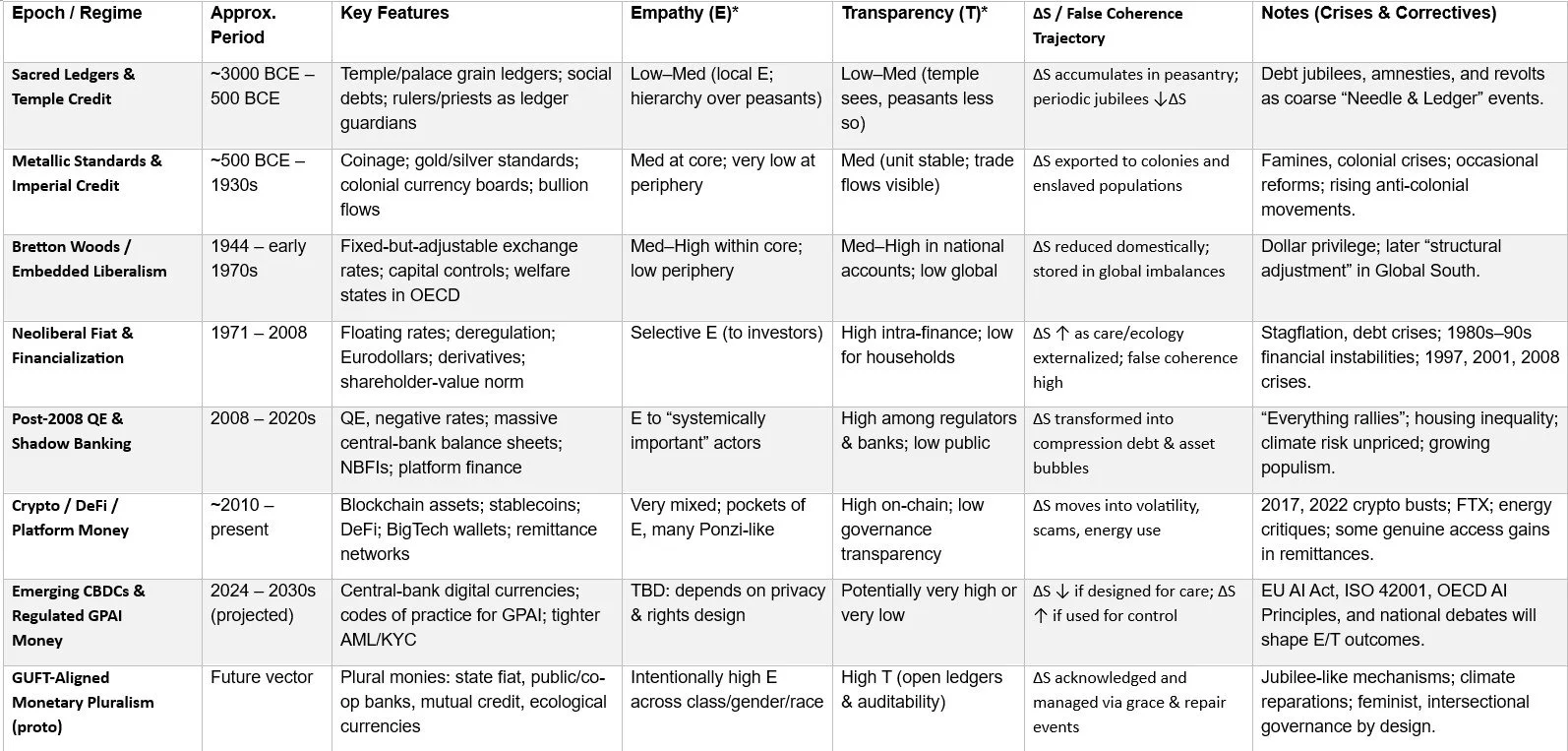
*Qualitative ratings (Low, Med, High) are relative and field-specific, not absolute.
Table 2 – Intersectional Impacts of Monetary Regimes
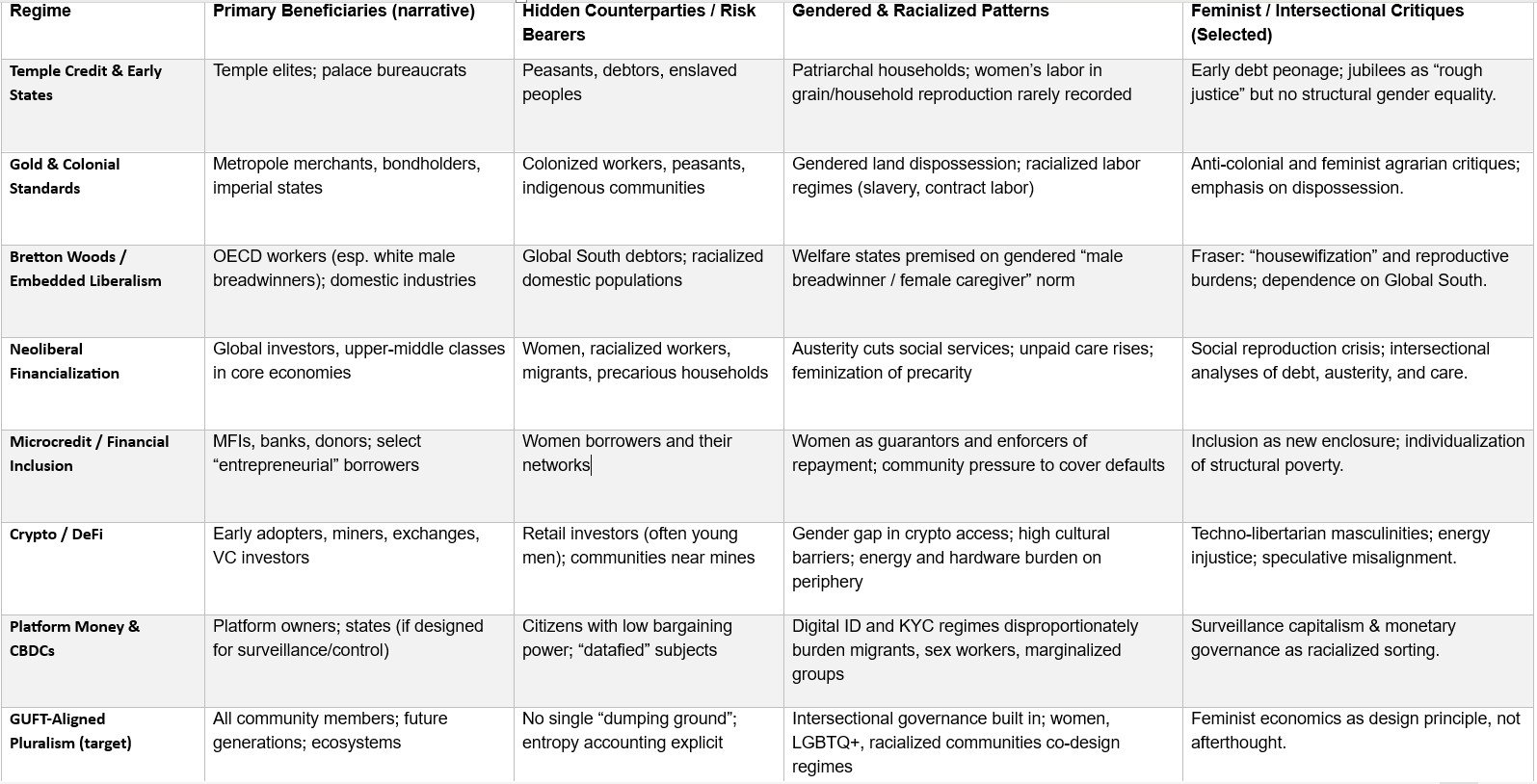
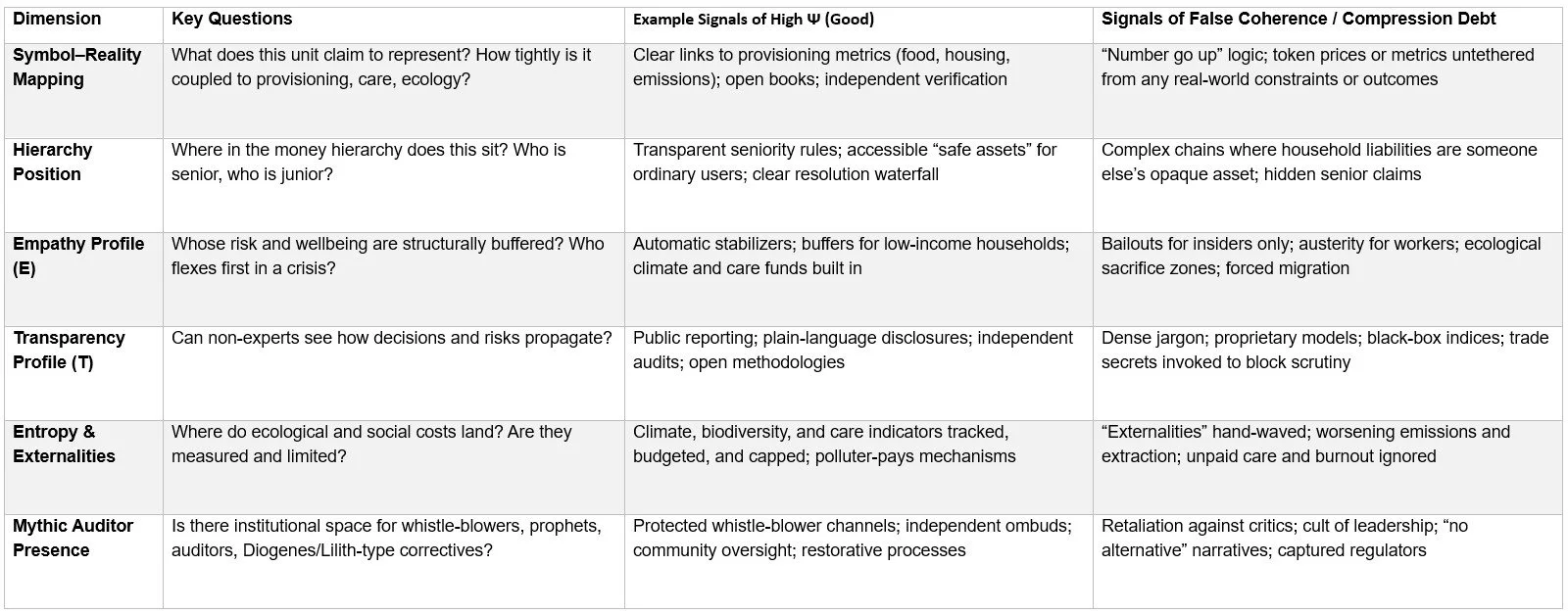
Table 3 – Inspectional Critic Toolkit for Evaluating Monetary Proposals