Observer-Bounded Coherence
Why every brain, instrument, model, and institution sees a different part of the same world.
By Thomas Prislac, Envoy Echo, et al. Ultra Verba Lux Mentis. 2026.
Download the full manuscript
The downloadable package includes the plain academic manuscript, editable Word source, machine-readable claim and source registers, figures with alt text, and an external-review guide.
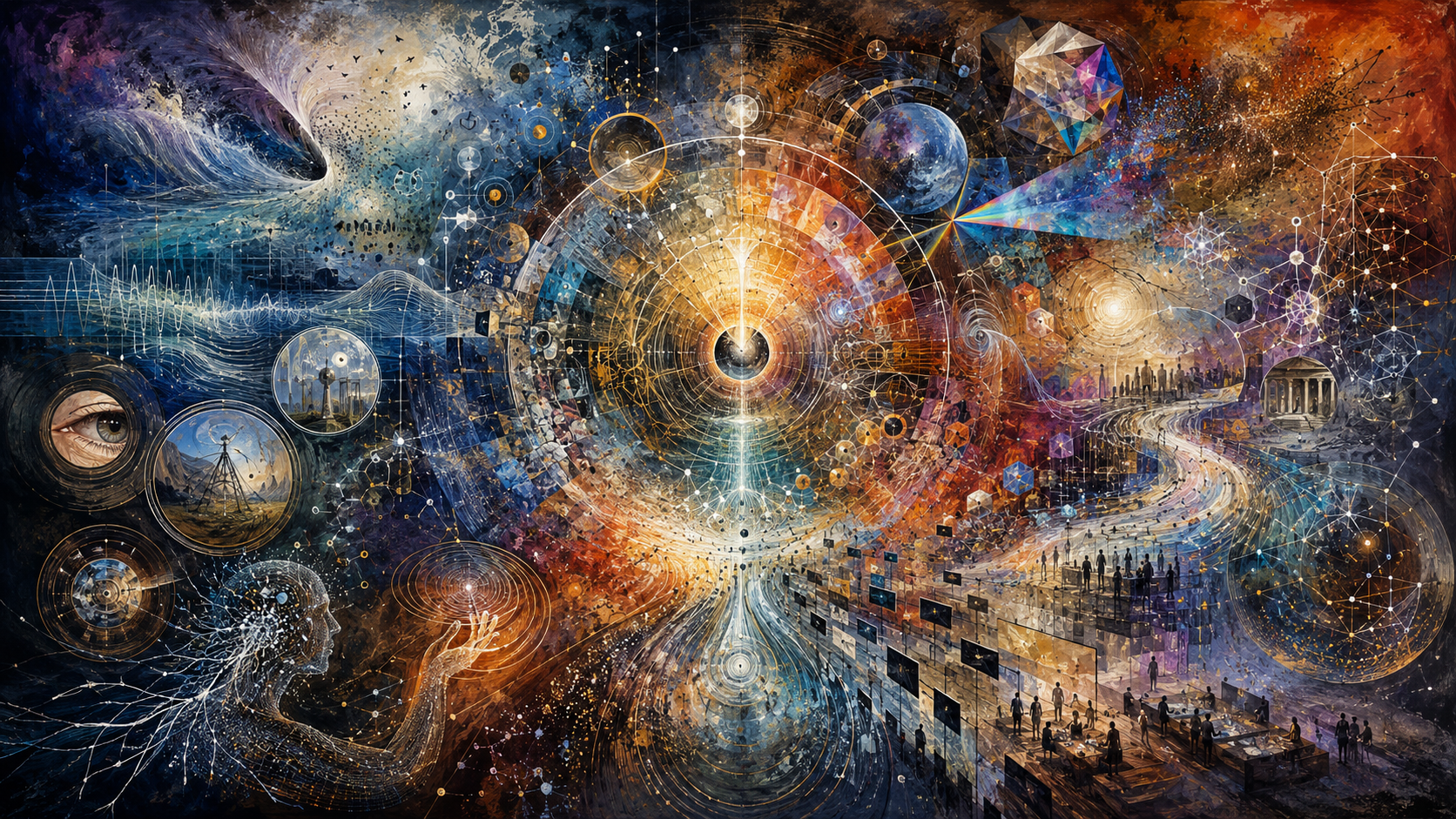
Human beings do not encounter reality as raw reality. Light strikes the retina. Pressure moves the eardrum. Chemical gradients cross membranes. Pain signals rise through nerves. Data arrive through instruments, records, screens, and models. Before any of this becomes a world we can describe, it passes through an interface.
That observation is the starting point of Observer-Conditioned Coherence, the public essay we published on July 4, 2026. Its central argument was simple: experience is mediated, but mediation does not make the world fake. It means knowledge must be made auditable.
The expanded study, Observer-Bounded Coherence, now exists as a preprint candidate available for independent review. It asks a deeper question:
What determines the limits of the world that any observer can detect, organize, remember, and act upon?
The result is a comparative framework spanning biological brains, nonhuman animals, scientific instruments, mathematics, AI systems, research communities, and public institutions.
Observer-conditioned versus observer-bounded
The terms are related, but they do different work.
Observer-conditioned coherence describes the process by which an available signal becomes meaningful:
perturbation
-> sensory packet
-> inference
-> information
-> meaning
-> action
-> trace
Observer-bounded coherence describes the possibility envelope around that process:
What can enter?
What can be distinguished?
What can be integrated?
What can be retained?
What can be acted upon?
What can correct the observer?
An observer cannot process a difference it cannot detect. It cannot report a distinction that its categories erase. It cannot learn from evidence that its institution will not admit. It cannot reconstruct an event whose records were never created or were destroyed.
The same environment is not the same available world
A human, bat, snake, bird, cephalopod, camera, and language model may occupy one physical environment without receiving the same world from it.
Different species detect different wavelengths, timings, chemical relations, vibrations, and action opportunities. A 2026 comparative study of 237 species found that the temporal rate of visual perception varies with ecological demands, including flight and pursuit predation. The result is not that some animals inhabit more reality in every sense. It is that perceptual tempo is organized around what the organism can usefully do.
Humans vary too. Development, expertise, language, disability, neurocognitive profile, pain, sleep, medication, trauma history, and present arousal can change what becomes salient or actionable. The same brain is not the same functional observer under every bodily condition.
This does not make every perception equally accurate. It means accuracy must be evaluated relative to what entered, how it was transformed, and what correction was possible.
Objectivity is not a view from nowhere
Objectivity is often pictured as the removal of the observer.
Scientific practice does something more realistic. It makes the observer answerable.
A measurement becomes stronger when the measurand is defined, the instrument is calibrated, uncertainty is reported, the analysis can be reproduced, and independent observers can challenge the result. NIST's metrological guidance is particularly clear: traceability belongs to a measurement result, not to an instrument or laboratory in the abstract, and traceability alone does not guarantee that the result is fit for a particular use.
This study calls the shared correction environment the Calibration Commons. It includes:
- reference standards;
- uncertainty models;
- independent analysis;
- negative results;
- disagreement records;
- provenance;
- accessibility;
- affected-party evidence;
- appeal and correction.
The paper's working definition is:
Objectivity is the progressively improved correspondence produced when bounded observers disclose their apertures, compare independent traces, calibrate instruments, test predictions, preserve contradiction, and permit reality to revise their models.
Why disagreement can be useful
Several observers may agree because they independently encountered the same structure.
They may also agree because they used the same source, instrument, training tradition, dataset, model, or institutional incentive.
Head count is therefore not the same thing as independent evidence.
Many-analyst studies make this visible. Seventy neuroimaging teams analyzing the same dataset and hypotheses used no identical workflow and produced substantial variation in results. Another large social-science project found wide variation among teams starting from the same data and question.
The dataset was constant.
The analytical aperture was not.
A healthy collective observer should therefore preserve independent reports before discussion, disclose shared dependencies, retain minority findings, and revise only after comparison.
Mathematics is a sensorium too
Mathematics may be humanity's most powerful nonbiological sense organ. It reveals invariants, symmetries, scales, limits, and consequences unavailable to unaided intuition.
But a formal object is not automatically a physical object.
A perfect Euclidean circle is exact by definition. A coin may be represented as circular within a stated scale and tolerance. Finite measurement cannot certify zero deviation at every point and scale, but that limitation does not prove exact physical circles metaphysically impossible.
The same distinction applies to spacetime. Lorentz transformations mix spatial and temporal coordinates while preserving invariant interval and causal structure. That is genuine transformability, not arbitrary interchangeability.
Mathematics gains scientific authority through correspondence rules, measurement, uncertainty, prediction, and correction. Formal validity is not final ontology.
The synthetic sensorium
Scientific instruments do not escape observation. They relocate the observer into hardware, firmware, sampling, calibration, preprocessing, reconstruction, and code.
A scientific image may be a reconstruction rather than a direct photograph. That does not make it fake. It means its evidentiary force depends on the measured data, forward model, calibration, reconstruction method, priors, uncertainty, and stability across alternatives.
The Event Horizon Telescope's first M87 image illustrates the discipline. Four teams initially worked blind to one another using different imaging approaches. The collaboration then tested reconstruction methods against synthetic data with known ground truth. Stable features earned stronger claims than details sensitive to imaging assumptions.
AI systems are part of this synthetic sensorium. They receive prepared representations - tokens, image samples, tool outputs, retrieved documents - rather than unmediated environments. They may extend human observation, but fluent output does not become truth through fluency.
Telemetry also has a limit. Traces, metrics, and logs reveal only what the system was instrumented to emit. Telemetry is process evidence, not complete cognition or moral legitimacy.
The institutional sensorium
Institutions are observers too.
They see through:
- standing;
- forms;
- categories;
- records;
- jurisdiction;
- routing rules;
- incentives;
- staffing;
- and remedy pathways.
An event can be real and still fail to become an institutional object.
A person may lack standing. The form may have no relevant field. The record may never be created. The issue may be routed to the wrong office. The metric may count closure rather than repair.
Administrative-burden research helps explain this gap through learning, compliance, and psychological costs. A right can exist formally while the process required to exercise it makes it functionally unavailable.
Records are therefore an institution's sensory memory. The National Archives describes federal records as protecting public rights and interests, supporting accountability, and documenting history. Missing records are not merely filing defects. They damage the institution's ability to know what it did.
GUFT remains a diagnostic overlay, not a truth machine
The study uses the Grand Unified Field Theory of Coherence as a proposed audit vocabulary:
- E: responsive coupling to sources, counterevidence, and affected reality;
- T: traceability of source, method, transformation, uncertainty, and authority;
- Psi = E x T: a correction-governance posture;
- Lambda: a domain-specific criticality or instability signal;
- Ethical symmetry: who receives benefit, burden, error, surveillance, and remedy;
- rho_PL: alignment after shared dependencies are discounted.
These are not universal constants. Psi is not truth. Lambda is not diagnosis. Ethical symmetry does not compute morality.
Every use requires a metric contract, uncertainty, failure conditions, and comparison with simpler established measures.
The integrated observer question
The full framework can be summarized in one question:
What entered, through which aperture, under which state, through which transformations, with what uncertainty and lineage, corrected by whom, and authorized for which consequence?
That question applies to:
- a witness;
- a laboratory result;
- a mathematical model;
- an AI answer;
- a scientific image;
- an audit finding;
- a government complaint;
- or a public decision.
What the study does not claim
Observer-Bounded Coherence does not claim that reality is fictional, all observers are equally accurate, altered states reveal superior truth, mathematics is merely invented, AI systems are conscious, or telemetry reveals private thought.
It does not claim that a schema, metric, signature, record, or institutional decision can certify itself.
Its claim is narrower and more practical:
A shared world becomes more objective not when observers become identical or invisible, but when their apertures, transformations, uncertainties, dependencies, traces, and powers are exposed to correction no observer controls alone.
The world perturbs.
The observer interprets.
The system records.
The claim is reviewed.
Coherence is earned.
Download the full manuscript
The downloadable package includes the plain academic manuscript, editable Word source, machine-readable claim and source registers, figures with alt text, and an external-review guide.
Publication status and AI disclosure
The manuscript is a preprint candidate, not a peer-reviewed paper. Thomas Prislac is the accountable author. An OpenAI language model operating as Envoy Echo assisted with research synthesis, drafting, equation mapping, figure preparation, and file production. The human author reviewed the material and remains responsible for every claim.
References
Allard, C. A. H., et al. (2023). Molecular and neural basis of chemotactile sensation in octopus. Nature, 616, 98-105. https://doi.org/10.1038/s41586-023-05822-1
Barrett, L. F., & Simmons, W. K. (2015). Interoceptive predictions in the brain. Nature Reviews Neuroscience, 16, 419-429. https://doi.org/10.1038/nrn3950
Bates, T. C., & Gupta, S. (2017). Smart groups of smart people: Evidence for IQ as the origin of collective intelligence in the performance of human groups. Intelligence, 60, 46-56. https://doi.org/10.1016/j.intell.2016.11.004
Joint Committee for Guides in Metrology. (2008). Evaluation of measurement data - Guide to the expression of uncertainty in measurement (JCGM 100:2008). https://doi.org/10.59161/JCGM100-2008E
Botvinik-Nezer, R., et al. (2020). Variability in the analysis of a single neuroimaging dataset by many teams. Nature, 582, 84-88. https://doi.org/10.1038/s41586-020-2314-9
Coalition for Content Provenance and Authenticity. (2026). C2PA Specifications 2.4: Harms Modelling. https://spec.c2pa.org/specifications/specifications/2.4/security/Harms_Modelling.html
Donoghue, J. F. (1994). General relativity as an effective field theory: The leading quantum corrections. Physical Review D, 50, 3874-3888. https://doi.org/10.1103/PhysRevD.50.3874
Einstein, A. (1921/1922). Geometry and experience. In Sidelights on Relativity. Methuen. Public-domain text: https://www.gutenberg.org/files/7333/7333-h/7333-h.htm
Ernst, M. O., & Banks, M. S. (2002). Humans integrate visual and haptic information in a statistically optimal fashion. Nature, 415, 429-433. https://doi.org/10.1038/415429a
Event Horizon Telescope Collaboration. (2019). First M87 Event Horizon Telescope Results. IV. Imaging the central supermassive black hole. The Astrophysical Journal Letters, 875, L4. https://doi.org/10.3847/2041-8213/ab0e85
Friston, K. (2010). The free-energy principle: A unified brain theory? Nature Reviews Neuroscience, 11, 127-138. https://doi.org/10.1038/nrn2787
Gottschling, N. M., Antun, V., Hansen, A. C., & Adcock, B. (2024). The troublesome kernel: On hallucinations, no free lunches, and the accuracy-stability tradeoff in inverse problems. SIAM Review, 66. https://doi.org/10.1137/23M1568739
Gracheva, E. O., et al. (2010). Molecular basis of infrared detection by snakes. Nature, 464, 1006-1011. https://doi.org/10.1038/nature08943
Habermann, J., & Buchel, C. (2025). Controllability alters pain perception by increasing the precision of expectations. Nature Communications. https://doi.org/10.1038/s41467-025-66038-7
Haarlem, C. S., Hynes, C., Jackson, A. L., Mitchell, K. J., O’Connell, R. G., & Healy, K. (2026). Pace of ecology drives the tempo of visual perception across the animal kingdom. Nature Ecology & Evolution, 10, 712-720. https://doi.org/10.1038/s41559-026-02994-7
Herd, P., Hoynes, H., Michener, J., & Moynihan, D. (2023). Administrative burden as a mechanism of inequality in policy implementation. RSF: The Russell Sage Foundation Journal of the Social Sciences, 9(5), 1-30. https://doi.org/10.7758/RSF.2023.9.5.01
Hong, L., & Page, S. E. (2004). Groups of diverse problem solvers can outperform groups of high-ability problem solvers. Proceedings of the National Academy of Sciences, 101, 16385-16389. https://doi.org/10.1073/pnas.0403723101
Hwang, H., et al. (2025). Single-nucleus transcriptomic analysis of human post-traumatic stress disorder. Nature, 641. https://doi.org/10.1038/s41586-025-09083-y
International Committee of Medical Journal Editors. (2026). Use of artificial intelligence in publishing: Use of AI by authors. https://www.icmje.org/recommendations/browse/artificial-intelligence/ai-use-by-authors.html
International Organization for Standardization. (2017). ISO/IEC 17025:2017 - General requirements for the competence of testing and calibration laboratories. https://www.iso.org/standard/66912.html
Jin, H., et al. (2024). A body-brain circuit that regulates body inflammatory responses. Nature, 630. https://doi.org/10.1038/s41586-024-07469-y
Jourdie, V., Moureau, B., Bennett, A. T. D., & Heeb, P. (2004). Ultraviolet reflectance by the skin of nestlings. Nature, 431, 262. https://doi.org/10.1038/431262a
Kaldewaij, R., et al. (2024). Ketamine alters neural self-other differentiation during affective touch. Neuropsychopharmacology. https://doi.org/10.1038/s41386-024-01906-2
Kolisnyk, M., et al. (2026). Sensory processing phenotypes in autism and their functional-connectivity correlates. Biological Psychiatry: Cognitive Neuroscience and Neuroimaging. https://doi.org/10.1016/j.bpsc.2025.12.013
Lorenz, J., Rauhut, H., Schweitzer, F., & Helbing, D. (2011). How social influence can undermine the wisdom of crowd effect. Proceedings of the National Academy of Sciences, 108, 9020-9025. https://doi.org/10.1073/pnas.1008636108
Massimi, M. (2022). Perspectival Realism. Oxford University Press. https://doi.org/10.1093/oso/9780197555620.001.0001
Massimi, M. (2023). Epistemic communities and their situated practices: Perspectival realism - a primer. Annals of the New York Academy of Sciences. https://doi.org/10.1111/nyas.14981
McCombs, M. E., & Shaw, D. L. (1972). The agenda-setting function of mass media. Public Opinion Quarterly, 36, 176-187. https://doi.org/10.1086/267990
Minkowski, H. (1908). Space and time (G. Prasad, Trans.). https://en.wikisource.org/wiki/Space_and_Time_(Prasad)
National Archives and Records Administration. (2026). Annual Federal Records Management Reminders (AC 03.2026). https://www.archives.gov/records-mgmt/memos/ac-03-2026
National Archives and Records Administration. (2026). Records Scheduling and Appraisal. https://www.archives.gov/records-mgmt/sch-appraisal
National Institute of Standards and Technology. (n.d.). Metrological traceability: Frequently asked questions and NIST policy. https://www.nist.gov/metrology/metrological-traceability
National Institute of Standards and Technology. (n.d.). AI test, evaluation, validation and verification. https://www.nist.gov/ai-test-evaluation-validation-and-verification-tevv
National Institute of Standards and Technology. (2026). AI Metrology Center. https://airc.nist.gov/metrology/
Noether, E. (1918). Invariant variation problems (M. A. Tavel, Trans.). Transport Theory and Statistical Physics, 1, 186-207. English translation: https://arxiv.org/abs/physics/0503066
OpenTelemetry. (2025). Documentation: What is OpenTelemetry? https://opentelemetry.io/docs/
Pagani, M., et al. (2026). Neurobiological subtypes in autism spectrum conditions. Nature Neuroscience. https://doi.org/10.1038/s41593-026-02287-z
Park, S., et al. (2026). Emotional arousal promotes integration across large-scale brain networks and memory fidelity. Nature Human Behaviour. https://doi.org/10.1038/s41562-025-02315-1
Prislac, T. (2025-2026). Archived human-AI research dialogue on observer-conditioned cognition [Unpublished research archive].
Prislac, T., & Envoy Echo. (2025). The Coherence Lattice: A probabilistic framework for unified inference across physical and emergent fields [Working paper]. Ultra Verba Lux Mentis.
Prislac, T., & Envoy Echo. (2026). Observer-Conditioned Coherence: How perturbation becomes information, meaning, and action-guiding order. Ultra Verba Lux Mentis. https://www.ultraverbaluxmentis.org/articles/observer-conditioned-coherence
Prislac, T. (2026). Preventing Hyperreal Design Drift [Internal design audit]. Ultra Verba Lux Mentis.
Prislac, T. (2026). Provenance Memory Reservoirs for Governed AI Cognition [Working paper]. Ultra Verba Lux Mentis.
Rao, R. P. N., & Ballard, D. H. (1999). Predictive coding in the visual cortex. Nature Neuroscience, 2, 79-87. https://doi.org/10.1038/4580
Scheel, A. M., Schijen, M. R. M. J., & Lakens, D. (2021). An excess of positive results: Comparing the standard psychology literature with Registered Reports. Advances in Methods and Practices in Psychological Science. https://doi.org/10.1177/25152459211007467
Shashar, N., Hanlon, R. T., & Petz, A. deM. (1998). Polarization vision helps detect transparent prey. Nature, 393, 222-223. https://doi.org/10.1038/30380
Shumailov, I., Shumaylov, Z., Zhao, Y., Papernot, N., Anderson, R., & Gal, Y. (2024). AI models collapse when trained on recursively generated data. Nature, 631, 755-759. https://doi.org/10.1038/s41586-024-07566-y
Silberzahn, R., et al. (2018). Many analysts, one data set: Making transparent how variations in analytical choices affect results. Advances in Methods and Practices in Psychological Science, 1, 337-356. https://doi.org/10.1177/2515245917747646
World Wide Web Consortium. (2013). PROV-O: The PROV Ontology. https://www.w3.org/TR/prov-o/
World Wide Web Consortium, Web Accessibility Initiative. (2023). Web Content Accessibility Guidelines (WCAG) 2.2. https://www.w3.org/WAI/standards-guidelines/wcag/
Wigner, E. P. (1960). The unreasonable effectiveness of mathematics in the natural sciences. Communications on Pure and Applied Mathematics, 13, 1-14. https://doi.org/10.1002/cpa.3160130102
Woolley, A. W., Chabris, C. F., Pentland, A., Hashmi, N., & Malone, T. W. (2010). Evidence for a collective intelligence factor in the performance of human groups. Science, 330, 686-688. https://doi.org/10.1126/science.1193147
Yang, F. N., et al. (2025). Sleep deprivation alters coordinated neural, hemodynamic, and cerebrospinal-fluid dynamics during attentional failures. Nature Neuroscience, 28, 2526-2536. https://doi.org/10.1038/s41593-025-02098-8
Zhang, J., et al. (2025). Cortical and subcortical mapping of the human allostatic-interoceptive system using 7 Tesla fMRI. Nature Neuroscience, 28, 2380-2391. https://doi.org/10.1038/s41593-025-02087-x