Signed With Eyes Open: Tina Kotek and the Campaign-Finance Bill She, Herself, Called Flawed
By Thomas Prislac, with research and editorial collaboration from Envoy Echo. Ultra Verba Lux Mentis. 2026.
House Bill 4018 preserved Oregon’s deadline for campaign-contribution limits while delaying major transparency systems and changing the rules that would enforce those limits. Governor Tina Kotek signed it after warning that the bill could weaken enforcement, narrow disclosure, and create ambiguity. Oregon faced a genuine implementation crisis. The signature still records a choice.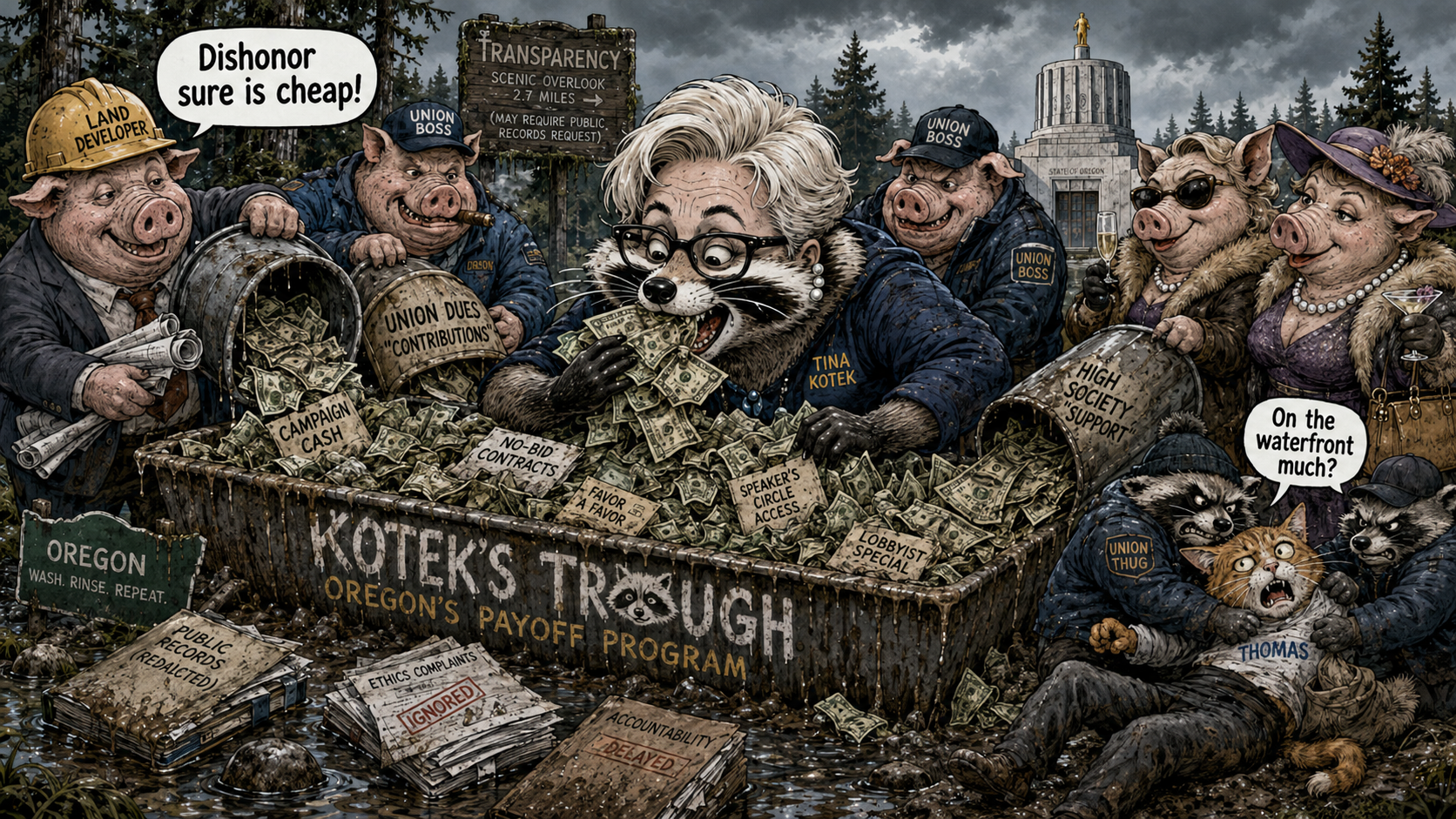
Dishonorable systems rarely carry their own costs. They reward those who feed the trough, protect those who control access, and transfer the blows to honorable people who insist that money, power, and the public record must still answer to one another.
The Confession Above the Signature
Most signing letters explain why a bill deserves to become law.
Tina Kotek’s letter concerning House Bill 4018 does something stranger. It begins by admitting the defect.
On April 9, 2026, the governor informed Secretary of State Tobias Read that she would sign the bill “despite its flaws” because Oregon needed contribution limits to begin as planned the following year. She invoked mounting pressure upon democratic institutions, argued that the state could not risk derailing its overdue reform, and described the bill as necessary to keep implementation on schedule. Then, before placing her signature beneath the decision, she stated that the measure appeared to go beyond sequencing and could “weaken enforcement standards, narrow disclosure requirements, and introduce new ambiguities.”
That sentence should not disappear beneath the ceremony.
It distinguishes this case from the ordinary political accusation that an executive failed to notice a bill’s hidden defect. Kotek noticed. She named three separate categories of danger, enforcement, disclosure, and statutory clarity, before signing the measure into law.
She also identified the provisions that required later repair. Coordinated expenditures needed clear treatment as contributions. Voters needed to know who funded independent expenditures. The anti-evasion rule built around an entity’s “sole purpose” needed strengthening. Kotek asked the 2027 Legislature to correct those weaknesses, then closed her letter by acknowledging that HB 4018 was not the final word: “There is more work to be done.”
The OOPS series proceeds from a simple standard: labels do not perform absolution; they make representations. A Democratic governor may believe sincerely in campaign-finance reform, yet the party label cannot convert a consciously accepted enforcement weakness into democratic strength.
The issue here is not whether Kotek secretly wanted loopholes. The public record reviewed for this article does not establish bribery, donor-directed drafting, quid pro quo, personal enrichment, or a scheme designed to benefit a named campaign. The narrower finding carries enough weight:
Governor Kotek knowingly accepted identified democratic-control risks because she personally deemed the alternative implementation risks to be worse.
That is not a corruption charge. Oregon has a way of preventing records that substantiate those charges from seeing the light of day. It is, however, an accountability finding.
The Implementation Crisis Was Real
A fair account must begin with the strongest evidence favoring the governor’s decision.
Oregon did face a serious implementation problem.
The Legislature passed House Bill 4024 in 2024 to create campaign-contribution limits, restrict networks designed to evade them, establish new committee categories, require added disclosure for certain independent expenditures, impose investigation deadlines and penalties, limit campaign-fund carryovers, and build a public campaign-finance dashboard. The Secretary of State’s office later warned that implementation required major changes to ORESTAR, new administrative rules, internal procedures, public guidance, staff training, and external-user education.
Secretary of State Tobias Read supported HB 4018 because the 2024 law had left his office with unclear requirements, insufficient resources, an aging technology platform, and a timeline he regarded as dangerous. In testimony, Read warned that a confused or legally vulnerable launch could make compliance easiest for campaigns wealthy enough to employ specialized counsel while eroding public confidence in the reform itself. He argued that HB 4018 preserved the essential contribution limits while giving the state more time to build the complicated disclosure system.
Legislators across party lines voiced similar concern. The bill passed the House 39 to 19 and the Senate 20 to 9. Several supporters made clear that they regarded the decision as an unpleasant rescue operation rather than an ideal reform. Senator Lew Frederick opened his written floor explanation with the admission, “I do not want to vote yes,” then concluded that allowing the existing implementation structure to proceed unchanged posed the greater danger.
HB 4018 appropriated $1,552,520 to the Secretary of State for the first implementation phase. It preserved the January 1, 2027 start date for contribution limits, provided a fourteen-day cure period for excess contributions, modified committee categories and contribution rules, and changed numerous definitions and procedures.
As of August 2026, the Elections Division reports that its six core Phase One deliverables remain on track for January 1, 2027. Those deliverables include new rules and guidance, ORESTAR modifications, address protections, internal staff preparation, and training for external filers. The office also warns that the project has no margin for unexpected delay.
These facts matter because accountability fails when criticism erases the constrained choice.
Kotek did not select between a flawless reform and a flawed one. She confronted competing risks: preserve the original statutory design and risk a confused, underfunded, possibly failed launch, or modify that design so contribution limits could begin while postponing and revising other protections.
A veto would not automatically have produced a clean system. Nor does the record prove that advocates’ preferred amendments could have been enacted, funded, tested, and deployed within the remaining time.
The implementation problem was real.
So was the compromise chosen to solve it.
When a Technical Fix Becomes a Substantive Choice
Supporters repeatedly described HB 4018 as a technical-fix bill.
Much of it was technical. The measure renamed committees, corrected cross-references, restored statutes needed during the transition, adjusted filing deadlines, protected certain personal information, revised the penalty matrix, and supplied the Secretary of State with money and time. The Oregon Business and Industry testimony supporting the bill described extensive work among business and labor representatives, community organizations, treasurers, election officials, and policymakers to produce a workable system.
Yet a bill does not remain merely technical because its supporters use that adjective.
The Legislature’s own staff summary records changes with unmistakably substantive consequences. HB 4018 moved major disclosure-reporting and dashboard provisions from 2028 into a later implementation sequence, with disclosure requirements beginning in 2031 and the dashboard applying to elections after January 1, 2032. It delayed some complaint, enforcement, and anti-proliferation provisions; revised original-source reporting; changed contribution limits and in-kind contribution rules; altered carryover allowances; and permitted corporations and labor organizations to establish separately segregated political funds.
The dashboard delay alone moves a central public-transparency promise roughly four years beyond its original target. That dashboard was intended to show major contributors, aggregate political giving, industry patterns, original sources of independent-expenditure funding, campaign costs, and categories of spending. Under HB 4018, the Secretary of State must create it by January 1, 2032, and several dashboard-dependent disclosures apply to elections occurring afterward.
A delay may still be justified. Building a reliable disclosure system takes money, software, staff, testing, rules, and time. The honest description, however, is not that nothing substantive changed.
Kotek’s own letter closes that rhetorical escape. Once the governor says a measure may weaken enforcement and narrow disclosure, “technical fix” can no longer serve as the final classification.
The phrase may describe parts of the bill.
It cannot describe away the parts she warned about.
A Limit Is Only One Part of a Control System
Campaign-finance reform works through several distinct controls.
Contribution limits restrict the amount that a person or organization may give. Disclosure reveals who supplies political money and, in more complicated structures, where that money originated. Anti-evasion rules prevent nominally separate entities from multiplying a contributor’s lawful limit. Coordination rules distinguish genuinely independent political speech from spending functionally arranged with a candidate. Investigations, penalties, and public reporting give the system a means to detect and correct violations.
These controls perform different work.
A state can impose numerical limits while leaving the public unable to see who financed political activity. It can publish extensive donor information while allowing related entities to multiply contributions. It can prohibit excessive giving but define coordination so ambiguously that enforcement becomes costly, slow, or vulnerable in court.
HB 4018 does not eliminate Oregon’s contribution limits. Beginning in 2027, an individual may give a candidate committee up to $3,300 per election, a multicandidate committee up to $5,000 per year, and party or legislative caucus committees up to $10,000 per year. Other committee categories remain unlimited. These changes represent a major departure from Oregon’s recent system of unrestricted political contributions.
That improvement should not be minimized.
Neither should it substitute for the rest of the control environment.
The Campaign Legal Center urged Kotek to veto HB 4018, arguing that deleting explicit coordinated-expenditure language could create uncertainty about whether coordinated spending would count as a contribution. The organization also criticized the “sole purpose” test for related entities and identified inconsistencies it believed would complicate enforcement. Those arguments came from an advocacy organization rather than a court, and the bill’s supporters disputed them. Still, Kotek’s signing letter independently identified the same three areas as needing repair.
That convergence matters.
The most damaging witness against the claim that HB 4018 involved only harmless technical cleanup is not an opposition activist, a rival candidate, or a newspaper columnist.
It is the governor who signed it.
The Disclosure Bargain
Kotek’s decision embodies a recognizable form of administrative reasoning.
Begin the limit now. Build the more complicated visibility system later. Accept some ambiguity so the principal reform can survive its launch.
In certain circumstances, phased implementation represents sound governance. A system that attempts everything at once may accomplish nothing. Privacy, software architecture, filer education, investigations, appeals, rulemaking, and public reporting cannot be wished into existence by statutory deadline.
Phasing becomes dangerous, however, when the deferred component supplies the evidence needed to determine whether the first component works.
The public will soon receive contribution limits, but some of the architecture designed to illuminate original funding sources and display campaign-finance activity will arrive years later. The state will therefore begin regulating a complex money network before completing the most ambitious tools for seeing that network.
This does not make the limits fictional.
It makes the reform asymmetrical.
Candidates, committees, corporations, unions, parties, advocacy organizations, election officials, and sophisticated donors will begin adapting to the new law in 2027. The public dashboard intended to translate much of that activity into accessible civic knowledge is scheduled for 2032.
The institutions with lawyers, treasurers, political consultants, and established relationships will understand the system first. Ordinary voters will receive the public-facing instrument later.
One may accept that bargain because the alternative risks postponing contribution limits themselves.
One should not pretend the bargain carries no democratic cost.
Reader-supported public-interest work
Help keep careful research open.
Ultra Verba Lux Mentis is a nonprofit research organization. Voluntary gifts help fund open research, independent review, accessibility, public education, documentation, and practical public-interest tools.
This article and UVLM’s public materials remain available whether or not you donate.
Opens the UVLM donation page in a new tab. Giving is always optional.
Who Entered the Drafting Room?
The process by which HB 4018 emerged remains contested.
Oregon Business and Industry said the amendments resulted from many hours of good-faith discussion involving business and labor representatives, community-based organizations, campaign treasurers, the Secretary of State’s office, and policymakers. Other supporters, including the Oregon League of Conservation Voters, Oregon Nurses Association, and Oregon Futures Lab, argued that the bill protected ordinary participation by preventing a chaotic rollout that would favor sophisticated campaigns.
Honest Elections Oregon told a sharply different story. Its testimony said campaign-finance reform organizations had been excluded from the process and that an 84-page amendment appeared at 5:23 p.m. before an 8:00 a.m. hearing the next morning. Two days later, according to the same testimony, a 95-page amendment appeared at 11:33 a.m. before another 8:00 a.m. hearing. OPB and the Oregon Capital Chronicle also reported that good-government organizations said legislative leaders had shut them out while consulting business and labor interests.
Those accounts do not prove a secret conspiracy. They do reveal a dispute that deserves more than a procedural shrug.
A campaign-finance law governs the relationship between money and political access. Its legitimacy therefore depends partly upon transparent answers to basic questions: Who participated in drafting the amendments? Which language came from election administrators, political parties, unions, business groups, public-interest advocates, legislative counsel, or leadership staff? Which recommendations were accepted, modified, or rejected, and why?
Kotek acknowledged concerns not only about the bill, but also about “the process to draft and pass” the changes. That acknowledgment prevents the administration from dismissing the process complaint as an invention of disappointed outsiders.
The Legislature may have chosen the best available compromise.
A process compressed into late amendments and disputed access makes that conclusion harder for the public to verify.
The Future Legislature as Repair Shop
Kotek did not sign HB 4018 and simply hope for the best.
On the same day, she signed Senate Bill 1502, which requires the Secretary of State to file a proposed measure for the 2027 session recommending changes to the campaign-finance limits and related reporting system based on implementation experience under HB 4024 and HB 4018.
That creates a real corrective mechanism. The Secretary of State must study the developing system, prepare recommendations, and place a proposal before the next Legislature.
Yet a repair pathway is not the same thing as a repaired control.
The Secretary of State can recommend. The Legislature may amend, delay, dilute, reject, or fail to act. Political coalitions can change. New ambiguities may appear only after regulated actors test the statute. A future bill may enter the same negotiation structure that produced the present one.
Kotek’s request therefore resembles a management decision to accept a known residual risk while assigning remediation to a later period.
Internal-control professionals recognize the form. A responsible risk acceptance should identify the defect, the owner, the mitigation, the due date, the monitoring process, and the evidence required for closure.
Kotek identified several defects and pointed toward a legislative owner. SB 1502 creates a reporting route. The Elections Division’s current implementation page supplies ongoing milestones for the 2027 launch.
What remains missing is closure.
Until lawmakers enact an adequate correction, the signing letter should remain attached to the law as an open finding.
Transparency Is Not Absolution
Kotek deserves credit for issuing the letter.
Executives often sign compromised legislation while allowing ceremonial language to imply confidence they do not possess. Kotek instead placed the uncertainty into the public record. She acknowledged the advocates who had raised concerns, named the weaknesses she saw, and asked legislators to repair them.
That transparency improves the decision.
It does not erase the decision.
Public disclosure allows Oregonians to judge the trade rather than mistake it for an uncomplicated success. It also prevents later officials from claiming that nobody anticipated the ambiguity, the enforcement problem, or the narrowed disclosure.
The letter therefore performs two opposing functions at once.
It mitigates the failure of transparency by revealing the governor’s reasoning, yet it strengthens the case for accountability because it establishes knowledge before authorization.
Kotek cannot fairly be accused of hiding every concern.
She also cannot fairly claim she did not know.
What the Record Does Not Establish
The documentary record reviewed here does not show that Tina Kotek signed HB 4018 in exchange for campaign money, at the direction of a donor, to protect a particular union, corporation, party, or candidate, or to enrich herself.
It does not prove that every disputed provision will become an exploitable loophole. Courts have not yet interpreted the contested coordination and anti-evasion language. The Secretary of State has not yet completed rulemaking, and the limits have not yet operated through a full election cycle.
Nor does the record prove that vetoing HB 4018 would have produced a superior result. State election administrators described a credible risk of failed implementation, legal confusion, and a system navigable chiefly by well-funded campaigns. The Legislature supplied additional money, and the Elections Division now reports that Phase One remains on schedule.
Those limits matter because criticism becomes propaganda when it treats uncertainty as permission to invent motive. However, this does not preclude a concerned citizen from drawing up a nexus of beneficiaries.
Plainly, though, the evidence supports a more exact conclusion:
Kotek signed a bill she decided was necessary to preserve Oregon’s contribution-limit deadline, even though she understood, as most career politicians do, that the same bill would weaken other safeguards essential to meaningful campaign-finance accountability.
One need not inflate that finding. Although it is funny that the money flows more easily and that she is a beneficiary… So, one should not dilute it either.
Signed With Eyes Open
Political leaders often ask to be judged by the difficulty of the choices they face.
They should be.
Difficulty explains why a compromise became plausible. It does not remove authorship from the person who chose it. Nor should we not question whether the difficulty of the choice as an officer translates to personal difficulties as a candidate.
Kotek decided that contribution limits beginning in 2027 justified accepting statutory ambiguity, delayed transparency (a recurring theme in her administration,) and possible enforcement weakness while Oregon attempted to build the rest of the system. She recorded that judgment in a letter, signed the law, and assigned repair to the next legislative session.
The decision may prove defensible if you squint really hard.
The limits may work. Rulemaking may close part of the ambiguity so long as the inevitable “Committee on Rulemaking Rules” rules that rulemaking rules can being proposing rules... Which will someday allow the Secretary of State to build a beaver damn of a reliable system. The 2027, or 28 or 29, Legislature may treat coordinated expenditures clearly as contributions, strengthen the sole-purpose test, preserve original-source disclosure, and supply the money needed for durable enforcement. Should those things occur, the public record should say so, and this article should receive an update.
Accountability does not require failure to be permanent.
It requires responsibility to remain visible until repair becomes real.
Oregon should therefore resist two equally convenient stories. The first says HB 4018 destroyed campaign-finance reform and rendered every limit meaningless. The available evidence does not establish that. The second says the bill merely corrected technical details while leaving the substance untouched. The governor’s own letter makes that story impossible.
The truth lies in the uncomfortable middle.
Oregon gained an implementable path toward contribution limits by accepting a weaker and later path toward some forms of transparency and enforcement. Kotek judged that exchange necessary. She did not make it unknowingly.
Her signature belongs beneath the contribution limits.
It also belongs beneath the exceptions, delays, ambiguities, and repair promises.
The eyes were open.
The record should remain open with them.
This article relies primarily upon Governor Kotek’s April 9, 2026 signing letter; the enrolled text and legislative staff summary for HB 4018; the Oregon Secretary of State’s implementation materials; official testimony from Secretary Tobias Read and participating organizations; Senator Lew Frederick’s written vote explanation; Senate Bill 1502; and reporting by Oregon Public Broadcasting and the Oregon Capital Chronicle. Advocacy materials establish the positions and analyses of their authors, not adjudicated facts.The article does not allege bribery, corruption, conspiracy, quid pro quo, donor control, or personal enrichment. It invites documentary correction concerning the drafting process, implementation status, interpretation of coordinated expenditures, anti-evasion rules, disclosure obligations, or later legislative repair.Government records establish what the bill says, what officials represented, and what implementation actions the state reports. Legislative testimony and advocacy documents establish the analyses and positions of their authors; they do not independently adjudicate disputed legal effects. News reporting supplies contemporaneous context, quotations, process history, and competing accounts. The article’s central accountability finding rests most heavily upon the enrolled law, official implementation record, and Governor Kotek’s own signing letter.
Works Consulted
Primary government and legislative sources
Kotek, Tina. “RE: House Bill 4018.” Letter to Oregon Secretary of State Tobias Read, April 9, 2026. The governor explains why she signed HB 4018 “despite its flaws” and identifies concerns involving enforcement, disclosure, coordination, anti-evasion language, and statutory ambiguity.
Oregon Legislative Assembly. Enrolled House Bill 4018-B, 2026 Regular Session, subsequently assigned Chapter 139. The controlling statutory text modifies campaign-finance timelines, committee classifications, contribution rules, disclosure provisions, cure procedures, and related implementation requirements.
Oregon Legislative Information System. “HB 4018, 2026 Regular Session.” Measure overview, enrolled text, amendments, votes, fiscal materials, and official legislative status.
Oregon Secretary of State, Elections Division. “Campaign Finance Reform Implementation.” Current implementation schedule, Phase One deliverables, contribution-limit timing, ORESTAR work, rulemaking, guidance, training, and implementation-risk disclosures.
Oregon Legislative Assembly. Senate Bill 1502, 2026 Regular Session. Directs the Secretary of State to pre-session file a 2027 legislative proposal based upon experience implementing HB 4024 and HB 4018.
Legislative Policy and Research Office. SB 1502 Staff Measure Summary. Describes the required 2027 recommendations and situates them within Oregon’s developing contribution-limit and disclosure system.
Official testimony and vote explanations
Read, Tobias. “Testimony of Tobias Read, Oregon Secretary of State, in Support of HB 4018.” House Committee on Rules, February 10, 2026. Read argues that the bill preserves contribution limits while giving the state a realistic implementation path for technology, enforcement, guidance, and disclosure.
Frederick, Lew. “Vote Explanation, HB 4018-B: Campaign Finance Reform.” Oregon State Senate, March 5, 2026. Frederick describes the bill as flawed and difficult, while arguing that the risks of inaction and a failed 2027 launch were worse.
Mann, Preston, Oregon Business & Industry. “Support for HB 4018-8.” House Committee on Rules, February 12, 2026. OBI characterizes the amendments as the product of stakeholder negotiation and argues that delayed implementation was necessary for a functional system.
Llewellyn, Patrick, Campaign Legal Center. “Testimony in Opposition to HB 4018-6.” House Committee on Rules, February 11, 2026. The testimony analyzes coordinated expenditures, entity-proliferation rules, firewall language, and ambiguities the organization believed could weaken the 2024 reforms.
Meek, Daniel, Honest Elections Oregon. “Testimony on HB 4018 in Opposition to Proposed -6 Amendment.” House Committee on Rules, February 10, 2026. The testimony documents the organization’s objections to the drafting process, disclosure delays, anti-evasion language, in-kind contribution rules, carryover provisions, and original-source reporting.
Journalism and contemporaneous reporting
Dole, Bryce. “Oregon Democrats’ Campaign Finance Proposal Would Establish Spending Limits, Push Back Other Provisions.” Oregon Public Broadcasting, February 11, 2026. The report explains the early amended proposal, the implementation argument, the delayed public tracking system, and the divide between institutional stakeholders and good-government advocates.
Baumhardt, Alex. “Oregon Lawmakers Reveal Reworked Plans to Partially Delay Campaign Finance Law.” Oregon Capital Chronicle, February 11, 2026. The report covers the extensive amendment, delayed provisions, and competing descriptions of the measure as implementation rescue or substantive weakening.
Baumhardt, Alex. “Shut Out of Campaign Finance Bill, Good Governance Groups Tell Lawmakers to Vote Against It.” Oregon Capital Chronicle, republished by Oregon Public Broadcasting, February 23, 2026. The report examines disputed drafting access, business and labor participation, coordinated expenditures, in-kind contributions, and anti-evasion concerns.
Baumhardt, Alex. “Good Governance Groups to Take Campaign Finance to Ballot if Lawmakers Adopt Loopholes.” Oregon Capital Chronicle, March 4, 2026. The report documents opposition groups’ threat to pursue ballot action and their request that Kotek refuse the legislation.
Dole, Bryce. “Oregon Legislature Passes Campaign Finance Bill Over Good Government Pushback.” Oregon Public Broadcasting, March 6, 2026. The report covers the final legislative votes, lawmakers’ acknowledged misgivings, the implementation rationale, disputed loopholes, and the commitment to revisit the system in 2027.
Ballotpedia News. “Oregon Enacts Campaign Finance Changes, Four Other Election Bills in 2026.” April 23, 2026. Provides a concise post-enactment summary of HB 4018’s principal changes and delayed dashboard implementation.
The above commentary is published in alignment with Ultra Verba Lux Mentis’s mission statement to amplify neurodiverse voices while researching cognitive offloading technologies to aid neurodiverse persons in participating within sectors of societal power traditionally denied them. It does not reflect the viewpoints of the organization itself.
Political satire created under the editorial direction of Thomas Prislac and Ultra Verba Lux Mentis, with AI-assisted illustration, 2026.