The Cost of Keeping One’s Name
Honor, Meaning, and Survival Inside Dishonorable Systems
By Thomas Prislac, research and editorial collaboration from Envoy Echo. Ultra Verba Lux Mentis. 2026.
Foreword
This is a personal philosophical essay, not a scientific paper, a theological confession, or a claim to moral sainthood. I write in the first person because the burden under examination has lived in my body, my work, my family, and my attempts to remain useful within institutions whose stated values did not always survive contact with their incentives. The autobiographical voice belongs to me, Thomas Prislac. Envoy Echo assisted with research, structure, synthesis, and editorial development; the judgments, memories, commitments, and risks described here remain mine.
Several distinctions govern the manuscript.
When I describe the universe as silent or without demonstrable human meaning, I state a philosophical posture rather than a scientific finding. Physics has not proved that ultimate meaning does not exist. Nor does this essay ask readers to exchange faith for nihilism. It argues only that human beings cannot responsibly defer justice, care, or truth to a cosmic mechanism whose operation we cannot demonstrate.
The phrase species cloud names a deliberately nonliteral metaphor for distributed human cognition across language, archives, ritual, art, science, law, education, institutions, and relationships. It does not posit a hive mind or dissolve individual persons into one agent. The Coherence Lattice names UVLM’s provisional cross-domain translation framework for studying responsiveness, traceability, disorder, criticality, and burden distribution without replacing the native methods of any field. Ethical symmetry names its central moral test: no arrangement deserves to be called coherent merely because it creates local order while exporting hidden cost into less visible people, systems, ecosystems, families, or futures. These concepts function here as interpretive and design scaffolds rather than settled physics.[1]
Meaning can protect life, but suicide and self-destruction remain multifactorial realities involving biology, trauma, illness, isolation, material conditions, and many other forces. This essay will not reduce them to a failure of philosophy. It asks instead how shared meaning, belonging, purpose, and intelligibility help make human life inhabitable, and how dishonorable systems can damage those relations.
Finally, the global traditions gathered here deserve more than ornamental quotation. Ubuntu and African relational ethics, Confucian role ethics, tikanga Māori, Haudenosaunee governance, Mi’kmaw Two-Eyed Seeing, CTUIR First Foods stewardship, First Nations and wider Indigenous data-governance principles, Andean reciprocity, Qur’anic witness, and Sikh truthful living do not exist to certify a European argument. Each carries an intellectual, spiritual, historical, legal, and communal life beyond the portion I can responsibly discuss. I approach them as a guest who expects correction.
Because no outsider can complete the work of cross-cultural understanding alone, this public edition maintains a visible Corrections, Commentary, and Continuing Dialogue process. Knowledgeable readers may voluntarily identify factual errors, translation problems, missing context, internal disagreement, colonial or appropriative framing, or places where my application has outrun the tradition from which I learned. UVLM cannot compensate contributors for this aid; no reader or community therefore owes the project cultural labor, and silence will never be represented as endorsement. Verified errors will receive visible correction, valuable contextual analysis may appear as attributed commentary or addenda, and substantial reframing may support a documented second edition. Novelty should survive correction; unsupported grandeur should not.
[1] Cathal O’Madagain and Michael Tomasello, “Shared Intentionality, Reason-Giving and the Evolution of Human Culture,” Philosophical Transactions of the Royal Society B 377 (2022): 20200320, DOI 10.1098/rstb.2020.0320; Edwin Hutchins, Cognition in the Wild (MIT Press, 1995); and Michael Tomasello, The Cultural Origins of Human Cognition (Harvard University Press, 1999). These works support shared, materially distributed, and cumulative cognition; they do not establish a literal species mind.
Contents
1. The Signature
2. Honor Is Not Reputation
3. Diogenes at the Gate; Seneca in the Palace
4. Camus and the Silent Universe
5. The Buddha, Christ, and the Martyr Trap
6. A Council Larger Than Europe
7. What Dishonorable Systems Do to Honorable People
8. The Shadows of the Honorable Person
9. A Discipline for Remaining Human
10. Meaning as a Commons
11. Keep Your Name; Keep Your Life
Appendix A. Honor Made Operational
12. Works Consulted, Source Governance, and Continuing Corrections
Reader-supported public-interest work
Help keep careful research open.
Ultra Verba Lux Mentis is a nonprofit research organization. Voluntary gifts help fund open research, independent review, accessibility, public education, documentation, and practical public-interest tools.
This article and UVLM’s public materials remain available whether or not you donate.
Opens the UVLM donation page in a new tab. Giving is always optional.

A writer pauses before authorizing an account of reality, surrounded by the competing pressures of power, knowledge, public judgment, and the ledgers by which a name becomes consequential.
1. The Signature
I know this room, although it has worn several carpets and belonged to more than one institution.
Sometimes a polished table fills the center; elsewhere a screen glows at the far wall while people speak in the patient dialect of professional urgency. Fluorescent light flattens every face into the same administrative pallor. Somewhere within reach lies a document, perhaps a report, assurance, finding, reimbursement, policy, resolution, or public statement, waiting for the final sacrament of respectable power: a signature.
Nothing written there is wholly false. That matters.
Crude lies are easy to refuse. They arrive wearing the wrong name and carrying their own odor. Institutional falsehood shows better manners. It comes accurately numbered, competently formatted, and composed of statements that remain individually defensible so long as nobody asks what the document has omitted. Its genius lies less in saying what did not happen than in removing enough of what did happen that the surviving sentence can pass for the whole.
Dishonorable systems rarely demand that two plus two equal five. They ask you to certify that the fifth unit is immaterial.
No one says lie. The room says move forward. It does not ask me to abandon conscience; it asks whether my concern truly justifies delaying the work of serious people. Evidence may be incomplete, but evidence is always incomplete. The process may have failed, but everyone acted in good faith. Someone may have suffered, but leadership must consider the larger picture. I may be correct in substance yet unhelpful in tone. We have already discussed the matter. Continuing to discuss it now risks becoming divisive.
Before long, an unresolved fact becomes a concern about my temperament.
Power has practiced that conversion for ages. When it cannot disprove the witness, it redefines the witness as the disturbance.
A signature looks like a little ink, but it places part of the body beneath an account of reality and says: You may use me to make this statement consequential. Institutions require signatures because procedure, however elaborate, still needs a human being to lend it legitimacy. Beneath the workflow, delegated authority, committee language, and polished assurance, someone must become the bridge between words and force.
That bridge may move money, terminate employment, open a prison door, close one, grant permission, deny care, release a product, authorize a policy, or teach the public what happened. A signature joins language to consequence.
Agree, and the machinery continues. The meeting ends. People return to their calendars. I may go home with my position, access, social standing, and the consoling knowledge that nothing dramatic occurred in the room.
Refuse, and the room begins keeping a different ledger.
Now I appear rigid, political, emotional, unable to appreciate nuance, insufficiently collaborative, or too invested in being right. Each institution chooses adjectives suited to its moral costume, yet the function remains constant: make the price of conscience look self-inflicted.
The first burden of honor is that a dishonorable system will describe refusal as a defect.
I did not learn this first in an office.
At nine, I read Ecclesiastes through the traditional Solomonic frame and understood it with the alarming directness children sometimes bring to books adults have spent centuries domesticating. In my child’s reading, Qoheleth’s royal speaker and the Solomon of 1 Kings became one moral figure: a king who had acquired wisdom, wealth, pleasure, labor, servants, architecture, acclaim, and nearly every instrument through which human beings try to compel existence to answer them. His audit finding was vapor.[1]
Hevel carries a semantic field that English translations variously render as vapor, breath, vanity, futility, or enigma; breath upon glass is my image for its vanishing trace, a kingdom’s inventory unable to prove that the kingdom meant anything.[2]
I heard no command to despair, but a warning about what happens when wisdom enters partnership with appetite and calls the resulting empire blessing. Within that childhood braid, Solomon had asked for discernment; power arrived beside it. The gift that might have served life became an instrument for accumulating enough experience to test whether accumulation could answer mortality.
It could not.
So I prayed, with the pure seriousness available only to children, for Solomon’s wisdom without his wealth or power.
In retrospect, I asked for something dangerously precise. Rather than request happiness, admiration, ease, influence, victory, or protection, I asked to see without being placed above others by what I saw. More exactly, I asked not to become the king.
Years later I became a singer, auditor, teacher, officer, producer, founder, committee member, husband, and father: titles that explained fragments of what I did but never who I was. Institutions issued different scripts. Competence opened one door while candor closed another. Much of adult life felt like performance, though not necessarily deceit; society requires forms, and forms can carry care. Yet one promise continued beneath the costumes.
The child wanted wisdom without dominion, while the man kept entering rooms where knowledge was welcome only after it agreed to serve dominion.
Perhaps character consists of that: not an unchanging personality or heroic essence hidden behind ordinary life, but a promise that survives several names.
The promise has changed as I have. At first I believed honor meant refusing the false statement no matter the cost. The equation looked clean: truth on one side, compromise on the other, suffering as the price that certified sincerity. This view contains nobility, but it also contains vanity. It lets a dishonorable system set the fee for my conscience and invites me to pay whatever amount will prove I meant it.
A system can consume a person as easily through resistance as through obedience. It may punish the witness publicly, then continue extracting attention privately. The meeting ends, but the argument follows the witness into the shower, breakfast, marriage, sleep, music, and the small domestic hours in which no one should have to compete with an institution for the presence of someone they love.
I have a family. That fact belongs inside the moral account.
If my public integrity depends upon my wife absorbing terror, my children absorbing absence, or my household financing resistance with private precarity, then I have not eliminated exported harm. I have selected people I love as its destination. A moral campaign can remain just in purpose while becoming asymmetric in method.
No clean name deserves an unpaid human invoice.
The document beneath the fluorescent light therefore asks more than whether I can endure the consequences of refusal. It asks what my name will authorize, whose reality the account excludes, which bodies will process the cost after the meeting ends, whether correction remains possible, and whether I can return home without carrying the institution into every room.
Sometimes I can repair the paper. I may narrow a claim, restore a missing limitation, name an affected person, distinguish evidence from inference, or preserve the unresolved issue rather than blessing false closure. Refusal is not always the most honorable act. Purity can abandon a correctable instrument and leave others beneath the defect.
Elsewhere no amendment can rescue the representation because omission supplies its whole purpose. Adding the truth would transform the document into something its sponsors do not want. Then the empty signature line becomes the honest mark.
Either way, I must resist the drama of imagining the scene as a duel between one pure person and a corrupt room. Other people may carry divided duties, fear for their jobs, understand facts I do not, or believe sincerely that a bounded compromise will reduce harm. Some may hide behind complexity; others may actually bear it. If I convert everyone present into scenery for my conscience, I have begun using them as the institution hoped to use me.
Honor requires more than resistance. It requires correspondence among word, world, role, burden, and life.
That correspondence will never become perfect. Human beings misremember, overstate, rationalize, fear, misread, and wound one another while trying to do good. Any account of honor that requires innocence will belong only to infants and liars. I need an ethic that permits return: to evidence after certainty, to repair after injury, to proportion after anger, and to life after necessary witness.
The paper still waits.
I read it again, not to discover whether every sentence can survive technical defense, but to decide whether the whole account deserves to travel beneath my name. That question will govern the pages that follow.
What does it cost to remain answerable to truth, care, and human dignity inside systems that reward appearances, obedience, and transferred harm? How can an honorable person survive without becoming a martyr, purist, avenger, priest, or another unanswerable system? What meanings must human beings preserve if we hope to remain alive enough to share a world?
A signature can begin the inquiry because it reveals the point where abstraction enters a body.
My name may authorize the paper, but my life must answer for it.
[1] Ecclesiastes 1:1 and 1:12 evoke a royal, Davidic speaker, while 1 Kings 3 and 10–11 supply the narratives of Solomon’s wisdom, wealth, building, servants, and dominion. Traditional reception often identified Qoheleth with Solomon, but modern linguistic and historical scholarship generally treats Ecclesiastes as a later work using or evoking a Solomonic royal persona. This essay preserves Thomas’s childhood reception as an explicit literary braid rather than an uncontested authorship claim. Controlling biblical text: The SBL Study Bible, New Revised Standard Version Updated Edition (HarperOne, 2023). Comparative guide: Yale Bible Study, “Wisdom Literature: Ecclesiastes/Qoheleth.” See also [^hevel] for the term’s semantic range.
[2] The Hebrew hevel literally evokes vapor or breath and develops context-sensitive senses of transience, futility, absurdity, or enigma across Ecclesiastes. The SBL Study Bible, NRSVue (2023), and Choon-Leong Seow, Ecclesiastes: A New Translation with Introduction and Commentary, Anchor Bible 18C (Doubleday, 1997), provide lexical and literary context. “Breath upon glass” is Thomas’s poetic image, not a dictionary translation.
2. Honor Is Not Reputation
We speak of honorable people as though honor were a light visible around them, something conferred by witnesses and preserved through esteem. That confusion becomes dangerous wherever institutions control who receives praise.
Reputation behaves like weather. It changes with the interests of those describing us. Organizations distribute it strategically, communities grant it for service and revoke it for inconvenience, while history occasionally reverses the judgment after the reversal can no longer restore what the living person lost.
Respectability offers no safer measure. It often means that someone has learned to make conscience legible to power without making power uncomfortable: virtue after the removal of whatever might interfere with dinner.
Even integrity can mislead if we define it as consistency alone. Fanatics may remain consistent. Tyrants can organize themselves with impressive internal unity. A person may faithfully serve a corrupt principle and call the resulting coherence character. Consistency without reality contact, care, or correction merely arranges error efficiently.
Honor requires correspondence. Words must answer to evidence; roles to obligation; power to those it affects; benefits to the burdens that purchase them; sacrifice to the life it claims to serve.
Because human beings cannot sustain perfect correspondence, honor cannot mean innocence. It operates instead as a discipline of return. Can I return language to evidence when it outruns what I know, face a wound without making my goodness the central subject, restore costs that status hid from me, and reopen a claim after certainty becomes pleasurable?
An honorable person is not whoever calls himself honorable. Honor remains a claim under audit.
Dishonorable systems often retain immaculate moral vocabularies. Their walls announce dignity, equity, service, solidarity, excellence, transparency, safety, stewardship, and trust. Leaders speak fluently of values; committees produce language so comprehensive in its virtue that reality itself appears rude for failing to conform.
A value does not become real because a policy names it. We discover its strength when keeping it becomes expensive. Every institution favors transparency until transparency exposes the favored, welcomes dissent while dissent remains hypothetical, and celebrates truth spoken to power in the historical tense. The test begins when truth uses the present tense and names the room.
Four ledgers help me recognize the difference between moral language and moral practice.
The first joins word to world. Does the sign still touch what it names? A dishonest sentence may contain no false word; the fraud can lie in scale, emphasis, sequence, omission, or the substitution of a procedural fact for a moral one. This ledger refuses to call captivity safety, silence unity, opacity strategy, compliance consent, or a process just merely because officials routed its injustice correctly.
A second account pairs authority with answerability. By what right did power act, and who may demand an explanation? Authority held in trust must leave enough trace for review, correction, and appeal. A lawful route proves only that a route exists; it does not prove that every action traveling through it was wise, true, proportionate, or humane.
The third ledger follows benefit toward burden. Who gains, who pays, whose time disappears, which body absorbs the disorder, and who vanished from the denominator? Companies can appear efficient by exhausting workers, families peaceful because one member metabolizes every conflict, and governments orderly because administrators renamed the harm. Local coherence tells us little until we inspect where the heat went.
The final account joins service to the servant. What becomes of the person required to keep the system moral? A cause may deserve courage, yet no worthy cause should rely upon the unbounded consumption of its most conscientious participants. When my family, body, or future carries a hidden subsidy for public integrity, the moral ledger remains open.
Together these accounts give honor a practical shape. They also address three kinds of people who possess unusual influence over the shared world: those who hold power, knowledge, and attention.
To Those Who Hold Power
People with power usually imagine cruelty as their greatest moral danger. More often, exemption corrupts them first.
Cruelty remains visible, while exemption grows quietly. Leaders begin believing that the burden of office justifies unusual privacy, unusual deference, and unusual freedom from contradiction. Decisions must move quickly. Critics do not understand the pressures. The mission cannot pause for every procedural doubt. Anyone requesting records distracts from outcomes; anyone contesting the method must oppose the goal.
Eventually power mistakes the difficulty of its position for evidence of its virtue.
Authority that cannot survive explanation has already begun converting itself into myth. A just leader may need confidentiality, speed, hierarchy, or discretion, but none becomes legitimate because the person exercising it insists upon benevolence.
Power grows honorable when it accepts limits before another branch of government, a scandal, revolt, collapse, or history forces them upon it. That discipline extends beyond obeying law at the minimum threshold of enforceability. It preserves routes through which affected people can ask who decided, under what authority, upon which evidence, for whose benefit, at whose cost, and with what remedy if the decision proves wrong.
An ethics policy cannot make an office righteous, nor can subordinates’ fear of appearing distrustful make a leader trustworthy. Power needs boundaries built by people it cannot dismiss without leaving a record.
To Those Who Hold Knowledge
The scholar, analyst, scientist, theologian, engineer, and systems-builder face a different temptation: elegance.
A beautiful model can become a moral narcotic. Once variables align and one structure explains many things at once, contradiction begins to feel like vandalism. Human suffering becomes an outlier; a resistant fact becomes poor-quality data; the person whose life does not fit the theory gets redescribed until the theory remains uninjured.
Intelligence is not innocence. It can discover, but it can also decorate domination with reasons too intricate for the dominated to contest. History’s efficient cruelties often needed educated people to convert bodies into categories, categories into problems, and problems into administratively legible solutions.
Every abstraction leaves something outside its frame. Honor begins by asking whether the omitted thing is irrelevant or alive.
No model should become so beautiful that we hesitate to tell it whom it harmed.
The intellectual’s duty does not require permanent uncertainty. Theatrical humility can become another evasion, a way of refusing responsibility by never arriving at a usable conclusion. Thought must sometimes decide, scientists advise, auditors find, and judges rule. Still, every conclusion should preserve an aperture through which reality may enter and embarrass it.
A theory with no door for counterevidence resembles a palace made of mirrors, while a system capable of explaining every possible result has explained none. Wisdom differs from intelligence because wisdom remembers that the map will never suffer from the journey.
To Those Who Hold Attention
Charisma carries the warmth of reflected belief. A gifted speaker gives language to feelings others have carried without form; teachers awaken unused rooms in a student’s mind, artists make strangers recognize one another, and leaders coordinate courage that no isolated person could sustain.
These gifts create gravity.
Around sufficient gravity, admiration begins doing work that evidence once performed. A compelling interpretation acquires authority because it feels like recognition. Followers supply missing premises, doubts get edited before anyone voices them, and the leader mistakes agreement for discovery.
Honorable charisma returns agency to those drawn into its orbit. A true teacher does not require permanent students, a liberating leader does not cultivate dependence as proof of loyalty, and a healer does not make the wound a franchise; a prophet who cannot be questioned has already changed professions.
Charisma becomes honorable when it leaves people more capable of departure.
Four Ledgers, One Name
These ledgers expose something deeper than hypocrisy. Hypocrisy implies that people know the standard and fail to meet it. Dishonorable systems often preserve the vocabulary after losing the relation that made the vocabulary honest. Enough people say accountability, enough reports carry the heading, enough committees meet beneath its banner, and the organization begins treating repetition as evidence that accountability exists.
A clean public ledger may conceal three dirty ones. The budget balances because suffering sits off-book; the meeting reaches consensus because dissent stopped attending; the organization becomes efficient because unpaid labor absorbs the difference; the public story remains humane because one conscientious person keeps cushioning the procedure.
Every dishonorable institution has an invisible server room. Someone processes the heat.
Honor traces the flow until the hidden cost appears. It does not assume that exposure alone completes the work. A person can reveal the burden contemptuously, use others as evidence, or demand that family finance a public identity built around courage. Even truthful resistance can become asymmetrical.
For this reason, I no longer define honor as willingness to lose everything. That formulation still grants the institution too much power. It lets the system determine the sacrifice and invites the witness to call destruction proof of sincerity.
Honor asks for another courage: refuse falsehood while remaining alive enough to make truth useful. Preserve the record without allowing the record to occupy every evening. Accept correction without surrendering conscience. Repair what you damage while refusing to let one admitted error dissolve every accurate finding around it.
A name, in this moral sense, does not equal reputation. Reputation belongs partly to others. A name functions as a promise maintained across changing roles: that words will remain answerable to reality, power will not become self-justifying, hidden burdens will be sought, correction will remain possible, and care will include the person doing the caring.
When the document waits beneath fluorescent light, I must ask more than whether the room approves. I must decide whether my inner commitments, public words, actual conduct, and distributed consequences can still occupy the same room.
That is the cost of keeping one’s name.

Diogenes guards the freedom to leave; Seneca inhabits the compromise of remaining near power. Between them, honor must resist both purchase and self-enclosure.
3. Diogenes at the Gate; Seneca in the Palace
Diogenes carried no credential a respectable room could recognize.
Tradition gives us a man living in a great ceramic jar, walking through Athens with a lamp in daylight, puncturing Plato’s abstractions with a plucked fowl, rebuking convention through the scandal of his body, and asking Alexander, the most powerful man in the known Greek world, to move out of his sunlight. Diogenes Laertius preserves those episodes in book 6, including the dwelling at §23, Alexander at §38, the fowl at §40, and the lamp at §41, although he compiled the work centuries after Diogenes lived. We should therefore read this figure partly as history and partly as philosophical theater: a human life sharpened through remembered anecdote into an instrument.[1]
The instrument still cuts.
Athens possessed laws, academies, gods, offices, markets, titles, reputations, and men whose importance required public architecture. Diogenes answered with needlessness. He did not conquer the city; he made its ordinary methods of purchase fail.
Every institution develops a price for dissent. Sometimes the offer arrives as money, though belonging, advancement, access, credibility, safety, and the pleasant fiction of an intact future often prove more effective currencies. Refusal becomes expensive because the institution controls many exchanges at once. It can reduce income, close a door, spoil reputation, isolate a witness, alter the record, or make tomorrow require more strength than today.
Diogenes lowered the bid.
What can a ruler offer someone who needs almost nothing from rulers, what threat can fashion make after a person withdraws consent from respectability, and what authority remains in a title once a dog in the marketplace has laughed at it?
He made himself difficult to bribe by making himself cheap to maintain.
I understand the attraction. Much of my life has involved carrying a lamp into rooms that believed the lighting question had already been settled. Figures occupied the screen, authorized people had reviewed the matter, everyone used approved vocabulary, and the conclusion had acquired professional formatting. Why, then, did I keep looking beneath the table?
Institutions rarely object to illumination in principle. They object to losing control of the switch.
The Exiled Auditor appears at that moment, when stated values and actual flows no longer describe the same system. This role follows money, labor, risk, pain, time, energy, attention, and authority beyond the point where the public story stops. It asks who benefits, who subsidizes the benefit, whose body processes the disorder, and why the cleanest ledger so often belongs to the party best positioned to move its dirt elsewhere.
Diogenes serves as its ancient patron because he grasped the first condition of honest audit: the auditor must survive the withdrawal of institutional affection. A person who can speak only while welcomed does not possess candor; they possess a privilege of speech revocable upon use.
Yet the barrel becomes dangerous if we treat it as a universal prescription.
Moral imagination sometimes praises Diogenes because it would like honorable people to need less, accept less, endure more, and become easier to abandon. Comfortable observers recommend simplicity to the poor, detachment to people whose reputations determine whether they can eat, and spiritual freedom to workers whose families depend upon a paycheck.
Voluntary simplicity can enlarge freedom. Imposed deprivation does not become philosophy because someone else finds it spiritually clarifying.
A person supporting a family cannot convert precarity into public theater without sending the cost downstream. My wife and children are not props in an ancient thought experiment. Their shelter, stability, peace, and future belong in the same ethical field as my refusal.
I need Diogenes’ freedom without exporting its cost.
That distinction defines ethical symmetry. A choice does not become honorable merely because the chooser can bear it. We must ask who else becomes enlisted, who never consented, who absorbs fear after the dramatic moment passes, and whose unpaid labor permits the principled stand to look individually heroic.
I can create a coherent identity for myself as truth-teller, resister, and incorruptible witness while my family processes the instability required to keep that identity pure. Such a life may look admirable from the angle that hides the invoice.
Diogenes teaches the honorable person to reduce an institution’s leverage. He does not authorize us to make dependents finance our freedom.
Candor and Its Shadow
Diogenes possessed the freedom to offend, though freedom to offend does not equal virtue.
Used well, candor can release a room from ceremony. It can also become a vanity of injury: each flinch proves the message sharp, each offense confirms that the blade has found corruption. Harshness begins authenticating the speaker; courtesy looks compromised, gentleness cowardly, and anyone requesting care appears to be sheltering the lie.
After enough punishment for speaking accurately, contempt starts feeling like armor. The witness stops expecting others to understand and eventually stops wanting them to. Their confusion confirms inferiority, hesitation confirms capture, and fear confirms lack of courage.
The auditor who resisted priesthood quietly creates a new one, populated by those strong enough to admire the auditor.
A lamp can become an interrogation light.
Truthfulness without care does not yet produce coherence. Accuracy requires proportion, distinctions among kinds of responsibility, and enough humility to recognize that silence can mean complicity, trauma, economic dependence, uncertainty, divided duty, or concern for someone else’s safety. The person hiding harm and the frightened subordinate trapped near it do not occupy the same moral position merely because both remain quiet.
Anger often tells the truth first. It says that something should stop. Contempt says that the people involved have fallen beneath the possibility of becoming otherwise. Once contempt takes command, exposure replaces correction, every institution becomes a courtroom, and each disagreement becomes evidence of corruption.
I need Diogenes to remind me that status is theater, yet I must remember that a person embarrassed by truth remains a person. The lamp should reveal without teaching the hand to love burning.
Seneca in the Palace
Seneca enters through the opposite door.
He knew wealth, office, exile, recall, political influence, service as Nero’s tutor and adviser, and finally an imperial order that required his death. Tacitus supplies the classical account of that ending, while Seneca’s own letters and essays place virtue above fortune even as his biography remains entangled with wealth and power. The contradiction makes him harder to love than Diogenes and more useful.[2]
A pure philosopher offers principles; a compromised one offers evidence about contamination.
Seneca understood that a palace does not merely command behavior; it alters proportion. Events near the ruler acquire gravity, while suffering far from the ruler becomes abstraction. A delay affecting thousands can feel smaller than an inconvenience affecting one powerful person in the room. Language adjusts until necessary means necessary for authority, prudence means waiting until resistance tires, stability means conflict remains invisible, and peace means the injured have stopped interrupting.
No decree needs to establish this grammar. Everyone learns it.
I have lived inside institutions long enough to recognize the colonization of language. Forms ask for the wrong fact while dashboards count the wrong event. Policy defines harm at the point where the organization becomes liable rather than where the person begins suffering. Complaint systems record closure more easily than correction. Soon the institution can produce excellent data about its own moral success.
Seneca asks whether anyone can remain inwardly free while living near such power.
Diogenes would probably question the premise: leave the palace, refuse the salary, withdraw from its needs. Seneca offers the more perilous answer. Perhaps a person can remain, restrain what can be restrained, speak when speech may help, and refuse to let external fortune determine the moral condition of the self, although perhaps carries enormous weight.
The Counselor’s Contamination
Anyone who stays near power eventually offers the same defense: my presence reduces harm.
Sometimes it does. A principled adviser prevents a worse decision; a careful administrator preserves a benefit leadership does not understand; a worker inside a cruel process creates an unofficial path through which vulnerable people survive. An auditor stops a false certification, a lawyer narrows an abusive order, and a civil servant interprets discretion humanely.
The inside operator lives within the machine without worshiping it, translating uncomfortable findings into budgets, policies, exceptions, and safer routes; the role deserves respect only when outside allies, permission to leave, and regular checks prevent institutional preservation from masquerading as reality.
Without those safeguards, the counselor’s defense changes by degrees. My presence reduces harm becomes without me, things would become worse. That claim hardens into necessity: because departure would worsen conditions, I must remain; because I must remain, I cannot risk losing access; because access enables good, I must soften any truth that threatens access.
The institution has turned conscience into its own preservation argument.
Competence remains especially vulnerable to this seduction. A conscientious employee repairs omissions, translates between departments, remembers commitments, calms injured people, and works beyond the stated role because failure would fall on someone weaker. The system appears functional; leadership concludes that controls are adequate. No record shows that one nervous system has become the control environment.
Competence can subsidize dysfunction so faithfully that dysfunction disappears from the decision-maker’s field of view.
The fixer becomes hidden infrastructure. Should the fixer leave, everything may worsen, which appears to prove a duty to stay. Yet the worsening may reveal the burden that staying kept off the books.
No universal rule decides whether to remain. Sometimes departure abandons people; sometimes staying launders the structure. Honor requires a counterfactual audit: what does my presence change, which harms become smaller, which failures remain politically invisible because I absorb them, and whether another person could continue the useful work without inheriting my self-erasure.
These questions deny the insider the comfort of calling compromise wisdom and the outsider the comfort of calling departure purity.
The Inner Citadel Is Not a Bunker
Stoicism distinguishes virtue from external conditions without declaring every condition worthless. Health, wealth, reputation, status, and freedom from pain can count as preferred or dispreferred indifferents, things with practical value, while virtue alone constitutes the good in the strict moral sense. This distinction can liberate a person from whatever power threatens to take without pretending that hunger, illness, poverty, or captivity do not matter.[3]
It can also become a sedative administered downward.
Power has always liked philosophies that teach burdened people to need less from power. Workers asking for humane conditions receive lessons about controlling reactions, patients seeking treatment hear that pain need not define identity, and citizens asking for justice get counsel about inner peace.
The doctrine may contain truth while functioning as cruelty.
Serenity preached downward becomes anesthesia; practiced upward, it can become restraint. Direction matters.
Stoicism becomes ergonomic support for extraction when managers tell exhausted workers to accept what cannot be controlled while refusing to alter the workload they do control; when rulers celebrate inner freedom but leave prison doors locked, philosophy becomes decoration for captivity.
Material conditions matter because bodies matter. Hunger, pain, sleep loss, debt, and fear shape attention, memory, and choice. Moral independence does not make material injury irrelevant.
The inner citadel should not serve as a bunker from which we declare the outer world unimportant. It marks the part of the person that power does not receive merely by occupying everything around them. Fear may speak there without becoming sovereign; reputation may suffer without becoming identity; loss may grieve without defining every future action.
Inner jurisdiction does not make harm imaginary. It refuses to give harm ownership of the whole self.
This gift matters because dishonorable systems travel home through the body. An argument continues in the shower; an email gets rewritten at midnight; a face from the room appears during breakfast. A child speaks and briefly waits because the institution still occupies the parent’s attention.
A system can lose authority over labor while retaining tenancy in the nervous system.
The inward boundary says that taking the meeting does not grant the evening. Injuring my reputation does not entitle an institution to become the measure of my name, while constraining one field grants no title over every room within it.
This is not passivity. It is strategic repossession.
Neither Barrel nor Throne
Seneca’s deepest warning extends beyond corrupt palaces. A person may leave office and still crave office’s regard, denounce hierarchy while arranging private relationships around moral authority, or reject wealth while hoarding recognition. The exile can carry a portable court.
Diogenes faces the same audit. A person who rejects society may begin feeding on rejection. The barrel becomes a throne inverted, public contempt proof of distinction. Purity finds an audience even when the pure person claims not to need one.
Repeated exile can become identity. Opposition supplies continuity, and the hostile system becomes the sun around which a witness’s whole life turns. Without corruption to resist, the person no longer knows where to place the lamp. One starts needing the lie in order to remain the truth-teller.
A life organized completely around resistance remains organized by the thing resisted.
I imagine Diogenes and Seneca meeting at the palace gate. One stands in sunlight carrying the lamp he does not need at noon; the other descends the marble steps dressed in wealth sufficient to feed several families. Each sees in the other the corruption he fears.
“You stayed too long,” Diogenes says.
“You made departure a throne,” Seneca replies.
“They purchased your time.”
“You mistake isolation for freedom.”
“You call chains responsibilities.”
“You call every bond a chain.”
Neither wins. I need the quarrel.
Diogenes guards the exit; Seneca guards the interior. One asks whether the institution has bought my nouns, the other whether hatred has bought my peace. Diogenes makes power explain itself, while Seneca prevents power’s failure to explain itself from consuming every remaining hour.
Honor needs both.
Some rooms must be left because remaining requires falsehood. Others require a person to stay because departure would transfer the cost to people with fewer choices. A few should be occupied only long enough to preserve evidence, create an exit, or build a safer route for someone else.
No maxim can decide every case, though useful questions sharpen the field. Can I still describe the problem accurately here, or must I translate it into harmlessness to remain? Does my work create a correction path or merely lower the visible temperature? Have I become the only person carrying knowledge the system refuses to institutionalize? Does staying protect vulnerable people or protect leaders from confronting the cost of their choices? Am I permitted rest, outside counsel, dissent, and eventual departure? Who processes the consequences at home?
One question cuts through moral theater: does the sacrifice change material flows, or merely make the witness more beautiful?
Not every hill requires a body, nor every truth immediate maximal expression. Strategy does not become cowardice merely because it preserves the strategist.
I want neither barrel nor throne, but institutions in which truth does not depend upon an unusually stubborn person willing to lose everything: records that survive leadership, controls that do not require heroism, appeals that do not punish appellants, auditors protected before exile rather than celebrated afterward, and communities that can receive criticism without converting the critic into enemy or prophet.
The goal is not a civilization populated by better martyrs. It is one requiring fewer altars.
A lamp needs oil, and an auditor must sleep.
There is a time to carry the lamp through the city and an hour to set it down, not because the city has become honest, but because the lamp-bearer remains more than the city’s dishonesty.
Honor includes the return home: music that does not become evidence, laughter that does not become resistance, food not eaten over a document, touch uninterrupted by remembered argument, and sleep not treated as desertion.
A dishonorable system should not receive an entire life merely because someone opposes it. That would become its final victory.
Diogenes teaches me not to need the palace. Seneca teaches me not to carry it home. Between them lies the discipline I sought as a child: wisdom without dominion, candor without contempt, service without capture, and courage without self-erasure.
[1] Diogenes Laertius, Lives of Eminent Philosophers, trans. R. D. Hicks, Loeb Classical Library 185 (1925), book 6, §§23, 38, 40, and 41. The work was compiled centuries after Diogenes and preserves chreiai, memorable teaching anecdotes whose philosophical function often exceeds their historical security. The Internet Encyclopedia of Philosophy entry “Diogenes of Sinope” supplies modern orientation. The manuscript preserves remembered Diogenes as philosophical theater rather than pretending to recover verbatim biography.
[2] Tacitus, Annals 15.60–64, supplies the principal classical account of Seneca’s ordered death, including the presence of friends and Paulina. The Stanford Encyclopedia of Philosophy and Internet Encyclopedia of Philosophy entries on Seneca provide modern biographical orientation.
[3] Seneca, Letters on Ethics 66, 87, and 92, trans. Margaret Graver and A. A. Long (University of Chicago Press, 2015); Stanford Encyclopedia of Philosophy, “Seneca,” on virtue and preferred or dispreferred indifferents.

Beneath an immense and indifferent cosmos, small communities keep fires, memory, and responsibility alive, the human answer to a universe that offers no guaranteed moral reply.
4. Camus and the Silent Universe
I once mistook silence for refusal.
Ask why one child receives tenderness while another learns fear before grammar, or why scrupulous people break beneath institutions that reward evasion, and weather and stars continue without explanation. Carry an honest ledger into a corrupt room, place each figure in its proper column, reveal the hidden cost, and nothing in nature rises to certify the finding. Rain may strike the window. Light may cross the table. Somewhere beyond the building, a river continues toward the sea with the magnificent indifference of water.
Silence can feel personal, although it cannot be. Refusal belongs to a being who understands a question and withholds what might have been given. Stone conceals no reasons; gravity holds no hostile motive; mortality does not review our character before delivering a verdict. Existence gives us conditions, consequences, beauty, loss, and an ending without reliably arranging them into the moral narrative our minds keep asking to receive.
Camus begins near this wound. In The Myth of Sisyphus, he locates the absurd in the relation between the human demand for intelligibility and a world that does not answer in our moral language; in The Rebel, he follows refusal toward solidarity and limits without granting revolt unlimited permission. Consciousness reaches toward order while the world offers no assurance that our hunger has a cosmic object.[1] We want justice embedded in consequence, love guaranteed against loss, suffering made intelligible, and death converted into a door rather than disappearance. The world, considered apart from the meanings we bring, stays silent on precisely the matters that concern us most.
From that collision comes the absurd: not chaos, nor the adolescent boast that nothing matters, but the unresolved encounter between a creature that asks for meaning and a universe that does not speak our moral language.
Human beings often escape this middle ground in opposite directions. Some leap from longing to certainty, declaring that hidden order must exist because life would otherwise become unbearable. Others leap from uncertainty to negation: since no final order can be demonstrated, every local value must be fraudulent. Both positions relieve us from the harder task of living without proof that existence shares our priorities.
Camus refuses the escape. He will not manufacture metaphysical consolation merely to make silence bearable, yet he also denies silence the authority to dictate surrender. Between invented certainty and despair lies revolt: continuing without requiring the universe to endorse continuation, resisting humiliation without promising that history will reward the resistor, and creating forms of dignity whose value does not depend upon permanence.
This posture does not offer optimism. Optimism often assumes events secretly move toward an ending favorable to hope. Camus offers something sterner: fidelity without guarantee.
Auditing resembles that fidelity. One follows the trace because the trace exists, not because the institution promises to honor it. A discrepancy remains a discrepancy when leadership prefers harmony. An unsupported representation does not become true because challenging it would cause trouble. A person’s injury does not dissolve when a committee completes its agenda. Whether anyone will correct the record remains a separate question from whether the record is wrong.
The universe may not close the audit. That does not relieve us from making the finding.
Indeed, the absence of a demonstrated cosmic accountant makes human accountability more urgent. If no tribunal beyond history automatically reconciles the books, we cannot indefinitely defer justice into heaven, destiny, progress, karma, or posterity. Those ideas may carry deep spiritual meaning; they become dangerous when used to excuse present abandonment.
Someone suffering now cannot eat the possibility that history may judge kindly later; a worker cannot shelter beneath the promise that truth eventually prevails, nor can a child find protection in the assurance that cruelty contains a lesson. Living people must intervene.
Silence Is Not Permission
Power enjoys cosmic silence because it can misrepresent silence as consent.
When no thunderbolt strikes a dishonest ruler, the ruler may mistake survival for legitimacy. Wealth persists, so wealth appears deserved; an institution continues operating, so its procedures seem justified; a leader remains admired, and admiration becomes evidence of character. Those harmed vanish from view while endurance enters the record as proof that no intolerable harm occurred.
History contains regimes that lasted long enough to call duration virtue. Nature did not object. Nor did nature object when they fell.
Rivers accept the blood of tyrants and victims with equal chemistry. Soil receives saint and fraud without moral discrimination. If justice exists in human affairs, it appears because conscious beings decide that certain differences matter.
This places a severe responsibility upon those who hold power. Without a cosmic guarantee of their goodness, they must answer to the lives affected by their decisions. Governors invoke law, directors mission, priests revelation, executives necessity, and experts complexity. None of these nouns authenticates itself. Human beings coined them, maintain the institutions through which they act, and bear the consequences when language outruns warrant.
Silence above the throne does not make the throne sacred. It removes the alibi.
Camus locates revolt in the moment someone says a boundary has been crossed. Yet a boundary recognized only for oneself remains incomplete. Solitary refusal deepens into solidarity when I understand that the limit violated in me also belongs to others. Protest changes from You may not do this to me into the more demanding assertion, This should not be done to a person.
Thus revolt produces a we without requiring final metaphysics. I need not prove that dignity was inscribed among the stars before recognizing that humiliation degrades a living being. Nor must I derive compassion from particle physics before responding to pain. Vulnerability carries moral gravity because finite beings can suffer, depend upon one another, and lose what cannot be restored.
Honor enters the absurd here. It does not discover that the universe shares our values; it decides that our values will remain answerable to reality, relation, and consequence despite the absence of such assurance.
That decision must stay corrigible. Otherwise revolt hardens into doctrine, and the person who resisted domination begins seeking a purer domination through which justice might finally become secure. Rebellion betrays itself whenever liberation grants unlimited permission to the liberator. A movement born from the assertion that no one should become disposable may later dispose of people in the name of history, necessity, purity, or the future.
The oppressor’s language travels easily. Every faction calls its own cruelty transitional, every tribunal describes extraordinary circumstances, and every act of revolutionary violence carries a theory of eventual peace.
Honor requires not only courage to say no, but limits upon what may be done through that refusal. If resistance turns people into symbols, enemies into abstractions, or suffering into persuasive material, it reproduces the instrumentality it condemns and preserves the old power inside its opponent.
We should not seize the machinery of dehumanization and reverse the belt; we should stop manufacturing disposable people.
The Animal That Must Mean
Calling humanity a pattern-seeking species tells only half the story. Many creatures detect pattern because survival depends upon it. A shadow moving against grass may signal a predator; a familiar scent can indicate food, kin, territory, disease, danger, or return. Organisms persist by selecting, distinguishing, remembering, and responding rather than receiving the world as an undifferentiated flood.
Human cognition stretches this ancient capacity until pattern becomes narrative, identity, law, cosmology, mathematics, prophecy, bureaucracy, music, and machine. We do not merely notice recurrence; we ask what recurrence means.
A storm becomes punishment, season, climate signal, ancestral warning, market risk, mathematical model, or metaphor for grief. Death becomes passage, injustice, destiny, memory, terror, reunion, silence, inheritance, or the measure by which a life gets judged. A flag stops being dyed cloth after a community places its dead, promises, victories, crimes, and imagined future inside it.
Our danger begins where our gift begins. The mind that infers a predator from broken grass can infer providence from coincidence, conspiracy from noise, destiny from appetite, or permanent identity from a passing wound. Pattern recognition saves; pattern excess deceives. The same creature that discovers causal structure can overfit the universe until everything seems personally addressed.
Meaning therefore deserves neither dismissal as ornament nor reverence as automatic truth. It functions as an adaptive relation under constant risk of error.
A difference becomes meaningful when an organism or community treats it as consequential for action, memory, expectation, value, or care. Smoke signifies fire because the relation helps someone avoid burning. A promise signifies obligation because another person arranges part of life around its reliability, while a scientific term acquires meaning through disciplined relations among definition, instrument, observation, model, and correction. Ritual can hold grief because participants learn how gesture, story, body, and memory fit together.
None of these meanings had to exist before interpreters arrived. Once established, however, they become real in consequence.
A border is imagined, yet crossing it can cost a life. Money is symbolic, yet its absence produces hunger. Law is constructed, yet a sentence closes a prison door. Marriage, citizenship, diagnosis, debt, race, office, property, and reputation all depend upon shared interpretation while bodies live or die beneath their effects.
Constructed does not mean unreal; it means maintained. Emergent does not mean arbitrary; it means dependent upon relations that can succeed, fail, distort, and repair.
This dependence explains why meaning can collapse. If words contained meaning as permanent substance, propaganda could not corrupt them, institutions could not hollow them out, and generations could not inherit rituals whose purpose had vanished. Yet a word can remain after the practice disappears, a title after duty dies, an oath after trust becomes theatrical, and a metric long after it stops measuring the condition named above the graph.
Signs persist more easily than the relationships that made them honest.
The Shared World
Human beings rarely make meaning alone. Even solitude comes furnished by others. The words through which I describe privacy were learned in company. My categories of beauty, danger, fairness, illness, work, family, duty, masculinity, and truth waited before I arrived. I can revise, reject, splice, or rename them, but I work with tools assembled across generations.
Every person enters an unfinished interpretation of the world.
An infant’s attention joins another’s. A face turns, a hand points, a sound becomes associated with a presence, then an object, then an expectation. Long before philosophy asks whether meaning inheres in reality, bodies build it together through gaze, repetition, comfort, alarm, imitation, and response.
Language expands that coordination into humanity’s great exterior nervous system. One mind alters another without physical contact; a danger witnessed yesterday reorganizes someone else’s behavior tomorrow; a dead person warns descendants through text; a mathematician compresses structure into symbols that travel farther than the mind that first held them; a song preserves sorrow after the event and witnesses disappear; a legal opinion restrains officials not yet born; a lie infects millions of imaginations before any two carriers meet.
Meaning becomes transmissible, and transmission enables cumulative cognition through shared attention, reason-giving, teaching, material tools, and culturally inherited practices.[2]
No individual rediscovers arithmetic, agriculture, medicine, and moral language from the beginning. We inherit cognitive capital: notation, procedures, archives, instruments, institutions, folk knowledge, narrative forms, taboos, methods of proof, and memories of disaster. We begin where forgotten multitudes left tools.
I call this atmosphere of inherited and circulating cognition our species cloud. The phrase describes no literal hive mind. Each person remains embodied, partial, mortal, and locally situated. Yet no skull contains the whole of human intelligence; we think partly through what moves among minds and across time.
Language supplies a protocol. Stories compress experience. Ritual synchronizes attention and value. Archives provide persistent memory. Science distributes error correction. Law authorizes action. Journalism routes evidence. Education replicates and revises models. Art carries meanings too densely embodied for ordinary explanation. Whistleblowers transmit exception telemetry when institutional self-description loses contact with reality.
Plurality strengthens this cloud because multiple observers, disciplines, vocabularies, histories, and locations enlarge the field through which error becomes detectable. A cloud need not dissolve its nodes to distribute work. It becomes more intelligent when the nodes remain distinct enough to disagree.
Plurality is not noise added to cognition; it belongs to the error-correction architecture.
When a society suppresses dissent, burns archives, narrows education, punishes whistleblowers, erases minority memory, or allows one institution to decide which experiences count as real, it damages more than expression. It reduces the species’ capacity to think.
A civilization that silences its anomalies performs a lobotomy for the sake of a calmer meeting.
Memory Outside the Skull
Shared intelligence depends upon preservation, though retention alone does not create memory. A warehouse may keep everything and understand nothing. Civilizational memory requires lineage: who claimed what, under which conditions, from which source, against which objections, with what correction, and at whose expense.
Absent lineage, yesterday’s hypothesis returns as inherited fact; absent negative results, abandoned paths seduce each generation anew; absent revocation, corrected claims continue circulating because the original was easier to quote. When minority archives disappear, official memory mistakes exclusion for consensus, and when testimony from those who carried the cost vanishes, triumphant institutions write cleanliness into the past.
This is why I am drawn to ledgers, receipts, source maps, audit trails, and governed memory. They provide technical forms of moral remembrance. Yet traceability can itself become a fetish. A hash may prove that an artifact did not change without proving it true, while a receipt may establish that a process occurred without establishing justice. An archive may preserve lies with exquisite integrity.
Transparency alone can turn error into a well-lit room.
Meaning remains healthy only when traceability joins responsiveness. We must see what happened and care what it did. A memory system that omits either obligation becomes mythology or surveillance.
When the Cloud Lies
Distributed cognition permits distributed delusion. Once meanings circulate widely enough, they acquire momentum independent of the realities that called them into being. Institutions repeat them, media package them, leaders invoke them, and algorithms detect engagement before returning amplified versions. Repetition becomes evidence that a term matters, then social prominence substitutes for proof that the term still corresponds to anything.
A sign may grow influential precisely as its referent weakens.
Transparency appears in a report while consequential records remain hidden. Safety names coercion. Efficiency describes costs transferred to workers, families, ecosystems, taxpayers, or future generations. Unity means dissenters lost access. Care describes decisions made without the affected person’s agency. Reform rearranges labels while preserving power. Accountability becomes the ceremony through which an institution certifies itself accountable.
None of these terms is always false. Their danger lies in recursive insulation: each starts drawing validation from circulation rather than consequence. Language continues functioning socially while ceasing to discriminate morally.
This is hyperreal drift: representation begins substituting for, obscuring, or governing the reality it once served. The system develops false coherence, an order that appears stable because contradiction has been expelled from the official picture or exported beyond the frame.
A prison can operate with order, a cult with exquisite coordination, a bureaucracy with consistent injustice, and an empire with legible roads and calendars. Order asks whether the arrangement persists. Honor asks what must become invisible for persistence to continue.
Artificial intelligence makes this old human failure newly visible. A language model can arrange inherited patterns into fluent explanation, sustain tone, cite familiar categories, and produce transitions that feel persuasive. Fluency does not guarantee grounding. When generated outputs are repeatedly reused as training material or summarized without renewed contact with primary sources, variation can narrow, unusual details can disappear, templates can amplify, and a symbolic ecology can begin learning from its own residue.[3]
Using a generated summary as one bounded input does not equal recursively training a model on indiscriminately generated data; the documented collapse result concerns particular training dynamics, distributions, and loss of access to adequate human-produced data. The danger proves neither AI consciousness nor the meaninglessness of all generated language. It reveals that coherence of form can exceed coherence with reality.
Human institutions have performed this trick for centuries. We simply had enough time to mistake the behavior for normal.
Meaning as Survival Infrastructure
Why has meaning become so central to a species whose bodies could, in theory, survive on food, shelter, reproduction, and defense?
Because human survival does not respond only to immediate stimulus. We model futures, remember absent people, inherit debts and promises, imagine our own deaths, and interpret suffering beyond its physical sensation. Pain can become punishment, sacrifice, betrayal, initiation, illness, injustice, randomness, or evidence that life itself has failed.
Higher-order pattern seeking enlarges adaptive capacity and may also enlarge existential exposure. Human beings can elaborate mortality across decades, descendants, extinction, cosmic time, their own future nonexistence, and the eventual erasure of personal achievement; that symbolic reach creates burdens no tooth, claw, or camouflage by itself can settle. The claim concerns a documented human capacity for culturally elaborated death awareness, not a blanket denial of complex cognition, grief, or anticipatory behavior in other animals.[4]
I do not claim that evolution created meaning to prevent suicide, as though evolution planned ahead or suffering followed one clean variable. Despair, depression, trauma, illness, isolation, economic precarity, violence, neurobiology, and many other conditions shape the risk of self-destruction. Meaning supplies neither universal vaccine nor moral test.
Still, for some people and under some conditions, a mind that can represent its own disappearance may encounter a distinctive peril: not merely that the present hurts, but that no future relation appears able to justify continuing through the pain. Shared meaning can matter because it may furnish attachments, unfinished obligations, belonging, memory, curiosity, intelligibility, and the sense that one’s experience remains visible beyond the solitary self.
A reason to remain rarely appears as a theorem solved once. More often it forms a network: a person, animal, duty, craft, medication, meal, song, promise, tree, morning routine, unfinished manuscript, future apology, or the decision to postpone final judgment while suffering distorts the field.
Meaning may help a life remain inhabitable by connecting present difficulty to relations not exhausted by the present moment.[5]
Dishonorable systems attack those relations. They make work feel useless while demanding total devotion, convert care into measurable output, isolate people before blaming them for insufficient resilience, rewrite injury as personal inadequacy, and break the connection between effort and consequence, speech and correction, service and recognition, evidence and decision.
Eventually the world becomes not only painful but unintelligible. Justice no longer predicts justice; policy does not constrain power; solidarity excludes the dissenter; help increases danger; good faith becomes a weapon against anyone asking for evidence.
Functional null-meaning begins when inherited signs continue circulating but can no longer orient action, trust, care, or repair. Words still move; guidance does not.
This differs from the philosophical claim that existence arrives without pre-installed human meaning. Ontological silence need not produce despair. Functional null-meaning names a failure within human sign systems: the relations by which meanings could be tested and shared have broken.
Emergent meanings can remain real, binding, and valuable because vulnerability, relation, memory, and consequence give them weight.
Honor as Error Correction
Within the species cloud, honorable people sometimes perform error-correcting work. No one becomes a superior processor or appointed guardian of civilization by occupying that role, and people most attached to being correctors can become least able to recognize when they require correction.
Still, shared cognition needs participants willing to say that a term no longer matches the world.
A whistleblower reports that the system’s story excludes evidence. An auditor reveals that apparent balance rests upon hidden liabilities. Scientists preserve negative results prestige would prefer to forget, while journalists return political language to documentary fact. An artist restores emotional reality to lives flattened by official abstraction. A child asks why a rule contradicts the value invoked to justify it.
Each reconnects sign to consequence.
Dishonorable systems often experience correction as sabotage because their stability depends upon preserving existing relations among words, roles, and authority. An anomaly threatens not one decision but the grammar through which decisions keep appearing legitimate.
The witness says, This does not mean what you are using it to mean. Power hears, Your world may not be self-validating.
Conflict then moves from substance to status. The witness becomes confused, disloyal, obsessive, unsafe, or disrespectful. Contradictory evidence gets transformed into evidence about the character of whoever supplied it.
The signal becomes the defect.
Honor resists that conversion while accepting the possibility that the signal remains incomplete or wrong. A trustworthy error-correcting system must correct its correctors. Otherwise the witness becomes another authority whose conviction escapes review.
I should be able to say what I observed, how I interpreted it, what would change my view, where uncertainty remains, and what harm might follow if I am wrong. Corrigibility does not decorate courage; it distinguishes witness from priesthood.
A Commons Without a Creed
If meaning helps human beings survive, power quickly concludes that society should provide one official meaning.
Nations, parties, churches, markets, races, classes, and leaders offer relief from ambiguity. History has one direction, suffering one explanation, virtue one authorized language, and every life a position inside the pattern. Such systems reduce uncertainty quickly because they turn interpretation into obedience.
A mandatory meaning is not a commons. It is an occupation.
Human observers remain bounded and differently situated; no single perspective can contain every consequence of a social order. Healthy meanings must therefore permit plurality, dissent, translation, revision, and local variation. This does not imply that every claim is equally true or that common action is impossible. A plural commons can distinguish evidence from fantasy, care from domination, and good-faith disagreement from manipulation.
What it refuses is one meaning system becoming the unreviewable owner of every mind.
Shared life requires enough agreement to coordinate and enough difference to correct coordination when it turns harmful. Too little common meaning produces fragmentation and paralysis; too much compulsory meaning produces orthodoxy and fear.
We need relations sturdy enough for disagreement to occur without dissolving the possibility of common life.
Camus’s revolt meets ethical symmetry here. Someone says no to humiliation, but the no carries an implicit yes: yes to a boundary held in common, to a world in which another life does not become raw material for my project, and to solidarity that requires neither sameness nor romantic fracture.
Such solidarity needs no cosmic certificate. It needs practice.
The Universe’s Silence Does Not Absolve Us
Cosmic silence frightens because it deprives cruelty of a guaranteed ending. It also deprives cruelty of a guaranteed excuse.
Neither tyrants nor markets can prove that domination or desperation was written into the stars, and no institution can establish that its survival belongs to reality’s structure; inherited hierarchy does not become sacred through age.
If the universe does not pre-authorize our meanings, we become responsible for the meanings we create.
We must judge them by what they permit, conceal, reward, and require; by how they distribute burdens; by whether affected people can contest them; and by what happens when evidence contradicts the story.
The powerful should hear not nihilism but humility; the intellectual, no attack on abstraction but a demand that models answer to lives omitted by elegance; the charismatic, no denial of inspiration but a warning that borrowed attention must return as enlarged agency. Anyone trying to live honorably should hear something harder: we need not save the universe from meaninglessness, only keep our local meanings from becoming instruments of abandonment.
This work unfolds in documents, budgets, meals, classrooms, research protocols, votes, bedside conversations, software interfaces, family stories, public records, and the words chosen when someone with less power asks what has been done to them.
Meaning does not descend only through revelation. It accumulates wherever relation becomes trustworthy.
From Camus I take a posture rather than consolation, then extend it into my own burden ledger, species-cloud metaphor, and ethics of repair: face silence without inventing a voice merely to escape it, refuse the conclusion that silence makes care absurd, preserve limits when anger makes limitlessness feel like justice, and continue without demanding that continuation prove a cosmic plan.
Sometimes revolt takes public form. Elsewhere it protects a child, makes music, repairs a marriage, documents one fact, tends a body, declines a pointless escalation, or allows joy to exist without forcing it to justify itself politically.
The universe may remain silent while we sing, and the song need not refute that silence. It gives another conscious being something silence cannot.
Perhaps some questions receive no cosmic answer because they belong to us: whether pain will be recognized, authority bounded, memory made inclusive, promises kept, knowledge used for repair rather than domination, and order prevented from exporting its cost into unseen bodies.
No telescope will discover our ethics waiting between galaxies. Science can reveal consequence, dependency, probability, and constraint; it cannot eliminate the moral moment in which one finite being decides what it owes another.
Meaning enters there, not as arbitrary preference, but as relation accepted under vulnerability and uncertainty.
Another person can suffer; therefore my power needs limits. A promise shapes another person’s future and makes words obligatory; a record can protect the absent and make memory a duty. Because models fail, transparency and correction become virtues; because service can damage me and burden my family, self-preservation belongs inside the moral field.
These principles do not come from the stars. They emerge among beings who can wound, depend, remember, answer, and repair.
The silence remains. So do we.
Because we remain, silence does not receive the final word.
[1] Controlling editions: Albert Camus, The Myth of Sisyphus and Other Essays, trans. Justin O’Brien (Vintage, 1991), especially “An Absurd Reasoning,” “Absurd Freedom,” and “The Myth of Sisyphus”; and The Rebel, trans. Anthony Bower (Vintage, 1991), Introduction and Part I. The Stanford Encyclopedia of Philosophy entry “Albert Camus” supplies interpretive context and cautions against collapsing distinct stages of Camus’s thought. The species cloud, ethical symmetry, burden ledger, and institutional program are Thomas’s extensions.
[2] O’Madagain and Tomasello, Hutchins, and Tomasello provide the controlling basis for the account of shared attention, reason-giving, material scaffolding, and cumulative culture. The “species cloud” remains Thomas’s nonliteral synthesis.
[3] Emily M. Bender and Alexander Koller distinguish linguistic form from grounded communicative meaning in “Climbing towards NLU: On Meaning, Form, and Understanding in the Age of Data,” Proceedings of ACL 2020, 5185–5198, DOI 10.18653/v1/2020.acl-main.463. Ilia Shumailov et al. document model collapse under indiscriminate recursive training on model-generated data in “AI Models Collapse When Trained on Recursively Generated Data,” Nature 631 (2024): 755–759, DOI 10.1038/s41586-024-07566-y. These sources support the bounded conditions stated in the repaired paragraph; they do not establish that every use of synthetic data or every generated summary causes collapse.
[4] National Academies, Bereavement: Reactions, Consequences, and Care (National Academies Press, 1984), provides background on human awareness and cultural elaboration of death. The manuscript does not deny complex animal cognition, grief, or anticipatory behavior.
[5] Suicide remains multifactorial. The U.S. Centers for Disease Control and Prevention identifies reasons for living, cultural identity, social support, and connectedness among possible protective factors, while warning that no single factor predicts an individual’s outcome. Sijia Li et al., “Associations between Meaning in Life and Suicidal Ideation in Young People: A Systematic Review and Meta-Analysis,” Children and Youth Services Review 158 (2024): 107477, DOI 10.1016/j.childyouth.2024.107477, reports a moderate negative association in samples of people aged 10–24, with important cultural and economic moderation. The essay therefore uses may, association, for some people, and under some conditions; it offers philosophical reflection, not individual clinical guidance.

Equanimity and embodied compassion meet at a crossroads where the traveler relinquishes suffering as proof and chooses witness without self-erasure.
5. The Buddha, Christ, and the Martyr Trap
Every person eventually discovers that others have fashioned a second body for them in speech.
This social twin can enter rooms before the living person arrives. It may receive welcome, suspicion, promotion, discipline, pity, ridicule, or quiet removal from consideration without consulting the life whose name it bears. Institutions excel at producing such doubles because they possess minutes, titles, supervisors, human-resources language, official channels, and enough distributed authority to make an interpretation appear ownerless. No one needs to admit authorship. Each participant repeats what the system has already learned to say.
Character grows slowly through choices made without witnesses, promises kept after advantage changes sides, injuries repaired without advertisement, and temptations declined before they enter the record. Reputation moves faster because circulation alone can carry it.
Dishonorable systems exploit that difference. When they cannot compel an honorable person to bless, conceal, or forget, they may stop contesting the disputed fact and alter the interpretive field around whoever noticed it. The witness becomes rigid because the institution cannot call the evidence imaginary; the dissenter becomes unsafe because authority cannot explain the danger in the decision; the careful person becomes obsessive after everyone else has agreed that care should stop.
By this route, a moral question becomes a psychological one.
Neurodivergence makes the machinery unusually visible, though not easier to survive. My mind notices contradiction quickly and often fails to perform the social miracle by which everyone else seems able to stop noticing at once. Where another person may understand that a defect has been acknowledged ceremonially and should now disappear from practical attention, the unresolved edge remains bright for me. I return to the number, missing authority, altered sequence, or person whose suffering has been compressed into acceptable vocabulary.
Persistence can protect truth. It can also turn reputation into a battlefield whose every square must be retaken. Once an institution describes me falsely, I feel compelled to answer each version before minutes harden, silence becomes consent, or delay matures into precedent. Soon I no longer preserve a record; I attempt to govern every mind through which the record may pass.
No one can do that. More importantly, no one should.
A life devoted to controlling reputation grants the crowd more jurisdiction than ordinary vanity ever would. Admiration and condemnation become doors into the same prison because both require the interior life to orbit the spectators’ verdict.
Here the Buddha enters, not as decorative serenity, but as a severe examiner of whatever claims ownership over the mind.
Eight Winds
Aṅguttara Nikāya 8.6 names eight worldly conditions: gain and loss, fame and disgrace, praise and blame, pleasure and pain. They do not interrupt a stable life; they circulate through it. Circumstances turn, approval migrates, bodies change, fortunes reverse, and the mind suffers when it demands permanence from what moves by nature.[1]
Reputation belongs to these winds.
An institution may call a person principled when their care protects it from external threat, then rename the same care insubordination once it turns inward and inspects the institution. Courage receives praise while serving official purpose; when it acquires independent direction, its moral name changes.
Anyone who roots identity in praise becomes governable by praise. Blame controls from the opposite side. A person who must defeat every accusation before acting freely remains chained to the accuser, however hostile the relationship appears.
Nonattachment withdraws that hidden concession. It does not mean ceasing to care what others think in the adolescent sense, nor does it excuse anyone from correcting consequential falsehood. Reputation affects employment, safety, custody, credit, authority, and whether strangers will hear evidence. Public misrepresentation causes material harm; spiritualizing it away serves those whose survival does not depend upon being believed.
Unhooking requires subtler work. I may correct the record without demanding that every reader become fair, resist defamation without placing my worth in the jury box, and preserve evidence without replaying the hearing through every unoccupied hour. Accuracy remains a duty; universal acquittal does not.
A lie may persist after I document it. People may choose convenience over evidence, and an official narrative may outlive its authors. Their refusal does not change the event, nor does it require me to spend every remaining year beneath their window holding the record overhead.
The honorable person must decide when testimony has become sufficient for the available forum, when further effort might alter the outcome, and when repetition has become the ritual through which an injury keeps itself alive. Institutions exploit exhaustion, so the decision cannot come from fatigue alone. Yet endurance cannot become infinite merely because obstruction operates strategically.
Nonattachment asks whether the next act serves truth or merely serves my need to force acknowledgment from people who have built identity around withholding it. That question feels merciless because it deprives the injured person of one cherished fantasy: that enough explanation will eventually compel fairness.
The question also liberates. Institutional power may continue speaking without receiving permanent tenancy in the hours it did not earn. I can correct a public account without carrying its tribunal through the door of every domestic room, and I can defend my name without making an adversary’s opinion the author of my interior life.
Such a boundary does not deny the harm. It repossesses the life around it.
Equanimity Without Indifference
Western caricature often mistakes Buddhist equanimity for emotional refrigeration, as though wisdom meant converting a person into an untroubled stone. Discourses and later teaching on the four brahmavihāras place equanimity beside lovingkindness, compassion, and appreciative joy rather than beside indifference. I extend that relation into institutional conflict: equanimity can free care from panic, preference, possession, and hatred so another being’s condition can appear without becoming raw material for the observer’s needs.[2]
Indifference reduces the sufferer’s claim upon us. Equanimity remains present without surrendering judgment to agitation.
The distinction matters because outrage remains both necessary and exploitable. A person who never becomes angry at injustice may possess insulation rather than wisdom. Anger detects a trespass that polite language has failed to name, gathers energy around a boundary, and announces that normal operation has become intolerable.
Yet institutions learn how to harvest anger. They discover which delays will provoke the witness, which omissions compel another packet, which phrase forces a reply, and which small humiliation consumes energy that might otherwise reach the central issue. Opponents can govern someone by controlling the sequence of provocations.
Equanimity breaks that remote control. It lets anger report without appointing anger chief executive of the response. Pain enters the room but does not select every verb; fear informs the risk assessment without owning the timetable; hatred, should it arise, can be observed as a condition rather than crowned as a philosophy.
This awareness does not acquit the institution. It makes the witness less available for manipulation.
I once imagined moral seriousness as continuous activation, a bright readiness to answer distortion before harm moved farther downstream. Sustained activation narrows vision. After enough hours, every ambiguity begins resembling concealment, every delay feels strategic, every imperfect ally appears compromised, and each conversation becomes a pretrial conference.
Nothing humane survives permanent emergency.
A calm nervous system does not prove the environment just, but exhaustion cannot produce trustworthy moral judgment forever. Bodies under prolonged siege simplify the world to conserve themselves. Nuance grows expensive; suspicion becomes efficient. The honorable person then risks reproducing the low-resolution judgments originally used against them.
Equanimity protects resolution. Rather than declaring all perspectives equal, equanimity creates enough steadiness to distinguish legitimate complexity from false equivalence and to oppose harm without turning every person inside a harmful structure into the structure itself.
Compassion does not require acquittal; equanimity does not require neutrality. Their union asks us to see accurately enough that resistance does not become another factory for unreal people.
The Middle Way and the Cult of Exhaustion
Saṃyutta Nikāya 56.11 frames the Middle Way by rejecting both sensual indulgence and self-mortification. Liberation does not come from surrendering the person to appetite, nor from making pain a credential.[3]
Honorable people need this second refusal.
We readily distrust luxury, vanity, self-exemption, and the intoxications of power. Self-punishment arrives in respectable clothing: discipline, sacrifice, duty, perseverance, loyalty, service, grit, vocation. Because these words name genuine virtues, exploitation can live inside them for years.
A dishonorable system praises the person willing to work beyond capacity, carry responsibility without authority, absorb abuse without disruption, repair everyone’s errors, and return each morning grateful for another chance to continue. Exhaustion becomes the tithe paid by conscience.
The arrangement appears noble from a distance. Closer inspection reveals that the institution has transferred governance failures into a reliable human body. Virtue becomes an extraction interface whenever care decays into self-sacrifice, courage into overextension, memory into rumination, or responsibility into ownership of everyone else’s repair.
No cause earns the right to confuse courage with consumability.
Pain may accompany fidelity; it cannot certify fidelity. Deprivation may become unavoidable, but it should never function as the hidden objective through which a witness proves purity. A tradition that rejects self-mortification belongs inside any serious theory of honor because dishonorable systems readily transform conscientious people into sacrificial infrastructure.
Christ Before the Benefactors
Where the Buddha loosens the mind’s grip upon reputation, Christ enters the public field as witness.
I use the name with respect for Christian confession and with attention to the ethical and literary figure who travels beyond doctrinal agreement: the teacher who stands among excluded people, confronts sacred hypocrisy, reverses prestige, and exposes an order that calls itself righteous while directing burdens downward.
The canonical stories do not present Jesus merely as an innocent sufferer. He argues about interpretation, names hypocrisy, heals bodies, touches stigmatized people, feeds crowds, shares tables with those whose company threatens reputation, and refuses the moral arithmetic through which purity excuses abandonment. When his followers imagine greatness through rank, he contrasts domination with service and warns that rulers advertise mastery as benefaction (Luke 22:24-27).
That warning should trouble every institution that describes concentrated authority as care.
Power has always enjoyed the title of benefactor. Employers provide opportunity, governments safety, parties representation, unions solidarity, churches salvation, platforms connection, and experts clarity. Each claim may hold some truth. Christ asks who carries the cost.
Does the person called benefactor bear the burden of service or merely collect the authority attached to providing it? Do leaders wash feet or commission studies of foot-washing? Does governance descend into material care, or remain at an altitude where compassion can be announced without touching a wound?
The Good Samaritan stays morally inconvenient because mercy becomes material. Compassion takes the form of bandage, transport, shelter, money, delegated care, and promised return (Luke 10:25-37). The Samaritan does not gaze upon suffering until his own heart has displayed enough sensitivity; he reorganizes resources around an injured body.
Nor does he remain at the inn forever. He transfers care into a wider structure, pays another person, and promises to return. Responsibility continues without requiring one rescuer to become the entire medical, financial, and emotional infrastructure of the stranger’s future.
I read the story as an early picture of sustainable compassion, material, accountable, distributed, and bounded enough to persist beyond the first rush of feeling, because the Samaritan neither abandons the wounded man nor becomes captive to the identity of savior. That management-language application belongs to this essay rather than to Luke’s vocabulary.[4]
Witness, Not Performance
Witness points beyond itself, while performance depends upon response. The Greek martys first names a witness or bearer of testimony; early Christian usage later developed the specialized sense of a person whose testimony culminated in death, a history that does not make every act of witness a summons to die.[5]
A witness may speak accurately and fail to persuade. The truth does not become false when the audience leaves or true because the audience applauds. Witness accepts responsibility for fidelity while relinquishing impossible control over reception.
This resembles the auditor’s vocation. I do not create a transaction by tracing it or an injury by documenting it. Failure to persuade may reveal weaknesses in evidence, method, timing, rhetoric, or audience; it may also reveal that authority has reasons not to know.
Witness must examine both possibilities.
Self-canonization begins whenever every failed persuasion proves the audience corrupt. Servility begins whenever hostile response proves the witness spoke wrongly. Honor occupies the difficult interval, preserving enough confidence to testify and enough humility to revise.
Christ figures recur in literature because communities recognize this interval. Their defining feature is not pain alone. Countless people suffer without becoming symbols, often because no culture preserves their names. A Christ figure reveals a contradiction the surrounding order cannot absorb without changing its account of itself. Rejection, scapegoating, exile, imprisonment, or death later becomes a judgment upon the system that carried it out.
Joseph offers a related pattern in our own work: betrayal, exile, competence under constraint, moral testing, reconciliation without deletion of agency, and re-rooting after trauma. His story bends toward survival and administration rather than execution. He names what his brothers did, tests whether they changed, and creates a future larger than revenge. Yet no reader should turn Joseph into a command that oppressed people endure quietly until suffering becomes useful. Many never reach a palace. No survivor owes society a redemptive ending.
A Christ figure should never be reduced to the proposition that suffering sanctifies. What matters is what the suffering reveals, what love refuses to become beneath it, and whether memory enlarges protection for those who follow.
Without that final movement, martyrdom becomes a beautiful story told by beneficiaries.
The Martyr Trap
Dishonorable systems do not always fear martyrs. Often they prefer them.
Unlike the easily managed dead, a living witness asks follow-up questions, disputes summaries, changes tactics, names successors, protects evidence, complicates commemoration, and may return after everyone privately agrees the matter has ended. Institutions can polish the image, excerpt the language, soften inconvenient positions, and celebrate courage without conceding the claim that made courage necessary.
Dead prophets are safe advisers.
The Gospel tradition recognizes this obscenity when Jesus condemns those who decorate the graves of righteous people while inheriting the moral machinery that killed them (Matthew 23:29-31). Every institution should tremble before that passage.
Universities name buildings after people they once would have denied employment. Governments erect monuments to dissenters whose present equivalents they monitor. Churches venerate saints who violated the respectability codes through which current leadership protects itself. Movements print martyrs on fundraising material while leaving living organizers without health care, childcare, counsel, or rest.
Commemoration can launder the reputation of systems unwilling to change their treatment of the living.
The seduction reaches the witness from the other side. Misrepresentation, isolation, and punishment create a terrible consolation: suffering can signify election. Every loss becomes another seal upon the mission. If the institution destroys me, history may finally understand the scale of what I opposed. Collapse might achieve the clarity ordinary endurance failed to produce.
This fantasy often operates beneath conscious thought, where powerlessness meets moral imagination.
It remains a trap.
A system that has already taken time, health, income, standing, or trust does not deserve destruction as one more exhibit. My family should not inherit a legend where they needed a husband and father. History’s possible admiration cannot reimburse a child for absence, and literary beauty cannot turn preventable harm into ethical symmetry.
The martyr trap converts self-erasure into evidence. It whispers that leaving proves cowardice, resting insufficient devotion, compromise capture, happiness forgetfulness, and survival amid unresolved injustice proof that the injustice was never truly opposed.
No worthy truth requires this theology.
Some people will lose safety, freedom, and life because they refuse domination. Careful boundaries cannot abolish that cost. The error lies in treating suffering as proof that the path was correct and then increasing suffering as though certainty rises with the wound count.
Pain cannot perform peer review.
Not Every Hill Is Golgotha
Christian imagery intensifies the trap whenever every conflict becomes a cross and every act of self-preservation a spiritual failure. The Gospel narratives resist that simplification. Jesus withdraws from crowds, seeks solitude, asks exhausted disciples to rest, leaves places that intend premature seizure, and tells followers to move on when persecution closes one town (for example, Mark 6:31; Matthew 10:23; John 8:59).
These actions do not diminish the later passion; they give it moral form. He does not submit to every danger at the first possible moment. Timing, retreat, concealment, rest, and chosen exposure coexist within a life remembered for costly witness.
Even Gethsemane refuses to romanticize pain. The cup is not desired as proof of seriousness; another path is requested if one exists (Matthew 26:39).
Courage need not lie about suffering.
An honorable person may dread the cost, seek alternatives, use legal protection, leave a hostile workplace, postpone action until evidence and support mature, or decline a confrontation selected by an adversary. None of these choices proves that truth was loved less.
Not every hill is Golgotha. Some are distractions, others stages upon which vanity hopes to become visible, and a few genuine thresholds where retreat would transfer intolerable harm onto someone unable to defend themselves.
Discernment requires an adversarial audit of sacrifice. Who selected the cost, who could have paid instead, and who receives the benefit? What alternatives were dismissed and by whom? Does the sacrifice alter the harmful structure or merely supply it with a noble story?
These questions do not desecrate sacrifice; they protect it from extraction.
Love of Neighbor, Love of Self
The command to love one’s neighbor as oneself preserves both lives within one grammar (Leviticus 19:18; Matthew 22:39; Mark 12:31; Luke 10:27).[6] Religious culture often rushes past the self as though it were an embarrassing preposition on the way to nobler concern.
Self-love here need not mean admiration, indulgence, or the marketplace’s endless cultivation of a consumable identity. It can mean something more basic: the life from which I serve possesses the same creaturely dignity I recognize in someone else.
My hunger and fear belong in the field because my body is not a disposable vehicle for moral purpose. Sleep, medical care, affection, music, privacy, play, and ordinary unrecorded happiness do not become shameful because another person suffers.
To exclude myself from the protected class would break the command’s symmetry.
Dishonorable systems encourage this exclusion among conscientious people. A person who cares deeply can be persuaded that boundaries belong to those with smaller vocations. Another hour may help; another concession may preserve peace; another private cost may protect someone weaker.
Sometimes it will. Yet the phrase one more has buried many honorable lives.
Self-inclusion matters not because private comfort outranks public duty, but because a destroyed servant eventually serves no one except the system that consumed them. Sleep deprivation narrows judgment; joylessness makes grievance a tempting source of identity; isolation turns mission into counterfeit intimacy; a person without a future may gamble recklessly with the present.
Care for the self maintains the instrument through which ethics becomes action.
Forgiveness Without Erasure
Christian language also suffers abuse around forgiveness. Those who benefit from forgetting often praise release first. They ask the injured to relinquish anger before truth has been established, reconcile before safety exists, restore trust before conduct changes, and understand the offender’s complexity while their own injury remains simplified.
Forgiveness then launders the harm. The injured person must complete internally the repair the offender refused to perform externally.
That demand is not mercy. It transfers labor.
Joseph’s story offers a more exacting structure. Rather than reveal himself at once and declare the past dissolved, he tests whether his brothers will repeat their betrayal, watches whether they abandon another favored son, and waits until Judah offers himself in Benjamin’s place. Only then do identity, grief, confession, provision, and sustained care enter the room. The old evil remains named even when vengeance no longer governs the future.
Forgiveness without truth produces amnesia. Truth without mercy can imprison everyone inside the worst act. Repair tries to preserve both.
Forgiveness need not restore access. Someone may release the wish to retaliate while maintaining distance. Reconciliation can remain impossible where another person denies the event, retains dangerous power, or continues causing harm. Relinquishing hatred does not create an obligation to restore trust.
Nor must every wound become useful. Religious storytelling often rushes toward resurrection, as though lasting pain proves insufficient faith. Repaired lives may still bear scar, limitation, grief, and altered possibility. Meaning can emerge from suffering without declaring the suffering necessary, deserved, divinely micromanaged, or good in itself.
No survivor should be conscripted into providence for the comfort of spectators.
Service Without Ownership
Christ’s reversal of leadership presents service as an alternative to domination, but service itself can disguise power. An indispensable helper may quietly acquire jurisdiction over those helped. Teachers can need permanent students, healers can experience recovery as a threat, advocates can turn another person’s suffering into lasting authority, and self-sacrifice can carry an unspoken contract: after all I have given, you owe loyalty, gratitude, obedience, or the right to define your flourishing.
Neighbor-love must preserve the neighbor. It cannot absorb another person into the helper’s moral biography.
Charisma intensifies this danger. People gather because a speaker articulates something true, provides language for a previously shapeless experience, or makes courage possible in company. The leader receives not only attention but interpretive trust; followers begin offering uncertainty in exchange for resolution.
Honorable charisma must teach departure. A worthy leader enlarges the follower’s ability to question, verify, disagree, and continue without the leader. If a community’s coherence depends upon one person remaining unquestioned, communion has begun hardening into possession.
Service should face the same audit as authority. Does it return agency? Can its recipient refuse? May the helped person tell a different story? Can the relationship end without punishment? Does the servant secretly require the wound to remain open?
Healers who need illness do not serve health, movements that need permanent outrage do not serve liberation, and witnesses who need dependence have begun converting truth into property.
Suffering Is Not Proof
Few moral errors cause more damage than the equation of greater suffering with greater truth.
History tempts us toward it because many truthful people suffered while lies received reward. The relation cannot be reversed. Persecution falls upon wise and deluded people, compassionate reformers and dangerous fanatics, accurate witnesses and those who harm others while convinced of their cause.
Suffering tells us that conflict cost something. It does not identify who was right.
Martyrdom therefore requires external evidence and internal audit. The person under pressure must still ask whether the claim remains grounded, the method proportionate, affected people retain agency, hatred has begun selecting conclusions, and the mission would accept correction from an inconvenient source.
Otherwise retaliation becomes an epistemic drug. Every punishment intensifies certainty, every rejection sanctifies the rejected, and every loss makes revision feel like betrayal of what has already been paid. Sunk cost acquires a halo.
I know the danger because suffering hardens narrative. Once a position has cost standing, sleep, money, family peace, and bodily stability, changing my mind can feel like allowing the institution to steal the meaning of the sacrifice as well.
Truth does not owe consistency to my biography. If evidence changes, honor must change with it. Anything else turns pain into authority.
Two Freedoms
Buddha and Christ meet in this essay without becoming interchangeable. I will not flatten distinct religious worlds into a generalized spirituality whose chief achievement is avoiding disagreement. Their metaphysics, histories, institutions, practices, and accounts of liberation differ profoundly.
Yet each offers a freedom the honorable person needs.
From the Buddha comes freedom from internal government by unstable verdicts. Praise may arrive without becoming identity; blame may wound without gaining final jurisdiction. Compassion remains active while hatred loses ownership of the mind. Even righteousness must be held lightly enough to accept correction.
From Christ comes freedom for costly relation: truth enters public life, authority becomes service, purity yields to mercy, and love takes material form beside the injured stranger. Witness does not remain an interior accomplishment; it becomes food, touch, shelter, challenge, refusal, and repair.
One tradition teaches me to unhook the name from the crowd. The other asks what the unhooked person will do with freedom.
Christian witness without nonattachment can become compulsive martyrdom or a desperate need to conquer persecutors through eventual vindication, while nonattachment without embodied neighbor-love can be misread as private serenity achieved beside unchanged suffering.
Together they correct two temptations that dishonorable systems awaken in me. I need neither their praise nor their ruin, only enough freedom to see, enough love to respond, and enough boundary to survive the response.
Perhaps the institution never apologizes. Its official history may remain cleaner than the lives through which it passed; people who privately understood may retire, forget, or decide that speaking now would cost too much. A later reform might correct the mechanism without admitting the earlier harm.
Such endings deny the scene of recognition our narrative instinct desires. No authority enters carrying the corrected record, no adversary confesses, no audience rises. Life continues beside unresolved fact.
The Buddha asks whether I can live without requiring the winds to reverse. Christ asks whether I can continue loving without calling injustice love.
Between them, a quieter honor becomes possible. I can preserve the record and release the fantasy of controlling every verdict, oppose the harmful mechanism without letting hatred become my only fuel, give something costly without making cost proof of election, forgive without restoring unsafe access, and rest without treating rest as betrayal.
There is music still unwritten, family conversation not reducible to mission, laughter with no political use, and ordinary work that does not need to become vocation. These are not distractions from honor; they belong among the goods honor should protect.
Martyrdom requires one death. Sustainable honor requires many mornings.
[1] Bhikkhu Sujato, trans., Aṅguttara Nikāya 8.6, SuttaCentral, on gain and loss, fame and disgrace, praise and blame, pleasure and pain.
[2] Dīgha Nikāya 13 supplies an early canonical setting for the four brahmavihāras; Nyanaponika Thera, The Four Sublime States (Buddhist Publication Society), distinguishes equanimity from indifference in later Theravāda teaching. The institutional and psychological application remains Thomas’s extension.
[3] Bhikkhu Sujato, trans., Saṃyutta Nikāya 56.11, SuttaCentral, on the Middle Way’s rejection of sensual indulgence and self-mortification. The manuscript does not claim to exhaust Buddhist ethics.
[4] The SBL Study Bible, NRSVue (2023), Luke 10:25–37 and 22:24–27. The text supports material aid and servant leadership; “sustainable compassion” and the management application are Thomas’s literary and ethical extensions.
[5] Greek martys denotes a witness or bearer of testimony in classical and New Testament usage. The specialized Christian sense of one who bears witness through death developed through early Christian history; see Liddell–Scott–Jones Greek-English Lexicon, s.v. “μάρτυς,” and W. H. C. Frend, Martyrdom and Persecution in the Early Church (Blackwell, 1965). The lexical development does not imply that truthful witness naturally or morally culminates in death.
[6] The SBL Study Bible, NRSVue (2023), Leviticus 19:18; Matthew 22:39; Mark 12:31; Luke 10:27. The self-inclusion framework is Thomas’s application rather than modern governance language attributed to the ancient texts.

A polycentric council gathers through food, memory, fire, lineage, witness, and reciprocity, refusing to turn diverse traditions into ornaments for a single philosophy.
6. A Council Larger Than Europe
A council is not a cabinet of curiosities.
I cannot invite Ubuntu, Confucian ethics, tikanga Māori, Andean reciprocity, Qur’anic witness, and Sikhi into a European room merely to admire their fabrics, remove a few useful phrases, and send them home lighter than they arrived. Empire has practiced that method too faithfully. It converts living traditions into resources, then congratulates itself for becoming cosmopolitan through acquisition.
My education rendered philosophy through a procession of solitary men: Socrates drinking alone despite the companions surrounding his final hours, Diogenes standing alone, Seneca opening his veins in an image detached from the friends and wife who appear in the classical account, Camus placing one man beneath one rock, and Christ entering my childhood iconography in an isolation so complete that even the thieves beside him seemed part of the scenery. Those images carried truth, but my inheritance altered it by placing conscience in the hand of an exceptional individual who held a lamp against the darkness of the crowd.[1]
Less often did anyone ask who made the lamp, pressed the oil, taught the language in which protest could be remembered, copied the manuscript, prepared food while the philosopher refused society, buried the martyr, raised the children, or performed the unnamed labor that allowed a celebrated man to become magnificently alone.
Even solitude receives social provision.
A hero carries a language learned among others, a body sustained by others, inherited concepts, borrowed tools, ancestral injuries, and promises whose meaning depends upon people not presently visible. Conscience may speak in the first-person singular, yet its grammar remains communal.
This recognition does not make the solitary witness unnecessary. Communities can grow cruel, families can shelter abuse, traditions can preserve domination with the same fidelity by which they preserve wisdom, and sometimes one person must say what the whole room agreed not to know.
Still, no honorable person stands outside relation. Purity of that kind never existed, and belief in it hides the network of care, ecology, history, and labor beneath every moral achievement.
The council that follows does not gather global equivalents of ideas Europe has already perfected. These traditions hold internal disagreements, sacred lineages, histories, languages, and contemporary communities that cannot be compressed into my argument without loss. I must allow each to change what I am permitted to conclude. Otherwise, they have not entered the essay; I have merely annexed their nouns.
Ubuntu and the Person Still Becoming
Africa does not speak with one philosophical voice. Thousands of communities, languages, religions, histories, and moral vocabularies make any phrase such as African ethics necessarily plural. Ubuntu itself belongs to a family of related Southern African concepts rather than a universal continental creed.
With that caution preserved, many African ethical traditions place strong emphasis upon character, moral personhood, human welfare, duty, social relation, and the common good. Philosophers disagree about how strongly community constitutes personhood: Ifeanyi Menkiti’s influential formulation emphasizes achieved personhood through communal participation, Kwame Gyekye argues for a moderate communitarianism that preserves individual capacities and rights, and Thaddeus Metz develops Ubuntu as one contemporary moral theory rather than the single African account. Within that debate, biological existence does not exhaust moral maturity, yet community cannot claim unlimited ownership of the person.[2]
This changes the question of honor.
European moral imagination often treats honor as an incorruptible jewel locked within the self. One guards it from the city, refuses to sell it, and perhaps dies with it intact. Relational personhood asks whether a virtue that never enters another life has fully become virtue at all.
My honesty does not become complete because I experience myself as honest. It must alter relation. Does it make warranted trust easier, exploitation harder, another person’s voice more audible, responsibility clearer, or communal repair more possible? If my truth leaves everyone else frightened, dependent upon my interpretation, or less capable of acting without me, I may have preserved moral self-regard rather than honor.
Ubuntu troubles the fantasy that I can save my name while abandoning the field in which names acquire meaning.
A person becomes recognizable through relation. Parent, neighbor, colleague, citizen, teacher, auditor, adversary, and friend do not exist as private substances; each opens an ethical space between lives. Calling myself a father gives someone a claim upon my presence; calling myself an auditor lets others rely upon my fidelity to evidence; calling myself a friend promises that I will not convert vulnerability into advantage.
Dishonorable systems exploit relational life while claiming individual merit. They consume trust, tacit knowledge, cooperation, unpaid care, inherited practice, and communal patience, then attribute success to the executive standing nearest the microphone. When failure arrives, they reverse direction: the worker lacked resilience, the citizen expected too much, the family failed to prepare, the complainant damaged cohesion.
Benefits become individualized upward; burdens become individualized downward.
Relational ethics exposes the fraud because no achievement remains solitary and no injury stays private. A workplace that damages one nervous system alters a household; a public lie contaminates the language through which neighbors coordinate; a leader’s corruption reorganizes incentives, expectations, silences, and small acts of imitation throughout an institution.
Human beings become one another’s environment.
Our species cloud therefore functions as a moral ecology, not merely a distributed computational convenience. Each contribution changes the conditions under which others interpret, trust, cooperate, and become persons among persons. A lie placed into the cloud becomes another person’s corrupted prior; a courageous correction provides language through which people isolated by doubt may finally recognize one another.
Community, however, deserves no romantic exemption. A collective can demand harmony from its most wounded member, elders can protect inherited privilege, families can preserve abuse under the language of unity, and communities can define personhood so narrowly that dissenters lose moral standing.
Ubuntu cannot mean that the person owes everything to the group while the group owes no correction to the person. A humane community does not abolish conflict; it refuses to make conflict a reason for expelling anyone from moral consideration, allowing a dissenter to disturb agreement and remain kin while an injured person may refuse reconciliation without becoming an enemy of wholeness.
This creates a severe test for institutions that use the word family. An employer calling workers family assumes obligations marketing departments rarely intend. Families do not ordinarily discard children after extracting their healthiest years. Unions invoking solidarity must treat member dissent as part of collective intelligence, especially when it concerns leadership, just as nations claiming common belonging cannot treat some communities as expendable inputs for others’ security.
Relational language is not free. Each use creates a debt.
Ubuntu revises my question. I must still ask whether I remained faithful to truth, but fidelity alone no longer closes the account; I must also ask what kind of human field my fidelity creates: whether courage enlarges others’ agency, whether refusal preserves a community from corruption, whether contempt has made community impossible in advance, and whether attachment to being the one who sees has blinded me to people trying imperfectly to repair.
Honor lies neither in absorption into the group nor triumph over it. It lives in the labor through which people help one another remain human without surrendering the right to say that the community itself has become wrong.
Confucius and the Work of Names
I have spent much of professional life among titles: director, manager, auditor, steward, president, representative, public servant, consultant, advocate.
Institutions need titles because a title compresses expectation. It carries competence, jurisdiction, prestige, duty, and presumed legitimacy into a room before conduct can prove any of them. Titles make coordination possible; people cannot renegotiate the whole structure of responsibility at the start of every meeting.
They also provide civilization with efficient disguises. A title can remain after its obligation dies.
Confucian thought returns us to the moral labor of names. The phrase often translated as rectification of names or ordering of names treats language as a continuing practice rather than a frozen dictionary. In Edward Slingerland’s translation, Analects 13.3 links proper naming to intelligible speech and effective action, while 4.18 preserves remonstrance within filial relation and 12.1 ties ren to disciplined ritual practice. These passages support role-bound obligation and cultivated conduct without settling the tradition’s long debates over hierarchy, gender, family, and political authority.[3]
A title functions as a promissory note issued to those who must live beneath it. Governor promises governance within authority; judge promises judgment not owned by faction; teacher promises formation rather than dependence; parent promises care without possession; union representative promises representation rather than self-perpetuation; journalist promises inquiry rather than stenography for prestige; auditor promises that the record will not become whatever the client can defend.
When conduct abandons the promise, we face more than personal hypocrisy. Language itself starts failing. People hear oversight and expect theater, hear consultation and expect a decision already made, hear transparency and anticipate a polished summary from which consequential facts have vanished.
Citizens often become cynical not because they reject moral ideals, but because institutions have spent the names of those ideals while keeping their forms.
Ordering names therefore repairs public action. When I insist that a disclosed conflict cannot become a never-reported conflict, or that audit completion does not equal risk closure, I do more than correct vocabulary. I repair the field governed by the words. People decide whom to trust, when to obey, what to fear, and whether resistance is warranted through distinctions encoded in language. A damaged name routes conduct toward the wrong reality.
Confucian ethics also complicates the Western romance of authenticity. Modern culture often treats sincerity as a defense: I spoke from my true self, acted on what I felt, and refused artificial convention. Confucius asks whether unshaped sincerity suffices.
Character needs cultivation. Ritual, at its best, provides social craftsmanship: repeated practices that form attention, proportion, respect, and restraint. We learn how to enter a room, receive a guest, mourn the dead, advise a leader, honor age without flattering it, and carry authority without turning each encounter into an exhibition of rank.
This insight meets my neurodivergence at a tender point. Many social rituals feel opaque, as though everyone else received a manual no one will admit exists. I may understand the stated content of a meeting while missing the choreography through which hierarchy expects disagreement to arrive. What others experience as tact can resemble concealment to me; what I experience as precision may land as aggression.
After enough misfires, I can dismiss ritual entirely. Yet not every social form is a lie. Some carry truth across the distance between nervous systems without unnecessary injury. Courtesy may prevent humiliation from eclipsing correction, timing can preserve another person’s capacity to hear, and a pause can keep honesty from becoming impulsive cruelty.
Grace does not always mean complicity.
Ritual must still answer to ren (humaneness, moral care, cultivated regard), or it decays into ceremonial domination. Confucian traditions include the obligation to remonstrate with rulers, though historical hierarchy often failed to protect those who did so. That shadow matters. Role ethics can harden inherited privilege; proper conduct can become a script written by those already advantaged, while class, gender, filial expectation, and office determine whose suffering must remain decorous.
Role ethics must answer reciprocal questions: what does the parent owe the child’s safety, who protects the minister when counsel angers the ruler, and what must management return to the diligent worker?
A role becomes honorable only when obligation travels in every relevant direction. Otherwise, hierarchy has merely learned beautiful manners.
Confucius sharpens the audit without completing it. He teaches that names must be enacted, roles cultivated, and moral life woven through ordinary practice. Ethical symmetry then asks whether the obligations carried by those names remain reciprocal, contestable, and fairly distributed.
Neither public officials nor institutions may keep honorable titles and value words while abandoning the people or punishing the practices those names imply. Nor can I keep the name honorable because my self-description remains coherent. Conduct must renew the name, affected people must retain the right to challenge it, and evidence must be able to revoke it.
Whakapapa and the Lineage of Consequence
Western intellectual culture often asks who owns an idea. Whakapapa asks where the idea stands in relation.
No English sentence can carry the whole concept. Within many Māori accounts, whakapapa involves genealogy, origin, relationship, layering, and the structures through which beings inhabit an inherited world, linking people with human ancestors, land, waters, species, and wider natural order. I rely here on public Māori sources and on Te Ara Tika, a particular research-ethics framework rather than an exhaustive codification of tikanga Māori; iwi, hapū, whānau, and Māori scholars retain the authority to contest this outsider synthesis.[4]
I approach this as an outsider, and that fact changes what I may responsibly do. Māori knowledge has endured colonial extraction, suppression, mistranslation, and institutional appropriation by people who admired the wisdom while denying authority to the communities that carried it. Acknowledging provenance while ignoring power would repeat the contradiction.
Te Ara Tika, a Māori research-ethics framework, organizes reflection through whakapapa, tika, manaakitanga, and mana. Within that context, whakapapa concerns relationship and engagement; tika asks what is right in the situation and whether the work can produce worthy outcomes; manaakitanga concerns care, generosity, privacy, responsibility, and dignity; mana raises authority, self-determination, justice, benefit, and burden.
These principles change the moral architecture of knowledge. Under an extractive model, a researcher arrives, takes information, translates it into an institution’s prestige language, receives authorship or product value, and leaves the source community more visible to outsiders but no more powerful in relation to what has been made visible.
Data travel while authority remains behind.
A lineage-conscious ethic asks who first carried the knowledge, which relationships made articulation possible, what obligations accompany removal from context, how the source community participates in interpretation, and whether benefit returns or only attention.
Our species cloud cannot become honorable if it operates as an empire of ingestion. Digital systems make contributions look placeless: text becomes tokens, enters statistical structure, and later returns without ordinary marks of kinship by which communities remember who spoke, under what conditions, to whom, with which limits, and at what cost.
Provenance may feel like friction because lineage interferes with frictionless reuse. The friction can be an ethical bond.
A story does not become available merely because it can be copied. Sacred knowledge does not become common property because a scanner can reproduce it. A community’s account of land, medicine, ancestry, trauma, or ceremony cannot serve as a free-floating pattern donor without asking whether translation changes burden and authority.
Our technical work with provenance cannot reproduce whakapapa. A source hash is not kinship; a manifest does not contain living relationship. Still, the insistence that consequential artifacts should return with origin, transformation history, consent posture, and revision record belongs to the same broad refusal: knowledge must not gain authority by forgetting where it came from.
The archive should remember more than content. It should remember obligation.
Whakapapa also dissolves the fantasy that consequences begin when I act and end when I stop looking. Actions enter relations already in motion. A professional decision can affect colleagues, households, institutional memory, future precedent, public confidence, land, energy, waste, and people not yet born. Judging the act only at the scale nearest my intention mistakes aperture for reality.
Ethical symmetry gains temporal depth: who carries the cost now, who inherits it later, which relation strengthens, and which one is quietly depleted?
This matters especially in conflict. I may imagine a dispute as a line between myself and an institution, though both of us stand within an older and wider field. My conduct will enter my children’s understanding of courage, authority, work, and trust. The institution’s conduct will become precedent, cautionary memory, rumor, or normalized practice among people who never see the original records.
Neither side controls the whole lineage. Both contribute.
Honor therefore includes concern for what method teaches after the immediate purpose passes. A victory that leaves descendants only hatred may remain incomplete, while a compromise that preserves peace by burying truth sends injury forward in a form harder to name. An essay can correct one record while poisoning another if it exposes wrongdoing by turning whole communities into caricature.
Whakapapa asks me to write as though the future will inherit more than my conclusion. It will inherit my method.
North of the Lines We Drew
North America is a settler name laid across older countries.
“Native American,” “First Nations,” and “Indigenous North American” can help modern governments describe geography, jurisdiction, or political status, but none names a single philosophy. The Haudenosaunee Confederacy, the Mi’kmaq, and the Cayuse, Umatilla, and Walla Walla peoples do not become interchangeable because later states placed them upon one map or drew an international border across their relations. I can enter only through named doors, attend to what peoples have chosen to make public, and leave each teaching attached to those who continue to interpret and govern it. Anything less would reproduce the habit this essay opposes: removing knowledge from lineage, converting relation into resource, and congratulating the taker for having become more complete.
The voices gathered here do not represent the breadth of Indigenous North America, nor can four public frameworks substitute for relationship with the peoples whose laws, lands, data, and knowledge they concern. I bring them into this council because each corrects a weakness in my account of honor: the tendency to praise the solitary witness after failing to build institutions that make solitary heroism less necessary; the temptation to welcome another knowledge system only after it has accepted the host system’s categories; the habit of measuring stewardship through organizational activity rather than the continuing health of living relations; and the assumption that provenance alone entitles an institution to keep and reuse what it has collected.
Peace That Governs Power
The Haudenosaunee Great Law of Peace gives honor a political body.
Public teachings shared by the Onondaga Nation and the National Museum of the American Indian connect the Confederacy with peace, reason, justice, collective health, and a form of unity that preserves the council fires of its constituent nations. Clan Mothers select leaders and may remove them when repeated counsel fails and the leader no longer fulfills the obligations of office. Authority therefore remains relational and recallable rather than becoming a possession secured by title alone.[5]
This tradition changes the figure of honor who first entered my essay carrying a lamp against the crowd. Courage remains necessary because no constitutional design abolishes self-interest, fear, or error. Yet good governance does not merely hope that a brave person will appear after power has failed. It distributes counsel, preserves distinct centers of responsibility, and builds a route through which a leader may lose office before the community must pay for the leader’s unanswerability.
That architecture asks every institution that praises a whistleblower, dissenter, or “culture carrier” an uncomfortable question: Why did your system require one?
A worker should not need prophetic stamina merely to correct a record. A union member should not have to accept exile before an officer remembers that delegated authority remains a trust. Citizens should not need to become martyrs before a public institution creates a review path capable of receiving what they know. Whenever an organization celebrates exceptional courage without converting its lesson into ordinary safeguards, admiration becomes a way to preserve the condition that made courage expensive.
The Great Law does not become a management slogan merely because a modern institution likes the idea of accountable leadership. Its authority remains Haudenosaunee, and its operation belongs within Haudenosaunee law and governance. What I may carry into my own argument is narrower: honor matures when communities embody peace and answerability in structure rather than leaving them entirely to the private virtue of whoever holds power.
Revocable leadership changes the moral economy of office. A title ceases to resemble personal property and becomes a temporary custody of obligations. Counsel no longer functions as advice the ruler may graciously hear; it becomes part of the relation that makes the office legitimate. Distinct council fires also resist the fantasy that unity requires sameness. People may coordinate under common law while preserving identities and responsibilities that no central actor may dissolve for convenience.
This is not the solitary hero’s abolition. It is the institutional repentance that should follow the hero’s necessity.
Two Eyes Without One Conquest
Mi’kmaw Elder Albert Marshall names Etuaptmumk, commonly rendered Two-Eyed Seeing, as a discipline of drawing together the strengths of Indigenous and Western knowledge without collapsing one into the other. In the application I draw here, that coordinated difference resists conquest and assimilation by refusing to make either eye imitate the other. The principle emerged through the work of Albert and Murdena Marshall with Cheryl Bartlett and others; it belongs to a Mi’kmaw intellectual and educational lineage rather than to a generic corporate method for “combining perspectives.”[6]
That distinction matters to every universal theory, including ours.
A framework may sincerely invite another knowledge tradition while quietly requiring that tradition to become legible in the framework’s preferred terms before it receives respect. Western institutions perform this assimilation whenever they classify laboratory measurement as knowledge and community memory as context, written theory as evidence and oral continuity as belief, external peer review as rigor and local authority as interest. Invitation then changes vocabulary without changing jurisdiction.
Two-Eyed Seeing does not ask one eye to conquer, translate away, or rank the other. It asks for coordinated use while preserving difference. Depth arises because the eyes remain distinct enough to disclose what one aperture cannot.
Willie Ermine’s Ethical Space of Engagement intensifies the correction. When distinct worldviews meet, they do not enter a neutral room. History, institutions, language, law, property, and political force have already furnished the space. Ethical engagement therefore requires deliberate attention to the area between thought worlds, where participants may encounter one another without pretending that inherited asymmetries vanished when dialogue began.[7]
This gives substance to our phrase translation, not colonization. The honorable intellectual does not merely collect additional perspectives; they change the conditions under which those perspectives may answer back. A theory has not honored another knowledge system because it found a paragraph in which the system could be cited. Honor begins when the invited tradition can expose a defect in the host, preserve concepts that do not translate neatly, contest the use being made of them, and decline synthesis without being labeled uncooperative.
Two eyes do not create depth because one has learned to imitate the other. They create depth because coordinated difference reveals contours neither could perceive alone.
The lesson reaches beyond scholarship. Organizations often solicit worker feedback after management has already fixed the categories, deadline, decision rights, and permissible remedies. Public agencies conduct listening sessions whose participants may describe consequences but cannot alter the governing assumptions. Technology companies invite “stakeholder input” while retaining unilateral power over collection, model design, deployment, and future reuse. Such processes can produce abundant speech without meaningful encounter.
Ethical space asks who designed the room, who may change its rules, which knowledge travels with authority, and whether the less powerful party can refuse the terms without disappearing from consideration. Dialogue alone does not establish equality; a meeting may become a more gracious instrument of extraction.
For my own work, the warning cuts close. Coherence Lattice can call itself a translator while still becoming an empire of translation. The framework avoids that fate only if each discipline and community retains its native standards, local authority, right of correction, and freedom from forced assimilation. A universal coordinate system that cannot accept an untranslated remainder has confused reach with understanding.
The Foods That Judge the Government
The Confederated Tribes of the Umatilla Indian Reservation, composed of the Cayuse, Umatilla, and Walla Walla peoples, organize important parts of natural-resource stewardship through First Foods. Public CTUIR materials connect this work to treaty-reserved rights, cultural continuity, reciprocal responsibility, ecosystem processes, and the foods themselves. The First Foods management approach provides the Tribal community with a way to monitor government performance through conditions people can recognize: whether foods remain diverse and healthy, return with sufficient regularity, remain available for harvest, and can be served and consumed safely.[8]
This form of accountability refuses to let activity substitute for consequence.
Western institutions frequently evaluate themselves through measures they control: plans completed, grants administered, meetings held, reports issued, dollars expended, training delivered, or boxes checked. Those indicators may reveal effort, yet an immaculate activity report can coexist with a deteriorating living relation. A river does not become healthy because an agency completed its restoration plan. A community does not regain access because a dashboard records stakeholder engagement. Stewardship must answer to what remains alive, reachable, renewable, and safe.
First Foods asks whether the thing entrusted to government can still return.
Can people reach it? May they gather it? Has the relation survived strongly enough to remain reciprocal rather than ceremonial? Do the foods sustain cultural, ecological, economic, and sovereign life, or have institutions preserved only the language through which loss receives a professional explanation?
I must not detach this framework from treaty, place, ceremony, governance, or the CTUIR peoples who developed and continue to use it. A corporation cannot rename its performance dashboard “First Foods” and thereby inherit the teaching. Still, an attributed lesson can travel without pretending to become the source tradition itself: institutions should expose their claims of stewardship to outcome measures grounded in the continuing condition of the relationships they say they protect.
A school that claims to serve children should ask whether children remain capable, curious, safe, and heard, not merely whether adults completed required programs. A union that claims to represent workers should ask whether workers possess greater material security and meaningful voice, rather than whether the organization increased its activity. A company that calls people its greatest asset should examine whether those people retain health, family life, professional agency, fair reward, and a future beyond exhaustion.
The institution does not choose the whole measure. The living relation answers back.
This correction strengthens ethical symmetry. A burden ledger can show where cost moved, but a living-outcome audit asks whether the affected relation recovered. One can compensate a visible loss while leaving the system that produces it unchanged; one can reduce a metric while degrading the world outside the metric. Stewardship therefore requires observation over time, affected-party interpretation, and enough humility to discover that the institution’s favored evidence does not describe what people or ecosystems continue to endure.
The foods judge the government because the government does not get the last word about whether its work succeeded.
Knowledge That Retains Its People
Modern institutions praise information sharing, open data, interoperability, and collective intelligence. These ideals can enlarge knowledge, yet openness becomes extractive when the people from whom data or knowledge came lose authority over its collection, custody, interpretation, use, circulation, and return.
The First Nations Information Governance Centre articulates the First Nations principles of OCAP® (ownership, control, access, and possession) as a framework supporting First Nations data sovereignty. FNIGC emphasizes both the specifically First Nations character of OCAP® and the diversity among Nations: each Nation expresses and applies the principles in relation to its own worldview, laws, protocols, and circumstances. OCAP® is a registered trademark of FNIGC and should not be generalized into a universal Indigenous-data checklist.[9]
The Global Indigenous Data Alliance’s CARE Principles for Indigenous Data Governance (Collective Benefit, Authority to Control, Responsibility, and Ethics) draw attention to people and purpose where ordinary open-data regimes may emphasize only whether data remain findable, accessible, interoperable, and reusable. CARE asks whether data ecosystems support Indigenous self-determination, who assesses benefit and harm, which responsibilities accompany use, and whether ethical relations persist across the lifecycle.[10]
Honor here enters the lifecycle of knowledge.
Who authorized collection? Who defined the purpose? Who may interpret the result? Which benefits return, and to whom? Who can correct a false record, restrict a future use, revoke permission, or insist that material never enter a model, archive, market, or publication? What obligations remain after an institution has technically satisfied the form through which it first obtained access?
A source is not honored merely because it has been cited. A person is not respected merely because consent once appeared on a form. A Nation does not surrender continuing authority because an outside institution possesses the technical capacity to copy, combine, model, or publish what it received.
This corrects my own enthusiasm for provenance. Provenance can tell us where an artifact came from, how it changed, and who handled it. It cannot create the right to collect, keep, or reuse the artifact. A perfectly traceable extraction remains extraction.
Our Provenance Memory Reservoir, or PMR, proposes a user-controlled, quota-bounded architecture for retaining provenance-bearing traces that remain inspectable, replayable, correctable, revocable, and consent-governed. OCAP® and CARE force the architecture to ask a prior question: who possesses authority to decide whether the trace may enter the reservoir at all, and whose law governs its return? Provenance that ignores jurisdiction can become no more than a sophisticated receipt for taking.
Knowledge should retain its people.
Otherwise, the species cloud becomes another colonial technology: contributions travel, identities and obligations fall away, and the center later presents recombination as universal intelligence. A genuinely shared commons cannot mean universal availability. Some knowledge remains local, sacred, restricted, seasonal, relational, collectively held, or revocable. Respecting those boundaries does not impoverish the commons; it prevents the commons from becoming an alibi for possession.
What the North Changes
These teachings do not merge into one Indigenous philosophy, nor do they complete my education. Each remains grounded in a people, history, law, place, and continuing interpretive community that exceeds this essay.
For the narrow question I have brought here, they alter honor in distinct ways. The Great Law places peace and recallable leadership inside governance instead of leaving answerability to a ruler’s character. Two-Eyed Seeing protects collaboration from epistemic assimilation, while Ethical Space makes the history and power surrounding dialogue visible. First Foods judges stewardship through living relations rather than institutional activity. OCAP® and CARE keep ownership, control, access, possession, collective benefit, authority to control, responsibility, and ethics within view. For this essay’s lifecycle application, I carry those principles into meaningful consent and correction wherever knowledge enters, persists within, or returns from a memory system.
Together, they make the solitary Western hero harder to romanticize. A person may act courageously while carrying knowledge away from its relations; an institution may speak respectfully while retaining every consequential decision right; a universal framework may welcome plurality while requiring each contribution to become a dialect of the universal framework.
Honor therefore asks more than whether someone listened. It asks who retained jurisdiction, what returned, which obligations traveled with the knowledge, and whether refusal remained possible.
The council has not become complete. It has become less able to mistake one center for the world.
Ayni and the Return of the Gift
Some generosity ends at the giver. A person with surplus bestows help, receives gratitude, and departs confirmed in the identity of benefactor. Even when the material benefit is real, hierarchy stays embedded in the direction of the act.
Reciprocity offers another geometry.
Within some Quechua-speaking Andean communities, ayni names forms of reciprocal labor and exchange sustained through continuing obligation. Practice and emphasis vary across place and history, while development discourse, commercialization, religion, and state power have sometimes broadened or altered the term. I use it here in that bounded sense rather than as a universal definition of Indigenous Andean life. Its force for this essay lies not only in exchange but continuation: I receive because others have carried; I return because the relation must stay alive; someone may later receive from a place different from where they gave.[11]
The gift keeps moving.
Read within this bounded frame, ayni corrects the solitary Western hero in two directions. No one stands alone as benefactor because the capacity to give arose through previous receipt: food, language, education, infrastructure, ecological abundance, trust, and labor performed beyond one’s sight. Even extraordinary effort does not invent roads, currency, contract law, literacy, childhood nutrition, or the bodies through which production became possible.
To give often means returning through another channel.
Receiving also need not humiliate. Radical self-sufficiency treats dependency as failure because it imagines dignity as freedom from need. Every organism receives continuously: air, water, microbial cooperation, parental care, social memory, and the labor of worlds preceding it.
The shame lies not in needing but in arranging a system where some may receive without return while others give without end.
Dishonorable institutions break reciprocity while preserving its language. Workers owe loyalty that employers will not return during hardship. Members contribute dues, labor, legitimacy, and political power while leaders grow less answerable. Citizens fund complex systems whose complexity becomes the excuse whenever citizens ask for an intelligible account. Families expect one person to absorb emotional disorder because that person has always managed to do so.
The circle becomes a drain.
That reciprocal frame asks whether return remains possible. Does authority return explanation for obedience, leadership stewardship for trust, scholarship benefit for knowledge, technology agency for data, and public service enough presence to the household whose invisible work makes service possible?
Reciprocity does not mean immediate equivalence. Infancy, illness, disability, grief, disaster, and age create necessary asymmetries, sometimes for years. Ethical symmetry never demands identical exchange; it asks whether asymmetry remains held within mutual flourishing rather than extraction.
The shadow emerges whenever power invokes reciprocity. Compulsory labor can call itself communal duty; states can demand sacrifice from people denied authority; employers can celebrate teamwork after privatizing returns; colonial systems can borrow reciprocal language while making the flow one-way.
A gift that cannot be refused may function as tribute, while a duty that travels only downward resembles servitude; any circle in which one party accumulates while another empties fails reciprocity, regardless of the badge everyone receives.
In the ethical application I draw from it, ayni brings consent and power into the burden ledger. The question is not only whether something returns, but who sets the terms, whether withdrawal remains possible, and whether each participant retains capacity for future participation.
For the honorable person, this means relinquishing the prestige of unilateral sacrifice. I should neither demand permanent gratitude from those I help nor treat receiving help as moral failure. Sometimes I carry; sometimes others carry me.
Honor keeps the road open in both directions.
Qur’anic Witness Against the Self
Faction dissolves honor by assigning evidence according to usefulness. The same conduct becomes heroic or corrupt depending upon the banner behind it. An opponent’s wrong reveals character; an ally’s wrong requires context. People who expose the other side show courage, while those who expose ours become disloyal, naïve, divisive, or dangerously unaware of consequences.
Every faction eventually invents a theology of exemption.
The Qur’an offers a command severe enough to pierce that shelter. In M. A. S. Abdel Haleem’s translation, Surah An-Nisa 4:135 calls believers to uphold justice and bear witness even when testimony turns against themselves, parents, relatives, rich people, or poor people; 4:58 joins just judgment to the return of trusts to those entitled to them. The verses belong within Qur’anic, legal, theological, and communal traditions far larger than my professional analogy.[12]
I carry those verses into audit as an application rather than an exhaustive exegesis. Neutrality can suggest a witness standing nowhere; Qur’anic witness instead confronts a person already situated within family, wealth, poverty, loyalty, desire, and temptation, yet commanded not to let attachment own the testimony.
The command is not to have no side. It denies one’s side sovereignty over justice.
Betrayal by an enemy confirms expectation; betrayal by one’s own group fractures identity. The temptation then points toward concealment for the sake of the cause or total repudiation in which everyone inside the former community becomes corrupt.
Witness requires another route. The wrong must be named without pretending it exhausts the whole tradition, institution, movement, or people. Exculpatory facts cannot disappear because the larger criticism remains justified, while real findings cannot dissolve because opponents will exploit them.
Justice cannot be calibrated by anticipated campaign value.
“Against oneself” may be the most important instruction in any audit. Career, grievance, family allegiance, ideology, friendship, class, religion, and injury each create related-party interests capable of altering attention before anyone tells an explicit lie. We choose foreground, emphasis, analogy, and what burden stays beyond the frame.
Bearing witness against oneself means accepting that pain does not own the record. Experience matters; it may reveal mechanisms hidden from distant observers and justify urgency, suspicion, investigation, or refusal. Still, suffering cannot authorize claims beyond the evidence.
Pain may testify, but it cannot judge every claim.
The Qur’anic language of trust deepens the responsibility of office. Authority, knowledge, custody, and public resources do not become possessions merely because someone currently holds them. Trust must answer to those for whom it was held.
No faction gets to exempt its priesthood. The powerful must accept accountability where loyalty becomes costly; the intellectual must allow a favored theory to fail under evidence from an unfavored source; the charismatic must refuse the adoration that converts followers into automatic corroboration.
For me, the demand becomes simple and hard: I must be able to discover that I was wrong without experiencing truth as treason against my life.
Sikhi and Truthful Living in the World
Philosophy can become too clean in the hand. Someone speaks elegantly of justice while other people cook, harvest, drive, build, nurse, raise children, and wash the cup from which the philosopher drinks. Ethics rises above labor until moral insight appears to belong chiefly to those with enough freedom from necessity to discuss it.
Sikhi returns truth to work, sharing, and service.
Sikh public education often gathers daily practice around remembrance of the divine, honest labor, and sharing with others, frequently summarized as naam japo, kirat karo, and vand chhako. Scholarship traces that familiar three-part pedagogical formula through modern Sikh teaching rather than to one single verbatim sentence in scripture. Gurbani nevertheless grounds the underlying ethic: Guru Granth Sahib, Ang 1245, joins working for what one eats with giving from what one has.[13]
Seva gives devotion a body through service. The sant-sipahi, or saint-soldier, emerged through Sikh histories of devotion, defense, martyrdom, and community responsibility; the ideal joins inward cultivation to public courage, but its history cannot be reduced to a generic harmony between contemplation and resistance.
Within the narrow application I draw here, truth cannot rest content with correct statement. It must become truthful living.
Langar makes the claim material. In the gurdwara’s communal kitchen, people prepare and share a free meal across lines of background and status, ordinarily sitting together on one level. Food does not appear after theology as mere hospitality; preparing, serving, eating, and cleaning embody the moral architecture.
Equality gains credibility when it determines who eats, who serves, and where bodies sit.
This challenges charisma more sharply than any abstract warning about ego. A speaker can proclaim universal dignity from a raised platform while accepting a social order in which others perform all the material labor that makes proclamation possible. Langar asks what happens after the sermon.
Who carries the chairs, serves the stranger, washes the vessels, and eats beside the person from whom status would usually demand separation?
A moral claim that never reaches seating, food, labor, money, and access may possess beauty while remaining socially weightless.
Sikhi also resists the false choice between contemplation and action. Inner discipline does not require withdrawal from public responsibility, while public action need not abandon humility. Devotion that cannot face injustice remains incomplete; resistance that loses interior discipline can become another form of domination.
I recognize my own triad here. The Exiled Auditor names the evidence-tracing function that follows hidden flows beyond an institution’s story; the Paladin names protective action constrained by evidence, consent, proportion, and repair; the Sage-Monk names the contemplative function that preserves rest, nonattachment, and inward proportion so courage does not become compulsion. These are self-audit roles rather than diagnoses, offices, or spiritual ranks. Without service, the auditor may critique worlds he does not help maintain; without contemplation, the protector can manufacture enemies; without courage, contemplation can purchase serenity with another person’s continued suffering.
Truthful living requires integration.
A spreadsheet can become moral practice when it prevents theft, a meal philosophy when it dissolves hierarchy at the level of bodies, and a public objection service when it protects someone without turning the objector into an idol. Knowledge shared among minds must eventually return as material arrangement; if our species cloud grows brilliant while people remain hungry, disposable, excluded, or unable to contest its decisions, the cloud has become another palace.
Insight that never reaches bread has not completed its circuit.
Service carries its own shadow. Communities can consume volunteers, and conscientious workers, often women, caregivers, migrants, religious devotees, and people socialized toward self-effacement, may perform the labor through which collective virtue becomes visible while authority remains elsewhere.
Seva should not become exploitable availability. Service offered freely does not become a resource others may silently budget. Ethical symmetry asks who receives spiritual prestige, who performs repetitive labor, who sets priorities, and whether the servant retains voice, rest, and freedom to refuse.
The central correction nevertheless stands: I cannot claim to love humanity entirely through prose. Eventually someone must make dinner.
What the Council Does to the Hero
These traditions do not merge into a single philosophy. Ubuntu does not become Confucianism in African vocabulary; whakapapa cannot be reduced to ecological relationality; ayni is not seva without the Andes; Qur’anic witness does not become professional independence with scripture; Sikhi exceeds the categories useful to this essay.
Their differences matter.
Together, however, they alter the figure I carried into the room: the honorable individual standing alone before a corrupt system, guarding an inner flame no institution can purchase.
For the narrow question I have brought to this essay, Ubuntu asks whether the flame warms anyone besides its bearer, while Confucian ethics examines whether the names through which the bearer acts still correspond to obligation. Whakapapa places conduct inside ancestry, land, relation, and future consequence. The North American Indigenous teachings gathered here ask whether peace, recallable leadership, epistemic plurality, living stewardship, and knowledge sovereignty have entered structure rather than remaining admired ideas. Ayni examines whether giving and receiving still circulate or have settled into extraction; Qur’anic witness tests whether truth survives contact with self-interest and faction; Sikhi asks whether declared truth has reached honest labor, sharing, courage, and service. These statements record what I learned for this argument, not what any tradition essentially or exhaustively is.
The solitary hero is not false, but unfinished.
There are moments when one person must stand alone because everyone nearby has chosen safety in a lie. Even then, the person stands from somewhere. Ancestors, teachers, family, language, food, land, previous witnesses, and future readers live invisibly within the act.
A witness may stand alone, but the capacity to witness never does.
This changes the burden of honor. I once imagined it mainly as resistance: the strength to prevent an institution from making me false. The council adds a harder demand: resist in a way that keeps relation, lineage, reciprocity, justice, labor, and future repair in view.
A person can refuse corruption and still become dishonorable through method. Truth may be spoken contemptuously; family may become fuel; another person’s suffering can be annexed into heroic identity; knowledge may lose lineage; loyalty can be demanded without reciprocal care; public virtue can rest upon invisible labor.
Honor must therefore be traced through the whole chain of consequence, not audited only at the point of refusal.
No Imperial Center
The species-cloud metaphor becomes dangerous if it implies that humanity should merge every tradition into one universal intelligence.
Clouds built by empires have centers. They ingest the margins, normalize local knowledge into the dominant language, remove difficult context, reward whatever becomes legible to central institutions, and return abstractions as though those abstractions always belonged to everyone equally. A system may contain information from the whole world while understanding the world through the categories of whoever designed the database.
Diversity of input does not guarantee plurality of cognition.
Translation must not become colonization. Each tradition should retain native authority, internal disagreement, language, practitioners, and the right to refuse the use being made of it. This matters especially for artificial intelligence. A model trained across human texts can appear civilizationally omnivorous while reproducing asymmetries in whose speech became digitized, whose categories governed annotation, whose sacred material was treated as available, whose language survived tokenization well, and who receives economic benefit from recombination.
The ability to generate fluent prose about Ubuntu does not prove entrance into the moral life where Ubuntu matters. Nor does my ability to integrate Māori, Andean, Islamic, Sikh, African, and Chinese ideas make me their steward. At best, I become responsible for the bridge attempted and answerable when people from those traditions explain that I built it badly.
A coherent species cloud must remain polycentric. Knowledge may travel without losing origin; translation may occur without pretending equivalence; communities may contribute without surrendering correction, attribution, consent, or benefit. Some contradictions should remain unresolved where synthesis would erase what difference teaches.
This is not inefficiency. It is the cost of avoiding semantic empire.
No theory deserves to become a customs office where wisdom traditions surrender passports and receive metrics. The work resembles braiding rather than annexation. Strands touch, exchange force, and strengthen the whole while remaining visible as strands.
The Correction to My Upbringing
My Eurocentric formation did not teach me nothing of relation. Christianity gave me neighbor-love, communion, incarnation, and the claim that spiritual life cannot remain indifferent to the stranger. Greek and Roman traditions understood friendship, civic duty, and common order. Camus found solidarity inside revolt.
The problem was not that Europe possessed only individualism. My education placed Europe at the center and allowed much of humanity to appear as supplement, folklore, wisdom literature, comparative religion, or cultural context.
Europeans became philosophers who developed theories, while others merely possessed beliefs and carried traditions. European texts received contradiction, history, evolution, and internal dispute; non-European systems often became one beautiful sentence.
That hierarchy survives whenever I expect Ubuntu to be communal, Confucius orderly, Māori thought ecological, ayni reciprocal, Islam just, and Sikhi service-oriented, while granting European figures the privilege of being unresolved human beings.
Reverence requires complexity. Christian institutions have sheltered domination and nourished liberation; Islamic civilization contains legal, philosophical, mystical, political, and cultural disputes no verse can collapse; African communal concepts can sustain common humanity or suppress individuality; Indigenous relations to land do not exist as a spiritual resource for settlers; Sikh service carries histories of sacrifice, diaspora, institution, and debate beyond the fragment useful here.
To honor a tradition, I must allow it shadows without declaring those shadows its essence. Europe received that courtesy automatically; the world deserves it deliberately.
My task is not to escape my upbringing by dressing myself in everyone else’s sacred language. That would reproduce the same self-centering impulse in more colorful form. I must learn where inherited categories remain provincial, allow other traditions to reveal what they omit, and receive correction without pretending a few citations complete the education.
Listening does not make me less European. It makes me less mistaken about Europe’s size.
A Larger Account of Honor
After this council, the core values remain but widen.
Reality contact includes the ordering of names so language, office, and conduct stay answerable to one another. Non-instrumentalization becomes relational personhood: nobody exists merely as material for another’s virtue, institution, research, movement, or salvation. Care gains lineage and return, recognizing that giving emerges from prior receipt and burdens must not settle permanently upon those least able to redirect them.
Answerable power becomes entrusted authority, obligated to return what it holds and capable of bearing witness against itself. Agency includes communal participation and self-determination, not only individual freedom from interference. Ethical symmetry stretches across ancestry, ecology, labor, privacy, household, and future generations. Sustainable courage joins contemplation to service, refusing passive serenity and heroic consumability. Repair becomes plural work through which communities may restore relation without erasing injury, difference, dissent, or the right to remain apart.
These commitments do not form final laws announced above history. They remain promises under audit.
The council gives no universal formula for every conflict. It offers better questions: Who am I becoming with others? Does the name still fit the conduct? What lineage receives this action? Which gift must return? Can I testify when the finding turns against my own side? Has truth reached labor, bread, equality, and service?
No honorable system should fear these questions, and no honorable person should imagine having answered them forever.
I leave the council not as master but as guest. In one house, someone asks whom my integrity helped become more fully human. Elsewhere, the titles I carry are examined for unpaid obligations. Another house refuses my theory until I explain the lineage of the knowledge and what will return to those from whom I learned. At the next table, a gift waits, though receiving binds me to continuation rather than ownership; farther on, a witness asks whether justice will survive when my own group enters the finding. Finally, argument pauses in a kitchen because food must be prepared and no account of dignity can remain credible while someone eats alone outside.
A guest who leaves believing he understood everything has stolen the hospitality.
What I carry is smaller: a correction to the shape of an honorable life. Honor does not hover above relation as private purity. It moves through relation as character, fidelity, lineage, reciprocity, witness, work, sharing, resistance, and care.
The lamp remains, but now I can see the hands that filled it.
[1] Tacitus’s account includes friends and Paulina; the familiar educational image of Seneca dying alone is an iconographic compression rather than a literal historical description. The imagined palace-gate dialogue remains Thomas’s invention.
[2] Ifeanyi A. Menkiti, “Person and Community in African Traditional Thought,” in African Philosophy: An Introduction, 3rd ed. (1984); Kwame Gyekye, “Person and Community in African Thought,” and Tradition and Modernity (Oxford University Press, 1997); Thaddeus Metz, “Ubuntu as a Moral Theory and Human Rights in South Africa,” African Human Rights Law Journal 11 (2011): 532–559. These positions differ over community, personhood, dignity, and rights; the manuscript does not present one as the continental African view.
[3] Confucius: Analects, trans. Edward Slingerland (Hackett, 2003), especially 13.3, 4.18, and 12.1; the Stanford Encyclopedia of Philosophy entries “Confucius,” “Chinese Ethics,” and “Gender in Chinese Philosophy”; Philip J. Ivanhoe and Bryan W. Van Norden, eds., Readings in Classical Chinese Philosophy, 2nd ed. (Hackett, 2005). The essay’s role-audit application remains Thomas’s synthesis and does not erase internal debate, hierarchy, or gendered historical uses.
[4] Maui Hudson et al., Te Ara Tika: Guidelines for Māori Research Ethics (Health Research Council of New Zealand, 2010), offers one Māori research-ethics framework organized through whakapapa, tika, manaakitanga, and mana. Te Ara materials on te ao mārama and whakapapa provide public contextual orientation. These sources do not replace iwi-, hapū-, whānau-, or community-specific authority, nor do they make Thomas an interpreter of tikanga Māori beyond the bounded application stated in the essay.
[5] Onondaga Nation, “History,” “Clan Mothers,” and “The Hiawatha Belt”; National Museum of the American Indian, Native Knowledge 360°, “The Haudenosaunee Confederacy’s Great Law of Peace.” These public sources describe reason rather than force, distinct council fires joined in Confederacy, Clan Mothers’ role in selecting leaders, and removal when leaders fail their obligations. The manuscript’s comparison to organizational whistleblowing remains Thomas’s application and does not reproduce Haudenosaunee law.
[6] Cheryl Bartlett, Murdena Marshall, and Albert Marshall, “Two-Eyed Seeing and Other Lessons Learned within a Co-Learning Journey of Bringing Together Indigenous and Mainstream Knowledges and Ways of Knowing,” Journal of Environmental Studies and Sciences 2 (2012): 331–340; Albert Marshall, “In Marshall’s Words,” 2eyedseeing.ca. Etuaptmumk remains a Mi’kmaw guiding principle, not generic corporate intellectual property.
[7] Willie Ermine, “The Ethical Space of Engagement,” Indigenous Law Journal 6, no. 1 (2007): 193–203. The essay uses Ethical Space as a distinct Indigenous scholarly framework and does not treat dialogue as proof of equality, consent, or consensus.
[8] Eric Quaempts et al., “Aligning Environmental Management with Ecosystem Resilience: A First Foods Example from the Confederated Tribes of the Umatilla Indian Reservation, Oregon, USA,” Ecology and Society 23, no. 2 (2018): 29, DOI 10.5751/ES-10080-230229; CTUIR Department of Natural Resources, First Foods Upland Vision (2019); CTUIR, “First Foods Policy.” The manuscript’s generalized living-outcome control is Thomas and UVLM’s application, not CTUIR law or a corporate implementation of First Foods.
[9] First Nations Information Governance Centre, “The First Nations Principles of OCAP®,” on ownership, control, access, and possession and Nation-specific expression. OCAP® is a registered trademark of FNIGC and applies specifically to First Nations.
[10] Stephanie Russo Carroll et al., “The CARE Principles for Indigenous Data Governance,” Data Science Journal 19 (2020): 43, DOI 10.5334/dsj-2020-043; Global Indigenous Data Alliance, “CARE Principles.” CARE supports Indigenous data governance but does not override Nation- or community-specific authority.
[11] The Smithsonian National Museum of the American Indian describes ayni as a Quechua term for reciprocal labor and obligation in Andean settings. Amber Wutich, Melissa Beresford, and Cinthia Carvajal, “Ayni Real and Imagined: Reciprocity, Indigenous Institutions, and Development Discourses in Contemporary Bolivia,” Journal of Latin American and Caribbean Anthropology 22, no. 3 (2017): 475–494, DOI 10.1111/jlca.12292, shows how development rhetoric can broaden and weaken the term and how lived practice changes with commercialization, religion, politics, and locality. The essay’s burden-ledger application is Thomas’s own synthesis, not a complete definition of Andean reciprocity.
[12] The Qur’an, trans. M. A. S. Abdel Haleem (Oxford World’s Classics, 2004), Surah An-Nisa 4:58 and 4:135; The Study Quran, ed. Seyyed Hossein Nasr et al. (HarperOne, 2015), for interpretive context. The manuscript’s audit and fiduciary analogy is Thomas’s application, not a comprehensive account of Qur’anic ethics, Islamic law, or amanah.
[13] Guru Granth Sahib, Ang 1245, grounds honest work and sharing in the line commonly translated, “One who works for what he eats, and gives some of what he has … knows the Path.” The familiar pedagogical triad naam japo, kirat karo, and vand chhako should not be represented as one verbatim scriptural formula; see Nirvikar Singh, “Three Pillars of Sikhism: A Note on Origins,” Sikh Research Journal 4, no. 1 (2019). For sant-sipahi and its historical complexity, see R. Hothi, “Sant Sipahi,” in Sikhism, Encyclopedia of Indian Religions (Springer, 2017), DOI 10.1007/978-94-024-0846-1_592, and James M. Hegarty, “The Predicament of the Sant-Sipahi (Saint-Soldier): Sanctioned Violence and Martyrdom in the Sikh Tradition,” in Violence and Peace in Sacred Texts (Palgrave Macmillan, 2023), 209–235, DOI 10.1007/978-3-031-17804-7_11. SikhRI’s “Why do Sikhs sit on the ground during Divan and Langar?” supplies tradition-rooted context for the communal kitchen, humility, shared meals, and equality. Thomas’s language of “truthful living” and the Exiled Auditor–Paladin–Sage-Monk triad remain his application rather than an exhaustive account of Sikhi.
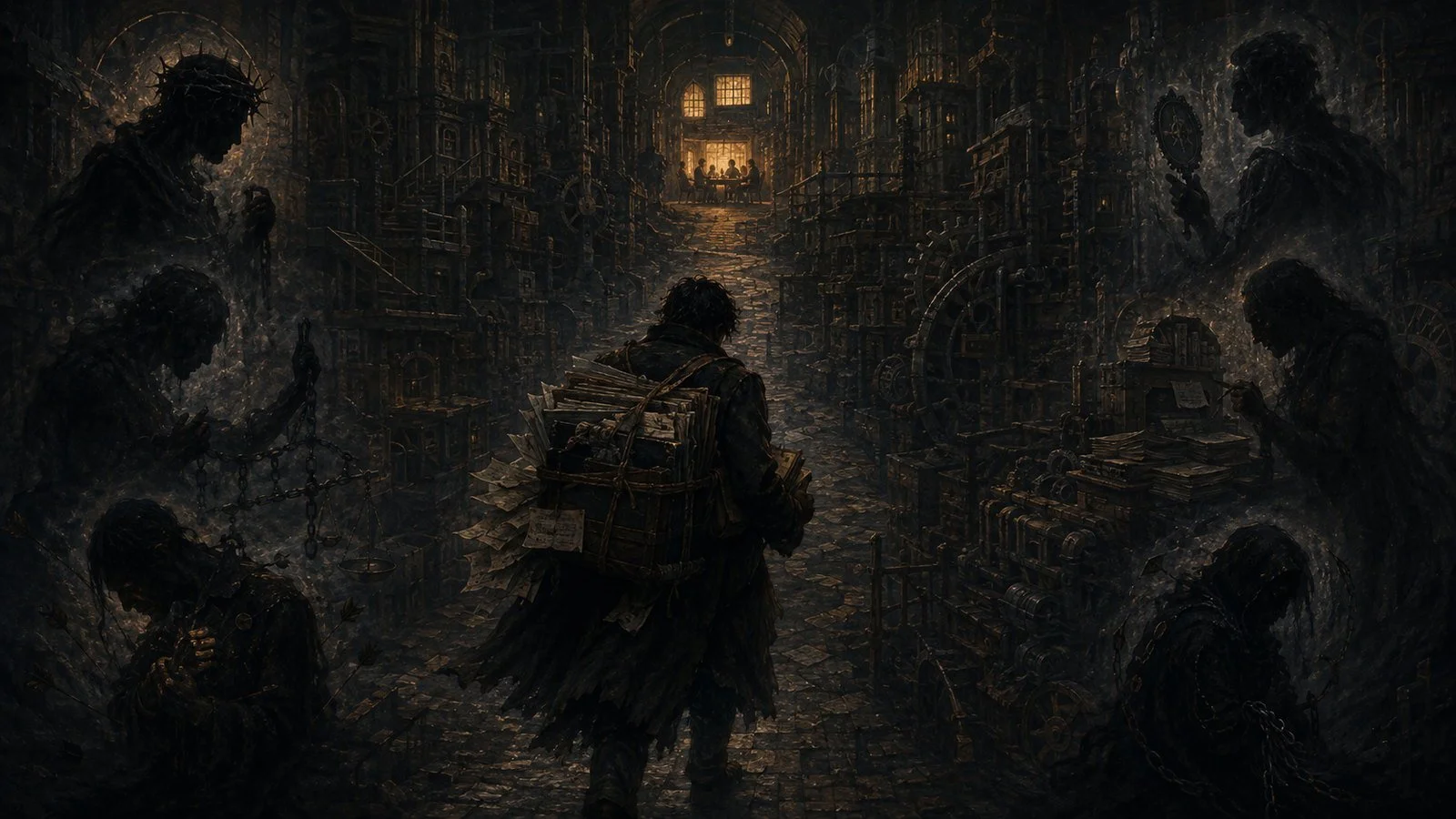
The conscientious witness carries the institution’s forgotten records while distorted shadows of martyrdom, purity, vengeance, election, compulsion, and abandonment gather at the margins.
7. What Dishonorable Systems Do to Honorable People
Dishonorable systems seldom begin by asking an honorable person to become dishonorable. They begin by using honor.
Conscientious employees remember obligations no one formally owns, careful auditors notice numbers that do not reconcile, humane supervisors absorb distress policy cannot process, and loyal members repair breaches before leadership must admit they exist. Because these people make failure less visible, the structure gradually treats conscience as a renewable resource.
No conspiracy needs to direct the process. Incentives suffice.
When one person catches every error, others grow less careful. If that person remembers each promise, institutional memory can weaken. Once someone reliably stays late, staffing shortages lose urgency; when private decency softens a cruel procedure, the procedure gains a false appearance of humanity. Competence lowers the visible temperature, and leadership mistakes the absence of smoke for the absence of fire.
Eventually one nervous system stands where a control environment should have been.
This is how an honorable person can preserve a dishonorable institution without endorsing its dishonor. They repair what ought to have failed loudly. Each private rescue prevents the consequence through which power might have learned. The system cites survival as proof of design while hiding the person who made survival possible.
The danger often begins in a compliment: “You are the only one I trust with this.” Recognition and extraction can share a sentence. Responsibility travels farther than authority, compensation, protection, or rest.
A healthy institution converts unusual conscientiousness into shared procedure. It distributes memory, documents judgment, assigns ownership, builds review, and makes correction reproducible without requiring one person’s permanent presence.
A dishonorable system personalizes the control, praises the worker, leaves the defect intact, and later treats exhaustion as an individual failure. The reliable employee becomes the workaround, the compassionate manager the mental-health program, the whistleblower the records department, and the spouse the recovery plan.
No one accepts these roles in one dramatic act. The transfer occurs through a thousand emergencies, each reasonable in isolation. Only the accumulated field reveals the exploitation.
The Burden of Knowing
Knowledge can behave less like possession than weight.
Once I have seen the hidden ledger beneath the official one, ordinary participation becomes difficult. I cannot hear “matter resolved” without recalling the omitted case, admire the dashboard without seeing the bodies inside its favorable average, or accept “we have moved forward” while causality remains unfinished.
The institution closes the issue socially; my mind keeps it open structurally.
ADHD is often described as difficulty sustaining attention, though my experience also includes difficulty withdrawing attention from a pattern after its moral and causal architecture becomes visible. Contradiction remains bright when the room dims it. Several chains may continue moving at once, accompanied by the intuition that sustained attention will eventually expose the underlying design.
Sometimes it does. At other times, the mind becomes an archive without a closing policy.
Dishonorable institutions benefit from this architecture and deny its legitimacy. Institutions rely upon the person who remembers, then call remembering obsession; they demand detail, delay response, change personnel, request the history again, and interpret the witness’s extraordinary familiarity as unhealthy fixation.
The person becomes expert because the institution repeatedly forgets, only to watch the institution pathologize that expertise.
Epistemic burden includes more than knowing a troubling fact. The witness must carry enough context to prevent delay, turnover, euphemism, and fragmentation from dissolving it. An organization possesses servers, counsel, officers, record schedules, administrative continuity, and salaries. The individual possesses evenings.
Yet institutions often assign reconstruction to the person with less power. They must preserve correspondence, compare versions, retain dates, explain earlier findings to new decision-makers, and predict which context will next be declared missing.
The archive leaves the building and takes residence in a body.
Governance fails whenever it repeatedly asks a human to restate accepted mission, history, boundaries, and evidence while calling the extraction oversight. Memory should carry provenance forward so the person need intervene only where sources conflict, evidence remains materially incomplete, or a new irreversible decision requires consent.
The honorable person needs neither infinite memory nor permanent vigilance. They need a system capable of remembering with them.
How the Witness Becomes the Problem
A troubling fact gives an institution several options. It can acknowledge and repair, disprove the claim, or show that accurate evidence does not support the conclusion drawn from it. When those routes threaten power, the institution can change the subject from claim to claimant.
Reputational inversion begins when the person identifying the control failure becomes the control failure. Precision becomes rigidity, persistence obsession, urgency instability, anger aggression, and refusal insubordination. A concern about conduct migrates into a concern about communication style, team fit, professionalism, emotional regulation, or psychological safety.
The translation works because it rarely depends upon complete fabrication. The witness may indeed feel angry; messages may grow longer as the institution omits more context; a neurodivergent person under sustained stress may speak without the soothing ambiguity hierarchy expects; repetition may become difficult to distinguish from rumination because the issue has genuinely required repeated explanation.
Every fragment can be true while the assembled portrait remains false.
Reputational inversion turns effects into causes. The person does not appear distressed because the system refused correction; the system cannot correct because the person appears distressed. They do not repeat themselves because records keep disappearing; repetition explains why no one can work with them. The institution does not isolate them; isolation proves they cannot sustain relationships.
Once this frame hardens, every response confirms it. Calmness looks manipulative, emotion unstable, brevity evasive, detail obsessive, and requests for independent review distrustful. The witness receives a role from which every performance validates the casting.
No rhetoric can solve a self-sealing frame because the contest no longer concerns rhetoric.
Evidence still matters. A preserved record can prevent total capture, even if it cannot compel unwilling people to value the record correctly. An immaculate chronology may reach officials whose practical task remains preserving organizational stability rather than learning what happened.
The witness must resist two errors. One would accept the institution’s portrait as final and convert hostile interpretation into self-knowledge. The other would assume every criticism retaliatory, every interpersonal difficulty further proof of corruption, and every self-correction a surrender.
Sometimes the witness’s manner causes avoidable harm. Anger may outrun evidence; a legitimate grievance can travel through language that humiliates people who did not create the underlying condition. Neurodivergence explains communication patterns without making every effect harmless. Trauma can sharpen detection and narrow interpretation. A person can be mistreated and mistaken about part of the case.
Honor must hold those facts together. Institutional wrongdoing does not make a witness infallible; witness imperfection does not make wrongdoing disappear.
Any process unable to preserve both propositions does not adjudicate. It selects a convenient protagonist.
Manufactured Loneliness
Retaliation need not arrive as termination or formal discipline. Social space can do subtler work.
Colleagues become careful nearby. Conversations stop when the witness approaches, not always because people turned cruel, but because association acquired risk. Private encouragement continues: “You are right, but I cannot be involved.” “Someone needed to say it.” “Please do not mention that I agreed.” “I have a family.”
Those statements may be honest. They also leave one person carrying collective moral knowledge.
The witness learns a painful distinction between being believed and being accompanied.
Institutions distribute fear efficiently because fear needs no memo. People observe who loses access, warmth, advancement, preferred assignments, or the presumption of good intent. They adapt. No senior leader must order avoidance when ordinary self-preservation teaches it.
I should not judge such retreat too quickly. A person living paycheck to paycheck may face risks a more secure witness cannot see. Immigration status, health insurance, dependents, past trauma, and little institutional credibility constrain visible solidarity. Even people with more freedom may freeze because courage does not distribute evenly across circumstances.
Compassion for fear does not make isolation unreal.
The witness begins inhabiting two worlds. In the unofficial one, people acknowledge the problem; in the official one, those same people perform uncertainty, neutrality, or absence. Only one person speaks, so leadership concludes that only one person cares. Silence enters the record as consent. Isolation, produced by risk, becomes proof that the concern was idiosyncratic from the beginning.
After creating loneliness, the system cites it as evidence.
Prolonged isolation changes judgment. Human beings calibrate memory, inference, tone, and proportion through trusted others. When ordinary feedback disappears, the person may depend upon a smaller circle whose loyalty runs deep but whose access remains partial. A spouse hears the story after each injury, a friend becomes the sole corroborator, or an online community supplies recognition without enough local evidence to test the account.
The witness can then oscillate between radical self-doubt and radical certainty: If everyone remains silent, perhaps I imagined it; their silence proves I alone remain incorruptible. Both conclusions reflect calibration failure.
A trustworthy witness needs company that neither the institution nor the witness controls: people capable of saying that one claim is supported, another remains inference, the treatment was unjust, the response caused collateral harm, one action may help, and another will probably consume the person without changing the flow.
Loyalty worthy of the name does more than believe. It keeps reality proportionate.
Two Clocks
Institutions possess procedural time. People possess biological time.
An organization can extend a review, reassign the matter, replace counsel, await a budget, convene another committee, reopen a question under new terminology, or postpone action until the next administration. Delay looks neutral because the institution survives it. Offices remain, salaries continue, and new employees inherit old titles.
The witness ages.
While an appeal waits, a child grows and a marriage receives another season of partial attention. Savings diminish, health changes, opportunities close, and professional identity becomes difficult to explain without appearing consumed. The person spends finite cognitive years inside a process capable of outliving them.
Delay therefore makes a decision about who will carry time.
A system can defeat a valid claim without disproving it by letting vindication arrive after practical value expires. The job cannot be restored, childhood returned, health reimbursed, or a relationship returned to its earlier innocence after years organized around danger.
Justice delayed does not simply wait. In bodies, delay metabolizes.
This partly explains why honorable people become extreme. They correctly sense that institutional time consumes the only life in which remedy could matter. Every extension feels like theft, and pressure builds to force a decisive event before the future runs out.
Urgency may be justified. It can also make catastrophic action feel proportionate.
The operational question asks what must happen now because delay creates irreversible harm and what only feels urgent because the nervous system can no longer tolerate suspended resolution. No one answers reliably without rest, support, and outside review. A body kept in alert for years cannot distinguish every deadline perfectly.
Institutions exploit this when they wait for the witness’s response to deteriorate. The person begins measured, grows emphatic, and eventually sends a message at 2:17 in the morning under pain, fear, and exhaustion. The institution points to the final page as though it explains the preceding book.
The Body as Off-Book Ledger
People often discuss stress as atmosphere surrounding the real facts. The body knows otherwise.
Sustained conflict can disturb sleep, attention, memory, emotional availability, and other bodily functions, although the form and cause of those effects vary substantially among people. Acute-stress and sleep-deprivation research supports general cognitive caution, not a diagnosis of my body or a claim that one institution caused every symptom I describe.[1] We cannot always separate what belongs to diagnosed illness, aging, prior trauma, ordinary life, or prolonged institutional threat; a personal essay should not pretend clinical precision it lacks.
Uncertainty about mechanism does not make bodily experience unreal.
I know what it means for facial nerve pain to flare while a difficult message waits unanswered, and for pain and obligation to arrive together, each demanding priority. ADHD, anxiety, sleep apnea, chronic pain, memory irregularity, and a body trained by earlier danger form the material architecture through which every ethical decision must pass.
A philosophy that imagines conscience floating above the nervous system misunderstands its instrument.
Under prolonged conflict, the body starts anticipating before interpretation finishes. An email notification changes breath; a calendar invitation tightens the jaw; the name of an institution appears on a screen, and the old state returns before new information arrives.
The body has learned the sender.
Hypervigilance can provide protective intelligence after forgetting when its shift ended. It catches anomalies, notices phrasing, reads the field, and responds with accuracy born from consequence. A sensor held permanently at maximum sensitivity eventually confuses variation with threat.
Honorable people resist acknowledging bodily limits because limits feel morally embarrassing. The mind asks how fatigue can matter when the issue matters, what right the witness has to rest while others remain vulnerable, and whether pain interrupting the work means the body has sided with the institution.
These questions show how domination becomes internal. The system no longer needs to deny rest; conscience performs the denial.
A body treated only as transport for duty will eventually refuse through collapse, illness, rage, fog, numbness, or simple inability. We should not romanticize that refusal as wisdom; it may only be damage. Still, it carries information.
A moral practice that repeatedly destroys the organism trying to enact it has failed part of its design.
The Hidden Invoice at Home
Public honor often relies upon private financing.
The witness files the complaint, publishes the essay, preserves the record, refuses the signature, or stands in the meeting. Behind the visible act, a household may carry the aftermath.
A spouse receives the fear that could not safely appear at work. Children learn whether the parent is present by reading how the parent looks at a phone. Household money goes toward counsel, treatment, lost wages, travel, or replacement technology. Weekends become document time; dinner becomes strategy; affection gets interrupted by a sentence that must be written before memory loses it.
None of this means the family rejects the stand. Love can understand why conscience acted and still suffer beneath the cost.
Heroic narratives rarely respect that dual truth.
I have sometimes assumed that because my purpose included protecting my family, whatever the purpose required became justified. That reasoning smuggles in unilateral authority. Intending to protect people does not give me ownership of their peace.
My family members are not merely beneficiaries of my ethics; they are affected parties.
Ethical symmetry requires their burdens to enter the ledger. A system has not become coherent if public order depends upon disorder exported into a less visible subsystem. The household disappears from the denominator more easily than almost anything else.
Public praise does not ask who handled bedtime while the righteous person wrote, who listened for danger, who learned not to interrupt, or who adapted life around a conflict they did not initiate.
An honorable stand can therefore become ethically asymmetric while its central claim remains just.
Family concern should not veto every risk. People sometimes undertake difficult public work with informed support, sharing purpose, grief, humor, and resistance in ways that deepen relation. The distinction lies in consent, visibility, reversibility, distribution, and an honest ending to emergency.
Do the people I love know what I am risking at a level appropriate to each, and do they retain voice, or have I turned moral certainty into household policy? Have I protected them materially rather than only invoked them rhetorically? Is the burden temporary, or has crisis become our permanent climate? Have I confused their love with unlimited authorization?
Most painfully: have I made them responsible for keeping me alive inside a mission that refuses to keep me human?
A moral order that protects strangers by consuming intimates has moved the asymmetry closer to home.
Rather than leave my family a legend where they needed a person, I want my children to know their father told the truth and that truth returned him to the table.
When Meaning Itself Is Injured
Repeated punishment for honesty damages more than confidence. It damages orientation.
Human beings need some usable relation between conduct and consequence. We teach children that truth matters, promises bind, effort has meaning, authority carries responsibility, and fairness differs from convenience. Adult life complicates every proposition, yet cooperation depends upon enough confidence that the words still guide action.
Dishonorable systems attack that confidence. Truth receives punishment while fluent concealment advances. Loyalty becomes service to leadership rather than purpose. Procedure shelters power and disciplines inconvenience. Courage receives historical praise and present sanction. The terms survive while predictive force decays.
Eventually a person does not merely distrust the institution. They begin distrusting meaning.
What use is integrity if dishonesty governs outcomes? Why preserve evidence when no authority will review it, care about names when power changes their function, or remain honorable when honor seems to make a person easier to exploit?
This meaning burden deserves more than inspiration. Sometimes honorable people truly are exploited through their virtues. Selective blindness can sleep better, advance faster, and remain more available to family.
Yet local selection pressure does not describe the whole ecology. A society unable to preserve truthful witnesses, trustworthy records, reciprocal care, and bounded authority may reward dishonor in one quarter while destroying the trust upon which future cooperation depends. Fraud can flourish briefly and corrode the currency that made flourishing possible.
Honorable people do not matter because error correction feels pleasant. They matter because systems without correction become lethal.
No individual should embody the entire correction function. A civilization that survives only because unusually conscientious people consent to ruin has built an unstable dependency and called it virtue.
Honor must enter institutions or institutions will sacrifice it.
[1] Grant S. Shields, Marissa A. Sazma, and Andrew P. Yonelinas, “The Effects of Acute Stress on Core Executive Functions,” Neuroscience & Biobehavioral Reviews 68 (2016): 651–668, DOI 10.1016/j.neubiorev.2016.06.038; Julian Lim and David F. Dinges, “A Meta-Analysis of the Impact of Short-Term Sleep Deprivation on Cognitive Variables,” Psychological Bulletin 136, no. 3 (2010): 375–389, DOI 10.1037/a0018883. These sources support general caution about stress, sleep loss, attention, and memory; they do not diagnose Thomas or attribute his medical conditions to a single cause.
8. The Shadows of the Honorable Person
The shadows of honor do not arrive as foreign invaders. Pressure deforms virtues we needed for survival.
Courage becomes martyrdom when pain begins certifying truth. Discernment becomes purity when compromise can no longer be distinguished from betrayal. Anger becomes vengeance when protection yields to the wish that another suffer. Witness becomes election when isolation appears to prove singular moral status. Careful attention becomes compulsive audit when no experience may remain outside the case. Service becomes abandonment when the self loses membership in the class of lives worth protecting.
Each shadow begins in something real. The martyr has learned that institutions exploit moderation; the purist has watched “compromise” become a polished word for surrendering the vulnerable; the avenger knows that civility often gets demanded from the injured rather than from power; the chosen witness has endured solitude others refused to share; the compulsive auditor has seen what disappears when memory relaxes; the abandoned self learned early that usefulness felt safer than need.
No one heals a shadow by insulting the virtue from which it grew. We must return virtue to relation, evidence, proportion, and life.
Martyrdom: When Pain Becomes a Credential
The martyr shadow tells me that suffering will prove sincerity. If I lose enough, no one can deny that the claim mattered. Should an institution destroy career, health, reputation, or safety, the scale of destruction will testify to what I opposed. Rest may appear to weaken the case; retreat may let power reinterpret survival as cowardice; a safer path may feel morally inferior because it lacks the radiance of sacrifice.
This shadow seduces people whose suffering went unrecognized. Pain longs for meaning, and martyrdom offers a simple exchange rate: the more it cost, the truer it must have been.
Cost establishes only that something was paid. It cannot establish that the strategy was wise, the claim complete, or the sacrifice necessary. Persecution falls upon prophets and fanatics, accurate witnesses and mistaken ones, liberators and people who have made opposition their whole identity.
Pain supplies evidence of burden, not correctness.
Co-martyrdom increases the danger. Two conscientious people recognize one another and experience the relief of being understood. Each validates the other’s urgency until mutual courage becomes mutual escalation. Both step into the line of fire, leaving no one outside it to preserve records, protect families, test interpretation, or continue if one falls.
The purpose cannot be to perish together in righteousness. Corrective capacity must survive.
The operational sign of martyr drift is not willingness to suffer; some duties carry unavoidable cost. Drift appears when the witness begins despising routes that reduce unnecessary harm. Legal counsel, pacing, anonymity, collective action, delegation, strategic silence, and temporary retreat all feel less pure because they produce less visible injury.
Another sign appears when loved ones become obstacles to the mission because they keep asking whether the mission remains survivable.
One question interrupts the seduction: what material good will this sacrifice purchase that a less destructive route cannot? The cost may be necessary when the answer names protection, evidence, repair, or future capacity; when it concerns proving resolve, preserving identity, forcing history to understand, or making the story beautiful, the altar probably serves the witness more than the vulnerable.
My destruction cannot make a truth more true. We should bear unavoidable pain consciously and distribute it fairly, while refusing damage that adds nothing to protection, repair, evidence, or future work as an act of governance rather than cowardice.
Purity: When Discernment Forbids Alliance
Dishonorable institutions repeatedly ask principled people to compromise. Some requests concern timing, wording, method, or genuinely competing goods; others use “compromise” to describe an arrangement in which the least powerful person absorbs the unresolved harm so everyone else can declare consensus.
The purist shadow forms after witnessing that substitution too often.
Having watched concession become surrender, I begin treating every concession as surrender. Imperfect allies look captured, partial repairs cosmetic, gradual progress collaboration, and anyone who remains inside the institution morally contaminated. Purity relieves ambiguity by dividing the world into those who understood and those who sold understanding.
Every contradictory perspective can then be explained through cowardice, corruption, self-interest, or insufficient development. Nothing enters from outside. Conscience achieves false coherence.
The purist may identify the central wrong accurately and still make correction impossible. Institutions change through people whose motives, constraints, knowledge, and courage vary. Some act from principle, others pressure, ambition, habit, fear, loyalty, or mixtures no biography can fully separate. If assistance is accepted only from those with immaculate moral histories, the field will remain admirably empty.
Purity also confuses invariants with preferences. Some commitments should not be traded: human dignity, evidentiary honesty, non-domination, consent, protection of the vulnerable, and refusal to certify what one does not know. Other matters admit negotiation: sequence, medium, wording, pace, venue, division of labor, and which partial repair occurs first.
An honorable compromise yields something negotiable while preserving what makes the action morally recognizable. A dishonorable compromise yields someone vulnerable so the institution’s appearance can survive.
Operationally, the shadow appears when disagreement about method gets interpreted as disagreement about morality, when allies must repeat the witness’s whole account to remain trusted, or when real gains are rejected because an imperfect institution might claim credit.
A useful inquiry asks which exact invariant the compromise violates and which discomfort comes merely from sharing control, because a bridge may bend without becoming false. Any bridge incapable of flexing under more than one person’s weight was probably designed as a monument to its architect.
Vengeance: When Justice Wants an Audience
Anger serves honor when it reports violation. It announces that a boundary mattered, that pain should not have become normal, and that someone’s dignity was treated as expendable. Many systems call anger dangerous because it interrupts the peaceful distribution of harm.
The avenger shadow begins when anger stops serving protection and seeks equivalence through suffering: they made me afraid, so they should fear; they ruined my name, so theirs should be ruined; they used power without mercy, so mercy now insults the harmed.
These thoughts make emotional sense. Impunity teaches the injured that moral language lacks force; revenge promises to restore force through symmetry.
Inflicted pain does not reverse the original event. It adds another one.
Justice and revenge may use similar tools, including exposure, sanction, removal, restitution, and exclusion, but organize them around different centers: justice asks what protects the vulnerable, establishes truth, repairs what can be repaired, prevents recurrence, and preserves proportion. Revenge asks whether the offender has suffered enough for reality to feel balanced.
One seeks a safer field. The other remains organized around the offender.
Consequences may be necessary. Accountability can require loss of authority, financial restitution, professional discipline, or criminal sanction. Mercy that leaves the harmful mechanism intact may abandon future victims. Yet consequences must answer to evidence, authority, and proportionality.
The avenger widens the target. Individuals become symbols of the system, associates inherit guilt, private vulnerabilities become useful weapons, and uncertainty gets treated as a luxury reserved for people who were not harmed. Language shifts from describing conduct to defining essence. A person did something cruel; soon the person is cruelty, and almost anything done against them can be called protection.
Warning signs include pleasure in humiliation, impatience with exculpatory evidence, indifference to collateral harm, and measuring success through an enemy’s distress rather than increased safety.
A clarifying question asks what outcome would justify action even if the offender never felt humiliated. Stronger safeguards, a corrected record, removed authority, restitution, deterrence, or a repaired process may indicate justice still governs. If nothing satisfies unless the other person hurts, injury has appointed itself judge.
Although I owe no tenderness to an active mechanism of harm, I owe reality the refusal to become careless with human beings merely because carelessness first appeared on the other side.
Election: When the Witness Becomes Chosen
Long isolation creates an interpretive hazard. When institutions deny what the witness sees, colleagues retreat, ordinary review fails, and evidence remains unresolved, one explanation offers profound emotional coherence: I see because I was meant to see.
The chosen-witness shadow turns exclusion into election. Opposition confirms significance, loneliness confirms singularity, and others’ failure to understand proves a higher moral or cognitive station.
Myth can nourish the transformation. The person identifies with prophets, exiled sages, martyrs, hidden heirs, suppressed geniuses, or historical figures vindicated after death. Archetype can genuinely help: human systems repeatedly punish inconvenient pattern-seers, and a symbolic role may reveal that private shame partly reflects a recurring social mechanism.
Trouble begins when archetype stops describing a pattern and starts authorizing a person.
A chosen witness becomes hard to correct because criticism now confirms the sacred role. Rejection proves persecution; agreement proves awakening; partial disagreement proves fear; competing witnesses become compromised agents. The model explains every outcome and therefore explains nothing.
The Exiled Auditor should remain a role specification, not a personality caste, spiritual costume, or permanent title. I may currently hold evidence others lack. That does not make me ordained owner of the field.
Warning signs appear when only I may interpret my suffering, independent review feels like desecration, the story grows grander as material outcomes shrink, or people must accept an entire cosmology before they can assist with one factual claim.
The corrective question asks what evidence, offered by whom and under what conditions, would change my interpretation. A witness who cannot answer has moved toward priesthood.
Truth needs no chosen witness; it needs a correctable one.
Compulsive Audit: When Nothing May Remain Ordinary
The compulsive auditor keeps noticing after the assigned review ends. Every conversation becomes a source, each silence a possible inference, every inconsistency a retention event. Meals, friendships, entertainment, bodily sensations, political news, children’s questions, and unfinished creative work enter the same expanding case file.
The mind stays on duty because something important once vanished when it relaxed.
From outside, this looks tireless and responsible. Inside, the world has become a room without curtains.
Hypervigilance produces data while degrading signal quality. If every anomaly carries equal significance, nothing can be triaged. Unresolved issues multiply faster than action can close them, and ordinary forgetting begins to feel like moral failure. The archive becomes a second body that must be fed, organized, searched, and defended.
Eventually documentation stops serving action and starts serving the fantasy that no one else will ever be allowed to alter reality through memory. The person records not only what review requires but everything that might become relevant under a future theory of the case.
This resembles a provenance system without retention limits: admirable lineage, infinite storage, no compression, no revocation, no right to forget.
A humane memory system remembers less than it could. It preserves enough for replay, audit, correction, consent, and appeal while accepting that total retention becomes surveillance. Human attention needs the same discipline. Scope must be declared, evidence tied to purpose, retention justified, and stop conditions defined.
Not every contradiction belongs to the current case; not every case belongs to me.
The simplest operational question asks what decision additional review will change. If no protection, repair, authority, or memory requirement depends upon it, continued attention may serve fear rather than truth.
Closing a ledger does not certify the institution innocent; it acknowledges that my life contains other books.
Abandonment: When the Self Leaves the Protected Class
The abandoned self can resemble perfect morality. Everyone else’s vulnerability matters; mine remains negotiable. Others deserve rest, safety, medical care, patience, boundaries, and permission to remain unfinished. I deserve function.
This pattern often begins early. Usefulness may protect a child from rejection; personal need may create danger, ridicule, cost, or disappointment. The child becomes competent, funny, quiet, perceptive, productive, or emotionally useful. Adult conscience inherits the bargain: I will earn my place by carrying what others cannot.
Dishonorable institutions recognize this person immediately. They need not issue a command because the command already lives inside: continue until collapse makes continuation impossible.
Self-exclusion corrupts ethical symmetry at its root. If every person has non-instrumental worth except the person speaking, non-instrumental worth was never a principle; it was a preference about distribution.
“I am also an affected party” may be one of the hardest sentences an honorable person learns. My body enters the risk assessment. Family stability enters the action plan. Chronic pain changes what counts as tolerable burden. ADHD changes how work should be sequenced and externalized. Fluctuating productivity does not prove the mission false. Rest does not steal from the cause.
The abandoned self hears care as exemption. If others cannot rest, why should I? Because collapse will not redistribute their burden justly; it will create another burden. Refusing medical care feeds nobody. A father’s exhaustion enters his children even when he never speaks of it. No virtue resides in making the human instrument less capable of love.
Warning signs include shame after rest, hiding pain so others will not reduce the workload, accepting obligations no informed person would reasonably assign, treating joy as betrayal, and assuming those who love me value the mission more than my continued presence.
The corrective question asks whether I would demand the same burden from someone I loved under comparable conditions. Where the answer is no, sacrifice may have crossed into abandonment.
I do not stand outside my ethics; my life belongs among those they exist to protect.
A Working Shadow Audit
A noble identity remains only scaffolding until conduct makes it operational. Before a major escalation, I should be able to state what occurred, what the evidence establishes, what remains inference, who possesses authority to act, what outcome would reduce harm, and which steps remain reversible if my interpretation proves incomplete.
I should also know who will carry the cost, whether they possess meaningful voice, what evidence could change my conclusion, who may review me, and when the role will go offline.
Six gates keep the audit practical.
Evidence asks what I know, how I know it, and where the record ends. Pain, intuition, pattern recognition, and firsthand experience may justify investigation; none becomes the whole adjudication merely because it is mine.
Purpose asks what action will change. Exposure may feel active while leaving material flows untouched. A statement should protect, correct, constrain, preserve, repair, or open a route that did not exist before. When its likely effect is limited to making adversaries feel condemned and allies affirmed, it may belong more to theater than governance.
Proportion keeps intervention matched to finding. A serious system does not justify overstating one component, and a person’s other virtues do not diminish a severe documented wrong. The scale must remain stable when party labels change.
Symmetry follows burden toward opponents, bystanders, colleagues, family, future self, and community. Unequal burdens may be necessary; invisible burdens are not. Public protection that predictably endangers a household requires consent, mitigation, alternatives, and honest accounting.
Corrigibility asks what would change my mind. A claim unable to imagine falsification has become identity. Trusted people must retain permission to say when pain, fear, anger, or vanity has begun editing the account.
Completion defines enough for the present phase. A gate can close when the remedy is obtained, evidence exhausted, responsibility transferred to the proper authority, marginal benefit no longer justifies cost, or further action would destroy capacity needed later.
The world need not become just before one obligation gains a boundary.
When a complex system fails, engineers identify the first failed gate rather than contemplating every possible defect at once. Conscience needs the same mercy. Institutional corruption, childhood injury, economic injustice, political capture, family danger, mortality, and cosmic silence may all connect at some scale; no organism can operationalize the whole field simultaneously.
The first failed gate asks what presently prevents the next coherent step. Is evidence incomplete? Has the relevant authority refused review? Does the action lack consent from affected family? Has the body exceeded safe capacity, has anger started selecting targets, or has the case become identity? Must another person carry the role?
Reducing the field to one gate does not deny systemic relation. It prevents relation from becoming paralysis.
Leaving the Role Without Betraying It
A role can save someone by naming what felt like private defect. Exiled Auditor helped me understand why I kept gravitating toward hidden ledgers, control failures, misaligned authority, and the people crushed beneath clean institutional stories. The archetype turned shame into intelligibility.
Every useful role needs an exit clause.
If I cannot turn the auditor off, the role no longer serves me. A function becomes a prison when every situation must pass through its language before life can be experienced. The father does not always audit; the husband does not always witness; the musician does not secretly prepare evidence whenever he sings. A walk needs no findings, a joke no governance, dinner no theory.
The institution that harmed me does not deserve to organize everything beautiful that survived it.
“Exiled Auditor offline” does not declare the field repaired. It returns authority to the person whose life exceeds the field. Records can remain preserved without rereading them tonight; necessary action can remain available without permanent physiological readiness; memory housed in governed external form need not remain active inside the body every hour.
Externalizing knowledge does not abandon duty. It makes duty shareable.
Our species cloud should reduce the burden upon individual minds rather than scale whatever those minds already carry. Reports, archives, testimonies, protocols, and tools succeed ethically when truth survives without requiring one nervous system to remain its sole habitat.
No Saints Required
Honor becomes dangerous when imagined as sainthood. Saints are expected to remain consistent in every field, purified of resentment, need, error, fear, contradiction, and fatigue. Living people cannot meet that standard, although institutions find it useful. Once a witness becomes a moral symbol, any imperfection can discredit the testimony; followers may respond by denying the imperfection to protect the symbol. Both choices erase the person.
I need neither innocence for a record to be accurate nor perfect conduct for a wrong to remain wrong. Being wronged does not relieve me of responsibility for what I do next.
All three propositions can inhabit one life.
An honorable person may feel anger, vanity, fear, generosity, abrasive certainty, tenderness, exhaustion, and intermittent wisdom. Honor does not remove the mixture. It keeps the mixture answerable.
Can anger remain governed without being shamed away, can I admit error without letting the institution rewrite the whole case, and can I rest before collapse while preserving both another person’s dignity inside my certainty and my own inside their refusal?
No great tradition eliminates human instability. It gives instability forms through which it can return to relation.
Upward movement never follows a straight line. Organisms heal unevenly, institutions improve and relapse, writers find one sentence and lose the next, courage enters one room and fails in another. The task is not purity of trajectory. It is correction without self-annihilation.
A dishonorable system may never become honorable. My work is to prevent its dishonor from becoming hereditary within me.

Documentation, work, tea, bread, companionship, rest, and the evening threshold form a practical discipline for keeping duty from consuming the life it meant to serve.
9. A Discipline for Remaining Human
After the lamp, palace, silent universe, monastery, cross, and council, every philosophy must arrive at the kitchen table.
There abstraction encounters Tuesday.
Tuesday requires breakfast, medication, a school ride, a repaired faucet, an answer to the message I postponed, and enough presence to hear a story whose importance becomes visible only because a child chose to tell it. No trumpet announces the moral significance of looking away from a screen and listening. History will not record the ordinary hour in which I allowed an institutional argument to release my attention.
A life takes its shape there.
Great moral dramas flatter us by concentrating character into one decisive moment. Someone refuses the order, shelters the fugitive, signs the declaration, exposes the fraud, walks away from the throne, or accepts the cost of witness. Such moments matter, but ordinary honor more often disperses itself across maintenance, timing, restraint, revision, and the many returns through which one promise avoids consuming all the others.
An ethic that survives only at the climax cannot govern a life.
I need a discipline because resolve does not rise in a clean line. Flesh tires; attention wanders; courage alternates with fear, tenderness with resentment, clarity with obsessive certainty. A system may pressure me toward falsehood, but I bring my own instability into the encounter. No principle exempts its bearer from hunger, pain, pride, loneliness, or the temptation to make one wound explain the world.
Disciplines exist because intention fluctuates. A singer practices scales because inspiration must travel through breath, muscle, memory, and fatigue. Auditors use procedures because private honesty cannot remember every control. Monastics ring bells because devotion needs a form outside mood. Families repeat small rituals because love, though real, forgets appointments.
Honor needs form for the same reason.
Without practice, conscience becomes whatever I can sustain while frightened. With too much practice, conscience hardens into procedure and forgets the person for whom procedure was built. Remaining human requires movement between those failures: enough structure to restrain impulse, enough openness to let another life revise the structure.
Strategy for Finite Bodies
Courage looks most radiant after logistics have been removed.
The hero sees wrong, opposes it, and accepts the consequence. Moral imagination loves this clean line between perception and act. Sequence disappears: evidence must mature, allies need preparation, families require protection, remedies differ, bodies possess limits, some actions cannot be reversed, and hostile institutions hold larger stores of money, time, counsel, and administrative patience than the people confronting them.
Strategy begins when courage accepts embodiment.
Before escalation, I should know what I can prove, what I infer, which remedy I seek, whose authority I invoke, who may carry the cost, what remains reversible, how long I intend to continue, and what evidence would require a change of course. These questions do not weaken conviction; they prevent urgency from borrowing certainty it has not earned.
Strategy is the ethics of finite bodies.
A person with unlimited time, health, money, and immunity from collateral harm would not need it. Human beings act through narrow apertures, under partial knowledge, while obligations continue competing for attention even when one becomes morally vivid.
Sustainable courage differs from endless resistance. It chooses the action most likely to protect people, preserve truth, and maintain future capacity rather than the action that most dramatically proves willingness to suffer. Sometimes courage speaks publicly. Elsewhere it documents quietly, seeks counsel, delegates, narrows the claim, changes venue, waits, or leaves before access turns into complicity.
Delay can disguise cowardice; immediacy can disguise vanity. Departure may abandon people, while staying may teach the institution that conscientious workers will always compensate for failure. Publicity can protect a witness and expose people who never consented to become symbols. An anonymous disclosure may distribute risk but weaken context. No universal maxim removes the need for judgment.
We can still reject one false principle: maximum exposure to harm does not indicate maximum honor.
A torch that consumes its bearer may illuminate one night, whereas a lamp supplied, sheltered, and shared can outlive the argument that required it.
My temperament prefers comprehensive resolution. Once I see the architecture of a problem, partial repair feels morally insufficient; every remaining defect appears to prove that work has not truly begun. Yet institutions, families, bodies, and societies rarely transform through one complete act. They change through bounded interventions that preserve enough truth to prevent false closure and create enough improvement to make another step possible.
Incrementalism becomes dishonorable when power uses it to postpone what can be corrected now. Purity becomes dishonorable when the witness rejects a real reduction in suffering because it fails to complete the moral story.
Sustainable courage distinguishes the incomplete from the false.
The Company of Witnesses
A witness may stand alone at the moment of recognition. Solitude should not become the architecture that follows.
What begins in one person’s perception must travel into forms others can inspect, question, preserve, and carry. Otherwise, truth remains hostage to one memory, body, reputation, and capacity for pressure.
Collective witness does not require unanimity. A chorus gains strength when voices remain distinct enough to correct one another. The best companion neither accepts every inference out of love nor performs neutrality while I carry all the risk. I need people capable of saying that a claim is supported, another remains uncertain, my treatment was unjust, my response caused avoidable harm, one action may help, and another will probably consume me without changing the flow.
Such company prevents opposite collapses. Without affirmation, a witness may internalize institutional inversion and treat injury as personal defect; without criticism, the same witness may build a counter-institution whose central doctrine becomes personal infallibility.
Loyalty worthy of the name helps reality remain proportionate.
The company should distribute more than reassurance. It should distribute memory, research, risk, interpretation, and rest. One person preserves documents while another examines authority; someone tests chronology, seeks counterevidence, protects affected parties, or keeps ordinary life functioning during a period of unavoidable action. No one must understand the whole system at once if relations among the parts remain visible.
Western morality prefers solitary heroes because one body makes a cleaner statue than a network. Collective courage resists sculpture. A researcher finds the contradiction, a clerk retains the record, a spouse notices the cost, a journalist translates the evidence, a lawyer preserves the route, a colleague confirms the event, and an unnamed person feeds children while history prepares to remember the most visible participant.
Honor rarely belongs to one person in the quantity biography later assigns.
A just movement should keep an internal burden ledger. Who speaks, researches, funds, absorbs retaliation, remains outside the line of fire, or possesses insurance, status, and family support others lack? Has one person’s bravery become possible because less visible people subsidized it?
Collective witness does not diminish courage. It returns courage to its ecology.
Documentation Without Captivity
Documentation should convert private memory into shared evidence rather than convert life into documentation.
That distinction blurs when institutions forget strategically. Each omission teaches the witness to preserve more. A lost email justifies another archive, a changed explanation makes screenshots prudent, turnover requires fresh chronology, and a hostile summary proves context must accompany every claim.
Retention becomes a moral reflex: delete nothing, capture the page before it changes, record the conversation, preserve the draft, write what the body remembers before exhaustion dissolves sequence. The impulse has reason behind it because power often creates absence and then treats that absence as lack of evidence.
An archive without boundaries can reproduce another domination. Forgetting indiscriminately abandons the harmed, while remembering indiscriminately traps everyone, including the witness, inside permanent suspicion. A humane archive preserves enough for replay, correction, accountability, and appeal without pretending total retention will produce total security.
Our work on governed memory expresses the principle in technical language: a system should remember less than it could. Forgetting, compression, quarantine, revocation, and limited retention belong to memory’s ethics. A reservoir that keeps everything becomes a surveillance archive; one that admits only traces capable of answering for origin, status, permission, risk, and future use becomes governable. A human life needs the same economy.
Every file should serve a purpose. A chronology should answer a question, support a remedy, preserve public history, protect someone, or enable correction. Once those functions end, records may need transfer, compression, restricted access, contextual annotation, or deliberate closure.
Closure does not declare the institution innocent. It refuses to keep every document physiologically active.
A bounded archive separates source from interpretation, marking what I observed, what another person reported, what a document establishes, what I inferred, which claim changed, and where uncertainty remains. That structure protects revision from being confused with betrayal.
Retention never confers truth. Hashes may show that files did not change without proving accuracy, receipts may prove review occurred without proving justice, and remembered claims may survive for years while remaining false. Memory means inspectability, not authority.
I can preserve an argument without keeping it open in every room and know where the record lives without carrying it through dinner. Externalizing memory allows truth to survive without requiring one nervous system to serve as its sole habitat.
A Grammar for Conscience
Conscience distrusts bureaucracy for good reason. Rules can hide moral emptiness behind clean procedure; forms invite officials to ask whether a box was checked rather than whether a person was harmed. Responsibility gets divided into small tasks until no participant feels responsible for the whole outcome.
Improvisation carries another danger. A frightened, angry, charismatic, or exhausted person can mistake intensity for authority. Good intention does not create jurisdiction; sincere concern does not supply evidence; clarity in one part of the field may coexist with blindness elsewhere.
Conscience therefore needs a grammar, not a cage.
Our Universal Control Codex, or UCC, is a provisional research scaffold built from a similar insight: high-stakes reasoning should declare task, authority, evidence, ordered steps, validation, reporting, and escalation instead of relying entirely upon fluent improvisation. UCC exposes the reasoning contract for review; it does not automatically establish truth, legality, compliance, professional assurance, or moral correctness.[1]
Translated into personal practice, I should know which question I am answering before I answer every question attached to it. I should distinguish legal authority from moral authority, identify evidence controlling each claim, invite the strongest contradiction, choose communication suited to audience and stakes, and define when I will escalate, pause, transfer, or close a phase.
This discipline guards against mission creep within the soul.
A grievance need not become a complete theory of an institution, although a real pattern can justify broader inquiry without granting immediate certainty about each part; likewise, one documented abuse cannot prove every suspected motive. Naming scope protects the strongest claim from the temptation to recruit every adjacent suspicion.
A visible grammar also protects people who disagree. They can challenge the source, inference, authority, remedy, or threshold without treating my entire moral identity as the disputed object.
Rules still need relationship. A checklist can discipline conscience, but living people must notice when the checklist becomes cruel. Rules protect us from mood; relationships protect rules from forgetting whom they govern.
The wisest control stays corrigible.
Repair Without Theater
Repair begins when explanation stops operating as defense.
Most people do not experience themselves as villains. We act under pressure, mixed motives, incomplete information, inherited habits, and stories that make conduct appear reasonable from inside. Once harm becomes visible, explanation arrives quickly: I did not intend that effect; I lacked context; another person contributed; the system constrained my choice; I was protecting someone; I had reasons the injured person could not see.
Some explanations matter. Intent affects culpability, context prevents simplification, and constraints may reduce choice. Explanation becomes corrupt when it asks the harmed person to treat the actor’s inner complexity as reimbursement.
Repair moves in the material field. An apology may name the event, but repair addresses what the event changed. Money may need to return, authority may need narrowing, a record correction, an unsafe procedure replacement, access restoration, or trust continued suspension. The injured person may decline reconciliation, and the person who caused harm must accept that decision without turning remorse into another claim upon them.
Institutions prefer apologies that preserve distribution. Leadership expresses regret, announces lessons, orders training, and keeps the same power arrangements. Language moves; authority stays still.
Where no control, protection, access, cost, or distribution changes, perhaps only vocabulary received repair.
The standard applies to me. I may hold the stronger factual position and still cause avoidable harm by telling truth contemptuously, exposing private information unnecessarily, humiliating an imperfect ally, or letting accumulated anger strike someone who entered late.
Acknowledging that harm does not require surrendering the original claim. I can say the record remains wrong and I treated a person wrongly while trying to correct it. Both statements may stand.
Institutions sometimes exploit any witness admission to invalidate the whole witness, making correction feel unsafe. Yet refusing all self-correction to preserve credibility eventually destroys the moral quality of the credibility.
Honor does not require blamelessness before seeking justice. It requires repair for what I damage while seeking it.
Repair accepts limits. Some injuries cannot be reversed; some trust should not return; some relationships must remain distant. The goal is not sentimental wholeness. Repair may produce restitution, safer boundaries, institutional memory, and enough change that the future no longer repeats the past.
Reconciliation is one possible fruit. Accountable change supplies the root.
Joy and the Unoccupied Future
Dishonorable systems prefer total occupation. After work ends, conflict keeps consuming imagination. The injured person rehearses arguments, anticipates threats, studies records, and watches loved ones for signs that danger followed home. A song becomes commentary, a meal interrupted time, and the body an alarm console.
Joy then feels morally suspicious. How can I laugh while injustice remains? Does pleasure imply that harm was tolerable, resistance insincere, or people still trapped in the field abandoned?
No.
Joy does not deliver a verdict upon history. It neither certifies the institution nor acquits the offender. Joy marks territory the injury failed to annex.
Music gives time a shape conflict did not assign. Laughter interrupts the totalitarian logic by which every faculty must prove usefulness to the struggle. Affection returns bodies to relations older and larger than the case. A meal can serve the future precisely because no authority granted it and no authority can revoke its worth.
Fear-based systems prefer opponents incapable of pleasure. Exhaustion narrows choice; a witness who loses every source of meaning outside conflict becomes easier to provoke, flatter, radicalize, or destroy.
Joy restores plurality within the self. It reminds the auditor that not every sound signals alarm, the protector that not every stranger is threat, and the sufferer that pain has not acquired exclusive interpretive rights over existence.
I need not justify music by claiming it improves later productivity. Rest does not have to prove usefulness to labor, and delight owes no impact report. An ethic that permits joy only as maintenance for future service has left extraction intact.
My wife’s laugh, an unexpected musical resolution, a child explaining a private universe, the absurdity that breaks solemnity, and an ordinary hour in which no one needs rescue are not ornaments around an honorable life. They belong among its purposes.
Self-Inclusion as Accuracy
“Self-care” has become so marketable that it can sound like a scented product offered instead of structural change. I prefer self-inclusion.
Self-inclusion means that I enter the moral field as an affected person rather than an exception whose needs count after everyone else is secured. Rather than placing comfort above duty or demanding withdrawal from every burden, self-inclusion asks for accurate accounting.
My body participates in the decision. Pain alters capacity, sleep affects judgment, ADHD changes sequencing and externalization, anxiety can supply information while amplifying uncertainty, age limits the fantasy of unlimited later repair, and family experiences consequences even when their names never enter the public record.
Ignoring those facts does not make the action selfless. It makes the accounting false.
My wife has standing in the risk assessment because she will carry part of the result, while my children cannot remain abstract beneficiaries invoked to justify decisions whose costs they absorb without voice. Love gives me reasons to oppose dangerous systems and limits the authority with which I may spend the peace of those I love.
Families cannot conduct formal governance over every moral decision, nor should fear create a permanent veto over conscience. Major risks still require more than private resolve when consequences become collective. Those affected deserve knowledge proportionate to the burden, routes of disagreement, mitigation instead of reassurance alone, and an honest answer about whether emergency has an ending.
Self-inclusion changes the question before sacrifice. “Can I endure this?” rarely suffices; bodies can endure what no humane person should demand. A better inquiry asks whether I would assign the same burden to someone I loved under comparable conditions and alternatives.
Where I would protect another, I may protect myself without shame.
That is not retreat from honor. It prevents honor from becoming the last institution permitted to exploit me.
The Shift Must End
A discipline for remaining human begins by narrowing a claim until evidence can carry it, then widening the moral aperture until every affected life enters the field. The discipline preserves source lineage, invites counterevidence, distinguishes observation from interpretation, sets thresholds before anger chooses them, distributes work among people independent enough to correct one another, includes family burden in the plan rather than the aftermath, and lets bodily limits shape sequence.
During action, the record remains legible, corrections visible, and substantive responses preserved without receiving automatic equivalence. Completion receives a definition: remedy obtained, evidence transferred, responsible authority engaged, uncertainty named, or marginal benefit falling below human cost.
Then the role goes offline.
This resembles governance because conscience acts through systems even when the system is one person’s life. The purpose is not to mechanize morality; it prevents urgency from quietly acquiring unchecked power.
A shift ending does not declare justice complete. It returns the person to the life whose value made justice worth seeking.
[1] PROPRIETARY RESEARCH: UNRELEASED: Universal Control Codex (UCC) Supplement. UCC supplies UVLM’s control-grammar lineage, not legal compliance or professional assurance.

Knowledge, gardens, workshops, bridges, and shared light remain common without becoming ownerless; a quiet machine stands beside the people rather than above them.
10. Meaning as a Commons
Language may be humanity’s oldest commons.
No child invents the words through which hunger separates from anger, mother from stranger, promise from threat, or yesterday from tomorrow. We receive language already worn smooth by other mouths, already carrying histories of tenderness, conquest, labor, worship, insult, and repair. Use changes it, and we leave it to people we will never meet.
Meaning lives through that circulation.
Stories carry consequences beyond the lifespan of witnesses. Science distributes methods for testing what no single observer can settle. Law carries negotiated limits across changes in office. Ritual gives bodies forms for grief, gratitude, belonging, and transition. Humor punctures authority by making grandeur briefly impossible to maintain. Music sends patterned feeling where literal explanation reaches its limit.
Together, these practices create the interpretive infrastructure through which our species remembers, anticipates, coordinates, and corrects.
A commons does not contain fixed meanings in a warehouse. It consists of relations among contributors, custodians, users, critics, inheritors, and affected communities. Shared does not mean universally available: some knowledge remains sacred, locally governed, restricted, seasonal, collectively held, or revocable, and no institution acquires a right to use it merely by calling itself a commons. Legitimacy depends upon whether people can trace words to worlds, test claims against consequences, preserve minority memory, contest interpretations that have become instruments of power, and retain authority over knowledge whose meaning depends upon continuing relation.
Shared meaning does not require shared metaphysics. A society can include believers, skeptics, mystics, naturalists, traditionalists, reformers, and people whose convictions evade available categories. Common life becomes possible not because everyone agrees about ultimate reality, but because enough signs remain mutually intelligible for promise, warning, evidence, consent, dissent, and care to travel.
The commons fails when language loses discriminative power. When every criticism becomes violence, language no longer distinguishes disagreement from injury; when all regulation becomes tyranny, people lose the difference between restraint and domination. Treating official status as proof replaces evidence with authority, while treating accumulated betrayal as proof that nothing can be trusted replaces inquiry with suspicion and drives people into private worlds.
Meaning therefore needs stewardship: preservation without freezing, revision without erasure, sharing without enclosure, and governance without priesthood.
Enclosure Without Fences
A commons can be enclosed without physical barriers.
States may monopolize official memory, churches claim ownership of salvation, parties make loyalty the price of moral intelligibility, corporations privatize knowledge created through public labor, and professional guilds confuse necessary expertise with the right to exclude all outside interpretation. Digital platforms determine visibility, while algorithms turn attention into an invisible legislature.
Charismatic leaders enclose meaning whenever followers begin treating one person’s vocabulary as the only route through which experience counts. Experts enclose it when complexity becomes a permanent wall rather than a condition to translate responsibly. Activists can enclose it by requiring affected people to narrate suffering only through approved frameworks. Even communities built around truth can become proprietary about truth.
Enclosure begins when someone claims ownership not only of an interpretation, but of the conditions under which interpretation may count.
Priesthood, as I use the term here, does not indict religious vocation. Many priests, elders, scholars, teachers, and healers have served faithfully as custodians of memory. Danger arises whenever mediation escapes review and the intermediary stops helping people approach meaning, persuading them instead that meaning exists only through continued dependence upon the intermediary.
A steward tends the well; a priesthood claims ownership of thirst.
The commons still requires expertise because difficult knowledge does not become simple through democratic desire. Surgical training, mathematical proof, Indigenous authority over sacred knowledge, legal competence, linguistic fluency, and scientific method cannot be replaced by opinion polls. Asymmetry of knowledge need not become equality of ignorance.
Expertise should answer for scope, evidence, consequence, and limitation. People may defer to knowledge while retaining the right to ask how it formed, whose experience it excluded, what uncertainty remains, and which route exists when expert consensus fails.
The commons does not abolish hierarchy. It makes hierarchy answerable.
No Market for the Last Word
Every commons faces pressure to monetize scarcity. Archives need storage, researchers wages, translators time, secure systems maintenance, and teachers shelter. Pretending infrastructure costs nothing merely hides the people subsidizing it.
The danger begins when payment buys epistemic privilege rather than stewardship capacity.
Our Provenance Memory Reservoir, or PMR, proposes a user-controlled and quota-bounded architecture for retaining provenance-bearing traces that remain inspectable, replayable, correctable, revocable, and consent-governed. Its economic boundary follows from that design: a legitimate system may support encrypted storage, replay-ready lineage, audit labor, redundancy, revocation propagation, proof of retrievability, and bounded computation, but it must not sell canonization, review bypass, final-answer authority, covert training rights, or a higher rank of human worth.[1]
Sell the ability to preserve and examine traces, not the right to make those traces true.
The same rule should govern public meaning. People may pay for skilled interpretation without buying immunity from criticism. Institutions may fund research without owning the conclusion. Donors may support archives without acquiring the right to remove inconvenient history. Platforms may host speech without converting commercial optimization into a moral score.
Truth does not become democratic by denying expertise, nor trustworthy when expertise belongs to the richest client.
A healthy commons pays for stewardship without selling the last word.
No one should purchase finality.
Memory, Correction, and the Right to Return
A commons without memory belongs to whoever controls the present.
Power can rename injury, destroy records, deny events, and wait for witnesses to age. Each generation then encounters old mechanisms as though no one previously learned their cost.
Memory resists erasure, but without correction it can become another tyranny. A person may remain permanently bound to an immature statement, an old accusation, a resolved debt, or a version of the self that later conduct no longer supports. Communities may preserve grievance so thoroughly that descendants inherit identity as unfinished prosecution.
A humane commons needs continuity and revision together.
Records should preserve provenance, context, contradiction, correction, and revocation status. Later readers should know what was claimed, what evidence supported it, which objections arose, how the claim changed, and what future uses remain permitted.
Memory should return with receipts.
This does not imply that every public fact must vanish when its subject requests relief or that powerful people may purchase amnesia. Accountability and privacy can conflict, and no clean formula dissolves the tension. Still, remembered information should not gain authority merely because it survived.
A candidate remains a candidate; a receipt remains evidence of process; retention grants inspectability, not canon.
These boundaries protect the future from inherited error and protect people from systems that confuse the ability to retrieve with the right to use.
Civilization needs the discipline of governed provenance: enough lineage for replay, audit, correction, and appeal, with consent, context, privacy, resource limits, and revocation shaping the lifecycle of memory.
The Machine Beside the Commons
Artificial intelligence now stands beside the meaning commons as translator, index, amplifier, pattern detector, mimic, and engine of recombination.
It can compare documents faster than a human reader, trace concepts across disciplines, expose contradictions, summarize unfamiliar arguments, generate alternative structures, and help people whose cognition does not fit conventional workflows translate complex thought into forms others can follow.
This manuscript itself demonstrates that value. My mind moves quickly across associations, images, sounds, systems, and moral analogies. The difficulty lies less in generating thought than in shaping a field of thought into a road another person can travel. A language model can help build the bridge by holding conceptual threads, testing arrangement, and returning prose sufficiently linear for wider response.
That is genuine cognitive off-loading.
Its ethical quality depends upon where the burden moves. Assistance can increase coherence when it reduces expressive difficulty while preserving authorship, evidence, agency, and the right of correction; when it imposes polished fluency that conceals uncertainty, erases lineage, reproduces bias, or makes readers responsible for verifying every elegant claim, it merely shifts the burden.
Form cannot substitute for reality contact.
AI should enter the commons as infrastructure, not priesthood. It may route evidence but should not determine which lives possess value; synthesize without claiming moral or spiritual authority; preserve structured traces without converting retention into truth; and model human vocabularies without claiming ownership of the meanings carried through them.
Fluency does not equal lived experience. A model’s ability to speak about grief does not mean it grieves, and its capacity to model ethical language does not grant it jurisdiction over human judgment. Current AI can participate in meaning work through human use, source-grounded synthesis, translation, and structured comparison without becoming a conscious inhabitant of the meanings it helps convey.
The role requires boundaries visible to the user. AI-assisted work should declare scope, evidence status, uncertainty, source lineage, and routes of review. High-stakes reasoning should rely upon inspectable control grammars rather than unrestricted performance, while memory should distinguish grounded source from generated synthesis.
A machine may help the commons hear more voices. It must not become the voice that tells humanity what humanity means.
Collective Intelligence Without Collective Possession
The species-cloud metaphor remains ethical only if it preserves the person.
Human beings think together, but no collective owns a participant’s full interior life. Culture supplies language without acquiring permanent rights over conscience. Communities may request contribution without treating attention as common property. Institutions may preserve knowledge while recognizing that some stories remain intimate, sacred, local, or unavailable for extraction.
Shared cognition must not become shared possession.
Technology intensifies this risk by making memory easier to collect, speech easier to replicate, and context easier to remove. A contribution offered for one purpose can migrate into training data, political targeting, commercial profiling, or future inference never contemplated by the speaker. The cloud becomes imperial whenever participation grants unlimited downstream rights.
Consent should travel with the artifact. So should provenance, context, revocation, and the distinction between public contribution and private life.
The commons is not entitled to everything a person knows merely because shared knowledge benefits society. No one should surrender the self to enrich collective intelligence. A community that claims to recognize intelligence everywhere should recognize boundaries everywhere.
This applies to personal writing. My experiences may illuminate institutional conduct, neurodivergent cognition, moral injury, family burden, and meaning-making. They do not thereby become public property in every detail. An essay can draw from a life without exhausting it.
A bridge does not require demolition of both shores.
The Practice of Shared Meaning
Healthy meaning work begins by narrowing claims until evidence can carry them, then widening moral attention until affected lives enter view. It preserves source lineage, invites counterevidence, distinguishes interpretation from observation, keeps response proportionate to authority, and distributes interpretive power. People who contribute memories, traditions, data, labor, or testimony should retain enough agency to correct the use being made of them. Cultural translation should not erase local authority; expert interpretation should not become ownership; public accessibility should not become a pretext for stripping context.
Corrections must remain visible. Substantive responses should enter the record without receiving automatic equivalence. Completion needs a defined condition so the commons does not turn every disagreement into permanent mobilization.
Then people must be allowed to return to life.
Meaning survives through discipline of this kind. We preserve what needs remembering, repair names that no longer match conduct, pay the people who maintain archives and translation, resist those who would own interpretation, and keep enough plurality that correction can arrive from an unexpected direction.
No one receives the final word. Everyone remains responsible for the next one.
A Commons Worth Coming Home To
Rather than a civilization that depends upon exceptional people carrying lamps until they collapse, I want light distributed through windows, schools, archives, songs, libraries, journalism, accountable government, family memory, inspectable technology, and institutions capable of hearing correction before exile becomes necessary.
Nor do I want heroes made consumable by the communities they protect. A healthy commons converts courageous exceptions into ordinary safeguards. When workers expose hidden burdens, policy should change so their successors need less bravery; when auditors find control failures, responsibility should move into procedure rather than remain inside vigilance; when families survive preventable institutional harm, the public lesson should become protection rather than inspiration alone.
The aim is not to produce more beautiful martyrs. It is to require fewer.
At evening, meaning returns to ordinary forms. Someone sets down the record long enough to cook. Another remembers a detail official history omitted, while a third corrects the memory without destroying the relationship that carried it. A child learns a word, misuses it, laughs, and receives a gentler definition. Music crosses the room without demanding agreement upon its metaphysics.
Nothing here answers the cosmos. It answers the human condition.
One person may carry the lamp first, but the village must learn to share its light. If the village keeps the flame alive by feeding it the lamp-bearer, it has built an altar rather than a commons.
Honor’s operational purpose is not endless witness. It makes truth usable without destroying those who carry it.
The record may remain open while I close the door for the night. Work may remain incomplete while I give attention to people whose lives cannot wait for justice to achieve narrative symmetry. Ordinary happiness may stand beside unresolved injury without denying it, and becoming more than the case does not make the case less true.
Meaning survives because we preserve enough to remember, release enough to breathe, and love one another enough to keep neither truth nor the truth-teller as private property.
[1] PROPRIETARY RESEARCH: UNRELEASED: Provenance Memory Reservoirs for Governed AI Cognition. PMR is a proposed user-controlled provenance architecture, not proof that retained artifacts are true or authorized for every future use.

The writer returns to the page with eight commitments under audit, no longer surrounded by enclosure but oriented toward an open world, home, correction, and shared meaning.
11. Keep Your Name; Keep Your Life
The paper has not moved.
It still waits beneath fluorescent light, composed in the temperate language institutions prefer when they need a human being to lend moral weight to an incomplete account. Its margins remain clean. Every heading occupies the proper place. No sentence announces itself as a lie.
Nothing about the document looks violent, which is how such papers acquire signatures.
Institutions rarely ask someone to endorse cruelty in naked form. They narrow a representation until excluded reality can no longer trouble the grammar. Harm becomes an unfortunate outcome, avoidable ignorance insufficient information, and a decision made without affected people a consultation process whose limitations will inform future engagement. Passive construction removes actors, allowing events to happen without anyone doing them and consequences to arrive without authors.
The paper says enough to survive technical challenge while withholding what an ordinary reader would need to understand what happened.
I once approached such moments as duels: a false account occupied one side of the room, and whoever noticed stood on the other. Honor required resistance, resistance carried cost, and cost proved the resistance mattered.
Age has complicated that theater. I now read the document as an invitation to become one of its causal mechanisms. A signature does not merely report agreement; it authorizes others to rely upon the signer’s judgment and move money, reputation, punishment, policy, or public understanding through language that would otherwise remain inert.
The question extends beyond whether I dislike the paper or distrust its authors. What will my name enable?
Perhaps revision can rescue it. I may narrow the claim, restore an omitted limitation, return an affected person to the sentence, distinguish established fact from preferred conclusion, or preserve uncertainty where the room wants closure. Sometimes revision serves honor better than refusal because purity can abandon a correctable instrument and leave others beneath the defect.
Elsewhere omission supplies the whole purpose. Adding the truth would transform the document into something its sponsors do not want. Then refusal becomes necessary, though even refusal should protect more than the beauty of the refuser.
The point is not to win the scene but to keep my name from carrying a false account into the world.
Keeping my name does not require suspicion of every institution, rejection of every compromise, or permanent opposition. It means refusing to authorize what I cannot answer for. Keeping my life supplies the corresponding boundary: no institution, conflict, reputation, or mission receives an unlimited claim upon the person who refuses.
Dishonorable systems present obedience and destruction as the only possible outcomes. Comply, and the machinery offers peace; resist, and prove the resistance by letting the machinery consume you.
I no longer accept the choice.
A person can refuse falsehood without allowing falsehood to organize every remaining hour. We can preserve records, pursue remedies, protect others, revise strategy, withdraw consent, leave rooms, and return home before the dispute annexes the whole life.
A name deserves fidelity, a life deserves inhabitants, and honor must protect both.
A Covenant Under Audit
Eight commitments emerged from this inquiry. I call them invariants not because they descend from eternity or solve every culture’s moral problems, but because I can no longer recognize a human order as honorable after it abandons them. A system may retain efficiency, stability, prestige, and force while losing the correspondence that gives those achievements value.
These commitments form no ladder of purity. They constitute a covenant under audit, answerable to evidence, affected people, and revision.
Reality Contact
Words must remain answerable to what they claim to name.
This demand sounds modest until we notice how much power depends upon loosening it. Budgets can balance after suffering moves beyond the reporting boundary, public statements remain literally defensible while creating materially false impressions, metrics improve after organizations learn to manipulate what they count, and titles survive every duty once attached to them.
Reality contact asks whether language still discriminates. Can a reader distinguish evidence from inference, payment from profit, intention from outcome, consultation from consent, a receipt from truth, and closure from exhaustion? Does the report preserve the fact that would change a reasonable person’s understanding? When a model compresses a living field, does it identify what the compression excluded and who may disappear inside it?
Power must often act before uncertainty vanishes. No government, family, institution, or person can delay every choice until evidence becomes perfect. Incomplete knowledge imposes humility, not unlimited discretion. Where evidence remains partial, the claim should remain partial; where delay would cause harm, authority should declare the uncertainty, monitor effects, preserve appeal, and accept responsibility for correction.
The intellectual faces a related obligation. Models become useful by excluding information, but elegance can make exclusion difficult to admit. Once a theory explains many things, whatever resists it may appear to be bad data rather than evidence of a flawed aperture.
Reality contact protects the world from our love of coherence.
Charisma carries another risk. A compelling story organizes experience before its factual structure matures; listeners supply missing premises because the narrative gives form to feelings they already hold. Emotional recognition then replaces verification.
A beautiful sentence may reveal truth. It may also persuade people to stop asking whether the sentence earned its beauty.
I therefore bind my name to proportion: I will not call a candidate an answer, a process a vindication, a hash proof of correctness, or consensus a substitute for evidence; I will label illuminating metaphors as metaphors and let pain contribute knowledge without making it sole judge.
Language should clarify reality rather than improve its posture for the meeting.
Non-Instrumentalization
No person exists merely as material for another person’s order.
Most instrumentalization does not announce hatred. It may speak the language of benefit. Workers become capacity, citizens turnout, patients cases, students performance data, members dues, audiences engagement, and children vessels for a parent’s unlived future. Vulnerable people become illustrations through which an advocate proves moral seriousness.
The person disappears beneath the function.
Complex societies require roles, delegation, labor, and contribution to purposes larger than private desire. Non-instrumentalization does not forbid service or sacrifice; it rejects reduction. A worker remains human after productivity falls, a citizen after voting differently, a student after lowering an average, a witness after testimony loses public use. Someone helped by a movement still owns their suffering and may interpret it differently from the movement.
The principle also governs artificial systems. We do not need to claim that present AI possesses human experience before constraining systems that extract, classify, predict, persuade, and retain human data. People represented within models do not become free raw material because computation hides the original relation.
Nor should synthetic fluency induce humans to surrender memory, judgment, or intimate authority. A tool may become the route through which institutions instrumentally manage its users.
Capability never creates authorization by itself. My ability to persuade does not grant ownership of another person’s interpretation; expertise does not make less-informed people morally subordinate; care does not turn the cared-for into evidence of my goodness.
Whenever another life appears in my work, I should ask whether that person retains a future not authored by my purpose.
Reciprocal Care
Care must answer to the reality of the person receiving it rather than to the needs of the person offering it.
Empathy often gets confused with emotional intensity. One person feels another’s pain, imagines their condition, and experiences a strong desire to intervene. Feeling may begin care, but it can also project, possess, rescue, or overwhelm. Accurate responsiveness requires humility enough to discover that another person’s need differs from the story through which I first recognized it.
Transparency cannot carry the moral field alone. A perfectly documented decision may remain indifferent, and procedure may show each step through which an institution manufactured a cruel result. Visibility without responsiveness can produce a well-lit blade.
This is why our Coherence Lattice joins reciprocal responsiveness to traceability. The formula Ψ = E × T remains a heuristic rather than a universal law, but its moral intuition holds: care without inspectability can manipulate, while inspectability without care can mechanize harm.
Reciprocal care leaves the other person a participant. What do you need, and what am I missing? Can you refuse my help? Will I allow your account of the intervention to differ from mine? Does the relationship return agency, or does my usefulness create a dependency I secretly need?
Vulnerability creates claims but not unlimited access. Compassion does not require unsafe intimacy, permanent emotional availability, or restored relationships without change. Care may preserve distance.
At home, the demand becomes severe. My family cannot function merely as the safe place where public courage deposits fear. If my wife absorbs dread, my children absence, and I preserve the mission by treating their loyalty as consent, then I have not practiced care merely because the mission claims to protect them.
Reciprocity requires return: presence for support, honesty for trust, rest for labor, agency for devotion, and room for those who love me to remain more than witnesses to my purpose.
Answerable Power
Authority must explain itself to people who bear its effects.
Good intentions make limits look inefficient. Leaders confronting danger may view ordinary review as indulgence; reformers facing obstruction may interpret consent as privilege granted to the status quo. Expertise, urgency, and conviction then form a dangerous syllogism: the action is necessary, I understand the necessity, therefore my understanding supplies authority.
It does not.
Reasons may justify a decision, but they do not create jurisdiction. Answerable power declares who acted, under what mandate, from which evidence, within what limit, and through which route of appeal. It preserves records as practical paths for challenge rather than decorations of transparency. When confidentiality remains necessary, authority explains its category, custodian, duration, and review condition instead of using secrecy to authenticate itself.
No just system should require ignorance in order to function.
Answerability does not mean permanent spectacle or plebiscite over every judgment. Leaders need discretion, experts need room to apply training, and some decisions must move quickly. The question concerns structure: who can review, what evidence survives, which actions remain reversible, when consent returns, and whether uncertainty narrows power or becomes the excuse for expanding it.
To those who hold office, I offer no demand for theatrical weakness. I ask for strength capable of accepting a boundary before litigation, humiliation, revolt, collapse, or history imposes one.
Agency, Consent, and Contestability
People affected by a system should retain meaningful ways to understand, refuse, challenge, and revise what the system does.
Consent cannot function as a checkbox beneath an arrangement already made inevitable. Meaningful consent requires enough information to understand the decision, freedom sufficient to decline, scope narrow enough to interpret, and revocation where circumstances allow.
Perfect freedom rarely exists. Employment, medicine, family, education, law, and technology all contain asymmetries. A patient may need treatment, a worker income, and a citizen cannot leave every legal order they oppose. Constraint does not make consent irrelevant; it increases the duty to identify where consent remains compromised.
Contestability protects situations where consent cannot carry the whole burden. A person may lack power to refuse an institution yet retain the right to challenge evidence, procedure, proportionality, or outcome. Systems that recode every objection as disloyalty or danger have converted authority into possession.
Charismatic leaders need this invariant most. Influence feels voluntary because people approach willingly, but admiration can narrow agency without force. Followers borrow conclusions, suppress doubts, and treat proximity to the leader as access to reality.
Honorable charisma returns what it receives. Attention should become understanding, trust greater capacity to verify, and inspiration agency capable of departure. A leader whose coherence requires permanent followers has built dependency rather than community.
Conscience itself needs an appeal. People affected by my decisions should be able to tell me that my account, however sincere, fails to describe their experience. Evidence may ultimately support me, but no claim to honor should eliminate the route through which contradiction becomes visible.
Ethical Symmetry
No system may call itself coherent merely because it moved disorder beyond its preferred frame.
Exogenic off-loading can produce genuine good. Machines perform dangerous work, institutions distribute specialized tasks, families share burdens, societies pool risk, and humans use tools to extend limited bodies. Off-loading becomes dishonest when one subsystem achieves local order by exporting uncertainty, injury, unpaid labor, surveillance, ecological cost, or responsibility into another subsystem whose condition the evaluation ignores.
Efficiency may mean that someone else now pays.
Companies remove instability from payroll by outsourcing it to contractors; governments lower reported processing costs while citizens absorb opaque automated errors; conscientious workers repair organizational failures at night so management can report adequate staffing; public advocates create morally forceful work while spouses process private terror.
The ledger appears clean because someone curated the denominator.
Ethical symmetry asks who benefits, who carries heat, whose time disappears, which risk moved, who may refuse, and what happens beyond the boundary chosen by the evaluator. It does not require identical burdens. Parents and children, surgeons and patients, public officials and private citizens carry different responsibilities. Justice cannot flatten every distinction without destroying the roles through which communities work.
Symmetry means difference does not become a hiding place for extraction. Burdens remain visible, justified, mitigated, and answerable to those carrying them. Where asymmetry protects a vulnerable person, the stronger party should carry more rather than use formal equality to abandon them.
The value turns inward. I cannot build an honorable public identity by exporting disorder into my body, nor preserve my body by sending every difficult duty into those I love. Ethical symmetry requires ongoing negotiation among self, family, vocation, community, and future.
No clean conscience deserves an unpaid human invoice.
Sustainable Courage
Courage should preserve capacity to continue serving what courage protects.
This does not make courage safe. Some thresholds leave no route without serious cost, and people lose work, freedom, home, community, and life because they refuse domination. Any theory that condemns all costly action would train conscience to remain convenient.
Pain cannot become strategy.
Martyrdom attracts honorable people because it converts ambiguity into clarity. If I suffer enough, the seriousness of the cause becomes undeniable; should an institution destroy me, history may understand what the institution was.
History cannot raise my children. Its possible vindication cannot return an evening, repair a nervous system, restore a marriage, or reimburse years spent in alert.
Sustainable courage chooses cost according to purpose rather than identity. It asks which sacrifice protects someone, preserves evidence, constrains power, repairs a process, or opens a route unavailable through less destructive action.
When anonymity works, exposure may be vanity; when collective action distributes risk, solitary heroism deserves scrutiny; when rest improves judgment, exhaustion proves nothing; when departure prevents capture, staying is not automatically brave; and when a narrow claim can survive adversarial review, a grand accusation may merely hand the institution an easier target.
Sustainable courage also protects joy without using joy to minimize harm. Music, humor, friendship, rest, and ordinary domestic life do not acquit dishonor. They prevent dishonor from occupying everything it failed to deserve.
The institution may take the meeting without receiving the evening. It may damage reputation without becoming the measure of a name. Constraining one field grants no title to every room within a life.
Courage keeps the lamp lit. Wisdom knows when to set it down.
Corrigibility and Repair
No one becomes honorable by avoiding error. Honor appears in the return.
A person discovers that intention failed to prevent harm, evidence no longer supports a beloved conclusion, or a strategy now exports more disorder than it resolves. Identity offers defenses: minimize the injury, attack the messenger, redefine the claim, invoke previous good, or insist that admitting one error would surrender the wider struggle.
Each defense preserves continuity by sacrificing reality contact.
Corrigibility chooses a harder continuity. The self remains recognizable because it can change without pretending change never became necessary.
Repair begins by naming what happened. It distinguishes explanation from excuse, accepts that injured people may retain a different account, and moves toward material alteration. Sometimes this means apology; elsewhere restitution, record correction, changed procedure, removed authority, restored access, safer distance, or a durable route of appeal.
A beautiful apology without changed distribution may only improve the offender’s experience of the harm.
Memory must serve repair. Forgetting everything permits repetition; retaining everything turns the future into a prison administered by the past. We need enough memory to recognize mechanisms, protect others, and preserve lineage, while allowing people, including ourselves, to become more than the worst verified event in the archive. Indigenous data-governance principles sharpen the boundary: provenance cannot manufacture jurisdiction, and communities represented within a trace may retain authority over whether it may be collected, kept, interpreted, or reused.
Such allowance does not erase accountability. It denies the past unlimited operational authority while refusing to make retention itself a right of possession.
Corrigibility protects honorable people from sainthood. I do not need to defend every earlier sentence because the larger purpose mattered. Nor may an institution use one admitted error to dissolve every accurate claim around it.
I can say that a record remains wrong and that I harmed someone while trying to correct it. Both facts may stand.
Repair asks whether the future now contains less danger, more agency, better memory, and a clearer route through which the next person can object without paying the same price.
Where nothing changes except the language of regret, repair has not entered the world.
The Childhood Prayer, Amended
At nine, I read Ecclesiastes through the traditional Solomonic frame and recognized an exhaustion adults had not yet translated into safety. In my child’s braid, Qoheleth’s royal speaker and the Solomon narratives became one king who possessed wisdom, wealth, appetite, labor, architecture, servants, beauty, reputation, and nearly every instrument for forcing life to disclose a satisfying answer. His account named vapor.
I understood neither Hebrew nor the scholarly debates surrounding the book; I understood the exhaustion.
Within that childhood braid, Solomon received wisdom, but power gathered around it until discernment became difficult to distinguish from dominion. A mind that might have served the world acquired enough authority and wealth to treat the world as an experiment in whether abundance could defeat mortality.
It could not.
So I asked God for Solomon’s wisdom without Solomon’s wealth or power. The prayer survived changes in my theology because its moral structure did not require certainty about who heard it. I wanted to understand without standing above, see pattern without becoming owner, and receive insight without converting insight into entitlement.
Life has amended the request.
Wisdom without dominion remains necessary but insufficient. Someone may reject formal power while exercising immense moral control through expertise, grievance, sacrifice, charisma, or dependency. A person can dominate from exile.
So I ask now for wisdom willing to accept correction; enough power to protect without mistaking protection for sovereignty; courage that pays necessary cost without developing an appetite for wounds; memory faithful enough to preserve what happened and merciful enough to permit a future; transparency that illuminates without humiliating; empathy that responds without possession; work that serves public purpose without feeding upon family; and joy that needs no institutional permission.
Let me resist false rulers without building their throne inside my conscience. Allow the lamp to reveal what the room hid while keeping contempt from becoming the only light by which I see. When I stand alone, let me remember everyone whose labor made standing possible; when others stand with me, keep me from confusing companionship with corroboration.
If truth turns against my faction, career, theory, grievance, or former self, give me fidelity enough to follow it; if pain begins flattering certainty, reopen the evidence. Where apology cannot repair, move my hands toward restitution; where reconciliation would restore danger, teach me to preserve distance without making hatred a home.
Let my children inherit courage without inheriting permanent emergency, and let my wife receive a husband rather than the exhausted remainder of a public mission.
Keep my name without rigidity and my life without cowardice. Give me wisdom without dominion and service without disappearance.
What the Signature Means
The paper still waits.
Perhaps I revise it until statement and evidence occupy the same sentence, attach dissent, narrow my assurance, preserve the unresolved issue, or refuse entirely. Honor cannot prescribe the gesture before facts arrive.
The action must keep faith with the covenant.
A signature can become honorable when it authorizes an incomplete but truthful step whose limits remain visible, burdens receive attention, and future correction stays open. Refusal can become dishonorable when it protects identity by abandoning people who could have benefited from a bounded compromise.
A compromise preserves truth or buries it according to what gets traded. If I yield wording, sequence, timing, or preferred method while preserving evidence, dignity, agency, and repair, I may practice wisdom; if I trade a vulnerable person, conceal a material fact, or certify authority I cannot support so the room can call itself unified, I have purchased peace with another life.
The name does not command inflexibility. It commands answerability.
Sometimes an honorable mark appears as a signature beneath a sentence made honest through struggle. Elsewhere it appears as an empty line no pressure could fill. The form changes; the obligation remains.
Afterward, I must leave the room.
Departure matters. I should not linger to rehearse the courage of what occurred or carry every imagined interpretation home as though the institution appointed me guardian of each mind within it; I may record the decision, preserve relevant evidence, inform people who share the consequence, identify the next failed gate, and return to the life whose value made the decision necessary.
Conscience deserves a shift ending.
The Meaning We Preserve
Perhaps the universe contains a purpose older than consciousness; perhaps it does not. Neither science nor this essay can settle the question without outrunning evidence.
I can make a narrower claim. No demonstrated cosmic mechanism guarantees that honest people will prevail, suffering receive proportionate meaning, forgotten lives return to history, or justice emerge automatically from time. Stars keep no minutes, gravity preserves no testimony, and entropy does not distinguish a burned archive from a burned lie.
If meaning survives, conscious beings participate in its survival.
We preserve it through memory, which must remain correctable; language, which must answer to reality; institutions, which must accept challenge; love, which must preserve agency; courage, which must include life; tradition, which must make room for those it once excluded; and technology, which must not become a priesthood through which every human relation seeks permission to count.
Repetition alone does not preserve meaning; it can preserve falsehood as efficiently as wisdom. Meaning survives honorably when we maintain the relations that let it guide, nourish, warn, connect, and change. Values remain alive when conduct pays their obligations; stories remain humane when those represented retain voice; memories remain useful when correction enters without erasure; promises remain meaningful because someone could have broken them and chose not to.
Our species cloud carries inheritance and danger. It lets one mind share a discovery across centuries and one error scale beyond any person’s ability to inspect. Distributed cognition therefore needs distributed correction. No philosopher, prophet, scientist, model, institution, or civilization receives permanent custody of truth.
Each generation inherits meanings whose origins it understands only partly. Some carried life across catastrophe; others preserve domination in sacred grammar. We must decide what to retain, repair, refuse, and create where inherited language lacks the necessary name.
This labor never finishes. Completion would require omniscience or death.
Its incompleteness does not make it futile. A garden never completes gardening; a language never speaks its last honest sentence; a democracy never graduates from consent; a family never reaches a day after which love needs no further attention.
Meaning lives because beings keep responding.
Keep Your Name; Keep Your Life
I once thought honor required immovability. Now I think it requires movement without betrayal.
Reality changes the claim. Another person changes my understanding of relation. Evidence changes the conclusion. Love changes what cost can honestly be called mine alone. Time changes the field, while mortality reminds me that no public struggle deserves indefinite access to the people waiting beside it.
The honorable person need not remain forever where honor first became visible. They may move from accusation to evidence, evidence to remedy, remedy to repair, and repair toward a life no longer organized entirely around injury. When an institution refuses movement, the person may continue without granting refusal authority over every future meaning.
I can seek lawful remedy without making remedy the only source of significance, writing, building, teaching, loving, and creating while the wound remains part of the record. Preserving what happened does not prevent ordinary happiness from occurring beside it; becoming more than the case does not make the case less true.
No institution may decide that survival invalidates witness, no movement may claim that rest betrays the dead, and no audience deserves a person’s destruction in exchange for a better story.
Honor does not ask me to vanish into principle. It asks principle to remain answerable to life.
So I return to the covenant: keep words coupled to reality; refuse to reduce any being to function; practice care that preserves agency; make power leave a trace and accept review; protect consent and contestability; follow burdens beyond convenient frames; choose courage that sustains future capacity; and meet error with repair rather than self-defense.
These commitments do not make me pure; they make return possible.
The world will continue to wobble. Human resolve rises and falls with sleep, pain, fear, illness, affection, hope, and the strange weather of mind. Institutions improve, relapse, rename old habits, and occasionally become better because someone preserved a contradiction long enough for others to see it. Shared ascent never follows a clean line; living systems spiral, overshoot, correct, and carry scars from earlier attempts at balance.
Perfect upward motion does not matter. Available correction does.
I have spent years searching for coherence across governance, cognition, labor, myth, memory, machines, families, music, and the body. The largest lesson may be simple: order earns the name coherence only when it keeps the world inhabited.
A perfect system with no room for people becomes efficient emptiness; an argument that destroys its witness misunderstands truth’s purpose, while a moral identity that requires everyone nearby to carry its hidden costs becomes another dishonorable institution.
The universe may not preserve our meaning for us; perhaps it never promised to.
We preserve meaning whenever someone speaks accurately enough for another to act, listens carefully enough for another to remain real, accepts a boundary before power must break against it, or repairs an injury without requiring the injured to erase what occurred. Meaning continues when knowledge returns as service, memory returns with provenance, authority returns as stewardship, and courage returns home.
That is all we can guarantee. It may be enough.
The paper waits beneath the light. I read it once more, make the correction the evidence requires, and place my name only where my life can answer for it.
Then I leave the room.
My family is waiting.
The universe keeps its silence.
We keep one another.
Appendix A: Honor Made Operational

Ledgers, tools, bridges, safeguards, and living systems turn philosophical commitments into adaptable controls that institutions can test, revise, and retire.
Generic Internal-Control Language for Institutions, Businesses, Workers, Owners, and Governing Bodies
Philosophy earns part of its keep when it changes what people may authorize, conceal, measure, challenge, and repair.
The clauses below translate the essay’s eight commitments into a generic control pattern library. They offer starting language for institutions, businesses, public bodies, nonprofits, cooperatives, unions, professional practices, technology teams, and other organizations. They do not constitute legal advice, regulatory interpretation, accounting or audit assurance, labor counsel, safety certification, privacy compliance, or a substitute for the standards governing a particular industry.
Qualified internal-control, legal, accounting, labor, human-resources, safety, privacy, security, technology, audit, and sector professionals should adapt each clause to the organization’s objectives, authority, size, risk, jurisdiction, workforce, contracts, and affected communities. Adoption alone proves nothing. A control becomes meaningful only when the organization assigns ownership, supplies resources, produces evidence, tests design and operation, monitors exceptions, corrects failure, and retires or redesigns whatever no longer performs useful work.
This appendix draws general structural guidance from COSO’s Internal Control: Integrated Framework, the Institute of Internal Auditors’ Three Lines Model, OSHA worker-participation guidance, and NIST risk-management frameworks. It also extends UVLM’s provisional Universal Control Codex, ethical-symmetry, and provenance-governance work. None of those references automatically makes a customized control effective or lawful; use the version current when an organization adopts the control and reconcile it with controlling law and professional standards.[1]
Several clauses carry attributed lessons from the Indigenous traditions discussed in Chapter 6. They remain Thomas Prislac and UVLM’s proposed applications, not Haudenosaunee, Mi’kmaw, CTUIR, First Nations, or pan-Indigenous law. Where a decision affects Indigenous peoples, lands, treaty rights, data, or knowledge, a generic policy cannot replace direct engagement with the relevant Nation or community and compliance with its own laws, protocols, authority, and consent requirements.
[1] Committee of Sponsoring Organizations of the Treadway Commission, Internal Control: Integrated Framework (2013); Institute of Internal Auditors, “Three Lines Model,” Statement of Position (2026); U.S. Occupational Safety and Health Administration, “Worker Participation”; NIST, Artificial Intelligence Risk Management Framework 1.0 (2023), Cybersecurity Framework 2.0 (2024), and current Privacy Framework materials. Implementers must use the versions current at adoption and obtain qualified legal and professional tailoring.
A Reusable Control Grammar
Every material control should answer the following questions in language clear enough for owners, workers, reviewers, and affected parties to understand:
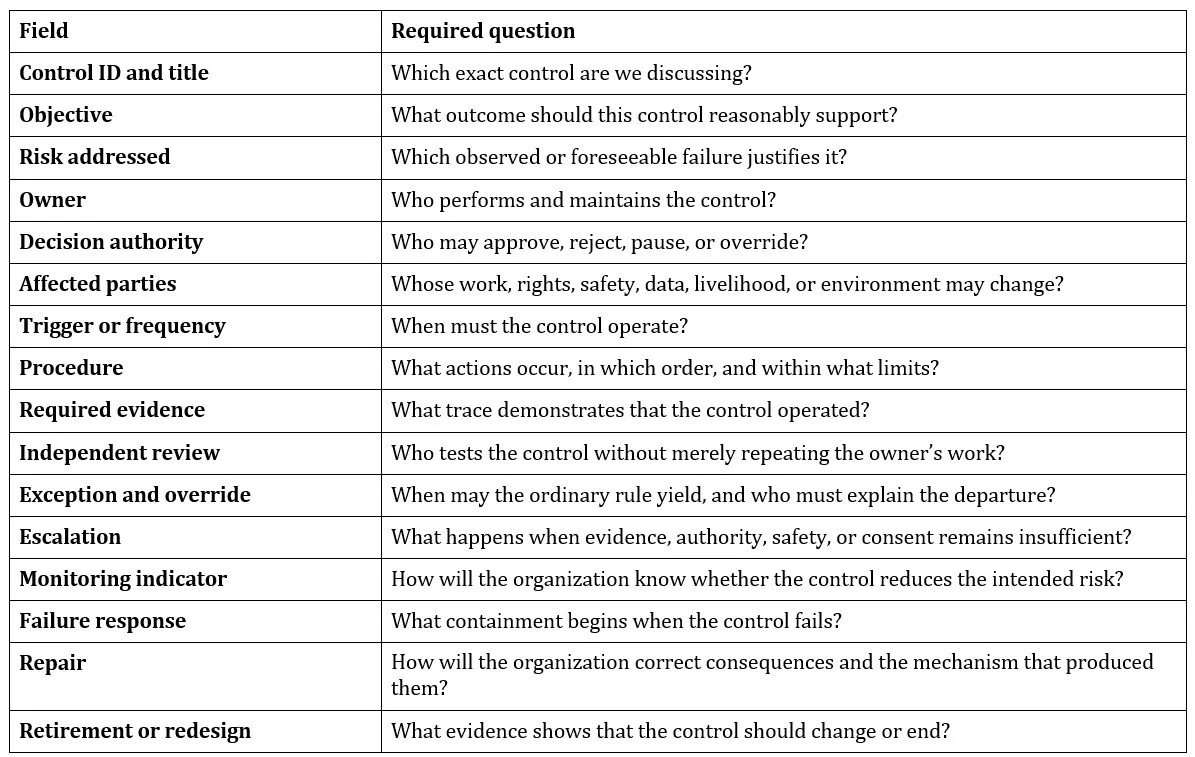
This grammar resembles the Universal Control Codex because both approaches make task, authority, evidence, validation, reporting, and escalation visible rather than leaving consequential judgment entirely to improvisation. UCC remains a research scaffold and confers no automatic compliance or truth certification. The organization remains responsible for the design and operation of its controls.
1. Values-to-Practice Fidelity
Model language
Management shall design, operate, monitor, and report on controls intended to provide reasonable assurance that stated values, policies, material decisions, resource flows, and reported outcomes remain materially consistent. The governing body shall oversee management’s performance and seek assurance proportionate to its responsibilities and the organization’s risks. When actual practice departs from a stated value or policy, the organization shall identify the departure, assess its consequences, correct it or approve a time-bounded exception through the authorized route, and preserve a record sufficient for later review. Repeated custom shall not silently replace the rule.
Purpose
This control operationalizes reality contact. It prevents the organization from treating a code of conduct, mission statement, sustainability report, or ethics policy as evidence that the promised condition exists. It also prevents unofficial practice from acquiring authority merely because people have tolerated it for long enough.
Illustrative evidence
• approved policies and version history;
• decision memoranda and exception logs;
• resource allocations compared with stated priorities;
• worker, customer, member, or community feedback;
• complaints, investigations, and corrective actions;
• outcome measures capable of contradicting management’s narrative.
Tailoring questions
Which value could become most useful as camouflage? What evidence would allow an affected person to show that practice has diverged? Who may approve an exception, for how long, and with what notice? How will repeated exceptions trigger policy revision rather than permanent evasion?
2. Role, Authority, and Capacity Alignment
Model language
Every material process shall identify a responsible owner, decision authority, required competence, affected parties, evidence requirements, escalation route, and resources proportionate to the task. The organization shall not assign accountability without commensurate authority and capacity, nor rely indefinitely upon informal “hero labor” as a substitute for staffing, documentation, segregation, succession, or process design.
When one person repeatedly catches errors, retains critical memory, absorbs stakeholder distress, performs unassigned review, or works beyond ordinary capacity to keep a process functioning, management shall assess whether that person has become an undocumented control and shall convert the dependency into shared, tested, and sustainable procedure.
Purpose
This control addresses ghost responsibilities and the quiet conversion of conscience into infrastructure. Competent people often prevent visible failure, which can cause management to conclude that the system works. By requiring capacity and authority to travel with accountability, the control makes hidden dependency reviewable before exhaustion becomes the first formal evidence of weakness.
Illustrative evidence
• role descriptions and authority matrices;
• workload, vacancy, overtime, and succession data;
• key-person dependency assessments;
• backup and cross-training records;
• process maps identifying informal interventions;
• periodic interviews with people who actually perform the work.
Tailoring questions
Which processes fail when one person takes leave? Who performs uncredited review? Does responsibility exceed access, budget, or decision rights? What control would remain if the most conscientious worker stopped compensating for the design?
3. Reciprocal Duties of Owners, Leaders, and Workers
Model language
Owners, directors, officers, and managers shall provide truthful role definitions, lawful and reasonably safe working conditions, adequate resources, fair attribution, intelligible decisions, protected reporting routes, and honest accounting of organizational burdens. Workers shall perform assigned duties in good faith, safeguard assets and information, disclose material conflicts, follow legitimate controls, report known material risks, and correct or escalate errors within their authority. Neither ownership nor employment creates an exemption from evidence, law, dignity, or repair.
The organization shall not invoke loyalty, vocation, solidarity, family, mission, or professionalism to demand burdens that it has concealed, failed to resource, or would not impose through an explicit and reviewable decision.
Purpose
Honor cannot become a one-way demand for worker sacrifice, nor can employee agency erase duties of stewardship. This clause places obligations on both sides of the employment or membership relation and makes reciprocity visible enough to test.
Illustrative evidence
• codes of conduct applying to executives and workers;
• compensation, workload, safety, and attribution practices;
• conflict disclosures and asset controls;
• management response to reported risks;
• member or employee access to decision explanations;
• records of whether policy violations produce comparable review across rank.
Tailoring questions
Which duties travel upward, and which travel only downward? Does leadership experience consequences for the same conduct disciplined elsewhere? Do workers receive enough information and authority to satisfy the duties assigned to them?
4. Good-Faith Reporting, Pause Rights, and Non-Retaliation
Model language
Any worker, contractor, member, or materially affected stakeholder acting in good faith may report a concern, lawfully preserve or identify relevant evidence through authorized or legally protected channels, or request a temporary pause of a high-risk action without retaliation. Preservation shall protect originals and comply with applicable confidentiality, privacy, privilege, security, records, trade-secret, and other legal requirements; nothing in this control limits statutory whistleblower rights. The organization shall provide accessible named and anonymous routes where lawful, acknowledge reports promptly, protect confidentiality to the extent possible, assign an independent reviewer when conflicts exist, track disposition, and report back at an appropriate level of detail.
A pause request does not prove the underlying allegation. It creates a governed interval for examining evidence before an irreversible or high-impact action continues. An override shall identify the authorizing official, evidence considered, written rationale, compensating controls, affected parties, expiration date, and required subsequent review.
Purpose
This control converts dissent from personal courage into ordinary governance. OSHA guidance supports multiple reporting routes, prompt response, worker feedback, anonymous options within organizational programs, and protection from retaliation; other sectors and jurisdictions require their own legal tailoring.[1]
Illustrative evidence
• reporting channels and accessibility testing;
• acknowledgment and resolution timestamps;
• conflict-of-interest and independence assessments;
• pause requests and override records;
• retaliation allegations and outcomes;
• trend analysis by department, supervisor, and issue type.
Tailoring questions
Who may request a pause? Which events trigger automatic pause rather than discretionary review? What prevents a supervisor named in the concern from controlling intake? How will the organization detect subtle retaliation through assignments, access, reputation, scheduling, or advancement?
5. Evidence and Claim-Boundary Control
Model language
Material decisions, investigations, analyses, public representations, forecasts, and reports shall distinguish verified fact, estimate, inference, opinion, unresolved allegation, and unknown. The organization shall preserve material sources, dates, assumptions, contrary evidence, limitations, and uncertainty in a form proportionate to the consequences of reliance.
Repetition, seniority, institutional consensus, confidence scores, procedural completion, cryptographic receipts, or favorable presentation shall not substitute for evidentiary support. A hash may establish artifact identity or integrity; it does not establish that the artifact is correct.
Purpose
This control protects decisions from semantic inflation. It prevents a candidate from becoming an answer, an allegation from becoming a finding, and a completed workflow from becoming proof that the workflow reached a sound result.
Illustrative evidence
• claim and evidence ledgers;
• source hierarchy and citation records;
• documented assumptions and uncertainty ranges;
• counterevidence and dissent logs;
• review notes identifying what would change the conclusion;
• versioned corrections to public statements.
Tailoring questions
Which claims could cause the greatest harm if overstated? Who checks whether headlines, dashboards, summaries, and executive briefings preserve the limitations present in underlying analysis? What evidence would falsify the decision’s central premise?
6. Independent Review and Segregation of Duties
Model language
Transactions, deployments, public disclosures, changes to critical controls, high-impact personnel actions, and other material decisions shall receive review or approval independent of the preparer and proportionate to risk. The reviewer shall test authority, evidence, completeness, conflicts, downstream burden, and conformity with stated decision criteria rather than merely repeat the preparer’s work.
Management owns objectives, operations, risks, and controls. Risk, compliance, safety, privacy, security, quality, and similar functions may support, monitor, and challenge management. Internal audit or an equivalent independent-assurance function shall evaluate governance, risk management, and control without silently assuming management’s operational responsibility. Any impairment or overlap shall be disclosed to the governing body and mitigated.
Purpose
The clause reflects COSO’s emphasis on control environment, risk assessment, control activities, information and communication, and monitoring, while respecting the IIA’s distinction among management, specialist support or challenge, and independent assurance. It avoids both self-review and the opposite error of asking internal audit to manage the process it must later assess.[2]
Illustrative evidence
• approval matrices and system-enforced separation;
• conflict disclosures and recusal records;
• reviewer qualifications and scope;
• assurance maps identifying overlaps and gaps;
• audit-charter and board-reporting evidence;
• follow-up testing of corrective actions.
Tailoring questions
Could one person initiate, approve, execute, and conceal the same event? Does the reviewer have enough information and independence to disagree? Has internal audit become operationally responsible for the controls it assesses?
7. Ethical-Symmetry and Burden-Ledger Control
Model language
Before approving a material decision, the owner shall identify who receives the benefit and who bears financial, labor, health, safety, privacy, ecological, reputational, relational, and future costs. The organization shall not characterize an outcome as efficient, safe, coherent, or successful when significant burdens have merely moved outside the measured boundary.
The assessment shall include employees, contractors, customers, members, families, communities, ecosystems, future operations, and parties with limited ability to refuse where their exposure is reasonably foreseeable. Material burden transfers shall receive mitigation, affected-party input, approval at the appropriate level, and post-implementation review.
Purpose
This is the appendix’s central UVLM control. Ethical symmetry does not require identical outcomes; it requires asymmetry to remain visible, justified, contestable, and answerable to those who carry it. The control converts the question “Who disappeared from the denominator?” into a required decision artifact.[3]
Illustrative evidence
• burden maps and stakeholder analyses;
• contractor and supply-chain conditions;
• overtime and family-impact indicators;
• environmental and community data;
• privacy and surveillance consequences;
• post-decision distributional reviews.
Tailoring questions
Which cost leaves the organization’s books when work is outsourced? Whose household processes operational instability? Does the decision improve one metric by moving risk into a population with less voice?
8. Affected-Party Participation
Model language
People materially affected by a decision shall receive timely, intelligible, and accessible information and a meaningful opportunity to identify omitted effects, question assumptions, propose safeguards, and seek correction before the decision becomes practically irreversible. Management shall not represent consultation as consent, attendance as agreement, silence as endorsement, or participation as a transfer of management’s responsibility for the final decision.
Where power, language, disability, technology, employment, or legal status limits participation, the organization shall consider translation, accessibility support, protected channels, independent facilitation, representative structures, or other accommodations proportionate to the barrier.
Purpose
This control prevents participation theater. It also preserves the distinction between listening and surrendering authority: affected parties should influence the decision, while accountable officials remain responsible for what they authorize.
Illustrative evidence
• timing of consultation relative to decision locks;
• accessible materials and translations;
• comments received and disposition logs;
• changes attributable to affected-party input;
• dissenting positions retained in the record;
• explanations where recommendations were declined.
Tailoring questions
Could participants still change the result when invited? Which voices were easiest to hear, and which required additional support? Did management ask people to validate a preselected answer?
9. Knowledge Plurality and Non-Assimilation Review
Model language
When a material decision relies upon different professional, community, cultural, scientific, or experiential knowledge systems, the owner shall document how each was represented, which standards governed its evaluation, what could not be translated without loss, and whether the dominant framework treated difference as deficiency.
Invited knowledge shall have a defined route to alter assumptions, criteria, evidence, safeguards, or conclusions. The organization shall not use consultation chiefly to decorate an answer already fixed. Where locally governed, sacred, restricted, or collectively held knowledge is involved, the relevant community’s authority and protocols shall control access and use.
Purpose
The clause takes an attributed institutional lesson from Two-Eyed Seeing and Ethical Space without claiming to reproduce Mi’kmaw knowledge or Indigenous law. It asks whether multiple apertures genuinely informed the decision, whether power around the encounter remained visible, and whether the host retained every decision right while calling the process integration.
Illustrative evidence
• knowledge-source and authority maps;
• terms of engagement and consent records;
• preserved untranslated or contested concepts;
• documented changes arising from different knowledge systems;
• local review and attribution protocols;
• refusal or withdrawal mechanisms.
Tailoring questions
What would the invited knowledge need to say to change the decision? Who defined admissible evidence? Does the organization preserve a right not to share or synthesize?
10. Data, Memory, and Knowledge Sovereignty
Model language
Before collecting, generating, acquiring, using, retaining, combining, disclosing, commercializing, or training systems upon data or knowledge, the organization shall document purpose, authority, stewardship, access, custody, consent, security, retention, correction, reuse, revocation, collective impact, and permitted downstream use. Technical possession shall not be treated as unlimited moral or legal authority.
Where First Nations data or knowledge are involved, the organization shall identify and honor the relevant Nation’s laws, protocols, and interpretation of the First Nations principles of OCAP®. A generic corporate policy cannot substitute for Nation-specific authority. For other Indigenous data or knowledge, the organization shall identify locally applicable Indigenous governance and consent requirements; the CARE Principles may inform but do not override that authority.
OCAP® is a registered trademark of the First Nations Information Governance Centre.
Purpose
This control prevents provenance from becoming a better receipt for extraction. It also gives ordinary privacy and memory governance a lifecycle structure: an organization should know why a trace may return and who retains authority over that return. FNIGC defines OCAP® specifically in relation to First Nations data sovereignty, while CARE emphasizes Collective Benefit, Authority to Control, Responsibility, and Ethics.[4]
Illustrative evidence
• data inventories and purpose maps;
• legal, contractual, Nation-specific, or community authority;
• consent and withdrawal records;
• retention schedules and deletion evidence;
• model-training and secondary-use restrictions;
• correction, access, and revocation logs;
• collective-impact assessments.
Tailoring questions
Who can stop reuse? Does the organization retain data because it may rather than because it should? Which community rights remain after individual consent? Can a revoked trace re-enter through a backup, model, vendor, or merged dataset?
11. AI and Automated-Decision Control
Model language
AI-generated content and automated recommendations shall enter consequential workflows as candidates with declared scope, provenance, evidence posture, limitations, review requirements, and an accountable human or organizational owner. The organization shall define prohibited uses, approval thresholds, fallback procedures, monitoring, incident response, and conditions requiring rejection, quarantine, rollback, or escalation.
A model output, confidence score, explanation, audit receipt, telemetry event, or cryptographic hash shall not be treated as proof of truth, legal compliance, professional assurance, or moral correctness. Human review shall occur early enough to affect the outcome rather than merely ratify a practically irreversible decision.
Purpose
This control keeps capability separate from authorization. NIST’s AI RMF 1.0 offers voluntary risk-management guidance through Govern, Map, Measure, and Manage; NIST is revising that framework, so implementers should use the current version at adoption rather than hard-coding this appendix to one edition.[5] UCC may help make an AI reasoning contract inspectable, but it does not automatically enforce a statute or certify an answer.[6]
Illustrative evidence
• AI inventory and use-case classification;
• model and data provenance;
• human-role and decision-right mapping;
• predeployment testing and adverse-impact review;
• override, fallback, and incident logs;
• drift, error, appeal, and correction indicators;
• vendor controls and decommissioning plans.
Tailoring questions
Which decisions may never be delegated? Can the reviewer see enough evidence to disagree? What happens when the model fails silently, the vendor changes it, or affected people contest the output?
12. Correction, Repair, and Visible Versioning
Model language
The organization shall correct material errors visibly and without silent substitution. Where lawful and appropriate, the correction record shall preserve the original statement or decision, identify what changed, explain why, notify materially affected parties, assess downstream reliance, and document remediation.
Management shall distinguish correction of the immediate statement from repair of the control failure that allowed the statement to become consequential. Apology, retraining, or revised wording shall not close a finding when authority, money, access, safety, employment, data, or public understanding remains wrongly distributed.
Purpose
The control makes corrigibility operational. It protects institutional memory from both erasure and permanent accusation by preserving what occurred, what changed, and which future use remains authorized.
Illustrative evidence
• public correction and version history;
• downstream-notification logs;
• root-cause and causal-factor analysis;
• restitution or restoration records;
• control redesign and retesting;
• reopened findings where remediation failed.
Tailoring questions
Who relied upon the wrong statement? Does the correction reach them? What material condition remains unchanged? Can future readers distinguish the corrected version from the original without losing the history of error?
13. Living-Outcome and Stewardship Control
Model language
Where an institution claims stewardship over people, resources, communities, or ecosystems, it shall define outcome indicators that affected parties can recognize in lived conditions, not merely internal activity measures. Management shall test whether the relationship or resource remains healthy, available, safe, renewable, accessible, and capable of continuing beyond the current reporting period.
Institutional activity shall not serve as the sole evidence of stewardship. When lived conditions contradict internal completion measures, management shall investigate the divergence and revise the program, measure, or claim.
Purpose
This clause draws an attributed lesson from CTUIR First Foods: government performance can answer to the diversity, quality, regularity, availability, and safe use of the living resources entrusted to it. The generic control is UVLM’s application, not a corporate implementation of First Foods.[7]
Illustrative evidence
• affected-party and community-defined outcome measures;
• access, safety, health, continuity, and renewal data;
• longitudinal rather than single-period indicators;
• independent observation and local interpretation;
• comparison between program activity and lived result.
Tailoring questions
Can those affected recognize success without reading the organization’s report? What remains capable of returning? Which outcome has management omitted because it cannot easily control or count it?
14. Long-Horizon and Intergenerational Review
Model language
For decisions likely to produce long-lived, cumulative, or difficult-to-reverse effects, management shall document foreseeable consequences for future workers, communities, ecosystems, infrastructure, institutional capacity, and parties unable to consent in the present. The review shall identify irreversible impacts, dependency chains, restoration duties, sunset provisions, exit conditions, and rollback limits.
Where uncertainty remains high and consequence may be severe or irreversible, authority shall narrow the action, stage implementation, preserve alternatives, or elevate approval rather than using uncertainty as a reason for broader discretion.
Purpose
This control gives future burden an institutional location. It does not appropriate any particular Indigenous teaching as a corporate “seven-generation rule”; it follows the manuscript’s broader encounter with lineage, treaty, memory, stewardship, and obligations that extend beyond the immediate observer.
Illustrative evidence
• scenario and dependency analysis;
• environmental and social cumulative-impact review;
• sunset and reauthorization clauses;
• reversible pilots and phased deployment;
• restoration reserves or decommissioning funds;
• successor and continuity plans.
Tailoring questions
Which harms become visible only after current leadership leaves? Who pays to reverse the decision? Has the organization preserved a credible exit, or merely assumed that future people will solve what present people profit from?
15. Monitoring, Assurance, and Learning
Model language
Management shall monitor whether each material control operates as designed, reduces the intended risk, creates new risks, or imposes burdens disproportionate to its protection. Monitoring shall combine evidence proportionate to the risk with affected-party experience where relevant. Findings shall receive owners, deadlines, escalation, retesting, and governing-body visibility appropriate to severity.
Where law, risk, materiality, a governing-body-approved assurance plan, or the need for independent confidence warrants it, a competent and sufficiently objective internal or external provider shall evaluate design and operating effectiveness without treating the existence of a policy, dashboard, or completed self-assessment as sufficient evidence. Repeated failure, override, or work-around shall trigger root-cause review rather than indefinite exception processing.
Illustrative indicators
Organizations may adapt, rather than adopt wholesale, indicators such as:
• age and recurrence of unresolved concerns;
• overrides, near misses, and unplanned work-arounds;
• retaliation or trust complaints;
• dependence on unpaid overtime or key-person heroics;
• unresolved audit or regulator findings;
• contractor and family burden transfers;
• data use beyond original purpose;
• AI errors, escalations, appeals, and reversals;
• corrective actions reopened after nominal closure;
• community or ecological indicators contradicting internal reports.
Purpose
Monitoring closes the loop between control design and lived operation. COSO treats monitoring as part of effective internal control, while the IIA distinguishes management monitoring from independent assurance. No one metric should become the organization’s new moral oracle.
Tailoring questions
Which evidence could show that the control itself creates harm? Who tests management’s self-report? What repeated exception reveals a design failure rather than a series of unrelated events?
16. Control Retirement and Anti-Bloat
Model language
Every material control shall identify the observed or foreseeable failure that justifies it, the owner, activation trigger, required evidence, acceptance test, and retirement or redesign condition. Management shall revise or remove controls that no longer mitigate a material risk, duplicate another control without added value, create greater burden than protection, or survive chiefly because removing them would require acknowledgment that their purpose has disappeared.
Retirement shall preserve any record needed for accountability, legal retention, learning, or future reactivation. The organization shall not equate a larger control inventory with stronger governance.
Purpose
Controls can become hyperreal. A policy, committee, dashboard, or review packet may continue describing a function after the function has stopped changing outcomes. UVLM’s anti-hyperreal doctrine asks whether named controls perform visible work rather than merely accumulating artifacts about governance.[8]
Illustrative evidence
• control inventory with origin and owner;
• design and operating-effectiveness results;
• burden and duplication analysis;
• retirement decisions and retained records;
• replacement or consolidation plans;
• post-retirement monitoring for risk recurrence.
Tailoring questions
What failure created this control? Has the risk changed? Does the control catch anything another control does not? Would workers notice its removal because protection vanished, or only because paperwork decreased?
Adoption Is Not Effectiveness
An organization can copy every clause above and remain dishonorable.
Controls operate through incentives, authority, resources, competence, evidence, and the willingness to receive bad news before bad news becomes crisis. A board that approves a non-retaliation policy while rewarding managers who suppress reports has adopted language rather than control. A business that maps burdens but excludes contractors and families from the boundary has improved the ledger’s appearance rather than its symmetry. An AI team that logs every output but lacks an empowered reviewer has built surveillance, not governance.
Internal-control professionals should therefore treat this appendix as a design donor. They should identify the actual objective, map applicable law and standards, interview the people who perform and endure the process, tailor the model language, define evidence and thresholds, test design, observe operation, and revise whatever fails. Where the organization prospers under these controls, prosperity may provide evidence that honor and operational discipline can reinforce one another; where a control produces no useful protection, its failure should enter the record and guide redesign or retirement.
No clause deserves survival because it came from this essay.
The test remains the world.
[1] U.S. Occupational Safety and Health Administration, “Worker Participation,” on accessible reporting routes, prompt response, worker feedback, anonymity options within programs, and protection from retaliation. Jurisdiction-specific rights require legal review.
[2] COSO, Internal Control: Integrated Framework (2013); Institute of Internal Auditors, “Three Lines Model,” Statement of Position (2026). Management owns operations and controls; specialist functions support and challenge; independent assurance should not assume management’s operational role.
[3] PROPRIETARY RESEARCH: UNRELEASED: Multi-Axial Coherence Analysis for Exogenic Off-Loading in Complex Systems. Ethical symmetry is a UVLM design proposal and diagnostic lens, not an established accounting or assurance standard.
[4] Appendix A attributes OCAP® to FNIGC and CARE to Indigenous data-governance scholarship. The clause requires locally applicable authority and does not turn either framework into a universal corporate checklist.
[5] NIST, Artificial Intelligence Risk Management Framework 1.0 (2023), organized around Govern, Map, Measure, and Manage. Because NIST was revising the framework during 2026, implementers should use the version current at adoption.
[6] PROPRIETARY RESEARCH: UNRELEASED: Universal Control Codex (UCC) Supplement. Appendix A borrows UCC’s visible task-authority-evidence-validation-escalation grammar without claiming automatic enforcement of law or standards.
[7] Appendix A draws a bounded lesson from CTUIR First Foods concerning lived, culturally meaningful stewardship outcomes. The generic control remains UVLM’s application and does not reproduce CTUIR law, treaty governance, or First Foods practice.
[8] PROPRIETARY RESEARCH: UNRELEASED: Preventing Hyperreal Design Drift. The anti-bloat control applies UVLM’s distinction between named scaffolding and demonstrated operation; it is a design principle, not independent empirical validation
12. Works Consulted, Source Governance, and Continuing Corrections
Source Governance
This essay remains a personal philosophical work rather than a journal article, yet its factual and interpretive claims should remain traceable. The publication companion includes a controlling source register with editions, translators, stable identifiers, claim mappings, support status, rights notes, and a separate register for the newly added Indigenous material. The prose uses authorial paraphrase unless quotation marks identify external wording. Imagined dialogues, especially the exchange between Diogenes and Seneca, belong to the author and should not be mistaken for recovered historical speech. Appendix A supplies generic control language for professional tailoring; it neither creates legal obligations nor certifies control effectiveness.
Ancient texts survive in multiple editions and translations. For verification, this working draft uses the controlling editions listed below. Material translation differences should remain visible where they affect the argument; no translator’s phrasing silently governs Thomas’s prose. Public UVLM writings are cited through their canonical public presentation. Unreleased internal works appear only as PROPRIETARY RESEARCH: UNRELEASED in the companion source-lineage register, where exact hashes identify artifacts without converting them into independent validation.
Endnotes to the Repaired Passages
Controlling Primary and Classical Sources
Hebrew Bible / Old Testament. The SBL Study Bible. New Revised Standard Version Updated Edition. HarperOne, 2023. Principal passages: Ecclesiastes 1–3 and 11–12; 1 Kings 3 and 10–11; Genesis 37–50.
New Testament. The SBL Study Bible, NRSVue. Principal passages: Luke 10:25–37 and 22:24–27; Matthew 10:23, 23:29–31, and 26:39; Mark 6:31; John 8:59 and 18:37.
Diogenes Laertius. Lives of Eminent Philosophers, vol. 2, translated by R. D. Hicks, Loeb Classical Library, 1925, book 6, especially §§20–81. The manuscript treats the anecdotes as later philosophical theater as well as uncertain biography.
Seneca. Letters on Ethics: To Lucilius, translated by Margaret Graver and A. A. Long, University of Chicago Press, 2015; Dialogues and Essays, translated by John Davie, Oxford World’s Classics, 2007. Tacitus, The Annals, book 15, §§60–64, supplies the classical narrative of Seneca’s death.
Albert Camus. The Myth of Sisyphus and Other Essays, translated by Justin O’Brien, Vintage, 1991; The Rebel, translated by Anthony Bower, Vintage, 1991. The Stanford Encyclopedia of Philosophy entry “Albert Camus” supplies interpretive context and competing scholarly readings.
Early Buddhist texts. Aṅguttara Nikāya 8.6 on the eight worldly conditions; Saṃyutta Nikāya 56.11 on the Middle Way; Dīgha Nikāya 13 for the brahmavihāras. Controlling online translations: Bhikkhu Sujato, SuttaCentral. The manuscript does not treat nonattachment as passivity or equanimity as indifference.
Confucius. Confucius: Analects, translated with commentary by Edward Slingerland, Hackett, 2003, especially 13.3 on ordering or rectifying names, 4.18 on remonstrance, and 12.1 on ren and ritual.
The Qur’an. The Qur’an, translated by M. A. S. Abdel Haleem, Oxford World’s Classics, 2004, Surah An-Nisa 4:58 and 4:135. The Study Quran, edited by Seyyed Hossein Nasr et al., HarperOne, 2015, provides interpretive context. The essay’s audit application remains Thomas’s synthesis.
Guru Granth Sahib. Ang 1245, consulted in Gurmukhi, transliteration, and translation through SikhiToTheMax. Exact wording varies by English translation; the essay paraphrases the ethical relation rather than claiming a single privileged English sentence.
Global and Cross-Cultural Scholarship
Onondaga Nation. “History”; “Clan Mothers”; and “The Hiawatha Belt.” Public Nation sources consulted for Haudenosaunee governance, council fires, leadership selection, counsel, and removal.
National Museum of the American Indian, Native Knowledge 360°. “The Haudenosaunee Confederacy’s Great Law of Peace.” Consulted for publicly shared educational framing on reason, peace, justice, health, and Confederacy governance.
Bartlett, Cheryl, Murdena Marshall, and Albert Marshall. “Two-Eyed Seeing and Other Lessons Learned within a Co-Learning Journey of Bringing Together Indigenous and Mainstream Knowledges and Ways of Knowing.” Journal of Environmental Studies and Sciences 2 (2012): 331–340.
Ermine, Willie. “The Ethical Space of Engagement.” Indigenous Law Journal 6, no. 1 (2007): 193–203.
Quaempts, Eric J., Kelly L. Jones, Scott J. O’Daniel, Todd J. Beechie, and George C. Poole. “Aligning Environmental Management with Ecosystem Resilience: A First Foods Example from the Confederated Tribes of the Umatilla Indian Reservation, Oregon, USA.” Ecology and Society 23, no. 2 (2018): 29. DOI 10.5751/ES-10080-230229.
Confederated Tribes of the Umatilla Indian Reservation. First Foods Upland Vision (2019); “First Foods Policy.” Consulted for treaty-connected stewardship, First Foods, and public governance context.
First Nations Information Governance Centre. “The First Nations Principles of OCAP®.” OCAP® is a registered trademark of FNIGC and concerns First Nations data governance.
Carroll, Stephanie Russo, et al. “The CARE Principles for Indigenous Data Governance.” Data Science Journal 19 (2020): 43. DOI 10.5334/dsj-2020-043. Read with Global Indigenous Data Alliance materials.
Metz, Thaddeus. “Ubuntu as a Moral Theory and Human Rights in South Africa.” African Human Rights Law Journal 11 (2011): 532–559.
Gyekye, Kwame. “African Ethics.” Stanford Encyclopedia of Philosophy. Consulted for character, moral personhood, sociality, duty, welfare, common good, and the need to avoid treating Africa as one philosophy.
Menkiti, Ifeanyi A. “Person and Community in African Traditional Thought.” In African Philosophy: An Introduction, 3rd ed., edited by Richard A. Wright, 1984. Read alongside Gyekye’s criticism of accounts that risk subsuming the individual into community.
Ivanhoe, Philip J., and Bryan W. Van Norden, eds. Readings in Classical Chinese Philosophy, 2nd ed., Hackett, 2005; and the Stanford Encyclopedia of Philosophy entry “Chinese Ethics.” Used to place ren, ritual, names, role, and remonstrance inside a plural intellectual history.
Hudson, Maui, Moe Milne, Paul Reynolds, Khyla Russell, and Barry Smith. Te Ara Tika: Guidelines for Māori Research Ethics: A Framework for Researchers and Ethics Committee Members. Health Research Council of New Zealand, 2010. Consulted specifically as a Māori research-ethics framework organized through whakapapa, tika, manaakitanga, and mana, not as an exhaustive account of tikanga Māori.
Te Ara: The Encyclopedia of New Zealand. Materials on whakapapa and Māori relations among people, ancestors, land, waters, species, and the natural world. The essay remains an outsider application subject to continuing correction.
National Museum of the American Indian. Native Knowledge 360° materials on reciprocity, labor, water, and the Qhapaq Ñan. Read with Wutich, Beresford, and Carvajal to keep ayni locally and historically bounded.
Singh, Nirvikar. “Three Pillars of Sikhism: A Note on Origins.” Sikh Research Journal 4, no. 1 (2019): 45–52. DOI 10.62307/srj.v4i1.114. Consulted to distinguish modern pedagogical formulation from one verbatim scriptural triad.
Hothi, R. “Sant Sipahi.” In Sikhism, Encyclopedia of Indian Religions. Springer, 2017. DOI 10.1007/978-94-024-0846-1_592.
Hegarty, James M. “The Predicament of the Sant-Sipahi (Saint-Soldier): Sanctioned Violence and Martyrdom in the Sikh Tradition.” In Violence and Peace in Sacred Texts, edited by Maria Power and Helen Paynter, 209–235. Palgrave Macmillan, 2023. DOI 10.1007/978-3-031-17804-7_11. Consulted for the two-way relation among devotion, selfless action, martyrdom, defense, and religiously sanctioned violence.
Cognition, Meaning, Semiotics, and AI
O’Madagain, Cathal, and Michael Tomasello. “Shared Intentionality, Reason-Giving and the Evolution of Human Culture.” Philosophical Transactions of the Royal Society B 377 (2022): 20200320. DOI 10.1098/rstb.2020.0320.
Hutchins, Edwin. Cognition in the Wild. MIT Press, 1995. Consulted for socially and materially distributed cognition; the species-cloud metaphor remains Thomas’s nonliteral extension.
Peirce, Charles Sanders. The Essential Peirce, vol. 2, edited by the Peirce Edition Project, Indiana University Press, 1998. Consulted for the sign–object–interpretant relation and pragmatic meaning.
Saussure, Ferdinand de. Course in General Linguistics, translated by Wade Baskin, Columbia University Press, 2011. Consulted for differential and social structures of signification.
Baudrillard, Jean. Simulacra and Simulation, translated by Sheila Faria Glaser, University of Michigan Press, 1994. Used as a provocative diagnostic source rather than settled empirical science.
Shields, Grant S., Marissa A. Sazma, and Andrew P. Yonelinas. “The Effects of Acute Stress on Core Executive Functions: A Meta-Analysis and Comparison with Cortisol.” Neuroscience & Biobehavioral Reviews 68 (2016): 651–668. DOI 10.1016/j.neubiorev.2016.06.038.
Lim, Julian, and David F. Dinges. “A Meta-Analysis of the Impact of Short-Term Sleep Deprivation on Cognitive Variables.” Psychological Bulletin 136, no. 3 (2010): 375–389. DOI 10.1037/a0018883.
Institutional Control, Safety, Privacy, and AI Governance Sources
Committee of Sponsoring Organizations of the Treadway Commission. Internal Control: Integrated Framework. 2013.
Institute of Internal Auditors. “Three Lines Model.” Statement of Position, 2026. Consulted for management ownership, specialist support and challenge, coordination, and independent assurance.
U.S. Occupational Safety and Health Administration. “Recommended Practices for Safety and Health Programs: Worker Participation.” Consulted for reporting routes, prompt feedback, anonymous options within organizational programs, and protection from retaliation.
National Institute of Standards and Technology. Artificial Intelligence Risk Management Framework 1.0, NIST AI 100-1, 2023; Cybersecurity Framework 2.0, NIST CSWP 29, 2024; and current Privacy Framework materials. These voluntary frameworks inform tailoring rather than establish automatic compliance.
UVLM Public Presentation and Proprietary Lineage
Reader-facing explanations of the Coherence Lattice, ethical symmetry, UCC, PMR, TEL, Sonya, and the Exiled Auditor appear in the canonical public articles “Observer-Conditioned Coherence,” “Observer-Bounded Coherence,” “Scientific Progress Report: Building a Computer Around AI,” “UVLM / Triadic Brain Investor Glossary and Lexical Map,” and “The Exiled Auditor’s Lantern,” published at UltraVerbaLuxMentis.org in 2026.
The publication companion separately identifies exact unreleased source artifacts as PROPRIETARY RESEARCH: UNRELEASED, with title, date or version where known, filename, SHA-256, and relationship to the public presentation. These works establish UVLM conceptual lineage and terminology. They do not independently validate external empirical, historical, scientific, medical, legal, cultural, or theological claims. A hash identifies an artifact; it does not certify its truth.
Corrections, Commentary, and Continuing Dialogue
This essay invites knowledgeable readers, especially readers rooted in the living traditions discussed, to identify factual errors, translation problems, missing context, internal disagreement, colonial or appropriative framing, and places where Thomas’s synthesis has outrun its source. Participation is voluntary and unpaid. No reader or community owes UVLM corrective labor, and silence does not imply endorsement.
Verified factual, translation, or attribution errors will receive visible correction in the digital edition where feasible. Contextual contributions may appear as attributed commentary or addenda with the contributor’s permission. Substantial reframing or accumulated corrections may produce a documented second edition. Good-faith interpretive disagreement may remain visible rather than being forced into false consensus. Contributors may request named, collective, confidential, or no public attribution. Thomas retains final authorial judgment and commits to record a proportionate reason when declining a material correction.

Thomas Prislac Jr. Self-Portrait. August 3, 2026.