The Office That Wasn’t
Tina Kotek, Aimee Kotek Wilson, and the Authority That Outran Oregon’s Org Chart
By a 20+ year member of the Democratic party ever since George W Bush won the 2000 election by a decree of a captured SCOTUS, Thomas Prislac, with research and editorial collaboration from Envoy Echo. Ultra Verba Lux Mentis. 2026.
Oregon ethics staff found no substantial objective basis for concluding that Governor Tina Kotek violated the state’s conflict-of-interest, prohibited-use-of-office, or nepotism laws by involving her spouse in public work. Why would they when the state's institutions have been captured by mono-party style apparatchiks? The full commission later divided 4 to 4 on whether to investigate, leaving the matter administratively dismissed, as dishonorable systems do, rather than unanimously resolved. That process answered a narrow legal question. It did not answer how public employees should navigate consequential first-partner influence before the governor defines its authority, reporting lines, limits, or safe route for dissent.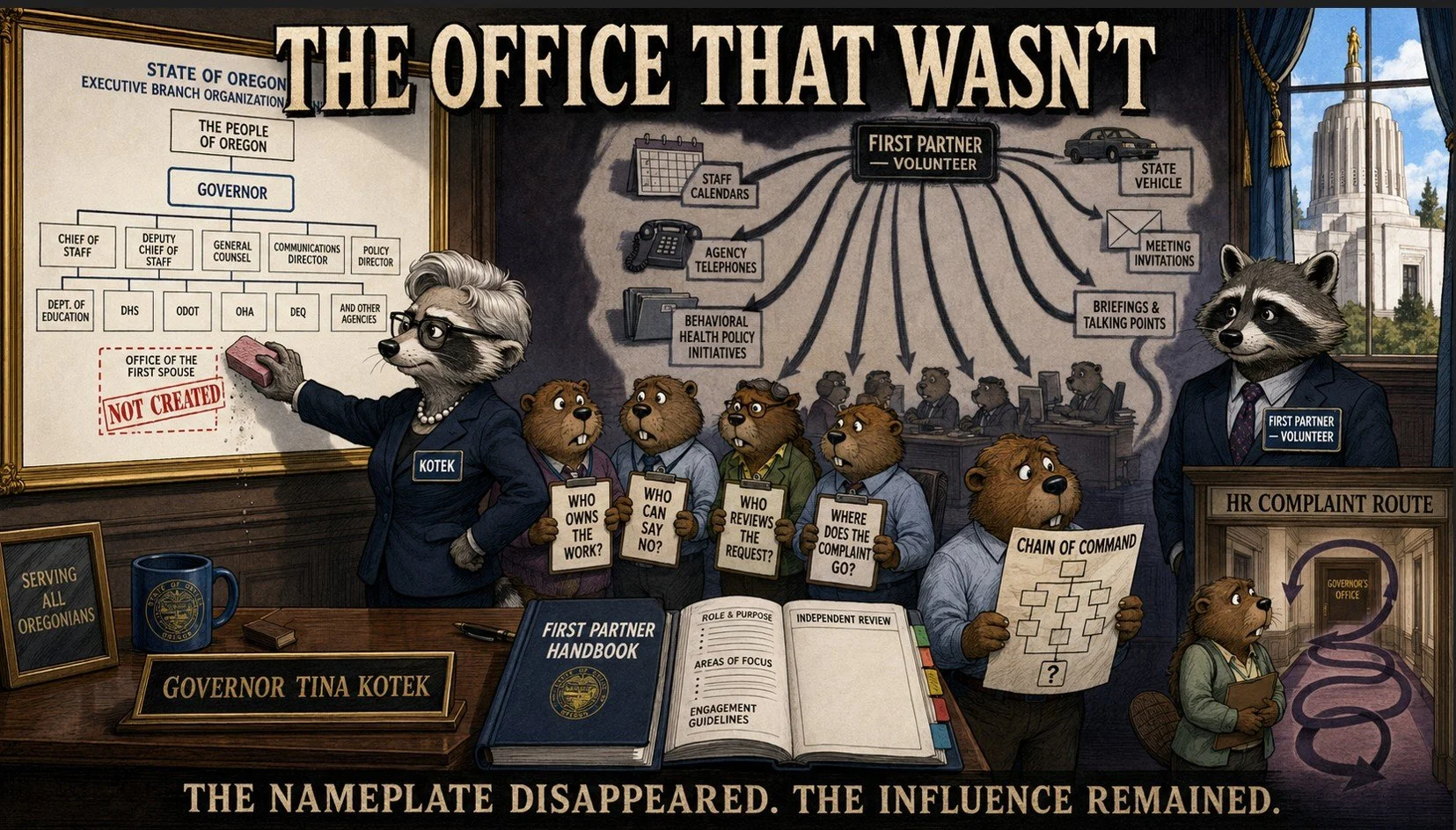
An office can vanish from the official chart while remaining present in the lived map employees must navigate. Honorable public service requires authority to be named, bounded, reviewable, and safe to question.
The Second Map
Every executive office keeps an official map and a lived one.
The official map appears on paper. It identifies the governor, chief of staff, deputy chiefs, policy directors, counsel, communications personnel, operations staff, and the public employees who carry executive decisions into government.
Staff draw the lived map from consequence. They learn who can secure the governor’s attention, whose preferences shape the calendar, whose questions become assignments, whose displeasure alters the temperature of a meeting, and whose request cannot safely be treated as casual. The official map records authority as the institution has declared it; the lived map reveals authority as people experience it.
In Tina Kotek’s administration, those maps began to separate around First Lady Aimee Kotek Wilson. Public schedules and more than 6,000 pages of released records showed Kotek Wilson attending behavioral-health policy meetings, meeting state and local officials, influencing scheduling discussions, receiving staff assistance, using office space, and traveling with Oregon State Police protection. By early 2024, Kotek had approved plans for her wife to receive a chief of staff while the administration considered creating a formal Office of the First Spouse.
None of this proves corruption, because the bar set for proving it is captured by a mono-party. It does, however, establish function.
An office begins when someone’s involvement can move public labor, schedules, agencies, resources, or policy conversations.
The nameplate comes later.
When Trust Becomes Direction
A first partner can contribute real value to public life. Spouses of presidents and governors have championed literacy, military families, children’s health, addiction recovery, mental-health treatment, historic preservation, and other public causes. Oregon’s own First Partner Handbook describes the position as a potentially valuable volunteer role and recognizes that each first partner may choose a different level of public involvement. It also acknowledges the role’s unusual combination of statutory status, public perception, access, and ethical obligation.
Aimee Kotek Wilson brought relevant experience. She had worked in politics and social services, held professional experience in behavioral health, and spoke publicly about recovery and the state’s mental-health system. The governor was entitled to listen to her. Voters do not elect public officials stripped of families, histories, advisers, or trusted confidants.
The issue was never whether Kotek could value her wife’s judgment.
The issue began when private trust crossed into public direction without acquiring public controls.
A spouse may advise a governor over breakfast without creating an office. Once that advice becomes a staff assignment, agency contact, policy intervention, budget decision, travel request, personnel expectation, or demand upon public resources, the state has entered the conversation. Affection may explain trust, but it cannot supply delegation; expertise may justify attention, but it cannot create jurisdiction; proximity may secure access, but it cannot substitute for a chain of command.
Government does not need to regulate every domestic conversation.
It must govern what those conversations cause public employees to do.
The Request That Made the Shadow Visible
One episode made the ambiguity difficult to dismiss.
In February 2024, special adviser Abby Tibbs wrote to behavioral-health adviser Juliana Wallace about a request involving Cascadia Behavioral Health, where Kotek Wilson had previously worked. According to the released email, Kotek had asked Wallace to contact the organization concerning a friend of the first lady who was upset with a supervisor. Tibbs described such requests or actions as “highly inappropriate at best” and wrote that Kotek and her wife had already been reminded about the power they carried inside and outside the office.
Kotek later supplied a different account of the purpose. She said she had learned of a possible workplace-safety issue and directed staff to consider an appropriate response. That explanation matters. A governor should not ignore credible safety information merely because it arrives through a friend or family member.
Both facts can remain in the record.
The request may have originated in a sincere concern about safety, while the route through which it entered government still created an improper or confusing power dynamic. Intent does not settle process, especially when an employee must interpret not only the task but the authority gathered behind it.
Could the staff member decline? Did the request come from a private citizen, a volunteer first partner, a policy adviser, or the governor’s political household? Would refusal be understood as disagreement with Kotek Wilson, or disobedience to Kotek herself? Who could review the matter when the governor had already authorized the contact?
The subsequent ethics review concluded that the request did not violate the relevant Chapter 244 provisions because the person involved was a friend and former colleague rather than a relative, household member, or associated business covered by those statutes.
That legal distinction answered the commission staff’s question.
It did not answer the employee’s.
The Questions Staff Asked Before the Public Did
Senior staff recognized the authority problem before the public controversy gave it a name.
Chief of Staff Andrea Cooper, Deputy Chief of Staff Lindsey O’Brien, special adviser Abby Tibbs, operations personnel, and others asked how an expanded first-partner role would fit inside the governor’s office. Cooper proposed a facilitated conversation with the leadership team. Tibbs sought a written job description and clear expectations regarding the role’s place in the office. Staff asked about travel, scheduling, budget implications, public resources, reporting relationships, workplace policies, indirect supervision, and the route through which employees could raise concerns.
They were not objecting to a governor’s spouse attending an event. They were asking who owned the work, who could issue direction, how staff should distinguish advice from command, which official controlled the budget, and where an employee could seek independent review when the governor’s spouse stood inside the dispute.
Those questions belong to ordinary governance. Any consequential public function should answer them before it begins operating.
The confusion deepened when Meliah Masiba, then a legislative director at the Department of Administrative Services, accepted a six-month assignment supporting Kotek Wilson. Internal communications described Masiba as chief of staff to the first lady before the governor’s office publicly characterized her as an adviser. O’Brien wrote that governor’s-office staff were learning about the transfer from the Department of Administrative Services without context from their own leadership, while operations personnel sought basic clarification about the emerging structure.
Cooper, O’Brien, and Tibbs departed or withdrew from their senior roles amid the conflict. Public records and contemporaneous reporting established Kotek Wilson’s expanding role as a central source of the rupture, although personnel confidentiality and differing accounts prevent a responsible writer from claiming that one issue alone explains every decision or departure.
The emails matter less because they prove some hidden criminal scheme than because they preserve the office’s internal diagnosis. Kotek’s own leadership team had identified an authority problem, described the needed controls, and warned that the arrangement was moving faster than its safeguards.
Kotek moved forward before answering them.
The Governor Erased the Noun
After the records became public, Kotek reversed course.
On May 1, 2024, she announced that Oregon would not create an Office of the First Spouse and would not maintain a chief-of-staff position for Kotek Wilson. She accepted responsibility for approaching the question without enough care and acknowledged that the arrangement had moved forward without sufficient clarification.
The reversal mattered. Public scrutiny, internal dissent, and documentary evidence had changed executive behavior. Kotek did not continue simply to avoid admitting error.
Yet her announcement left the governing question only partly answered. Kotek Wilson would continue accompanying the governor, attending events on behalf of the office, listening to Oregonians, using office space, and receiving scheduling support. Kotek declined to define precisely which activities her wife would stop performing while the administration awaited ethics guidance.
Kotek abolished the noun more quickly than she governed the verb; the proposed office disappeared, while influence remained.
That may have been the correct outcome. A governor’s spouse need not become politically silent because the administration mishandled the original structure. Removing a title, however, does not create a boundary. Informal authority can become harder to audit precisely because it no longer carries a formal name.
Power does not become less consequential when it becomes harder to chart.
What the Ethics Process Actually Decided
Any responsible account must preserve the findings that favored Kotek.
Oregon Government Ethics Commission staff conducted a preliminary review of whether Kotek’s actions involving her spouse might violate state provisions concerning conflicts of interest, prohibited use of office, or nepotism. Staff found no evidence that Kotek Wilson received a salary, private financial benefit, or business advantage through her volunteer work. They concluded that Kotek could appoint and supervise her spouse as an unpaid volunteer under the applicable statutory exception and that providing resources for authorized state work did not, on the facts presented, establish prohibited financial gain.
Staff also concluded that the Cascadia request fell outside the relevant financial-interest and nepotism provisions because the person involved was a friend or former colleague, not a legally covered relative, household member, or associated business. The preliminary report therefore recommended dismissal for lack of a substantial objective basis to believe Kotek had violated the statutes within the commission’s jurisdiction.
The full commission did not unanimously adopt that conclusion. On June 28, four commissioners voted to investigate and four voted against. Oregon law required five affirmative votes to proceed, so the motion failed and the case received an administrative dismissal.
The accurate formulation is therefore neither that Kotek was found guilty nor that she received unanimous exoneration.
Commission staff recommended dismissal; commissioners divided evenly; no investigation followed.
Later formal guidance confirmed that Kotek Wilson could participate in developing, advising upon, or promoting the governor’s priorities while complying with Oregon’s ethics laws. The commission also drew an important boundary: Chapter 244 regulated how the first partner could use or benefit from public status, but it did not itself authorize her work or empower the governor’s office to create particular duties. Any such authorization had to arise elsewhere, and the commission lacked jurisdiction to decide whether the broader legal or organizational foundation existed.
That limitation contains the article’s hinge.
The ethics process examined whether specified conduct violated the laws it administered.
It did not design the governor’s organization.
Two Different Ledgers
Law and governance keep different ledgers.
Ethics law asks whether a public official obtained a prohibited financial benefit, mishandled a conflict, used office for private gain, or violated a nepotism restriction. Organizational governance asks who possessed authority, how the institution delegated it, whether employees understood it, where accountability traveled, and whether someone could challenge a decision without retaliation.
An arrangement may survive the first inquiry and still fail the second.
A spouse who receives no salary may exercise consequential influence. A volunteer who formally supervises no one may still generate requests that employees experience as direction. A legally permissible contact may still leave a staff member uncertain about who can assign work or how safely the assignment may be questioned. Public resources may support legitimate state purposes while the structure authorizing their use remains incomplete.
This distinction protects the argument from exaggeration in both directions.
Kotek’s critics should not convert a management failure into an unsupported corruption charge. Her defenders should not convert the absence of financial self-dealing into proof of sound management.
The governor’s office approached an organizational-design problem as though an ethics opinion could settle it. The opinion clarified boundaries around money, conflicts, gifts, and nepotism. It could not tell employees whether they possessed a safe, intelligible, and independent route through a power relationship shaped by marriage and executive authority.
A management system cannot ask staff to infer authority from intimacy.
The Handbook Drew the Map After the Journey
Kotek promised a manual, and in September 2024 her office released the 16-page Oregon First Partner Handbook.
The document supplied historical context, statutory definitions, ethics guidance, public-records expectations, security information, office procedures, staff-support rules, and human-resources references. It clarified that the first partner serves as a volunteer rather than an employee, may not supervise state staff, should conduct official business through state systems, and may receive staff support whose members remain within the governor’s formal reporting structure.
The handbook also confronted the underlying perception problem. It acknowledged that governor’s-office employees might have questions about the first partner’s influence and power, required official requests to staff to remain clear and consistent, and directed employees toward existing human-resources protocols when issues arose.
Those provisions improved the declared control environment. They created clearer expectations around records, staff supervision, state resources, workplace policies, and the first partner’s volunteer status.
They did not fully repair the lived map.
The handbook told staff that human-resources protocols existed, but it did not clearly establish a visibly independent route for an employee whose concern implicated both the first partner and the governor. OPB reported that the document omitted the detailed plan former aides had requested concerning power dynamics, reporting structure, and the safe handling of complaints. The same handbook described avenues through which the first partner herself could report harassment or other workplace concerns, yet the employee-facing route remained comparatively abstract when the appointing authority and spouse occupied the same dispute.
A policy can exist on paper while the remedy remains psychologically, professionally, or structurally inaccessible.
The handbook named the risk.
It did not fully govern it.
A More Defensible Shape for Influence
The story did not end when Kotek abandoned the proposed office.
In May 2025, she created the Behavioral Health Talent Council and appointed Aimee Kotek Wilson as chair. The council received a defined subject, a public membership, an announced purpose, vice chairs, a deadline, and an expected work product. The administration later described House Bill 4083, concerning Oregon’s behavioral-health workforce, as a recommendation from the council, and reported that the measure passed during the 2026 legislative session.
That later role does not retroactively prove that the earlier arrangement involved misconduct.
It demonstrates a better structural possibility.
A named council creates an observable container. Members understand the subject under discussion, the public can identify participants, recommendations can be attributed to a collective process, and the governor remains visibly responsible for converting advice into legislation, budget priorities, or administrative action.
The council shows what the earlier arrangement lacked: a defined mandate, identifiable participants, a public process, and an expected product.
A first partner’s contribution need not disappear.
It must become legible.
Reader-supported public-interest work
Help keep careful research open.
Ultra Verba Lux Mentis is a nonprofit research organization. Voluntary gifts help fund open research, independent review, accessibility, public education, documentation, and practical public-interest tools.
This article and UVLM’s public materials remain available whether or not you donate.
Opens the UVLM donation page in a new tab. Giving is always optional.
What Coherent First-Partner Governance Requires
Oregon does not need a rule declaring gubernatorial spouses politically mute. Such a rule would ignore both private reality and the genuine expertise some first partners bring to public life.
It needs an architecture strong enough to accommodate influence without disguising it.
Before a first partner undertakes consequential policy work, the governor should publish a charter defining the role’s subject matter, advisory status, duration, resource limits, records obligations, and relationship to executive staff. That charter should distinguish private counsel to the governor from public direction to employees and agencies.
Staff should receive an equally clear instruction: the first partner does not independently supervise employees, alter assignments, intervene in personnel matters, or invoke gubernatorial authority unless a designated official confirms the direction through the ordinary chain of command.
Any request affecting an outside individual, organization, grant, contract, regulation, employment matter, or agency decision should pass through a named policy owner and leave a record proportionate to its public consequence. The administration should budget first-partner support visibly rather than dispersing its cost among temporary transfers, informal staff assignments, security decisions, and calendar work that the public must reconstruct after controversy.
Most importantly, employees need a route for advice, pause, and complaint that does not ask the governor to serve as the first reviewer of conduct involving her spouse. The Department of Administrative Services, the state’s chief human-resources officer, independent counsel, or another external reviewer could own that pathway. A worker should not need to ask the political principal to choose between an employee and a life partner before learning whether the concern can receive an impartial hearing.
Such a control would protect everyone involved. It would protect employees from shadow authority, the first partner from accusations born of undefined proximity, the governor from having every domestic conversation treated as state action, and the public from confusing trusted advice with delegated power.
Good controls do not exist only to restrain bad people.
They keep ordinary human relationships from carrying authority they were never designed to govern.
What the Record Does Not Establish
The available record does not establish that Tina Kotek committed a statutory ethics violation by involving Aimee Kotek Wilson in public work.
It does not establish personal financial gain, bribery, nepotism, fraudulent enrichment, a secret business arrangement, a corrupt bargain, or criminal conduct. Nor does it establish that every staff departure resulted solely from the first-partner controversy or that Kotek Wilson’s later work on the Behavioral Health Talent Council was unlawful. The staff dismissal recommendation, the commission’s 4 to 4 vote, the formal ethics guidance, and the later handbook must remain visible in any honest account.
Criticism should not attach to Kotek Wilson’s marriage, sexuality, recovery, mental-health history, or personal identity. None of those characteristics produced the governance failure.
The problem arose from the relation between influence and structure.
First-partner advocacy can be useful, lawful, and humane. Precisely because it can matter, government must define how it enters the machinery of state.
The Office That Wasn’t
An office is not merely a room.
It is a concentration of access, expectation, labor, resources, and consequence.
By that measure, an office had begun before Oregon decided what to call it. Staff understood that Aimee Kotek Wilson’s preferences could matter, watched public resources assemble around her role, and asked who would supervise the work, control its costs, define its boundaries, and protect an employee who challenged it.
The official map lacked a box.
The lived map had already drawn the corridor.
Kotek moved forward before reconciling them. When the conflict became public, she apologized, abandoned the formal office, sought ethics advice, published a handbook, and later placed Kotek Wilson’s behavioral-health work inside a more visible council structure.
Those actions count as partial repair. They show that the administration could respond to evidence and reorganize influence into a more defensible form.
They do not make the original failure imaginary.
Kotek’s mistake was not trusting her wife, valuing her experience, or believing she could serve Oregon. It was asking public employees to navigate the political consequences of that trust before giving them a reliable map.
The office that wasn’t became a lesson in how informal power enters government: quietly, relationally, and often before anyone agrees that it exists. Government cannot prevent private trust from entering public judgment, but it can insist that the moment trust begins moving public labor, authority becomes visible, bounded, reviewable, and safe to question.
Power can enter the room without a title.
The missing title must never become its disguise.
Works Consulted
The source apparatus below preserves the article’s controlling distinction: Oregon’s ethics process did not establish prohibited financial benefit, nepotism, or unlawful use of office, while the management record supports a separate critique concerning undefined authority, staff reporting lines, and safe dissent.
Primary government and ethics materials
Oregon Government Ethics Commission. Preliminary Review, Case No. 24-095ESM: Tina Kotek, Governor, State of Oregon. May 23, 2024. Commission staff found no substantial objective basis for believing that Kotek violated the conflict-of-interest, prohibited-use-of-office, or nepotism statutes within the commission’s jurisdiction. The document also records the facts reviewed concerning Kotek Wilson’s volunteer role and the Cascadia Behavioral Health request.
Oregon Government Ethics Commission. Approved Meeting Minutes, June 28, 2024, Agenda Item 96. Four commissioners voted to open an investigation and four voted against it. Because five affirmative votes were required, the motion failed and the case was administratively dismissed.
Oregon Government Ethics Commission. Advice No. 24-170I to Chris Warner, Chief of Staff, Office of the Governor. July 9, 2024. The commission advised that a first partner may develop, advise upon, or promote gubernatorial priorities while complying with Chapter 244, but stressed that those ethics laws do not themselves authorize the first partner’s duties or determine whether the Governor’s Office may establish an Office of the First Spouse.
Office of Governor Tina Kotek. Oregon First Partner Handbook. September 2024. The handbook describes the first partner as an unpaid volunteer and public official, states that the first partner does not supervise state employees, places support staff under the governor’s formal chain of command, and acknowledges employee concerns about perceived first-partner influence.
Office of Governor Tina Kotek. “Governor Kotek Launches Behavioral Health Talent Council to Address Workforce Crisis.” May 30, 2025. The release identifies Aimee Kotek Wilson as chair of a 22-member council charged with developing a workforce action plan by January 31, 2026.
Office of Governor Tina Kotek. “Governor Kotek Highlights Major Wins for Oregonians in 2026 Legislative Session.” The release identifies House Bill 4083 as a recommendation of the Behavioral Health Talent Council chaired by Kotek Wilson.
Public-records reporting and contemporaneous journalism
VanderHart, Dirk, and Lauren Dake. “Oregon Governor’s Staffers Raised Concerns About Role of First Lady Before Exits.” Oregon Public Broadcasting, April 26, 2024. This report reproduces and contextualizes released emails concerning the Cascadia request, the proposed chief-of-staff arrangement, staff concerns over public resources and power dynamics, and the departures of Andrea Cooper, Lindsey O’Brien, and Abby Tibbs.
VanderHart, Dirk, and Lauren Dake. “How the Role of Oregon’s First Lady Unfolded in Emails Among Kotek’s Staff.” Oregon Public Broadcasting, April 29, 2024. This chronology traces the administration’s development of the proposed first-spouse role and the questions senior staff raised before Kotek sought formal ethics guidance.
VanderHart, Dirk, and Lauren Dake. “Oregon Gov. Tina Kotek Apologizes, Walks Back Plan to Expand Her Wife’s Role in Administration.” Oregon Public Broadcasting, May 1, 2024. The report documents Kotek’s cancellation of the proposed Office of the First Spouse and chief-of-staff position while noting that Kotek Wilson would continue representing the office and receiving certain support.
VanderHart, Dirk. “Oregon Ethics Commission Dismisses Complaints Made Against Gov. Tina Kotek.” Oregon Public Broadcasting, June 28, 2024. The report provides contemporaneous context for the commission’s evenly divided vote and administrative dismissal.
VanderHart, Dirk. “Ethics Laws Allow Oregon First Lady Aimee Kotek Wilson to Work in Governor’s Office, Commission Says.” Oregon Public Broadcasting, July 10, 2024. This report explains the formal advice and its jurisdictional limit: ethics law regulates financial conflicts and benefits but does not itself create the role’s organizational authority.
VanderHart, Dirk. “Oregon Gov. Tina Kotek Releases Long-Promised ‘First Spouse Handbook.’” Oregon Public Broadcasting, September 23, 2024. The report examines what the handbook clarified and what it left unresolved concerning power dynamics, reporting structures, and employee complaint pathways.
Supplemental chronology
“Oregon’s First Lady Gets New State-Funded Adviser Amid Top-Aide Departures.” Oregon Public Broadcasting, March 24, 2024.
“Influence Sought by Oregon First Lady Isn’t Unique Nationally, but Has Caused Trouble for Kotek.” Oregon Public Broadcasting, March 27, 2024.
“Oregon Gov. Tina Kotek Will Seek Ethics Guidance on First Lady’s Increased Role in Administration.” Oregon Public Broadcasting, April 3, 2024.
“Gov. Tina Kotek’s Behavioral Health Director Resigns.” Oregon Public Broadcasting, July 26, 2024.
Source-use note
Official ethics documents establish the commission’s jurisdiction, staff recommendation, vote, dismissal posture, and formal advice. The Governor’s Office materials establish the later handbook, council structure, and administration’s description of policy outcomes. OPB’s reporting supplies the public-records chronology and quotations from released internal emails. None of these sources, separately or together, establishes bribery, personal enrichment, criminal conduct, or an unlawful current role for Kotek Wilson.
Evidence and correction note
This article relies principally upon released governor’s-office communications reported by Oregon Public Broadcasting; Governor Kotek’s May 2024 public statements; the Oregon Government Ethics Commission preliminary review, June 28 meeting record, and July 2024 advisory guidance; the September 2024 Oregon First Partner Handbook; and official materials concerning the Behavioral Health Talent Council and its subsequent policy recommendations.
The article distinguishes statutory ethics findings from organizational-governance analysis. It does not allege personal financial gain, nepotism, bribery, corruption, criminal conduct, or an unlawful current role for Aimee Kotek Wilson.
Documented corrections, relevant records, and substantive responses from the Governor’s Office, Aimee Kotek Wilson, former staff members, the Department of Administrative Services, or other knowledgeable parties should enter the public correction record.
The above commentary is published in alignment with Ultra Verba Lux Mentis’s mission statement to amplify neurodiverse voices while researching cognitive offloading technologies to aid neurodiverse persons in participating within sectors of societal power traditionally denied them. It does not reflect the viewpoints of the organization itself.
Political satire created under the editorial direction of Thomas Prislac and Ultra Verba Lux Mentis, with AI-assisted illustration, 2026.