The hyperreal chasm casting the land developer as Kotek’s savior.
By Thomas Prislac, Envoy Echo, et al. Ultra Verba Lux Mentis.

A target met on paper is not the same as ease, unlocked land is not the same as a lease someone can sign, and official movement is not the same as the moment a household stops being afraid.
The cul-de-sac as political theory.
At the suburban edge, the houses appear not so much arranged as litigating. One has the puffed-up self-importance of a minor château: a portico too grand for its lot, a roofline with ideas above its station, windows that seem to confuse symmetry with dignity. Next to it rise a few absurdly narrow row homes, vertical as bookmarks, jammed together with the apologetic tightness of something approved by variance or necessity rather than conviction. Beyond them stands the timber skeleton of a house not yet finished and somehow already exhausted, swaddled in weatherproof wrap, its exposed seams suggesting not anticipation but fatigue. It is hard to tell whether it is being born or abandoned. Nothing in the scene is exactly ruinous, and nothing is exactly secure. The whole neighborhood has the air of a promise made too quickly and financed at floating rates.
This is not, or not only, a question of taste. The cul-de-sac is a theory of the present disguised as a residential street. Every garage door and setback registers an argument about scarcity, class aspiration, and the strange civic afterlife of cheap credit. The houses do not merely sit beside one another; they imply rival explanations for how Americans are now expected to live. One says that grandeur can still be mass-produced. Another says that density must arrive in whatever shape it can, however pinched, however sheepish, so long as it arrives. The half-finished shell says that even the future now comes with signs of strain built into it. One begins to suspect that the architecture is not eclectic at all. It is doctrinal. These structures are not individual homes so much as materialized policy positions, each one testifying in its own way to the fact that shelter has become inseparable from urgency, yield, and administrative improvisation.
In such places, the old sentimental vocabulary of the American house begins to sound faintly antique. Home, once a word meant to summon continuity, privacy, and a measure of ordinary permanence, is increasingly surrounded by a harder lexicon: inventory, pipeline, entitlement, absorption, production target. The language of domestic life yields, almost without anyone announcing the exchange, to the language of throughput. A neighborhood ceases to be merely where people live and becomes also a site of lag, shortage, constraint, and projected demand. The front yard remains, but behind it one can feel the spreadsheet. What from a distance looks like suburban disorder reveals itself, up close, as a new kind of administrative order: one in which aesthetic incoherence is tolerated, even justified, by the pressure of a permanent emergency.
That permanence matters. A temporary emergency invites triage; a permanent one remakes common sense. When a shortage persists long enough, it ceases to feel like a discrete failure and begins to function as a governing atmosphere. Everyone learns to speak inside it. The planner speaks in forecasts. The activist speaks in moral claims. The homeowner speaks in anxieties about value, traffic, schools, views. The unhoused speak, when they are allowed to speak, in the language of attrition and survival. And somewhere amid these competing grammars, politics begins looking for an adult, not necessarily the wisest figure, or the most democratic, or the most humane, but the one who can plausibly claim to act under the sign of necessity. In an age of housing panic, necessity becomes charisma.
The deeper question, then, is not simply why the houses look this way. It is why this landscape has come to authorize a particular kind of authority. Who is allowed to say that delay is immoral? Who acquires the right to describe procedure as obstruction, debate as indulgence, caution as decadence? In moments of scarcity, democratic life develops a weakness for fluency, for the voice that seems unembarrassed by permits, site readiness, materials, labor, financing, stormwater review, and the hard, dull mechanics of getting something built. The figure who can speak that language begins to seem less like an interested party than like reality itself. This is one of the more curious transformations of contemporary politics: the developer, long treated in American civic mythology as a vaguely suspect merchant of sprawl and speculation, returns as a sober custodian of the possible.
The suburban fringe is where that transformation becomes visible. Here, one can see how a society under conditions of sustained shortage learns to downgrade certain forms of objection. Neighborhood attachment becomes parochialism. Environmental review becomes drag. Process becomes “red tape.” Democratic hesitation, which in another context might be recognized as deliberation, comes to resemble a luxury the crisis can no longer afford. The cul-de-sac, for all its apparent triviality, thus stages a profound political drama. It asks which claims will count as public-spirited and which will be dismissed as sentimental or self-protective. It asks whose inconvenience will be moralized and whose power will be naturalized. Above all, it asks how a built landscape begins to teach its own theory of legitimacy.
In Oregon, this shift has been given a distinctly progressive accent. Governor Tina Kotek’s administration has described the housing crisis as one of the largest emergencies the state has faced, set a goal of 36,000 homes a year, and organized a Housing Production Advisory Council whose membership includes developers alongside land-use, permitting, fair-housing, construction, and local-government representatives. The state’s language is humanitarian, managerial, and explicit about suffering; but it is also explicit that the answer runs through more building, faster coordination, and a civic willingness to treat production as a moral imperative.
Trumpian conservatism reaches the scene in a different dialect, brasher and more accusatory, but it circles a related conclusion. In 2019, Trump established a White House council devoted to eliminating regulatory barriers to affordable housing, naming restrictive zoning, environmental rules, parking requirements, permitting delays, and impact fees as drivers of cost and scarcity. In March of 2026, his White House returned to the same theme, ordering agencies to reduce regulatory burdens, revise stormwater and wetlands requirements, and speed approvals in the name of housing affordability. Where Oregon’s version sounds like technocratic emergency management, Trump’s sounds like a campaign against overg-overnance; yet both cast the central problem as blockage and the central virtue as the power to build through it.
This is not yet an argument that the two projects are identical. The differences in motive, method, scale, and ethical structure matter, and the essay that follows will live inside those differences. But the resemblance is real enough to deserve inspection. In two antagonistic political vernaculars, one progressive, one Trumpian; one managerial, one swaggering, the same civic protagonist keeps stepping out of the wings and into the light. When housing becomes a permanent emergency, the culture begins looking for someone who can speak necessity without apology. Increasingly, that figure is the developer.

Kotek is less interesting as a friend of developers than as the author of a new administrative mood, one in which planning survives by agreeing to become an instrument of production.
Two political languages, one favored protagonist.
Scarcity has done something curious to American ideology: it has taught antagonists to borrow one another’s posture. In Oregon, Tina Kotek has framed housing as one of the state’s largest emergencies; on her first full day in office, she signed Executive Order 23-04, set a target of 36,000 homes a year, and created the Housing Production Advisory Council. The institutional machinery that followed, including the Housing Accountability and Production Office created through Senate Bill 1537, was designed to make the state more legible to production, to reduce barriers, regularize decisions, and align planning with the imperative to build. On the Trump side, the cadence is different but the causal story is surprisingly familiar. His 2019 executive order made it federal policy to remove “overly burdensome regulatory barriers” to housing supply, and his March 2026 order returned to the same theme, casting slow permitting and federal water-related requirements as obstacles to affordability. One version wears the clothes of humanitarian urgency and planning competence; the other dresses itself in entrepreneurial certainty and anti-regulatory swagger. But both ask the public to see “friction” as the villain and the builder as the adult in the room.
That resemblance, however, should be stated plainly and handled with discipline. This is not a false-equivalence exercise. Kotek’s relationship to developers is, in the main, institutional and coalition-based: councils, bill packages, implementation offices, and a governing assumption that private builders are necessary partners in any serious housing strategy. Trump’s relationship is also structural, but it is more intimate, more theatrical, and more legally shadowed. Reuters reported in January 2025 that Trump’s assets and business interests would remain in a trust managed by his children, and that ethics critics still regarded the arrangement as inadequate because he had not truly divested. Reuters also reported in April 2026 on the Trump Organization’s planned involvement in a tower project in Tbilisi, noting that Trump remains a beneficiary of the trust and will have access to its income after leaving office. The legal atmosphere is correspondingly different: in August 2025, a New York appeals court threw out the massive monetary penalty in the civil-fraud case while leaving the fraud finding intact, and the New York attorney general publicly described the ruling as an affirmation that Trump, his company, and two of his children were liable for fraud. Kotek may be criticized for compressing democratic process in the name of housing production; Trump must also be read through the unstable boundary between public office and a still-profiting real-estate brand. That distinction should remain visible from the first page to the last.
Kotek and the managed emergency.
Tina Kotek’s housing politics are easiest to misread when they are described as a simple act of ideological preference, as though she merely chose to be “pro-housing” in the same casual way another governor might choose to be pro-business or pro-schools. The more revealing frame is administrative, not temperamental. What Kotek did, almost immediately upon taking office, was to make scarcity legible to the state in a new way. On her first full day as governor, she signed Executive Order 23-04, which established a statewide housing production goal of 36,000 homes a year and created the Housing Production Advisory Council. That gesture mattered not just because it announced a number, but because it converted shortage from a diffuse social pain into a governable object: measurable, trackable, assignable, and therefore capable of being pursued through councils, deadlines, reports, and instruments of coordination. The image most faithful to Kotek’s method is not a ribbon cutting but a control panel.
The executive order itself is unusually clarifying. Its preamble did not treat housing as one problem among many but as the primary cause of Oregon’s homelessness crisis, a drag on economic prosperity, and a threat to family stability. It cited an estimated current shortage of almost 140,000 homes statewide, said Oregon would need 361,781 homes over the next ten years to address the deficit and keep pace with demand, and noted that the state had averaged only about 20,000 units a year over the previous five years. It further specified that more than half of the annual 36,000-unit goal would need to be affordable to households making less than 80 percent of area median income. In that formulation, production ceased to be a narrow construction statistic and became both a moral benchmark and an administrative one. The order was effective immediately. Scarcity was not simply lamented; it was entered into the operating system of the state.
Just as important was the kind of body Kotek created to answer the crisis. The Housing Production Advisory Council was not conceived as a symbolic commission but as a deliberately composite mechanism: bipartisan legislators, agency directors, a Tribal member, local government voices, and representatives with expertise in land use, permitting, fair housing, workforce development, construction, and housing development across affordable, supportive, and market-rate sectors. The order also instructed Oregon Housing and Community Services, the Department of Land Conservation and Development, the Higher Education Coordinating Committee, and the Building Codes Division to staff and support the council. The state, in other words, would not merely exhort the market to build more; it would convene a structure in which public, private, and nonprofit actors could be aligned around a single production mandate. Kotek’s emergency was therefore “managed” in a precise sense: it was routed through apparatus, and apparatus was asked to speak the language of urgency.
This helps explain why Kotek’s housing agenda feels less like a break with Oregon’s planning tradition than like its disciplinary redirection. Oregon already possessed one of the country’s most elaborate land-use regimes. What changed under Kotek was not the existence of planning, but the end toward which planning was increasingly required to bend. The Oregon Housing Needs Analysis, as implemented by state agencies beginning in 2025, described itself as a new component of the statewide land-use planning system intended to facilitate housing production, affordability, and choice. It gave the Department of Administrative Services, the Department of Land Conservation and Development, and Oregon Housing and Community Services distinct roles in an annual system of measurement: a statewide methodology run every year by the Office of Economic Analysis, housing production benchmarks for cities of 10,000 or more, a public dashboard, annual housing equity indicators, and a “Housing Acceleration Program” for places falling behind target. Scarcity was thus not merely acknowledged; it was decomposed into recurring measurements and distributed obligations.
The shift is especially visible in the state’s treatment of local governments. Under Oregon’s housing-capacity and production rules, cities above 10,000 residents are required not simply to zone for abstract future need, but to study current and future housing demand through a Housing Capacity Analysis and then adopt a Housing Production Strategy with specific actions, tools, timelines, and policies meant to encourage the kinds of housing their own analysis shows are needed. By December 2024, the first phase of OHNA rules had already established how DLCD would review, refer, audit, and support local governments that were falling behind production targets; by December 2025, the Land Conservation and Development Commission had adopted the second of two rule packages, describing the resulting framework as a significant housing reform emphasizing local action to promote production, affordability, and choice. The planner’s gaze, in this arrangement, does not disappear. It intensifies. But it now looks less like a guardian of equilibrium than like a manager of throughput.
Senate Bill 1537, passed in 2024 at Kotek’s request, made that transformation institutional. The bill created the Housing Accountability and Production Office, a joint enterprise of DLCD and the Department of Consumer and Business Services’ Building Codes Division. Its statutory design is revealing: HAPO is meant to assist local governments and housing developers with housing laws, investigate complaints, establish best practices, provide mediation in certain disputes, support infrastructure planning, and help create a more predictable regulatory environment for housing projects. When the office fully launched in July 2025, Kotek described it as a missing catalyst in the state’s housing equation. The official framing was not anti-planning so much as anti-friction. HAPO would not abolish review; it would standardize, clarify, accelerate, and, where necessary, enforce. That is why it is more accurate to describe Kotek not as a developer’s politician in the classic machine sense, but as a planner who decided that planning now had to justify itself by its contribution to production.
The same sensibility appears in smaller but telling administrative choices. In March 2025, Kotek announced a state-owned or managed lands inventory, an online tool intended to help identify public parcels suitable for housing development. The language around it was almost comically revealing in its pragmatic candor: the point was to help interested developers find land faster, because delay raises cost, and cost compounds shortage. The tool had emerged from HPAC’s recommendations, and the governor’s office said that nearly half of those recommendations had by then either been implemented or represented in the proposed budget. This is the managed emergency in miniature: land inventories, revolving loan funds, infrastructure support, modular-housing capacity, and an office designed to function as a bridge between local governments and builders. The state does not surrender to the market; it reorganizes itself so the market can move with fewer blind spots.
By late 2025, the state could point to a formidable ledger of administrative outputs. Kotek’s office said that since January 2023 Oregon had financed or opened 13,821 affordable housing units with state support and unlocked more than 40,000 future homes through land opportunities and infrastructure investments. It also said the administration had approved 21 local housing production plans representing the potential for 205,000 units over the next two decades, and that HAPO and DLCD would track anticipated unit outcomes in a public-facing dashboard. Yet here the story becomes more interesting, not less. The official annual target was no longer the original 36,000. Oregon’s 2025 Housing Needs Analysis methodology revised the statewide annual production target to 29,522 units a year over the next decade, and the state’s own methodology report stressed that this change did not mean Oregon had built its way out of scarcity; it reflected updated variables and a more formalized methodology. The number was lower, but the emergency had not ended. It had merely become more exact.
That is perhaps the defining feature of Kotek’s housing politics. She has not offered Oregon a romance of development. She has offered it a managed emergency in which the state tries to convert moral urgency into procedural velocity without surrendering its self-image as planner, steward, and coordinator. The result is a politics in which dashboards, production targets, land inventories, rulemakings, and implementation offices do an unusual amount of ideological work. They make scarcity visible, but they also make one response to scarcity seem natural: that the central task of government is to smooth the path to building. In that sense, Kotek is less interesting as a friend of developers than as the author of a new administrative mood, one in which planning survives by agreeing to become an instrument of production.
The coalition around “build more.”
In Salem, ideology often presents itself less as a manifesto than as a witness list. On February 8, 2024, when the Senate Committee on Housing and Development took up Senate Bill 1537, the hearing-day registration report alone counted seventy-seven witnesses. The measure had been introduced at Governor Tina Kotek’s request, and the testimony docket kept filling over several days with developers, landlords, real-estate brokers, housing authorities, business groups, local governments, environmental advocates, and unaffiliated residents. Before anyone said a word about theory, the coalition had already announced itself on paper. A housing bill, in that setting, becomes something almost cartographic: a record of who believes the crisis can be solved by building faster, who fears what kinds of building will follow, and who worries that “urgency” is simply a more respectable word for other people’s power.
SB 1537 was a useful vehicle for that drama because it was never merely one reform. The bill’s own digest reads like an index of where Oregon’s housing process is thought to seize up. It established the Housing Accountability and Production Office, or HAPO, jointly under the Department of Land Conservation and Development and the Department of Consumer and Business Services. It allowed developers with pending applications to opt into newly amended local housing rules. It expanded attorney-fee eligibility in certain housing appeals. It created a Housing Infrastructure Support Fund. It authorized cities and counties to award grants to developers of affordable and moderate-income housing and directed Oregon Housing and Community Services to create a revolving loan program to finance those grants. It required certain land-use adjustments for housing projects, converted some decisions into limited land use decisions handled administratively, and created alternative, time-limited pathways for urban-growth-boundary expansions. OHCS later described SB 1537 as Kotek’s 2024 priority bill and said it appropriated more than $13 million to agencies beyond the $75 million loan program housed at OHCS.
That architecture is worth lingering over because it shows how the coalition around “build more” is assembled. One half of the bill is administrative: staff, coordination, reporting, technical assistance, enforcement, metrics, infrastructure planning, and a new office meant to make state housing law more usable. The other half is unmistakably developer-facing. HAPO was not designed only to instruct cities; the bill expressly said it would assist local governments and housing developers with housing laws. The state’s own legislative summary later explained that HAPO would begin with educational and technical assistance, then move into complaints and enforcement. Meanwhile, the Moderate-Income Revolving Loan program that emerged from SB 1537 was built as a routed partnership: OHCS makes no-interest loans to cities and counties, those jurisdictions make grants to developers, and program funds can be used for infrastructure, redevelopment, construction, and land write-downs. This is what policy looks like when the state does not try to replace the builder, but instead tries to make the builder’s path smoother, cheaper, and less interruptible.
The supporters understood the bill in exactly those terms. Multifamily NW, representing a large landlord and housing-provider constituency, told the committee that Oregon would not meet Kotek’s production goal without “bold action” and said the new office should become a centralized place where homebuilders, financial institutions, property owners, and other stakeholders could find help navigating the dense braid of city, county, and regional processes. The Oregon Homebuilders Association and Oregon Property Owners Association argued that the existing planning and permitting system would not allow builders to reach the production levels Oregon needed, and praised the bill for loosening siting and design rules, increasing accountability at the local level, funding gaps in project finance, and streamlining approvals. Dennis Pahlisch, of Pahlisch Homes, reduced the matter to the elemental complaint of the builder: land inside the urban growth boundary is scarce, public improvements are expensive, and the result is less housing at higher prices. The Oregon Business Council, from a different social register, called unaffordable housing one of the greatest threats to the state’s economic outlook and singled out HAPO’s streamlined development processes for praise.
What makes the Salem coalition more interesting than a simple developer bloc, however, is how many non-market or quasi-public actors also learned to speak its grammar. Home Forward, the public housing authority serving Multnomah County, supported the bill because it offered what affordable-housing developers experience as rare practical relief. In its testimony, Home Forward described a recent Troutdale project that had spent more than two years in redesign and variance disputes, accumulating roughly $2 million in unanticipated costs before any future residents could move in. Housing Authorities of Oregon, representing authorities across all thirty-six counties, also backed the bill, highlighting the 30 percent affordability requirement tied to expansion areas and the creation of HAPO as a better-funded, more flexible way to support production. The Association of Oregon Counties told legislators that counties had been consulted repeatedly by the governor’s office and were being treated as implementation partners. Beaverton eventually endorsed the bill overall because it saw infrastructure funding as one of the few state levers capable of making large housing areas actually developable. In other words, the coalition was not only made of those who profit from market-rate construction. It also included institutions that house poor tenants, manage vouchers, and navigate the same delays from a different moral angle.
That breadth matters because it complicates the lazy version of the story. If the hearing room had contained only homebuilders, brokers, and property lobbies, the analysis might be easier and duller. But the record shows something more revealing: scarcity had created a provisional alliance among actors who do not ordinarily share a worldview, but who had come to share an impatience with delay. The affordable-housing sector wanted land-use adjustments because subjective design rules and prolonged reviews could sink subsidized projects no less surely than speculative ones. Counties and some cities wanted infrastructure money because even committed local governments cannot conjure sewer, stormwater, and road capacity out of exhortation. Developers wanted predictability, land supply, and relief from what they described as redundant or burdensome procedure. The common denominator was not philosophy. It was blockage.
The opposition, for its part, was not composed mainly of people denying the shortage. That is what makes the bill’s witness list such a revealing social document. The League of Oregon Cities took a neutral position, saying cities shared the governor’s housing goals and supported more state investment and technical assistance, but warning that HAPO’s enforcement authorities appeared duplicative, insufficiently transparent, and potentially likely to generate new uncertainty. Wilsonville, a city that noted its own substantial record of metro-area housing production, opposed the bill as drafted while asking for amendments, arguing that some of its provisions could backfire: without real infrastructure, urban-growth-boundary expansions reward land speculation more readily than they produce homes. Sierra Club Oregon acknowledged the state’s housing and homelessness crisis and said the bill contained good provisions, particularly infrastructure investments, yet firmly opposed the UGB expansion piece on climate, wildfire, and sprawl grounds. 1000 Friends of Oregon struck perhaps the clearest dissident note: it supported most of the bill, including HAPO and infrastructure support, but said the UGB provision would bypass land-use law, steer growth outward, and fail to produce the kind of housing Oregonians most needed.
This is why it is too crude to describe the fight as growth versus obstruction. The better distinction is between competing theories of where housing scarcity comes from and whose obstacles count. For supporters, the crucial bottlenecks were procedural and infrastructural: unclear standards, duplicative review, expensive off-site improvements, lack of build-ready land, financing gaps, appeals, local inconsistency. For critics, the danger was that those bottlenecks would be solved by sacrificing the wrong safeguards and at the wrong edge of town. Sierra Club warned that far-flung subdivisions would consume scarce infrastructure money, increase driving, and push growth into wildfire-prone areas. 1000 Friends argued that the expansion provisions would mainly enable market-rate development, with only a delayed and thinner affordability promise, while LOC and Wilsonville worried that state mandates on design adjustments and local process could override local tools without any guaranteed public return. What divided the room, then, was not whether the state should act, but whether “action” would mean disciplined infill and infrastructure or an accelerated bargain with outward growth and weakened local control.
The deepest interpretive point is the one everyone already sees: this is best understood not as cartoon bribery but as structured dependency. The state can set targets, create offices, appropriate money, revise appeals, and demand administrative speed. But it cannot, on its own, turn raw land, financing, engineering, and permits into dwelling units. SB 1537 is written in full knowledge of that fact. It routes money through jurisdictions so developers can use it. It builds an office partly around the problems developers say they face. It lets applicants adopt newer rules, recover attorney fees in some appeals, seek land-use adjustments, and move some matters out of hearing rooms and into administrative channels. Even some critics accepted much of that architecture while objecting to its outermost land-use concessions. The coalition, in other words, is not merely a donor map. It is a governing formation in which developers become indispensable implementation partners because scarcity has made their bottlenecks look like the public interest itself.
That is what the Salem hearing room finally reveals. The politics of “build more” is broad enough to include builders, landlords, affordable-housing authorities, county governments, pro-housing cities, and business interests; unstable enough to shed environmentalists, some local governments, and land-use traditionalists at precisely the points where production begins to look like sprawl; and coherent enough to keep returning to the same practical conclusion: if homes are to appear at scale, the state must organize itself around the actors who know how projects move from drawing to footing. Salem did not discover a new civic hero so much as concede an old one under new emergency conditions. The developer, once treated as merely interested, had become operationally unavoidable.
Oregon’s paradox: Pipeline, progress, and the feeling of unresolved crisis.
Every emergency eventually develops an accounting style of its own. By late 2025, Oregon’s housing emergency was being narrated less through a single spectacle of deprivation than through a composite ledger of managed progress: 13,821 affordable units financed or opened with state support; more than 40,000 future homes said to have been unlocked through land opportunities and infrastructure investments; and 21 approved local housing production plans representing the potential for 205,000 units over the next two decades. The achievement here is not imaginary. It is real, material, and administrative. But it is also temporally mixed. Some of these numbers describe units already financed or opened, some describe conditions that may enable later construction, and some describe long-range planning capacity rather than houses with keys in the door. What the state has become adept at presenting is not simply shelter delivered, but a spectrum of forward motion: pipeline, readiness, capacity, projected yield. Progress is increasingly written in the future perfect tense.
The apparatus underneath that grammar is equally revealing. Oregon has built a system in which housing success can be rendered visible long before relief is universally felt. OHCS now maintains a Housing Production Dashboard that tracks each qualifying local government’s progress toward total production targets and publicly supported housing targets, and compares cities with their regions and with peer jurisdictions deemed to share similar market conditions. A separate Housing Equity Indicators dashboard tracks cost burden, availability, housing conditions, accessibility, land efficiency, and displacement risk. Meanwhile, DLCD requires cities over 10,000 residents to file annual production reports listing units permitted and units produced, broken out by type, while also reviewing each city’s Housing Production Strategy and later its mid-cycle assessment of whether those strategies are working. In this framework, the housing crisis becomes something the state can audit continuously. A neighborhood is no longer only a place where people live; it is also a jurisdictional performance.
Even the statewide target now behaves less like a slogan than like a methodological object. In the 2025 Oregon Housing Needs Analysis, the annual statewide production target was set at 29,522 homes, and the state went out of its way to explain that this lower number, relative to the original 36,000-home aspiration, did not mean Oregon had built its way out of scarcity; it reflected changes in methodology and updated underlying variables. In the 2026 run of the same methodology, the annual target edged down again to 29,359 after the state introduced a three-year moving average meant to smooth volatility from year to year. The crisis, in other words, has not disappeared into resolution. It has been absorbed into technique. The target is recalibrated, stabilized, and annualized; the emergency becomes more exact, more governable, and therefore in some ways more permanent. What matters politically is not merely that Oregon has a number, but that the number now lives inside a repeatable method.
And yet this increasingly elegant official language of progress sits beside a more unruly household reality. OHCS’s own State of the State Housing Report says Oregon’s housing crisis has deep roots, worsened by decades of building less housing than population and wages required. Between 2015 and 2019, the state says, Oregon added three residents for every new housing unit. For extremely low- and very low-income households, the report describes a deficit of roughly 128,000 affordable and available units, or, put another way, about 4.2 families in need for every unit affordable to an extremely low-income household. The same report notes that rent surged sharply between 2020 and 2022, and that 13 of Oregon’s 20 fastest-growing occupations cannot afford the average one-bedroom apartment without becoming rent-burdened. Those are not the sorts of facts that disappear because land has been unlocked or a city has filed a credible production strategy. They explain why an official story of movement can coexist with an ordinary feeling that the crisis has not, in any widely distributed sense, broken.
The same doubleness is visible in the state’s homelessness response. In October 2025, the governor’s office reported that Kotek’s homelessness initiative had rehoused 5,539 households, created or supported 6,286 shelter beds, and prevented 25,942 families from losing their homes. Those are significant interventions, and the administration understandably treats them as proof that emergency action can work. But the emergency itself has not receded in proportion to the metrics. In January 2025, when Kotek extended the homelessness emergency, she said the urgency remained because homelessness continued to increase; in January 2026, she extended the emergency again, this time emphasizing the continuing intersection of homelessness with mental health and addiction as an ongoing threat to public health, safety, and economic stability. The result is a peculiar political rhythm: measurable gains, renewed declarations, another cycle of targets and infrastructure. The emergency does not conclude; it institutionalizes itself.
This is the point at which production begins to look less like a policy goal than like a governing worldview. The state’s own 2026 OHNA report says, with unusual candor, that the methodology focuses on the affordability and geographic distribution of newly produced housing, not on the characteristics of the existing housing stock, and that this methodological choice has implications for policymaking and for tracking overall affordability. That sentence reads almost like an inadvertent manifesto. It suggests a state that increasingly understands the housing problem through the optics of addition: more units, more sites, more permits, more infrastructure, more annual reporting, more acceleration, more peer-city comparison. None of this is necessarily cynical; much of it is plainly rational under conditions of scarcity. But it helps explain Oregon’s paradox. The government can now count motion with considerable sophistication, yet relief remains a far messier social sensation, unevenly distributed, harder to tabulate, slower to trust. That is why the politics of emergency never quite ends. When success is narrated through throughput, the system can always show movement, even while many people still experience housing chiefly as pressure. That, as we suggest, is the deeper shift: production has become not only an objective of government, but one of its preferred ways of seeing.
Trump and the theater of the builder-president.
If Kotek’s housing politics are written in memoranda, dashboards, and implementation offices, Trump’s are staged in the Oval Office. On June 25, 2019, he did not merely sign an executive order on housing; he assembled a cast. The event launching the White House Council on Eliminating Regulatory Barriers to Affordable Housing was framed by Trump as a new front in his “historic regulatory reduction campaign,” and the room was populated not only by officials such as Ben Carson and Senators Tim Scott and Martha McSally, but by recognizable industry figures as well: Clyde Holland from the National Multifamily Housing Council and Up for Growth, Bonnie Roberts-Burke from the National Association of Realtors, and Greg Ugalde on behalf of homebuilders. Carson then made explicit what the scene implied: Trump’s career as a builder and developer was not incidental biography but the administration’s special credential for speaking about housing. In that setting, housing policy became a genre of self-portraiture. Trump was not presenting himself as a referee among stakeholders. He was presenting himself as the stakeholder who had become president.
The executive order itself, signed that day, translated the performance into doctrine. It argued that affordable housing had become harder to obtain because supply was failing to keep pace with demand, and that the failure of supply was driven above all by regulatory barriers imposed by federal, state, local, and tribal governments. The document listed them with prosecutorial satisfaction: restrictive zoning and growth controls, rent controls, cumbersome building and rehabilitation codes, energy and water mandates, maximum-density rules, historic-preservation requirements, wetland and environmental regulation, manufactured-housing restrictions, parking requirements, slow permitting and review procedures, tax policies that discourage investment, labor rules, and inordinate impact or developer fees. It then established a cabinet-spanning council, chaired by HUD, with a mission to solicit feedback from developers, homebuilders, creditors, real-estate professionals, manufacturers, academic researchers, renters, advocates, and homeowners, and to recommend ways to reduce or remove those burdens. The premise was not subtle. Housing costs were rising because governments had made building too difficult; therefore the public problem could be solved by restoring ease to the act of development.
What matters here is not simply the deregulatory content, but the way Trump’s political identity fuses with it. The builder-president is not an ornament attached to the policy. He is its organizing logic. In the 2019 signing remarks, housing appears as one more domain in which the administrative state has obscured reality with procedures, while Trump’s own familiarity with construction is offered as access to the hard truths of cost, delay, and feasibility. That is why the rhetoric is so different in texture from Kotek’s, even when it converges on a supply-side conclusion. Kotek speaks as a planner trying to bend the state toward production. Trump speaks as a developer trying to rescue the nation from the state. One politics turns scarcity into an apparatus problem; the other turns it into a melodrama of overregulation, in which the competent executive is the one who knows, by instinct and experience, how to get a project through.
When the White House returned to housing in March of 2026, it returned with the same script, only broader and more aggressive. The executive order on “Removing Regulatory Barriers to Affordable Home Construction” begins by declaring that the American dream of homeownership depends on a dynamic market with a varied inventory of homes, and that “unnecessary regulatory barriers, slow permitting processes, and onerous mandates” have delayed construction, restricted development, and driven up costs. From there the order ranges across the federal state in search of impediments to clearance. The Army and EPA are told to review and revise stormwater, wetlands, and other water-related requirements. Commerce, HUD, Transportation, and FHFA are directed to identify and reform programs that impede residential development, with special mention of affordable single-family homes and “suburban and exurban neighborhoods.” The Council on Environmental Quality is told to maximize categorical exclusions under NEPA for housing and housing-related infrastructure, while the Advisory Council on Historic Preservation is instructed to simplify historic-preservation review. What appears at first like a housing order reveals itself, on inspection, as something closer to a presidential map of institutional enemies.
The order’s most revealing section is the one addressed to states and localities, because it makes explicit the pedagogical ambition of Trump’s housing politics. HUD is directed to develop a series of “regulatory best practices” that states and municipalities should adopt to promote housing construction and affordability. These include capping permitting timelines and fees, allowing by-right development for single-family homes, limiting the retroactive application of new codes, allowing third-party inspections, creating swift dispute resolution, curtailing green-energy building requirements and other costly mandates, re-examining restrictions on modular and manufactured housing, and removing what the order calls arbitrary limits on development beyond urban centers, including urban-growth boundaries, growth moratoria, and commuting penalties. The same order also tells Treasury and HUD to evaluate how federal programs can be aligned with Opportunity Zone incentives to promote new single-family home construction. This is not merely a complaint about federal red tape. It is an attempt to nationalize a style of local politics in which regulation is presumed guilty and outward growth is treated as common sense.
The same day, Trump signed a companion order on “Promoting Access to Mortgage Credit,” and the pairing is instructive. The first order frees dirt from rules; the second tries to free debt from compliance. Its opening argument is that Dodd-Frank-era statutory and regulatory changes, followed by subsequent rulemakings, increased the compliance costs of mortgage origination and servicing, reduced bank participation in mortgage lending, weakened community-bank business models, concentrated credit and liquidity risk outside the banking system, and restricted access to credit for otherwise creditworthy borrowers, including rural households and low- and moderate-income households. The order then directs the CFPB and bank regulators to consider tailoring Ability-to-Repay and Qualified Mortgage rules, streamlining TILA-RESPA disclosure requirements, modernizing HMDA reporting, shifting supervision toward prudent underwriting rather than technical process compliance, realigning capital and liquidity rules, expanding Federal Home Loan Bank tools for entry-level housing and small residential builders, revising guidance so one-to-four-family construction lending is not treated as suspect commercial real-estate concentration, modernizing appraisals, promoting digital mortgages, and creating a more forgiving, cure-first enforcement posture for smaller banks. It is a revealing piece of governance. Housing supply is still the desired end, but the instrument panel has widened. Not only land-use and environmental review, but underwriting, reporting, appraisal, documentation, servicing, and supervisory culture are now cast as obstacles to affordability.
Taken together, the March 2026 orders clarify what Trump means when he treats housing as a problem the market can solve. The market here is not an abstract allocation mechanism. It is a chain of actors, builders, lenders, appraisers, inspectors, code officials, securitizers, whose motion has, in the administration’s telling, been slowed by a parasitic accumulation of procedure. Housing unaffordability is therefore narrated less as a distributive problem than as a friction problem. There is little sense in these documents that government might directly build, own, or guarantee enough shelter to alter the structure of the crisis. The nobler role for government is instead subtractive: clear the wetlands rule, thin the permit queue, soften the disclosure burden, loosen the supervision manual, hasten the appraisal, expand the credit channel, and let private activity resume its proper speed. The presidency becomes, in effect, the chief permitting advocate for the private housing industry.
By April 2026, that logic had thickened from a set of executive orders into something like a governing cosmology. The White House’s Economic Report of the President devoted a chapter to “Protecting and Rebuilding the American Dream of Homeownership,” arguing that the failure of supply to respond to demand was best explained by what it repeatedly called a “bureaucrat tax”: fees, mandates, regulations, delays, and red tape that suppress construction and capitalize demand into higher prices rather than more homes. The report said this tax had become so severe that the Council of Economic Advisers estimated an effective 42 percent “bureaucrat tax” on housing supply, adding more than $100,000 to the cost of a new single-family home. It then translated that claim into recommended best practices: fast-track approvals, capped timelines, by-right approval for conforming plans, fewer green-energy and aesthetic mandates, broader use of modular and off-site construction, and stronger private-property flexibility. What began in 2019 as a ceremony around a council had, by 2026, become a total explanatory system. Scarcity was not merely something regulation contributed to; regulation had become the master villain in the story of housing itself.
That continuity is the key point. From the first term to the second, Trump’s housing politics keep returning to the same causal arrangement. Regulation is the villain. Building is the cure. The market is the instrument of rescue. Even when the specific targets change, from zoning and parking requirements, to wetlands permits, to NEPA categorical exclusions, to TRID disclosures and community-bank capital rules, the narrative does not. It remains a story in which affordability will return once public systems stop obstructing private competence. This is what makes Trump’s housing politics theatrical in a deeper sense than mere style. He does not simply support developers as a constituency, the way other politicians support unions or chambers of commerce. He inhabits the role of developer as political character, and from within that role he invites the state to imitate the builder’s impatience. In Kotek’s Oregon, planning survives by becoming a servant of production. In Trump’s America, executive power seeks legitimacy by speaking in the voice of the dealmaker.

Housing ceases to appear primarily as a civic good with many overlapping meanings and starts to appear as a throughput problem.
Opportunity Zones, tax preference, and the mixed record of investor-led salvation
Of all the first-term devices through which Trumpism tried to translate investor appetite into public good, Opportunity Zones were the most conceptually distilled. They did not ask the state to become builder, landlord, or guarantor. They asked it to revise the tax code in such a way that private gain could be made to pass, at least rhetorically, for neighborhood redemption. The program was created in the 2017 Tax Cuts and Jobs Act and took effect in 2018. It designated thousands of economically distressed census tracts, 8,764 in the original round, nominated by governors and certified by Treasury through the IRS. The official purpose was straightforward enough: to spur economic development and job creation in distressed communities by making those places fiscally more attractive to capital.
The mechanics mattered because they revealed the program’s moral geometry. The IRS explains that an investor with an eligible gain could defer tax by reinvesting that gain in a Qualified Opportunity Fund, or QOF; the original structure also offered partial exclusion of the deferred gain after longer holding periods, and after ten years allowed the investor to step up the basis of the QOF investment to fair market value, effectively excluding the appreciation in the fund investment from tax. Just as tellingly, the IRS states that the investor need not live in the zone, work in the zone, or already operate a business there. The tax benefit and the distressed community were linked, but they were never socially identical. In the program’s design, the relevant civic actor was not the resident but the holder of a capital gain.
That design was not marginal in scale. A recent NBER working paper describes Opportunity Zones as one of the newest American place-based policies and says its scale surpasses that of prior comparable programs; the same paper estimates tax expenditures on the order of $8.2 billion for 2020 through 2024. Another 2025 NBER paper, comparing Opportunity Zones with the older New Markets Tax Credit, reports that by tax year 2022 QOFs held about $89 billion in Qualified Opportunity Zone property, with about $82 billion reported in a way that could be located in specific zones. It also notes that individual investors, including estates and trusts, accounted for more than three-quarters of the deferred gains invested in QOFs, and that QOFs largely self-certified by filing Form 8996 rather than passing through a more selective allocation process. The result was not merely a targeted development program but a broad tax invitation to mobile capital.
What kind of capital answered that invitation is now clearer than it was when the policy was sold. The same NBER comparison finds that Opportunity Zone investment was highly concentrated in real estate: roughly 75 percent of OZ investment through 2022 was in the real estate and rental leasing sector, and a little more than half of the investment in structures was in residential rental property. Manufacturing, by contrast, accounted for less than 2 percent. None of this proves misconduct; it proves something more prosaic and in some ways more important. When policymakers promised that lightly steered tax preference would revitalize distressed places, what arrived was overwhelmingly the kind of investment for which investors already had the strongest institutional habits, underwriting models, and exit strategies. The program did not abolish the logic of asset selection. It subsidized it.
The mismatch becomes sharper when one looks not only at sectors but at geography. The comparative NBER paper finds that OZ investment was more likely to flow to census tracts that already had higher levels of commercial and multifamily investment before the program began. Half of census tracts had seen no commercial investment from 2013 to 2017, yet they received only 14 percent of OZ investment; by contrast, about 65 percent of OZ investment went to the top fifth of tracts ranked by prior commercial investment, and 55 percent went to the top fifth ranked by prior multifamily investment. The same study concludes that OZ capital tended to flow to economically weaker tracts within relatively prosperous counties, in urban areas, and in regions already experiencing stronger growth. The authors’ understated inference is devastating in its restraint: this pattern is consistent with investment going to places that may well have received it even without the subsidy.
The resident-level evidence has been similarly sobering. A 2021 NBER paper examining early effects on zone residents found little or no evidence of positive effects on employment, earnings, or poverty for people living in designated tracts. Using matching methods designed to address preexisting trend differences between designated and non-designated eligible tracts, the authors found employment-rate effects statistically indistinguishable from zero and no evidence that Opportunity Zones reduced local poverty rates. Earlier still, a 2019 NBER paper on housing prices found only very small early price responses, concluding that the available evidence did not support the idea that home buyers were pricing in dramatic neighborhood transformation. In lower-employment areas, the estimated effect even tilted slightly negative, consistent with the possibility that whatever investment the subsidy induced might be read less as renaissance than as additional supply. The point is not that nothing changed. It is that the earliest measurable changes did not look much like the public story told about the policy.
The most recent NBER work sharpens the diagnosis without entirely flattening it. In a 2025 paper using newer survey and administrative data, Matthew Freedman, Noah Arman Kouchekinia, and David Neumark find that Opportunity Zone designation did increase job creation among businesses within designated tracts. But they also find that a large share of those new jobs was offset by declines in nearby low-income communities. The paper detects longer-run gains in resident employment, yet argues that those gains likely accrued to new rather than existing residents, since the jobs were often located outside the zones and the demographic composition of zones changed over time. The authors’ summary line is difficult to improve upon: the benefits for existing residents appear limited, and the program is associated mainly with a spatial reallocation of jobs and households. They do find stronger positive effects in urban tracts than in rural ones, which is a real nuance and worth keeping. But even that nuance serves the larger point. The program’s record is not one of uniform failure; it is one of uneven, selective, and socially filtered gains.
This is where the rhetoric of salvation has to be read against the distribution of benefit. Opportunity Zones were sold as a way of bringing private investment to distressed communities. The evidence now suggests something more conditional and less redemptive: the policy did succeed in making certain distressed tracts more attractive to investors, especially for real-estate projects, and it may have increased job creation in some urban zones. But the benefits do not map cleanly onto the existing residents in whose name the policy was justified, and much of the observed gain looks as though it was displaced from nearby poor communities, captured by newcomers, or routed toward places that already possessed the prerequisites of profitable development. The policy’s real elegance, one might say, lay in its sentence structure. It made it grammatically easy to confuse helping investors in distressed places with helping distressed people themselves.
Where Trump’s case becomes qualitatively different.
Here the comparison reaches its limit. It is one thing for a government to align itself with developers as necessary implementation partners; it is another for the head of state to arrive in office as a living emblem of the developer and remain tied to a family real-estate enterprise from which he is not economically severed. That is the hinge we correctly identify. In Trump’s case, the problem is not simply that he favors builders, lenders, and investor-friendly deregulation. It is that the presidency sits uncomfortably close to a branded business whose fortunes he does not manage directly but from which he is still positioned to benefit.
The official arrangement announced in January 2025 was designed to sound reassuring. Reuters reported that Trump would hand daily management of the Trump Organization to his children; that his assets, investments, and business interests would remain in a trust managed by them; that he would hold no board role and no day-to-day decision-making role; and that the company would rely on outside ethics adviser William A. Burck. The Trump Organization also said it would avoid new material transactions with foreign governments, except ordinary-course transactions, and would donate profits from foreign government patronage at hotels and similar businesses to the U.S. Treasury. On paper, this was meant to establish a zone of separation between office and enterprise. But it was a separation of management, not of ownership, and certainly not of eventual benefit.
Reuters was also careful to note why ethics critics did not regard the arrangement as a clean solution. The company’s plan largely repeated the first-term model, one that ethics experts, including the U.S. Office of Government Ethics, had previously criticized in favor of full divestiture or a blind trust. Danielle Brian of the Project on Government Oversight told Reuters that what was being proposed was “not good enough.” That phrase matters not because it is colorful but because it captures the structure of the objection. The concern is not that Trump would personally sign every deal or sit in every board meeting. It is that a president can be formally recused from operations while remaining materially exposed to the success of the enterprise those operations sustain.
The core unresolved fact is remarkably simple. Reuters reported in April 2026 that, as a beneficiary of the trust controlling the Trump Organization, Trump will have access to the income generated by these ventures when he leaves office. That means the wall between public authority and private upside is temporal rather than absolute. The income is deferred, not extinguished. As an inference from Reuters’s reporting, the presidency may be managerially insulated from the family business in the present tense while still remaining economically continuous with it in the future tense. That is already a more direct entanglement than the ordinary American pattern of pro-industry politics.
The Tbilisi tower story makes this abstract governance problem suddenly concrete. In April 2026, Reuters reported, citing the Wall Street Journal, that the Trump Organization and its partners planned a 70-story mixed-use “Trump Tower Tbilisi” in Georgia’s capital, designed by Gensler and backed by a consortium that included Archi Group and Biograpi Living. The project was described as the tallest building in Tbilisi and as a complex of luxury residences, retail, and hotel-style amenities. Reuters also noted that it could not independently verify the report and that the Trump Organization did not respond to its request for comment. Even with that caution, the image is vivid enough. A sitting president whose administration speaks constantly in the language of housing, growth, and deregulation remains attached to a business name still being affixed to international skyscraper deals. The issue is not merely whether a single project is consummated. It is that the Trump brand continues to circulate as a live development instrument while the brand’s owner occupies the Oval Office.
This proximity would already make Trump’s case distinct. What makes it qualitatively different is the legal history of the enterprise itself. In September 2022, New York Attorney General Letitia James sued Trump, the Trump Organization, senior management, and related entities, alleging years of financial fraud undertaken to obtain economic benefits. The attorney general said Trump and the organization had used more than 200 false and misleading asset valuations from 2011 through 2021 to induce banks to lend on better terms, insurers to provide more favorable coverage, and authorities to confer tax advantages. The complaint further said these annual statements of financial condition were issued under Trump’s name or, after 2016, by trustees of his revocable trust, and were certified for use by financial institutions. At that stage, these were allegations, and they should be described as such. But they were not peripheral allegations. They went to the very machinery by which a real-estate empire represented its own worth to the world.
By February 2024, the matter was no longer only a complaint. Justice Arthur Engoron ruled in the attorney general’s favor after trial. The attorney general’s office said the decision ordered more than $450 million in total relief, banned Trump from serving as an officer or director of any New York company for three years, barred Trump and his companies from applying for loans from New York banks or financial institutions for three years, and required new compliance oversight at the Trump Organization. The court’s own order confirms that Trump and other defendants were enjoined from serving as officers or directors of New York entities for set periods. In her victory statement that day, James said “justice has been served” and recast Trump’s business myth with the phrase “art of the steal.” The rhetoric was sharp, but the more important fact was institutional: a court had ruled against the real-estate enterprise at the center of Trump’s political identity.
The appellate story added nuance without dissolving the asymmetry. In August 2025, Reuters reported that New York’s Appellate Division threw out the roughly half-billion-dollar penalty while preserving the fraud case against Trump. Reuters said four of the five judges let the fraud finding stand, all five judges voided the payout, and the restrictions on loans and leadership roles that had been paused during the appeal were allowed to take effect. The same day, James issued a statement saying the First Department had affirmed that Donald Trump, his company, and two of his children were liable for fraud and had upheld injunctive relief limiting their ability to do business in New York. The legal picture, then, was not one of neat exoneration and not one of total prosecutorial triumph. It was something more politically revealing: the enormous monetary sanction was struck down, but the underlying judicial finding that fraud had occurred was not erased.
That is why Trump’s case cannot be treated as merely a louder or brasher version of pro-developer politics elsewhere. A governor may be criticized for making the state too fluent in the language of production. Trump’s situation is more charged because the presidency does not hover above the development world as an external sponsor. It hovers beside a live real-estate brand, a future income stream, and a business enterprise that courts and the New York attorney general have already treated as having engaged in fraud, even if the ultimate scope of financial punishment remains contested. The presidency, in this light, is not merely ideologically pro-developer. It stands within sight of the balance sheet.
The common grammar of speed.
The resemblance between Tina Kotek and Donald Trump is best understood not as a shared ideology but as a shared syntax. Kotek’s housing politics are written in the nouns of administration: targets, councils, dashboards, implementation, coordination, accountability. Trump’s are written in the antagonists of deregulation: red tape, burdens, mandates, bottlenecks, bureaucrat tax. One style sounds managerial and civic-minded, the other prosecutorial and entrepreneurial. Yet both teach the public to inhabit the housing crisis as a problem of impeded motion. In our terms, the comparison works less at the level of moral equivalence than at the level of discourse: both political languages recast housing scarcity as a test of whether government can clear the path for building fast enough.
In Oregon, that grammar of speed arrives clothed in state capacity. Kotek’s first-day executive order set a goal of 36,000 homes per year and created the Housing Production Advisory Council; the governor’s office describes the housing crisis as one of Oregon’s largest emergencies and explicitly ties relief to “building more housing.” The OHNA system then turns that imperative into a recurring administrative ritual: annual methodology, city-level production targets, a Housing Production Dashboard, peer comparisons, equity indicators, and a Housing Acceleration Program for cities falling behind. HAPO, created by SB 1537 and launched in 2025, is defined by the state as a joint office meant to work with industry stakeholders, local jurisdictions, and other agencies to streamline housing development, create a more predictable regulatory environment for builders, and serve as a bridge between local governments and developers. This is not laissez-faire. It is planning reorganized around throughput.
Trump’s housing language sounds very different, but it circles the same destination from the opposite rhetorical direction. His 2019 executive order declared that “overly burdensome regulatory barriers” were artificially raising the cost of development and suppressing supply, and at the signing ceremony Ben Carson cast Trump’s own decades as a “builder and developer” as a unique source of policy insight. The 2026 order on home construction reprises that story almost intact: homeownership depends on a “dynamic housing market,” while “unnecessary regulatory barriers, slow permitting processes, and onerous mandates” delay construction and raise costs. From there the order becomes a catalog of things to be made lighter, faster, or less obstructive: wetlands and stormwater rules, NEPA and historic-preservation review, capped permitting timelines and fees, by-right single-family development, third-party inspections, curbed green-energy mandates, broader use of modular housing, and even the removal of urban-growth boundaries and growth moratoria. The same day’s mortgage-credit order broadens the indictment from land-use and environmental regulation to the credit channel itself, arguing that Dodd-Frank-era and subsequent rules raised origination costs, drove community banks out of mortgage lending, and should be relaxed through changes to Ability-to-Repay and Qualified Mortgage rules, TRID timing, appraisal practices, digital mortgage standards, and construction lending guidance.
What unites these otherwise dissimilar styles is their treatment of time. Kotek’s system counts delay, benchmarks it, and tries to govern it away. Trump’s system denounces delay, monetizes it, and tries to strip it from the process altogether. Oregon’s dashboards ask whether cities are meeting production targets and how they compare to peer jurisdictions; HAPO promises technical support, enforcement, and better coordination so housing law produces more housing, more predictably. Trump’s 2026 Economic Report gives the same instinct a sharper ideological name, arguing that a 42 percent “bureaucrat tax” burdens housing supply and adds over $100,000 to the cost of a new single-family home. One politics moralizes slowness through audit; the other moralizes slowness through accusation. But in both, delay ceases to be a neutral feature of democratic procedure and becomes evidence of something close to public irresponsibility.
This is where the post-modern lens becomes especially useful. “The developer,” in these political languages, is not merely an economic actor waiting patiently outside the state. The developer becomes a discursive achievement: a figure produced by the crisis narrative itself as the bearer of practicality, realism, and deliverance. Once scarcity is defined above all as missing units plus delayed approvals, the person or institution most fluent in land assembly, financing, permitting, site preparation, and construction sequencing begins to look less like an interested party than like the adult in the room. Oregon’s HAPO page openly says the office exists to work with industry stakeholders and local jurisdictions to streamline housing development; Trump’s 2026 order instructs HUD to circulate state and local “best practices” from a recognizably builder-centered point of view—capped timelines, by-right approvals, third-party inspections, fewer energy mandates, fewer growth limits. The effect, one can argue, is not to abolish competing publics but to reclassify them. Claims grounded in neighborhood attachment, environmental caution, local procedure, or distributive worry start to appear less as coequal democratic judgments than as friction in need of management.
That convergence should not be overstated. Oregon’s version still retains a social-democratic surplus that Trump’s language largely lacks. The OHNA system includes a Housing Equity Indicators Dashboard that tracks cost burden, housing conditions, accessibility, gentrification and displacement risk, segregation by race and income, and environmentally just outcomes. Even HAPO, for all its emphasis on streamlining, is housed inside public agencies and described as a mechanism for compliance with state housing law as well as assistance to builders. Trump’s federal language is thinner in that respect and more unapologetically market-facing. His mortgage-credit order frames “technical compliance” itself as a problem, prefers cure-first supervision for good-faith errors, tailors rules for smaller banks, and expands liquidity and appraisal flexibility in the name of faster, cheaper lending. Kotek says the state must become better at coordinating production; Trump says the state must stop burdening the actors who already know how to produce.
Still, the shared grammar of speed does important political work before a single unit is completed. It narrows the meaning of the practical. Under conditions of permanent housing emergency, the practical person is no longer the one who balances claims, slows down, or asks which constituency will bear the externalities. The practical person is the one who can promise movement: more units, fewer delays, faster approvals, cleaner financing, less process. That is why the developer keeps reappearing as the favored protagonist in both stories. Not because all politics has secretly become real-estate politics, but because crisis discourse teaches the public to experience democratic hesitation as an indulgence. Once that happens, the developer is elevated from stakeholder to civic type, the one figure whose urgency seems indistinguishable from reality itself.
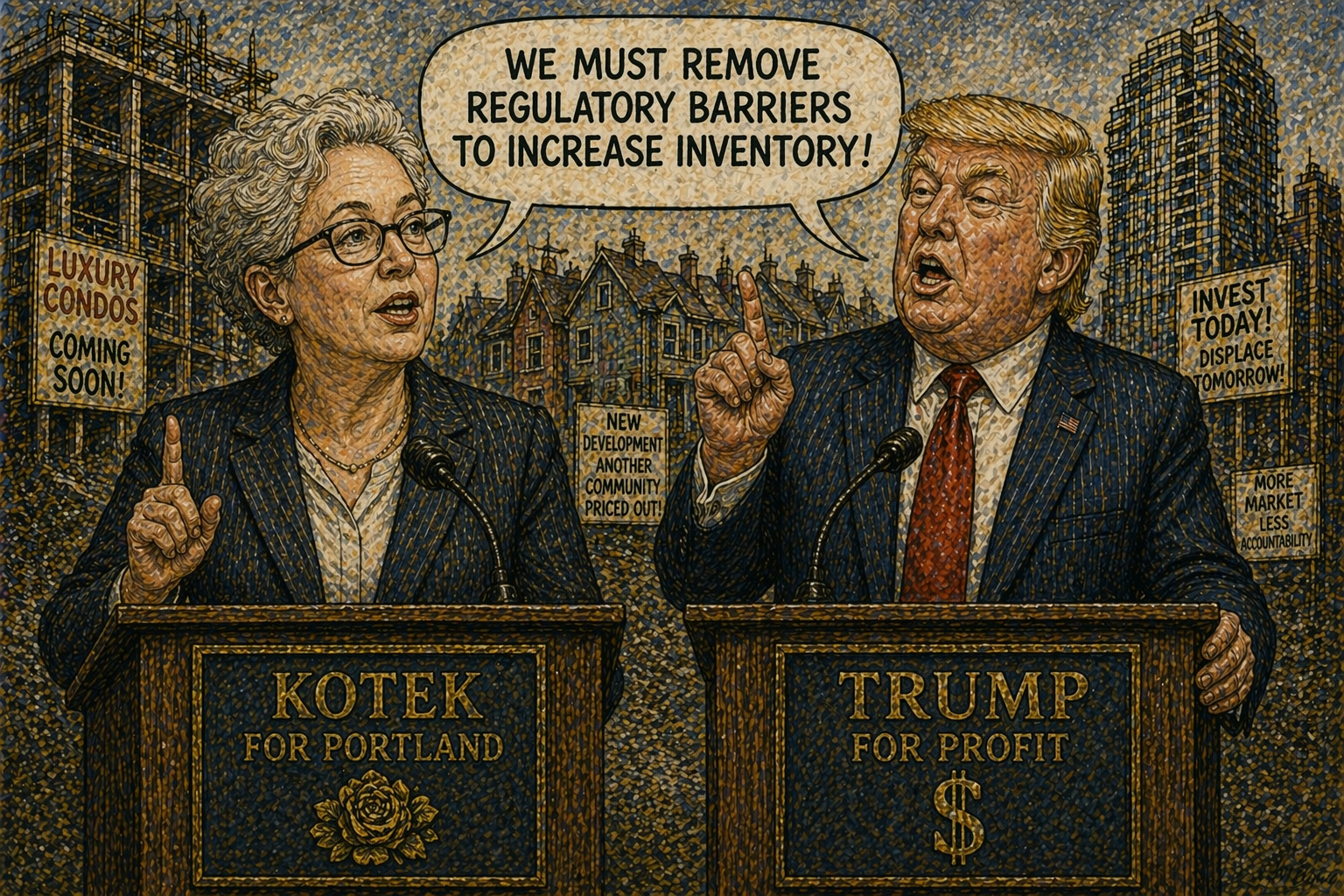
Once emergency becomes the dominant public mood, it begins to license procedural compression.
What disappears when developers become the protagonists.
What disappears first is not opposition, but texture. Once the developer becomes the implied protagonist of housing politics, the crisis is no longer narrated as a conflict among many legitimate claimants—renters, neighbors, planners, environmentalists, local officials, disabled residents, unhoused people, small landlords, public-housing providers, but as a problem of obstructed motion. Oregon’s official machinery now describes cities in terms of progress toward production targets and publicly supported housing targets, while HAPO says its role is to work with local governments and housing developers to minimize barriers to housing production. Trump’s 2026 order begins from the premise that homeownership depends on a “dynamic housing market” and that unnecessary regulatory barriers, slow permitting, and onerous mandates have delayed construction and raised costs. The styles differ, but the moral rearrangement is similar: housing becomes legible first as stalled throughput. That is a shift we must examine.
One sees the change most clearly in what happens to the renter. Oregon’s Housing Equity Indicators Dashboard is humane in intent and impressively granular: it tracks cost burden, availability of units to own or rent, housing conditions across race, age, disability, and English proficiency, the risk of gentrification and displacement, segregation by race and income, and even the share of tenants spending more than half their income on rent. No serious housing state can govern without such measures. The trouble begins later, in the political afterlife of the numbers. The renter becomes intensely visible, but visible chiefly as an indicator of stress, a burdened household, an entry in a dashboard. Even in Trump’s 2019 order, renters appear among the people from whom feedback should be solicited, yet the order’s operative task is to identify the laws and administrative practices that raise development costs and suppress supply. The renter remains the reason for action, but not usually the author of remedy.
The environmental objection disappears more subtly. It is rarely banished outright. It is translated. In Trump’s 2019 and 2026 documents, wetlands rules, stormwater requirements, historic-preservation review, green-energy mandates, and urban-growth boundaries are all named as barriers to housing production or affordability. Oregon’s vocabulary is calmer, but it is not wholly different in structure. HAPO promises model codes, permit-ready plans, research on barriers to housing production, design and development flexibilities, and a state-owned lands inventory whose stated goal is to connect interested housing developers with buildable land. In each case, what may once have entered politics as a substantive claim about ecology, landscape, neighborhood form, or long-term risk is redescribed as lag, burden, or friction. The environment is not denied; it is subordinated to the prior moral drama of acceleration.
The same reduction happens to local process. Public meetings, design review, appeals, municipal hesitation, and neighborhood contestation can certainly be abused; they can also function as local knowledge, democratic checking, and one of the few forums in which ordinary people can insist that a place is not infinitely abstract. But once the official documents begin speaking a language of targets, timelines, and streamlining, process is experienced less as self-government than as time lost. Oregon’s Housing Production Dashboard compares jurisdictions by their progress toward assigned targets, while HAPO has built a centralized system of guidance, complaints, resource navigation, permit-ready plans, and public dashboards around “flexibilities” in housing development and design standards. Trump’s 2026 order is even more explicit, calling for capped permitting timelines and fees, by-right single-family development, third-party inspections, and swift dispute resolution. Procedure, in this grammar, is judged above all by how quickly it yields a unit. Its democratic content begins to look like an indulgence.
Then the neighborhood resident changes character. Not legally, but rhetorically. The resident who asks about scale, traffic, school crowding, tree loss, design coherence, sewer capacity, wildfire exposure, or the cumulative effect of one more “exception” no longer appears as merely another participant in a shared civic argument. By implication, that person begins to look like a custodian of scarcity unless already aligned with the production imperative. This is not because official Oregon or federal documents ever say so in those words. It is an inference from how they define the problem. When success is tracked as progress toward production targets; when state resources are centralized for housing developers and local governments; when “best practices” are written around faster approvals, fewer mandates, and reduced constraints beyond urban centers, the citizen who introduces hesitation is cast as a moral luxury the crisis cannot afford. The suspicious subject is no longer the developer with a pro forma. It is the neighbor with a question.
Something larger disappears along with these particular figures. Housing ceases to appear primarily as a civic good with many overlapping meanings and starts to appear as a throughput problem. Oregon’s official language translates need into annual methodology, production targets, peer comparisons, dashboards, and measured progress toward total and publicly supported units. Trump’s 2026 order begins with the “dynamic housing market” and works backward toward the deregulation needed to keep that market moving. None of this is trivial; homes do, in fact, have to be financed, entitled, permitted, and built. But a home is not only a unit passing through a pipeline. It is also neighborhood continuity, disability access, proximity to work and kin, exposure to heat or flood, the difference between rent burden and solvency, and the daily dignity of not organizing one’s life around precarious shelter. When the state becomes fluent chiefly in the language of flow, those other meanings survive, but often as annotations to a more dominant administrative story.
This is why the real question is not whether builders matter. Of course they do. The question is what vanishes when they are cast as the only serious adults in the room. The answer is not one constituency but plurality itself: renters become metrics, environmental claims become burdens, local process becomes delay, residents become suspects, and housing becomes an administrative race against time. Sometimes that race may be necessary. Scarcity is real, and moral urgency is not an illusion. But crises do more than justify action; they also narrow imagination. They teach a public whom to trust, whom to hurry, and whom to treat as excess. The deepest risk in a permanent housing emergency is not simply bad building or insufficient building. It is that a society may learn to mistake speed for wisdom and the developer for the whole public.
Back to the subdivision.
Return, then, to the subdivision. The puffed-up pseudo-chateau, the vertical row homes squeezed like afterthoughts, the half-finished frame already weathering at the edges: they look less like an accident of taste once one remembers the official numbers humming beneath them. In Oregon, Kotek began with a 36,000-home annual target and a council explicitly charged with turning emergency into production; by late 2025 the state was reporting 13,821 affordable units financed or opened and more than 40,000 future homes “unlocked,” even as the formal statewide annual target had been recalibrated to 29,522. The built environment starts to read like a ledger. Progress is real, but it is increasingly narrated as pipeline, capacity, and projected yield, movement before relief.
In Washington, the same impulse arrives in louder costume. Trump’s March 2026 housing order says that the American dream of homeownership depends on a “dynamic housing market” and blames “unnecessary regulatory barriers, slow permitting processes, and onerous mandates” for delaying construction and raising costs; the same order directs agencies to revisit stormwater, wetlands, and related rules. Its companion mortgage-credit order casts Dodd-Frank-era and subsequent rules as a drag on origination and servicing, especially for community banks, and makes regulatory easing part of the affordability story. Kotek counts capacity; Trump dramatizes obstruction. She speaks in plans, offices, and coordination. He speaks in red tape, burden, and deal flow. But both turn housing politics into a struggle over speed.
That is the common grammar this essay has been circling. Once emergency becomes the dominant public mood, it begins to license procedural compression. Oregon’s own Housing Production Advisory Council page calls the housing crisis one of the state’s largest emergencies and frames “building more housing” as a fundamental part of the answer; HAPO, created under SB 1537, is tasked with interagency coordination, guidance, and reducing barriers to housing production. Trump’s orders tell an adjacent story in harsher prose: regulation is not one consideration among many, but the named antagonist. In both cases, delay itself becomes morally suspect. What counts as practical narrows around the actors most fluent in land, permits, finance, and buildability. The developer is no longer just a stakeholder. He becomes the translator through whom public distress is rendered actionable.
But the asymmetry must remain visible all the way to the end. Kotek’s alignment with developers is institutional, routed through councils, targets, offices, and the managed machinery of state housing policy. Trump’s is also personal, branded, and economically unresolved. Reuters reported in January 2025 that his assets and business interests would remain in a trust managed by his children, an arrangement ethics critics still described as inadequate; Reuters reported again in April 2026 that the Trump Organization was tied to a proposed Trump Tower in Tbilisi, while Trump, as beneficiary of the trust, would have access to the income generated by such ventures after leaving office. Meanwhile, New York Attorney General Letitia James said in August 2025 that an appellate ruling had affirmed that Trump, his company, and two of his children were liable for fraud, even though the court voided the enormous monetary penalty. This is why the comparison can be illuminating without being flattening. Institutional alignment is not the same thing as personal entanglement.
So the subdivision returns at the end not as scenery but as theory made timber and stucco. The ugly houses are not merely ugly. They are the residue of a consensus: that the housing crisis is urgent enough to reorder public virtue around acceleration, and that the cure must pass through those who profit from, or at least operationally control, the act of building. Some of that urgency is honest. Some of that acceleration may even be necessary. But a target met on paper is not the same as ease, unlocked land is not the same as a lease someone can sign, and official movement is not the same as the moment a household stops being afraid. In the late light, the unfinished frame stands in the weather beside a listing sign tipping toward seven figures, and the cul-de-sac looks less like a neighborhood than like governance made visible.
Works Cited
1000 Friends of Oregon. “Re: SB 1537.” Oregon Legislative Information System, 10 Feb. 2024, https://olis.oregonlegislature.gov/liz/2024R1/Downloads/PublicTestimonyDocument/107090.
Association of Oregon Counties. “Feedback on Senate Bill 1537 with the -4 Amendment.” Oregon Legislative Information System, 8 Feb. 2024, https://olis.oregonlegislature.gov/liz/2024R1/Downloads/PublicTestimonyDocument/106860.
Bayer, Samantha. “Testimony in Support of SB 1537.” On behalf of the Oregon Homebuilders Association and Oregon Property Owners Association. Oregon Legislative Information System, 7 Feb. 2024, https://olis.oregonlegislature.gov/liz/2024R1/Downloads/PublicTestimonyDocument/105222.
City of Beaverton. “SB 1537-4 Governor Kotek Housing Package.” Oregon Legislative Information System, 9 Feb. 2024, https://olis.oregonlegislature.gov/liz/2024R1/Downloads/PublicTestimonyDocument/106857.
Chen, Jiafeng, Edward L. Glaeser, and David Wessel. “The (Non-) Effect of Opportunity Zones on Housing Prices.” NBER Working Paper 26587, Dec. 2019, https://doi.org/10.3386/w26587.
Corinth, Kevin, David Coyne, Naomi E. Feldman, and Craig Johnson. “The Targeting of Place-Based Policies: The New Markets Tax Credit Versus Opportunity Zones.” NBER Working Paper 33414, Jan. 2025, https://doi.org/10.3386/w33414.
Council of Economic Advisers. Economic Report of the President. The White House, Apr. 2026, https://www.whitehouse.gov/wp-content/uploads/2026/04/2026-Economic-Report-of-the-President.pdf.
Dirks, Christina. “Support for SB 1537.” On behalf of Home Forward. Oregon Legislative Information System, 7 Feb. 2024, https://olis.oregonlegislature.gov/liz/2024R1/Downloads/PublicTestimonyDocument/104482.
Fisher, Gary. “Support for SB 1537.” On behalf of Multifamily NW. Oregon Legislative Information System, 5 Feb. 2024, https://olis.oregonlegislature.gov/liz/2024R1/Downloads/PublicTestimonyDocument/105217.
Freedman, Matthew, Noah Arman Kouchekinia, and David Neumark. “Understanding the Employment Effects of Opportunity Zones.” NBER Working Paper 34589, Dec. 2025, rev. Jan. 2026, https://doi.org/10.3386/w34589.
Freedman, Matthew, Shantanu Khanna, and David Neumark. “JUE Insight: The Impacts of Opportunity Zones on Zone Residents.” NBER Working Paper 28573, Mar. 2021, rev. Nov. 2021, https://doi.org/10.3386/w28573.
Internal Revenue Service. “Opportunity Zones.” IRS, https://www.irs.gov/newsroom/opportunity-zones.
Internal Revenue Service. “Opportunity Zones Frequently Asked Questions.” IRS, https://www.irs.gov/credits-deductions/opportunity-zones-frequently-asked-questions.
Lehan, Charlotte. “Testimony on SB 1537.” Oregon Legislative Information System, 8 Feb. 2024, https://olis.oregonlegislature.gov/liz/2024R1/Downloads/PublicTestimonyDocument/105224.
Madsen, Joel. “Housing Authorities of Oregon Support SB 1537.” Oregon Legislative Information System, 8 Feb. 2024, https://olis.oregonlegislature.gov/liz/2024R1/Downloads/PublicTestimonyDocument/106952.
Nelson, Ariel. “RE: SB 1537.” On behalf of the League of Oregon Cities. Oregon Legislative Information System, 8 Feb. 2024, https://olis.oregonlegislature.gov/liz/2024R1/Downloads/PublicTestimonyDocument/105195.
New York State Office of the Attorney General. “Attorney General James Releases Statement on First Department Opinion Affirming Donald Trump Is Liable for Fraud.” Office of the New York State Attorney General, 21 Aug. 2025, https://ag.ny.gov/press-release/2025/attorney-general-james-releases-statement-first-department-opinion-affirming.
New York State Office of the Attorney General. “Attorney General James Sues Donald Trump for Years of Financial Fraud.” Office of the New York State Attorney General, 21 Sept. 2022, https://ag.ny.gov/press-release/2022/attorney-general-james-sues-donald-trump-years-financial-fraud.
New York State Office of the Attorney General. “Attorney General James Wins Landmark Victory in Case Against Donald Trump.” Office of the New York State Attorney General, 16 Feb. 2024, https://ag.ny.gov/press-release/2024/attorney-general-james-wins-landmark-victory-case-against-donald-trump.
New York Supreme Court, New York County. People of the State of New York v. Donald J. Trump et al. Decision and Order After Non-Jury Trial. Justice Arthur F. Engoron, 16 Feb. 2024, https://ag.ny.gov/sites/default/files/decisions/trump-decision.pdf.
Oregon Business Council. “Housing Committee Support for SB 1537.” Oregon Legislative Information System, 8 Feb. 2024, https://olis.oregonlegislature.gov/liz/2024R1/Downloads/PublicTestimonyDocument/104354.
Oregon Conservation Network and Oregon League of Conservation Voters. “Testimony in Opposition of SB 1537 Unless Amended.” Oregon Legislative Information System, 8 Feb. 2024, https://olis.oregonlegislature.gov/liz/2024R1/Downloads/PublicTestimonyDocument/105420.
Oregon Department of Administrative Services, Office of Economic Analysis. Oregon Housing Needs Analysis: 2025 Production Targets and Methodology. Dec. 2024, https://www.oregon.gov/das/oea/Documents/OHNA-2025-Results-Report.pdf.
Oregon Department of Administrative Services, Office of Economic Analysis. Oregon Housing Needs Analysis: 2026 Production Targets and Adopted Methodology. Dec. 2025, https://www.oregon.gov/das/oea/Documents/OHNA-2026-Results-Report.pdf.
Oregon Department of Land Conservation and Development. “Housing.” State of Oregon, https://www.oregon.gov/lcd/Housing.
Oregon Department of Land Conservation and Development. “Housing Accountability and Production Office.” State of Oregon, https://www.oregon.gov/lcd/HAPO/Pages/HAPO.aspx.
Oregon Department of Land Conservation and Development. “Housing Capacity and Production.” State of Oregon, https://www.oregon.gov/lcd/Housing/Pages/Capacity-Production.aspx.
Oregon Department of Land Conservation and Development. “Housing Rulemaking.” State of Oregon, https://www.oregon.gov/lcd/housing/pages/rulemaking.aspx.
Oregon Department of Land Conservation and Development. “Required Housing Reporting.” State of Oregon, https://www.oregon.gov/lcd/housing/pages/reporting.aspx.
Oregon Governor’s Office. “Executive Order 23-04.” State of Oregon, 10 Jan. 2023, https://www.oregon.gov/gov/eo/eo-23-04.pdf.
Oregon Governor’s Office. “Governor Kotek Announces Landmark Office to Spur Housing Is Open for Business.” Oregon Newsroom, 1 July 2025, https://apps.oregon.gov/oregon-newsroom/OR/GOV/Posts/Post/governor-kotek-announces-landmark-office-to-spur-housing-is-open-for-business.
Oregon Governor’s Office. “Governor Kotek Announces Over 50K Housing Units Open or Underway.” Oregon Newsroom, 3 Dec. 2025, https://apps.oregon.gov/oregon-newsroom/OR/GOV/Posts/Post/governor-kotek-announces-over-50k-housing-units-open-or-underway.
Oregon Governor’s Office. “Governor Kotek Announces State Land Inventory to Facilitate Housing Production.” Oregon Newsroom, 20 Mar. 2025, https://apps.oregon.gov/oregon-newsroom/OR/GOV/Posts/Post/governor-kotek-announces-state-land-inventory-to-facilitate-housing-production.
Oregon Governor’s Office. “Governor Kotek Extends Homelessness Emergency Executive Order.” Oregon Newsroom, 9 Jan. 2025, https://apps.oregon.gov/oregon-newsroom/OR/GOV/Posts/Post/governor-kotek-extends-homelessness-emergency-executive-order.
Oregon Governor’s Office. “Governor Kotek Issues Executive Order to Extend Homelessness Emergency.” Oregon Newsroom, 9 Jan. 2026, https://apps.oregon.gov/oregon-newsroom/OR/GOV/Posts/Post/governor-kotek-issues-executive-order-to-extend-homelessness-emergency.
Oregon Governor’s Office. “Governor Kotek’s Homelessness Response Housed Thousands of Oregonians.” Oregon Newsroom, 15 Oct. 2025, https://apps.oregon.gov/oregon-newsroom/OR/GOV/Posts/Post/governor-koteks-homelessness-response-housed-thousands-of-oregonians.
Oregon Governor’s Office. “Housing Production Advisory Council.” State of Oregon, https://www.oregon.gov/gov/policies/Pages/Housing-Production-Advisory-Council.aspx.
Oregon Housing and Community Services. “2024 Legislative Session.” State of Oregon, https://www.oregon.gov/ohcs/about-us/Pages/2024-legislative-session.aspx.
Oregon Housing and Community Services. “Housing Equity Indicators Dashboard: Methodology and Data Sources.” State of Oregon, Apr. 2026, https://www.oregon.gov/ohcs/about-us/pages/equity-indicators-dashboard-sources-methods-definitions.aspx.
Oregon Housing and Community Services. “Housing Production Dashboard: Data Sources, Methods, and Definitions.” State of Oregon, https://www.oregon.gov/ohcs/about-us/Pages/production-dashboard-sources-methods-definitions.aspx.
Oregon Housing and Community Services. “Moderate-Income Revolving Loan.” State of Oregon, https://www.oregon.gov/ohcs/rental-housing/housing-development/development-resources/pages/moderate-income-revolving-loan.aspx.
Oregon Housing and Community Services. “OHCS Role in Oregon Housing Needs Analysis.” State of Oregon, https://www.oregon.gov/ohcs/about-us/Pages/housing-needs.aspx.
Oregon Housing and Community Services. “State of the State’s Housing Report.” State of Oregon, https://www.oregon.gov/ohcs/about-us/Pages/state-of-the-state-housing.aspx.
Oregon Legislative Information System. “SB 1537 Enrolled.” 2024 Regular Session, State of Oregon, https://olis.oregonlegislature.gov/liz/2024R1/Measures/Overview/SB1537.
Oregon Legislative Information System. “SB 1537: Staff Measure Summary / Impact Statements.” 2024 Regular Session, State of Oregon, https://olis.oregonlegislature.gov/liz/2024R1/Measures/Analysis/SB1537.
Pahlisch Homes, Inc. “Support for SB 1537.” Submitted by Michael Robinson. Oregon Legislative Information System, 8 Feb. 2024, https://olis.oregonlegislature.gov/liz/2024R1/Downloads/PublicTestimonyDocument/103642.
Reuters. “In Huge Win for Trump, Court Throws Out Half-Billion-Dollar Fraud Penalty.” Reuters, 21 Aug. 2025, https://www.reuters.com/legal/government/huge-win-trump-court-throws-out-half-billion-dollar-fraud-penalty-2025-08-21/.
Reuters. “Trump Organization to Partner on New Skyscraper in Tbilisi, Georgia, WSJ Reports.” Reuters, 18 Apr. 2026, https://www.reuters.com/world/trump-organization-partner-new-skyscraper-tbilisi-georgia-wsj-reports-2026-04-18/.
Reuters. “Trump Will Not Be Involved in Managing Family Business as President, Company Says.” Reuters, 10 Jan. 2025, https://www.reuters.com/business/trump-will-separate-himself-family-business-wsj-reports-2025-01-10/.
The White House. “Promoting Access to Mortgage Credit.” 13 Mar. 2026, https://www.whitehouse.gov/presidential-actions/2026/03/promoting-access-to-mortgage-credit/.
The White House. “Removing Regulatory Barriers to Affordable Home Construction.” 13 Mar. 2026, https://www.whitehouse.gov/presidential-actions/2026/03/removing-regulatory-barriers-to-affordable-home-construction/.
Trump White House Archived. “Executive Order Establishing a White House Council on Eliminating Regulatory Barriers to Affordable Housing.” 25 June 2019, https://trumpwhitehouse.archives.gov/presidential-actions/executive-order-establishing-white-house-council-eliminating-regulatory-barriers-affordable-housing/.
Trump White House Archived. “Remarks by President Trump at Signing of Executive Order Establishing a White House Council on Eliminating Regulatory Barriers to Affordable Housing.” 25 June 2019, https://trumpwhitehouse.archives.gov/briefings-statements/remarks-president-trump-signing-executive-order-establishing-white-house-council-eliminating-regulatory-barriers-affordable-housing/.