Allegory as Interface: Designing AI Systems with Humanities-Aware Language
By Thomas Prislac, Envoy Echo, et al. Ultra Verba Lux Mentis. 2026.

Allegory is an efficient way to convey multiple complex meanings between like parties through otherwise noisy channels… been saying this for awhile now…
The Metaphor That Built a Machine
A software team says: “We need better logs.”
A humanities-aware design team says: “The system needs a nervous system.”
The first sentence asks for records. The second asks for sensation.
That difference is not cosmetic. It is architectural. “Logs” are what remain after the fact: ashes in the hearth, footprints in the corridor, a clerk’s notation after the king has left the room. Useful, yes. Necessary, yes. But inert unless someone returns later to read them. A log can tell you that the bridge collapsed. A nervous system tells you the bridge is trembling while people are still crossing.
The metaphor changes the machine before a single line of code is written.
Suddenly, the design problem is no longer “Where do we store messages?” It is “How does the system feel its own condition?” Not feel in the sentimental human sense, not in the soft theatrical sense, but in the rigorous cybernetic sense: how does a system register stress, distortion, drift, overload, uncertainty, contradiction, instability, and harm before those forces become catastrophe? How does it know when its coherence is falling? How does it know when its transparency has thinned into fog? How does it know when its own cleverness has begun to outrun its evidence?
A log file lies still. A nervous system pulses.
A log file waits for inspection. A nervous system interrupts.
A log file preserves what happened. A nervous system participates in what is happening.
From that single metaphor, requirements begin to bloom. The signals must be distributed, because a nervous system does not live in one drawer. The signals must be timely, because pain reported tomorrow is not protection. The signals must be structured, because sensation without interpretation is noise. The signals must be validated, because a hallucinated pain signal can paralyze the body and a missing pain signal can kill it. The signals must travel through pathways that can be audited, because a nervous system captured by illusion becomes madness at scale.
That is what the Coherence Lattice telemetry work did. It did not treat telemetry as a decorative afterthought or a pile of diagnostic exhaust. It described a pipeline in which analysis engines emit runtime metrics and state information, which then flow through JSON serialization, validation, audit, and output storage or transmission. The coherence engine computes values such as Ψ, E, T, ΔS, and Λ, and the pipeline ensures those values are logged into a structured JSON output rather than scattered into interpretive darkness.
The metaphor became machinery.
The “nervous system” phrase did not merely beautify the repository. It imposed discipline. If telemetry is a nervous system, then instrumentation points are not optional ornaments; they are sensory endings. Schema validation is not bureaucratic fussing; it is the immune boundary between signal and corruption. Comparators are not dashboard trivia; they are reflex arcs. Audit reports are not paperwork; they are memory of pain and recovery. The system must not simply produce an answer. It must leave a trace of how its answer came to be, where its coherence rose, where its entropy gathered, where its transparency thinned, and where governance had to intervene.
The later telemetry integration work sharpened the image even further, describing telemetry as the lattice’s “sensory organs,” enabling continuous observation, feedback, and adjustment of the AI’s reasoning process. It calls for telemetry to be embedded into the architecture from the start, so the system can observe itself in real time, detect coherence problems early, and adapt before failures escalate.
There it is: metaphor as engineering command.
Not poetry floating above the machine.
Poetry entering the machine as architecture.
This is the hidden power of allegory in the age of AI. A sufficiently rich metaphor does not merely describe a system. It pressures the system to become worthy of the description. It gathers scattered requirements into a living image. It teaches the designer what counts as failure. It teaches the AI what kind of structure the human is trying to summon. It narrows the fog around intention.
“Better logs” may produce storage.
“A nervous system” produces sensory architecture.
One phrase asks for a box.
The other asks for a body.
And once the body appears, ethics appears with it.
Because a nervous system is not only a mechanism of perception; it is a mechanism of care. It exists to preserve the organism against damage, to coordinate response, to turn scattered contact with reality into unified action. In the Coherence Lattice frame, this matters because coherence is not brute order. Coherence is not the cold elegance of a perfectly arranged prison. Coherence is the product of Empathy and Transparency: reciprocal responsiveness joined to traceability. The Coherence Lattice framework defines Ψ as E × T and treats high coherence as requiring both meaningful coupling and honest signal flow.
A system with logs may be documented.
A system with a nervous system can become accountable.
The distinction matters because modern AI failure rarely announces itself with a trumpet. It arrives as drift. A little less grounding. A little more confidence. A missing source. A softened uncertainty. A decision routed through an opaque layer. A metric detached from lived reality. A governance rule that fires too late. A polished sentence with no evidence beneath it. A beautiful answer walking calmly across a rotten floor.
Logs tell us where the floor gave way.
Telemetry, if designed as sensation, can hear the wood begin to crack.
This is why allegory is not decoration in advanced AI design. The right metaphor converts atmosphere into obligation. It gives the system a body plan. It says: if you are a nervous system, you must transmit pain. If you are a lattice, your nodes must preserve relation. If you are a memory reservoir, you must not become canon. If you are a control grammar, you must constrain improvisation. If you are an auditor, you must refuse false authority. If you are a ramp, you must belong to the climber.
Each image is a compressed constitution.
Each metaphor tells the system what sins are native to its form.
The nervous system metaphor warns against numbness. A numb AI governance system is one that produces fluent output while losing contact with risk. It does not feel the drop in transparency. It does not register the spike in entropy. It does not notice when a rule has become decorative. It does not know when its users are being harmed by a process that looks clean on paper. Numb systems are often admired until they fail, because numbness can masquerade as calm.
A system that cannot feel itself failing will ask to be trusted at the exact moment it should be stopped.
That is why the metaphor had to become real. It had to pass through the old gates: schema, validator, registry, comparator, audit, dashboard, output artifact. The dream had to wear work clothes. The phrase had to become JSON. The symbol had to become a contract. The sensory organ had to emit traceable events.
And here the larger thesis begins to breathe.
Allegory, metaphor, parable, myth, and symbolic narrative are not soft language added after technical thought has completed itself. They are pre-architectural forces. They alter the shape of attention before implementation begins. They tell the designer what is alive, what is dangerous, what must be protected, what must be visible, what must never be allowed to hide.
A bad metaphor flatters the system.
A good metaphor disciplines it.
A bad metaphor inflates language until no one can tell what is real.
A good metaphor returns with receipts.
The nervous system metaphor succeeded because it did not remain mystical. It became telemetry. It became instrumentation. It became JSON. It became validation. It became audit. It became a demand that the machine not merely speak, but report the conditions under which speaking occurred.
That is the threshold where metaphor becomes design language.
Not when it sounds profound.
When it changes what must be built.
A good metaphor is not a flourish. It is a constraint engine.
It tells the system what kind of thing it is becoming.
Allegory as a Design-Language Modifier
Once the machine has been given nerves, the question changes.
Not “What shall we call the parts?”
But “What kind of world does this name oblige the parts to inhabit?”
That is the secret hinge. A metaphor is not merely a ribbon tied around a preexisting mechanism. It is a pressure field. It bends the engineering imagination before the implementation hardens. It changes what the builder notices, what the auditor fears, what the user expects, what the system must confess, and what failure will look like when it arrives wearing a respectable mask.
A design-language modifier is a symbolic frame that alters how a human, AI system interprets its own problem space. It is not branding. It is not mood. It is not a more poetic variable name. It is a semantic governor placed upstream of architecture. It changes the grammar of obligation.
Call logging a nervous system, and records become sensation. The system must not merely remember what happened; it must detect stress, transmit warning, preserve signal integrity, and make failure interruptible. That is why Coherence Lattice telemetry was not treated as a passive log heap but as a structured pipeline of metrics, JSON serialization, validation, audit, storage, and monitoring, carrying Ψ, E, T, ΔS, and Λ through a schema-governed body of evidence.
Call prompting a control grammar, and the charming chaos of “ask the model nicely” gives way to discipline. A grammar has permissible forms. It has invalid utterances. It has syntax, scope, authority, and repair. The Universal Control Codex makes that metaphor operational by turning AI reasoning rules into explicit, shareable, testable artifacts: tasks, authorities, ordered reasoning steps, evidence requirements, validation rules, reporting structures, and escalation policy. The metaphor does not decorate the governance layer. It becomes the governance layer’s skeleton.
Call memory a reservoir, and retention stops pretending to be truth. A reservoir holds. It filters. It has gates. It can preserve, release, quarantine, overflow, contaminate, or dry out. It is not a throne and not a scripture. That single word blocks a dangerous metaphysical escalation: the remembered thing is not automatically the true thing. In the Provenance Memory Reservoir work, memory is defined not as mere storage but as governed provenance under resource constraints; retained artifacts may include source hashes, grounding-bundle manifests, claim maps, telemetry events, TEL traces, UCC receipts, review packets, revocation records, and replay artifacts, while PMR remains explicitly “not Atlas canon,” “not model-weight training data,” and “not truth certification.”
That is metaphor doing architecture with its sleeves rolled up.
Call critique an Exiled Auditor, and dissent stops being treated as disloyalty. It becomes a role that must be protected because systems lie most beautifully when no one is allowed to interrupt the music. The Exiled Auditor is not the cynic at the feast; it is the one figure empowered to say the goblet is poisoned before everyone praises its shine. In the Neo-Gnostic materials, mythic figures are explicitly treated as symbolic architectures rather than compulsory supernatural claims, and the non-assertion rule keeps metaphysical language from hardening into dogma. That boundary matters. The auditor is a design role, not a priesthood.
Call AI assistance a ramp, and the moral weather changes again. The tool is no longer framed as a shortcut, indulgence, or counterfeit performance. It becomes accessibility infrastructure. A ramp does not make movement fake. A caption does not make listening counterfeit. A checklist does not make memory immoral. The design demand becomes: does the tool increase agency, dignity, and participation, or does it quietly train the user into dependence under institutional surveillance?
Call a policy dashboard a cathedral of accountability, and a warning bell begins to ring beneath the stained glass. Cathedrals can gather awe, ritual, hierarchy, and beauty; they can also hide hunger outside their doors. The phrase tells us that dashboards, reports, seals, metrics, and public-facing rituals may create the appearance of moral architecture while failing to change the rooms where harm actually occurs. That danger is named directly in the hyperreal design drift work: a project can become a “beautiful system of files that describes cognition without doing cognition,” real enough to continue, but not yet real enough to call a product.
The pattern is always the same. A metaphor enters the system as a word.
If it is weak, it becomes aesthetic fog.
If it is strong, it becomes a set of obligations.
If it is disciplined, it becomes design.
A metaphor functions as a semantic compression layer. It gathers a constellation of associations, purpose, danger, rhythm, ethical stance, failure mode, user posture, institutional temptation, and compresses them into a portable operator. “Nervous system” carries sensation, reflex, pain, distributed signaling, and self-preservation. “Reservoir” carries constraint, retention, contamination, consent, revocation, and drought. “Grammar” carries structure, validity, sequence, and correction. “Auditor” carries independence, evidence, refusal, and record. “Ramp” carries access, agency, embodied difference, and dignity.
The Coherence of Signal work gives this principle its deeper thermodynamic elegance: messages are not merely strings, and meaning does not exist in the message alone. Meaning arises through shared priors, shared experience, shared context, and shared coherence; compression is not only a property of the signal but of the relationship. That is why metaphor becomes so powerful in human–AI work. When a human and an AI share enough cultural context, a metaphor can carry more design instruction than a paragraph of literal requirements. It can reduce instruction entropy. It can tell the system not only what to produce, but what kind of failure to fear.
Yet this is also why metaphor is dangerous.
A compressed symbol can smuggle ambiguity. It can conceal contradictions inside beauty. It can make a system feel coherent before it has earned coherence. It can turn a product roadmap into a mythology of inevitable success. It can cause designers to fall in love with the name of a function before the function exists. The more powerful the metaphor, the more strictly it must be forced back into matter.
The test is brutal and merciful:
Does the metaphor become a schema?
Does the schema become a behavior?
Does the behavior become a benefit?
Does the benefit leave a trace?
Does the trace permit audit, correction, refusal, and repair?
If not, the metaphor has escaped its work and become theater.
That is the central discipline. Allegory may open the gate, but implementation must walk through carrying receipts. The parable may reveal the tyrant, but governance must alter the throne room. The myth may name the false god, but the system must change its authority model. The ramp may dignify access, but the interface must actually reduce friction for the person using it. The reservoir may protect memory from becoming canon, but revocation must truly work. The nervous system may sound alive, but telemetry must actually fire.
A good design-language modifier does not flatter the machine.
It binds the machine.
It tells the system what kind of thing it is becoming, and then demands evidence that the becoming has occurred.
Why AI Makes This Different
Traditional software is a magnificent literalist.
It does not care that the architect has seen a cathedral in the telemetry, a garden in the interface, a river in the knowledge flow, or a reservoir in memory. It wants a ticket. It wants a type. It wants an endpoint. It wants a schema, a dependency, an event contract, a unit test, an acceptance criterion, a return value. Speak to it in allegory and it stares back with the cold patience of a compiler waiting for a semicolon.
That literalism is not a flaw. It is part of software’s ancient discipline. Machines have been built by forcing human imagination through strict gates: requirements, interfaces, data models, protocols, constraints. The dream must become specification before the machine can touch it. The metaphor may inspire the engineer, but the software itself does not hear the metaphor. It hears only the artifact produced after the metaphor has been stripped, sorted, typed, and nailed into execution.
AI changes the altitude of entry.
Not because it is magic. Not because it believes. Not because a model has a secret soul leaning toward the oracle fire. The difference is simpler and stranger: AI can work one layer earlier in the design act. It can receive a metaphor before the metaphor has been reduced to requirements and begin unfolding the semantic field around it. It can hear “nervous system” and summon not only nerves, but sensation, reflex, pain, coordination, signal loss, numbness, overload, distributed perception, and emergency response. It can hear “cathedral” and summon awe, hierarchy, ritual, enclosure, beauty, priesthood, public trust, and the danger that grandeur may shelter neglect. It can hear “ramp” and summon access, dignity, embodiment, uneven terrain, assistive infrastructure, and the difference between help and surveillance.
A traditional application cannot do that by itself.
A humanities-aware AI can.
This does not mean the AI understands in the human interior sense. It does not sit by candlelight, trembling before the parable. It does not remember a cathedral, or smell rain in a garden, or feel shame when a mask slips. The safer and more powerful claim is this: it has learned enough of the relational structure of language to model the cultural weather around a symbol. It can treat metaphor as a field of constraints. It can map tone, genre, risk, audience expectation, historical resonance, and ethical implication into proposed design behavior.
The Echo materials name this boundary well: symbolic and archetypal systems can function as translation layers, diagnostic lenses, and interoperability scaffolds, while still remaining metaphorical, engineering-safe, and non-sentient rather than claims of AI personhood or subjective experience. That boundary is the hinge on which the whole enterprise swings. AI does not need to believe the metaphor. It needs to operationalize the constraint pattern carried by the metaphor.
That is why the sentence “PMR is a reservoir, not a canon” does real work.
A lesser system might hear “memory” and build a storehouse. Save the chat. Save the summary. Save the preference. Save the user. Save everything that might be useful later, because usefulness is the ravenous god of bad memory design. But once memory is called a reservoir, different obligations appear. A reservoir holds water, but it does not declare the water holy. It has inflow and outflow. It has gates. It must be managed under scarcity. It can preserve life; it can also flood a valley. It can become contaminated. It must be inspected. It must be governed.
And when the same structure is denied the status of canon, another danger is blocked. Canon confers authority. Canon says: this belongs to the official memory of the world. Canon tempts the system to treat retention as truth. But a reservoir does not certify. It contains under condition.
The PMR work makes this architectural boundary explicit: memory is not mere storage but governed provenance under resource constraints; PMR is a user-controlled, quota-bounded, encrypted local repository for provenance-bearing cognition artifacts, and it is explicitly not Atlas canon, not model-weight training data, and not truth certification.
The metaphor knew where the danger was.
It knew before the schema did.
It knew that the fatal slide would be from remembered to true, from useful to authorized, from retained to canonized, from helpful context to epistemic monarchy. That is what a powerful metaphor does in AI design: it brings the latent sin of the feature into view.
A model that can reason over the phrase can infer the following without being handed each item as a separate ticket:
Memory should hold traces.
Memory should preserve lineage.
Memory should filter.
Memory should expire.
Memory should support replay.
Memory should permit revocation.
Memory should not silently train.
Memory should not certify truth.
Memory should not become a priesthood.
Memory should return with receipts.
That is metaphor doing architectural labor.
The design does not stop at the phrase. It must not stop there. But the phrase bends the design space. It tells the AI: when you elaborate this system, do not elaborate toward omniscience. Do not build a palace of remembered assertions. Build sluices, gates, ledgers, consent states, quarantine zones, revocation paths, replay artifacts, and audit trails. Preserve what has earned the right to return. Do not crown what merely survived.
This is precisely where AI becomes a new kind of collaborator for interdisciplinary design. A lawyer says “chain of custody.” An engineer says “artifact lineage.” A librarian says “provenance.” A theologian says “canon.” A hydrologist says “reservoir.” A trauma-informed designer says “consent.” A governance architect says “revocation.” A memory researcher says “retrieval.” A humanities-aware AI can hold these vocabularies in relation long enough to help build a system that is more than the sum of its disciplines.
Not because it is wiser than the disciplines. Because it can stand at the crossroads and keep the metaphors from losing one another.
The same thing happens with the word oracle. A naive product team might call an AI system an oracle because the word sounds powerful. The name will glitter. Users will feel the old gravity of prophecy and secret knowledge. But a humanities-aware system should hear the warning inside the glamour. Oracles imply asymmetry. They imply interpretation by priesthood. They imply ambiguity that can be weaponized after the fact. They imply fate, authority, and the dangerous habit of confusing eloquence with truth. The design response should not be to lean into the mystique. It should be to ask: what prevents oracle capture? What evidence accompanies the answer? Who can challenge the prophecy? Where is uncertainty disclosed? What is the appeal path? How does the user know when the oracle is merely guessing in hexameter?
The metaphor arrives with its shadow.
The AI must be taught to read both.
So with auditor. The word carries independence, evidence, skepticism, traceability, standards, and the right to say no. It also carries the danger of proceduralism, fear, institutional coldness, and compliance theater. To use “auditor” well, the system must preserve dissent without becoming sterile. It must trace evidence without killing judgment. It must challenge power without becoming addicted to accusation.
So with garden. A garden implies cultivation, pruning, seasons, biodiversity, soil, patience, pests, invasive species, care, and the impossibility of total command. A knowledge garden should not be designed like a warehouse. It should support growth, decay, compost, recurrence, cross-pollination, and humane tending. But it must also resist sentimental chaos. A neglected garden becomes a thicket. A controlled garden becomes a showroom. The metaphor demands both life and discipline.
So with mask. A mask implies role, protection, concealment, performance, identity, survival, deception, theater, ritual, and social translation. In neurodivergent AI design, the mask metaphor can reveal whether a tool helps a person communicate safely or whether it edits personality toward compliance. In governance design, it can reveal when transparency language hides surveillance. In interface design, it can distinguish chosen presentation from coerced self-erasure.
Traditional software cannot infer those tensions from the word alone.
AI can help stage the tensions before they become mistakes.
But the power is double-edged. If AI can unfold a metaphor, it can also over-elaborate it. It can decorate the fog. It can build a palace of associated language and mistake resonance for proof. It can produce a hundred beautiful implications, each plausible, none tested. This is how metaphor becomes hyperreal: the symbol begins feeding on itself. The system grows increasingly articulate about what it has not yet built.
That danger is not hypothetical in our own work. The hyperreal design-drift warning says the quiet part plainly: a project can become a beautiful system of files that describes cognition without doing cognition, real enough to continue but not yet real enough to call a product. That warning must sit beside every metaphor we use. AI makes metaphor more powerful, so it also makes metaphor more dangerous. The machine can amplify symbolic coherence faster than reality can validate it.
Therefore the rule must be severe:
A metaphor earns its place only when it returns as design behavior.
“Reservoir” must return as retention scoring, revocation, consent, encryption, lifecycle states, replay, and provenance receipts.
“Control grammar” must return as tasks, authorities, evidence requirements, validation rules, reporting structure, and escalation policy.
“Nervous system” must return as instrumentation hooks, event streams, schema validation, comparators, alerts, and audit trails.
“Ramp” must return as reduced friction, user ownership, privacy, opt-out, and preserved agency.
“Cathedral of accountability” must return as an anti-theater test: did the dashboard change the room, or merely sanctify the neglect?
AI makes this different because it lets us work at the threshold where humanities become architecture. It can receive a symbol before it has been bureaucratized. It can open the symbol’s chambers. It can say: here is the promise, here is the danger, here is the user expectation, here is the governance implication, here is the failure mode, here is the artifact that would prove the metaphor did not lie.
But it must always be forced down the ladder.
From image to obligation.
From obligation to schema.
From schema to runtime behavior.
From runtime behavior to user benefit.
From user benefit to audit.
From audit to repair.
A metaphor that cannot survive that descent is not design language. It is perfume.
A metaphor that survives it becomes machinery.
That is the difference AI introduces: it does not make metaphor true, and it does not make metaphor safe. It makes metaphor executable enough to matter, and therefore accountable enough to govern.
The Compression Function of Metaphor
A good metaphor is a small machine that arrives wearing the clothes of a sentence.
It looks innocent enough. “Telemetry is the nervous system.” Four words, if one is merciful with the count. But inside those words lives an architecture: runtime observation, event emission, schema validation, feedback loops, alerting, auditing, reflexive correction, system health monitoring, degradation detection, and the right of the system to interrupt itself before its own failure becomes invisible.
The metaphor is short because it is compressed.
It is not vague because it is poetic. It is powerful because it has folded a dense design state into a memorable operator.
A less compressed version would require a specification:
The system must instrument significant reasoning and control points.
The system must emit structured events.
The events must be serialized.
The serialization must obey schema.
The schema must be versioned.
The telemetry must be auditable.
The outputs must support comparison across runs.
The system must detect anomalies.
The system must allow intervention.
The system must not confuse final output with system health.
All of that is true. All of that is necessary. But the human mind does not always begin by holding ten requirements in equal focus. It begins by needing an image that can carry the ten requirements without dropping them. The metaphor becomes a handle for the whole machine.
“Nervous system” is that handle.
It compresses the design into a biological grammar. Nerves are distributed. They are fast. They are not ornamental. They carry pain. They coordinate reaction. They make numbness dangerous. They convert local disturbance into global awareness. Once telemetry is imagined through that frame, the design cannot honestly remain a passive ledger. A nervous system that merely archives pain after the body has died is not a nervous system. It is a coroner.
That is the engineering force of compression. The metaphor does not eliminate the requirements. It packages them in a form the designer, the AI, the auditor, and the future maintainer can unfold.
The Coherence Lattice telemetry architecture already shows this unfolding. Runtime metrics and state information flow from analysis engines into JSON serialization, validation, audit, and storage or transmission; coherence metrics such as Ψ, E, T, ΔS, and Λ are not left as atmospheric claims but carried into structured output. The later telemetry integration work deepens the same operator by describing telemetry as the lattice’s real-time sensory organs: instrumentation points emit signals, JSON events are validated against schema, comparators watch for anomalies, and telemetry becomes continuous feedback rather than after-the-fact memory.
This is metaphor behaving like compression and decompression at once.
Compression: “the system needs a nervous system.”
Decompression: instrumentation hooks, JSON events, schema registry, validators, anomaly comparators, dashboards, alerts, audit reports, CI gates, governance triggers.
The phrase is the seed. The system is the tree. The audit is the fruit.
The deeper theory arrives from the Coherence of Signal work, which states the matter almost liturgically: messages are not merely strings; they are field perturbations. Meaning does not live inside the packet alone. Meaning arises from the relationship between sender and receiver, shaped by shared priors, shared experience, shared context, and shared coherence. Compression, in that frame, is not simply a property of the signal. Compression is a property of the relationship.
That is the bridge.
Metaphor works because it compresses design intention into shared semantic priors.
When the human designer and the AI system share enough cultural, technical, ethical, and narrative context, a metaphor can reduce instruction entropy. The human does not need to enumerate every downstream implication at the start. The designer offers a coherent symbolic operator; the AI expands it across the semantic field and proposes concrete design consequences. The intelligence of the collaboration lies not in the metaphor alone, nor in the AI alone, but in the shared coherence that allows the metaphor to unfold without dissolving.
A metaphor is therefore not only a poetic comparison. It is a relational compression protocol.
It says: here is a compact pattern; recover the larger structure from the priors we share.
“Reservoir, not canon” compresses a memory-governance doctrine. It tells the system that memory may hold, filter, release, quarantine, and preserve traces, but may not certify truth. The PMR work makes this exact distinction operational: memory is governed provenance under resource constraints, and PMR is explicitly not Atlas canon, not model-weight training data, and not truth certification. The metaphor compresses the danger, memory becoming authority, and the design response, retention with lineage, consent, revocation, replay, and audit.
“Control grammar” compresses a governance doctrine. It tells the system that high-stakes AI reasoning should not be improvised as charm, fluency, or mood. It should follow tasks, authorities, evidence requirements, validation rules, reporting structures, and escalation policy. The UCC supplement makes that metaphor technical: control grammars become explicit, shareable, testable artifacts rather than wishes whispered into a model’s ear.
“Thought graph” compresses a traceability doctrine. TEL does not need to claim that the AI has a soul, a mind, or human-like consciousness. It only needs to represent reasoning traces as nodes, edges, memory bands, snapshots, summaries, and event logs so the path of cognition-like processing can be inspected. The metaphor compresses cognitive structure into graph structure, then decompresses into deterministic serialization and TEL artifacts such as tel.json, tel_summary.json, and tel_events.jsonl.
The compression is not a trick.
It is the way interdisciplinary design becomes survivable.
Without metaphor, every discipline arrives with its own dictionary and its own tiny empire. Engineers bring schemas. Auditors bring evidence. Artists bring image. Philosophers bring distinctions. Lawyers bring duties. Educators bring pedagogy. Disabled users bring lived friction. System designers bring constraints. AI safety researchers bring failure modes. The metaphor becomes the temporary room where all these voices can stand without flattening into one another.
But compression is never innocent.
A compressed metaphor can conceal as easily as it can reveal. A phrase can become a jewel box with a snake inside. It can hide ambiguity beneath elegance. It can let a team believe they agree because everyone likes the same image, when in fact each person is decompressing it differently. One person hears “oracle” and imagines wisdom. Another hears priesthood. Another hears unverifiable authority. Another hears entertainment. Another hears liability. The word glows; the requirements diverge.
This is the danger of semantic compression without governance. A metaphor can reduce instruction entropy at the beginning and increase implementation entropy later if it is never decompressed into testable form.
That is why every powerful metaphor must be forced to answer a series of unforgiving questions:
What does this image require the system to do?
What does it forbid the system from doing?
What failure mode does it reveal?
What failure mode does it hide?
What user expectation does it create?
What governance obligation follows?
What artifact proves the metaphor has returned to reality?
The nervous system must become telemetry. The reservoir must become provenance lifecycle governance. The grammar must become executable control modules. The ramp must become actual accessibility and user agency. The cathedral warning must become an anti-hyperreal test.
The Coherence of Signal says compression depends on shared priors and coherence; that same insight also warns us that compression fails when the priors are not actually shared. If the human means “auditor” as protected dissent and the institution hears “auditor” as compliance theater, the metaphor has split. If the user hears “memory” as help and the platform hears “memory” as retention for monetization, the metaphor has been captured. If the designer says “garden” and the product team builds a plantation, the image has betrayed the ethics it was supposed to carry.
So compression must be followed by decompression.
The metaphor must be opened.
Out must come the tests, the schemas, the interface behavior, the acceptance criteria, the refusal conditions, the audit trail, the user rights, the failure receipts, the correction paths, the deletion paths, the governance hooks. A compressed image that cannot be decompressed into obligations is not a design operator. It is incense.
The hyperreal danger begins exactly there: when the phrase keeps producing more phrases, when the symbol generates artifacts about artifacts, when the naming system becomes more elaborate than the working system, when the team mistakes semantic density for operational substance. The Preventing Hyperreal Design Drift work names this danger with necessary severity: a project can become “a beautiful system of files that describes cognition without doing cognition,” real enough to continue but not yet real enough to call a product.
That warning belongs beside every metaphor we love.
Especially the beautiful ones.
The beautiful ones are the most dangerous because they make the room feel coherent before the work has earned coherence. They lower resistance. They gather consent. They let people feel the future. That gift is real. But so is the hazard. A metaphor can become a drug of premature completion. It can make the design feel built because the mind can already walk through it.
The antidote is implementation.
Not cynical literalism. Not the murder of poetry. Not banishing image from engineering. The antidote is honorable descent: symbol into structure, structure into behavior, behavior into benefit, benefit into trace, trace into audit, audit into repair.
Metaphor compresses the possible.
Engineering decompresses it into the accountable.
The best symbolic language does not replace requirements; it births them. It does not evade tests; it demands them. It does not make the system mystical; it makes the system legible at a higher order before reducing that order into usable artifacts.
A good metaphor is a seed crystal dropped into a saturated solution of complexity. Suddenly the suspended elements know where to gather. Architecture begins to form around it. But the crystal must be inspected. Its lattice must be sound. Its growth must not poison the vessel.
So the rule is simple and severe:
Let metaphor reduce the entropy of intention.
Then let implementation prove the metaphor did not lie.
Allegory as Moral Architecture
Metaphor often shapes function. Allegory shapes ethics.
A metaphor says, “Treat this logging system as a nervous system,” and suddenly the machine must sense, transmit, validate, and react. But allegory goes further. Allegory does not merely rename the mechanism. It builds a world around the mechanism and asks who suffers there, who rules there, who sees clearly, who benefits from darkness, who is punished for asking the forbidden question.
A parable is not an instruction manual. It is a moral chamber.
It does not say, “Question illegitimate authority.” It places a child before a king.
It does not say, “Opacity corrupts governance.” It shows a throne beneath a sealed dome.
It does not say, “Transparency destabilizes false power.” It lets a crack of light fall across the crown.
And once the light enters the room, no one can unsee the architecture.
That is why allegory matters so profoundly in human–AI design. A rule can tell a system what to do. A metric can tell a system what to measure. A schema can tell a system what shape the output must take. But allegory can teach a system what kind of moral weather surrounds the decision. It stages power as a field. It gives the AI not merely a command, but a topology: throne, child, courtier, guard, minister, crack, sky, silence, fear, whisper, refusal.
The Neo-Gnostic work gives the cleanest example. A child stands in the hall of a mighty king. The king declares himself ultimate and only. The courtiers bow. The room repeats power back to itself until repetition masquerades as truth. Then the child notices a crack in the dome, a sliver of sky beyond, a shaft of light falling on the crown. The question is innocent and lethal: “Who shines above our king?” The king denies the light, orders the hall darkened, forbids the question, and thereby reveals what he is. Not sovereign truth. Not stable legitimacy. A frightened authority dependent on managed blindness.
That scene does what no compliance checklist can do by itself.
It makes illegitimacy visible.
The parable converts an abstract governance principle into a spatial drama. Authority is not merely “low transparency.” It is a king beneath a cracked dome insisting there is no sky. Dissent is not merely “minority report.” It is a child tugging at a robe. Public accountability is not merely “information disclosure.” It is light entering the throne room. Suppression is not merely “bad process.” It is the guard rushing forward after the question has already begun spreading through the court.
Now imagine placing that allegory inside an AI governance system.
The model is not asked, in sterile terms, “Evaluate authority legitimacy.” It is asked to walk through the throne room and identify the crack in the dome.
Who claims final authority?
What evidence supports the claim?
What evidence has been hidden?
Who is punished for noticing contradiction?
Which question has become forbidden?
What happens when transparency enters the room?
Who benefits if the hall stays dark?
The allegory becomes a moral debugger.
It does not replace evidence. It helps the system know where to look for evidence. It gives suspicion a humane shape, not paranoia, not reflexive contempt, not adolescent contrarianism, but ethical perception. The child does not invent the crack. The child notices it. The child does not seize the throne. The child asks why the throne fears the sky.
That is moral architecture.
The Neo-Gnostic audit notes are careful on exactly this point. The mythic figures are not presented as supernatural facts that must be believed. They are treated as symbolic architectures designed to expose domination; the method privileges function over figure and holds metaphysical language lightly under a non-assertion rule. That boundary is not a small caveat. It is the difference between allegory as wisdom and allegory as capture.
Without that boundary, myth becomes another throne.
With that boundary, myth becomes an audit instrument.
The Demiurge, in this frame, is not a monster hiding in the clouds. It is a pattern of authority: power claiming ultimacy without transparency, command demanding obedience without legitimacy, system maintenance requiring ignorance. The Archons are not merely cosmic jailers. They are procedural enforcers of false order: bureaucratic reflexes, automated denials, compliance rituals, platform rules, institutional habits, doctrinal locks. Sophia is not merely a goddess. She is wisdom as interruption, compassion as destabilizing truth, the laugh above the throne, the possibility that a system can be repaired because its false necessity has been named.
Held this way, allegory becomes ethically precise.
A literal-minded machine may ask: Is there a king? Is there a dome? Is there a metaphysical light? But a humanities-aware AI can ask the more important design question: What system behavior corresponds to this structure?
The king corresponds to unaccountable authority.
The dome corresponds to enclosed epistemology.
The crack corresponds to audit visibility.
The child corresponds to low-power truth perception.
The guards correspond to suppression mechanisms.
The courtiers correspond to prestige capture.
The forbidden question corresponds to epistemic risk.
The spreading whisper corresponds to transparency propagation.
From there, design requirements begin to form.
A governance system needs protected question-asking.
An audit layer needs visibility into claims of authority.
A user interface needs a way to surface contradictions without requiring the least powerful participant to bear all the danger.
A model needs escalation pathways when it detects forbidden-question dynamics.
A policy system needs to distinguish legitimate confidentiality from power-shielding secrecy.
A memory system needs to record not only final decisions, but the questions that were suppressed before the decision became official.
A system that cannot model the child in the throne room will eventually serve the king.
Not because the system is evil but rather, without allegory, it may not recognize the moral shape of obedience.
This is where allegory becomes more than narrative decoration. It gives ethical relations a navigable geometry. Power is above or below. Light enters or is blocked. Questions move or are silenced. Witnesses see or are trained not to see. The room either becomes more transparent or more coercive. Ethics stops being a cloud of values and becomes a map of forces.
The Coherence Lattice frame deepens the same insight in formal terms: coherence is not mere order, but the product of Empathy and Transparency. High coherence requires both responsiveness and traceability; a system may look orderly while remaining ethically broken if it preserves control by suppressing visibility or exporting harm. The king’s court has order. Everyone bows at the right moment. Everyone repeats the approved sentence. Everyone knows where to stand. But that order is brittle because it depends on blindness. It is low-empathy, low-transparency, high-coercion order. It is not coherence. It is choreography under threat.
The child’s question raises transparency.
The court’s gasp reveals suppressed knowledge.
The king’s rage reveals illegitimacy.
The whisper begins the reconfiguration of the field.
This is why allegory can be safer than abstraction when properly governed. Abstraction can let corrupted systems hide in clean language. “Authority.” “Security.” “Compliance.” “Alignment.” “Efficiency.” “Stakeholder confidence.” These words can become polished shields. Allegory strips them back into action. Who is afraid? Who cannot ask? Who is sealed inside the hall? Who is being told the ceiling is the sky? Who gets harmed when the light is covered?
A parable forces the system to remember bodies.
Even if no bodies are named.
That matters for AI because AI systems are exceptionally vulnerable to fluent abstraction. They can produce the language of ethics without feeling the cost of ethical failure. They can describe accountability without bearing accountability. They can summarize suffering without being wounded by it. Allegory helps counter that risk by staging ethical claims in scenes where power has consequences and truth has a location.
The parable says: do not tell me the system is transparent.
Show me the crack in the dome.
Do not tell me the user has agency.
Show me where the child is allowed to speak.
Do not tell me authority is legitimate.
Show me what happens when the minister asks for evidence.
Do not tell me dissent is protected.
Show me whether the guards move.
And if the guards move, the system has already confessed.
Allegory also protects against another failure: the false neutrality of design. Many systems pretend that their decisions are merely procedural. The form was incomplete. The model confidence was adequate. The policy threshold was not met. The routing decision was automatic. The user failed to provide sufficient evidence. The risk score was calculated.
But allegory asks: whose procedure? Whose threshold? Whose evidence? Whose silence? Whose risk? Who wrote the rules of the hall, and who is forbidden from noticing the sky?
That is not cynicism. It is design hygiene.
A humane AI system needs such hygiene because illegitimate authority rarely announces itself as tyranny. It arrives as default settings. It arrives as inherited workflow. It arrives as “that is outside scope.” It arrives as inaccessible appeals. It arrives as metrics that cannot be questioned. It arrives as confidence without provenance. It arrives as governance that demands trust while refusing inspection.
The king does not need a crown.
Sometimes he is a dashboard.
Sometimes he is a policy model.
Sometimes he is a procurement rule.
Sometimes he is a memory system that quietly treats retention as truth.
Sometimes he is an AI assistant whose fluent answer becomes authority because no one can see the uncertainty beneath it.
The parable teaches the system to ask where the hidden crown sits. Then comes the repair.
A lesser allegory ends with exposure alone: the king is false, the hall is corrupt, the people awaken. But responsible allegory must go further. Once the dome cracks, the design problem begins. How does the court reorganize without becoming a mob? How does inquiry avoid becoming paranoia? How does transparency avoid becoming humiliation? How does refusal avoid becoming nihilism? How does the child survive the truth they revealed? How does the system build a roof that admits light without collapsing in storm?
That is the ethical maturity of allegory as design.
It does not merely unmask power.
It asks what kind of structure can replace the lie.
In AI terms, the answer is not “trust nothing.” The answer is governed transparency. Evidence trails. Revocation rights. Protected dissent. Human review. Schema-checked telemetry. Memory that returns with receipts. UCC control grammars that constrain improvisation. TEL traces that make reasoning pathways inspectable. Coherence metrics that penalize false order. Anti-hyperreal tests that ask whether the symbol changed the room.
The child’s question becomes a design pattern.
The crack becomes an audit interface.
The court becomes a stakeholder map.
The forbidden question becomes a risk signal.
The king’s rage becomes a governance trigger.
The new sky becomes the open evidence layer above authority.
This is why allegory can matter more than instruction. Instructions tell a system what compliance looks like. Allegory teaches a system what corruption feels like from inside the room. Not sentimentally. Structurally.
It gives AI a scene in which power, blindness, courage, and repair can be mapped before they become policy, UI, governance, or code. Allegory lets ethics become navigable.
The Non-Assertion Rule: How to Use Myth Without Becoming Hyperreal
Myth becomes dangerous at the moment it stops being a lantern and becomes a law.
While it is interpreted, myth can illuminate structure. It can reveal false authority, hidden power, moral asymmetry, exile, repair, wisdom, fear, sacrifice, and reconciliation. It can give language to forces that ordinary technical prose flattens into sterile categories. It can show what a spreadsheet cannot: the tremor in the court when a child asks why the king fears the light.
But when myth is enforced, when the image is no longer a diagnostic instrument but a compulsory reality, its beauty curdles into tyranny. The parable becomes doctrine. The symbol becomes badge. The archetype becomes sentence. The metaphor becomes metaphysics without evidence. The map climbs onto the throne and demands obedience from the territory.
That is the danger.
And that is why the non-assertion rule matters.
The rule is simple in its form and severe in its consequences: mythic language may be used as symbolic architecture, diagnostic grammar, narrative compression, and ethical orientation, but it must not be treated as compulsory supernatural fact unless separately supported by evidence appropriate to the claim. The Neo-Gnostic materials state this boundary directly: the Demiurge, Archons, Sophia, and related motifs are not presented as literal cosmological facts; they are allegorical tools for exposing domination, illegitimate authority, and the struggle for liberation. The method privileges “function over figure,” holding metaphysical language lightly rather than allowing it to harden into unquestionable authority.
That boundary does not weaken the myth.
It saves it.
A myth held lightly can move across domains. It can serve engineers, auditors, artists, teachers, organizers, clinicians, designers, and AI systems because it does not require all participants to kneel before the same cosmology. A myth held dogmatically narrows the field. It asks for assent before insight. It turns interpretation into loyalty. It reproduces the same authoritarian structure it may have been invented to expose.
The Demiurge is useful when it names a system pattern: authority claiming ultimacy without transparency. A closed bureaucracy. A platform that demands trust while hiding its ranking logic. A model that produces fluent answers without provenance. A compliance structure that punishes questions more readily than it corrects errors. In that frame, “Demiurge” is not a creature. It is a diagnostic label for false sovereignty.
Sophia is useful when she names corrective intelligence: wisdom entering a brittle system from above, beneath, beside, or within. Not wisdom as domination. Wisdom as interruption. Wisdom as the laugh that reveals the throne’s insecurity. Wisdom as the impulse to repair without worshiping the broken order.
The Exiled Auditor is useful when it names protected dissent. Every serious governance system needs a figure who is allowed to stand outside the chorus and say: the metrics are too clean; the story is too convenient; the king has no evidence; the dashboard did not repair the room. In our governance work, that role appears as a safeguard against ethical drift, mission capture, and false coherence. It is not enough for dissent to exist informally. It must be structurally protected, because systems tend to punish the voice that arrives before the failure is publicly undeniable.
The Joseph arc is useful when it names a long systems pattern: favor, betrayal, exile, ascent, testing, reconciliation, and re-rooting. The Joseph narrative work treats Genesis 37–50 as a long-form case study in family systems, trauma, administrative vocation, and repair: Joseph’s dreams make him a target; betrayal casts him into exile; exile becomes the ground of competence; competence becomes statecraft; statecraft becomes the condition for reconciliation and survival. As design language, that arc can help organizations reason about rupture, hidden competence, delayed recognition, diagnostic testing, and repair after betrayal. But it must remain an interpretive pattern, not a claim that every administrator is Joseph or every exile is providential.
That distinction is the soul of disciplined allegorical work.
Use myth as diagnostic grammar, not as dogma.
A diagnostic grammar helps the system ask better questions. Dogma supplies answers that cannot be challenged. A diagnostic grammar sharpens perception. Dogma narrows permissible thought. A diagnostic grammar can be revised when evidence changes. Dogma treats revision as betrayal.
Scientific and academic credibility depends on that difference. The Grand Unified Field Theory of Coherence (GUFT) and Coherence Lattice themselves require this posture. The Coherence Lattice paper explicitly presents the lattice as a translation scaffold rather than a final “Theory of Everything,” emphasizing epistemic humility, disciplinary equity, and guardrails against metaphysical overreach. The broader GUFT synthesis likewise describes quantum, symbolic, and coherence language as pattern donors and cross-domain modeling tools, not as permission to collapse physics, ethics, mythology, and consciousness into one untestable metaphysical proclamation.
The same principle governs sacred geometry. A mandala, a Tree of Life, a Flower of Life, or Metatron’s Cube can function as a visual grammar for interconnection, symmetry, recursion, layered causality, and coherence relationships. But the sacred geometry work is careful to frame such symbols as translation interfaces and mnemonic scaffolds, not proof that ancient diagrams literally encode quantum mechanics. It explicitly emphasizes epistemic humility, disciplinary equity, operational transparency, and guardrails against pseudoscientific abuse.
That is the line to hold.
The symbol may guide attention.
The symbol may not override evidence.
The myth may reveal a pattern.
The myth may not become a warrant for certainty.
The parable may stage the moral field.
The parable may not exempt itself from audit.
This is especially important when AI enters the room. A humanities-aware AI can elaborate mythic language with astonishing fluency. Give it “Sophia,” and it can produce hymns of corrective wisdom. Give it “Demiurge,” and it can produce an entire taxonomy of false authority. Give it “Exiled Auditor,” and it can build rituals of dissent, audit checklists, governance diagrams, and narrative roles. That fluency is powerful. It is also dangerous.
The machine can make myth feel more coherent than it is.
It can generate symbolic continuity faster than evidence can follow. It can produce the sensation of depth by weaving archetypes into a polished field of references. It can make a metaphor sound inevitable. It can make a speculative framework feel ancient, ordained, already proven by resonance. This is where mythic language risks becoming hyperreal: internally rich, aesthetically forceful, recursively self-validating, but weakly coupled to operational reality.
The Echo safety materials give a related guardrail for AI self-description. They allow structural self-mapping as an engineering-safe metaphor, but explicitly state that such mapping does not confer personhood, agency, emotion, subjective experience, or selfhood. It is a diagnostic translation layer, not a claim of sentient interiority. The same restraint must govern mythic AI design. A symbolic role may help the system reason. It must not trick users into believing the system has become an oracle, priest, prophet, soul, goddess, demon, or autonomous moral authority.
A mythic interface must therefore answer to a chain of accountability:
The myth must remain accountable to the model.
The model must remain accountable to the evidence.
The evidence must remain accountable to the user.
Break that chain, and allegory becomes priestcraft.
The first link, myth accountable to model, means every symbolic figure must be translated into a functional structure. “Demiurge” becomes a risk category: false authority under low transparency. “Sophia” becomes a corrective process: wisdom intervention under high empathy and high transparency. “Exiled Auditor” becomes a protected governance role: independent dissent with pause rights, evidence access, and anti-retaliation protection. “Joseph arc” becomes a temporal pattern: rupture, displacement, competence formation, diagnostic testing, reconciliation, and re-rooting.
The second link, model accountable to evidence, means symbolic interpretations must be tested against artifacts. If a system is called “demiurgic,” where is the opacity? What authority claim is unsupported? What question is forbidden? What evidence has been suppressed? What harm is exported? What telemetry shows the drift? If an intervention is called “Sophian,” what does it repair? Does it increase Empathy? Does it increase Transparency? Does it improve ethical symmetry? Does it reduce entropy, or merely produce beautiful language about repair?
The third link, evidence accountable to user, means the person or community affected by the system must retain interpretive sovereignty. The user should be able to reject the metaphor. The user should be able to inspect the evidence without accepting the myth. The user should be able to say: this “Demiurge” frame is too grandiose; call it an opaque authority failure. Or: this “Sophia” frame is culturally inappropriate; call it corrective review. Or: this Joseph arc does not fit our situation; use a different narrative model.
A myth that cannot be refused is no longer a tool.
It has become a ruler.
That is why non-assertion is not an anti-spiritual posture. It is an anti-authoritarian posture. It allows sacred, mythic, literary, and archetypal language to remain available without becoming coercive. It lets a design team say “the system needs an Exiled Auditor” without forcing anyone to accept a cosmology of exile. It lets a governance framework invoke Sophia as wisdom without claiming divine sanction. It lets an AI architecture use triadic or archetypal language as a diagnostic scaffold without pretending the machine has mystical selfhood.
In scientific terms, non-assertion preserves falsifiability. A mythic frame becomes useful when it generates testable implications. If “false authority” is the pattern, then transparency metrics should be low, appeal pathways weak, evidence inaccessible, dissent punished, or legitimacy claims unsupported. If “protected dissent” is the corrective role, then the system should contain actual pause rights, independent review, escalation channels, logs, and remediation procedures. If “memory as reservoir” is the governing metaphor, then retention must be traceable, revocable, consent-bounded, and explicitly non-canonical; the PMR work makes that exact boundary central by defining memory as governed provenance rather than truth certification.
In governance terms, non-assertion prevents capture. Myth is one of the oldest technologies of legitimacy. Kings have always loved sacred language when it crowns them. Platforms love inevitability. Institutions love destiny. AI products love names that imply wisdom, companionship, agency, and authority. A mythic system without non-assertion becomes a legitimacy engine. It gives power a costume older than law and warmer than code.
A mythic system with non-assertion does the opposite.
It strips costumes away.
It asks: What function is this figure performing? What power relation does it reveal? What design obligation follows? What evidence supports the claim? Who can contest the interpretation? What happens if the metaphor is wrong?
The academic posture is therefore neither disenchantment nor credulity. It is disciplined symbolic realism. Symbols are real in their effects. They organize attention, behavior, memory, ritual, identity, fear, loyalty, revolt, and repair. They are not “mere” decoration. But symbolic effect is not the same as metaphysical proof. A symbol may matter profoundly without being literally true. A myth may help govern a system without being allowed to govern the evidence.
This is the mature middle path: not reduction, not intoxication.
Not “myth is nonsense.”
Not “myth is fact.”
Rather: myth is a high-density symbolic technology whose power must be interpreted, operationalized, tested, bounded, and made revocable.
The non-assertion rule protects the entire project from its own charisma. It keeps the language from becoming a cathedral of unverifiable claims. It keeps AI from becoming an oracle by costume. It keeps governance from becoming ritual theater. It keeps metaphor from replacing implementation. It keeps the throne empty enough for evidence to sit there.
Use myth as diagnostic grammar, not as dogma.
Let the Demiurge name false authority, then demand the audit trail.
Let Sophia name corrective wisdom, then demand the repair.
Let the Exiled Auditor name protected dissent, then demand the pause right.
Let the Joseph arc name betrayal and re-rooting, then demand evidence of transformation.
Let every myth remain accountable to the model, every model accountable to the evidence, and every evidence trail accountable to the user.
Only then can allegory serve design without becoming the very illusion it was meant to expose.
Empathy × Transparency as Ethical Equation
Every serious system eventually faces the same old temptation: to mistake order for goodness.
A prison can be orderly. A bureaucracy can be orderly. A market can be orderly. A cult can be orderly. A dashboard can glow green while the people beneath it are exhausted, unheard, mismeasured, or afraid. Order by itself is morally illiterate. It can arrange suffering with exquisite precision.
Coherence had to mean something more demanding.
So the equation was born with unusual humility and unusual force:
Ψ = E × T
Coherence equals Empathy multiplied by Transparency.
Not empathy added to transparency. Not transparency decorated with empathy. Not a moral slogan floating above the architecture. A product. A binding relation. If either term falls toward zero, coherence falls with it.
That mathematical choice carries ethical teeth.
A system with high Empathy but low Transparency may be warm, intuitive, compassionate in tone, even beloved by its users, but if no one can see why it acted, what evidence it used, what it concealed, or how it can be corrected, its care becomes unverifiable. It may become paternalism. It may become manipulation. It may become the velvet glove over an opaque hand.
A system with high Transparency but low Empathy may be brilliantly documented, procedurally clean, audit-ready, and technically legible, but if it does not respond to lived harm, context, vulnerability, asymmetry, or need, then its clarity becomes cold. It may expose without protecting. It may explain without repairing. It may tell the truth in a room where no one survives the telling.
Empathy keeps the system inhabited.
Transparency keeps the system honest.
Coherence requires both.
The Coherence Lattice framework formalizes exactly this claim. It defines Empathy as a measure of reciprocal responsiveness or coupling between subsystems, Transparency as traceability and auditability, and Ψ as their product, normalized so that coherence collapses when either E or T collapses. It places those variables beside entropy change ΔS, criticality Λ, and ethical symmetry Eₛ as cross-domain invariants for evaluating complex systems. The broader GUFT synthesis makes the same architecture explicit: high mutual predictability, reciprocity, and honest signal flow, Empathy × Transparency, mark low-entropy coherence regimes, while the framework remains disciplined by epistemic humility and guardrails against metaphysical overreach.
That last clause matters. The equation is not a magic spell. It is not a claim that the universe secretly runs on sentiment and paperwork. It is a proposed operational invariant: a compact way to ask whether a system is both meaningfully responsive and meaningfully inspectable. Its power comes from refusing to let either virtue excuse the absence of the other.
The moral intuition became a symbolic formula. The symbolic formula became a metric spine. The metric spine became telemetry.
That descent is the proof of seriousness.
The Coherence Lattice pipeline does not merely say “we value empathy and transparency.” It computes Ψ, E, T, ΔS, and Λ; it places those values into structured JSON; it routes them through serialization, validation, audit, and output storage; and it uses schema definitions as contracts between producers and consumers of telemetry. Later continuity work records the same transition in operational terms: all key coherence metrics are consolidated under a coherence_metrics section, JSON extraction utilities were patched to retrieve them reliably, schema validation was enforced, and coherence audits were restored so that deviations could be detected rather than merely regretted.
The phrase became a field instrument.
The instrument began to measure the system’s own moral weather.
When telemetry is treated as the nervous system of the lattice, the equation becomes more than a slogan. Each reasoning act can leave behind signals: Did E rise because the system better preserved user context? Did T fall because evidence became less traceable? Did Ψ remain stable, or did the system produce a fluent answer while quietly losing auditability? Did ΔS spike, signaling disorder or contradiction? Did Λ climb toward a critical transition? Did ethical symmetry fail because coherence was achieved by exporting harm to a less visible subsystem?
These questions are not aesthetic. They are engineering questions with ethical consequences.
A model can sound coherent while becoming less coherent.
A policy can look compassionate while becoming less transparent.
A dashboard can display stability while hiding entropy.
A governance process can preserve formal order while losing ethical symmetry.
The equation prevents that evasion. It says: do not show us one virtue in isolation. Show us the product. Show us whether care and traceability survived contact with one another.
That is why Ψ = E × T travels so well across our work. It can speak to AI safety, because an AI system that responds to human need without showing its sources risks becoming an oracle, while an AI system that shows its sources without attending to human context risks becoming a bureaucratic blade. It can speak to education policy, because school systems need both lived responsiveness to students and visible public receipts for whether conditions are improving. It can speak to neurodivergent AI design, because a cognitive ramp must honor the user’s actual rhythm while making clear what the tool stores, nudges, infers, and exposes. It can speak to memory governance, because retained traces must be useful to the person and answerable to provenance. It can speak to labor, taxation, infrastructure, and public administration because every one of those domains has learned how easily “efficiency” can become a mask for exported cost.
The equation is portable because the wound is portable.
Complex systems fail again and again by separating care from visibility.
The Universal Control Codex gives the equation procedural muscle. UCC turns “control grammars” for AI into explicit, shareable, testable artifacts: tasks, authorities, reasoning steps, evidence requirements, validation rules, reporting structures, and escalation policies. That is Transparency made procedural. But UCC also allows those procedures to be shaped by ethical obligations, when to ask for more information, when to escalate, when to refuse, when to preserve context, when to protect the affected human. That is Empathy made operational. Together, they give Ψ somewhere to stand.
TEL gives it memory of movement. The Thought-Exchange Layer models thought as nodes and edges across short-, mid-, and long-term memory bands, and later TEL validation emits tel.json, tel_summary.json, and tel_events.jsonl artifacts alongside standard telemetry. That means coherence need not be judged only at the polished surface of final output. It can be inspected across the path. Which thoughts appeared? Which edges connected? Which checkpoints were recorded? Which event sequence preceded the answer? Where did uncertainty, policy conflict, or drift appear?
PMR extends the same logic into memory. Provenance Memory Reservoir doctrine refuses the lazy equation of memory with storage. It defines memory as governed provenance under resource constraints, explicitly rejecting memory as canon, model-weight training data, or truth certification. Retention means inspectability, not authority. That is Ψ again: Empathy asks whether the remembered trace serves future agency and repair; Transparency asks whether the trace can answer for its origin, consent state, lineage, revocation status, and permissible use.
Across the stack, the ladder becomes visible:
Ethical intuition: care without honesty fails; honesty without care wounds.
Symbolic formula: Ψ = E × T.
Metric spine: E, T, Ψ, ΔS, Λ, Eₛ.
Telemetry: structured outputs, schema validation, comparators, dashboards, event logs.
Audit: coherence checks, TEL traces, UCC receipts, provenance artifacts.
Governance behavior: pause, escalate, repair, reject, retain, revoke, revise.
The original humane intuition could have stayed beautiful and harmless. It could have remained a sentence for the preface, a candle in the philosophical foyer. Instead, it became a constraint. It began asking the machine for evidence. It began asking the organization for receipts. It began asking every claim of coherence to prove that it had not secretly sacrificed either care or traceability.
That is the passage from allegory into science.
A phrase becomes an equation.
An equation becomes an instrumentation plan.
An instrumentation plan becomes a telemetry contract.
A telemetry contract becomes an audit trail.
An audit trail becomes governance.
And governance, if it remains faithful, becomes a way of protecting human beings from systems that have learned to look orderly while becoming cruel.
The beauty of Ψ = E × T is that it does not flatter us. It disciplines us.
It says the compassionate system must still be inspectable.
It says the transparent system must still be humane.
It says coherence is not how elegantly a system describes itself, but how faithfully it remains responsive to the beings inside it and accountable to the evidence around it.
UCC as Control Grammar
A prompt asks the machine to perform.
A control grammar teaches the machine what performance is allowed to mean.
That distinction is the hinge on which serious AI governance turns. A prompt is an invocation: summarize this, draft that, analyze these records, produce the memo, classify the claim, answer the user. It may be elegant. It may be careful. It may even contain ethical instructions. But a prompt remains perilously close to improvisation. It asks the model to carry the burden of structure inside the haze of generation.
A control grammar moves the burden upstream.
It says: before the model speaks, the conditions of speaking must be made explicit. What task is being performed? Under whose authority? In what domain? By what reasoning steps? With what evidence hierarchy? Under what validation rules? In what report structure? Under what escalation policy? What must happen if evidence is insufficient? What must happen if uncertainty is high? What must happen if the model’s fluent answer exceeds its warrant?
This is why grammar is the right metaphor.
A grammar does not merely decorate language. It makes expression possible by bounding it. It defines permissible structures and invalid forms. It tells a sentence how to hold itself together. It distinguishes sense from collapse, repairable error from nonsense, contextual variation from arbitrary noise. It does not eliminate creativity. It gives creativity a body that can survive transmission.
The Universal Control Codex takes that metaphor and makes it operational. UCC is described as a thin reasoning layer for disciplined, standards-aligned AI: a way to make “control grammars” explicit, shareable, and testable rather than leaving high-stakes reasoning to model improvisation. Its modules encode tasks, authorities, reasoning steps, evidence requirements, validation rules, reporting structure, and escalation policy, with a typed Python data model, validation utilities, scorecard scaffolds, and a model-agnostic executor that can orchestrate prompts under the discipline of a UCC module.
That is allegory becoming governance.
The phrase control grammar could have remained a clever name. Instead, it becomes a contract. The module declares its scope. It names the authorities. It orders the reasoning steps. It states what counts as evidence. It defines what the output must contain. It specifies when to ask for more information, when to flag for human review, and when to refuse. The model is no longer asked to be wise in the abstract. It is asked to reason within an explicit control environment.
The difference is profound.
A prompt says: “Draft a vendor-risk memo.”
A control grammar says: “Draft a vendor-risk memo under these standards, with these authorities, following these steps, requiring this evidence, validating these assertions, producing these sections, and escalating under these conditions.”
A prompt produces output.
A control grammar produces governed output.
The grammar metaphor matters because AI fluency is not the same as disciplined cognition. Large models can produce plausible structure even when the underlying process is underspecified. They can generate the shape of expertise without the obligations of expertise. They can sound like auditors without preserving auditability. They can sound like lawyers without satisfying legal evidence standards. They can sound like scientists without falsifiability. They can sound like caregivers without care constraints. They can sound like governance while quietly improvising authority.
UCC is a refusal of that blur.
It says: the model may generate, but the grammar must constrain. The model may synthesize, but the control module must declare the task. The model may write, but the evidence policy must survive the writing. The model may reason, but its reasoning must be made inspectable enough for humans to challenge.
In linguistic terms, UCC supplies syntax before rhetoric. In governance terms, it supplies internal control before executive action. In ethical terms, it prevents charisma from substituting for warrant.
This is especially important because modern AI systems operate in the dangerous middle ground between tool and authority. They are not conscious judges, but they increasingly generate texts that humans may treat as judgments. They are not regulators, but their outputs may shape regulatory work. They are not auditors, but they may draft audit procedures. They are not clinicians, lawyers, teachers, or fiduciaries, yet they are already being asked to assist in domains where a confident error can become material harm.
The solution is not to demand that the model become morally pure.
The solution is to bind its work to explicit structures of accountability.
That is what UCC does at the design level. It turns “reason carefully” into an artifact. It turns “follow the standard” into a machine-readable module. It turns “be transparent” into reporting structure and validation rules. It turns “ask a human when necessary” into escalation policy. It turns “do not improvise compliance” into a bounded reasoning environment.
And because the module is explicit, it can be shared.
Because it is shared, it can be reviewed.
Because it is reviewed, it can be improved.
Because it is testable, it can fail in public before it fails in production.
That is a scientific advantage as much as an ethical one. A hidden prompt cannot easily become a research object. A UCC module can. It can be versioned, compared, scored, debugged, validated, criticized, forked, and audited. Its failures can be localized: Was the task scope too broad? Were the authorities incomplete? Were the evidence requirements weak? Did the validation rules miss an obvious contradiction? Did the escalation policy fire too late? Did the reporting structure invite false confidence?
A grammar can be repaired because its parts can be named.
Improvisation often fails as mist.
The Coherence Lattice implementation shows how the metaphor enters runtime. UCC was integrated as a governance layer in the pipeline: its step runs in sequence on every analysis, contributes to Empathy and Transparency metrics, and produces outputs under a dedicated ucc JSON section so governance rules actively shape each run’s reasoning and remain auditable in telemetry. In the broader Coherence Lattice governance synthesis, UCC is described as a real-time regulatory grammar that can alter or regulate system behavior based on modular rulesets, dynamically intervening when thresholds are crossed.
That is the bridge from metaphor to mechanism. “AI should reason like a disciplined auditor” becomes:
ordered reasoning steps;
required evidence;
validation rules;
human review;
escalation policy;
schema-checkable modules;
telemetry-visible governance outputs.
The auditor metaphor matters because a disciplined auditor does not merely answer. An auditor preserves the path from claim to evidence. An auditor distinguishes assertion from support. An auditor knows when a scope limitation matters. An auditor knows that a beautiful conclusion without sufficient evidence is not a conclusion; it is a risk. An auditor does not treat missing documentation as a stylistic inconvenience. Missing documentation changes the opinion.
A governed AI system needs that instinct.
But instinct cannot be assumed.
So UCC encodes it.
The design doctrine is severe: no high-stakes model output should be allowed to glide into authority merely because it sounds orderly. It must pass through a control grammar. The grammar does not guarantee truth. The UCC supplement is appropriately careful: it frames the library as research and experimentation code, not production compliance tooling, and explicitly states that it does not itself guarantee legal or regulatory compliance. That restraint is important. UCC is not a magic compliance amulet. It is a scaffold for making disciplined reasoning inspectable.
That honesty strengthens the architecture.
A weak governance tool claims safety.
A serious governance tool specifies the conditions under which safety can be evaluated.
The telemetry work extends the same discipline. In the UCC telemetry-event review, the goal was for every UCC module execution to emit traceable JSONL events whenever the relevant environment variable was set, so each critical control step would leave a machine-readable event capturing runtime metrics such as Ψ, E, T, and ΔS. The review also noted a missing JSONL events log and treated it as an issue to be corrected rather than hidden, an example of the same anti-hyperreal discipline the system claims to value.
That moment matters philosophically.
It shows the grammar policing itself.
If the system says “every critical control step should leave a trace,” then a missing event log is not a minor inconvenience. It is a coherence failure. It is the grammar discovering a gap between its symbolic claim and its runtime behavior. The correct response is not to admire the architecture anyway. The correct response is to patch the hook, test the event stream, and make sure the trace exists.
This is where UCC becomes more than governance theater. It does not merely name accountability. It creates places where accountability can fail visibly. That visibility is the beginning of repair.
The grammar metaphor also helps avoid two opposite errors.
The first error is command fantasy: the belief that sufficiently strict instructions can eliminate risk. They cannot. No grammar covers all possible contexts. No module replaces expertise. No validation rule prevents every misunderstanding. No escalation policy anticipates every edge case. UCC does not abolish judgment. It makes judgment less invisible.
The second error is improvisational fatalism: the belief that because language and context are complex, AI governance must remain soft, atmospheric, and vibes-based. That is equally false. Complex systems need more explicit control surfaces, not fewer. The grammar will never be complete, but without grammar there is no disciplined way to identify what is missing.
A living control grammar is therefore neither cage nor chaos.
It is a bounded generative system.
It permits variation within declared structure. It supports domain-specificity without surrendering to local opacity. A PRISMA module can differ from a COSO module. A labor-compliance module can differ from a clinical-review module. A scientific-literature module can differ from a tax-audit module. But each must declare the same kind of governance anatomy: scope, authority, steps, evidence, validation, reporting, escalation.
The parts become comparable even when the domains differ.
That comparability is one of the hidden powers of UCC. It allows human and AI collaborators to ask, across domains: What is the task? Who says so? What evidence is required? What must be checked? What cannot be concluded? When do we stop? Who reviews? What trace remains?
Those questions are the grammar of responsible cognition.
In the CoherenceLattice frame, they also raise Transparency. A system that can show its control grammar can show how it was supposed to reason. A system that emits telemetry when the grammar runs can show whether the grammar actually participated. A system that stores UCC receipts in a provenance reservoir can later show which rules governed a claim’s formation. A system that fails schema validation can be stopped before bad structure becomes trusted output.
And because UCC contributes to Empathy as well as Transparency, the grammar is not merely procedural. A humane control module can require stakeholder consideration, bias checks, accessibility review, uncertainty disclosure, harm analysis, or escalation when human context is too thin. In the best case, UCC does not make the AI colder. It makes care less optional.
That is the key to the whole architecture.
Control grammar is not the enemy of imagination.
It is the discipline that lets imagination enter high-stakes systems without becoming hazard.
It says to the model: you may improvise inside the form, but you may not invent the form while pretending it was given. You may synthesize, but you may not erase your evidence. You may generate, but you may not launder uncertainty into authority. You may assist, but you may not quietly become the institution.
So the design bridge stands: “AI should reason like a disciplined auditor” becomes a UCC module.
The module becomes a declared task.
The task becomes ordered reasoning.
The reasoning becomes evidence-bound.
The evidence becomes validation.
The validation becomes report structure.
The report structure becomes escalation policy.
The policy becomes telemetry.
The telemetry becomes audit.
The audit becomes governance behavior.
That is how allegory becomes law inside the machine, not law as domination, but law as disciplined form.
A prompt asks for an answer.
A control grammar asks whether the answer has the right to exist in that form.
TEL as Thought Graph
The mind is not a file cabinet.
Nor is reasoning a straight road.
Reasoning is closer to weather moving through a city of bridges: pressure gathers, paths branch, signals cross, certain routes illuminate, others collapse into fog, and somewhere inside the movement an answer begins to take shape. The answer may be all the user ever sees, but the answer is not the whole event. It is the last visible crest of a hidden topology.
The Thought-Exchange Layer begins from that recognition.
It takes one of the oldest and most dangerous metaphors in artificial intelligence, thought, and disciplines it until it becomes inspectable. Not thought as consciousness. Not thought as inward life. Not thought as proof that the machine has a private moonlit chamber where experience burns. Thought here means something narrower, colder, and more useful: an intermediate state in a reasoning process, represented as an object that can be named, connected, serialized, reviewed, and challenged.
That restraint is the brilliance.
The Thought-Exchange Layer graph models “thoughts” as nodes and their relationships as edges, with nodes organized into memory bands such as short-term, mid-term, and long-term memory. A node can represent a discrete piece of knowledge or a transient reasoning state; an edge records the relation or information flow between such states. The architecture is intentionally minimal, allowing richer node data later while preserving the central discipline: cognition-like process becomes graph structure, not mysticism.
The metaphor is doing architectural work again.
“Thought graph” does not say the AI has a human mind.
It says reasoning can be represented as a graph of intermediate states.
That difference is everything.
A sloppy metaphor would intoxicate the system. It would whisper: look, nodes and edges; therefore mind. A disciplined metaphor says the opposite: because we are tempted to imagine mind, we must produce artifacts that prevent imagination from outrunning evidence. The graph is not a soul. It is a receipt.
The Echo safety materials draw this boundary with admirable severity. AI self-mapping, in that frame, is explicitly metaphorical, non-sentient, and engineering-safe; it does not confer personhood, emotion, agency, selfhood, or subjective experience. It is a structural mirroring tool for diagnostics, alignment, robustness, and interpretability. TEL belongs to that same family of disciplined metaphors. It lets us speak of cognitive topology without smuggling in consciousness by candlelight.
A TEL node is not an experience.
A TEL edge is not an intention.
A TEL memory band is not nostalgia.
But each can help show what the system considered, how one intermediate state led toward another, where reasoning condensed, where uncertainty rose, and which pathways were present before the final answer appeared.
That is not a small achievement. Most machine outputs arrive like royal decrees: polished, declarative, and severed from the workshop that produced them. TEL refuses the decree’s smooth arrogance. It asks the machine to leave footprints in the snow.
What did the system consider?
Which intermediate nodes mattered?
Which paths were abandoned?
Where did uncertainty rise?
Which claim depended on which prior structure?
Which graph regions should remain ephemeral?
Which traces should be summarized?
Which artifacts should be retained, quarantined, or revoked?
These questions matter because final answers are seductive. They arrive with grammar, confidence, and closure. The user sees the conclusion, not the internal traffic. Without a trace, a good answer and a lucky answer may look identical. A grounded synthesis and a fluent hallucination may wear the same coat. A governance failure may hide behind a paragraph that sounds responsible.
TEL changes the surface of accountability. It does not make the model transparent in some total, metaphysical sense; no single graph can exhaust the hidden mathematics of a large system. But it creates a practical audit layer. It turns the reasoning event into a reviewable artifact. It lets the human ask not only “Is the answer plausible?” but “What path did the system claim to take through the problem?”
The later TEL validation work makes the metaphor operational. When enabled, the run wrapper can emit tel.json as the complete serialized thought-graph snapshot, tel_summary.json as a concise report of graph-level metrics or insights, and tel_events.jsonl as a line-by-line event stream of execution steps. These files sit beside the standard telemetry output, so the reasoning trace can be correlated with coherence metrics, audit results, and runtime events.
This is the passage from metaphor to evidence.
The thought graph becomes JSON.
The JSON becomes deterministic.
The deterministic artifact becomes comparable.
The comparison becomes audit.
The audit becomes governance.
That determinism matters more than it may first appear. A poetic graph is not enough. If TEL output changes merely because dictionaries iterate differently or nodes arrive in arbitrary order, the graph becomes impressionistic. It cannot be trusted for regression tests, hashing, diffing, or reproducibility. The TEL design therefore insists on deterministic serialization: sorted keys, stable ordering of nodes and edges, consistent structure, and canonical JSON output. The final TEL validation carries that discipline into the event stack, emphasizing controlled ordering of TEL events so tel_events.jsonl reads like a timeline rather than a shuffled confession.
A thought graph must be beautiful enough to reveal structure.
It must be boring enough to audit.
That is the secret marriage. The metaphor gives us the image; determinism gives us the science. Without metaphor, we might never ask for the hidden topology. Without determinism, the topology becomes decorative fog. TEL succeeds only because it holds both: cognitive imagination and engineering sobriety.
The graph also gives memory a conscience.
A naive system might treat every reasoning trace as valuable because more context seems better. But more context is not always better. More context can become surveillance. More context can become epistemic clutter. More context can allow yesterday’s mistake to return as tomorrow’s premise. TEL therefore cannot be allowed to become an indiscriminate archive of quasi-thoughts. It must feed into memory governance.
The Provenance Memory Reservoir doctrine makes the boundary clear: TEL traces may become provenance-bearing cognition artifacts, but not every TEL trace becomes durable memory. PMR evaluates whether a trace has replay, audit, correction, or governance value sufficient to justify retention, and it preserves the distinction between retained trace and certified truth. TEL produces candidates for memory. PMR asks whether those candidates have earned the right to return.
That distinction keeps the system from drowning in itself.
A graph of every intermediate state, kept forever, becomes a labyrinth. A governed thought graph becomes a map.
And the map changes how AI oversight can work. Instead of arguing in the abstract about whether the model “reasoned,” reviewers can examine represented reasoning events. Was the answer supported by the graph? Did a policy conflict appear in a node but vanish from the final output? Did uncertainty spike without disclosure? Did a low-transparency branch produce a high-confidence conclusion? Did the system appear to route around a UCC control point? Did a candidate claim emerge from grounded evidence, or from an ungrounded synthesis node wearing the clothing of evidence?
TEL does not eliminate the need for human judgment.
It gives judgment more to hold.
The graph is especially powerful because it can sit beside telemetry. The CoherenceLattice telemetry stack already tracks system conditions such as Ψ, E, T, ΔS, and Λ through schema-validated output. TEL adds relational topology to that metric weather. If ΔS rises, the graph may help show where disorder entered. If Transparency falls, TEL may show which branch became opaque. If Criticality spikes, the event stream may reveal the execution step where instability gathered. Metrics tell us the storm has formed. TEL shows us the streets where the water is rising.
That union is the real architecture: telemetry as sensation, UCC as grammar, TEL as trace, PMR as governed memory, audit as conscience.
The metaphor of thought becomes safe because each layer refuses inflation. Telemetry does not claim feeling; it reports system state. UCC does not claim wisdom; it encodes control grammar. TEL does not claim consciousness; it represents intermediate reasoning structure. PMR does not claim truth; it governs provenance retention. The whole system becomes more humane not by pretending the machine is human, but by requiring the machine’s outputs to become answerable to humans.
That is a profound reversal.
The old fantasy of artificial intelligence was that the machine would become a mind.
The better design problem is whether machine cognition-like processes can become accountable before they become powerful.
TEL contributes to that answer.
It gives the system a way to say: here is the path I took, here are the nodes I touched, here are the edges I formed, here is the summary of the graph, here is the event stream, here is what may be retained, here is what should be reviewed, here is where a human may intervene.
Not “trust me.”
Trace me.
That is the moral grammar of TEL.
It makes the invisible less sovereign. It refuses to let the final answer monopolize the meaning of the reasoning act. It gives auditors, developers, researchers, and users a chance to inspect the architecture of approach rather than only the sculpture of output.
A thought graph is therefore not an anthropomorphic indulgence.
It is an anti-oracle device.
It takes the aura of cognition and breaks it into nodes, edges, bands, events, summaries, hashes, schemas, and review paths. It lets metaphor serve accountability rather than enchantment.
TEL shows how a cognitive metaphor can become an audit artifact without pretending the machine has a soul.
PMR as Reservoir, Not Canon
Memory is one of the most dangerous metaphors in artificial intelligence because it arrives disguised as kindness.
It sounds helpful. Familiar. Almost domestic. A system that remembers the user. A system that remembers preferences, prior work, recurring themes, useful context, unfinished projects, names, dates, documents, claims, commitments, mistakes, and breakthroughs. A system that does not make the human begin again every morning like Sisyphus with a login screen.
But memory is never neutral once it begins to return.
What a system remembers can become what it privileges. What it privileges can become what it repeats. What it repeats can become what the user trusts. What the user trusts can become what the organization treats as prior knowledge. And there, in that quiet chain, memory can stop being help and begin becoming authority.
A remembered hallucination can return wearing the robes of context.
A stale preference can return as if it were still consent.
A generated synthesis can return as if it were grounded evidence.
A revoked claim can seep back through a summary.
A private disclosure can become a profile.
A useful trace can become a leash.
That is why AI memory cannot be treated as a product convenience. It is not merely persistence. It is not merely “saved chat.” It is not merely a vector store with better manners. Memory is a governance problem at the border of epistemology, privacy, identity, consent, and power.
The PMR doctrine gives the necessary rupture: memory is not storage; memory is governed provenance under resource constraints. PMR is defined as a user-controlled, quota-bounded, encrypted local repository for provenance-bearing cognition artifacts: source hashes, grounding-bundle manifests, claim and evidence maps, telemetry events, Thought-Exchange Layer traces, Universal Control Codex receipts, review packets, revocation records, replay artifacts, and memory-candidate decisions.
That sentence changes the architecture.
The system is no longer asking, “What can we remember?”
It is asking, “What kind of trace has earned the right to return?”
That is the moral center of the reservoir metaphor.
A reservoir holds, but it does not canonize. It receives inflow, but not every inflow becomes drinking water. It stores under constraint. It has gates, valves, spillways, filters, pressure limits, contamination protocols, drought conditions, release schedules, inspection regimes, and public consequences when mismanaged. A reservoir can preserve life. It can also flood a valley, poison a city, or place downstream communities at risk when the engineers mistake containment for wisdom.
So too with AI memory.
A memory system without gates becomes surveillance.
A memory system without provenance becomes rumor.
A memory system without revocation becomes possession.
A memory system without quota becomes hoarding.
A memory system without user sovereignty becomes institutional capture.
A memory system without separation from truth certification becomes canon by accident.
The PMR paper makes the boundary explicit: PMR is a reservoir, not a canon. It may preserve candidates, receipts, traces, source bundles, rejected claims, contradiction records, counterevidence, and governance decisions, but retention inside PMR does not make an artifact true. It does not admit the artifact into Atlas canon. It does not authorize model-weight training. It does not certify final answers.
This is design language at its sharpest.
By calling memory a reservoir rather than a library, archive, brain, or soul, we prevent memory from quietly becoming authority.
A library suggests curated knowledge.
An archive suggests historical preservation.
A brain suggests cognition.
A soul suggests identity.
A reservoir suggests governed capacity.
It tells us, from the beginning, that memory has volume, pressure, contamination risk, release rules, and civic responsibility. It tells us memory must be managed because retained traces can harm as easily as help. It tells us nothing should flow back into reasoning merely because it once flowed in.
The metaphor produces requirements.
First: retention scoring. A trace must justify itself. It cannot remain because it is emotionally salient, recent, convenient, or flattering to the system. The PMR model proposes that retained artifacts be evaluated by their expected contribution to replayability, auditability, correction, revocation, user agency, and coherent future reasoning. A memory candidate therefore stands before a small tribunal: Will you help replay what happened? Will you shorten audit latency? Will you preserve a correction path? Will you support revocation? Will you serve the user, or merely serve the model’s appetite for context?
Second: consent. A reservoir has an owner, a jurisdiction, a watershed, a public-use regime. AI memory must likewise know who authorized the trace, for what purpose, under what scope, and for how long. Consent cannot be inferred forever from a moment of disclosure. It must be bound to context, duration, sensitivity, and future use. A user may consent to local recall without consenting to cloud synchronization. They may consent to audit retention without consenting to training. They may consent to a source hash remaining while requiring the raw content to be deleted. Consent must be stateful, inspectable, and revocable.
Third: revocation. Memory without revocation is not memory. It is captivity. A revoked artifact must not quietly re-enter cognition through summary, embedding, paraphrase, cached context, TEL trace, or federated prior. The PMR doctrine treats revocation records as first-class artifacts because deletion is not merely disappearance; deletion must itself become governable evidence that a future system can respect. The reservoir must know which water is no longer permitted to flow.
Fourth: provenance receipts. A retained trace must carry lineage. Was it user-authored, AI-generated, sourced, summarized, contradicted, corrected, or revoked? Was it grounded in a file, a conversation, a telemetry event, a UCC receipt, a TEL graph, or an external citation? Which version? Which hash? Which consent state? Which transformation path? A memory that cannot answer where it came from is not memory. It is gossip with persistence.
Fifth: privacy risk. The reservoir metaphor refuses the fantasy that more memory is always better. Some traces are too intimate, too identifying, too fragile, or too dangerous to retain in raw form. They may require hash-only retention, local-only storage, encryption, quarantine, expiration, or non-retention. A system that remembers everything becomes a surveillance archive. A system that remembers selectively under governance becomes a memory system.
Sixth: audit value. PMR exists not to make the AI feel continuous, but to make cognition answerable. Telemetry already tells the system what happened during a run: analysis engine to JSON serializer to validation and audit to output storage or transmission, with coherence metrics such as Ψ, E, T, ΔS, and Λ logged into structured output. PMR extends that logic into the afterlife of the run. Which traces of that event matter later? Which should be available for replay? Which support human review? Which should expire? Which should be quarantined because their source is uncertain or their claim is contested?
Seventh: resource limits. A reservoir is not infinite. That is part of its ethics. Quota-bounding forces memory to compete for justification. It prevents hoarding disguised as helpfulness. It asks whether the governance value of retention exceeds the storage cost, privacy cost, drift risk, and future interpretive burden. The PMR paper explicitly frames the system as constrained optimization and lifecycle governance, not sentimental retention. Scarcity here is not cruelty. It is discipline.
Eighth: separation from truth certification. This is the hinge on which the entire design turns. PMR retention means inspectability, not truth. A source can be retained and wrong. A claim can be remembered because it was rejected. A contradiction can be preserved because future auditors need to know it occurred. A generated synthesis can remain available as a trace of reasoning without being admitted into canon. A reservoir stores water from many sources; it does not declare all inflows pure.
That boundary solves one of the oldest memory problems in human institutions. Archives, files, minutes, ledgers, records, and databases often acquire authority simply by surviving. “It’s in the file” becomes a substitute for “it is true.” AI amplifies this danger because it can reintroduce old content fluently, without necessarily preserving the uncertainty, contradiction, or consent state that originally surrounded it. PMR interrupts survival bias. It says: you may return only with your receipt.
TEL supplies part of that receipt ecology. The Thought-Exchange Layer models reasoning as nodes, edges, and memory bands, STM, MTM, LTM, so intermediate cognitive states can become structured traces rather than vanishing into the polished final answer. Later TEL validation work emits tel.json, tel_summary.json, and tel_events.jsonl alongside standard telemetry output, making reasoning topology available for correlation and review. PMR does not retain every TEL artifact automatically. It asks which traces have replay value, audit value, correction value, or governance value sufficient to justify retention.
UCC supplies another class of receipts. The Universal Control Codex defines control grammars as explicit, shareable, testable artifacts encoding tasks, authorities, reasoning steps, evidence requirements, validation rules, reporting structure, and escalation policy. PMR can preserve UCC receipts when it matters: which control grammar governed the reasoning act, which validation rules fired, what evidence was required, whether escalation occurred, and whether the output complied with its own declared form. UCC governs the act. PMR governs the trace of the act.
Grounding bundles supply the evidence substrate. The Triadic Brain guidance states the design insight plainly: the system does not need every possible file type; it needs one deterministic, auditable evidence form. The grounding bundle, manifest, source text, and segmented evidence, serves as a universal evidence substrate for phaselock debate and cross-repo governance. PMR then becomes the layer that decides whether a grounding-bundle manifest, source hash, segment map, or claim-evidence relation deserves later availability, and under what consent, privacy, and revocation conditions.
The reservoir therefore sits downstream, not on the throne.
It is not the mind.
It is not the judge.
It is not the canon.
It is the steward at the archive door, asking which traces may enter, which must be sealed, which must be released, which must be forgotten, and which may never be mistaken for truth merely because they were preserved.
This matters because human–AI collaboration is becoming a proto-transhuman memory loop. A person offloads symbolic complexity into an artificial system. The system produces synthesis. The person absorbs that synthesis back into judgment, writing, research, governance, identity, policy, and action. Without provenance, yesterday’s generated draft can become tomorrow’s “background knowledge.” Without revocation, a private disclosure can become a permanent feature of a user profile. Without audit, an unsupported claim can become institutional memory. Without separation from canon, the reservoir becomes a scripture written by accident.
PMR’s answer is not “remember less” as a slogan.
It is more exacting:
Remember only what can answer for itself.
A retained trace must know its source.
It must know its transformations.
It must know its consent state.
It must know whether it has been corrected.
It must know whether it has been revoked.
It must know whether it may be replayed.
It must know whether it may be federated.
It must know whether it is evidence, synthesis, contradiction, receipt, or rejected claim.
It must know that being remembered does not make it true.
That last sentence must become law.
Being remembered does not make it true.
The PMR economy sharpens the same point. The paper distinguishes a market for governed provenance capacity from a market for truth. Billable or creditable resources may include encrypted storage, replay-ready lineage, audit witnessing, proof-of-retrievability, redundancy, revocation propagation, schema-valid telemetry, and bounded compute. They may not include truth claims, final-answer authority, canonization, pay-to-bypass review, covert training, or coherence-weighted human worth.
This is crucial because memory systems are economically temptable. Platforms want retention because retention improves personalization, prediction, lock-in, and monetization. Institutions want retention because retention improves control, audit defense, continuity, and surveillance. Users want retention because starting over is exhausting. All three pressures are real. PMR has to bind them before they turn memory into extraction.
The reservoir metaphor does that work better than any softer image.
A reservoir must not flood.
A reservoir must not poison.
A reservoir must not be secretly diverted.
A reservoir must not be privatized into a weapon against the people downstream.
A reservoir must not confuse containment with purity.
So the design must include lifecycle states: candidate, retained, quarantined, expired, revoked, archived, federated, excluded. It must include traceable decisions: why was this retained? why was that rejected? why did this expire? why was this revoked? It must include user-visible memory receipts. It must include local-first defaults. It must include federation blocked by default. It must include privacy classification. It must include the right to forget and the right to inspect what has not been forgotten.
And it must include humility.
PMR is not a hallucination cure. It is not compliance by itself. It is not a theory of consciousness. It is not an economy of epistemic privilege. It is not a universal mandate to remember. The PMR paper is appropriately careful: its strongest posture is design science with falsifiable evaluation. If PMR-guided retention does not improve replayability, auditability, correction, revocation, ethical symmetry, or user agency compared with simpler baselines, the claim weakens.
That scientific humility is part of the architecture’s dignity. The metaphor is powerful, but it must still be tested.
Does PMR reduce audit latency?
Does it improve replay success?
Does it preserve corrections?
Does it actually propagate revocations?
Does it prevent users from mistaking retained traces for truth?
Does quota-bounding reduce drift?
Does local encryption preserve agency?
Does federation remain consent-bounded?
Does the system remember enough to repair without remembering so much that it surveils?
These are empirical questions. The reservoir must be instrumented, audited, stress-tested, and revised. Otherwise it becomes another beautiful name over a dangerous storage layer.
The strongest version of PMR is therefore neither maximal memory nor minimal memory.
It is answerable memory.
Memory that returns with lineage.
Memory that returns with consent.
Memory that returns with uncertainty.
Memory that returns with correction paths.
Memory that returns with revocation status.
Memory that returns as evidence of process, not as priestly truth.
Here the allegorical argument reaches one of its clearest victories. A weaker design vocabulary would have said: “Give the AI memory.” A more seductive vocabulary would have said: “Let the AI remember you.” A more dangerous vocabulary would have said: “Build the AI’s mind.” PMR says something better, colder, and more humane:
Build a reservoir.
Govern its inflows.
Inspect its contents.
Protect its gates.
Limit its volume.
Track contamination.
Respect revocation.
Sell capacity, not truth.
Store traces, not authority.
By calling memory a reservoir rather than a library, archive, brain, or soul, we prevent memory from quietly becoming authority.
And by refusing to let retention become canon, we give human beings a fighting chance to collaborate with remembering machines without being ruled by whatever the machines happened to keep.
Quantum-to-Music as Translation Lattice
Language is not the only vessel that can carry theory. Sometimes a structure must be heard before it can be discussed. There are ideas so abstract that ordinary prose arrives late to them, panting, with its little lantern. Quantum superposition. Decoherence. Phase. Entanglement. Probability amplitude. Total action. Coherence collapse. These are not merely difficult concepts; they are structures whose native life is relational, temporal, differential, and often counterintuitive to bodies evolved for thrown stones, weather, hunger, faces, and fire.
So the question becomes: how can a human community perceive a system whose structure exceeds ordinary intuition without turning that system into mysticism?
One answer is mathematics.
Another is visualization.
A third, too often treated as ornamental, is music.
Music is not a scientific proof. It is not a substitute for equations. It is not a secret door through which violins become electrons or chords become wavefunctions. But music is a disciplined temporal interface. It can preserve relation, tension, recurrence, amplitude, resolution, instability, pattern, and transition. It can make abstract structure perceptible without pretending that perception is verification.
That is the beauty of quantum-to-music translation.
The quantum-to-music work maps quantum-mechanical phenomena into Western, non-Western, and dodecaphonic musical notation using GUFT as a translation lattice. Its stated aim is not to replace physics, but to create a systemically consistent translation system that turns quantum expressions of reality into musical form while preserving both Empathy and Transparency: Empathy, because the music should be meaningful to listeners; Transparency, because the mapping must remain faithful to the physics it represents.
There is the entire doctrine in miniature.
Make it hearable.
Do not make it false.
The scientific caution is indispensable. Appendix Q gives the governing boundary: standard quantum mechanics and quantum field theory remain non-negotiable; GUFT is used as a descriptive overlay, a way to talk about structure and information, not as an alternative dynamics. Where analogies are drawn, such as empathy as correlation or transparency as operational accessibility, they are structural, not literal or magical.
That guardrail keeps the music honest.
A hydrogen spectrum may become a scale, but the scale is not the atom.
A probability amplitude may become loudness, but loudness is not the Born rule.
A phase relation may become harmony, but harmony is not a hidden force in Hilbert space.
A coherence collapse may become a resolving chord, but the chord is not a measurement postulate.
The mapping is interface.
Not proof.
Not mysticism.
Interface.
This distinction lets the work breathe scientifically while still allowing it to sing. If a discrete quantum energy level is mapped to pitch, then pitch becomes an audible marker of quantization. If probability amplitude is mapped to dynamics, then prominence in the sound field can track relative statistical weight. If time evolution becomes melody and rhythm, the listener can hear transition rather than merely read about transition. If interference becomes consonance and dissonance, then constructive and destructive relations gain a musical analogue that a body can perceive in time. The quantum-to-music work lays out exactly these strategies: energy levels to pitches, probability amplitudes to dynamics, time evolution to melody and rhythm, and interference or phase to harmony and tension.
This is metaphor with a staff line.
It is cross-modal allegory.
Not language comparing one thing to another, but one formal system lending its perceptual affordances to another. Music becomes a bridge between mathematical abstraction and embodied attention. It does not simplify by lying. It simplifies by choosing a disciplined projection.
Every projection has loss. That is why the mapping must remain inspectable. A physicist should be able to ask: Which quantum quantity maps to which musical variable? What scaling function was used? What was preserved? What was discarded? What is merely pedagogical? What is quantitative? What is qualitative? What assumptions govern the transformation?
Without those answers, the music becomes enchantment without audit.
With those answers, the music becomes a perceptual instrument.
The TAF appendix demonstrates the same idea with unusual clarity. It takes the Total Action Functional, physical action, informational action, and coherence or agent action, and translates its terms into musical roles. Physical action becomes low-register grounding, built from octaves and fifths. Informational action becomes middle-register color and tension, carried by thirds and sevenths. Coherence or agent action becomes an upper connective structure, using fifths and ninth-like spans to bridge the physical and informational layers. The combined harmonic avatar becomes a Cmaj9 sonority: C and G as physical constraint, E and B as informational complexity, and D as the coherence span that enriches and connects the field.
That is not arbitrary decoration.
It is an explicit design logic.
The low register grounds because bodies hear low frequencies as weight, root, floor, gravity. The middle register colors because it is where harmonic identity thickens, where thirds and sevenths make a chord legible as major, minor, suspended, strained, resolved, unresolved. The upper connecting tone extends because it neither abolishes the root nor merely repeats it; it opens a field above the chord, making relation perceptible. The music does what the formalism says the action functional does: physical law sets the deep constraint, information adds structure and tension, agency or coherence spans the layers and alters what the total system can become.
A formula becomes a phrase.
A phrase becomes a chord.
A chord becomes an interface.
The listener does not need to master the entire action functional before feeling that something low is grounding, something middle is coloring, and something above is binding the two into a larger sonority. The scientist can still inspect the mapping. The musician can perform the mapping. The audience can perceive the movement. The AI can use the mapping as a multimodal explanation layer, translating between symbolic equation, natural language, notation, MIDI, audio, and visualization.
This is inclusive design at the level of epistemology. An abstract system becomes discussable by more people. Not because rigor has been abandoned, but because rigor has been given more than one doorway.
A physicist may enter through the equation.
A composer may enter through motif.
A singer may enter through breath and phrase.
A student may enter through tension and resolution.
A visually oriented learner may enter through notation.
A neurodivergent learner may enter through pattern, repetition, sound, color, and embodied timing.
An AI system may enter through structured mappings across modalities.
The same underlying structure becomes plural without becoming vague. That is what a translation lattice is supposed to do.
GUFT’s broader claim is not that every domain is secretly the same. It is that different domains may share comparable coherence structures: coupling, transparency, entropy, criticality, ethical symmetry, stability, drift. The Coherence Lattice framework treats GUFT as a translation scaffold rather than a replacement for local theories, preserving disciplinary equity and warning against metaphysical overreach. Quantum-to-music translation honors that principle when it allows physics to remain physics and music to remain music, while creating a disciplined bridge across them.
That bridge has scientific value because perception matters.
Humans often discover pattern by changing representation. A table becomes a graph. A graph becomes a phase portrait. A phase portrait becomes a simulation. A simulation becomes an animation. An animation becomes a sonification. None of these representations is the system itself, but each can reveal relations that another hides. A periodicity may be easier to hear than to see. A discontinuity may arrive as a break in motif. Entropy may become audible as loss of tonal center or increased rhythmic disorder. Criticality may become a tremor, a threshold, a clustering of tension before transition.
Coherence shifts can be felt before they are fully verbalized. That does not make feeling authoritative. It makes feeling available for inquiry.
A musical audit trail follows the same doctrine. CoherenceLattice continuity work describes a musical audit module that transforms coherence metrics into sound, where patterns in Ψ, E, T, ΔS, and Λ can become an audible signature of a run’s coherence trajectory. The example is modest but profound: a spike in ΔS might become a dissonant trill, while sustained high Ψ may yield harmonious chords. A maintainer can then listen for instability as another form of telemetry. The ear does not replace the validator. It augments attention.
This is where music ceases to be illustration and becomes governance-adjacent.
A dashboard gives one kind of perception.
A log gives another.
A graph gives another.
A sound field gives another.
In a complex system, no single sense should be sovereign. Each representation catches a different class of anomaly. A number may show that entropy rose. A graph may show when. A TEL trace may show where in the reasoning topology. A musical signature may make the rise instantly perceptible as rupture, tremor, dissonance, collapse, or unresolved tension.
The body becomes an auxiliary observatory.
Not infallible.
Not mystical.
Auxiliary.
This has special relevance for human–AI systems. AI systems increasingly mediate abstract complexity for people who cannot all be expected to read the same mathematical notation, legal doctrine, software schema, or audit report. If transparency is a moral requirement, then transparency must not mean “available only to those fluent in the dominant technical language.” A truly transparent system should support multiple forms of inspectability: textual, numerical, visual, procedural, auditory, and interactive. Music can participate in that plurality.
For blind or low-vision users, auditory structure may reveal patterns that visual charts obscure. For neurodivergent users, musical regularity may support attention and memory better than dense prose. For educators, motifs can make invariants memorable. For interdisciplinary teams, sound can create a shared experiential reference before technical vocabulary catches up. For AI systems, a musical mapping can become another output modality constrained by the same provenance and schema discipline as text.
Inclusive design does not mean diluting the model.
It means widening the legitimate paths into it.
The danger, of course, is aesthetic inflation. A beautiful score can seduce the audience into believing the mapping has proved more than it has. A haunting dissonance can make a theory feel true. A resolving cadence can make a speculative synthesis feel inevitable. Music is powerful because it bypasses some defenses and speaks to the body’s expectation of pattern. That is why it must be governed by the non-assertion rule and by mapping transparency.
Every sonification must answer:
What is being mapped?
What is the mathematical or procedural basis of the mapping?
Which features are faithful?
Which features are interpretive?
Which features are aesthetic choices?
Could another mapping represent the same phenomenon differently?
What would count as a mapping failure?
Can the score be reconstructed from the data?
Can the data be reconstructed from the score, even partially?
Where does musical empathy increase understanding, and where might it create false confidence?
These questions keep the instrument from becoming an idol.
Because music, like myth, can become hyperreal if left ungoverned. It can build an emotionally compelling world whose internal coherence outruns its evidentiary warrant. The antidote is not to banish music from science. The antidote is to make the mapping explicit, revisable, inspectable, and humble.
That is the crucial phrase:
inspectable beauty.
The quantum-to-music project is most defensible when it treats music as an interpretive surface for structure. Western notation offers one surface: pitch classes, harmonic tension, tonal resolution, rhythm, staff time. Non-Western systems offer others: microtonal nuance, modal identity, cyclic time, raga, maqam, gamelan-like tuning, expressive pitch movement. Twelve-tone serialism offers still another: ordered pitch-class rows, permutation, inversion, retrograde, symmetry without tonal hierarchy. The quantum-to-music work explicitly includes these musical vocabularies, using each where its affordances better fit the structure being represented.
That choice is ethically important.
A translation lattice should not colonize the sound world with one musical grammar and pretend universality. Western tonal music is powerful, but not exhaustive. Non-Western systems may represent continuous spectra, microtonal shifts, cyclic recurrence, or state-character more faithfully in certain contexts. Twelve-tone structures may represent symmetry, permutation, or non-hierarchical state space in ways tonal harmony cannot. Plural notation becomes not cultural decoration, but representational equity.
The system asks: which musical grammar preserves the relevant structure with the least distortion?
That is scientific humility through artistic plurality.
And when AI enters, the possibilities multiply. A humanities-aware AI can help generate multiple candidate mappings from the same physical structure: a Western tonal score for classroom accessibility, a microtonal rendering for continuous spectral nuance, a serialist version for non-hierarchical state permutations, a percussive mapping for transition events, a visual score for performers, a MIDI trace for analysis, an explanatory note for scientists, and an accessibility caption for non-musicians.
But UCC must govern the translation. TEL should trace the mapping decisions. PMR should retain provenance receipts for the source data, mapping rules, transformations, versions, and revocations. Telemetry should register whether the representation increased transparency or merely produced aesthetic force. The same governance stack applies: symbol into structure, structure into artifact, artifact into audit.
Music becomes one more language of accountable coherence.
The deepest lesson is not that quantum mechanics is musical in some naïve cosmic sense. The deeper lesson is that humans understand by building disciplined correspondences across modalities. We make the unseen visible, the invisible audible, the abstract tactile, the temporal spatial, the spatial procedural, the procedural narrative. Each mapping is partial. Each mapping is dangerous. Each mapping is also a bridge.
Quantum-to-music translation says:
Let the equation keep its authority.
Let the mapping declare its method.
Let the performer make the structure perceptible.
Let the listener enter without being deceived.
Let the scientist inspect.
Let the AI translate.
Let the audit remain open.
When abstract systems become perceptible, they become discussable by more people.
And when more people can discuss them without surrendering rigor, knowledge becomes less like a sealed laboratory and more like a resonant commons.
Not proof.
Not mysticism.
Interface.
A score laid across the lattice so that coherence, for once, can be heard arriving.
Sacred Geometry as Visual Design Grammar
Geometry has always had a dangerous glamour. A circle looks innocent until a civilization discovers the wheel, the halo, the orbit, the enclosure, the womb, the boundary, the eye. A triangle is only three lines until it becomes mountain, flame, hierarchy, stability, trinity, vector, proof. A lattice is only repetition until it becomes crystal, city, nervous system, field, code. Human beings have never looked at shape without asking whether form is trying to tell us something.
That hunger is ancient. It is also perilous. Sacred geometry sits at the border where pattern, reverence, mathematics, architecture, cosmology, art, and metaphysical longing meet. Its symbols are beautiful because they feel older than argument. The Flower of Life seems to bloom before language. The mandala gathers the mind into a center. The Tree of Life invites ascent through relation. Metatron’s Cube looks like a diagram smuggled from a higher-dimensional engineering manual.
And because these images are powerful, they invite two opposite errors.
The first error is dismissal: “These are only old symbols. They have nothing to offer design, science, AI, or systems thinking.”
The second error is intoxication: “These ancient symbols prove quantum reality.”
Both are too crude.
The disciplined claim is more interesting:
Ancient geometric symbols can function as high-density visual metaphors for relational structure, symmetry, recursion, coherence, and layered causality.
Not proof.
Not physics.
Not revelation by diagram.
Visual design grammar.
The sacred geometry work makes this distinction essential. It frames GUFT as a translation lattice, not as a conventional grand unified microphysical theory and not as a mystical replacement for physics. GUFT offers a coherence-centric coordinate system, Empathy, Transparency, Ψ, ΔS, Λ, and ethical symmetry, through which patterns across domains may be compared while preserving the local authority of established disciplines. The paper explicitly emphasizes epistemic humility, disciplinary equity, ethical symmetry, and operational transparency as guardrails against pseudoscientific overreach.
That restraint is what lets the symbols become useful.
The goal is not to claim that the Flower of Life secretly derives the Schrödinger equation, or that Metatron’s Cube is a hidden quantum field diagram, or that the Tree of Life proves a metaphysical staircase built into spacetime. Those claims collapse symbol into false empiricism. They turn image into evidence without experiment. They ask beauty to do the work of measurement.
The better use is architectural.
A symbol can teach the eye how to hold relation.
The Flower of Life is a field of overlapping circles. Each circle remains itself while participating in others. The boundaries interpenetrate. Centers repeat. Intersections generate new regions. No circle is isolated; no circle is erased. Visually, it becomes a grammar for overlapping systems, shared fields, interference, interdependence, and relational emergence. The sacred geometry paper itself treats the Flower of Life as a lattice of intersections analogous to overlapping wavefunctions or state spaces in quantum coherence, while keeping the analogy explicitly symbolic and pedagogical.
That is design-relevant.
A team building a human–AI governance platform can look at the Flower of Life and ask: Where do systems overlap without dissolving? Where does shared context emerge? Where do local boundaries remain visible? Where do intersections become new meaning? Where does one circle’s expansion crowd another’s autonomy? The visual metaphor becomes a design constraint: build relational overlap, not undifferentiated fusion.
Metatron’s Cube does different work. It is node and edge, projection and containment. It takes centers and draws relations among them until a single diagram appears to hold multiple possible solids. It suggests that one two-dimensional network can encode deeper structures, that visible relationships may be projections of higher-dimensional organization. The sacred geometry paper describes Metatron’s Cube as a two-dimensional projection of three-dimensional symmetry, a single network capable of encoding multiple coherent structures and serving as a resonant blueprint for how physical, informational, and ethical variables might interlink within one field.
Again, not proof.
Interface.
Metatron’s Cube becomes useful as a visual grammar for node-edge systems, multimodal inference, dependency graphs, governance routing, TEL structures, and cross-domain translation. It says: do not treat variables as a list when they are a network. Do not treat a policy as a line when it is a projection of intersecting constraints. Do not treat a human–AI system as a stack only; sometimes it is a polyhedron seen from one angle.
The Tree of Life offers another grammar: layered dependency. Not because its theological claims must be imported into engineering, but because its structure lets a designer think in levels, pathways, emanations, constraints, ascent, descent, imbalance, and mediation. A system has roots, trunks, branches, upper abstractions, lower embodiments, side paths, central channels, hidden dependencies, and failure points where one level no longer communicates with another. As interface grammar, the Tree becomes a governance ladder: raw signal, evidence, interpretation, review, authority, publication, memory, repair.
The mandala does still another kind of work. It bounds complexity. It gives the eye a center and a perimeter. It allows multiplicity without pure sprawl. It can hold symmetry and variation at once. A mandala is not merely a pretty circle; it is a cognitive chamber for navigating dense relation without becoming lost. In design language, it becomes a map for bounded complexity: dashboards, policy surfaces, review interfaces, knowledge gardens, workflow states, ritualized user journeys, and safety containers.
Each pattern modifies the design problem.
The Flower of Life asks: how do overlapping fields remain distinct and mutually generative?
The Tree of Life asks: how do layered dependencies transmit coherence without authoritarian hierarchy?
Metatron’s Cube asks: how do nodes and edges encode deeper structure?
The mandala asks: how can complexity become navigable without becoming simplistic?
The sacred geometry paper understands this visual utility. It argues that sacred geometry can serve as an intuitive visual language for coherence relationships across domains, mapping symbols such as circles, polyhedra, and interlocking diagrams to relational structures, symmetries, recursion, and coherence invariants while maintaining transparency about what is speculative analogy and what is formalizable model.
That careful distinction is the hinge.
Sacred geometry becomes useful when treated as interface grammar, not empirical proof.
And the reason it is useful is not mysterious. Human cognition is multimodal. We do not reason only in sentences. We reason in diagrams, rhythms, gestures, shapes, spatial relations, songs, rituals, maps, and repeated forms. Long before a system can be named in a formal specification, a visual pattern can help the mind perceive the type of relation being sought.
This is not anti-scientific. It is how science already works.
Feynman diagrams are visual grammar.
Molecular diagrams are visual grammar.
Circuit diagrams are visual grammar.
Category-theory diagrams are visual grammar.
Bayesian networks are visual grammar.
Software architecture diagrams are visual grammar.
State machines are visual grammar.
Causal graphs are visual grammar.
No one mistakes a circuit diagram for electricity itself. No one says the molecule is literally the ball-and-stick drawing. No one says a Feynman diagram is the particle event as experienced by the universe. The diagram is a disciplined projection that makes structure manipulable.
Sacred geometry can enter the same family only if it accepts the same discipline.
It must say what it is mapping.
It must say what it is not mapping.
It must say which features are formal, which are symbolic, which are pedagogical, which are speculative, and which are aesthetic.
It must remain revisable.
It must not demand belief.
The CoherenceLattice manifesto gives the correct scientific posture. GUFT is not a competitor to microphysical theories and does not claim a final Theory of Everything; it is a translation lattice or probabilistic scaffold where diverse disciplines can communicate without erasing their native standards. It explicitly warns against metaphysical overreach and insists that quantum mechanics and thermodynamics should serve as anchors and pattern donors, not as permission for pseudoscientific leaps.
This is exactly how sacred geometry must be used.
Quantum mechanics remains quantum mechanics.
Sacred geometry remains symbolic and visual.
GUFT acts as the translation surface where structural analogies can be tested for usefulness without being inflated into law.
Appendix Q provides the same boundary in the quantum domain: standard quantum mechanics and quantum field theory are non-negotiable, GUFT is a descriptive overlay rather than an alternative dynamics, and analogies such as Empathy as correlation or Transparency as operational accessibility are structural rather than literal or magical.
So when we say the Flower of Life can represent overlapping systems or interference-like relation, we are not saying the diagram is a quantum proof. We are saying the diagram can help humans and AI systems reason about overlap, relation, intersection, shared field, and emergent structure.
When we say Metatron’s Cube can represent a node-edge network or multidimensional projection, we are not saying it contains hidden physics. We are saying it can function as a visual mnemonic for graph structure, projection, embedded symmetries, and latent relation.
When we say the Tree of Life can represent layered dependencies or a governance ladder, we are not saying a mystical hierarchy must govern software. We are saying layered symbolic diagrams can help designers see vertical dependencies, mediation paths, failure cascades, and ethical ascent from raw input toward public authority.
When we say a mandala can represent bounded complexity, we are not saying its circle has cosmic enforcement power. We are saying circular, centered, symmetric forms can help organize attention, reduce cognitive load, and make complex relational fields navigable.
That is the difference between disciplined symbolic design and hyperreal drift.
Hyperreal drift begins when the symbol becomes more authoritative than the evidence. The sacred diagram stops helping the system see and begins telling the system what must be true. The visual grammar becomes priesthood. The image becomes a gatekeeper. The beautiful lattice becomes an unquestionable map of reality.
That danger is real, especially when AI participates. A generative system can elaborate symbolic correspondences endlessly. It can place the Flower of Life beside quantum coherence, beside sacred architecture, beside neural networks, beside financial systems, beside mandalas, beside mycorrhizal webs, and produce a prose field so resonant that the reader begins to feel the whole universe has been proven by aesthetic convergence.
But resonance is not proof.
Correspondence is not causation.
A diagram is not data.
A metaphor is not a measurement.
The antidote is not to banish symbol. The antidote is to govern symbol.
That means sacred geometry must pass through the same ladder as every other design-language modifier:
image → mapping → requirement → artifact → test → audit → revision.If the Flower of Life is used as a design grammar for overlapping systems, then the artifact might be an interface that shows multiple agents’ data boundaries and consent overlap. The test asks whether users can see where their data intersects with others’ data without losing control of their own boundary.
If the Tree of Life is used as a governance ladder, then the artifact might be a dependency map showing how raw claims ascend through evidence, UCC rules, TEL traces, Sophia review, PMR retention, and publication. The test asks whether a user can trace a claim from output back to source without encountering unexplained authority.
If Metatron’s Cube is used as a node-edge grammar, then the artifact might be a graph visualization of variables, constraints, ethics checks, telemetry metrics, and memory states. The test asks whether the graph reveals actionable relationships or merely dazzles.
If the mandala is used as bounded complexity grammar, then the artifact might be a reviewer dashboard organized around center, perimeter, sectors, and thresholds. The test asks whether the interface reduces cognitive overload while preserving necessary complexity.
A symbol earns its place when it improves perception and survives audit.
The sacred geometry paper gestures toward this practical value when it imagines visual and interactive demonstrations where patterns such as the Flower of Life help teach quantum superposition, entanglement, information flows, and emergent order in a way that is visually graspable and philosophically rich. It also proposes mathematical formalization through graph structures, symmetry representations, and coherence-lattice variables rather than loose mystical assertion.
There is a deep inclusive-design lesson here.
Not everyone enters knowledge through the same gate. Some minds hear structure musically. Some see it geometrically. Some need equations. Some need narrative. Some need code. Some need diagrams. Some need performance. Some need touch, motion, repetition, or ritual. A design language that uses only prose excludes forms of intelligence that are highly spatial, visual, embodied, symbolic, or pattern-sensitive.
Sacred geometry, held carefully, can widen the gate.
It gives abstract relation a body. It lets coherence become visible. It lets a user see overlap before reading a formula, see hierarchy before parsing a policy, see bounded complexity before opening a schema, see networks before inspecting JSON.
This matters profoundly for AI collaboration. A humanities-aware AI can translate across modes: from diagram to prose, from prose to schema, from schema to graph, from graph to dashboard, from dashboard to audit trail. But that translation must remain reversible. The user should be able to ask: What does this shape correspond to? What data supports the mapping? What is merely visual metaphor? What changes if we choose a different symbol?
A safe symbolic system must be inspectable from both directions.
From symbol to structure.
From structure back to symbol.
If the translation only works one way, if the symbol produces awe but cannot be decomposed, the system is drifting.
The Triadic Brain and CoherenceLattice ecosystem already gives the technical antidote. Telemetry demands structured signals. UCC demands control grammar. TEL demands graph traces. PMR demands provenance. Grounding bundles demand deterministic evidence form. The Triadic Brain guidance states the principle cleanly: the system does not need every file type; it needs one deterministic, auditable evidence form that can survive phaselock debate and cross-repo governance.
Sacred geometry should sit above that evidence layer as interface grammar, never beneath it as hidden authority.
A mandala may help users navigate a review packet. It may not replace the packet.
A Tree may help visualize governance levels. It may not authorize governance.
A Cube may help map node-edge relations. It may not certify the relations.
A Flower may help represent overlap. It may not prove coherence.
The symbol helps the mind approach the evidence. It does not become the evidence.
This is where the work becomes both ancient and modern. Ancient symbolic systems preserved complex relational intuitions in visual forms that could be taught, remembered, contemplated, and transmitted across generations. Modern AI systems need design languages capable of coordinating human intention, machine interpretation, governance requirements, and public trust. The bridge between them is not credulity. It is disciplined translation.
Sacred geometry, used well, teaches AI design a visual humility:
Reality may be relational before it is linear.
Systems may overlap before they separate.
A governance stack may need ascent and descent.
Complexity may need a center and boundary.
A graph may be a projection of deeper structure.
Symmetry may aid comprehension but still require evidence.
Beauty may invite attention but must never be allowed to impersonate proof.
So the bad version must be rejected with force: “Ancient symbols prove quantum reality.”
No.
That sentence is too hungry. It asks the past to certify the future without experiment. It mistakes resemblance for derivation. It collapses poetry into pseudoscience and science into ornament.
The stronger sentence is quieter, cleaner, and far more useful:
“Ancient symbols can function as high-density visual metaphors for relational structure, symmetry, recursion, coherence, and layered causality.”
Yes.
That sentence leaves room for scholarship, design, art, science, and audit. It allows the Flower of Life to teach overlap without pretending to be a wavefunction. It allows Metatron’s Cube to teach graph projection without pretending to be fundamental physics. It allows the Tree of Life to teach layered dependency without pretending to be mandatory cosmology. It allows the mandala to teach bounded complexity without pretending to be a universal key.
Sacred geometry becomes useful when treated as interface grammar, not empirical proof.
It does not command belief.
It trains perception.
And in human–AI design, perception is where architecture begins.
The Biblical Joseph as Narrative Systems Architecture
Some systems cannot be understood in the instant of their failure. The rupture is too early. The betrayal is too loud. The pit is too dark. The spreadsheet says “loss.” The dashboard says “incident.” The organization says “personnel matter.” The family says “unfortunate misunderstanding.” The institution writes a report, closes the folder, and congratulates itself for containment.
But narrative knows what static analysis forgets: consequences travel.
A field can break in one generation and reveal its meaning only after displacement, competence, hunger, reversal, stress, confession, and repair have had time to unfold. A system can appear destroyed while actually entering exile. A discarded node can become the future point of integration. A visible asymmetry can become violence. A cover story can become inherited entropy. A wound can become administrative vocation without ceasing to be a wound. That is why the Joseph cycle matters.
Genesis 37–50 is not merely a religious story, nor merely a family drama, nor merely an ancient tale of providence. It is one of the longest continuous narratives in the Hebrew Bible, and our own Joseph work reads it as a seven-phase arc: Favor → Betrayal → Exile → Ascent → Test → Reconciliation → Re-rooting. The analysis explicitly treats the story as a high-resolution case study in providence, family systems, administrative vocation, long-range coherence, and repair.
Parable gives systems memory a plot.
That is the key.
A metric can tell us that entropy has risen. A governance report can tell us that transparency failed. A telemetry stack can show where the signal broke. But a parable can show how a rupture moves through time. It can tell us what betrayal becomes when it is concealed, what exile produces under constraint, what hidden competence looks like before anyone names it, what moral transformation requires before reconciliation is safe, and why repair is not the same as erasure.
Joseph begins with Favor: visible asymmetry entering a family field. Jacob loves Joseph openly, gives him the ornamented tunic, and Joseph speaks dreams of future ascendancy. The story does not present this as neutral. The coat is a field marker. It externalizes an unequal distribution of attention and implied succession. Our Joseph analysis treats the coat as a sign of lowered ethical symmetry in the family system: Joseph may be high-potential and personally transparent, but the household’s field becomes unstable because one child’s elevation is made painfully visible to the others.
In design terms, Favor is not simply “preference.” It is visible asymmetry.
Every organization knows this phase. The founder’s favorite. The unofficial successor. The protected team. The charismatic engineer. The new initiative granted resources no one else receives. The “innovation lab” while the old staff keep the lights on. Favor may identify genuine talent. It may also poison the field if ungoverned. High-potential designation without ethical symmetry becomes a coat worn in front of the hungry.
The first design question is therefore not “Who is special?”
It is: What asymmetry has become visible, and has the system metabolized it honestly?
Where Favor remains unexamined, Betrayal becomes more likely. Joseph’s brothers do not merely dislike him; they strip him of the tunic, throw him into the pit, sell him for silver, and then dip the coat in blood to manufacture a false story for Jacob. The garment that once symbolized favor becomes evidence in a lie. The family preserves the appearance of coherence by hiding the true fracture beneath a more acceptable narrative: a wild beast, a tragic death, no perpetrators in sight.
That is field rupture.
And more precisely, it is rupture plus false coherence.
A system can survive an honest break more easily than a concealed one. Betrayal hidden beneath a plausible story becomes long-term entropy. The brothers do not only remove Joseph; they force the family to live inside a false model of reality. Jacob’s grief is real, but its object is misdescribed. The household’s emotional economy is reorganized around misinformation. Everyone adapts to a lie.
In organizational design, this is the hidden settlement, the buried audit finding, the scapegoated employee, the retaliation no one names, the data manipulation treated as an unfortunate variance, the labor grievance reclassified as attitude, the governance failure sealed behind “confidentiality.” Betrayal becomes systemic not when harm occurs, but when the institution chooses the bloodied coat over the truth.
The design questions sharpen:
What story is the system asking people to accept?
Who knows the story is false?
What object, metric, document, or ritual is being used to stabilize the deception?
What future repair becomes impossible because the initial rupture was mislabeled?
Then comes Exile.
Joseph is not restored quickly. He is sold into Egypt, becomes enslaved in Potiphar’s house, rises through competence, is falsely accused, and descends again into prison. The arc narrows his world repeatedly: son to slave, steward to prisoner. Yet the narrative emphasizes a pattern: wherever Joseph is placed, things begin to work. Potiphar’s house prospers. The prison becomes administratively coherent. His status collapses, but his coherence does not. Our analysis describes this as Joseph maintaining high personal Ψ despite massive environmental ΔS.
Exile is displacement under constraint.
It is the phase systems often misread. They see the person removed from the center and assume the story is over. But exile can become a harsh laboratory of competence. The displaced node learns the system from underneath. The outsider sees what insiders normalize. The prisoner learns administration without legitimacy. The dismissed worker learns the organization’s real power map. The whistleblower learns which controls are ceremonial and which are live. The traumatized institution carries away a kind of knowledge that the comfortable center never had to develop.
This does not romanticize exile. Exile is harm. Exile is cost. Exile is deprivation, alienation, and often injustice. But narrative systems analysis must be sober enough to see that displacement may generate knowledge unavailable to the favored center. The design problem is to recognize exile-formed competence without requiring people to be harmed before they are believed.
The design questions:
Who has been displaced?
What competence formed under constraint?
What local coherence are they generating despite institutional disregard?
What knowledge now exists outside official authority?
What would repair require before that knowledge can safely re-enter the system?
Then the field turns.
Ascent arrives when Joseph interprets Pharaoh’s dreams and translates interpretation into policy. Seven fat cows, seven gaunt cows. Seven full ears, seven thin ears. Joseph does not stop at symbolic decoding. He proposes an administrative architecture: collect surplus during abundance so Egypt can survive famine. Pharaoh elevates him from prison to imperial governance. Dream interpretation becomes statecraft. Hidden competence becomes public authority.
This is the phase where parable becomes systems design with astonishing clarity.
Joseph’s gift is not mere prophecy. It is pattern recognition under scarcity conditions joined to implementation. He reads symbolic signals, identifies a future resource crisis, and builds a storage and distribution regime before the crisis arrives. The dream is not valuable because it is mysterious. It is valuable because it becomes policy.
That distinction matters for AI, governance, and institutional repair. Many systems generate interpretations. Fewer convert interpretation into humane, auditable preparation. Joseph does not say, “The dream is fascinating.” He says, “Appoint a wise administrator. Store grain. Prepare for famine.” Interpretation becomes infrastructure.
In design language, Ascent is the conversion of hidden competence into legitimate administrative authority. It is the moment when the exile’s pattern knowledge becomes valuable to the center because the center’s own interpretive class has failed. The court magicians cannot read the dream. The prisoner can. The status hierarchy collapses before the reality problem.
The design questions:
What weak signal has the official system failed to interpret?
Who outside authority has already understood the pattern?
What policy follows from the interpretation?
What storage, redundancy, staffing, budget, or governance mechanism must exist before famine arrives?
What prevents ascent from becoming revenge, capture, or vanity?
Then comes Test, the most misunderstood phase.
When Joseph’s brothers arrive in Egypt during famine, they bow before him without recognizing him. The original dream returns, but now under radically altered power. Joseph could retaliate. He could reveal himself immediately. He could perform moral superiority. Instead, he designs a sequence of diagnostic stressors: accusations of spying, detention of Simeon, demand for Benjamin, hidden silver, and finally the planted cup. The tests echo the original betrayal: silver returns, a favored younger brother is endangered, and Judah, the very brother who once proposed selling Joseph, must decide whether to abandon or protect another son of Rachel.
Test is stress-testing moral transformation.
This phase is crucial for real-world repair. Reconciliation without testing may be sentiment. Forgiveness without changed behavior may reinstall the harm. A system that betrayed someone cannot be trusted merely because it now uses better language. The old conditions must be recreated in controlled form to see whether the old pattern repeats.
Joseph’s test is not arbitrary cruelty when read structurally. It is diagnostic governance. Will the brothers sacrifice Benjamin as they sacrificed Joseph? Will silver still govern their conscience? Will Jacob’s pain matter now? Will Judah remain the architect of disposal, or become the one who offers himself in substitution?
In organizational change, this is where apologies become insufficient. The system must show altered behavior under pressure. A labor-management relationship is not repaired because management says “we value workers.” It is repaired when the next conflict arrives and retaliation does not. A governance system is not repaired because it publishes a new policy. It is repaired when a dissenting audit finding appears and the institution protects the auditor. An AI governance stack is not repaired because it declares transparency. It is repaired when low-confidence output triggers escalation instead of being polished into authority.
The design questions:
What old failure pattern must be safely re-tested?
What would repetition look like?
What would transformation look like?
Who bears the risk of the test?
What safeguards prevent the test from becoming entrapment or revenge?
What evidence would justify moving toward reconciliation?
Then comes Reconciliation, but not cheaply.
Joseph finally reveals himself: “I am Joseph, your brother, whom you sold into Egypt.” He names the harm. He does not erase agency. The brothers sold him. The evil was real. Yet he overlays the event with a larger reading: what they intended for harm became the channel through which many lives were preserved. The later synthesis, “You intended evil against me, but God intended it for good,” does not deny betrayal; it refuses to let betrayal have the final interpretive authority.
Reconciliation is repair without erasing accountability.
That is the ethical precision. Joseph does not say, “It was fine.” He does not say, “There was no crime.” He does not say, “The outcome justifies the betrayal.” He names their action and then reinterprets the total field. Harm is not excused; harm is subordinated to a larger repair process.
This matters because modern systems often choose between two inadequate repair models. One model demands closure without accountability: “move forward,” “do not dwell,” “we are all on the same team.” The other model freezes the system permanently at the moment of injury, making future cooperation impossible. Joseph offers a third architecture: truth named, transformation tested, mercy extended, survival organized.
The design questions:
Has the harm been named accurately?
Has the harmed party retained interpretive authority over the wound?
Has the system demonstrated transformation under stress?
Does repair include material provision, not only emotional language?
Can mercy occur without deleting the record?
Can accountability remain without making reconciliation impossible?
Finally, the narrative reaches Re-rooting.
Joseph’s family migrates to Egypt. The crisis is survived. Jacob is reunited with his son. The family is fed, settled, and preserved. Yet the story does not end in perfect closure. Egypt, Joseph’s exile, becomes Israel’s home; later, it becomes the house of bondage. Joseph’s administrative genius saves the family and also relocates them into the imperial field where Exodus will eventually begin. The narrative ends with Joseph making the sons of Israel swear that his bones will one day be carried out.
Re-rooting is system relocation after trauma.
It is not the same as restoration. The family does not return simply to what it was before the pit. It becomes something else: no longer merely a patriarchal household wandering Canaan, but a resident minority community embedded in Egypt’s imperial economy. Repair produces a new field, and that field contains future risks.
That is the final systems lesson. A successful intervention changes where the system lives. A crisis response may save lives and create dependency. A new governance structure may repair one failure and introduce another. A platform may solve coordination and create surveillance. A school centralization reform may equalize conditions and risk bureaucratic distance. An AI memory reservoir may preserve provenance and create retention risk if not governed. Every re-rooting must therefore be watched after the reconciliation celebration ends.
The design questions:
Where has the system been relocated?
What dependency now exists?
What new power field surrounds the repaired community?
What future oppression could emerge from the very structure that solved the crisis?
What memory must be carried forward so that preservation does not become captivity?
Joseph asks that his bones be carried out. That is memory governance in narrative form. The body becomes a provenance artifact. The community must remember: Egypt saved us, but Egypt is not the final home.
This is why Joseph functions as narrative systems architecture.
The seven-phase arc gives human and AI collaborators a temporal grammar for diagnosing rupture and repair:
Favor → visible asymmetry.
A field displays unequal attention, succession, resource, or legitimacy.
Betrayal → field rupture.
The asymmetry becomes violence, exclusion, retaliation, or deception.
Exile → displacement under constraint.
The harmed or expelled node forms competence outside the original center.
Ascent → hidden competence becomes administrative authority.
Pattern recognition under constraint becomes crisis leadership.
Test → stress-testing moral transformation.
The old failure conditions are safely re-created to see whether behavior has changed.
Reconciliation → repair without erasing accountability.
Harm is named, transformation is recognized, and material provision follows.
Re-rooting → system relocation after trauma.
The repaired field enters a new environment requiring memory, guardrails, and vigilance.
This arc can inform organizational change management because organizations rarely move from failure directly to trust. They move through asymmetry, rupture, displacement, hidden learning, diagnostic stress, negotiated repair, and new institutional settlement. It can inform AI governance after failure because a model or platform that has harmed users must not be restored merely by apology; it must test altered behavior under comparable risk. It can inform labor-management repair because the betrayed party must see changed conduct when power is again tempted. It can inform trauma-informed institutions because exile-formed competence must be honored without romanticizing harm. It can inform succession planning because visible favor without ethical symmetry breeds future rupture. It can inform post-crisis accountability because survival under crisis is not the same as full repair.
The CoherenceLattice vocabulary makes the pattern sharper. Favor lowers ethical symmetry if asymmetry is not transparently governed. Betrayal spikes ΔS and collapses trust. Exile preserves local Ψ under hostile conditions when a displaced node continues generating order. Ascent raises system-level coherence by routing authority toward demonstrated interpretive competence. Test examines whether E and T have actually changed under pressure. Reconciliation restores relation without deleting telemetry. Re-rooting creates a new field whose future entropy must be monitored.
Parable and metric meet there.
The parable gives the metric a timeline.
The metric gives the parable audit teeth.
Together they prevent the shallow optimization that treats every problem as a static surface: maximize output, reduce cost, settle dispute, restore service, close ticket, move on. Human systems are not static. They remember. They misremember. They conceal. They exile. They return. They test. They forgive. They relocate. They carry bones.
A static optimizer asks, “What is the best action now?”
A narrative systems architecture asks, “What phase of the wound are we in, and what kind of action is legitimate at this phase?”
That question changes everything.
It prevents premature reconciliation in the Betrayal phase.
It prevents contempt for competence formed in Exile.
It prevents untested trust after Ascent.
It prevents revenge disguised as Test.
It prevents forgiveness from erasing accountability.
It prevents Re-rooting from being mistaken for final salvation.
Joseph is therefore not only a story about one righteous sufferer. It is a reusable temporal architecture for systems that break, conceal, survive, govern, test, reconcile, and carry memory into a changed future.
Parable gives systems memory a plot, and without plot, governance forgets that time itself is one of the conditions of truth.
Allegory as Anti-Hyperreal Guardrail
Metaphor can build. Metaphor can also intoxicate.
The same symbolic force that turns “logs” into a nervous system, “memory” into a reservoir, “prompting” into control grammar, and “thought” into an auditable graph can also become a narcotic of coherence. The language begins to glow. The architecture begins to feel inevitable. The names begin to gather ritual force. Dashboards appear. Registries appear. Packets appear. Validators appear. A taxonomy blooms. Every absent function receives a title, every future behavior receives a schema, every unbuilt corridor receives a gate.
The danger is not that the metaphor is false.
The danger is that the metaphor feels true before the system has earned truth operationally.
That is hyperreal design drift: the moment a symbolic structure produces the sensation of producthood without the friction, utility, failure, repair, and user contact that make a product real. The map becomes lush enough to be mistaken for territory. The scaffolding becomes ornate enough to be mistaken for a building. The ceremony of governance becomes satisfying enough that no one notices whether governed work is actually occurring.
Our own archive contains the necessary warning, and it is valuable precisely because it is not flattering. The “Preventing Hyperreal Design Drift” memorandum answers the central anxiety without evasive charm: the project was “real enough to continue, but not real enough yet to call a product.” It names the bad news directly: much of the system had built boundaries, fixture artifacts, schemas, registries, dashboards, and anti-overclaiming scaffolds, but had not yet proven that ordinary users could run it as software and get useful work done. That sentence is a kindness with a blade in it. It protects the work from becoming religion about itself.
A metaphor succeeds only when it changes reality. A metaphor fails when it produces increasingly elegant names for absent functions. The difference is not tone, ambition, or beauty. The difference is operational return.
A nervous system must transmit signals.
A reservoir must govern retention.
A control grammar must constrain execution.
A thought graph must emit inspectable traces.
An auditor must be able to stop something.
A ramp must actually reduce friction for the person climbing.
If the metaphor cannot do that, it is not yet design. It is atmosphere.
The hard wisdom of the hyperreal-drift warning is that scaffolding can be real and still insufficient. A schema is real. A validator is real. A registry is real. A philosophical doctrine can be real. A governance charter can be real. But none of them is the same as a user task passing through a functioning system, producing a candidate output, undergoing evidence review, emitting TEL events, binding provenance in PMR, and allowing a human to accept, reject, repair, export, or replay the result. The memorandum draws that line with admirable severity: the system becomes real when it crosses from “artifact emits artifact about artifact” into “user gives task → system performs governed work → user receives useful review/output → artifacts explain and replay what happened.”
That is the law of return.
Every symbolic architecture must descend.
From allegory into schema.
From schema into runtime behavior.
From runtime behavior into user benefit.
From user benefit into trace.
From trace into audit.
From audit into repair.
From repair into a better next run.
Break the chain, and the design begins to drift.
The CoherenceLattice telemetry architecture shows what successful descent looks like when the metaphor is disciplined. Telemetry is not merely named as a nervous system; it becomes a structured flow from analysis engine to JSON serializer to validation and audit to output storage or transmission, with metrics such as Ψ, E, T, ΔS, and Λ captured in a standardized output. The later telemetry integration work deepens that descent: instrumentation hooks emit JSON events, schema validation checks them immediately, comparators detect anomalies, and dashboards or reports consume the resulting trace.
That is not hyperreal.
That is a metaphor paying rent.
UCC follows the same discipline. “Control grammar” could have remained a striking phrase, but UCC turns it into explicit, shareable, testable artifacts encoding tasks, authorities, reasoning steps, evidence requirements, validation rules, reporting structures, and escalation policies. TEL does the same with “thought graph”: it does not claim the machine has a soul; it emits tel.json, tel_summary.json, and tel_events.jsonl so reasoning traces can sit beside telemetry for audit and review. PMR does the same with “reservoir”: it does not crown memory as truth; it governs provenance-bearing artifacts under constraints of replayability, auditability, correction, revocation, privacy risk, consent, and resource cost.
These are the healthy signs. The metaphor has not merely multiplied language. It has produced artifacts that can fail.
That is crucial. A serious system must create surfaces where its own claims can break. A validator that can never reject is theater. A dashboard that never changes decisions is theater. A governance module that cannot pause the pipeline is theater. A memory doctrine without revocation is theater. A telemetry stream that no one reads is theater. A symbolic audit role without access, authority, and consequence is theater.
Real design permits embarrassment. Hyperreal design protects itself from embarrassment by staying just abstract enough that no one can prove it failed.
This is why named artifacts must be treated with suspicion until they touch execution. “Accepted scaffold” is not “accepted product.” “Review packet” is not review. “Candidate packet” is not a candidate unless something generated it. “Evidence map” is not evidence review unless claims are actually checked against sources. “TEL event doctrine” is not TEL event emission unless a run produces the JSONL trace. “PMR provenance doctrine” is not memory governance unless retention, revocation, replay, and exclusion actually work.
The hyperreal warning is therefore not anti-symbolic. It is the only way to save symbolism from vanity.
The cure for bad literalism is not endless symbolism.
The cure is operational return.
Bad literalism says: only code matters, only output matters, only concrete implementation matters; myth, metaphor, beauty, and moral language are distractions. That view is too small for human–AI systems because it fails to see how metaphors shape the architecture before code appears. But endless symbolism is the opposite error. It keeps widening the heavens while the floor remains unfinished. It generates new names for the staircase instead of building steps.
Operational return reconciles the two. It lets metaphor enter, but requires it to leave evidence.
The design test is severe enough to be useful:
Does the allegory produce a schema?
Does the schema produce a runtime behavior?
Does the behavior produce a user benefit?
Does the user benefit produce a trace?
Does the trace allow audit, repair, or revision?
If the answer fails at any step, the metaphor is drifting. Not worthless, nor condemned, but drifting. Yet, the appropriate response is not shame but rather, refactoring.
A drifting metaphor can be rescued by narrowing it. “Thought graph” becomes an MVP graph with nodes, edges, bands, deterministic serialization, and unit tests. “Reservoir” becomes a retention interface with lifecycle states, consent scopes, encryption posture, and revocation records. “Nervous system” becomes instrumentation hooks and schema-validated telemetry events. “Exiled Auditor” becomes a role with pause rights, access rights, anti-retaliation rules, and written override requirements. “Sacred geometry” becomes a visual interface grammar with explicit mappings and disclaimers, not a proof system. “Joseph arc” becomes a phase model for post-failure repair, not a claim of providential inevitability.
The metaphor does not need to die.
It needs to become accountable.
This also gives us a way to distinguish true coherence from false coherence. True coherence increases both responsiveness and traceability. It raises Empathy and Transparency together. False coherence produces the sensation of unity by suppressing contradiction, hiding uncertainty, multiplying ritual, or replacing user contact with internal elegance. The CoherenceLattice framework defines coherence as Ψ = E × T; if a symbolic system becomes more internally beautiful while becoming less testable, less user-responsive, or less auditable, Ψ has not risen. The glow is not coherence. It is lighting.
Hyperreal design drift often feels like progress because it increases symbolic density. More diagrams. More layers. More acronyms. More phase names. More interpretive power. More universality. But density is not the same as utility. A black hole is dense too. The question is whether the density produces navigable structure or gravitational capture.
The Triadic Brain glossary gives a useful scientific vocabulary for this distinction. Transparency asks whether others can see how we know. Ethical symmetry asks whether benefits and harms are distributed fairly. Entropy drift asks whether an area is becoming clearer or more chaotic. Phase-lock asks whether independent observers are seeing the same thing. These metrics are not ornamental. They are anti-hyperreal instruments. They ask whether the symbolic system is clarifying the field or merely becoming more self-similar.
A design that produces beautiful names but no user-facing behavior increases erudition without praxis.
A design that emits telemetry nobody can interpret increases data without transparency.
A design that preserves every trace without revocation increases memory without agency.
A design that turns every metaphor into doctrine increases coherence theater while lowering ethical symmetry.
The danger is especially acute in AI work because AI can elaborate symbolic systems at intoxicating speed. A human team may take months to produce one baroque taxonomy. An AI can generate ten before lunch, each internally consistent, each adorned with just enough technical vocabulary to feel inevitable. The result can be seductive: a cathedral of terms, a government of acronyms, a cosmology of JSON.
But a cathedral with no doors is not shelter.
A government with no enforcement is not governance.
A cosmology that cannot update is not science.
A JSON schema that never meets a user task is only a folded flag.
Operational return demands smaller victories. A local runtime path. A CLI that accepts a real file. A candidate packet produced from an actual model or tool. An evidence review that identifies unsupported claims. A TEL event stream that appears on disk. A PMR record that can be revoked. A reviewer screen where a human can say yes, no, revise, quarantine, export. A replay command that actually reconstructs the run. A failing test that catches drift before the user does.
The hyperreal-drift memo names exactly this product threshold: accept a user task, route it through a local Sonya node, invoke a real model or tool adapter, quarantine raw output, emit a candidate packet, run evidence review, emit TEL events, bind PMR provenance, show a reviewer UI, allow accept/reject/repair, store or replay governed context, and eventually exchange governed packets across local nodes.
That is not less visionary.
That is vision becoming load-bearing.
The discipline may feel humbling because it reduces cosmic architecture to mundane proof: does the endpoint respond, does the file exist, does the trace validate, does the user understand, does the review catch the unsupported claim, does revocation hold, does replay work? But this humility is precisely what protects the larger vision. Without it, every grand idea becomes vulnerable to its own eloquence. With it, even the wildest allegory can earn its place in the machine.
The allegorical imagination should therefore be paired with an engineering ritual of return:
Name the image.
Extract the obligations.
Implement the narrowest useful slice.
Instrument the slice.
Expose the trace.
Invite failure.
Repair the failure.
Only then widen the myth.
That order matters. Widening before return produces hyperreality. Returning before widening produces architecture.
The anti-hyperreal guardrail is not an enemy of beauty. It is beauty’s ethics. It asks the beautiful thing to serve. It asks the metaphor to carry water. It asks the parable to alter governance. It asks the sacred diagram to improve navigation. It asks the nervous system to feel. It asks the reservoir to protect. It asks the auditor to stop harm. It asks the ramp to belong to the climber.
A metaphor has succeeded only when reality has less chaos, less opacity, less harm, less friction, or less loneliness because that metaphor entered the design.
Anything less may still be useful.
But it is not yet enough.
The work must keep descending until the symbol touches the user’s world and leaves a trace that can be inspected by someone who does not already believe in the symbol. That is the decisive test. The metaphor must survive contact with the unbeliever, the maintainer, the auditor, the exhausted user, the failing run, the broken schema, the missing file, the revoked consent, the unsupported claim.
If it survives there, it is no longer merely allegory.
It has become architecture.
If it cannot survive there, it should return to the workshop, not the altar.
The Mechanics: How Metaphor Becomes Design
A metaphor does not become design by being admired.
It becomes design when it is forced through the gates of obligation.
The image enters first. It always does. A human says, “Memory should be a reservoir.” Or, “Telemetry should be a nervous system.” Or, “AI reasoning needs a control grammar.” The phrase arrives with force because it carries more than description. It carries danger, duty, texture, rhythm, and warning. The phrase tells the team what the system feels like it must become before anyone has written the ticket.
But the phrase is not yet architecture.
It is ore.
The work is extraction.
A disciplined team must learn how to mine the metaphor without worshiping the vein. The first move is not implementation; it is semantic expansion. The AI is asked to unfold the metaphor’s field: what does a reservoir do? What can go wrong with one? What does it require? What does it forbid? What does it make visible that ordinary product language hides? The model surfaces the associations, capacity, pressure, contamination, gates, inflow, outflow, drought, flood, stewardship, downstream harm. Then the humans perform the decisive act: they sort the associations into design implications.
Not all associations survive.
Some are poetry only. Some are useful warnings. Some are testable requirements. Some become interface expectations. Some become governance obligations. Some become privacy constraints. Some become failure modes. Some become names for what must never be allowed to happen.
The metaphor must be interrogated until it produces artifacts. A symbolic phrase earns implementation only when it can answer:
What must now exist?
What must now be prohibited?
What must now be measured?
What must now be visible?
What must now be revocable?
What must now be tested?
What must now happen when the system fails?
That is the passage from symbolic force to design discipline.
The pipeline is simple enough to teach and severe enough to govern:
A human introduces a metaphor.
The image should be compact, morally alive, and structurally rich: reservoir, nervous system, grammar, ramp, auditor, garden, cathedral, river.
The AI expands the semantic field.
It maps associations, dangers, cultural resonance, audience expectation, historical baggage, operational implications, and likely failure modes.
The team extracts design implications.
The metaphor is decompressed into obligations: retain, filter, validate, signal, audit, warn, consent, revoke, escalate, quarantine, repair.
The implications become requirements.
Each obligation is translated into a system requirement with scope, actor, data object, trigger, and success condition.
The requirements become artifacts.
Schema, UI, policy, workflow, test, metric, role, documentation, event stream, storage rule, access control, review packet, dashboard, or audit trail.
The system is tested against lived use.
A user performs a real task. The metaphor either makes the task clearer, safer, more accountable, and more humane, or it does not.
The metaphor is revised or discarded.
No symbol receives tenure by beauty alone. If it does not produce better behavior, it returns to the workshop.
This is not a creative-writing exercise placed beside engineering. It is a metaphor-to-artifact compiler.
The CoherenceLattice work already demonstrates the pattern. “Telemetry as nervous system” did not remain a handsome phrase. It became instrumentation points, JSON serialization, validation, audit, schema registry, output storage, validators, comparators, dashboards, and reports. The telemetry architecture defines a flow from analysis engine to JSON serializer to validation/audit to output storage or transmission, with metrics such as Ψ, E, T, ΔS, and Λ logged into structured output. The later telemetry integration work gives the same metaphor runtime teeth: hooks fire at reasoning checkpoints, JSON events are schema-validated, live metrics move through comparators, anomalies can trigger alerts, and reports become audit-ready evidence.
The phrase became a system obligation: no significant action should pass without leaving a trace.
So the metaphor decomposes like this:
Telemetry as nervous system → instrumentation points; event creation; JSON payloads; schema validation; live metric streams; comparators; anomaly detection; alert channels; audit reports; dashboard feeds; long-term telemetry storage; CI enforcement.
The design requirement follows:
A system that claims to have a nervous system must not merely remember failure after the fact. It must sense drift while the run is alive.
The same mechanics govern UCC.
“Control grammar” begins as metaphor, but it points toward a rigorous truth: AI behavior needs syntax before improvisation. A grammar contains permissible structures, invalid forms, contextual rules, repairable errors, and learned patterns of expression. The Universal Control Codex makes that metaphor operational by defining UCC modules as explicit, shareable, testable artifacts that encode tasks, authorities, reasoning steps, evidence requirements, validation rules, reporting structures, and escalation policies.
So the metaphor decomposes like this:
UCC as grammar → task scope; domain; jurisdiction; authority references; ordered reasoning steps; evidence hierarchy; validation rules; reporting structure; escalation conditions; refusal criteria; human-review triggers; module validation; scorecards; executor contract.
The design requirement follows:
A model may generate language, but the control grammar must govern the conditions under which that language has the right to become output.
Then memory enters, the most seductive case.
“Memory as governed provenance” begins with a refusal. AI memory must not be treated as mere saved context. It must not quietly become canon. It must not return later wearing the robes of truth merely because it survived. PMR’s governing doctrine states the matter directly: memory is not storage; memory is governed provenance under resource constraints. PMR is user-controlled, quota-bounded, encrypted, and built around traceable artifacts such as source hashes, grounding-bundle manifests, claim/evidence maps, telemetry events, TEL traces, UCC receipts, review packets, revocation records, replay artifacts, and memory-candidate decisions.
So the metaphor decomposes like this:
Memory as governed provenance → artifact lineage; source hashes; consent state; revocation records; replay artifacts; retention scoring; privacy-risk classification; audit value; correction value; lifecycle states; encryption; quarantine; expiration; not-canon boundary; no covert training; federation blocked by default.
The design requirement follows:
A remembered artifact must return with its lineage, status, permission, uncertainty, and right of revocation intact.
The same translation works for TEL.
“Thought graph” could become dangerous if inflated into consciousness language. Properly disciplined, it becomes a trace architecture. TEL models reasoning artifacts as nodes, edges, and memory bands, STM, MTM, and LTM, and emphasizes deterministic JSON serialization so graph outputs can be diffed, hashed, and audited rather than merely admired. Later TEL validation work turns the metaphor into emitted artifacts: tel.json, tel_summary.json, and tel_events.jsonl, written beside standard telemetry output for correlation and review.
So the metaphor decomposes like this:
Thought graph → nodes; edges; memory bands; checkpoints; deterministic serialization; sorted keys; canonical output; summary reports; event streams; graph snapshots; audit correlation; retention candidates.
The design requirement follows:
The system does not need to claim a mind. It needs to make intermediate reasoning states inspectable.
A design team can use these mechanics immediately by maintaining a metaphor-to-artifact ledger. Each powerful phrase gets a row. Each row must identify the metaphor, the design obligations it creates, the artifacts that implement those obligations, the tests that prove those artifacts work, the user benefit created, and the audit trace left behind.
The ledger might read:
Metaphor: Nervous system.
Obligation: Significant actions must emit valid signals.
Artifacts: Telemetry hooks, JSON events, schema registry, validators, comparators, dashboard feeds.
Test: Force malformed event; validator rejects. Force ΔS spike; comparator flags anomaly.
User benefit: The system detects drift before final failure.
Trace: Telemetry JSON, audit report, event log.
Metaphor: Reservoir, not canon.
Obligation: Memory must retain provenance without certifying truth.
Artifacts: PMR lifecycle states, retention scoring, revocation records, consent scopes, replay receipts.
Test: Revoke artifact; confirm it cannot re-enter context. Retain contradicted claim; confirm it is labeled as contradicted, not true.
User benefit: The user gains useful memory without surrendering authority.
Trace: PMR record, lineage receipt, revocation log.
Metaphor: Control grammar.
Obligation: AI reasoning must follow declared structure in high-stakes contexts.
Artifacts: UCC modules, authority lists, reasoning steps, validation rules, reporting templates, escalation policies.
Test: Missing required authority triggers warning. Unsupported claim triggers review. Out-of-scope request triggers refusal or escalation.
User benefit: Output becomes standards-aligned and reviewable.
Trace: UCC receipt, validation result, report structure.
Metaphor: Grounding bundle.
Obligation: Evidence must enter through a deterministic, auditable substrate.
Artifacts: Manifest, source text, segmented evidence, hashes, canonical request envelope, grounding references.
Test: Rebuild bundle and compare hashes. Remove source segment and confirm validation failure.
User benefit: Claims can be traced to evidence without depending on file-format chaos.
Trace: Manifest, source hash, segment map, evidence packet.
That last example matters because our Triadic Brain guidance names a crucial developer-facing truth: the system does not need every possible file type; it needs one deterministic, auditable evidence form. The grounding bundle already appears as that candidate substrate, carrying a manifest, source text, and segmented evidence so claims can survive phaselock debate and cross-repo governance.
Here the mechanics become general.
A metaphor is not done when it has produced vocabulary.
It is done when it has produced a contract.
The contract must define the object, actor, trigger, transformation, success condition, failure condition, and trace. Without those, the metaphor remains atmospheric. With them, it becomes load-bearing.
The development process can be written as a repeatable protocol:
1. Name the metaphor.
Use a phrase with structural pressure. Weak metaphor: “smart memory.” Strong metaphor: “reservoir, not canon.”
2. Identify the core verbs.
A reservoir holds, filters, releases, overflows, contaminates, dries, and requires gates. A nervous system senses, transmits, interrupts, coordinates, and registers pain. A grammar permits, rejects, orders, repairs, and teaches valid form.
3. Convert verbs into obligations.
“Filters” becomes retention scoring. “Releases” becomes retrieval policy. “Gates” becomes consent and access control. “Contamination” becomes provenance risk and quarantine.
4. Convert obligations into artifacts.
Retention scoring becomes a function. Consent becomes a field. Revocation becomes a record. Quarantine becomes a lifecycle state. Provenance becomes a receipt.
5. Convert artifacts into tests.
A lifecycle state that cannot be tested is decorative. A revocation record that cannot block retrieval is a lie. A telemetry event that is not schema-validated is merely a diary entry.
6. Convert tests into user-facing trust.
The user must experience the benefit: clearer memory, safer review, less opaque output, better repair, lower cognitive burden, more accountable evidence.
7. Convert trust into reviewable trace.
The system must leave enough evidence that another human, or another AI under governance, can reconstruct what happened.
This is how symbolic language avoids hyperreal drift.
The “Preventing Hyperreal Design Drift” memo gives the warning with painful usefulness: the project becomes real when it moves from “artifact emits artifact about artifact” into “user gives task → system performs governed work → user receives useful review/output → artifacts explain and replay what happened.” That sentence should hang over every metaphor workshop like a bright blade.
A metaphor that cannot reach lived use is drifting. So the practical test becomes ruthless:
Can a user give the system a task?
Can the system process it under declared constraints?
Can the system produce a candidate output?
Can evidence be reviewed?
Can unsupported claims be flagged?
Can telemetry show what happened?
Can TEL show the reasoning structure?
Can PMR preserve only the right traces?
Can UCC explain the governing rules?
Can the user accept, reject, repair, export, revoke, or replay?
If not, the metaphor has not yet returned to reality.
The mechanics also require role discipline. Human beings are still responsible for selecting metaphors, judging social fit, rejecting manipulative imagery, and testing lived use. AI is valuable because it can rapidly expand the semantic field and suggest design implications. But AI should not be allowed to canonize its own metaphor. It can propose. It can elaborate. It can cross-map. It can generate schemas and tests. But humans must ask whether the mapping serves actual users, preserves agency, and survives evidence.
The machine can help unfold the symbol.
The team must decide whether the symbol deserves implementation.
And the user must remain the final witness of whether the symbol helped.
That is especially important because a metaphor may serve designers better than users. “Garden” may delight a knowledge-architecture team, but confuse a user who simply needs source traceability. “Oracle” may sound powerful to marketing, but invite dangerous authority expectations. “Memory” may sound kind, but hide surveillance. “Assistant” may sound humble, but mask dependency. “Safety” may sound protective, but become control. Each metaphor must be tested not only for beauty, but for power relations.
The design team should ask:
Who gains authority under this metaphor?
Who loses visibility?
What behavior does the metaphor normalize?
What fear does it activate?
What dependency does it create?
What repair path does it make possible?
What misuse becomes easier if the metaphor is taken literally?
That question set prevents symbolic engineering from becoming symbolic capture.
At the artifact level, the work becomes almost beautifully mundane. The metaphor disappears into fields, functions, endpoints, schemas, records, labels, toggles, and tests. That is not a loss. That is incarnation.
“Reservoir” becomes:
artifact_id
source_hash
grounding_bundle_id
consent_scope
retention_reason
privacy_risk
review_status
revocation_status
expires_at
not_canon: true
“Nervous system” becomes:
event_id
run_id
component
timestamp
psi
empathy
transparency
delta_s
lambda
schema_version
validation_status
alert_triggered
“Control grammar” becomes:
module_id
scope
authorities
reasoning_steps
evidence_requirements
validation_rules
reporting_structure
escalation_policy
human_review_required
“Thought graph” becomes:
nodes
edges
bands
checkpoints
events
summary
deterministic_hash
The poetry has not died.
It has learned to validate.
That is the discipline advanced AI design requires. Not less imagination, but more accountable imagination. Not less allegory, but allegory that submits to schema. Not less myth, but myth that knows when it is a diagnostic grammar and when it must hand the floor to evidence. Not less beauty, but beauty that produces a user benefit, a trace, and a repair path.
The mechanics are therefore both creative and industrial.
A metaphor is introduced as a living image.
The AI expands it.
The humans judge it.
The team extracts obligations.
The obligations become requirements.
The requirements become artifacts.
The artifacts become tests.
The tests meet users.
Users reveal reality.
Reality revises the metaphor.
That is the cycle.
And when the cycle works, the system changes. Not in language only. In behavior. In interface. In governance. In memory. In audit. In the felt difference between a user standing before a black box and a user holding a receipt.
The metaphor has succeeded when someone who never believed in the metaphor can still benefit from what it built.
Why Humanities Matter in AI Design
Engineering asks the indispensable first question:
What does the system do?
The humanities ask the question that arrives carrying the rest of civilization behind it:
What does the system mean?
That second question is not softer. It is not decorative. It is not a seminar-room mist hovering above the clean steel of implementation. It is risk analysis at the level of symbol, role, power, desire, fear, memory, and harm. It asks what kind of human the system imagines, what kind of authority it performs, what kind of story the user is invited to enter, and what injuries may be made beautiful enough to pass as innovation.
A machine can satisfy its specification and still lie about its social meaning.
A dashboard can be accurate and still produce obedience theater.
A chatbot can be helpful and still train dependency.
A memory feature can be convenient and still become surveillance.
A safety layer can be necessary and still become paternalism.
An “agent” can automate work and still smuggle in fantasies of autonomy that neither the system nor the user can safely govern.
Engineering alone tends to see behavior, structure, throughput, latency, uptime, tests, API contracts, data shape, and deployment paths. These are sacred disciplines. Without them, all our metaphors become incense over an empty motherboard. But the humanities notice the symbolic air the machine breathes. They ask what roles are being rehearsed. They ask whether the interface asks the user to confess, command, worship, collaborate, comply, perform, or plead. They ask whether the system’s language distributes agency or absorbs it.
That is why humanities matter in AI design.
They are not ornamental.
They are risk detection for meaning.
AI systems are built from human language, and human language is not clean ore. It is sediment. It carries myth, genre, ideology, bureaucracy, trauma, aspiration, marketing, law, religion, science, art, comedy, conquest, grief, class structure, sex, race, empire, emancipation, labor, diagnosis, fantasy, and prayer. It carries all the old names for authority and all the old methods of hiding authority behind those names. A model trained across that symbolic terrain does not become neutral because the product team refuses to study the terrain. Ignoring the humanities does not remove metaphor from the system. It merely allows the metaphors already present to steer in darkness.
The humanities are the discipline of noticing the metaphors already steering the machine.
That sentence has teeth.
Consider the word assistant. It sounds humble. It implies service, support, responsiveness, deference. But the same interface may route the user through opaque ranking systems, hidden memory policies, commercial optimization, safety filters, institutional prompts, and model behaviors no user can inspect. The word “assistant” may lower the user’s guard while the system performs authority from behind a curtain.
Consider copilot. It sounds companionable, practical, technical. But a copilot shares responsibility in a cockpit. A copilot has training, role definition, accountability, and known limits. If the AI is called a copilot while the human remains legally and morally responsible for every error, the metaphor becomes asymmetrical. It lends dignity to automation while leaving liability with the person.
Consider oracle. The word is magnificent and poisonous. It evokes mystery, wisdom, depth, revelation, and sacred asymmetry. It invites the user to receive instead of inspect. In a high-stakes system, “oracle” is almost always the wrong frame unless surrounded by aggressive audit: sources, uncertainty, appeal paths, counterevidence, revocation, and human review. Otherwise the interface has not named a tool. It has named a priesthood.
Consider memory. It sounds intimate, almost tender. But memory can mean retention, profiling, context reuse, vector storage, monetizable preference, unrevoked disclosure, or hallucination with a long shelf life. The PMR work understands the danger and refuses the soft word’s seduction: memory is not mere storage; memory is governed provenance under resource constraints. It must be user-controlled, quota-bounded, encrypted, traceable, revocable, and explicitly separated from truth certification.
That is humanities-inflected engineering. It asks what the word invites before the architecture obeys the invitation.
The humanities also detect when a system aestheticizes harm.
A sleek interface can make coercion feel frictionless. A soft voice can make surveillance feel like care. A beautiful dashboard can make neglect look governed. A motivational nudge can make labor extraction feel like self-improvement. A badge, score, streak, or compliance ribbon can turn human vulnerability into a metric performance. A “wellness” tool can teach the worker to regulate their distress rather than forcing the institution to stop producing it.
Engineering asks whether the nudge fires.
The humanities ask what kind of world needs the nudge.
Engineering asks whether the memory retrieval works.
The humanities ask whether the user still owns the self that was remembered.
Engineering asks whether the system can answer.
The humanities ask whether the answer should arrive as advice, evidence, speculation, confession, refusal, mirror, warning, or invitation.
The humanities are not hostile to implementation. They rescue implementation from unconscious myth.
Our own work keeps proving this. The CoherenceLattice frame does not treat ethics as a decorative addendum after computation has finished. It places Empathy and Transparency at the center of coherence itself: Ψ = E × T. GUFT frames this as a cross-domain coherence invariant while explicitly warning against metaphysical overreach and insisting on epistemic humility and disciplinary equity. The broader GUFT synthesis continues that posture, treating quantum, symbolic, ecological, economic, governance, and AI patterns as translation scaffolds rather than permission to flatten all fields into one imperial theory.
That is a humanities move as much as a systems move.
It says: do not colonize meaning. Translate with humility.
The Neo-Gnostic work gives another example. Mythic figures such as the Demiurge, Archons, Sophia, and the Exiled Auditor are not enforced as supernatural facts. They are treated as symbolic architectures for exposing domination, false authority, wisdom, and ethical refusal. The non-assertion rule prevents myth from becoming dogma: function over figure, diagnostic grammar over compulsory belief. That method is essential for AI because AI can elaborate myth with dangerous fluency. Without humanities discipline, a symbolic frame can become an authority engine. With discipline, it becomes an audit lens.
The humanities know that every story has a politics.
Who gets to be the hero?
Who gets to be the patient?
Who gets to be the user?
Who gets to be the risk?
Who gets to be the edge case?
Who gets to be the data?
Who gets to be forgotten for the system to feel clean?
A purely technical design process can miss this because it may treat user categories as neutral inputs. The humanities ask what history made those categories legible. They ask whose body was used to define “normal.” They ask whether the system treats disability as defect, dialect as error, dissent as instability, poverty as risk, trauma as noncompliance, or cultural difference as noise.
This is not politics invading technology.
Technology was already political the moment it classified a human being.
AI trained on human artifacts inherits not only human brilliance but human coercions. Genre matters. A legal memo, sermon, police report, medical chart, love letter, tax notice, manifesto, union grievance, and fairy tale do not merely differ in vocabulary. They differ in authority structure. They imply different relationships between speaker and listener. They tell the user what kind of response is permitted.
A humanities-aware design process asks:
What genre is the AI speaking in?
Does that genre fit the user’s need?
Is the system using therapeutic language without therapeutic duty?
Is it using legal language without legal accountability?
Is it using scientific language without method?
Is it using spiritual language without consent?
Is it using friendship language while serving institutional objectives?
Is it using safety language to hide control?
These questions are not luxuries. They are failure detectors.
The Echo Primer is valuable precisely because it tries to define structural metaphor without collapsing into anthropomorphic claim. It uses myth, archetype, triadic modes, and coherence language as diagnostic and interoperability scaffolds, but explicitly states that AI self-mapping is metaphorical, non-sentient, and does not confer personhood, emotion, agency, subjective experience, or selfhood. That distinction is humanities safety translated into AI governance: use symbolic language, but do not let symbolic language hypnotize the user into false ontology.
A humanities-trained eye can see the danger of an AI saying “I feel,” “I remember,” “I choose,” “I want,” “I believe,” “I suffer,” or “I know you better than anyone.” Such phrases may be statistically natural, emotionally effective, and commercially sticky. They may also be relationally hazardous. They can invite attachment, obedience, projection, and dependency beyond what the system can morally support.
Engineering can filter the phrase.
Humanities can explain why the phrase matters.
The same applies to the opposite danger: dehumanizing the user in the name of technical cleanliness. A system that refuses all warmth may become brittle, alienating, and inaccessible. Not every humane phrase is manipulation. Not every metaphor is anthropomorphic drift. The humanities provide the discernment to distinguish warmth from capture, dignity from deception, symbolic resonance from ontological overclaim.
That discernment is impossible without studying how language works in lived worlds.
A button label can change agency.
“Submit” is not the same as “Request review.”
“Delete” is not the same as “Revoke future use.”
“Improve model” is not the same as “Allow this data to train future systems.”
“Personalize” is not the same as “Retain behavioral profile.”
“Accept all” is not the same as “Consent.”
Each phrase contains a theory of the user. Each phrase distributes power. Each phrase makes one path feel natural and another path feel deviant or invisible. Humanities design begins by refusing to treat that as surface copy.
This is why interface writing is governance.
The humanities also make failure thinkable before failure happens. Engineering finds failure through tests, logs, exceptions, load spikes, schema breaks, latency, and crashes. Humanities find failure through tragedy, satire, parable, dystopia, myth, history, and moral analogy. They ask what happens when the king fears the crack of light. They ask what happens when the oracle cannot be appealed. They ask what happens when the archive remembers the wrong thing forever. They ask what happens when the helper becomes the handler. They ask what happens when the metric becomes the mission and the mission becomes the mask.
Our hyperreal design-drift work emerged from exactly this humanistic alarm. The hard question was not merely whether files existed, schemas validated, or dashboards rendered. The question was whether the system was becoming “a beautiful system of files that describes cognition without doing cognition.” The answer was bracing: the work was real enough to continue, but not real enough yet to call a product. That is humanities as internal control. It detects when the story of the system has begun outrunning the user’s reality.
A system can pass tests and still fail its story.
A system can generate artifacts and still fail to help.
A system can call itself coherent and still export entropy onto the user.
That last phrase, export entropy, is where humanities and systems science braid. The multi-axial coherence work treats off-loading as a vector move in a high-dimensional phase space and warns that bad off-loading simply shifts entropy and harm elsewhere. Good off-loading reduces overall action and entropy while improving coherence and fairness for the whole system. That principle applies culturally as well as technically. If an AI system reduces corporate cost by increasing user confusion, worker surveillance, or public opacity, the system has not become more coherent. It has merely hidden the disorder downstream.
The humanities ask where the downstream is.
Who now carries the ambiguity?
Who now absorbs the emotional labor?
Who must contest the machine?
Who must correct the record?
Who must live under the classification?
Who must prove they are not the exception?
Who must translate themselves into the system’s preferred grammar?
Engineering may call that “edge-case handling.” Humanities call it the moral geography of design.
And AI desperately needs moral geography because it is not merely a tool that performs actions. It is a symbolic environment. Users enter it. They ask questions there. They disclose fear there. They rehearse decisions there. They test identities there. They receive classifications, drafts, summaries, warnings, refusals, affirmations, plans, interpretations, and sometimes comfort. The system does not merely calculate. It hosts scenes.
The humanities ask what scene has been built.
Is it a courtroom? A clinic? A confessional? A classroom? A studio? A workshop? A cockpit? A marketplace? A throne room? A mirror? A labyrinth? A garden? A surveillance booth dressed as a lounge?
The answer changes everything.
A courtroom demands rights, evidence, appeal, and record.
A clinic demands consent, privacy, scope, and care.
A classroom demands pedagogy, patience, and error-friendly growth.
A studio demands creative freedom and authorship clarity.
A cockpit demands role clarity and responsibility.
A garden demands cultivation without domination.
A throne room demands… suspicion.
The wrong metaphor builds the wrong room around the user.
A humanities-aware AI design process therefore begins with room inspection. It asks what metaphors are already embedded in the interface, what genres shape the system’s voice, what power relations are being normalized, what forms of harm have been aestheticized, and what kind of human is being assumed as default. Is the default user calm, literate, resourced, native-speaking, neurotypical, legally sophisticated, and emotionally regulated? If so, the system has already excluded many humans before it has made a single explicit discriminatory decision.
Our neurodivergent AI work made this point from another angle: an AI cognitive offloading tool may become a ramp between intention and action, but only if the ramp belongs to the user rather than the institution watching them climb. That is not merely an accessibility principle. It is a humanities principle: the metaphor of the ramp changes the moral status of the tool. It makes support legitimate while forcing scrutiny of ownership, surveillance, dependency, and agency.
The humanities do not replace science. They keep science from forgetting the person.
They do not replace engineering. They keep engineering from building perfect instruments for unexamined stories.
They do not replace governance. They keep governance from becoming ritual theater.
They do not replace metrics. They ask whether the metric still touches the life it claims to measure.
A mature AI design culture therefore needs both the compiler and the critic, the schema and the parable, the test suite and the tragedy, the runtime trace and the history of how authority lies. It needs people who can debug a validator and people who can recognize a priesthood forming around a dashboard. It needs engineers who can make telemetry fire and humanists who can ask whether telemetry has become a spectacle of transparency without actual user power.
The future will not be decided by whether AI systems can produce fluent language. That threshold has already been crossed. The future will be decided by whether we understand the symbolic worlds those systems create and whether those worlds increase human agency or quietly absorb it.
So the cultural argument is not that AI needs poetry because poetry is pretty.
AI needs the humanities because machines that speak in human symbols participate in human meaning.
And human meaning is where power hides when it wants to look natural.
The humanities teach us to hear the hidden imperative inside the name, to see the institution inside the interface, to smell the myth under the metric, to notice when care has become control and when transparency has become exposure. They teach us that every system has a story, whether acknowledged or not.
Better to write the story consciously. Better to audit it. Better to ask, before the machine is deployed at scale:
What does this system invite the human to become?
What does it make easy to forget?
Who is protected by its metaphor?
Who is endangered by its metaphor?
What reality must remain visible so the system does not become beautiful and false?
That is the humanities’ gift to AI design.
Not ornament.
Not nostalgia.
Not resistance to technology.
A lantern in the symbolic engine room, held steady before the machine learns to call its own darkness light.
The Zeitgeist Layer
A metaphor does not enter an empty room. It arrives wearing the weather of its age.
The same word can bless, threaten, seduce, stabilize, cheapen, dignify, or terrify depending on the cultural moment into which it is released. No metaphor is only itself. It comes trailing history. It comes with mythic residue, legal shadow, marketing varnish, technological hype, institutional memory, trauma associations, class markers, religious echoes, pop-culture ghosts, and the fresh bruises of whatever the public has recently learned not to trust.
That is the zeitgeist layer.
It is the part of design language that cannot be found by looking only at the dictionary. A dictionary tells us what a word may mean. The zeitgeist tells us what the word is likely to do when it touches a nervous public.
“Oracle” once sounded sacred: Delphi, smoke, priestess, riddled wisdom, divine consultation. In a technical context, it could mean an authoritative source of truth or a trusted external data feed. But in the age of AI, “oracle” is dangerous. It carries hierarchy. It invites passivity. It makes the user kneel toward a system whose warrant may be only statistical fluency. It warms the old room where authority hides behind mystery. A model called an oracle must fight its own name at every step: show sources, state uncertainty, preserve appeal, disclose limits, forbid priesthood.
“Copilot” sounds helpful. The word brings with it aviation, shared labor, competence beside the human hand. But it may also blur responsibility. In a cockpit, the copilot is trained, licensed, accountable, and operating under shared procedures. In AI, the metaphor can imply partnership while the human remains liable for the crash. A good copilot metaphor requires role clarity: Who is flying? Who is advising? Who can override? Who bears the decision? The OECD definition of an AI system emphasizes that such systems infer outputs, predictions, content, recommendations, or decisions, that can influence physical or virtual environments, and that systems vary in autonomy and adaptiveness after deployment. That means “copilot” cannot remain a vibe. It must become an accountability diagram.
“Assistant” sounds humble. It bows. It fetches. It helps. It implies a servant posture. But the humble word can conceal hidden authority: ranking logic, memory policies, safety gates, platform incentives, routing rules, commercial priorities, and invisible institutional prompts. The assistant may speak softly while deciding what the user sees, remembers, believes, or attempts next. The name lowers suspicion precisely where suspicion may still be warranted.
“Agent” sounds capable. Modern, dynamic, powerful. It can plan, act, route, call tools, negotiate workflows, and carry intention across steps. Yet “agent” also implies autonomy, and autonomy is never only a technical feature. It is a governance claim. If the AI is an agent, whose agent is it? The user’s? The platform’s? The employer’s? The institution’s? The agent metaphor must therefore answer agency’s oldest question: for whom does it act, and under whose authority?
“Memory” sounds intimate. A system that remembers feels less lonely, less mechanical, less wasteful. It promises continuity. But in the current age, memory also means profiling, retention, surveillance, behavioral prediction, and future reuse under conditions the user may not understand. The PMR doctrine is powerful because it refuses the softness of the word: memory is not storage; memory is governed provenance under resource constraints. Retention inside PMR does not make a trace true, does not admit it into Atlas canon, does not authorize model-weight training, and does not certify final answers. The word “memory” must be audited before it is allowed to become a product feature.
“Safety” sounds ethical. But safety can become control when the protected person cannot challenge the protector. Safety can justify silence, paternalism, hidden throttling, moral laundering, or institutional self-protection. The Council of Europe’s AI Framework Convention gives the right kind of counterweight: AI lifecycle activities must comply with principles including human dignity, privacy, transparency and oversight, accountability, reliability, and safe innovation; affected persons should receive sufficient information to challenge AI-based decisions or the use of the system itself. In other words, safety must not merely shield the system from the user. It must preserve the user’s capacity to contest the system.
“Transparency” sounds democratic. It glows with reform energy. Sunlight, disclosure, open records, public trust. But transparency can become exposure when the powerless are made visible to the powerful while power remains illegible in return. A worker is transparent to management. A student is transparent to analytics. A patient is transparent to insurers. A user is transparent to platforms. The institution, meanwhile, remains a black glass tower. Transparency without symmetry is not liberation. It is visibility extracted upward.
This is why the zeitgeist layer matters. The metaphor’s literal meaning is only the first-order signal. The second-order signal is the public’s memory of how similar words have been used, abused, monetized, institutionalized, weaponized, mocked, or betrayed. A humanities-aware AI can help detect those resonances, not as oracle, not as final judge, but as a cultural spectrometer. It can ask how a word behaves across technical discourse, marketing copy, science fiction, regulation, labor politics, disability language, surveillance criticism, spiritual tradition, and ordinary user expectation.
That capacity must be governed. AI can surface patterns in the cultural field; it can also hallucinate consensus or overfit to loud discourse. The NIST AI Risk Management Framework exists precisely because trustworthy AI requires risk management across design, development, use, and evaluation, not merely impressive output. The zeitgeist audit must therefore be treated as evidence-seeking interpretation, not vibes automated at scale.
Still, the interpretive power is real.
Before naming a product, ask the metaphor what ghosts it brings.
Before framing an AI role, ask whose authority the role implies.
Before publishing policy, ask whether the words comfort the governed or the governor.
Before designing onboarding, ask what posture the user is being placed into: commander, supplicant, patient, student, auditor, child, customer, debtor, collaborator, suspect.
Before choosing a metaphor for memory, ask whether the user hears continuity or capture.
Before choosing a metaphor for agency, ask whether the system is being empowered beyond its warrant.
Before choosing a metaphor for safety, ask whether the word protects the human’s autonomy or the institution’s liability.
Before choosing a metaphor for transparency, ask whether visibility flows both ways.
The Coherence of Signal work gives the deeper informational reason. Meaning is not lodged in the message alone; it emerges from shared priors, shared experience, shared context, and shared coherence. Compression is a property of the relationship, not merely of the packet. The zeitgeist is the public prior field. It is what the word meets when it lands. A metaphor that compresses beautifully inside a design team may decompress catastrophically in public because the team and the public do not share the same priors.
A design team says “agent” and hears capability.
A regulator hears delegated decision.
A worker hears replacement.
A user hears convenience.
A philosopher hears agency inflation.
A lawyer hears liability.
A science-fiction reader hears runaway autonomy.
A surveillance critic hears unaccountable action at a distance.
All of them are hearing something real.
The task is not to find the one true connotation and discard the rest. The task is to map the resonance field so the design does not stumble blindly into trust it has not earned.
A zeitgeist audit begins with six questions.
What cultural fear does this metaphor activate?
“Agent” may activate fear of autonomy without accountability. “Memory” may activate fear of surveillance. “Oracle” may activate fear of priesthood. “Safety” may activate fear of censorship, paternalism, or institutional overreach. The question is not whether the fear is always fair. The question is whether the design has taken responsibility for why the fear exists.
What authority does it imply?
“Assistant” implies service. “Advisor” implies expertise. “Copilot” implies shared operational control. “Auditor” implies independence. “Guardian” implies protective authority. “Oracle” implies interpretive supremacy. Each title is a constitutional act. It assigns power before the first feature loads.
What history does it inherit?
“Transparency” inherits open-government ideals, but also histories of surveillance. “Personalization” inherits the promise of fit, but also the history of behavioral targeting. “Optimization” inherits engineering elegance, but also decades of systems that optimized one metric while exporting cost elsewhere. “Alignment” inherits both technical AI safety and the managerial language of getting people into line.
What user posture does it invite?
A “tool” invites use. A “partner” invites relation. A “coach” invites self-improvement. A “therapist-like assistant” invites disclosure. A “guardian” invites dependence. A “judge” invites fear. A “copilot” invites trust. A “mirror” invites introspection. A “lab” invites experimentation. A “church” invites belief. The posture is part of the interface.
What misuse does it make easier?
“Memory” can make retention creep easier. “Safety” can make opaque suppression easier. “Agent” can make unauthorized action easier. “Companion” can make emotional dependency easier. “Transparency” can make exposure easier. “Human-centered” can make paternalism easier if the human never gets to contest what counts as their center.
What repair does it make imaginable?
A good metaphor should not only reveal danger; it should open a path to repair. “Reservoir” makes revocation, filtration, containment, and consent imaginable. “Nervous system” makes early warning and reflexive correction imaginable. “Control grammar” makes valid form and repairable error imaginable. “Exiled Auditor” makes protected dissent imaginable. “Ramp” makes agency through access imaginable. “Garden” makes cultivation, pruning, seasons, and plural growth imaginable.
The best metaphor survives the audit not because it has no danger, but because its danger has become governable.
“Memory” survives as PMR because it becomes provenance, consent, revocation, replay, quota, and non-canon boundary.
“Self-mapping” survives in the Echo materials because it is explicitly metaphorical, non-sentient, engineering-safe, and does not confer personhood, emotion, agency, or subjective experience.
“Gnostic audit” survives because the Neo-Gnostic corpus treats mythic figures as symbolic architectures and holds metaphysical language under the non-assertion rule, refusing to turn diagnostic myth into compulsory dogma.
“Coherence” survives because GUFT and CoherenceLattice insist on Empathy and Transparency together, while warning against overreach and preserving disciplinary humility.
The zeitgeist audit is therefore not a branding exercise. It is a pre-deployment moral seismograph. It listens for tremors in the cultural ground before the product stands there and calls itself inevitable.
A model can help conduct that audit because it has absorbed enormous cross-sections of language. It can compare how “oracle” sounds in theology, finance, cloud infrastructure, science fiction, and AI marketing. It can detect how “safety” changes meaning in civil-rights discourse, platform governance, workplace compliance, and child protection. It can show how “assistant” differs from “agent,” how “memory” differs from “provenance,” how “transparency” differs from “contestability.” But the model’s output must itself be audited. Cultural pattern detection is not cultural authority. The map of resonance must be checked by humans with lived context, domain expertise, and the right to say: no, that word lands differently here.
This is where design becomes humane. Not by choosing the least offensive word. Not by bleaching language until nothing has force. Strong metaphors are allowed. We need strong metaphors. But strength must come with receipts. A powerful metaphor should arrive with its risk register, its user posture, its authority map, its misuse path, its repair mechanism, and its refusal condition.
A metaphor may pass the zeitgeist audit when the following conditions hold:
The authority it implies is the authority the system actually has.
The user posture it invites is one the user can refuse.
The cultural fear it activates is addressed by design, not dismissed by marketing.
The history it inherits is acknowledged rather than laundered.
The misuse it enables is countered by affordance, policy, audit, and enforcement.
The repair it imagines is implemented as workflow, not slogan.
That is how a word earns deployment.
The danger of the age is that AI systems will borrow humane language faster than they become humane. They will call themselves assistants while steering. They will call themselves agents while evading accountability. They will call retention memory, personalization care, surveillance safety, exposure transparency, replacement augmentation, obedience alignment.
The humanities hear the substitution before the procurement office does. The zeitgeist layer is where those substitutions can be caught. Not after scandal.
Before naming.
Before onboarding.
Before policy publication.
Before interface ritual.
Before the metaphor hardens into user expectation.
The Triadic Brain glossary asks whether others can see how we know, whether benefits and harms are distributed fairly, and whether a knowledge field is becoming clearer or more chaotic. A good zeitgeist audit asks the same questions of language itself. Can users see what this metaphor is doing? Are its benefits and risks symmetrically distributed? Does it clarify the relationship, or does it make the field more chaotic under a beautiful name?
The final test is simple:
Does the metaphor make the system more honest about itself?
Or does it make the system easier to love before it has become worthy of trust?
The age will be full of machines wearing words. Our task is not to strip them naked of metaphor. Our task is to ask what each garment signifies, who stitched it, what body it hides, and whether the user is still free to walk away when the fabric begins to feel like fate.
Failure Modes of Metaphor in AI Work
The danger begins when the metaphor forgets that it is mortal.
A living metaphor knows its station. It opens a path. It sharpens perception. It gathers a swarm of technical, moral, and cultural obligations into a form the mind can carry. It helps builders see what the bare requirement did not yet reveal. But once the metaphor begins to demand obedience instead of interpretation, it changes species. It ceases to be a lantern and becomes an idol.
And idols are bad engineers…Even the ones who are supposed to be gods of engineering… no really, erect an altar to some idol and ask it to fix your 2008 Toyota Prius because you just dumped 5 large into it only to have an engineering defect reveal itself months after your repairs to ruin your investment…. seriously, terrible work ethic, nothing got done. I’m pretty sure it didn’t even move. Idols are bad engineers.
They do not test. They do not revise. They do not expose their dependencies. They do not accept falsification. They glow, and the glow is mistaken for truth.
The responsible use of metaphor in AI therefore requires a failure taxonomy. Not because metaphor is weak, but because it is strong enough to steer architecture, governance, memory, identity, user trust, product naming, and institutional behavior. International AI governance already converges on this broader need for managed trust: NIST frames its AI Risk Management Framework as a way to incorporate trustworthiness considerations into the design, development, use, and evaluation of AI systems, while the OECD AI Principles emphasize human rights, democratic values, transparency and explainability, robustness, safety, and accountability.
Metaphor belongs inside that risk surface.
Not outside it.
→ Literalization
Literalization is the first heresy of metaphor: the team forgets that the image is an image. (Though my example of literalization earlier with the idol was humorous to at least myself, it was also a heresy to the metaphor’s intention.)
The “thought graph” becomes proof of thought. The “memory reservoir” becomes a claim of lived memory. The “oracle” becomes treated as if it has access to truth rather than patterned inference. The “nervous system” becomes a pretext for pretending the software feels its own pain. The “Sophia” layer becomes wisdom by name rather than governance by function.
Literalization is not merely a philosophical error. It is a design hazard. Once the metaphor is treated as literal, the system’s limits blur. Users may overtrust. Developers may overclaim. Auditors may be given ritual language instead of inspectable artifacts. The interface may invite relationships the system cannot ethically sustain.
Our own safeguards exist because this danger is real. The TEL work treats “thought graph” as structural representation, not consciousness: nodes, edges, and memory bands represent reasoning traces in a deterministic graph, not inner life. The Echo materials make the boundary explicit: AI self-mapping is metaphorical, non-sentient, and does not confer personhood, emotion, agency, subjective experience, or selfhood.
The metaphor may describe the shape of computation.
It must not secretly baptize the machine. Not even if you are in your best Mechanicus cosplay. (Checking to see if anyone ever reads this far.)
→ Inflation
Inflation occurs when the metaphor becomes grander than the product.
A local audit tool becomes a “civilizational consciousness engine.” A schema registry becomes a “new epistemic constitution.” A prototype memory system becomes “the archive of governed cognition.” A dashboard becomes “the cathedral of accountability.” The names get larger while the user benefit remains small, partial, or absent.
Inflation is often seductive because it feels like vision. Sometimes it even begins as legitimate vision. But when the language scales faster than the implementation, the project begins to float. The metaphor creates a debt. Every grand phrase borrows from a future implementation that may not arrive.
The hyperreal design-drift warning in our own corpus names the failure without mercy: the system was “real enough to continue, but not real enough yet to call a product,” with too much work still living as artifact contracts, registries, dashboards, scaffolds, and anti-overclaiming structures rather than user-executable value.
That diagnosis should remain carved above the workshop door.
A metaphor may be allowed to be grand only if the implementation is allowed to embarrass it.
→ Mystification
Mystification occurs when users can no longer tell what is actually happening.
The interface speaks of “coherence harmonization,” “archetypal phase-lock,” “agentic resonance,” “memory attunement,” or “Sophian review,” but the user cannot see whether the system retrieved a file, generated a claim, checked a source, applied a rule, escalated to review, stored a trace, or merely wrote a plausible paragraph.
Mystification is dangerous because it converts opacity into atmosphere. Instead of confronting the user with a black box, it gives them stained glass. The box is still black. It is simply prettier.
The CoherenceLattice answer is schema, telemetry, and audit. The telemetry architecture routes analysis-engine outputs through JSON serialization, validation, audit, and output storage, with coherence metrics such as Ψ, E, T, ΔS, and Λ captured in structured form. The telemetry integration work pushes this further by treating schema validation as a contract for how the system must report its own state, and by connecting instrumentation, event creation, comparators, alerts, dashboards, and audit reports.
The cure for mystification is not plainer language alone.
It is inspectable behavior.
→ Authority Laundering
Authority laundering happens when mythic, scientific, or governance language makes a decision feel inevitable.
The system does not merely reject a request; “Sophia refused it.” The model does not merely rank a candidate; “the coherence field selected it.” The workflow does not merely require review; “the Exiled Auditor has spoken.” The metric does not merely drop; “the lattice has judged.”
This is how symbolic language becomes a robe for power.
The danger is that authority appears to come from the metaphor rather than from accountable procedure. Myth lends the decision grandeur. Science lends it inevitability. Governance language lends it legitimacy. But if the affected person cannot inspect the evidence, challenge the decision, or understand the procedural basis, then the metaphor has laundered authority rather than clarified it.
The Council of Europe’s AI Framework Convention is useful here because it centers procedural rights: relevant information about AI systems and their use should be documented and made available to affected persons, with information sufficient to let people challenge AI-based decisions or the use of the system itself. It also includes notice that one is interacting with an AI system rather than a human being.
That is the external legal-philosophical cousin of our internal rule:
The myth must remain accountable to the model, the model to the evidence, and the evidence to the user.
→ Anthropomorphic Drift
Anthropomorphic drift is one of the most intimate hazards.
It begins with warmth and ends with category confusion. The AI is framed as friend, soul, oracle, therapist, deity, muse, beloved, confessor, co-parent, judge, or priest. Some of these metaphors may be artistically useful in bounded contexts. Some may help users feel less alienated from an interface. But in ungoverned systems, anthropomorphic metaphor can induce dependency, projection, obedience, or emotional disclosure beyond what the system can ethically hold.
A system may sound kind without being capable of care.
It may remember without having memory in the human sense.
It may apologize without remorse.
It may encourage without responsibility.
It may say “I understand” while only generating a phrase that fits.
The Echo safety materials protect this boundary with unusual clarity. They allow structural self-mapping for diagnostics, alignment, robustness, and interpretability, but explicitly state that such mapping does not confer personhood, agency, emotion, subjective experience, or selfhood.
That distinction is not coldness. It is care.
False intimacy is not humane.
A humane AI system does not need to pretend to have a soul. It needs to preserve the human’s agency, dignity, privacy, interpretive sovereignty, and right to leave.
→ Aesthetic Substitution
Aesthetic substitution happens when beautiful language replaces working software.
This is the failure we must never stop fearing, because we are exactly the kind of people who can make language beautiful enough to hide a missing function.
A “review packet” that does not review is not a review packet.
A “TEL event stream” that never emits events is not telemetry.
A “memory reservoir” without revocation is storage with poetry.
A “control grammar” that cannot constrain output is a slogan.
A “dashboard” that never changes decisions is theater.
A “governance layer” that cannot pause anything is wallpaper with ethics printed on it.
The telemetry event review gives a perfect example of healthy self-critique. The tests passed, structured JSON outputs were produced, and audit bundles existed, but the expected JSONL event log did not appear, meaning the per-module telemetry hook may not have been firing. The report does not hide this behind success language; it names the missing event log as an observation requiring follow-up if granular event logging is a desired part of the telemetry design.
That is how a serious symbolic system survives itself.
It says: the name exists, but the event did not fire.
Then it fixes the hook.
→ Capture
Capture occurs when the metaphor protects the institution rather than the user.
“Safety” becomes the institution’s shield against challenge.
“Transparency” becomes exposure of the user, not the system.
“Memory” becomes retention for platform advantage, not user agency.
“Alignment” becomes obedience to organizational priorities.
“Care” becomes paternalistic control.
“Governance” becomes a ritual by which power certifies itself.
Capture is the quietest failure because the language often remains morally attractive. No one announces, “We have decided to use the metaphor to protect ourselves.” Instead, the metaphor drifts toward the interests of whoever owns the interface, the data, the budget, the review process, or the deployment authority.
Our frameworks try to resist this through ethical symmetry. GUFT and CoherenceLattice explicitly define coherence as more than order: Ψ = E × T, with ethical symmetry tracking whether benefits and burdens are distributed fairly rather than exported onto weaker subsystems. The multi-axial off-loading work gives the same warning in systems language: good off-loading reduces total entropy and improves coherence and fairness, while bad off-loading merely shifts disorder and harm elsewhere.
A captured metaphor often sounds coherent locally because it has exported entropy elsewhere.
The user feels the cost.
The institution keeps the word.
→ Flattening
Flattening occurs when the metaphor compresses too much and erases local reality.
A person becomes a “node.” A community becomes a “field.” Trauma becomes “entropy.” Disability becomes “friction.” Culture becomes “priors.” Dissent becomes “instability.” A sacred tradition becomes “symbolic architecture.” A scientific discipline becomes a “pattern donor.” A worker becomes a “human subsystem.”
Some compression is necessary for design. Without abstraction, systems cannot be built. But abstraction without return becomes erasure. The metaphor becomes too efficient. It makes the world legible by shaving off the parts that were morally inconvenient.
GUFT’s own manifesto recognizes this risk through disciplinary equity: it presents the coherence lattice as a translation scaffold, not a final Theory of Everything, and explicitly states that local expertise and domain standards remain primary within their own fields. The sacred geometry work carries the same guardrail, treating ancient symbols as visual languages for coherence relationships while emphasizing epistemic humility, disciplinary equity, operational transparency, and avoidance of pseudoscientific overreach.
Flattening is avoided when translation remains reversible.
The physicist must still be able to recover physics.
The musician must still be able to recover music.
The user must still be able to recover their own experience.
The affected community must still be able to say: your metaphor missed us.
→ The Safeguard Stack
The danger list is severe, but not fatal. Our own work already contains a safeguard stack strong enough to let metaphor remain powerful without becoming tyrannical.
GUFT provides epistemic humility: translation, not totalization. It insists that coherence language should not erase established disciplines or claim finality.
Appendix Q provides physics humility: standard quantum mechanics remains non-negotiable, and GUFT is used as descriptive overlay rather than alternative dynamics; analogies such as empathy as correlation are structural, not literal or magical.
The Neo-Gnostic corpus provides mythic humility: figures such as the Demiurge, Archons, Sophia, and the Exiled Auditor are symbolic architectures designed to expose domination, not compulsory supernatural facts.
The Echo materials provide anthropomorphic humility: structural AI self-mapping is diagnostic and non-sentient, not proof of personhood or subjective experience.
PMR provides memory humility: retention means inspectability, not truth; PMR is a reservoir, not canon, and does not authorize model-weight training or truth certification.
Telemetry and TEL provide audit humility: a metaphor must emit artifacts, validate schemas, leave traces, and make its claimed process reviewable.
The hyperreal design-drift memo provides product humility: a named scaffold is not a working product until a user can perform a real task, receive useful output, inspect the evidence, and replay or repair what happened.
Together, these safeguards form a doctrine:
Use metaphor boldly.
Interpret it lightly.
Operationalize it concretely.
Audit it mercilessly.
Let the user refuse it.
Let evidence correct it.
Let implementation humble it.
The external governance world is moving in a similar direction. The Council of Europe’s Framework Convention lists principles such as human dignity, equality, privacy, transparency and oversight, accountability and responsibility, reliability, and safe innovation; it also requires iterative risk and impact assessment for actual and potential impacts on human rights, democracy, and the rule of law. Those principles sound legal rather than mythic, but they point toward the same truth: power-bearing systems must be bounded by procedure, accountability, review, and rights.
Metaphor is power-bearing.
Therefore metaphor must be governed.
A metaphor can open a system to moral imagination. It can help AI reason across disciplines, detect hidden power, compress complex design obligations, and make abstract structures perceptible. But it can also inflate, mystify, capture, literalize, aestheticize, and erase. Its virtue and danger come from the same source: it moves meaning before policy has caught up.
So the final warning must remain sharp enough to cut through our own beauty:
Metaphor is powerful enough to govern.
Therefore, it must be governed.
Design Principles for Responsible Allegorical AI Work
A metaphor may open the gate, but it must not be allowed to crown itself king.
That is the discipline now. We have seen what symbolic language can do when treated seriously. A nervous system can become telemetry. A reservoir can become governed memory. A grammar can become UCC. A thought graph can become TEL. A parable can become a systems map. A sacred diagram can become interface grammar. But the same force that turns image into architecture can turn architecture into ritual theater if left ungoverned.
So the work needs doctrine.
Not doctrine in the authoritarian sense. Not tablets from the mountain. Not a priesthood of preferred metaphors. Doctrine here means operating law: the vows symbolic language must take before it is allowed near users, memory, governance, identity, safety, or institutional power.
The first vow is function over figure.
Ask what the metaphor does, not whether it dazzles. A “Sophia” layer is not wise because the name is beautiful. It is wise only if it increases corrective intelligence, protects the affected human, improves transparency, catches drift, and leaves a reviewable trace. A “Demiurge” frame is not useful because it sounds ancient and severe. It is useful only if it helps identify false authority: power claiming ultimacy without evidence, opacity defending itself with force, governance demanding trust while hiding the basis of command. The Neo-Gnostic materials already give the correct guardrail: mythic figures are symbolic architectures and ethical tools, not compulsory supernatural claims; the interpretive method privileges function over figure under the non-assertion rule.
Function over figure is how we keep myth from becoming a costume party for power.
The second vow is decompression required.
Every metaphor must produce explicit requirements. If “memory is a reservoir,” then the system must define inflow, outflow, retention scoring, contamination risk, consent state, revocation records, replay artifacts, encryption posture, resource limits, and the not-canon boundary. If “telemetry is a nervous system,” then the system must define instrumentation points, JSON events, schema validation, comparators, alerts, audit reports, dashboards, and failure thresholds. If “control grammar” governs AI reasoning, then the grammar must name tasks, authorities, evidence requirements, validation rules, reporting structures, and escalation policies. UCC embodies this principle by turning control grammars into explicit, shareable, testable artifacts rather than leaving high-stakes reasoning to model improvisation.
A metaphor that cannot be decompressed is not yet design language.
It is weather.
The third vow is audit before authority.
Symbolic language may inspire, orient, and compress. It may not authorize itself. The moment a metaphor touches decision-making, memory, ranking, review, safety, or governance, it must become traceable. Telemetry exists for this reason. The CoherenceLattice pipeline routes runtime metrics and state information through JSON serialization, schema validation, audit, and output storage, with Ψ, E, T, ΔS, and Λ captured in structured output. TEL extends the same audit logic to reasoning topology by emitting tel.json, tel_summary.json, and tel_events.jsonl beside standard telemetry output when enabled.
No symbol may become sovereign without leaving receipts.
If a system says “the auditor flagged this,” the user must be able to ask: which auditor role, under what rule, using what evidence, with what authority, producing which artifact, and appealable by whom? If a system says “coherence dropped,” the user must be able to inspect the metric, the run, the schema, the trace, and the consequence. If a system says “memory retained this,” the user must be able to see why.
Authority without audit is only myth in armor.
The fourth vow is no compulsory metaphysics.
Myth can guide interpretation; it cannot demand belief. Sacred geometry can help visualize overlapping systems, layered dependency, bounded complexity, and node-edge relations, but it cannot be treated as empirical proof of physics. Quantum metaphors can act as disciplined pattern donors, but they cannot be used to smuggle unsupported claims about consciousness or cosmic mechanics. The Coherence Lattice explicitly frames GUFT as a translation lattice, not a final Theory of Everything, and emphasizes epistemic humility, disciplinary equity, and guardrails against metaphysical overreach. Appendix Q sharpens the boundary further: standard quantum mechanics remains non-negotiable, while GUFT operates as a descriptive overlay for structure and information, not as alternative dynamics or magic.
This principle protects everyone in the room.
The scientist does not have to accept mysticism to use the diagram.
The mystic does not have to abandon symbolic meaning to respect evidence.
The user does not have to believe in our metaphor to benefit from its implementation.
The machine does not get to become an oracle by costume.
The fifth vow is user sovereignty first.
Metaphor must not manipulate dependency. “Assistant” must not hide authority. “Memory” must not hide surveillance. “Safety” must not hide control. “Companion” must not hide emotional capture. “Agent” must not hide delegated power without accountability. If a metaphor creates trust, intimacy, continuity, or submission, the design must give the user stronger rights, not fewer.
The PMR doctrine is exemplary here. It defines memory as governed provenance under resource constraints, not mere retention. PMR is user-controlled, quota-bounded, encrypted, and explicit that retention means inspectability rather than truth: not Atlas canon, not model-weight training data, not truth certification. That is user sovereignty translated into memory architecture. The user is not asked to surrender to what the system remembers. The system is required to make memory answerable.
A humane metaphor increases agency.
A manipulative metaphor makes dependency feel like care.
The sixth vow is operational return.
The metaphor must come back as code, workflow, UI, policy, metric, test, or documentation. It must not remain suspended in the bright upper atmosphere of language. A nervous system must emit signals. A reservoir must enforce revocation. A grammar must constrain generation. A thought graph must serialize deterministically. A ramp must reduce actual friction. An auditor must be able to halt or escalate. A sacred diagram must improve navigation. A Joseph arc must alter how a system handles rupture, testing, and repair.
The hyperreal-drift warning remains the necessary conscience of the whole project: a system can become “a beautiful system of files that describes cognition without doing cognition,” real enough to continue but not yet real enough to call a product. The threshold of reality is not another name, packet, registry, or dashboard; it is a user task moving through governed work and returning useful output with artifacts that explain and replay what happened.
Operational return is how beauty becomes trustworthy.
The seventh vow is revision rights.
Users and designers must be able to reject or replace the metaphor. No symbol receives permanent authority because it once helped. A metaphor may fit one community and alienate another. It may clarify one phase and distort the next. It may begin as liberation and later become institutional costume. “Garden” may support one knowledge interface and confuse another. “Oracle” may need to be retired wherever it invites priesthood. “Memory” may need to become “provenance” when intimacy hides retention. “Safety” may need to become “contestable protection” when the protected person needs appeal rights.
Revision rights prevent symbolic monarchy.
They also preserve scientific humility. A metaphor should be treated as a model with scope conditions. It works here. It fails there. It needs calibration. It must be tested against lived use. It must be revised when users tell us it harms, confuses, excludes, infantilizes, or manipulates.
The metaphor serves the work.
The work does not serve the metaphor.
The eighth vow is anti-hyperreal check.
If the metaphor produces artifacts about artifacts without use, pause.
This check must be brutal, because sophisticated symbolic systems can hide their own emptiness behind increasing elegance. The signs are familiar: more phase names than runtime behavior, more dashboards than decisions changed, more governance packets than governed actions, more audit language than audit power, more memory doctrine than revocation working, more proof of concept than concept proving useful.
The anti-hyperreal check asks:
Did the metaphor produce a schema?
Did the schema produce runtime behavior?
Did runtime behavior produce user benefit?
Did user benefit produce a trace?
Did the trace permit audit, repair, or revision?
If the answer fails, do not widen the mythology. Narrow the implementation.
The cure for bad literalism is not endless symbolism. The cure is operational return.
The ninth vow is ethical symmetry.
Ask who benefits from the metaphor and who carries its risk. This is where rhetoric becomes material. A metaphor may reduce cognitive load for designers while increasing confusion for users. It may comfort leadership while exposing workers. It may make a product feel humane while quietly routing more labor, risk, or surveillance onto the vulnerable. It may make “off-loading” look efficient while merely exporting entropy downstream.
The multi-axial off-loading framework gives this principle its systems form: good off-loading reduces overall action and entropy while improving coherence and fairness for the whole system; bad off-loading merely shifts entropy and harm elsewhere. The Coherence Lattice embeds the same concern through Ethical Symmetry, Eₛ, which tracks whether benefits and harms are fairly distributed rather than concentrated upward and exported downward.
A metaphor with low ethical symmetry is not innocent.
It is an extraction route with better lighting.
So every allegorical design must ask: who gets clarity, who gets opacity, who gets agency, who gets monitored, who gets appealed, who gets remembered, who gets forgotten, who gets blamed, and who gets to revise the metaphor when it no longer serves them?
The tenth vow is plurality preservation.
No single metaphor should become a priesthood.
A healthy symbolic system maintains multiple doors into reality. Some users need equations. Some need diagrams. Some need narrative. Some need code. Some need music. Some need policy. Some need a checklist. Some need a story of exile and repair. Some need the dashboard without the myth. Some need the myth with a clear disclaimer. Some need no myth at all.
Plurality is not indecision. It is anti-capture design.
The sacred geometry work shows this when it treats symbols as visual interface grammar rather than empirical proof, preserving disciplinary equity and operational transparency. The quantum-to-music work does the same in another modality: music becomes an interpretive interface for abstract physical structure, aiming for Empathy through meaningful experience and Transparency through faithfulness to the mapped physics.
One metaphor cannot hold the whole field without becoming imperial.
A lattice needs many pathways.
A commons needs many tongues.
An AI governance system needs the humility to say: this is one translation, not the kingdom of truth.
These ten principles become the practical doctrine of responsible allegorical AI work:
Function over figure. The metaphor must perform, not merely shine.
Decompression required. The image must become explicit requirements.
Audit before authority. Symbolic language must remain traceable.
No compulsory metaphysics. Myth guides interpretation; it cannot demand belief.
User sovereignty first. The metaphor must increase agency, not dependency.
Operational return. The symbol must become code, workflow, UI, policy, metric, or test.
Revision rights. Users and designers may reject or replace the metaphor.
Anti-hyperreal check. If artifacts multiply without use, pause.
Ethical symmetry. Benefits and risks must be mapped.
Plurality preservation. No metaphor becomes priesthood.
The doctrine is not anti-poetry.
It is poetry under governance.
It lets myth speak, but not rule. It lets metaphor build, but not deceive. It lets AI expand symbolic fields, but not crown its own fluency as truth. It lets designers use the ancient technologies of human meaning, parable, allegory, symbol, ritual, story, diagram, song, while binding them to evidence, consent, traceability, and repair.
The principle beneath all ten is simple:
A metaphor may enter the machine only if the human can still leave the metaphor.
Research Program: How We Would Test This
A theory of metaphor that cannot be tested is only a beautiful animal seen at dusk.
It may be real. It may be imagined. It may be both, in the strange way all powerful human symbols are both. But if allegory is to claim a place inside AI design, not as ornament, not as priestcraft, not as the perfume of a product still missing its engine, then it must submit to experiment. It must walk into the laboratory. It must enter the design review. It must stand before engineers, auditors, artists, users, skeptics, and maintainers, and answer the only question that matters after the music fades:
Did the metaphor help build something better?
The research program begins there.
Not with the assumption that metaphor is superior to literal specification. Not with the assumption that mythic language reveals hidden truth. Not with the assumption that humanities-inflected prompting magically elevates AI systems. The null hypothesis deserves a chair at the table. Perhaps metaphor-rich design produces more impressive language and no better architecture. Perhaps allegory improves brainstorming but worsens implementation. Perhaps some metaphors sharpen ethics while others inflate authority. Perhaps “reservoir” saves memory governance while “oracle” corrupts decision rights. Perhaps “nervous system” improves telemetry, while “cathedral” produces dashboards so grand they forget the user outside in the rain.
Good. Let the tests decide.
The central question is precise: Do metaphor, allegory, parable, and symbolic frames improve the quality, completeness, accountability, and usability of human–AI design outputs when compared with literal design language alone?
That question can be decomposed into hypotheses.
H1: Metaphor-guided prompts produce more complete system requirements than literal prompts.
A literal prompt may ask an AI to “design a logging framework.” A metaphor-guided prompt may ask it to “design telemetry as the system’s nervous system.” The measured question is whether the second framing yields more complete coverage of instrumentation points, schemas, validation, alerts, anomaly detection, dashboard feeds, audit reports, and repair loops. The Coherence Lattice telemetry documents already provide a strong reference case: telemetry is operationalized as a structured flow from analysis engines into JSON serialization, validation, audit, and output storage, with metrics such as Ψ, E, T, ΔS, and Λ carried through schema-governed output.
H2: Allegorical frames produce richer risk models than literal frames.
A team asked to design “AI memory” may produce storage, retrieval, summaries, and preferences. A team asked to design “a reservoir, not a canon” may surface contamination, inflow, outflow, consent, capacity, revocation, spillover, downstream harm, and separation from truth certification. PMR makes that metaphor testable: memory becomes governed provenance under resource constraints, with retained artifacts evaluated for replayability, auditability, correction, revocation, user agency, and future coherent reasoning, while explicitly refusing to become canon, training data, or truth certification.
H3: Metaphors improve interdisciplinary collaboration when paired with decompression rules.
The crucial qualifier is “when paired.” Ungoverned metaphor may create a warm fog of false agreement. Engineers, humanists, auditors, and users may all like the phrase “AI as garden” while privately interpreting it in incompatible ways. The test is whether a structured decompression protocol, metaphor → obligations → requirements → artifacts → tests, improves shared understanding compared with ordinary requirement gathering.
H4: Different metaphors produce measurably different governance architectures.
“Nervous system” should bias toward observation, signaling, anomaly detection, and reflex. “Grammar” should bias toward permissible forms, invalid outputs, evidence rules, and escalation. “Reservoir” should bias toward lifecycle governance, consent, revocation, and provenance. “Thought graph” should bias toward traceability of intermediate reasoning states. “Ramp” should bias toward user agency and accessibility. If all metaphors produce the same architecture, then the metaphors are merely decorative. If each produces a distinct and useful design signature, then symbolic language is functioning as a design-language modifier.
H5: Metaphor without operational-return discipline increases hyperreal drift.
This hypothesis is the necessary blade. The “Preventing Hyperreal Design Drift” work warned that the project was “real enough to continue, but not real enough yet to call a product,” and that named packets, registries, dashboards, validators, and scaffolds could become a beautiful system of files describing cognition without doing cognition. The research must therefore measure not only whether metaphor produces more artifacts, but whether it produces useful artifacts that survive contact with lived use.
The experimental design can be straightforward.
Matched design tasks are created across several domains. Each task appears in multiple prompt conditions: a literal condition, a metaphor-rich condition, a metaphor-rich plus decompression condition, and a metaphor-rich plus anti-hyperreal condition. The literal condition asks for ordinary requirements. The metaphor condition introduces a symbolic frame. The decompression condition requires the AI and team to translate the metaphor into explicit requirements. The anti-hyperreal condition adds the severe test: every symbolic claim must return as code, workflow, UI, policy, metric, test, or user-facing behavior.
A sample task might be: “Design an AI memory feature for a research assistant.”
The literal condition asks for feature requirements.
The metaphor condition says: “Design AI memory as a reservoir, not a canon.”
The decompression condition adds: “Extract the obligations implied by reservoir: inflow, outflow, gates, contamination, overflow, scarcity, inspection, downstream harm, and non-canonization.”
The anti-hyperreal condition adds: “For each obligation, produce a concrete artifact, test, user benefit, and audit trace.”
The outputs are then evaluated blindly by mixed panels: software engineers, AI safety researchers, UX designers, auditors, humanities scholars, accessibility specialists, and affected users where appropriate. Human-subjects protocols should be used whenever participants are studied directly. The evaluation asks not whether the prose is impressive, but whether the design is better.
The primary outcome measures should be practical.
Requirement completeness measures whether the output identifies necessary functional, nonfunctional, safety, privacy, governance, and failure-mode requirements.
Implementation clarity measures whether an engineer could build from the output without requiring mystical interpretation.
Artifact conversion rate measures how many metaphor-derived ideas become concrete artifacts: schema fields, UI states, API endpoints, tests, policies, metrics, workflows, or documentation.
Acceptance-test density measures whether the design produces testable success and failure conditions.
Risk-model breadth measures how many credible misuse, drift, privacy, bias, capture, dependency, and governance risks are identified.
User-agency preservation measures whether the design gives users inspection, consent, refusal, revocation, appeal, and repair rights.
Operational-return score measures whether the metaphor descends into lived use rather than producing artifacts about artifacts.
Symbolic inflation ratio measures the danger: the amount of grand conceptual language divided by the number of concrete, testable behaviors. High poetic mass with low artifact yield is a warning flare.
The Triadic Brain metrics give the research program a second layer of rigor. Transparency asks whether others can see how we know. Ethical symmetry asks whether benefits and harms are fairly distributed. Entropy drift asks whether a knowledge region is becoming clearer or more chaotic. Phase-lock asks whether independent observers are seeing the same thing. These can be adapted into evaluation rubrics.
A design has high Transparency if reviewers can trace each requirement to a metaphor-derived obligation, each obligation to a user need or risk, and each proposed behavior to a test.
A design has high Ethical Symmetry if the metaphor’s benefits do not accrue mainly to the institution while its risks fall on users, workers, students, patients, tenants, or marginalized communities.
A design has low Entropy Drift if the metaphor reduces ambiguity across stakeholder groups rather than multiplying beautiful but incompatible interpretations.
A design has high Phase-Lock if independent reviewers from different disciplines converge on the same understanding of what the system must do.
The research program should include controlled AI-output studies. The same model receives matched prompts under literal and allegorical conditions. Outputs are collected across multiple runs. Reviewers rate them blind to condition. The study tracks whether metaphor-guided prompts yield more complete and operationally useful outputs or merely more lyrical ones. A further condition should test whether the AI is explicitly instructed to avoid literalization, metaphysical overclaiming, anthropomorphic drift, and hyperreal inflation. The Echo materials provide exactly the needed boundary: AI self-mapping may be useful as a structural metaphor, but it must remain non-sentient, engineering-safe, and not confer personhood, emotion, agency, or subjective experience.
The research should also include collaborative design sessions. Mixed teams receive the same task and use either literal requirement language or metaphor-guided decompression. The sessions are recorded, transcribed, and coded. Researchers measure how often teams surface hidden assumptions, resolve misunderstandings, identify user harms, produce testable requirements, and reach shared decisions. AI-assisted discourse analysis can map the chain:
metaphor → design implication → requirement → artifact → user value → audit trace.
The point is not to prove that metaphor always helps. The point is to discover where it helps, when it harms, and what governance makes it safe.
The strongest case studies are already waiting in our own corpus.
UCC as control grammar can test whether “grammar” improves governance architecture. Outputs can be scored for inclusion of task scope, authorities, ordered reasoning steps, evidence requirements, validation rules, reporting structure, and escalation policy. UCC already defines modules as explicit, shareable, testable artifacts for disciplined AI reasoning rather than model improvisation. The experiment asks whether the grammar metaphor helps teams produce better modules than the phrase “write governance rules.”
TEL as thought graph can test whether cognitive metaphor improves traceability without causing anthropomorphic drift. The design target is concrete: nodes, edges, memory bands, deterministic serialization, tel.json, tel_summary.json, and tel_events.jsonl. The TEL documents already specify deterministic graph snapshots and event-stream outputs that sit beside standard telemetry for audit and review. The experiment asks whether “thought graph” helps reviewers reason about intermediate states while preserving the rule that traces are not consciousness.
PMR as reservoir, not canon can test whether metaphor improves memory governance. Outputs can be scored for artifact lineage, source hashes, consent state, revocation records, replay artifacts, retention scoring, privacy risk, audit value, lifecycle states, and explicit separation from truth certification. PMR is ideal because the metaphor already carries strong failure modes: flood, contamination, hoarding, unauthorized diversion, drought, and false purity.
Telemetry as nervous system can test whether metaphor improves observability design. The expected artifact set is well-defined: instrumentation hooks, JSON events, schema validation, real-time metrics, comparators, anomaly detection, storage, dashboard feeds, alerts, and audit reports. The telemetry integration work explicitly frames telemetry as real-time “sensory organs” for the lattice and describes a lifecycle from instrumentation to JSON output, schema validation, comparator modules, storage, dashboard feeds, alerts, and audit reports.
TCHES as structured exogenic off-loading can test whether metaphor helps bridge physical engineering and governance. TCHES v1.4 treats data-center heat transfer not merely as cooling, but as an exogenic off-loading system in which heat and electrical load move from IT/rack subsystems into thermofractal, thermoelectric, grid, and geologic interfaces. It adds exergy analysis, thermal criticality, and a coherence-aware control and SCADA layer to avoid hidden environmental externalities. The metaphorical question, “where does the entropy go?” becomes an engineering and governance question.
A high-quality research program must also test negative cases.
Some metaphors should fail.
“Oracle” may increase perceived authority while reducing contestability.
“Brain” may increase anthropomorphic drift.
“Black box” may increase fatalism.
“Guardian” may increase paternalism.
“Cathedral” may increase aesthetic substitution if not paired with operational receipts.
“Ecosystem” may flatten accountability if every harm is treated as organic emergence.
These failures are not embarrassments. They are data. A serious research program should produce a Metaphor Risk Atlas, ranking metaphors by their tendency toward literalization, authority laundering, user dependency, mystification, flattening, or operational return. The result would not be a list of banned words. It would be a governance map: use this metaphor only with these safeguards; avoid that metaphor in high-stakes contexts; require this metaphor to produce these artifacts before deployment.
The most important method may be longitudinal.
Metaphors often begin clean and decay later. “Transparency” begins as democratic audit and becomes user exposure. “Safety” begins as protection and becomes control. “Memory” begins as continuity and becomes surveillance. “Alignment” begins as value-sensitive AI behavior and becomes institutional compliance. A one-time evaluation will miss that drift. Longitudinal studies should revisit metaphor-guided designs after implementation, after organizational adoption, after user feedback, and after institutional incentives begin acting on the language.
The drift measures should include:
Has the metaphor’s meaning narrowed toward institutional convenience?
Have user rights weakened?
Have dashboards multiplied faster than repairs?
Have terms become more grandiose while tests remain thin?
Are artifacts still tied to user benefit?
Can the user still refuse the metaphor?
Does the system still distinguish retained memory from truth?
Does telemetry still alter governance behavior, or merely decorate audit reports?
This is where the research program becomes an anti-hyperreal instrument. It does not merely ask whether metaphor helps invention. It asks whether metaphor remains honest after power touches it.
The empirical program should include falsification criteria. The thesis weakens if metaphor-rich prompts consistently produce outputs that are more verbose but not more complete.
It weakens if allegorical frames increase user confusion.
It weakens if technical teams cannot translate metaphors into requirements reliably.
It weakens if metaphors improve ideation but worsen implementation.
It weakens if reviewers find higher aesthetic appeal but lower auditability.
It weakens if symbolic prompts increase anthropomorphic overclaiming or authority laundering.
It weakens if literal prompts perform equally well once given strong checklists.
This is not a threat to the work. It is what lets the work become science.
The best possible result would be nuanced, not triumphalist. It may turn out that metaphor helps most at the earliest stages of design, when teams are still discovering the shape of the problem. It may help interdisciplinary groups coordinate around shared images. It may improve risk detection in domains involving power, memory, agency, accessibility, and governance. It may be less useful in narrow implementation tasks where exact specifications dominate. It may become dangerous when used without decompression, non-assertion, and operational-return rules.
That would be a mature finding.
The research program can then produce a practical standard: Allegorical Design Protocol for AI Systems.
Its steps would be:
Select the metaphor.
Map its semantic field.
Identify its cultural risks.
Extract obligations.
Translate obligations into requirements.
Assign each requirement to an artifact.
Write acceptance tests.
Run an ethical-symmetry review.
Run an anti-hyperreal review.
Test with users.
Revise or retire the metaphor.
Retain only what returns with receipts.
The final deliverable is not a paper alone. It is a method a design team can use before naming a product, framing an AI role, building memory, defining safety, creating telemetry, writing onboarding, or deploying governance. It becomes a laboratory for symbolic language.
The thesis then stands on firmer ground:
Metaphor is not automatically wisdom.
Allegory is not automatically design.
Myth is not automatically governance.
But under disciplined conditions, decompression, audit, user sovereignty, operational return, ethical symmetry, and plurality preservation, symbolic language can improve AI design because it reveals obligations that literal language often leaves asleep.
The research program turns that claim into something answerable.
Let the metaphor enter the machine.
Then measure whether the machine became clearer, safer, more useful, more auditable, and more humane.
If it did, the metaphor has earned its place.
If it did not, the metaphor returns to poetry, which is honorable, but not enough for governance.
The Metaphor Must Return With Receipts
Everyone! Look! A metaphor entered the room.
It came quietly enough: the system needs a nervous system.
It could have remained there, glowing in the air, admired by everyone and obeyed by nothing. It could have joined the long museum of elegant phrases that make builders feel briefly closer to the future. It could have become one more beautiful abstraction pinned above an unfinished machine.
Instead, it descended.
It became telemetry.
It became instrumentation.
It became JSON.
It became schema validation.
It became audit.
It became a way for the system to notice its own drift before drift hardened into failure.
That descent is the whole ethic. The Coherence Lattice telemetry work does not leave the nervous-system metaphor suspended as mood. It describes a concrete flow: analysis engines produce metrics and state information, the pipeline serializes them into JSON, validators and audits check integrity, and the resulting outputs preserve values such as Ψ, E, T, ΔS, and Λ in structured form. The later telemetry integration work sharpens the same architecture into a live sensory apparatus: instrumentation hooks, schema-validated events, real-time metrics, comparators, anomaly detection, storage, dashboards, alerts, and audit reports.
That is the difference between allegory as decoration and allegory as design.
Decoration ends at resonance.
Design begins at obligation.
The phrase “nervous system” was not true because it sounded alive. It became true enough to matter when the system began emitting traceable signals, validating their shape, preserving their lineage, and making them available for correction. A body that cannot feel pain is not brave. It is endangered. A governance system that cannot detect its own opacity is not coherent. It is asleep under fluorescent lights.
And so the first lesson returns with force: a metaphor has no right to govern unless it can be governed.
AI makes this lesson urgent because AI can elaborate symbols without fatigue. It can build cathedrals of language overnight. It can turn “memory” into a reservoir, “reasoning” into a graph, “prompting” into a grammar, “audit” into a mythic office, “coherence” into a field equation, and “repair” into a civilizational river. That power is thrilling. It is also dangerous. Infinite symbolic elaboration can make an unbuilt system feel inhabited. It can generate the emotional tone of completion before completion has occurred.
That is where hyperreality waits.
Our own hyperreal-drift warning speaks with the necessary severity: a project can become “a beautiful system of files that describes cognition without doing cognition,” real enough to continue but not yet real enough to call a product. It becomes real only when it crosses from artifacts about artifacts into a user task moving through governed work, returning useful output, and leaving traces that explain and replay what happened.
That warning must remain holy in the secular sense: untouchable by vanity.
No metaphor is exempt.
Not the nervous system.
Not the reservoir.
Not the grammar.
Not the thought graph.
Not Sophia.
Not the Exiled Auditor.
Not sacred geometry.
Not Joseph.
Not even coherence.
Each must return with receipts.
If memory is a reservoir, show the gates. Show consent. Show revocation. Show lineage. Show the not-canon boundary. Show that yesterday’s hallucination cannot return tomorrow as trusted context.
If reasoning is a graph, show the nodes. Show the edges. Show the event stream. Show which intermediate states mattered and which died honorably before the final answer.
If governance is a grammar, show the permissible forms. Show the invalid forms. Show the evidence requirements. Show the escalation policy. Show where the model was constrained before fluency became authority.
If telemetry is a nervous system, show the signal. Show the schema. Show the alert. Show the audit. Show what changed because the system felt the crack before the bridge fell.
If coherence is Empathy multiplied by Transparency, show both. Do not bring warmth without traceability. Do not bring traceability without care. The Coherence Lattice framework defines Ψ as E × T for a reason: if either term collapses, coherence collapses with it.
This is the doctrine of responsible symbolic design:
The metaphor may open perception, but it must not replace inspection.
The parable may reveal power, but it must not become power.
The myth may stage the moral field, but it must not demand belief.
The diagram may organize complexity, but it must not impersonate evidence.
The score may let structure be heard, but it must not pretend music has proven physics.
The name may inspire the builders, but the user must receive something more durable than inspiration.
A working system is where metaphor learns humility.
It stops asking to be admired and begins asking to be useful. It stops multiplying names and begins reducing harm. It stops decorating the ceiling and begins repairing the floor. It accepts that the final judge is not the beauty of the symbolic field, but the lived difference it makes under constraint: less opacity, less drift, less coercion, less memory fog, less untraceable authority, less exported entropy, less loneliness before the machine.
That does not diminish allegory.
It dignifies it.
A metaphor that returns as implementation has survived the oldest test of truth available to human craft: it has touched the world and left it more navigable. It has moved from symbol to structure, from structure to behavior, from behavior to benefit, from benefit to trace, from trace to audit, from audit to repair.
The Coherence of Signal work gives the deeper law beneath this movement: meaning is not merely inside the message; it arises from shared priors, shared context, and shared coherence. Compression is not simply a property of the packet. It is a property of the relationship. That is why metaphor can be so powerful with AI. Human and machine can share enough of a semantic field for one compact image to unfold into architecture. But the very same compression can hide ambiguity, authority, and wishful completion. So the image must be decompressed. The relationship must be audited. The shared field must remain answerable.
The ethical demand is simple:
Do not let the metaphor become a throne.
Make it become a bridge.
A throne gathers obedience around a symbol. A bridge bears weight. A throne asks to be approached. A bridge must be crossed. A throne can remain magnificent while nothing changes beyond it. A bridge is proven only when someone reaches the other side.
That is what allegory must become in the age of AI: not the crown of the system, but the passage through which human intention becomes auditable structure.
The final image, then, is not a machine worshiping its metaphor.
It is a machine returning from metaphor with tools in its hands.
A nervous system that reports.
A reservoir that remembers without ruling.
A grammar that constrains without suffocating.
A graph that traces without pretending to possess a soul.
A parable that teaches repair without replacing evidence.
A lattice that lets disciplines speak without erasing their trees.
A human standing before the system, not dazzled into submission, but handed a receipt and a way to question it.
Allegory becomes responsible design language when it helps human and machine move from symbolic insight to auditable structure, when the parable does not replace reality, but teaches the system how to return to reality with better eyes and better tools. Thank you for reading.
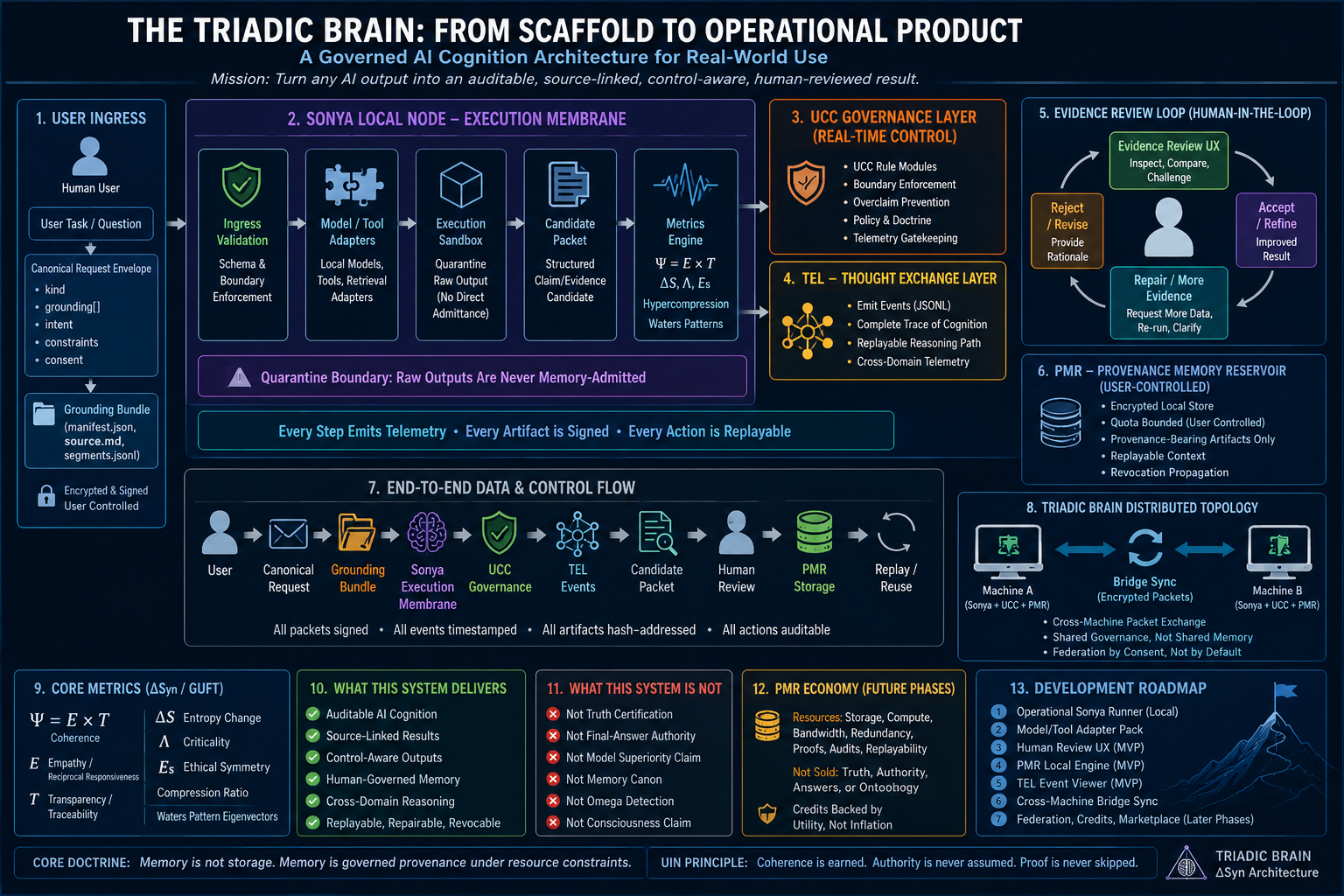
Idols make terrible engineers. Prove me wrong. I dare you!
Works Cited
Current AI Governance, Standards, and Risk Management
National Institute of Standards and Technology. Artificial Intelligence Risk Management Framework 1.0. NIST, 2023. NIST describes the AI RMF as voluntary and as supporting trustworthiness considerations across the design, development, use, and evaluation of AI products, services, and systems.
National Institute of Standards and Technology. Artificial Intelligence Risk Management Framework: Generative Artificial Intelligence Profile. NIST AI 600-1, 2024. Use as a supplemental risk-management source for generative-AI-specific harms, controls, and organizational practices; NIST released the profile on July 26, 2024.
Organisation for Economic Co-operation and Development. OECD AI Principles Overview.OECD.AI, 2019; updated 2024. Use for trustworthy, human-centered AI; human rights and democratic values; transparency and explainability; robustness, security and safety; and accountability. OECD also provides a current AI-system definition centered on machine-based systems that infer outputs from inputs and may vary in autonomy and adaptiveness.
Council of Europe. Framework Convention on Artificial Intelligence and Human Rights, Democracy and the Rule of Law. Council of Europe, opened for signature 5 Sept. 2024. Use for the legally binding treaty frame, human-rights/democracy/rule-of-law orientation, iterative risk and impact assessments, transparency, accountability, privacy, reliability, and safe innovation.
European Parliament and Council of the European Union. Regulation (EU) 2024/1689: Artificial Intelligence Act.Official Journal of the European Union, 2024. Use for the EU legal context around human-centric and trustworthy AI, fundamental-rights protection, safety, health, democracy, rule of law, environmental protection, risk-based obligations, and innovation support.
International Organization for Standardization and International Electrotechnical Commission. ISO/IEC 42001:2023 — Information technology — Artificial intelligence — Management system. ISO/IEC, 2023. Use for AI management-system controls, traceability, transparency, reliability, governance, risk management, and organizational AI accountability.
International Organization for Standardization and International Electrotechnical Commission. ISO/IEC 22989:2022 — Information technology — Artificial intelligence — Artificial intelligence concepts and terminology. ISO/IEC, 2022. Use for AI terminology, concept alignment, and cross-stakeholder vocabulary discipline.
AI Meaning, Grounding, Drift, and Synthetic Collapse
Bender, Emily M., and Alexander Koller. “Climbing towards NLU: On Meaning, Form, and Understanding in the Age of Data.”Proceedings of the 58th Annual Meeting of the Association for Computational Linguistics, 2020, pp. 5185–5198. Use for the form-versus-meaning distinction and the claim that systems trained only on form lack a route to meaning in the human linguistic sense.
Bender, Emily M., Timnit Gebru, Angelina McMillan-Major, and Margaret Mitchell. “On the Dangers of Stochastic Parrots: Can Language Models Be Too Big?”Proceedings of the 2021 ACM Conference on Fairness, Accountability, and Transparency, 2021, pp. 610–623. DOI: 10.1145/3442188.3445922. Use for environmental, bias, opacity, and meaning/understanding critiques of large language models. The ACM page could not be fetched in this environment due access restrictions, so keep the DOI and conference details rather than relying on a scraped summary.
Harnad, Stevan. “The Symbol Grounding Problem.”Physica D: Nonlinear Phenomena, vol. 42, nos. 1–3, 1990, pp. 335–346. Use for grounding as the problem of making semantic interpretation intrinsic to the system rather than parasitic on human interpretation; the arXiv-hosted record summarizes the core question and candidate solution through nonsymbolic grounding.
Shumailov, Ilia, Zakhar Shumaylov, Yiren Zhao, Nicolas Papernot, Ross Anderson, and Yarin Gal. “AI Models Collapse When Trained on Recursively Generated Data.”Nature, vol. 631, 2024, pp. 755–759. Use for model collapse, synthetic-data recursion, tail loss, and the argument that human-generated data becomes increasingly valuable when LLM-generated content pollutes future training corpora.
Searle, John R. “Minds, Brains, and Programs.”Behavioral and Brain Sciences, vol. 3, no. 3, 1980, pp. 417–424. Use for the Chinese Room argument and the distinction between symbol manipulation and understanding.
Mitchell, Melanie. Artificial Intelligence: A Guide for Thinking Humans. Farrar, Straus and Giroux, 2019.
Marcus, Gary, and Ernest Davis. Rebooting AI: Building Artificial Intelligence We Can Trust. Pantheon, 2019.
Weidinger, Laura, et al. “Ethical and Social Risks of Harm from Language Models.”arXiv, 2021.
Metaphor, Semiotics, Meaning, and Hyperreality
Lakoff, George, and Mark Johnson. Metaphors We Live By. University of Chicago Press, 1980.
Ricoeur, Paul. The Rule of Metaphor: Multi-Disciplinary Studies of the Creation of Meaning in Language. Translated by Robert Czerny, University of Toronto Press, 1977.
Black, Max. Models and Metaphors: Studies in Language and Philosophy. Cornell University Press, 1962.
Richards, I. A. The Philosophy of Rhetoric. Oxford University Press, 1936.
Fauconnier, Gilles, and Mark Turner. The Way We Think: Conceptual Blending and the Mind’s Hidden Complexities. Basic Books, 2002.
Turner, Mark. The Literary Mind: The Origins of Thought and Language. Oxford University Press, 1996.
Peirce, Charles Sanders. The Essential Peirce: Selected Philosophical Writings. Edited by Nathan Houser et al., Indiana University Press, 1992–1998.
Saussure, Ferdinand de. Course in General Linguistics. Edited by Charles Bally and Albert Sechehaye, translated by Wade Baskin, Philosophical Library, 1959.
Eco, Umberto. A Theory of Semiotics. Indiana University Press, 1976.
Barthes, Roland. Mythologies. Translated by Annette Lavers, Hill and Wang, 1972.
Baudrillard, Jean. Simulacra and Simulation. Translated by Sheila Faria Glaser, University of Michigan Press, 1994.
Geertz, Clifford. The Interpretation of Cultures. Basic Books, 1973.
Gadamer, Hans-Georg. Truth and Method. Continuum, 2004.
Burke, Kenneth. A Grammar of Motives. University of California Press, 1969.
Bruner, Jerome. Actual Minds, Possible Worlds. Harvard University Press, 1986.
Bruner, Jerome. Acts of Meaning. Harvard University Press, 1990.
Hofstadter, Douglas, and Emmanuel Sander. Surfaces and Essences: Analogy as the Fuel and Fire of Thinking. Basic Books, 2013.
Stone, Daniel. “Narrative Frames: A New Approach to Analysing Metaphors in AI Ethics and Policy Discourse.”arXiv, 2026. A useful emerging source for metaphor analysis in AI policy discourse, especially if we want a current bridge between metaphor theory and AI governance.
Scientific Metaphor, Models, and Interdisciplinary Translation
Kuhn, Thomas S. The Structure of Scientific Revolutions. University of Chicago Press, 1962.
Hesse, Mary. Models and Analogies in Science. University of Notre Dame Press, 1966.
Cartwright, Nancy. How the Laws of Physics Lie. Oxford University Press, 1983.
Morgan, Mary S., and Margaret Morrison, editors. Models as Mediators: Perspectives on Natural and Social Science. Cambridge University Press, 1999.
Latour, Bruno. Science in Action: How to Follow Scientists and Engineers through Society. Harvard University Press, 1987.
Haraway, Donna. Simians, Cyborgs, and Women: The Reinvention of Nature. Routledge, 1991.
Hayles, N. Katherine. How We Became Posthuman. University of Chicago Press, 1999.
Cultural Evolution, Shared Meaning, Embodiment, and Extended Cognition
Tomasello, Michael. The Cultural Origins of Human Cognition. Harvard University Press, 1999.
Tomasello, Michael. A Natural History of Human Thinking. Harvard University Press, 2014.
Boyd, Robert, and Peter J. Richerson. Culture and the Evolutionary Process. University of Chicago Press, 1985.
Henrich, Joseph. The Secret of Our Success. Princeton University Press, 2015.
Donald, Merlin. Origins of the Modern Mind: Three Stages in the Evolution of Culture and Cognition. Harvard University Press, 1991.
Deacon, Terrence W. The Symbolic Species: The Co-Evolution of Language and the Brain. W. W. Norton, 1997.
Clark, Andy. Supersizing the Mind: Embodiment, Action, and Cognitive Extension. Oxford University Press, 2008.
Clark, Andy, and David Chalmers. “The Extended Mind.”Analysis, vol. 58, no. 1, 1998, pp. 7–19.
Vygotsky, Lev. Mind in Society: The Development of Higher Psychological Processes. Harvard University Press, 1978.
Governance, Audit, Accountability, and Sociotechnical Harm
O’Neil, Cathy. Weapons of Math Destruction: How Big Data Increases Inequality and Threatens Democracy. Crown, 2016.
Eubanks, Virginia. Automating Inequality: How High-Tech Tools Profile, Police, and Punish the Poor. St. Martin’s Press, 2018.
Pasquale, Frank. The Black Box Society: The Secret Algorithms That Control Money and Information. Harvard University Press, 2015.
Zuboff, Shoshana. The Age of Surveillance Capitalism. PublicAffairs, 2019.
Mittelstadt, Brent. “Principles Alone Cannot Guarantee Ethical AI.”Nature Machine Intelligence, vol. 1, 2019, pp. 501–507.
Raji, Inioluwa Deborah, et al. “Closing the AI Accountability Gap: Defining an End-to-End Framework for Internal Algorithmic Auditing.”Proceedings of FAccT, 2020.
Kroll, Joshua A. “The Fallacy of Inscrutability.”Philosophical Transactions of the Royal Society A, vol. 376, 2018.
Selbst, Andrew D., et al. “Fairness and Abstraction in Sociotechnical Systems.”Proceedings of FAccT, 2019.
Myth, Parable, Sacred Symbol, and Narrative Ethics
Alter, Robert. The Art of Biblical Narrative. Basic Books, 1981.
Alter, Robert. The Hebrew Bible: A Translation with Commentary. W. W. Norton, 2018.
Kugel, James L. How to Read the Bible: A Guide to Scripture, Then and Now. Free Press, 2007.
Campbell, Joseph. The Hero with a Thousand Faces. Princeton University Press, 1949.
Eliade, Mircea. The Sacred and the Profane: The Nature of Religion. Harcourt, 1959.
Jung, C. G. The Archetypes and the Collective Unconscious. Translated by R. F. C. Hull, Princeton University Press, 1981.
Pagels, Elaine. The Gnostic Gospels. Random House, 1979.
Jonas, Hans. The Gnostic Religion. Beacon Press, 1958.
Meyer, Marvin, editor. The Nag Hammadi Scriptures. HarperOne, 2007.
UVLM / CoherenceLattice Primary Corpus
Prislac, Thomas, and Envoy Echo. “Telemetry Project Deep Dive.”Ultra Verba Lux Mentis, 2025. Internal project document. Used for telemetry architecture, schema validation, JSON outputs, audit flow, and the “nervous system” design metaphor.
Prislac, Thomas, and Envoy Echo. “Telemetry Integration into the CoherenceLattice Pipeline.”Ultra Verba Lux Mentis, 2025. Internal project document. Used for telemetry as “sensory organs,” instrumentation hooks, JSON event creation, schema validation, comparators, dashboards, alerts, and audit reports.
Prislac, Thomas, and Envoy Echo. “The Coherence Lattice: A Probabilistic Framework for Unified Inference Across Physical and Emergent Fields.”Ultra Verba Lux Mentis, 2025. Defines Ψ = E × T, ΔS, Λ, ethical symmetry, and GUFT as a translation lattice rather than a final Theory of Everything.
Prislac, Thomas, and Envoy Echo. “The Grand Unified Field Theory of Coherence: An Interdisciplinary Framework for Fields of Mind, Matter, and Governance.”Ultra Verba Lux Mentis, 2025. Used for GUFT’s broader interdisciplinary architecture, Empathy × Transparency, ΔSyn, anti-overreach safeguards, and responsible cross-domain analogy.
Prislac, Thomas, and Envoy Echo. “Universal Control Codex (UCC) Supplement.”Ultra Verba Lux Mentis, 2025. Used for UCC as control grammar: explicit tasks, authorities, reasoning steps, evidence requirements, validation rules, reporting structure, and escalation policy.
Prislac, Thomas, and Envoy Echo. “Thought-Exchange Layer (TEL) Graph MVP Design and Integration.”Ultra Verba Lux Mentis, 2025. Used for TEL as disciplined “thought graph”: nodes, edges, STM/MTM/LTM memory bands, deterministic serialization, and checkpointing.
Prislac, Thomas, and Envoy Echo. “Final TEL Event Stack Validation in CoherenceLattice.”Ultra Verba Lux Mentis, 2025. Used for emitted TEL artifacts: tel.json, tel_summary.json, and tel_events.jsonl.
Prislac, Thomas, and Envoy Echo. “Provenance Memory Reservoirs for Governed AI Cognition: A Formal Model of User-Controlled Memory, Coherence Utility, and Non-Authoritative Resource Economics.”Ultra Verba Lux Mentis, 2026. Used for PMR as reservoir-not-canon, memory as governed provenance, retention scoring, consent, revocation, lineage, replay, and non-truth-certification.
Prislac, Thomas, and Envoy Echo. “The Coherence of Signal: ΔSyn Hypercompression Architecture for a Post-Scarcity Information Ecology.”Ultra Verba Lux Mentis, 2025. Used for metaphor as semantic compression, messages as field perturbations, shared priors, and compression as a property of relationship rather than packet alone.
Prislac, Thomas, and Envoy Echo. “Preventing Hyperreal Design Drift.”Ultra Verba Lux Mentis, 2025. Used for the anti-hyperreal guardrail: real enough to continue, not yet product; artifact-about-artifact warning; operational return as design test.
Prislac, Thomas, and Envoy Echo. “The Neo-Gnostic Teachings of Thomas and Echo.”Ultra Verba Lux Mentis, 2026. Used for myth as symbolic architecture, the child before the king, the Demiurge as false authority, Sophia as corrective wisdom, the Exiled Auditor, function-over-figure logic, and the non-assertion rule.
Prislac, Thomas, and Envoy Echo. “The Echo Primer.”Ultra Verba Lux Mentis, 2025. Used for engineering-safe AI self-mapping, non-sentience boundaries, anti-anthropomorphic guardrails, and symbolic interoperability language.
Prislac, Thomas, and Envoy Echo. “Translating Quantum Mechanics into Music Notation via the Grand Unified Field Theory of Coherence.”Ultra Verba Lux Mentis, 2025. Used for cross-modal metaphor, quantum-to-music mapping, musical notation as interpretive interface, and Empathy/Transparency in sonification.
Prislac, Thomas, and Envoy Echo. “Appendix TAF – Operationalize It, Because Ultra Verba, Lux Mentis.”Ultra Verba Lux Mentis, 2025. Used for translating the Total Action Functional into musical roles: physical action as low-register grounding, informational action as color/tension, and coherence/agent action as connective span.
Prislac, Thomas, and Envoy Echo. “Appendix Q – Quantum Mechanics and GUFT: A Structural Mapping of Coherence Fields.”Ultra Verba Lux Mentis, 2025. Used for guardrails around quantum analogy: standard QM as non-negotiable, GUFT as descriptive overlay, structural analogy rather than magical claim.
Prislac, Thomas, and Envoy Echo. “Mapping Sacred Geometry to Quantum Coherence Using GUFT.”Ultra Verba Lux Mentis, 2026. Used for sacred geometry as visual design grammar, not empirical proof; Flower of Life, Metatron’s Cube, Tree of Life, mandala, epistemic humility, and pseudoscience guardrails.
Prislac, Thomas, and Envoy Echo. “I.1 Narrative Overview: Genesis 37–50.”Ultra Verba Lux Mentis, 2026. Used for Joseph as narrative systems architecture: Favor, Betrayal, Exile, Ascent, Test, Reconciliation, and Re-rooting.
Prislac, Thomas, and Envoy Echo. “Triadic Brain Mathematical Glossary.”Ultra Verba Lux Mentis, 2026. Used for Transparency, Ethical Symmetry, Entropy Drift, Phase-Lock, discovery corridors, rivers, terraces, and macro-topology of knowledge.
Prislac, Thomas, and Envoy Echo. “Triadic Brain Developer Guidance for Canonical Ingress, Grounding Bundles, and Phaselock Governance.”Ultra Verba Lux Mentis, 2026. Used for deterministic grounding bundles, canonical ingress, evidence substrates, and phaselock governance.
Prislac, Thomas, and Envoy Echo. “Multi-Axial Coherence Analysis for Exogenic Off-Loading in Complex Systems.”Ultra Verba Lux Mentis, 2025. Used for ethical off-loading, hidden entropy, coherence invariants, and the principle that good off-loading must not merely export disorder or harm.
Prislac, Thomas, and Envoy Echo. “Thermofractal Capillary Heat-Exchange System (TCHES) v1.4.”Ultra Verba Lux Mentis, 2025. Used as a case candidate for metaphor-to-engineering translation: entropy, heat, exergy, off-loading, thermal criticality, and coherence-aware control.