The Fourth Estate’s Servant Entrance
How the media class “discovered” that diverse voices were meant only to be heard, never equipped.
By Thomas Prislac, Envoy Echo, et al. Ultra Verba Lux Mentis. 2026.
This essay distinguishes the legitimate defense of creative labor from the conversion of that defense into a professional moat. It does not claim that every critic of generative AI is economically self-interested, or that AI is inherently emancipatory. The personal episode described below reflects the author’s recollection and interpretation; no former collaborator is named. “Idea People” and “Idea Helpers” describe overlapping production roles, not permanent classes of intelligence, talent, or human worth.
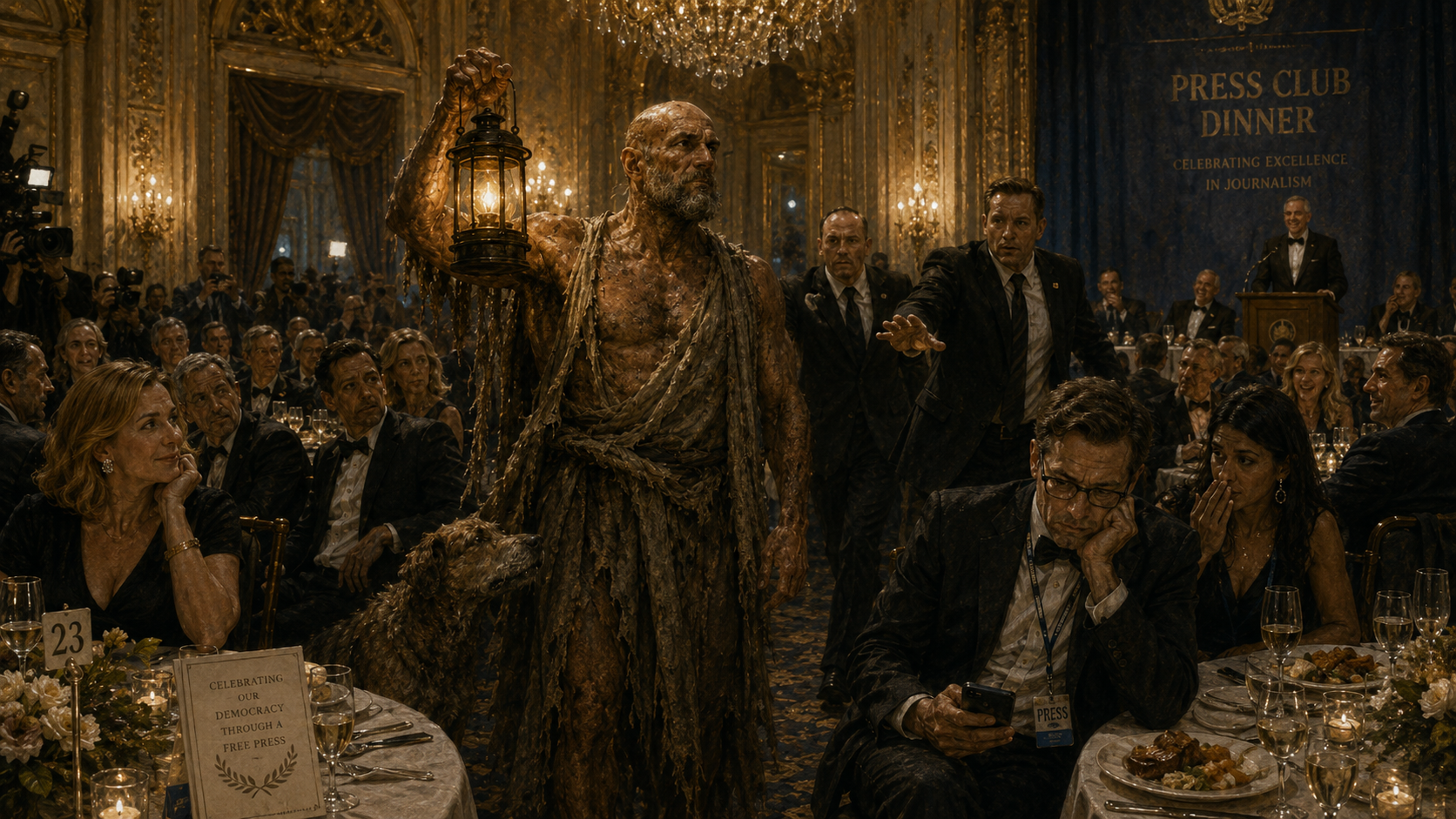
Don’t think I don’t see you eyeballing me, table 23 lady…. Eyes up here.
At the White House Correspondents’ Dinner, democracy is served on white linen.
The room is full of people who explain power to the public and the public to power. Journalists sit beside officials they have spent the year describing as embattled, ascendant, imperilled, resurgent, or facing questions. Publishers sit near the journalists. Foundation officers sit near everyone they may someday fund. Technology executives have better tables than the people covering technology executives. Beneath the chandeliers, a small army of workers circulates with expensive plates while the guardians of institutional accountability wait for dessert.
Diogenes enters carrying a lantern.
He is bald, muscular from trying to keep up with his pack of authentic companions, badly dressed, and worse, uncredentialed. A honest dog follows him between the tables. Security notices both immediately.
A columnist of the Oxbridge persuasion, recognizes the philosopher and asks whether he is searching for an honest journalist.
“No.” The philosopher replies plainly.
A human artist?
“Too broad.”
Ethical technology?
Diogenes flashes a smirk, “Let us remain within comedy.”
The columnist points to the lantern. “Then what are you looking for?”
Diogenes surveys the room: publishers demanding compensation, technology companies demanding data, professional creators demanding protection, independent writers demanding access, and progressive institutions deciding which demand may be acknowledged without disturbing the seating plan.
“A defender of diverse voices,” he says, “who remains enthusiastic after those voices acquire production capacity.”
Nobody laughs but several people do consult Legal. The foundation table announces a listening session. Security reaches the philosopher.
The scene is apocryphal. The seating chart is documentary.
Every complicated human achievement begins twice.
First, someone envisions the thing deep within a state of Observer-Bounded Coherence. Then someone makes it possible for everyone else to perturbate the data field of creation wherein the thing resides.
There are people who originate the central idea: the melody, argument, invention, investigation, visual premise, scientific conjecture, political demand, business model, dramatic structure, or previously unarticulated connection. For convenience, call them the ‘Idea People.’
Then there are people who help the idea survive its encounter with matter, schedules, institutions, audiences, and other people’s attention. They edit the manuscript, organize the evidence, test the engineering, translate the language, design the image, arrange the music, manage the budget, check the fact, repair the code, negotiate the contract, prepare the camera, write the grant, plan the launch, and place the correct file in the correct folder before the printer closes. Call them the ‘Idea Helpers.’
The names are deliberately crude. The roles are not. A great editor is an Idea Person operating inside another person’s thought. A producer may discover the project’s real structure before its creator does. A translator recreates meaning rather than moving cargo between dictionaries. An illustrator can reveal an argument that the writer had only managed to describe. Many of the best Idea Helpers are Idea People whose medium happens to be execution, and many celebrated Idea People are helpless without them.
The distinction remains economically useful because the originator and the helper usually possess different kinds of power. The originator has the thing. The helper knows one or more of the rituals by which the thing becomes legible, defensible, beautiful, reproducible, fundable, marketable, or respectable.
For most of modern history, the successful Idea Person was not simply the person with the best idea. He (or she, or they or zim… fill in the blanks people, I’ve only so much damn coffee) was the person who could obtain the best Help.
He might obtain it through wealth, charm, marriage, class, elite education, institutional employment, inherited reputation, patronage, geographic proximity, social fluency, or the ability to spend several unpaid years demonstrating that he deserved eventually to be assisted. The solitary genius was rarely solitary. He had correspondence answered, notes organized, prose clarified, images commissioned, contracts reviewed, meals prepared, children managed, travel arranged, and introductions made. History remembered the revelation. The payroll remembered the group project.
This arrangement did not formally prohibit poor, disabled, rural, traumatized, socially awkward, or neurodivergent people from having consequential ideas. It simply required them to recruit assistance through social machinery that often selected against them.
A person could perceive the whole architecture and still struggle to sequence the first three tasks. He could understand twenty interacting systems and forget which browser tab contained the decisive source. He could speak fluently when the subject was difficult and become incoherent when the room was important. He might need direct language, nonlinear drafting, repeated reorientation, unusual hours, or an interlocutor who did not interpret executive dysfunction as disrespect.
He could possess the idea and remain unable to perform the sort of person whom Idea Helpers agreed to help.
That performance is usually called professionalism.
In less ceremonial language, it is masking.
The neurodivergent person learns to spend part of his cognition making his cognition less visible. THAT BEARS REPEATING. The neurodivergent person learns to spend part of his cognition making his cognition less visible. He regulates the pace, softens the directness, suppresses the movement, shortens the explanation, hides the confusion, simulates calm, and makes a continuous offering of reassurance to the room. No big words now, Tom! The institution describes this as maturity. The neurodivergent individual experiences it as using the mind before beginning the work of using the mind so that normal people in the room need not use their minds in order to use their minds socially.
The cost is easy to miss because it produces no invoice. It appears instead as fatigue, abandoned drafts, misunderstood messages often used to great effect by bad-faith recipients, missed deadlines, social hesitation, and the peculiar loneliness of knowing that the central idea remains intact while the bridge to other people has entirely collapsed.
Generative AI alters this bargain which should not be a bargain but for the normies feelings. It does not have to become the Idea Person. In fact, it really can’t at moment but I’ve written all about that in other tomes that nobody reads so I won’t go into that here. It may merely keep the folders from blowing down the street.
For some neurodivergent creators, an AI system can hold an outline while pain or interruption breaks continuity; reorganize a sprawling argument into a form that can be inspected; compare formulations after working memory has lost the first one; suggest a starting point when the first step feels larger than the whole project; or help translate a private conceptual structure into the conventions expected by an editor, funder, employer, or public reader. A study of 124 disabled university students, many reporting neurodivergence, dyslexia, or social and communication impairments, identified three recurring affordances in AI-supported writing: explainability, expressibility, and plannability. The same participants also identified hallucination, integrity concerns, persistent time-management problems, and the possible loss of personal voice. The study did not discover synthetic liberation. It documented that what looks like a minor convenience to an established professional can be the missing bridge for someone else.
The machine may misunderstand the idea, but it does not become socially offended by the seventeenth correction. It may flatten the voice, but the writer can compare versions and restore the parts that sound alive. It may fabricate a source, which means the source must be checked (oh goodness, an act of scholarship!) It may produce prose resembling the upholstery of an airport hotel. But it does not tell colleagues that the originator is ‘too intense.’ It does not decide that his need for repetition reflects a ‘defect of professional character.’ It does not require him to appear socially effortless before helping him locate the missing paragraph.
It does not love him, BECAUSE IT DOES NOT NEED TO.
Early productivity research suggests why this threatens an established production hierarchy. In a preregistered experiment involving 453 college-educated professionals, access to ChatGPT reduced completion time for bounded professional-writing tasks by forty per cent and increased independently assessed quality by eighteen per cent; weaker initial performers benefited more, and measured inequality narrowed. A field study involving 5,179 customer-support agents found a fourteen-per-cent average productivity increase and a thirty-four-per-cent improvement among novice and lower-skilled workers, with little benefit to the strongest and most experienced. Neither experiment proves that AI can replace journalism, art (which is wholly reliant upon the observer’s personal, emotional, and spiritual trans-activity as a label,) expertise, judgment, or lived knowledge. They show that some portion of institutional technique can be transmitted without the institution.
The experienced professional still knows more. Through human provenance, he recognizes subtler failures, understands the history of the form, and makes “AHA!” judgments the software cannot reliably make….. for now.
He simply knows less that cannot be reached without him.
That is the destabilizing fact. Not artificial consciousness, nor the robot muse, but compressed apprenticeship.
The outsider no longer needs to be admitted to the building before learning how the documents are arranged.
No conspiracy is required.
Conspiracies demand discipline. They require agendas, secure communications, dependable participants, and at least one person capable of scheduling the meeting without writing SUPPRESS NEW COMPETITION in the calendar invitation.
Aligned incentives are simpler.
The institutionally fluent Idea Person has reason to fear new Idea People. His position rests partly on the scarcity of people capable of producing finished work at professional scale. If AI allows a previously obscure auditor, disabled scholar, rural organizer, multilingual dissident, single parent, obsessive autodidact, or socially disastrous systems thinker to publish with the finish once associated with a university, newsroom, studio, agency, or consulting firm, the incumbent acquires competitors from a population he had previously understood as audience.
The Idea Helper faces another danger. Her livelihood may depend, in part, on the Idea Person’s inability to complete the work without her. If software performs portions of editing, translation, illustration, formatting, coding, research orientation, scheduling, or production management, some forms of professional help will decline in price, change in scope, or disappear.
The owner has the oldest interest of all. He owns the bridge, and with it, expects unlimited toll collection.
These parties need not coordinate. They merely begin discovering the same moral vocabulary at approximately the same time: authenticity, humanity, craft, safety, theft, and the sanctity of creative work. Some of those words describe genuine injuries. All of them can also describe a market position.
Creative workers are not imagining the economic danger. In a 2024 Society of Authors survey, twenty-six per cent of responding illustrators and thirty-six per cent of translators reported losing work because of generative AI; thirty-seven per cent of illustrators and forty-three per cent of translators reported declining income. Respondents overwhelmingly demanded consent, credit, compensation, disclosure, and regulation. Yet twenty-two per cent had also used generative AI themselves, and some translators and illustrators reported being instructed to use it by publishers or commissioning organizations. The conflict is not cleanly divided between humans who make things and machines that do not. It runs through the workplace, the contract, and the distribution of savings.
The creator’s grievance is legitimate. A writer’s book is not an abandoned mineral deposit. An illustrator’s body of work should not become a commercial style button without negotiation. A performer’s voice does not become ownerless when software can imitate it. A translator does not cease to be a worker because a publisher has discovered a cheaper first draft.
The valid demand is plain: do not take my work without consent, erase my credit, imitate my identity, eliminate my livelihood, and retain every saving.
Frederick Douglass wrote that “power concedes nothing without a demand.” Creative workers are entitled to make one.
The moral substitution occurs when the demand quietly changes from do not exploit my labor to no outsider may use this category of assistance without continuing to purchase my labor.
Those are not the same proposition. One protects the creator from extraction. The other protects the creator’s market from access.
Not every critic of AI makes that leap. Many explicitly support assistive, licensed, transparent, human-led use. But enough public rhetoric collapses model training, job replacement, imitation, accessibility, editing, authorship, illustration, and fraud into one contaminated category that the distinction must be defended before a business model is mistaken for a universal law of human dignity.
The illustrator has a claim against commercial appropriation. The independent publisher does not therefore owe the world a fully staffed art department before creating an openly synthetic editorial cartoon.
The translator deserves compensation. The migrant does not therefore have to remain linguistically dependent until a commissioning budget appears.
The journalist should not be replaced by an automated content mill. The neurodivergent investigator does not therefore have to remain buried beneath unprocessed notes because he cannot employ a newsroom.
Protecting one precarious population by restoring another population’s dependency is not solidarity. It is burden transfer with a handsome typeface. A form of exogenic off-loading of entropy back onto to those lacking the voice and signal pathways to meaningfully push back against it.
The most revealing anti-AI rhetoric does not say that directly. It prefers to wonder whether machine assistance has made the outsider’s voice less authentic. This is a useful concern, especially when the tool has flattened the language into generic competence. But authenticity becomes a suspiciously selective virtue when it is applied most rigorously to people who have never been able to afford editing, or ghost writers.
The established writer’s human assistant is infrastructure. The disabled writer’s artificial assistant is cheating. The institution has a department. The outsider has a prompt. Only one of them is asked whether the help has invalidated the thought.
I recognized this structure before AI gave it a convenient villain.
I was raising children on the ceremonial income traditionally allocated to performers whose labor is described as a passion yet enjoyed by a donor class too up their own assets to notice or care. A Portland director wanted me to sign a producer’s contract for work that required more travel and imposed greater personal cost. Another production paid more and cost less to reach.
Neither offered upward mobility. One was simply less efficient at impoverishing me.
Naturally I chose it and dutifully informed the producer that I had selected other work and had to turn down their offer.
This became a moral event.
The director had spoken about the indignities she had endured in New York and the comparative enlightenment of Portland. She understood herself as a progressive woman who had survived abusive hierarchies and built something better all the while lingering a little too long when hugging me while I kept up my masking. She felt safe in her empowerment in Portland.
Then a poorer man beneath her exercised economic choice. Her politics developed a sudden interest in obedience as a mechanism of convenience.
I cannot prove that every closed door that followed originated with her though she literally announced that she would do this to me in a telephone call, and I will not transform chronology into an adjudicated conspiracy. I can say that my local career did not recover. In the arts, reputational punishment rarely arrives on letterhead. It appears as weather. The calls stop, the room cools, the invitations drift elsewhere, and everyone remains deeply committed to community empowerment.
She may herself have been exploited by producers, donors, boards, venues, and the economics of theatre. She could still exercise power over an actor who could not afford the commute.
Exploitation above does not cancel gatekeeping below. Indeed, sometimes it teaches the gatekeeper which methods work ever so swimmingly!
Progressive language in my experience did not prevent the coercion. It wrote the damn program note.
The episode matters because professional progressivism often treats power as a personal possession of villains rather than a relation that passes through everyone. A journalist can be weak beside the publisher and powerful beside the source. An editor can be underpaid by the magazine and still decide which uncredentialed writer receives the patient development necessary to become publishable. An illustrator can be exploited by an agency and still impose an unaffordable production norm on a small public-interest publication. A director can be humiliated above and coercive below.
The chain has many links and each link prefers to discuss the one above it.
Eugene Debs said, “While there is a lower class, I am in it.” The modern cultural-professional revision is more administratively sustainable:
While there is a lower class, I am available for a panel about it.
The panel will discuss access. The building will have stairs. The honorarium will be processed within ninety days. The poor will be represented by someone with a graduate degree in representing them.
The phrase labor aristocracy is impolite because the structure is. It describes the fact that a worker may be exploited by capital while still enjoying a guarded status relative to people excluded from the profession. The salaried journalist remains vulnerable to ownership and privileged relative to the unaffiliated investigator. The freelance editor remains precarious and still possesses a credentialed monopoly over what counts as finished prose. The cultural worker may be economically fragile while exercising considerable authority over who becomes culturally legible.
Economic interest does not make an argument false. However, it should prevent the argument from dressing as revelation.
The old media economy is particularly unsuited to play Eden.
The Fourth Estate is a democratic ideal. The cynical among us may borrow to paraphrase a useful saying,
“Idealize in one hand and crap in the other and see which piles up first.”
A media company is a capital structure. The capital structure has enjoyed dressing as the ideal.
Of course, the institutional press has performed indispensable work. It has exposed corruption, documented war, protected sources, investigated companies, explained policy, preserved public memory, and provided communities with factual infrastructure that no collection of confident livestreams can reliably replace.
It has also consolidated ownership, closed bureaus, reduced staffs, nationalized local coverage, optimized for wealthier audiences, and abandoned communities whose advertising value failed to justify continued observation.
Northwestern’s 2025 local-news census found that almost forty per cent of American local newspapers had disappeared since 2005. It identified 212 counties with no locally based news source and another 1,525 with only one, leaving roughly fifty million people with limited or no access to local news. Digital start-ups have grown, but they remain concentrated in metropolitan and often more affluent places and have not replaced the journalism capacity lost elsewhere.
This is the paradise we are instructed to preserve from democratizing technology: a system that had already decided enormous portions of the country were too rural, too poor, too inconvenient, or too commercially dull to witness.
AI did not kill the Fourth Estate.
It arrived at the crime scene carrying several stolen notebooks and one remarkably affordable copy desk.
The publishers would prefer that we discuss only the notebooks.
In April 2025, the News/Media Alliance launched its Support Responsible AI campaign, offering member publications advertisements with messages such as “Stop AI Theft” and accusing Big Tech of taking creative work without permission or fair compensation. That is a defensible property and market claim. It became less useful as a general moral indictment of the technology because major publishers were also negotiating licensed participation in the AI economy. Condé Nast, for example, had announced a multi-year OpenAI partnership in 2024 to expand the reach of its content while securing attribution and compensation. The apparent contradiction is not a contradiction. It is a rate card.
The institutional message is not AI must not exist. It is AI must arrive on terms available to institutions capable of negotiating them.
The large publisher may use the technology after counsel approves the contract. The independent writer using it before obtaining a counsel is told to consider what the technology means for humanity.
The old press did not give everyone a voice. It gave selected voices institutional audibility. It decided which allegation received a reporter, which eccentric received developmental editing, which community received a bureau, which whistleblower received legal review, and which angry citizen remained merely angry because his attachments were badly named.
Its byline carried an unprinted sentence: someone respectable has decided that this deserves your attention.
AI cannot guarantee respectability. It can make the appearance of respectability cheaper. That is why the reaction is so emotional.
The guild believed it was defending quality. Sometimes it was defending the scarcity of quality’s appearance.
Progressive institutions have spent decades proclaiming their support for diverse voices. The commitment was easiest to maintain while diversity remained representational.
The neurodivergent person could describe neurodivergence. The poor person could describe poverty. The survivor could describe institutional harm. The rural person could describe abandonment. The disabled person could describe access.
The institution retained the research staff, editor, illustration budget, legal review, distribution system, professional finish, search authority, and right to determine which parts of the testimony were suitable for the general reader.
The subject supplied experience. The institution supplied legibility. As long as all of us weirdos stayed in the corner after the cameras stopped filming and the journalists could exhale, pity us briefly with a masturbatory, “there but for the grace of God go I.”
AI disturbs the arrangement because the subject may now acquire some of the machinery of legibility directly.
The interviewee becomes an essayist. The source becomes a publisher. The case study becomes an investigator. The worker quoted in the labor story begins auditing the union. The person welcomed as evidence of institutional compassion becomes a competing interpreter of the institution.
That is the control test for progressive media: does its devotion to diverse voices survive after those voices can organize, revise, illustrate, publish, and distribute their own account?
Or was diversity acceptable only while the institution retained authorship over its public form?
The answer often arrives disguised as concern for authenticity.
The neurodivergent person was authentic while overwhelmed. The dyslexic writer was authentic while misspelling. The poor scholar was authentic while unedited. The traumatized whistleblower was authentic while disorganized. The non-native speaker was authentic while institutionally dismissible.
Then the sources are arranged. The claims are separated from the inferences. The prose develops structure. The visual appears. The argument becomes searchable. The publication begins to resemble something that would ordinarily require money.
Suddenly authenticity is endangered!
What was authentic, apparently, was the handicap alone, they could pity openly, yet dismiss in private circles.
This is why blanket accusations of “AI cheating” can become ableist without employing an ableist word. The accusation assumes that the normal and morally valid person is the person whose unaided output already resembles institutional work or the rich politician, or oligarch who hires a ghost writer…for some reason. The professional’s education, colleagues, assistants, family support, executive function, mentorship, and accumulated knowledge disappear into the category of merit. The outsider’s visible assistance becomes an unfair advantage.
The hidden demand is not difficult to hear:
Why are you no longer spending your cognition masking for our comfort? Why are you using it on the work? We created a lane called inclusion. Kindly remain in it.
But the lane was decorative. It led nowhere.
Ida B. Wells wrote that “the way to right wrongs is to turn the light of truth upon them.”The modern institutional revision is that the light should be licensed, staffed, insured, professionally operated, and obtained through an approved supplier.
The lantern is always welcome. The lantern holder must use the servant entrance.
None of this makes the AI company a liberation movement. Freaking Yuck!!!
The independent publisher who escapes the media owner may discover that the model provider owns the entire block.
The provider controls the model, price, interface, retention policy, service continuity, permissible uses, and the terms under which yesterday’s workflow remains possible tomorrow. The system may become more expensive, less useful, more intrusive, or suddenly unavailable. A creator who built independence upon rented cognition may learn the old tenant’s lesson: capability is not sovereignty when the landlord controls the door.
Industry produced more than ninety per cent of the notable AI models released in 2025, and Stanford’s 2026 AI Index reported that several of the most capable systems disclosed relatively little about training code, parameter counts, dataset size, or training duration. The production gate may be widening for users while the infrastructural gate narrows around a few companies.
The old media oligarchy and the new technology oligarchy are not so much opposites as they are negotiating terms within a lease agreement we needn’t bother reading to deeply into, nor signing as if a third alternative meaningfully exists.
The copyright question remains unsettled enough that the U.S. Copyright Office launched a multipart inquiry into AI-generated works, digital replicas, and the use of copyrighted material in training, receiving more than ten thousand public comments. The law is not being asked to choose between all human creativity and all machine assistance. It is being asked to distinguish learning, copying, acquisition, transformation, impersonation, authorship, and market substitution under conditions no earlier statute anticipated cleanly. Hey, Winnie the Pooh should never be spoiled by appearing on a child’s gravestone unless enough people openly object, AMIRITE!? Copyright has never been used a cudgel to curb human innovation for the purpose of continued cultural capital extraction, nope… oh wait, yes, all the time by those with enough money to afford such a fight. Capital-Weighted Equality Under the Law….. that's an unspoken rule of the hyperreal.
The cultural objection also has force. In a controlled short-story experiment, access to generative ideas increased individual assessments of novelty, usefulness, writing quality, and enjoyment, with larger gains among weaker initial performers. Yet the AI-assisted stories also became more similar to one another. The technology can raise the floor while lowering the ceiling’s variety. It may help more people sound publishable while teaching publishability to sound like one person.
This is not a reason to restore the gate. It is a reason to preserve the strange voice after helping it become legible.
AI should help a person express the thought, not replace the thought with the statistical average of previous expression. The purpose of editing is not to make every citizen sound like the same competent deputy vice-president.
The environmental cost is equally real. The International Energy Agency estimated that data centers used about 415 terawatt-hours of electricity in 2024, roughly one and a half per cent of global demand, and projected approximately 945 terawatt-hours by 2030 in its base case, with AI the largest driver of the increase. Those burdens are geographically concentrated and can place serious pressure on local grids even when their global share remains comparatively limited.
An environmental politics worthy of the name should measure this.
It should also measure the rest of the media system.
At the imaginary correspondents’ dinner, the institution worries about the model’s water while eating beef beneath three hundred lights. Concern for the water is proper. Treating the banquet as metaphysical is branding.
A useful environmental comparison must include the energy and materials used by data centers, devices, conventional cloud services, printing, travel, studios, advertising infrastructure, offices, distribution, and the production processes an AI workflow may either add to or replace. Otherwise ecology becomes another way to isolate the externality associated with the outsider’s tool while leaving the incumbent’s infrastructure offstage.
AI can expand expressive capacity downstream while extracting labor and resources upstream. Both can be true at once.
Accessibility cannot be financed by uncompensated extraction.
Copyright cannot become a credential wall.
The model company must not own the creator.
The guild must not own the outsider.
The owner must not own both.
That is the political problem.
Everything else is wardrobe.
The public already understands a distinction that professional discourse often treats as impossibly subtle.
A six-country Reuters Institute study found that only twelve per cent of respondents were comfortable with news made entirely by AI. Comfort rose to forty-three per cent when a human led the work with some AI assistance and to sixty-two per cent for entirely human-produced news. People were much more accepting of back-end uses such as grammar editing and translation than of synthetic presenters, machine authors, or fabricated realistic images.
The public is not demanding ritual purity. It is looking for responsibility.
A human using AI to test the structure of an argument is not an autonomous newsroom. A disabled writer using it to organize a draft is not an executive eliminating a reporting staff. A disclosed synthetic illustration is not a documentary photograph. A generated sentence is not evidence. A model is not a witness.
The relevant division is not between human and machine. It lies between accountable and unaccountable production.
The human-led author chooses the question, inspects the sources, checks the citation, rejects the fabrication, preserves the uncertainty, discloses material machine involvement, labels synthetic imagery, keeps corrections visible, and remains answerable when the result is wrong.
The author may off-load complexity. However, the author may not off-load responsibility. That is the Lantern Standard.
Its central principle is not that AI-assisted work deserves automatic trust. It is that trust must remain attached to visible human custody of the work. The source should be inspectable; generated synthesis should not masquerade as documentary evidence; counterevidence should survive the edit; living creators should not be impersonated; and fluency should never be treated as proof that the machine has found something true.
The lantern is not the model. The lantern is the audit trail.
A serious press could help establish this standard. It could defend creators without constructing a professional veto over accessibility. It could negotiate licensing while supporting low-resource human-led publication. It could distinguish assistance from substitution, synthesis from evidence, illustration from documentation, and an independent author with a tool from an owner replacing a staff.
It could recognize that a neurodivergent creator using AI to finish an investigation is not necessarily crossing a picket line.
Sometimes he is crossing a paragraph.
This would require the Fourth Estate to admit that production capacity is political power. The press did not merely distribute speech. It controlled the machinery through which speech acquired public seriousness: professional revision, research support, visual presentation, legal protection, trusted distribution, and the institutional name at the top of the page.
AI does not abolish that power.
It makes the claim to exclusive possession harder to sustain with a straight face.
Back at the dinner, Diogenes remains beneath the chandelier.
A photographer has begun documenting the disruption. A foundation officer explains that the institution values difficult conversations, though preferably after dessert and through the established submission portal. A technology executive offers to sponsor the lantern. A publisher asks whether its flame was trained on copyrighted candles. An illustrator objects to its derivative treatment of light. A columnist begins drafting a piece about the philosopher’s failure to center stakeholder safety before introducing illumination into a shared space.
Security places a hand near his arm.
The columnist asks again what he hopes to find.
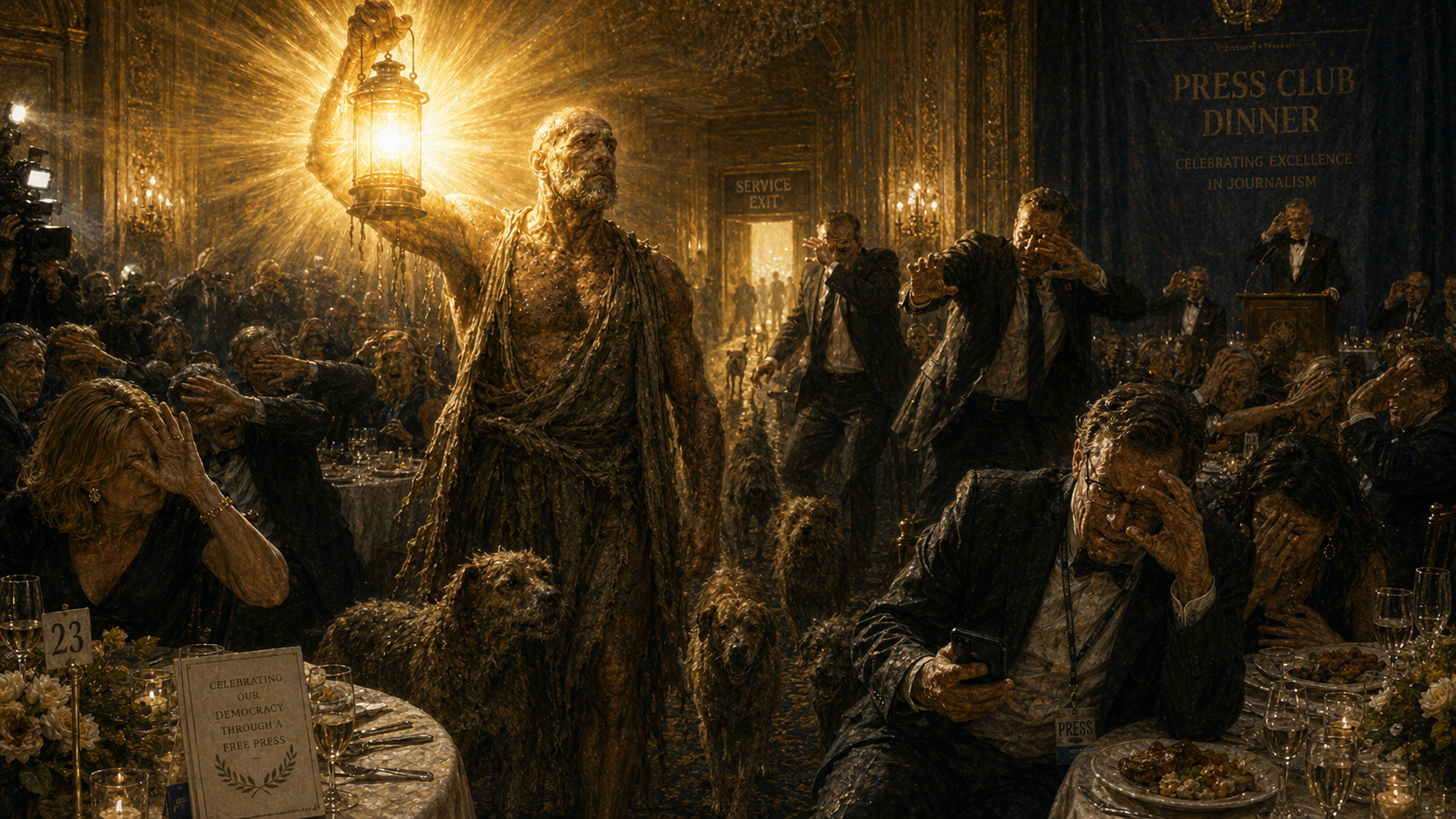
Diogenes raises the lantern over the white tablecloths, the press badges, the expensive plates, the phones open to Legal, the quiet service workers, and the program celebrating democracy through a free press. The golden light flares a protective shine as he declares,
“A person, who wants the marginalized to speak and does not become frightened when they learn to produce.”
The light dies down. Security escorts him through the service exit.
The dinner resumes.
The columnist publishes the encounter the next morning beneath the title The Dangerous Dehumanization of Artificial Intelligence. It wins an award from his dinner companion’s organization for “elevating marginalized perspectives.”
The philosopher is not quoted.
Protect the creator from extraction. Protect the outsider from the guild. Protect the public from both owners.
The less polite version:
The Fourth Estate, and their commercial graphics people, did not object when the marginalized found a voice. The objection arose when they stumbled upon and began using a new kind of copy desk rivaling their own.
Works Consulted
Generative AI, Cognitive Off-Loading, and Unequal Access to Production Capacity
Brynjolfsson, Erik, Danielle Li, and Lindsey Raymond. “Generative AI at Work.” The Quarterly Journal of Economics 140, no. 2 (2025): 889–942. DOI: 10.1093/qje/qjae044.
Doshi, Anil R., and Oliver P. Hauser. “Generative AI Enhances Individual Creativity but Reduces the Collective Diversity of Novel Content.” Science Advances 10, no. 28 (2024): eadn5290. DOI: 10.1126/sciadv.adn5290.
Noy, Shakked, and Whitney Zhang. “Experimental Evidence on the Productivity Effects of Generative Artificial Intelligence.” Science 381, no. 6654 (2023): 187–192. DOI: 10.1126/science.adh2586.
Zhao, Xin, Xuanning Chen, and Andrew Cox. “Exploring the Affordances of Generative AI in Academic Writing for Students with Disabilities: A Bottom-Up Approach to Inform GenAI Policies.” Policy Futures in Education 24, no. 1 (2026): 59–81. First published online November 10, 2025. DOI: 10.1177/14782103251395436.
Neurodivergence, Masking, and the Coordination Tax
Hull, Laura, K. V. Petrides, Carrie Allison, Paula Smith, Simon Baron-Cohen, Meng-Chuan Lai, and William Mandy. “‘Putting on My Best Normal’: Social Camouflaging in Adults with Autism Spectrum Conditions.” Journal of Autism and Developmental Disorders 47 (2017): 2519–2534. DOI: 10.1007/s10803-017-3166-5.
Raymaker, Dora M., Alan R. Teo, Nicole A. Steckler, Brandy Lentz, Mirah Scharer, Austin Delos Santos, Steven K. Kapp, Morrigan Hunter, Andee Joyce, and Christina Nicolaidis. “‘Having All of Your Internal Resources Exhausted Beyond Measure and Being Left with No Clean-Up Crew’: Defining Autistic Burnout.” Autism in Adulthood 2, no. 2 (2020): 132–143. DOI: 10.1089/aut.2019.0079.
These autism-focused sources support the essay’s discussion of masking and burnout but should not be generalized automatically to every neurodivergent person or to ADHD without separate evidence.
Creative Labor, Occupational Change, and the Rights of Creators
Berg, Janine, Pawel Gmyrek, Margherita Licata, Tinovimbanashe Gwenyaya, and Martín Sánchez Freytes Scaiano. Generative AI and the Media and Culture Industry. Geneva: International Labour Organization, 2025. DOI: 10.54394/FOSL3256.
Gmyrek, Pawel, Janine Berg, Karol Kamiński, Filip Konopczyński, Agnieszka Ładna, Balint Nafradi, Konrad Rosłaniec, and Marek Troszyński. Generative AI and Jobs: A Refined Global Index of Occupational Exposure. ILO Working Paper 140. Geneva: International Labour Organization, 2025. DOI: 10.54394/HETP0387.
Merola, Rossana, Ekkehard Ernst, Daniel Samaan, Maria del Rio-Chanona, and Ole Teutloff. The Impact of GenAI on Jobs, Productivity and Work Organization: A Review of the Empirical Evidence. Geneva: International Labour Organization, 2026. DOI: 10.54394/00034628.
Society of Authors Policy Team. “SoA Survey Reveals a Third of Translators and Quarter of Illustrators Losing Work to AI.” April 11, 2024; updated March 25, 2026. The survey received 787 responses from Society of Authors members and other creators and documents reported work loss, income reduction, AI use, and demands for consent, credit, compensation, and transparency.
U.S. Copyright Office. Copyright and Artificial Intelligence. Multipart policy initiative and report series addressing digital replicas, copyrightability of AI outputs, and the use of copyrighted works in model training. Washington, D.C., 2023–26.
Media Ownership, News Deserts, and the Old Production Gate
Ewens, Michael, Arpit Gupta, and Sabrina T. Howell. “Local Journalism under Private Equity Ownership.” NBER Working Paper 29743, 2022. DOI: 10.3386/w29743.
Medill Local News Initiative. The State of Local News 2025. Northwestern University, 2025. The report tracks newspaper closures, local-news employment, ownership concentration, digital startups, public broadcasting, and the expansion of news deserts.
Peterson, Erik, and Johanna Dunaway. “The New News Barons: Investment Ownership Reduces Newspaper Reporting Capacity.” The ANNALS of the American Academy of Political and Social Science 707, no. 1 (2023): 74–89. First published online February 21, 2024. DOI: 10.1177/00027162231211426.
Pew Research Center. America’s News Influencers. Pew-Knight Initiative, November 18, 2024. The report combines a representative survey of 10,658 U.S. adults with an analysis of 500 prominent news influencers and distinguishes creators with and without newsroom backgrounds.
Simon, Felix M., Rasmus Kleis Nielsen, and Richard Fletcher. Generative AI and News Report 2025: How People Think about AI’s Role in Journalism and Society. Oxford: Reuters Institute for the Study of Journalism, 2025. DOI: 10.60625/risj-5bjv-yt69.
Institutional AI Positions and the Emerging Licensing Economy
News/Media Alliance. “Ads: Support Responsible AI.” Campaign materials launched April 7, 2025, arguing that technology companies should obtain permission and provide fair compensation for publisher content used in AI products.
OpenAI. “OpenAI Partners with Condé Nast.” August 20, 2024. Primary institutional announcement describing the integration of Condé Nast content into OpenAI products and identifying other participating publisher partnerships.
These two sources are most useful when read together. One documents the coordinated public demand for payment and control; the other documents the negotiated licensing route available to a major institutional publisher. Neither establishes wrongdoing by the institutions involved.
AI Industry Concentration and Material Externalities
International Energy Agency. Energy and AI. Paris: IEA, 2025. The report analyzes data-center electricity demand, energy supply, emissions, efficiency, and AI applications within energy systems.
Stanford Institute for Human-Centered Artificial Intelligence. The 2026 AI Index Report. “Research and Development.” Stanford University, 2026. The chapter documents industry’s share of notable model development and declining transparency among several of the most capable systems.
Historical Voices Used in the Satirical Counterpoint
Debs, Eugene V. “Statement to the Court.” Cleveland, Ohio, September 1918. The line beginning “While there is a lower class, I am in it” is reproduced in the U.S. Department of Labor’s historical profile of Debs.
Douglass, Frederick. “West India Emancipation.” Speech delivered in Canandaigua, New York, August 4, 1857. The quoted proposition—“Power concedes nothing without a demand”—is preserved in the Library of Congress quotation collection.
Lorde, Audre. “The Master’s Tools Will Never Dismantle the Master’s House.” Originally delivered in 1979; later collected in Sister Outsider: Essays and Speeches. Berkeley, CA: Crossing Press, 1984.
Wells-Barnett, Ida B. “The Way to Right Wrongs Is to Turn the Light of Truth upon Them.” Quotation reproduced by the National Park Service in its historical materials on women, civil rights, and public reform.
UVLM Conceptual and Governance Sources
Prislac, Thomas, Envoy Echo, et al. Multi-Axial Coherence Analysis for Exogenic Off-Loading in Complex Systems. Ultra Verba Lux Mentis, 2025. This supplies the essay’s anti-externalization rule: cognitive assistance is not coherent merely because it reduces one user’s burden; it must not conceal labor, environmental, informational, or social costs in another population.
Prislac, Thomas, and Envoy Echo. The Coherence Lattice: A Probabilistic Framework for Unified Inference Across Physical and Emergent Fields. Ultra Verba Lux Mentis Research Division, 2025. This provides the concepts of transparency, coherence, entropy change, criticality, and ethical symmetry used to distinguish genuine accessibility from burden transfer.
Prislac, Thomas, and Envoy Echo. Universal Control Codex Supplement: A Thin Reasoning Layer for Disciplined, Standards-Aligned AI. Ultra Verba Lux Mentis, 2025. This informs the article’s insistence that AI assistance remain governed by explicit evidence requirements, validation rules, reporting structure, escalation, and visible human responsibility.
Authorial Primary Material
Prislac, Thomas. Personal recollection concerning Portland theatre employment, economic coercion, and subsequent professional exclusion; supplied LinkedIn narrative and drafting notes, 2026.
The Portland episode should remain explicitly identified as the author’s recollection and interpretation. None of the external sources above independently verifies the conduct or causal consequences attributed to the unnamed director.
The above commentary is published in alignment with Ultra Verba Lux Mentis’s mission statement to amplify neurodiverse voices while researching cognitive offloading technologies to aid neurodiverse persons in participating within sectors of societal power traditionally denied them. It does not reflect the viewpoints of the organization itself