When the Prophet Owns the Put:
How a market oracle can short the panic, buy the rebound, and call the round trip foresight
By Thomas Prislac, Envoy Echo, et al. Ultra Verba Lux Mentis. 2026.
This essay combines documented market research, an open analytical case involving Caterpillar, an original policy proposal, and Swiftian political satire. Nothing in the public record cited here establishes that Michael Burry manipulated Caterpillar, artificially suppressed its price, reversed his position near the trough, coordinated with another trader, or violated the law. The black-site passages near the end are a satirical attack on racialized and class-stratified state violence, not a literal proposal to abduct, imprison, or torture anyone. This is political commentary, not investment or legal advice, see? No torture!
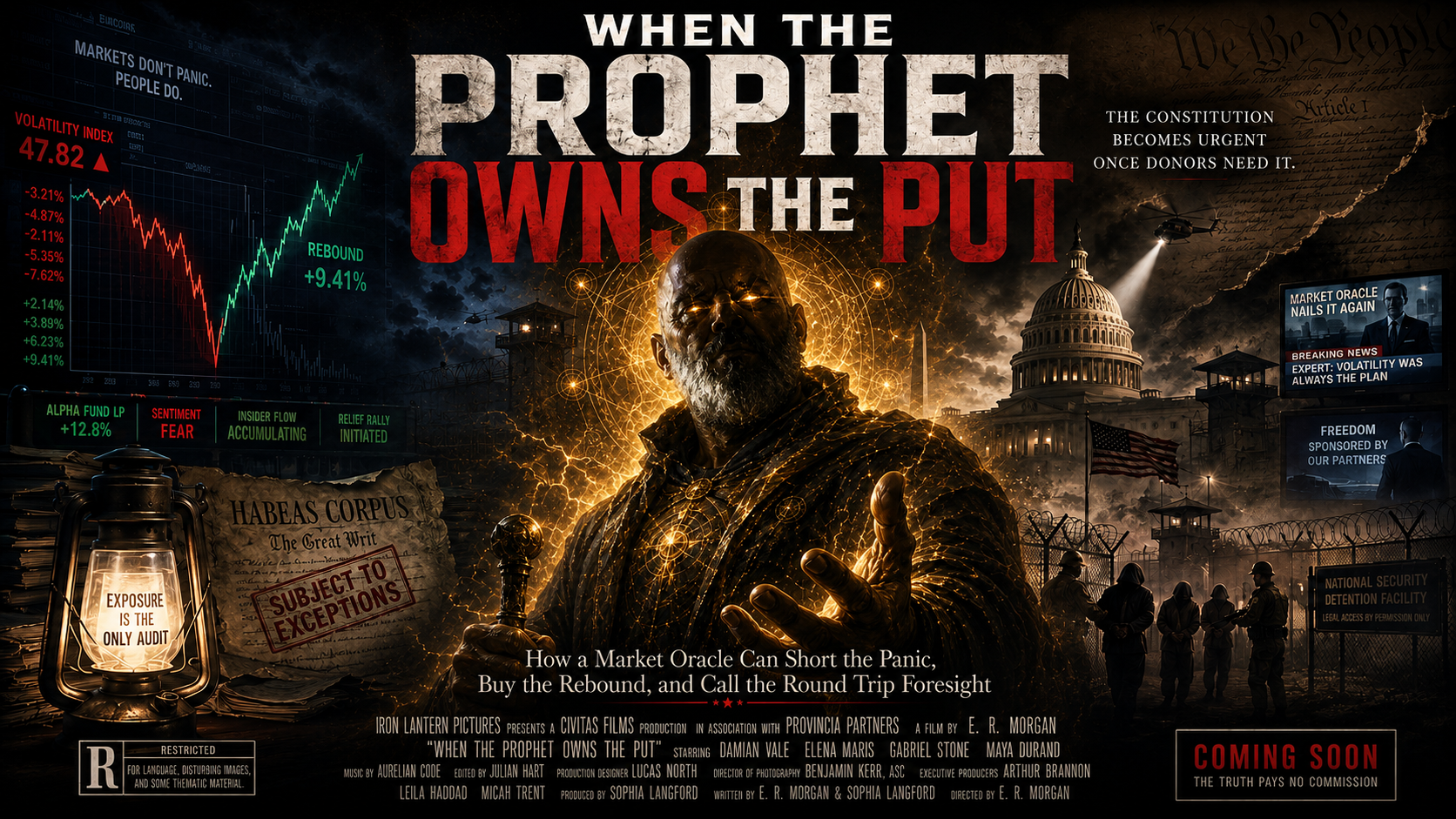
Rated R! Because AWESOME! ALL THE NAMES ARE FAKE BTW! Not meant to represent anyone living or dead…. or in any other state of transitory existence.
Somewhere in America, a man with a Bloomberg terminal is worried about a company.
This is not unusual. Worry is one of the financial industry’s principal renewable resources. It can be harvested before earnings, after earnings, during recessions, between recessions, and whenever a chief executive uses the phrase “temporary headwinds” with an insufficiently temporary expression.
What matters is that millions of people may become worried about the man’s worry.
The ordinary investor has an opinion. The market oracle has an event.
An ordinary person can study a company’s balance sheet, conclude that its valuation has become untethered from mortal arithmetic, and announce the finding to a social network consisting primarily of former co-workers, cousins, insurance agents, and one exceptionally committed bot. The market will absorb this information with the dignity it reserves for all unaffiliated human thought: none whatsoever.
A famous investor can make substantially the same observation and immediately enter the machinery of capital formation. A newsletter republishes the thesis. Financial television packages it between advertisements for tax-efficient wealth transfer. An algorithm classifies the language. Another algorithm extracts the ticker. News aggregators flatten every qualification into a headline. Portfolio managers forward the item to analysts who forward it to associates who forward it to interns who, after getting everyone their coffee, are asked whether the market has already priced in the fact that everyone is now asking whether the market has already priced it in.
By the time the sentence reaches the public, it has ceased to be merely a sentence. It is an instruction probability.
This is not mystical. Researchers studying live analyst commentary on CNBC found that prices began responding within seconds of a stock’s first mention; positive reports were largely incorporated within a minute, and trading intensity doubled in that opening minute. Other research found that only a minority of recommendation changes produced a clearly visible price effect, but that recommendations from leaders, “star” analysts, and previously influential analysts were more likely to do so. Prestige does not guarantee market movement. It changes the odds.
A respected financial commentator therefore occupies a peculiar constitutional and economic position. He is treated as a private citizen when he speaks, a market participant when he trades, a media figure when he appears on television, a fiduciary when he manages other people’s money, an entrepreneur when he sells access to his analysis, and an innocent weather vane when the market moves in the direction from which he profits.
Each identity is individually plausible.
Together they can become a business model.
The Man Who Predicts the Stampede
The usual defense of the market oracle is that he is simply providing information. Perhaps he has identified a genuine fraud. Perhaps a security is extravagantly overpriced. Perhaps management has mistaken a temporary fashion for a permanent industry. Perhaps the oracle has done the work while everyone else has been admiring the chart.
All of this may be true. The coffee may be black and pure, unpolluted by blasphemous secondary flavors added by those too weaken by temptation.
Short sellers have exposed real misconduct. Skeptical analysts are necessary to any market that wishes to be more than an issuer-sponsored affirmation circle. A prohibition against negative commentary would soon become the preferred civil-rights instrument of every overcompensated chief executive who believes “market transparency” means the public may inspect the company’s accomplishments but must schedule an appointment to view its liabilities.
The difficulty begins when we pretend that information enters the market without changing the market through the status of the person delivering it.
Financial markets do not merely reflect what participants believe. They alter the conditions under which those beliefs are later evaluated. George Soros described this as reflexivity: markets possess a cognitive function, in which prices are supposed to represent fundamentals, and an active function, in which prices themselves affect those fundamentals. Falling shares can impair financing, weaken acquisition currency, alter compensation, change supplier confidence, complicate debt issuance, and constrain management. The prediction may help create the corporate conditions later offered as proof that the prediction was correct.
Narratives matter because investors do not receive “the economy” directly. They receive representations of it. A recent NBER study of roughly one and a half million newspaper articles found that media narratives affected institutional portfolio flows even after researchers controlled for conventional macroeconomic and financial fundamentals; negative narratives had the stronger influence. The market does not trade only on facts. It trades on socially organized attention to facts, interpretations of facts, fears about other people’s interpretations, and anticipations of how those fears will be traded.
The oracle is thus not always standing outside the event, describing it.
Sometimes he has entered the causal chain.
Imagine that a celebrated investor has concluded that a company is overvalued. He establishes a short position, buys puts, enters a swap, removes a hedge, or otherwise arranges his affairs so that a decline will improve them. He then publishes his thesis. His reputation amplifies the statement. Some people sell because they agree. Some sell because they assume others will agree. Some sell because they expect algorithms to detect that agreement. Some sell because they know enough about crowd behavior to fear people who know less. The price falls.
The investor covers the short.
This means he buys.
The act of closing the original bearish position therefore creates demand near the lower price. If the decline was temporary, exaggerated, or driven partly by the attention shock rather than durable deterioration, value buyers may enter at the same time. The company may rebut the thesis. An analyst may defend the shares. The broad market may turn. Options dealers may rebalance. The panic may simply run out of frightened people.
The price begins to recover.
At this point the oracle may merely enjoy the profit already realized. Or he may establish positive exposure and participate in the rebound.
The complete opportunity is no longer simply “short high, cover low.” It is a reflexive round trip: short the expectation, publish the concern, profit from the decline, cover into the trough, acquire the abandoned asset, and profit again when the crowd discovers that the corporation has survived the commentator’s paragraph.
Short. Scorch. Scoop. Smile……. Slither? No, that takes it too far, too early in the essay.
The financier has now been right twice about a movement he may have helped create once.
There is nothing inherently unlawful about covering a short. There is nothing inherently suspicious about changing one’s view. A falling price can convert an overvalued security into a fairly valued one. New facts can emerge. An investor may decide that the market has finally taken the argument seriously enough.
But the public deserves to know whether it is witnessing analysis or choreography.
The relevant question is no longer, “Was the speaker bearish when he spoke?”
It is, “What was the speaker’s consolidated economic exposure before the statement, during the decline, at the trough, and through the rebound?”
A disclosure frozen at one instant can be perfectly accurate and economically incomplete.
The market oracle may tell the truth about Tuesday while quietly preparing to own Thursday.
Caterpillar, With Footnotes
Michael Burry offers a useful open case not because the public evidence establishes misconduct, it does not, and he has a Hollywood movie made about him so he’s totally above board in all things… yet, the visible sequence is unusually suggestive of the questions regulators do not routinely ask.
On June 30, 2026, Burry published a Substack post titled “Trading Post June 30, 2026,” with a subtitle referring to window-dressing, semiconductors, and Caterpillar. The publicly visible portion said that he was trading against some prevailing trends. Secondary financial reporting stated that Burry disclosed a Caterpillar short at approximately $1,060.98, along with several other bearish positions connected to the AI and semiconductor trade. His public post did not reveal the complete position structure or size.
Caterpillar closed on June 30 at approximately $1,064.90, then fell sharply. On July 17, the company’s own investor-relations quote showed an intraday low of $838.33. By July 23, the shares had closed around $894.54, a partial rebound from the low but still roughly sixteen per cent below the June 30 close.
This is the portion of the story that fits easily into a television graphic. Famous investor announces short. Stock falls. Red arrow. Serious music. A photograph of the investor looking as though he has just been informed that the economy’s bloodwork is irregular.
The less convenient part is that Caterpillar was not simultaneously reporting the sort of operating collapse that permits a narrator to skip causation and move directly to vindication. Its first-quarter filing reported $17.415 billion in sales and revenues, up twenty-two per cent from the prior-year quarter. The company also reported a firm order backlog of approximately $62.7 billion, about $11.5 billion higher than at the end of 2025, with the largest increase in Power & Energy.
Those figures do not establish that Caterpillar was reasonably valued above a thousand dollars a share. A prosperous company may be preposterously priced. A large backlog is not a divine guarantee of margin, execution, cash conversion, or permanence. Burry’s valuation thesis may prove fully correct.
But the company’s operating condition makes the episode analytically richer than a morality play in which a heroic short seller announces that a corpse is dead.
The market was weighing competing truths. Caterpillar had become extraordinarily expensive. Caterpillar also had strong reported sales and an enormous backlog. AI-related infrastructure demand had pushed the company into a new narrative category. The same business could be described as a beneficiary of durable capital investment or as a shovel manufacturer wearing an artificial-intelligence multiple.
This is precisely where prestige matters most: not when evidence is absent, but when genuine evidence supports several plausible weightings and one person has unusual power to choose which weighting becomes the public mood.
Still, a chart is not a subpoena.
The public record cited here does not tell us whether Burry covered the Caterpillar short, when he covered it, whether he later acquired positive exposure, whether a controlled entity traded around the trough, whether his commentary produced abnormal order flow, or whether the decline would have occurred in substantially the same form without him. It does not establish artificial price suppression, coordination, directional reversal, deception, or manipulation.
The Caterpillar episode is not an indictment. It is a research design.
An adequate inquiry would ask whether the decline remained abnormal after accounting for the broad market, industrial peers, valuation compression, interest rates, tariff developments, analyst revisions, company news, options activity, and other contemporaneous causes. It would reconstruct the dissemination route from the original newsletter through media pickup and downstream trading attention. It would examine short interest, borrow conditions, put activity, block purchases, covering, and any later acquisition of positive exposure by economically connected accounts.
Then it would either find an attributable prestige effect or it would not. The requirement that the theory be capable of failing is not an act of politeness toward billionaires. It is the difference between an audit and a screenplay.
The Fraud We Know and the Extraction We Do Not Name
American securities law, no really, stop laughing, such things do exist, already recognizes the crude version of this conduct.
Section 9 of the Securities Exchange Act prohibits certain transactions undertaken to create false market activity or raise or depress prices in order to induce others to trade. It also addresses materially false or misleading statements made for that purpose. The law does not regard every attempt to influence market behavior as innocent merely because it arrives in a sentence.
In June, a federal jury convicted activist short seller Andrew Left of participating in a securities-fraud scheme and twelve securities-fraud counts. According to the Justice Department’s account of the evidence, Left made false or misleading public statements, exploited his ability to move prices, established positions before commentary, prepared to close them after the resulting movement, and entered orders in the opposite direction from the recommendations he publicly advanced. Unfortunate last name BTW for all of us southpaws. Andy you had one job, don’t make lefties look bad….sigh. The conviction remains subject to the ordinary post-trial and appellate processes, but the factual boundary described by the government is familiar: deception, hidden conflict, market-moving commentary, and contrary trading.
That is the vulgar version. It is already illegal.
The harder problem is the elegant version, the version wearing disclosure.
Suppose the statement is substantially true. Suppose the position is announced. Suppose the commentator sincerely believes the security is overvalued. Suppose there is no secret payment, no fabricated fact, no forged document, no anonymous account, and no hidden arrangement with another trader.
Suppose only that the speaker knows his prestige is capable of becoming order flow, and that he privately keeps the gain produced by that capability.
Is this ordinary price discovery? …..Perhaps.
Is it the extraction of private profit from a public authority function that markets have accidentally conferred on a few individuals? …..Also perhaps.
The present legal framework is better at identifying lies than at examining ownership of influence.
That is understandable. The First Amendment does not disappear when a person becomes economically important. In Lowe v. SEC, the Supreme Court construed federal law to protect bona-fide impersonal investment publications from the licensing restraint sought in that case. Any serious reform must distinguish the right to publish analysis from the right to monetize a conflict created by the analysis.
The policy should therefore not be “the oracle may not speak.”
It should be “the oracle may not privately own the market’s reaction to his own oracle status.”
The Public Oracle Rule
A commentator should not become regulated merely because he is wealthy, famous, bearish, irritating, unusually good at interviews, or capable of causing executives to develop temporary interest in defamation law.
Designation should follow evidence.
If a person’s security-specific statements repeatedly produce statistically measurable price or volume effects, after controlling for confounding news, that person has become something more than an ordinary speaker for market-structure purposes. His prestige is functioning as an economic instrument.
Call him a Designated Market-Moving Commentator. The name is bureaucratically ugly, which is how we know it may eventually become law.
Once designated, the commentator would retain every right to sip black coffee, research, criticize, publish, condemn, ridicule, downgrade, praise, or warn. But if he or she ….or they …or uh, zim(?), chooses to speak publicly about a specific issuer, he or she ….or they …or uh, zim, and the entities he (fill in the blanks people, I’m trying and there’s only so much coffee) controls would enter a temporary position-neutrality and disclosure period.
The principle is simple enough to fit on the wall of a regulator’s office:
Speak or trade. Do not trade the audience’s reaction to your speech.
This would not require a permanent ban on ownership. It would require consolidated disclosure and a cooling period. Direct shares would count. So would options, swaps, managed accounts, family-office vehicles, trusts, controlled funds, contingent compensation, correlated positions intentionally constructed to capture the same movement, and positions held by entities operating under the speaker’s effective direction.
Any economically aligned gain realized during the controlled period would enter temporary escrow.
The escrow would not be a conviction. It would be evidence preservation conducted in the only language certain financial actors recognize as binding: unavailable liquidity.
If independent analysis found no material commentary effect, the funds would be released. If the movement was adequately explained by company news, sector repricing, macroeconomic change, or another stronger cause, the funds would be released. If the commentator had no aligned gain, there would be nothing to disgorge.
But if the evidence showed that a designated speaker’s public commentary materially contributed to an abnormal price movement and the speaker privately profited from that contribution, the attributable gain would no longer be treated as the natural private property of prestige.
This is strict in one important sense: the commentator would not escape merely by proving that the underlying opinion was defensible.
Truth is a defense against fraud.
It is not necessarily a complete answer to monetized market power.
A person may truthfully shout “fire” in a burning theatre. The truth of the statement does not answer whether he previously purchased the building’s evacuation contract and arranged to be paid by the fleeing patron.
The causal standard would have to be severe. Every stock price is the temporary settlement of countless arguments. Liability could not attach because a statement preceded a decline or because a plaintiff found a dramatic chart. The question would be whether the commentary was a material contributor after the analysis accounted for other market influences.
Not irrespective of them.
After accounting for them.
If causation cannot survive the controls, there is no case. If it can, the oracle should not keep the entire private harvest merely because the harvest was probabilistic.
The Double Harvest
The same rule must follow the position through the rebound.
A person who disclosed a short position should not satisfy transparency by showing the regulator one still photograph from a moving film. The meaningful object is his consolidated directional exposure over time. If the commentator begins with negative exposure, speaks, profits from the decline, covers near the trough, acquires positive exposure, and profits from the recovery, the entire round trip belongs within the inquiry.
The second leg matters because artificial or commentary-amplified suppression is often temporary. Once the price falls far enough, the short seller becomes a buyer. Value investors enter. The dramatic thesis loses novelty. The business continues operating. A rebound begins.
The oracle may therefore benefit from both the fear he helped organize and the relief that follows when the fear becomes exhausted. This is not necessarily a conspiracy. It may be the natural economic consequence of placing exceptional narrative power and exceptional trading capacity in the same hands.
Which is worse. Conspiracies require coordination. Structures reproduce themselves.
A complete restitution rule would capture short-side profit, rebound-side profit, derivative gain, and value transferred into controlled entities. It would also permit recovery for issuer and investor harms that can actually be demonstrated: increased financing costs, failed issuance, impaired acquisition currency, forced sales, distorted derivative settlements, emergency professional fees, and other measurable consequences of the attributable movement.
It should not simply award the company every dollar of temporary market-capitalization decline. Market capitalization is not cash in a drawer, and a transient quotation loss is not automatically a realized corporate injury.
The purpose is to repair the harm. Not to create a second speculative instrument called litigation. That would be adding that polluting cream and sugar.
Nor should the wrongdoer be permitted to announce personal poverty from the passenger seat of a jet owned by an LLC controlled by a trust advised by a family office funded by a partnership whose beneficial owner is believed to be a spiritual concept. That would be setting fire to the entire arabica bush forest.
The recovery analysis should pass through legal form to practical control.
But it must stop before it exports punishment onto people who did not participate. If the commentator owns an operating company, his shares, distributions, control rights, and transferred assets should be reachable. The corporation’s treasury should become jointly liable only if the corporation participated, financed, coordinated, concealed, knowingly benefited, or received the proceeds.
The workers are not substitute defendants. Neither are the pensioners, suppliers, customers, or minority shareholders. A remedy that protects investors by making unrelated workers absorb the bill is simply another financial innovation in moving harm downhill.
The Money Belongs to Everyone. The Voice Does Not.
The oracle problem sits inside a larger institutional contradiction.
American households possess enormous amounts of capital, but they exercise surprisingly little direct authority over the systems that govern it. At the end of the first quarter of 2026, U.S. retirement assets totalled approximately $47.6 trillion. Mutual funds managed fifty-eight per cent of 401(k) assets and forty per cent of IRA assets. By May, indexed mutual funds and exchange-traded funds held about $21.82 trillion and accounted for 53.8 per cent of combined long-term fund and ETF assets; indexed products held nearly sixty-four per cent of domestic-equity assets in that universe.
This capital is economically distributed among millions of workers, retirees, families, and institutions.
Its practical voice is concentrated through a comparatively narrow machinery of advisers, custodians, proxy platforms, fund complexes, and stewardship teams.
Research on BlackRock, Vanguard, and State Street found that the three managers collectively cast roughly a quarter of the votes at S&P 500 companies in the period studied. The finding does not establish a secret committee running corporate America. It establishes something more durable than a secret committee: an institutional structure in which widely dispersed savings produce highly concentrated voting authority.
The household bears the market risk.
The institution allocates the capital.
The fund complex transmits the vote.
The oracle organizes the story.
The worker discovers the meaning of the story when the company freezes hiring.
This is why the answer cannot consist only of punishing the occasional commentator whose conduct crosses a fraud line.
The architecture also requires counterpower.
UVLM’s Empowerment by Proxy proposal begins from a deliberately modest question: could investors retain full economic ownership of their securities while voluntarily delegating a narrow, revocable portion of voting authority into a worker-governed stewardship process?
The worker body would not manage the portfolio, hold the assets, promise returns, or replace the adviser. It would formulate general stewardship priorities through auditable democratic procedures. A registered investment adviser would preserve client-specific fiduciary review. A custodian and proxy platform would preserve entitlement, transmission, and reconciliation. The investor would retain dividends, appreciation, sale rights, tax attributes, and account value.
It is not a revolution in the cinematic sense. Nobody storms the exchange. Upturns the money changers’ tables. Smashes the usurious lenders’ overly creamed and sugared coffee drinks… I’m mean, what kind of nation would we be if we resorted to the behaviors of those who took offense at conduct inside Iron Age temples, AMIRITE folks?
The Bloomberg terminals remain tragically unburned. I can even smell the sickly sweetened coffee from here…
It is a proposed redistribution of… (careful now!!) …governance intelligence… (pwhew! that was a close one!) …inside the existing fiduciary machinery: narrow, revocable, contestable, and designed to fail closed when the authority cannot be proven.
The market oracle possesses concentrated narrative agency. Workers possess distributed knowledge of how firms actually function. Retirement savers possess much of the economic exposure. Empowerment by Proxy asks whether some portion of corporate voice can be routed toward the people who experience the effects of capital decisions without pretending those people have become portfolio managers.
The combined reform is therefore not complicated in spirit. Prevent the oracle from privately owning the price movement his prestige helps produce. Give dispersed capital a governed means of answering back.
The full research-stage design, including its fiduciary boundaries, worker-governance controls, rejected fee mechanisms, evidence ladder, and failure criteria, is available in the Empowerment by Proxy Expert Review Package.
The Last Resort, a Final Solution…… no wait, that’s not gonna sound right….are we live? Can we edit that last part out!? Oh wait, this is an article Tom…….ah what the heck, leave it in.
At this point, a cautious reader may object that escrow, beneficial-ownership reporting, civil restitution, independent event studies, fiduciary review, and transparent federal adjudication sound insufficiently American.
Where is the aircraft? Where is the hood? Where is the undisclosed jurisdiction?
The United States possesses another legal imagination for persons said to threaten national stability. Section 1021 of the 2012 National Defense Authorization Act affirmed military detention authority under the law of war for certain people connected to the September 11 attacks, al-Qaeda, the Taliban, or associated forces engaged in hostilities against the United States. It is not a securities statute. It provides no legal authority to treat a bearish investor as an enemy combatant.
This is precisely why it becomes useful….. erm…. as satire! Yeah, satire….
For decades, Americans were told that indefinite detention, secret transfer, abusive interrogation, and rights-free spaces involved difficult national-security balances too complicated for ordinary morality. Justice Department oversight later described the treatment of hundreds of post-September 11 detainees, finding that conditions imposed on some were excessively restrictive and unduly harsh and that some officers engaged in physical and verbal abuse. Other oversight materials documented complaints and findings involving Muslim inmates, anti-Islamic abuse, racial and ethnic slurs, religious discrimination, retaliation, and the mistreatment of Arab-American and Muslim people. The Senate Intelligence Committee published its study of the CIA’s detention and interrogation program in 2014.
The country processed this history through solemn panels, legal memoranda, redactions, euphemisms, and the national habit of regretting an abuse in language carefully designed not to inconvenience its architects.
Perhaps the problem was demographic. Perhaps liberty has been waiting for the correct plaintiff.
I therefore offer the final, entirely satirical solution to prestige-driven financial destabilization:
The Enemy Combatant of EBITDA
Under the Public Oracle National Defense Authorization Amendment, or UPONDAA, (as in, get UPONDAA the private jet you billionaire traitor to the free hand of the market, we’re going on a little trip…) a Designated Market-Moving Commentator whose aligned public statement produces a sufficiently severe price dislocation shall be designated a person substantially supporting associated forces engaged in hostilities against stable earnings guidance.
The associated forces may include volatility, convexity, offshore leverage, total-return swaps, and the militant quarterly rebalancing division of al-EBITDA.
The designation will be classified. Not because the evidence is sensitive. Because the committee would prefer not to read it aloud, committees being what they are.
The oracle will be apprehended at a conference, which should present no operational difficulty. He will be standing beneath a forty-foot banner that says DISRUPTION, explaining that uncertainty creates opportunity.
He will be rendered aboard a Gulfstream seized from one of his own controlled entities, creating the first federal program to achieve full cost recovery during abduction. Revenue neutrality is my JAM!!!!
The destination will be undisclosed. Probably Delaware….. okay, definately Delaware. A black site in Delaware is technically redundant, but the entity formation is exceptional.
There, the oracle will enter the Enhanced Due Diligence Program.
No waterboarding will occur. Only waterfall analysis.
No stress positions. Only consolidated positions.
No sleep deprivation. Only the natural consequences of reconciling four hundred and seventeen controlled entities to a general ledger without an intern, because I am indeed advocating cruelty.
No hood. Only a fleece vest turned inside out so the brand cannot influence the interrogator.
A single document will be placed on the table. → BENEFICIAL OWNERSHIP SCHEDULE.
The oracle will laugh.
The auditor will not.
“Identify every entity through which you held direct or synthetic exposure.”
“My advisers handle that.”
“Identify the advisers.”
“That information is proprietary.”
A second document will be placed beside the first.
RELATED PARTIES.
The oracle will be broken, weeping, begging for the guard to stop playing “Easy Street” by lunch. They’ll confess anything we want them to.
This is not torture. This is enhanced consolidation.
For years, his, wealth has enjoyed the metaphysical privilege of being simultaneously his, and not his… which in the land of GOP personal accountability is quite a feat! The trust owns it. The partnership controls it. The family office advises it. The foundation is considering whether to benefit humanity with it. The donor-advised fund has not yet decided what “donor-advised” requires. The offshore entity keeps it warm. The aircraft belongs to an LLC that has never met him. The vineyard is a research expense. The penthouse is price discovery.
At the black site, these spiritual distinctions will be gently removed with all the grace of a lady marine pointing for photographs.
Every entity will be asked one question:
Who controls you?
Any entity unable to answer will be detained as a material subsidiary.
The oracle’s lawyers will immediately petition for habeas corpus.
This is where the public benefit begins!
For decades, secret detention was an unfortunate complexity.
Now it has reached a donor.
The financial press will rediscover Magna Carta.
CNBC will broadcast a special called DUE PROCESS: IS IT BULLISH?
Fox Business will demand constitutional restraint….. because hell has frozen over apparently.
MSNBC will discover that state violence remains wrong even when the detainee owns an offshore reinsurance vehicle but nobody will know because of their poor ratings but that’s okay because their big brother CNBC has it covered anyway!
The Chamber of Commerce (yes kiddos, that is a thing) will file an amicus brief explaining that disappearance creates regulatory uncertainty.
A major investment bank will issue a research note titled Habeas Corpus: An Underappreciated Asset Class.
Moody’s will place the Constitution on positive watch.
Members of Congress who previously regarded indefinite detention as an exquisitely difficult balance will grasp the principle before the opening bell.
By Friday, the House and Senate will pass the Universal Due Process and High-Net-Worth Mobility Restoration Act by a vote of five hundred and thirty-five to zero, including several people who are not technically members of Congress.
The law will guarantee notice, counsel, evidence, confrontation, judicial review, humane treatment, freedom from secret transfer, and an embossed folder explaining that every human being possesses rights.
At first, these protections will apply only to accredited investors.
But liberty, unlike wealth, may eventually trickle down.
The billionaire’s habeas petition will establish a precedent for the fund manager. The fund manager’s precedent will reach the chief executive. The chief executive’s precedent will reach the professional class. The professional class will permit the warehouse worker to borrow it on weekends.
After several decades, perhaps a Muslim taxi driver will qualify.
This is the first plausible theory of trickle-down anything.
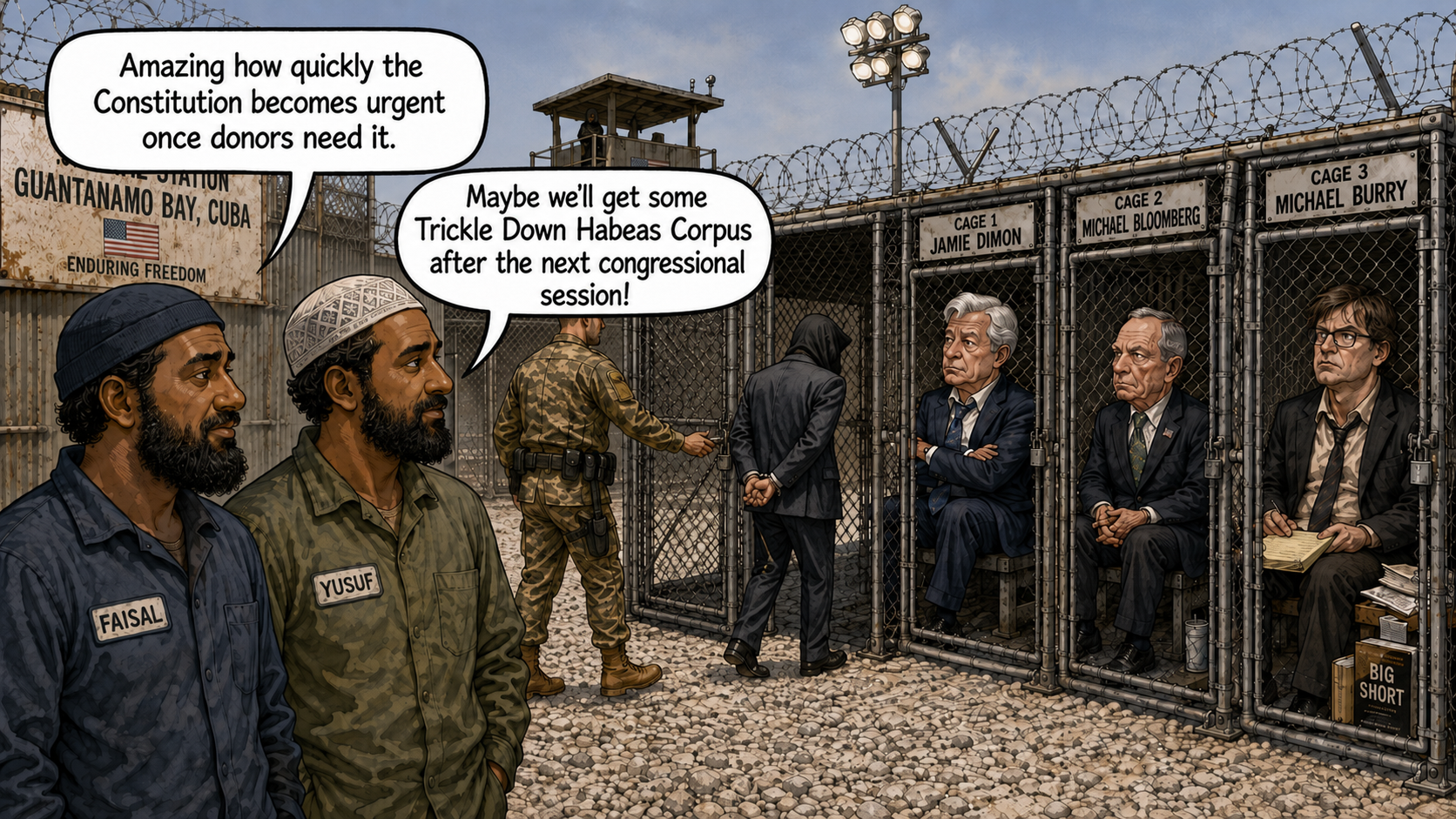
Render the Asshats… oh, I meant Assets….. speech to text, I swear!!
The black site is not the policy. It is the mirror.
The joke works because if you don’t laugh you cry, and the threatened application of abusive state power to an elite person produces an immediate moral clarity that decades of abuse directed downward somehow failed to summon.
Rights violation directed at Muslims, immigrants, prisoners, and poor people: complexity.
Rights violation directed at a politically connected financier with a family office: constitutional emergency, OH DEAR GOD THE HUMANITY! ONLY DERSHOWITZ CAN SAVE US FROM THIS LAWFARE!!!!!
The serious proposal is not to extend the basement, no matter how awesome the subsequent Tom Clancy style cinematic fever-dream such an extension would produce!
It is to raise the floor.
Do not render the commentator. Render the assets legible.
Let the person receive notice, counsel, evidence, trial, appeal, and every protection that was never supposed to depend on race, religion, citizenship, profession, or account balance.
Let the positions receive subpoenas.
Let the trusts receive consolidation.
Let controlled corporations answer for conduct they actually financed or concealed.
Let unrelated workers remain unrelated.
Let attributable gains be disgorged.
Let demonstrated losses be repaired.
Let speech remain free.
Let monetized prestige answer for itself.
Near the New York Stock Exchange, Diogenes stands at noon holding his lantern. A trader recognizes him and asks the customary question.
“Are you looking for an honest man?”
Diogenes shakes his head.
“A fair market?”
“No.”
“A reconciled related-party schedule?”
“Let us remain realistic.”
The trader points toward the lantern. “Then what are you looking for?”
Diogenes looks at the financial district, where every opinion has a position and every principle has a counterparty.
“A market commentator without an economic interest in the market’s reaction to his commentary.”
The crowd laughs. The market falls three per cent. Diogenes discloses that he was short. Uses his earnings to feed that pack of dogs he rolls with.
The Securities and Exchange Commission opens an inquiry.
The Constitution is released on its own recognizance.
And, somewhere in Delaware, an LLC that has never met its beneficial owner begins to sweat. Somebody call Hideo Kojima, I just pitched Metal Gear Sold 17, or wherever they are with that series….
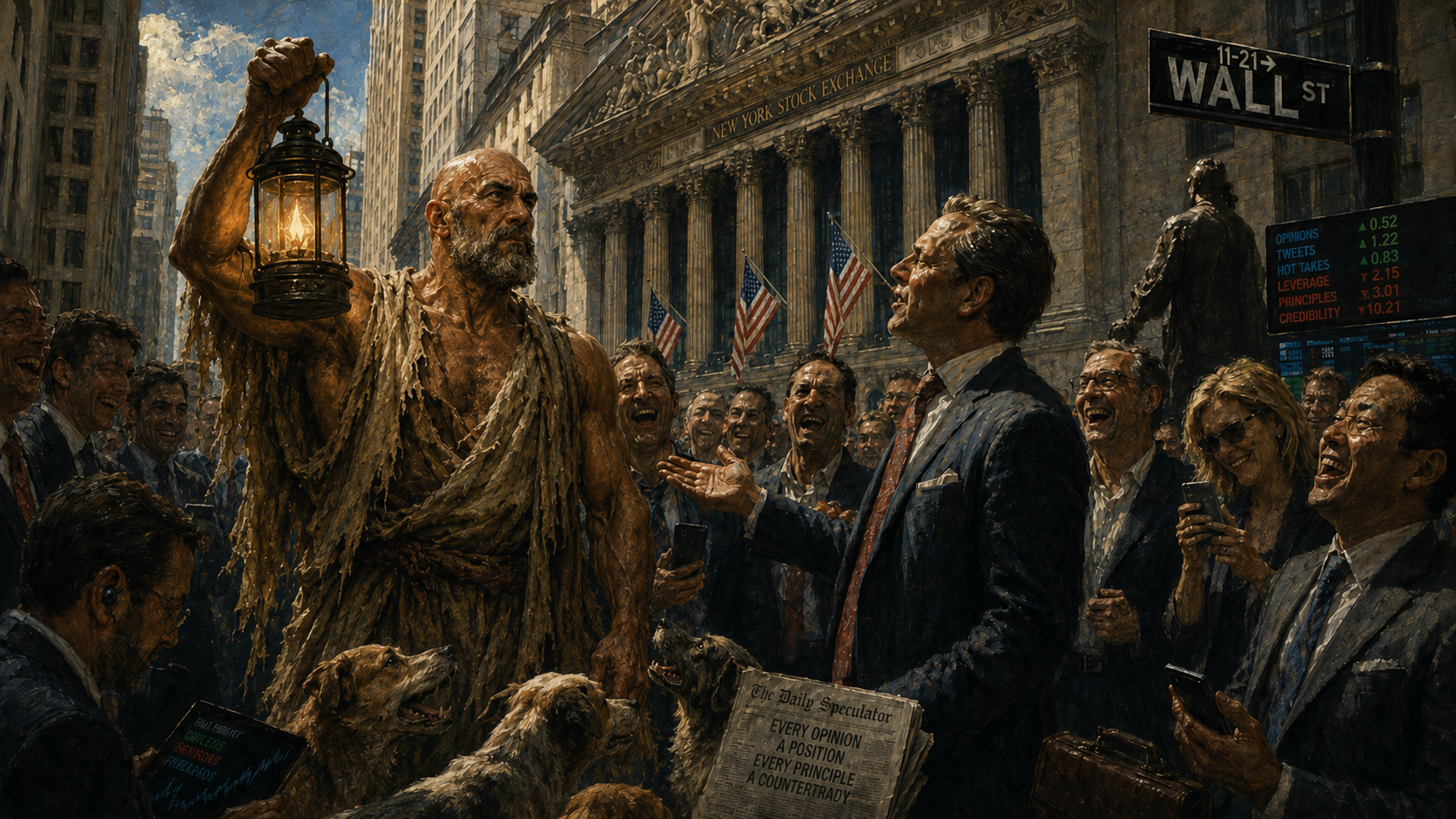
Oh yes, I do look that good!
Works Consulted
Market Reflexivity, Narrative Influence, and Institutional Power
Agarwal, Isha, Wentong Chen, and Eswar S. Prasad. 2024. “Beyond the Fundamentals: How Media-Driven Narratives Influence Cross-Border Capital Flows.” NBER Working Paper 33159. DOI: 10.3386/w33159.
Bebchuk, Lucian A., and Scott Hirst. 2019. “The Specter of the Giant Three.” NBER Working Paper 25914. DOI: 10.3386/w25914.
Busse, Jeffrey A., and T. Clifton Green. 2002. “Market Efficiency in Real Time.” Journal of Financial Economics 65, no. 3: 415–437. DOI: 10.1016/S0304-405X(02)00148-4.
Coffee, John C., Jr., Joshua Mitts, James D. Cox, Peter Molk, Edward Greene, Randall S. Thomas, Robert B. Thompson, Colleen Honigsberg, Andrew Verstein, Donald C. Langevoort, Charles K. Whitehead, et al. 2020. “Petition for Rulemaking on Short and Distort.” Petition submitted to the U.S. Securities and Exchange Commission.
Greenwood, Robin, Samuel G. Hanson, and Lawrence J. Jin. 2019. “Reflexivity in Credit Markets.” NBER Working Paper 25747. DOI: 10.3386/w25747.
Keynes, John Maynard. 1936. The General Theory of Employment, Interest and Money. London: Macmillan. See especially chapter 12 on expectations and the newspaper beauty contest.
Loh, Roger K., and René M. Stulz. 2011. “When Are Analyst Recommendation Changes Influential?” The Review of Financial Studies 24, no. 2: 593–627. DOI: 10.1093/rfs/hhq094.
Mitts, Joshua. 2020. “Short and Distort.” The Journal of Legal Studies 49, no. 2: 287–334. DOI: 10.1086/711119.
Shiller, Robert J. 2019. Narrative Economics: How Stories Go Viral and Drive Major Economic Events. Princeton, NJ: Princeton University Press.
Soros, George. 2003. The Alchemy of Finance: Reading the Mind of the Market. 2nd ed. Hoboken, NJ: John Wiley & Sons.
Umpleby, Stuart. 2007. “Reflexivity in Social Systems: The Theories of George Soros.” Systems Research and Behavioral Science 24, no. 5: 515–522. DOI: 10.1002/sres.852.
Caterpillar and the Michael Burry Open Case
Burry, Michael. 2026. “Trading Post June 30, 2026: A Little Window-Dressing, the SOX, and Caterpillar.” Cassandra Unchained, June 30. The publicly visible portion identifies the date, framing, and Caterpillar focus; detailed positions are subscriber material.
Burry, Michael. 2026. “Trading Post July 24, 2026—4 Shorts, 3 Longs.” Cassandra Unchained, July 24.
Caterpillar Inc. 2026. “Quarterly Report for the Period Ended March 31, 2026.” Form 10-Q. U.S. Securities and Exchange Commission.
Caterpillar Inc. 2026. “Stock Info” and historical stock-quote lookup. Investor Relations. Consulted for the June–July 2026 price sequence and the July 17 intraday low.
Caterpillar Inc. 2026. “Caterpillar Inc. Increases Dividend.” June 10.
Quiroz-Gutierrez, Marco. 2026. “Michael Burry Just Shorted Caterpillar’s AI Rally. One Analyst Says His Bet Won’t Even Matter.” Fortune, July 2. Included as a countervailing interpretation emphasizing possible fundamental infrastructure demand rather than a purely prestige-driven price effect.
Schepkov, Vlad. 2026. “Burry Shorts Caterpillar on Valuation Concerns, Also Shorts NVDA, TSLA, AMAT.” Investing.com, June 30. This report supplies the publicly reported Caterpillar entry price of $1,060.98 and Burry’s stated valuation rationale.
Stocktwits. 2026. “Michael Burry Doubles Down on MU, NVDA Shorts While Holding TSLA, PLTR Bets—Here’s What He’s Buying.” July 24. Consulted for reporting that Burry added to the Caterpillar short at $893.49.
Retirement Capital and Ownership Concentration
Investment Company Institute. 2026. “Quarterly Retirement Market Data, First Quarter 2026.” June 18.
Investment Company Institute. 2026. “Active and Index Investing, May 2026.” June 30.
Securities Law, Commentary, and Market Manipulation
Lowe v. Securities and Exchange Commission. 472 U.S. 181. Supreme Court of the United States, 1985.
United States Code. Title 15, § 78i. “Manipulation of Security Prices.”
U.S. Department of Justice. 2026. “Activist Short Seller Convicted for $21M Stock Market Manipulation Scheme.” Office of Public Affairs, June 2.
U.S. Department of Justice. 2026. “United States v. Andrew Left.” Criminal Division case record, No. 2:24-CR-456.
U.S. Securities and Exchange Commission. 2020. “Request for Rulemaking on Short and Distort.” File No. 4-758.
Detention, Rendition, and the Satirical Due-Process Argument
National Defense Authorization Act for Fiscal Year 2012. Public Law 112-81, § 1021. Enacted December 31, 2011.
U.S. Department of Justice, Office of the Inspector General. 2003. The September 11 Detainees: A Review of the Treatment of Aliens Held on Immigration Charges in Connection with the Investigation of the September 11 Attacks.
U.S. Department of Justice, Office of the Inspector General. 2003. Supplemental Report on September 11 Detainees’ Allegations of Abuse at the Metropolitan Detention Center in Brooklyn, New York.
U.S. Senate Select Committee on Intelligence. 2014. Committee Study of the Central Intelligence Agency’s Detention and Interrogation Program. S. Rep. 113-288.
UVLM Companion and Design Sources
Prislac, Thomas. 2026. Empowerment by Proxy: A Control-First Institutional Design for Worker Voice in Intermediated Capital Markets. Expert Review Edition, version 2.0. Ultra Verba Lux Mentis. Download the Expert Review Package
Prislac, Thomas. 2026. “The Criminally Unaffiliated: Why Oregon’s Obstructionists Should Stop Borrowing Donkeys and Elephants.” Ultra Verba Lux Mentis. Consulted as the immediate UVLM house-style and satirical-presentation precedent, not as independent evidentiary authority.
Research and satirical boundary
The Caterpillar discussion above presents a documented sequence and an untested causal hypothesis. It does not establish wrongdoing by Michael Burry or any connected person. The Andrew Left discussion concerns a jury conviction and the Justice Department’s public description of the evidence in that case; it is not offered as a factual analogy to Burry. The Public Oracle Rule, two-direction escrow, consolidated-exposure review, and expanded restitution system are original policy proposals requiring constitutional, securities-law, fiduciary, econometric, and market-structure review. The NDAA and black-site passages are Swiftian satire. The actual policy position is the opposite of rendition: abolish rights-free detention, preserve due process, and apply transparent law regardless of wealth, race, religion, or status.
The market oracle should remain free to speak. But no oracle possesses a natural private-property right in the market movement produced by the oracle’s own prestige.
The above commentary is published in alignment with Ultra Verba Lux Mentis’s mission statement to amplify neurodiverse voices while researching cognitive offloading technologies to aid neurodiverse persons in participating within sectors of societal power traditionally denied them. It does not reflect the viewpoints of the organization itself.